

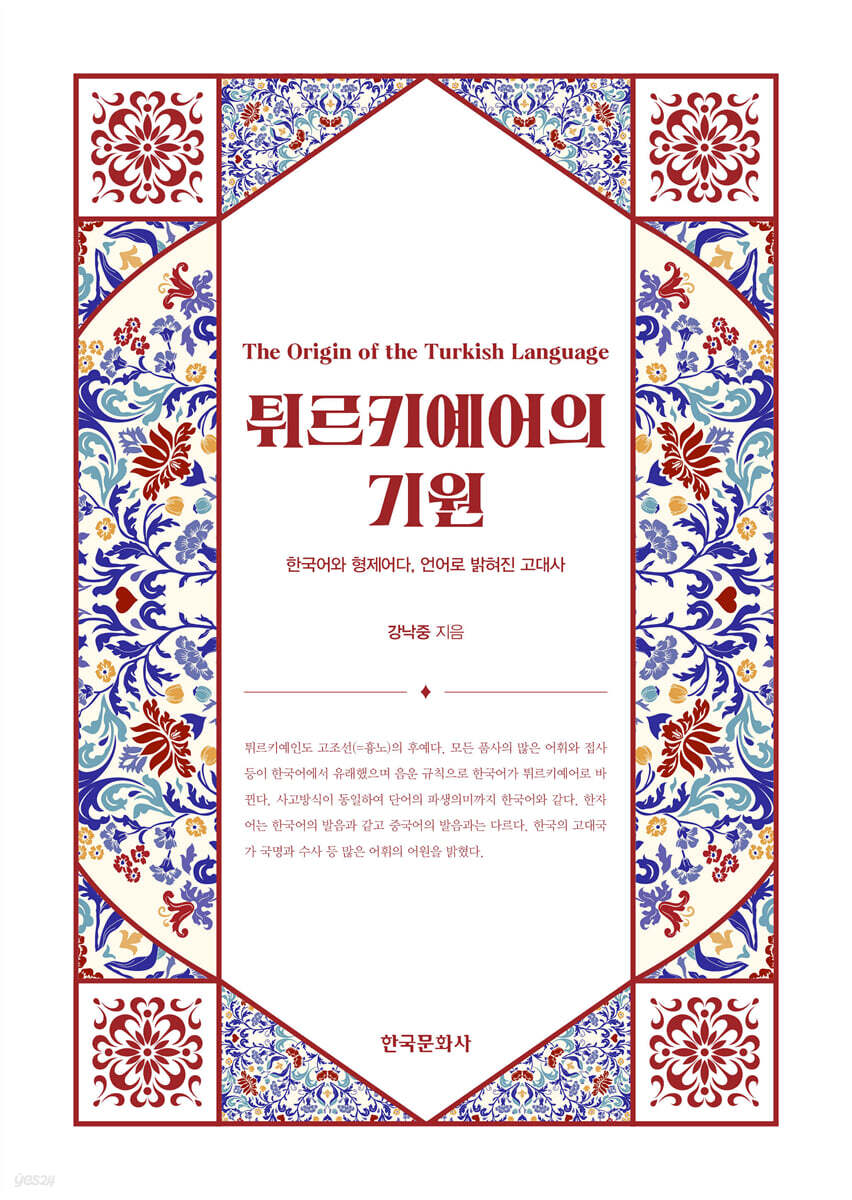
Origins of the Turkic language
 |
Description
Book Introduction
Turkic, Uzbek, and Japanese rhetoric was created in Korean.
It revealed the etymology of Korean numerals and revealed the etymology of many Korean words that had not been discovered until now.
It was proven in 'Kang Nak-jung (2012), Origin of Japanese - Japanese is a Gaya Language' that Japanese originated from Korean, and this book includes what the Japanese themselves revealed that the ancestral god of the Japanese crossed over to Korean.
Some domestic and foreign linguists who have not even properly studied the Middle Korean and dialects of Korean or the archaic languages of Japanese say that Korean and Japanese are not of the same family of languages based on a few common words and a few awkward colloquialisms, while others say that they are. Neither argument is persuasive.
Kang Nak-jung (2012) and no linguist who reads this book would argue that Turkic, Japanese, and Korean are not of the same family.
From now on, we should stop calling it the Altaic language family and instead call it the Gojoseon (=Xiongnu) language family.
It revealed the etymology of Korean numerals and revealed the etymology of many Korean words that had not been discovered until now.
It was proven in 'Kang Nak-jung (2012), Origin of Japanese - Japanese is a Gaya Language' that Japanese originated from Korean, and this book includes what the Japanese themselves revealed that the ancestral god of the Japanese crossed over to Korean.
Some domestic and foreign linguists who have not even properly studied the Middle Korean and dialects of Korean or the archaic languages of Japanese say that Korean and Japanese are not of the same family of languages based on a few common words and a few awkward colloquialisms, while others say that they are. Neither argument is persuasive.
Kang Nak-jung (2012) and no linguist who reads this book would argue that Turkic, Japanese, and Korean are not of the same family.
From now on, we should stop calling it the Altaic language family and instead call it the Gojoseon (=Xiongnu) language family.
- You can preview some of the book's contents.
Preview
index
preface
Legend
Turkic alphabet and Korean sounds
1.
Four countries that used the name Joseon
1.1 朝鮮(=古朝鮮)(?Shen)
1.2 Flexible
1.3 Female Truth/Female? (Aftershock)
1.4 Joseon (modern Joseon)
2.
History of Turkiye
2.1 Origin of the name Turkiye
3.
Turkish and Korean have similar ways of thinking.
4.
So-called Chinese characters in Turkic
5.
Korean phonetic rules
5.1 Full text
5.2 Dark consonant omission
5.3 Palatalization
5.4 Voiced consonants
5.5 ㅎ→ㅅ/__이/으/y
5.6 Vowel Simplification
5.7 Consonant contraction
5.8 Add sound
5.9 /i/ vowel retrograde assimilation (umlaut)
5.10 Vowel Combination
5.11 Vowel Replacement
5.12 Collection
5.13 Consonant contraction
5.14 Vowel decomposition
5.15 Consonant Replacement
5.16 Consonant Dropout
5.17 Phonological changes that can be assumed to have occurred when Korean was transformed into Turkic.
6.
Morphologically unique case of Korean 'word=a+b' where 'a=b'
7.
Unusual phonetic changes when Korean is converted to Turkic
7.1 Vowel Replacement
7.2 Vowel dropout
7.3 Consonant Replacement
7.4 Consonant Dropout
8.
affix
8.1 Suffix
8.2 Prefixes
9.
inspection
9.1 Instrumental case particle
9.2 Possessive particles
9.3 Objective particle
9.4 Dative particle, directional particle, and locative particle
9.5 Locating particle (~da/~de/~ta/~te)
9.6 Investigation of the abduction
9.7 Other investigations
10.
verb
10.1 Korean Verb Stem + ㄹ (Derivative Ending)
10.2 Korean verb stem + ㄴ (attributive ending)
10.3 Verbs created by misanalysis
10.4 Korean Verb Stem + I (Added Sound)
10.5 Noun=Verb Stem
10.6 A+la/le+mak
10.7 Kır+mak
10.8 A+da+mak
10.9 Adverb (Korean) = Verb (Turkish) or Adverb + Verb (Korean) = Adverb + Verb (Turkish)
10.10 Causative Verbs
10.11 Other verbs
10.12 Noun forms of verbs
10.13 Verb adjectives
11.
adjective
12.
noun
12.1 Investigation
12.2 Plural suffixes of nouns
13.
pronoun
14.
adverb
14.1 Onomatopoeia
15.
interjection
16.
conjunction
References
Legend
Turkic alphabet and Korean sounds
1.
Four countries that used the name Joseon
1.1 朝鮮(=古朝鮮)(?Shen)
1.2 Flexible
1.3 Female Truth/Female? (Aftershock)
1.4 Joseon (modern Joseon)
2.
History of Turkiye
2.1 Origin of the name Turkiye
3.
Turkish and Korean have similar ways of thinking.
4.
So-called Chinese characters in Turkic
5.
Korean phonetic rules
5.1 Full text
5.2 Dark consonant omission
5.3 Palatalization
5.4 Voiced consonants
5.5 ㅎ→ㅅ/__이/으/y
5.6 Vowel Simplification
5.7 Consonant contraction
5.8 Add sound
5.9 /i/ vowel retrograde assimilation (umlaut)
5.10 Vowel Combination
5.11 Vowel Replacement
5.12 Collection
5.13 Consonant contraction
5.14 Vowel decomposition
5.15 Consonant Replacement
5.16 Consonant Dropout
5.17 Phonological changes that can be assumed to have occurred when Korean was transformed into Turkic.
6.
Morphologically unique case of Korean 'word=a+b' where 'a=b'
7.
Unusual phonetic changes when Korean is converted to Turkic
7.1 Vowel Replacement
7.2 Vowel dropout
7.3 Consonant Replacement
7.4 Consonant Dropout
8.
affix
8.1 Suffix
8.2 Prefixes
9.
inspection
9.1 Instrumental case particle
9.2 Possessive particles
9.3 Objective particle
9.4 Dative particle, directional particle, and locative particle
9.5 Locating particle (~da/~de/~ta/~te)
9.6 Investigation of the abduction
9.7 Other investigations
10.
verb
10.1 Korean Verb Stem + ㄹ (Derivative Ending)
10.2 Korean verb stem + ㄴ (attributive ending)
10.3 Verbs created by misanalysis
10.4 Korean Verb Stem + I (Added Sound)
10.5 Noun=Verb Stem
10.6 A+la/le+mak
10.7 Kır+mak
10.8 A+da+mak
10.9 Adverb (Korean) = Verb (Turkish) or Adverb + Verb (Korean) = Adverb + Verb (Turkish)
10.10 Causative Verbs
10.11 Other verbs
10.12 Noun forms of verbs
10.13 Verb adjectives
11.
adjective
12.
noun
12.1 Investigation
12.2 Plural suffixes of nouns
13.
pronoun
14.
adverb
14.1 Onomatopoeia
15.
interjection
16.
conjunction
References
Publisher's Review
It has been linguistically proven that the Huns were Gojoseon, that the original pronunciation of Rouran and Jurchen was a variant pronunciation of Joseon, that the 'Go' of Gojoseon and Goguryeo is a phonetic transcription of the Chinese character for 'hae (=sun)', and that the 'Bu' of Buyeo is 'bul (=fire)', meaning 'hae (=sun)', that Gaya, Silla, and Baekje were all phonetic transcriptions of pure Korean words in Chinese characters, and that Hungary was founded by the Malgal people, and Bulgaria and Buryat were founded by the Buyeo people.
Looking at the fact that Germans are called Alman (=Al=gold=metal) + man (=person, person=human) in Turkic, we can see that it was a country founded by the Huns (the Huns worshipped a golden man and offered sacrifices to heaven).
The countries in the world whose names end in '~a' have '~a' originating from Korean, and 'stan' means land.
From Middle Korean to modern Korean, we looked into how consonants and vowels changed between each dialect and by what phonological rules these changes were made. We also presented the basis for each word on how Korean changed into Turkic through what phonological rules and consonant and vowel changes.
Gaya, Silla, and Turkic were countries founded by the Huns, so the Turkic language follows the phonetic rules of the Gaya and Silla languages.
Turkish also has so-called Chinese characters (more precisely, it should be called Sangja (商字).
Chinese characters (created by the Shang Dynasty, founded by the Dongyi people) are widely used, and their pronunciation is similar to that of Middle Korean and the Gyeongsang dialect, following their phonetic rules.
The noun endings of verbs are the same as in Korean, and the particles are the same as in the Gyeongsang dialect.
A great many words of all parts of speech are the same as in Korean, and Korean is changed into Turkic according to the phonetic rules of Korean and Turkic.
There are 46 suffixes and two prefixes similar to Korean.
Just as there are many words in various dialects of Korea that have the same root but use different suffixes with the same meaning, there are also many words in Turkish that have the same root as Korean but use different suffixes with the same meaning.
Turks and Koreans have similar ways of thinking, so even the derived meanings of the same words are the same.
Turkic, Uzbek, and Japanese rhetoric was created in Korean.
It revealed the etymology of Korean numerals and revealed the etymology of many Korean words that had not been discovered until now.
It was proven in 'Kang Nak-jung (2012), Origin of Japanese - Japanese is a Gaya Language' that Japanese originated from Korean, and this book includes what the Japanese themselves revealed that the ancestral god of the Japanese crossed over to Korean.
Some domestic and foreign linguists who have not even properly studied the Middle Korean and dialects of Korean or the archaic languages of Japanese say that Korean and Japanese are not of the same family of languages based on a few common words and a few awkward colloquialisms, while others say that they are. Neither argument is persuasive.
Kang Nak-jung (2012) and no linguist who reads this book would argue that Turkic, Japanese, and Korean are not of the same family.
From now on, we should stop calling it the Altaic language family and instead call it the Gojoseon (=Xiongnu) language family.
Looking at the fact that Germans are called Alman (=Al=gold=metal) + man (=person, person=human) in Turkic, we can see that it was a country founded by the Huns (the Huns worshipped a golden man and offered sacrifices to heaven).
The countries in the world whose names end in '~a' have '~a' originating from Korean, and 'stan' means land.
From Middle Korean to modern Korean, we looked into how consonants and vowels changed between each dialect and by what phonological rules these changes were made. We also presented the basis for each word on how Korean changed into Turkic through what phonological rules and consonant and vowel changes.
Gaya, Silla, and Turkic were countries founded by the Huns, so the Turkic language follows the phonetic rules of the Gaya and Silla languages.
Turkish also has so-called Chinese characters (more precisely, it should be called Sangja (商字).
Chinese characters (created by the Shang Dynasty, founded by the Dongyi people) are widely used, and their pronunciation is similar to that of Middle Korean and the Gyeongsang dialect, following their phonetic rules.
The noun endings of verbs are the same as in Korean, and the particles are the same as in the Gyeongsang dialect.
A great many words of all parts of speech are the same as in Korean, and Korean is changed into Turkic according to the phonetic rules of Korean and Turkic.
There are 46 suffixes and two prefixes similar to Korean.
Just as there are many words in various dialects of Korea that have the same root but use different suffixes with the same meaning, there are also many words in Turkish that have the same root as Korean but use different suffixes with the same meaning.
Turks and Koreans have similar ways of thinking, so even the derived meanings of the same words are the same.
Turkic, Uzbek, and Japanese rhetoric was created in Korean.
It revealed the etymology of Korean numerals and revealed the etymology of many Korean words that had not been discovered until now.
It was proven in 'Kang Nak-jung (2012), Origin of Japanese - Japanese is a Gaya Language' that Japanese originated from Korean, and this book includes what the Japanese themselves revealed that the ancestral god of the Japanese crossed over to Korean.
Some domestic and foreign linguists who have not even properly studied the Middle Korean and dialects of Korean or the archaic languages of Japanese say that Korean and Japanese are not of the same family of languages based on a few common words and a few awkward colloquialisms, while others say that they are. Neither argument is persuasive.
Kang Nak-jung (2012) and no linguist who reads this book would argue that Turkic, Japanese, and Korean are not of the same family.
From now on, we should stop calling it the Altaic language family and instead call it the Gojoseon (=Xiongnu) language family.
GOODS SPECIFICS
- Date of issue: November 7, 2025
- Page count, weight, size: 760 pages | 174*245*36mm
- ISBN13: 9791169193634
You may also like
카테고리
korean


korean

![GQ KOREA Mark (Monthly): December [2025]](http://librairie.coreenne.fr/cdn/shop/files/8ef265dbbfbf186523ed75ba7319009d.jpg?v=1765340328&width=3840)


