

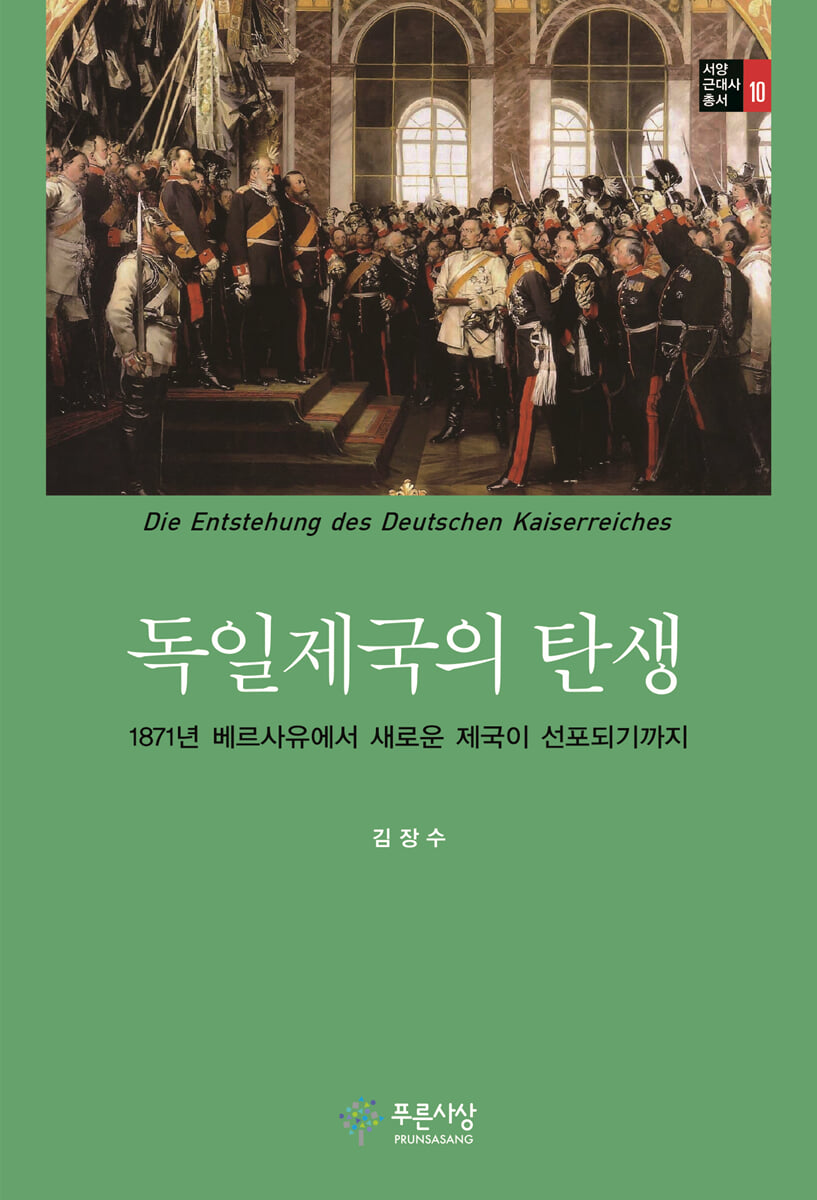
The birth of the German Empire
 |
Description
Book Introduction
Bismarck's leadership and Prussia's declaration of the German Empire
Professor Kim Jang-su (Professor Emeritus of History Education, Catholic Kwandong University)'s "The Birth of the German Empire" has been published by Pureunsasangsa as part of the "Western Modern History Series 10."
It explores the process by which Prussia, led by the Iron Chancellor Bismarck, declared the German Empire amidst the desire for unification that began to burn in the German-speaking world after the collapse of the Holy Roman Empire and the revolutionary storm that swept across Europe.
Professor Kim Jang-su (Professor Emeritus of History Education, Catholic Kwandong University)'s "The Birth of the German Empire" has been published by Pureunsasangsa as part of the "Western Modern History Series 10."
It explores the process by which Prussia, led by the Iron Chancellor Bismarck, declared the German Empire amidst the desire for unification that began to burn in the German-speaking world after the collapse of the Holy Roman Empire and the revolutionary storm that swept across Europe.
- You can preview some of the book's contents.
Preview
index
ㆍ At the beginning of the book
Chapter 1: Conflicts Surrounding German Unification
1.
Frankfurt National Assembly
2.
Greater Germanism and Lesser Germanism
3.
Erfurt Union Council
4.
Schwarzenberg's counterattack
5.
Olmütz humiliation
Chapter 2: Bismarck's Rise and the Danish War
1.
Bismarck's appearance
2.
Danish War
3.
Prussia's ambitions
Chapter 3: The Brothers' War
1.
The conflict between Prussia and Austria
2.
Bad Gastein Agreement
3.
Prussia-Italy secret military alliance
4.
Brothers' War
5.
The birth of the North German Confederation
6.
The emergence of the Austro-Hungarian Empire
Chapter 4: The War with France
1.
The Grand Duchy of Luxembourg issue
2.
France's response
3.
Spanish succession
4.
Telegram from Ems
5.
Franco-Prussian War
Chapter 5: The Birth of the German Empire
1.
Preparations for the German Empire
2.
The birth of the German Empire
ㆍ In conclusion
References
ㆍ Search
Chapter 1: Conflicts Surrounding German Unification
1.
Frankfurt National Assembly
2.
Greater Germanism and Lesser Germanism
3.
Erfurt Union Council
4.
Schwarzenberg's counterattack
5.
Olmütz humiliation
Chapter 2: Bismarck's Rise and the Danish War
1.
Bismarck's appearance
2.
Danish War
3.
Prussia's ambitions
Chapter 3: The Brothers' War
1.
The conflict between Prussia and Austria
2.
Bad Gastein Agreement
3.
Prussia-Italy secret military alliance
4.
Brothers' War
5.
The birth of the North German Confederation
6.
The emergence of the Austro-Hungarian Empire
Chapter 4: The War with France
1.
The Grand Duchy of Luxembourg issue
2.
France's response
3.
Spanish succession
4.
Telegram from Ems
5.
Franco-Prussian War
Chapter 5: The Birth of the German Empire
1.
Preparations for the German Empire
2.
The birth of the German Empire
ㆍ In conclusion
References
ㆍ Search
Detailed image

Into the book
On October 26, 1848, the Frankfurt National Assembly formally proposed a plan for German unification based on the principle of small German unity.
That is, Austria should not participate in the unified state but should maintain its existing territory.
Forces advocating for the unification of Germany also proposed the view that Germany should be unified under the leadership of Prussia.
Furthermore, they not only refused to recognize Austria's role, but also tried to expel it from the German sphere.
--- p.22
What were Bismarck's intentions? As before, this time too, his intentions were intertwined with many.
By the early 1870s, Bismarck was exploring ways to unify Germany.
However, in the local elections held in Bavaria in November 1869, separatist forces showed strength and the pro-Prussian cabinet was also greatly weakened.
Moreover, in February 1870, Bismarck rejected the Reichstag's proposal for immediate union with Baden on the grounds that the timing was inopportune, leading the National Liberal Party to accuse him of being indifferent to the national cause.
Also scheduled for 1870 were elections to the Imperial Diet, which would have the difficult task of controlling the new Diet, as it would also have the power to review the compulsory budget.
Bismarck was also pursuing plans to have Wilhelm I proclaimed Federal Emperor, or perhaps German Emperor, in the hope that a victory that would enhance the prestige of the House of Hohenzollern would impress the liberals and restore their confidence in him.
--- pp.170-171
Bismarck left nothing to chance, neither in political administration nor in ceremonies.
Therefore, it was impossible for Wilhelm I of Prussia to be crowned German Emperor in a proper manner.
No one was able or willing to place the imperial crown on the king's head.
What about the bishops, then? The king himself was the supreme bishop, ruling over the Protestants throughout his realm.
Wilhelm I did not attempt to crown himself emperor, as Napoleon Bonaparte had done in 1804.
Bismarck, aware of this, made advance plans.
Following this, a short service was held in the 'Hall of Mirrors', and Wilhelm I and his entourage walked to the platform set up at the end of the hall.
Wilhelm I sat in the center, with the other princes lined up on either side.
Bismarck read the proclamation of the German Empire in a calm, monotonous voice.
As Bismarck had planned, the eldest man, Archduke Frederick of Baden, stepped forward and shouted “Long live Kaiser Wilhelm” instead of “German Emperor” as Wilhelm I had wanted to hear all this time. The people drew their swords and the Emperor was crowned.
That is, Austria should not participate in the unified state but should maintain its existing territory.
Forces advocating for the unification of Germany also proposed the view that Germany should be unified under the leadership of Prussia.
Furthermore, they not only refused to recognize Austria's role, but also tried to expel it from the German sphere.
--- p.22
What were Bismarck's intentions? As before, this time too, his intentions were intertwined with many.
By the early 1870s, Bismarck was exploring ways to unify Germany.
However, in the local elections held in Bavaria in November 1869, separatist forces showed strength and the pro-Prussian cabinet was also greatly weakened.
Moreover, in February 1870, Bismarck rejected the Reichstag's proposal for immediate union with Baden on the grounds that the timing was inopportune, leading the National Liberal Party to accuse him of being indifferent to the national cause.
Also scheduled for 1870 were elections to the Imperial Diet, which would have the difficult task of controlling the new Diet, as it would also have the power to review the compulsory budget.
Bismarck was also pursuing plans to have Wilhelm I proclaimed Federal Emperor, or perhaps German Emperor, in the hope that a victory that would enhance the prestige of the House of Hohenzollern would impress the liberals and restore their confidence in him.
--- pp.170-171
Bismarck left nothing to chance, neither in political administration nor in ceremonies.
Therefore, it was impossible for Wilhelm I of Prussia to be crowned German Emperor in a proper manner.
No one was able or willing to place the imperial crown on the king's head.
What about the bishops, then? The king himself was the supreme bishop, ruling over the Protestants throughout his realm.
Wilhelm I did not attempt to crown himself emperor, as Napoleon Bonaparte had done in 1804.
Bismarck, aware of this, made advance plans.
Following this, a short service was held in the 'Hall of Mirrors', and Wilhelm I and his entourage walked to the platform set up at the end of the hall.
Wilhelm I sat in the center, with the other princes lined up on either side.
Bismarck read the proclamation of the German Empire in a calm, monotonous voice.
As Bismarck had planned, the eldest man, Archduke Frederick of Baden, stepped forward and shouted “Long live Kaiser Wilhelm” instead of “German Emperor” as Wilhelm I had wanted to hear all this time. The people drew their swords and the Emperor was crowned.
--- pp.215-217
Publisher's Review
Until 1871, when Wilhelm I of Prussia proclaimed an empire at the Palace of Versailles in France, Germany was not a single nation but a loose collection of dozens of states and cities, large and small.
However, after the French Revolution and the collapse of the Holy Roman Empire due to Napoleon's invasion, a desire for unification began to burn in the German-speaking world, and Austria and Prussia emerged as the states that had to carry out such a national task.
Since Austria advocated for Greater Germany in the form of a federal system, while Prussia advocated for Lesser Germany through the unification of the remaining countries excluding Austria, German unification was not easily achieved.
Bismarck, the Iron Chancellor who emerged as the real power in the military powerhouse Prussia, gave up on peaceful unification and drew a vision of German unification through war.
Professor Kim Jang-soo's (Professor Emeritus of History Education, Catholic Kwandong University) book, "The Birth of the German Empire," explores the process by which Prussia, led by Bismarck, defeated the interference of external powers such as Austria and France, unified Germany, and declared an empire.
From the preface
The Holy Roman Empire, which had maintained its national identity for about a thousand years since Otto the Great, disappeared into the back alleys of history after being defeated by Napoleon's army at the Battle of Jena-Auerstedt on October 14, 1806.
The empire's territory was subsequently divided between the Confederation of the Rhine, which became Napoleon's protectorate, Hohenzollern Prussia, and Habsburg Austria.
The German Confederation, which emerged in 1815 as a result of the Congress of Vienna, was a loose political system consisting of 35 states and four free cities (Freistadt), contrary to the expectations of the German people, and this aroused the discontent of the German intellectual class and university students.
The July Revolution in France in 1830 brought the need for unification to the forefront of German concern, and after the March Revolution in 1848, demonstrations calling for unification broke out throughout Germany.
The main task of the National Assembly, which began its work on May 18, 1848, in the St. Paul's Church in Frankfurt, was to transform the German Confederation into a unified state.
However, creating a strong central power while leaving the historically formed individual federal states intact was not an easy task, and there was no consensus among the members on the unification plan.
The German unification plan presented by the National Assembly at the time was Greater Germany and Lesser Germany.
Greater Germanism is the idea that the countries that joined the German Confederation should be included in a unified Germany, while Lesser Germanism is the idea that German unification should be led by Prussia and Austria should be excluded from the process.
Greater Germanism, which was first proposed in terms of timing, was not adopted due to Austria's opposition, and Lesser Germanism was also not realized due to Austria's opposition and Prussia's passive attitude.
At the time, Austria preferred a federal system over unification, as it believed that all of its territory should be included in a unified Germany.
Ultimately, the plan for German unification proposed during the March Revolution was not realized due to opposition from the interested parties, Prussia and Austria.
This also demonstrated that achieving German unification through peaceful means was extremely difficult under the circumstances at the time.
Then, starting in the 1850s, some politicians, especially conservative politicians, began to discuss German unification again, and there was a strong opinion that unification should be achieved through force rather than peaceful means.
These arguments came mainly from Prussian politicians.
In 1861, Bismarck, who emerged as a powerful figure when Wilhelm I of Prussia clashed with the parliament over the issue of military buildup, began to push for German unification.
This book covers in detail the course, results, and aftereffects of the Danish War, which was the starting point of the struggle for unification, as well as the subsequent wars with external powers, particularly Austria and France, which emerged as obstacles to German unification.
I will also briefly mention the German Empire that emerged after the war of unification.
However, after the French Revolution and the collapse of the Holy Roman Empire due to Napoleon's invasion, a desire for unification began to burn in the German-speaking world, and Austria and Prussia emerged as the states that had to carry out such a national task.
Since Austria advocated for Greater Germany in the form of a federal system, while Prussia advocated for Lesser Germany through the unification of the remaining countries excluding Austria, German unification was not easily achieved.
Bismarck, the Iron Chancellor who emerged as the real power in the military powerhouse Prussia, gave up on peaceful unification and drew a vision of German unification through war.
Professor Kim Jang-soo's (Professor Emeritus of History Education, Catholic Kwandong University) book, "The Birth of the German Empire," explores the process by which Prussia, led by Bismarck, defeated the interference of external powers such as Austria and France, unified Germany, and declared an empire.
From the preface
The Holy Roman Empire, which had maintained its national identity for about a thousand years since Otto the Great, disappeared into the back alleys of history after being defeated by Napoleon's army at the Battle of Jena-Auerstedt on October 14, 1806.
The empire's territory was subsequently divided between the Confederation of the Rhine, which became Napoleon's protectorate, Hohenzollern Prussia, and Habsburg Austria.
The German Confederation, which emerged in 1815 as a result of the Congress of Vienna, was a loose political system consisting of 35 states and four free cities (Freistadt), contrary to the expectations of the German people, and this aroused the discontent of the German intellectual class and university students.
The July Revolution in France in 1830 brought the need for unification to the forefront of German concern, and after the March Revolution in 1848, demonstrations calling for unification broke out throughout Germany.
The main task of the National Assembly, which began its work on May 18, 1848, in the St. Paul's Church in Frankfurt, was to transform the German Confederation into a unified state.
However, creating a strong central power while leaving the historically formed individual federal states intact was not an easy task, and there was no consensus among the members on the unification plan.
The German unification plan presented by the National Assembly at the time was Greater Germany and Lesser Germany.
Greater Germanism is the idea that the countries that joined the German Confederation should be included in a unified Germany, while Lesser Germanism is the idea that German unification should be led by Prussia and Austria should be excluded from the process.
Greater Germanism, which was first proposed in terms of timing, was not adopted due to Austria's opposition, and Lesser Germanism was also not realized due to Austria's opposition and Prussia's passive attitude.
At the time, Austria preferred a federal system over unification, as it believed that all of its territory should be included in a unified Germany.
Ultimately, the plan for German unification proposed during the March Revolution was not realized due to opposition from the interested parties, Prussia and Austria.
This also demonstrated that achieving German unification through peaceful means was extremely difficult under the circumstances at the time.
Then, starting in the 1850s, some politicians, especially conservative politicians, began to discuss German unification again, and there was a strong opinion that unification should be achieved through force rather than peaceful means.
These arguments came mainly from Prussian politicians.
In 1861, Bismarck, who emerged as a powerful figure when Wilhelm I of Prussia clashed with the parliament over the issue of military buildup, began to push for German unification.
This book covers in detail the course, results, and aftereffects of the Danish War, which was the starting point of the struggle for unification, as well as the subsequent wars with external powers, particularly Austria and France, which emerged as obstacles to German unification.
I will also briefly mention the German Empire that emerged after the war of unification.
GOODS SPECIFICS
- Date of issue: October 20, 2025
- Page count, weight, size: 240 pages | 148*218*20mm
- ISBN13: 9791130823317
- ISBN10: 1130823318
You may also like
카테고리
korean


korean

![GQ KOREA Mark (Monthly): December [2025]](http://librairie.coreenne.fr/cdn/shop/files/8ef265dbbfbf186523ed75ba7319009d.jpg?v=1765340328&width=3840)


