

Spicy Chinese History
 |
Description
Book Introduction
From Guizhou to Beijing to Seoul - spicy flavors take over the world.
Spicy is not a taste.
It is a sense of civilization.
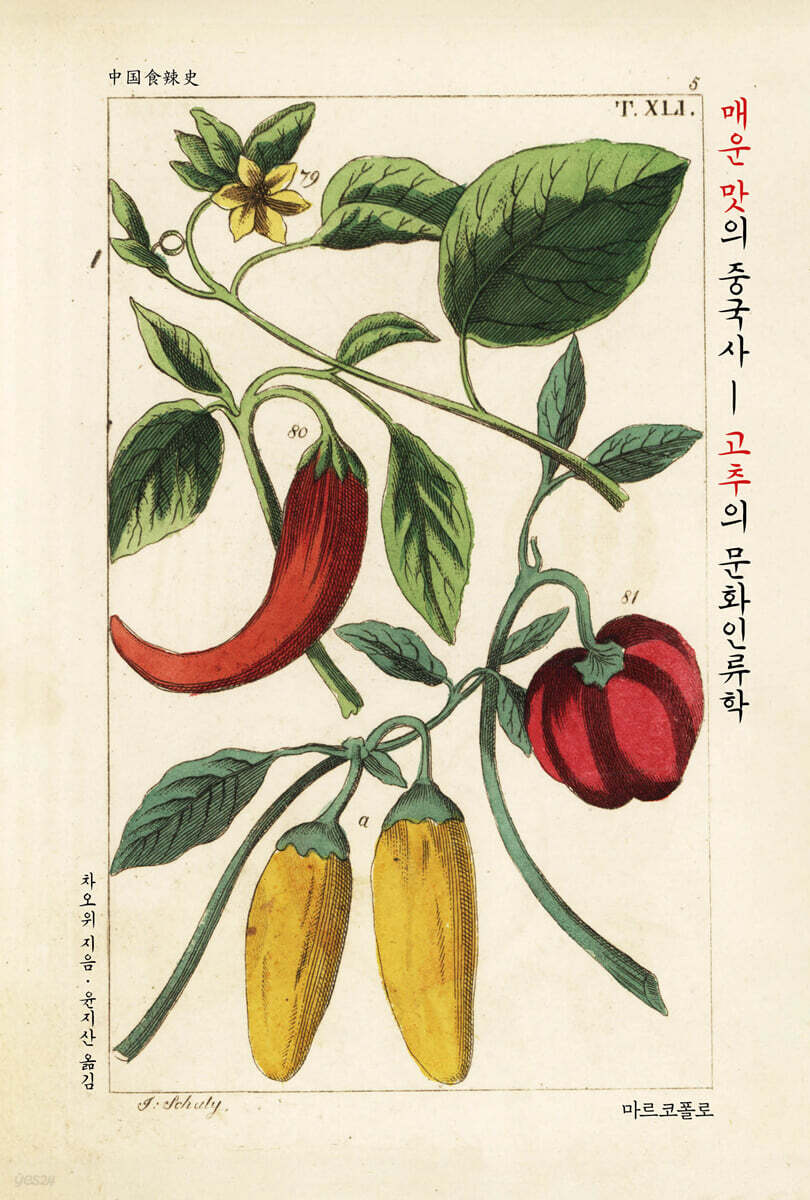
『A Spicy History of China』 is a cultural anthropological masterpiece by **Cao Yu**, a researcher of Chinese food culture, who traces the changes in human taste, class, body, and society through the plant called chili pepper.
From its origins in South America in the 16th century to its establishment as a culinary ingredient in Guizhou in the 17th century, chili peppers were not simply a spice, but also a survival technique and a social metaphor.
The book is divided into three parts.
Part 1 explores the origin and spread of chili peppers, Part 2 explores how spiciness was incorporated into the Chinese body and culture, and Part 3 explores how chili peppers functioned as symbols in social class and political change.
The author's analysis that "spiciness is not a matter of the tongue, but of power" persuasively illustrates how chili peppers began as commoners' meals and ultimately shaped China's identity.
This book also has a special meaning for Korean readers.
Korea's culinary culture, which loves spicy food, is closely connected to the "mala" (麻辣) culture of southern China, and today, the tables of Korea and China are exchanging each other's spices and sensibilities.
In short, 『The History of Spicy Chinese Taste』 is a ‘history of the exchange of tastes,’ an ‘anthropology of the senses,’ and a history of taste.
Spicy is not a taste.
It is a sense of civilization.
『A Spicy History of China』 is a cultural anthropological masterpiece by **Cao Yu**, a researcher of Chinese food culture, who traces the changes in human taste, class, body, and society through the plant called chili pepper.
From its origins in South America in the 16th century to its establishment as a culinary ingredient in Guizhou in the 17th century, chili peppers were not simply a spice, but also a survival technique and a social metaphor.
The book is divided into three parts.
Part 1 explores the origin and spread of chili peppers, Part 2 explores how spiciness was incorporated into the Chinese body and culture, and Part 3 explores how chili peppers functioned as symbols in social class and political change.
The author's analysis that "spiciness is not a matter of the tongue, but of power" persuasively illustrates how chili peppers began as commoners' meals and ultimately shaped China's identity.
This book also has a special meaning for Korean readers.
Korea's culinary culture, which loves spicy food, is closely connected to the "mala" (麻辣) culture of southern China, and today, the tables of Korea and China are exchanging each other's spices and sensibilities.
In short, 『The History of Spicy Chinese Taste』 is a ‘history of the exchange of tastes,’ an ‘anthropology of the senses,’ and a history of taste.
- You can preview some of the book's contents.
Preview
Detailed image

Publisher's Review
Spicy is not a taste - a sense of body and power
Chao Wei asserts, “Spiciness is not a taste.”
It is a physical experience and a politics of the senses.
The reason for eating peppers in the heat was to expel moisture and humidity from the body.
Thus, chili peppers became established as a cultural device that mediates the relationship between climate, constitution, physiology, and environment.
Interestingly, the spiciness gradually expanded into a metaphor for sex.
The burning sensation, the heat of the body, and the symbolism of the color red symbolized both masculine power and feminine seduction.
Additionally, peppers were consumed as a means of exorcising evil spirits and bringing good fortune.
In this way, chili peppers were a collective metaphor for Chinese culture, felt not just by the tongue but by the entire body.
The Spice of Class - The Burning Flavor of the Common People, the Seasoning of Power
The author reads chili peppers through the ‘hierarchical structure of food.’
In China, chili peppers first appeared on the tables of the poor and immigrants, not the nobility.
The common people's habit of seasoning their food with chili peppers instead of expensive meat or oil developed over time into a 'democratization of taste among the masses.'
As a result, the spiciness began on the periphery rather than the center of power, becoming a revolution of taste that eventually reorganized all of China.
Throughout the changing times of Chinese society, chili peppers have existed in unique ways.
During the 'revolutionary' period, it became a symbol of red, struggle, ideals, and labor, and after the reform and opening up, it returned to the center of popular consumer culture.
That is why Chao Wei says:
“The history of chili peppers is the social and emotional history of the Chinese people.”
South and North, center and periphery, and delocalized chili peppers
The spiciness of Chinese food varies from region to region.
The spiciness of Sichuan is the spiciness of abundance accompanied by the numbness of oil and pepper, and the spiciness of Honam is the spiciness of survival accompanied by fire, tears, and sweat.
On the other hand, the northern spiciness is an urban taste that was introduced relatively late.
Today, even these regional distinctions have become blurred.
The migration of immigrants, urbanization, and the development of the restaurant industry have given rise to a 'delocalized spicy taste'.
As a result, 'Mala Tang' and 'Hot Pot' have become standard foods that are enjoyed everywhere in China.
Chao Wei asserts, “Spiciness is not a taste.”
It is a physical experience and a politics of the senses.
The reason for eating peppers in the heat was to expel moisture and humidity from the body.
Thus, chili peppers became established as a cultural device that mediates the relationship between climate, constitution, physiology, and environment.
Interestingly, the spiciness gradually expanded into a metaphor for sex.
The burning sensation, the heat of the body, and the symbolism of the color red symbolized both masculine power and feminine seduction.
Additionally, peppers were consumed as a means of exorcising evil spirits and bringing good fortune.
In this way, chili peppers were a collective metaphor for Chinese culture, felt not just by the tongue but by the entire body.
The Spice of Class - The Burning Flavor of the Common People, the Seasoning of Power
The author reads chili peppers through the ‘hierarchical structure of food.’
In China, chili peppers first appeared on the tables of the poor and immigrants, not the nobility.
The common people's habit of seasoning their food with chili peppers instead of expensive meat or oil developed over time into a 'democratization of taste among the masses.'
As a result, the spiciness began on the periphery rather than the center of power, becoming a revolution of taste that eventually reorganized all of China.
Throughout the changing times of Chinese society, chili peppers have existed in unique ways.
During the 'revolutionary' period, it became a symbol of red, struggle, ideals, and labor, and after the reform and opening up, it returned to the center of popular consumer culture.
That is why Chao Wei says:
“The history of chili peppers is the social and emotional history of the Chinese people.”
South and North, center and periphery, and delocalized chili peppers
The spiciness of Chinese food varies from region to region.
The spiciness of Sichuan is the spiciness of abundance accompanied by the numbness of oil and pepper, and the spiciness of Honam is the spiciness of survival accompanied by fire, tears, and sweat.
On the other hand, the northern spiciness is an urban taste that was introduced relatively late.
Today, even these regional distinctions have become blurred.
The migration of immigrants, urbanization, and the development of the restaurant industry have given rise to a 'delocalized spicy taste'.
As a result, 'Mala Tang' and 'Hot Pot' have become standard foods that are enjoyed everywhere in China.
GOODS SPECIFICS
- Date of issue: November 12, 2025
- Page count, weight, size: 280 pages | 506g | 152*225*16mm
- ISBN13: 9791192667430
- ISBN10: 1192667433
You may also like
카테고리
korean


korean

![GQ KOREA Mark (Monthly): December [2025]](http://librairie.coreenne.fr/cdn/shop/files/8ef265dbbfbf186523ed75ba7319009d.jpg?v=1765340328&width=3840)


