

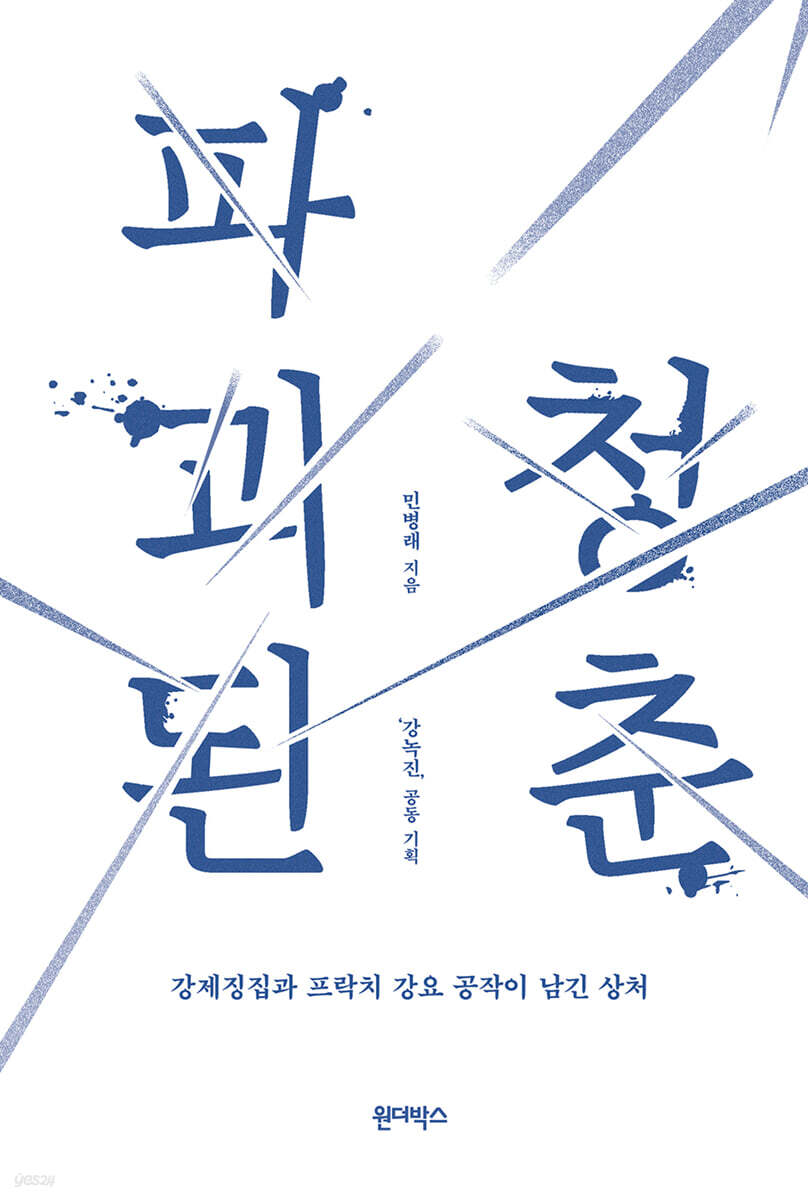
ruined youth
 |
Description
Book Introduction
The story of youth destroyed by the state
The first popular book to uncover the truth about 'forced conscription'
During the harsh military dictatorship of the 1970s and 1980s, countless students were drafted into the military simply for calling for democracy.
It wasn't a simple enlistment.
It was a 'kidnapping' in which all procedures were ignored, without a physical examination or enlistment order.
Inside the barracks, they were forced to reform their ideology and betray their comrades under surveillance and control.
This is the so-called ‘forced conscription and recording/guidance operation.’
According to official figures alone, 2,921 people were forcibly conscripted, 2,388 were forced to become spies, and 9 of them died.
Until now, forced conscription and recording operations have been known only through the testimonies of some victims, but there has been no book that comprehensively covers the whole story.
Only recently has the truth been gradually revealed through the Truth and Reconciliation Commission.
This book, jointly planned and published by author Min Byeong-rae and Kang Nok-jin (Committee for the Investigation of the Truth about Forced Conscription, Greening, and Guidance Operations), reveals the enormous reality of state violence that uses national defense obligations and the military as tools of oppression, and restores the lives of young people who perished within it.
This book is a requiem for the "broken youth," and an indictment that shows how an unresolved history continues to this day.
The first popular book to uncover the truth about 'forced conscription'
During the harsh military dictatorship of the 1970s and 1980s, countless students were drafted into the military simply for calling for democracy.
It wasn't a simple enlistment.
It was a 'kidnapping' in which all procedures were ignored, without a physical examination or enlistment order.
Inside the barracks, they were forced to reform their ideology and betray their comrades under surveillance and control.
This is the so-called ‘forced conscription and recording/guidance operation.’
According to official figures alone, 2,921 people were forcibly conscripted, 2,388 were forced to become spies, and 9 of them died.
Until now, forced conscription and recording operations have been known only through the testimonies of some victims, but there has been no book that comprehensively covers the whole story.
Only recently has the truth been gradually revealed through the Truth and Reconciliation Commission.
This book, jointly planned and published by author Min Byeong-rae and Kang Nok-jin (Committee for the Investigation of the Truth about Forced Conscription, Greening, and Guidance Operations), reveals the enormous reality of state violence that uses national defense obligations and the military as tools of oppression, and restores the lives of young people who perished within it.
This book is a requiem for the "broken youth," and an indictment that shows how an unresolved history continues to this day.
- You can preview some of the book's contents.
Preview
index
Recommendation
Header
Part 1: Those Who Went First
Chapter 1: The Death of a Nineteen-Year-Old Who Was Forcibly Drafted into the Military ┃ Jeong Seong-hui Chapter 2: Hanging Hisself Eight Days Before Discharge? ┃ Lee Yun-seong Chapter 3: 40 Years for a Friend Who Died Under Suspiciously ┃ Kim Du-hwang Chapter 4: A Choice Made at the Age of 22: Who Is Responsible? ┃ Han Yeong-hyeon Chapter 5: The Son of a War Veteran Who Died Under Suspiciously in the Military ┃ Han Hee-cheol Chapter 6: A Mother's Bitter Struggle After Losing Her Son ┃ Kim Yong-kwon Chapter 7: The Shackles of Unjust Death Never Go Away ┃ Choi Woo-hyuk
Part 2: State violence comparable to genocide
Chapter 1: The Military: A Prison Camp Chapter 2: Torture, Conversion, and Forced Spying, and Suspicious Deaths Chapter 3: Who Are the Perpetrators? Chapter 4: State Violence on a Level with Genocide
In closing
supplement
annotation
Header
Part 1: Those Who Went First
Chapter 1: The Death of a Nineteen-Year-Old Who Was Forcibly Drafted into the Military ┃ Jeong Seong-hui Chapter 2: Hanging Hisself Eight Days Before Discharge? ┃ Lee Yun-seong Chapter 3: 40 Years for a Friend Who Died Under Suspiciously ┃ Kim Du-hwang Chapter 4: A Choice Made at the Age of 22: Who Is Responsible? ┃ Han Yeong-hyeon Chapter 5: The Son of a War Veteran Who Died Under Suspiciously in the Military ┃ Han Hee-cheol Chapter 6: A Mother's Bitter Struggle After Losing Her Son ┃ Kim Yong-kwon Chapter 7: The Shackles of Unjust Death Never Go Away ┃ Choi Woo-hyuk
Part 2: State violence comparable to genocide
Chapter 1: The Military: A Prison Camp Chapter 2: Torture, Conversion, and Forced Spying, and Suspicious Deaths Chapter 3: Who Are the Perpetrators? Chapter 4: State Violence on a Level with Genocide
In closing
supplement
annotation
Into the book
He was caught trying to save a female student being dragged away in front of his eyes. He was a first-year student in the English-French department, and was nineteen years old, so he was under the age of conscription.
The prosecutor in charge, Jeong Hyeong-jo, and the police also ignored this.
Jeong Seong-hui received basic training at the 5th Division's new recruit training unit after serving in the 101st Reserve Forces on November 28th, and was assigned to the 3rd Platoon, 6th Company, 2nd Battalion, 36th Regiment, 5th Division on January 14, 1982.
About half a year later, on July 22, 1982, Jeong Seong-hee was found dead.
--- p.26
Lee Yoon-seong, who had been summoned several times, was taken to the 205th Unit again on April 30th.
What happened from that day until May 4th? When you go to the security unit, you're usually required to write a "story of my growth."
Whether it's 50 pages or 100 pages, I have to write without stopping.
I also have to read a book about Chun Doo-hwan's life, "From Hwanggang to Bukak," and write an essay about it.
Lee Yoon-seong must have experienced the same thing.
He would also have been asked to draw a genealogy of the Sungkyunkwan University student movement and asked who the core of the Sungkyunkwan University student movement was.
However, Lee Yoon-seong did not cooperate with the security force's investigation.
In the end, he died four days after being taken away.
This happened six months after I was drafted into the military on November 6, 1982.
--- p.49
“The security service also reached out to me.
In September, they said it was a special vacation and took me from the 22nd Division to the Security Command's Gwacheon branch.
Inspector Kwon Oh-kyung was waiting.
He said, 'No one knows you're here.
He threatened, "If you don't listen to me, I'll kill you without anyone knowing and leave you behind a barbed wire fence, saying you died while trying to defect to North Korea. That's the end of it."
They locked me up for several days and made me write a confession.
I wrote and wrote and was completely stripped bare.
At the end, we were asked to make a pledge in front of the Taegeukgi.
There was no way to refuse.
After the review, they decided that I had been modified to suit their tastes and sent me to the Jin Yang branch in Chungmuro.
Park Jun-hyun, who was in charge of Korea University, gave me three tasks.
One of them was an instruction to show the organizational chart of the People's Love Association, the Sociological Association, and the Academic Association Presidents' Meeting and to find out the current status of the people listed on the chart."
--- p.80
Not only Han Yeong-hyeon, but also Lee Yun-seong, who was forcibly conscripted and died in May 1983, received the same instructions from the Security Command.
It was the most vicious spy activity forced during the recording operation.
Forced conscription is essentially kidnapping and forced detention and should be condemned, but forcing spy activities is an even greater crime against humanity.
Human society defines and prohibits the use of captured enemy soldiers as spies and information warfare during wartime as a war crime.
Because it is against humanity to conduct espionage activities against one's own people, tribe, or brothers and sisters.
This is how the recording process went.
It was a plot to make those who were involved in student movement organizations betray their friends and seniors and act as spies.
--- p.103
Enlistment is a very important issue for young men in South Korea.
Because the timetable of your life is at stake.
Article 39 of the Constitution states that “No person shall be subject to disadvantageous treatment due to performance of military service obligations.”
Additionally, the Military Service Act states that a military service physical examination is conducted to determine whether or not one will enlist.
However, Kim Moon-soo and Kim Hyung-bo were not guaranteed the rights and procedures stipulated in the Constitution and the Military Service Act.
All processes were omitted.
This is not an unusual experience that only two people have experienced.
The Truth and Reconciliation Commission's 2nd term decided to investigate the truth on November 22, 2022, and revealed a total of 2,921 victims.
This is a number compiled from the Park Chung-hee, Chun Doo-hwan, and Roh Tae-woo administrations.
Everyone was dragged into the military amidst rampant illegality and lawlessness.
How could such atrocities have been committed over decades, and by state agencies so brazenly?
--- p.195
This operation, targeting student movements, was illegal from the beginning as it was a civilian surveillance outside the scope of the Security Command's duties.
The Security Command should only deal with the collection and processing of intelligence related to the military and the military.
But the security service ignored it.
Because there was a special order from Chun Doo-hwan and he had a history of creating numerous fabricated spies, this was considered nothing.
The atmosphere in the barracks was also transformed, and through the operation, information and spies were secured to subdue the special agent and destroy the student movement. For the Security Command, it was a killing iteration, an operation they could not give up.
--- p.223
Meanwhile, the 'Gangjeonchi' operation falls squarely within the definition of a crime against humanity by the International Criminal Court.
The Rome Statute, which formed the basis for the establishment of the Court, provides detailed examples of what constitutes crimes against humanity.
This includes murder, detention, torture, sexual slavery, and forced transfer that occur when the perpetrator carries out a comprehensive and systematic attack on civilians.
In the recording operation, nine young men were driven to their deaths and thousands were subjected to ideological reform and assault.
He was even subjected to water torture and electric torture.
Even enemy soldiers captured during the war were forced to perform acts of spying that should not have been done.
As revealed by the Truth and Reconciliation Commission, it was a crime against humanity that violated fundamental rights and trampled on physical freedom and freedom of conscience.
--- p.258
This death was mostly treated as a suicide due to personal despair.
The extreme right-wing anti-communist regime did not care about the youth of this land who were trying to fulfill their 'sacred duty of national defense.'
I had no intention of caring.
Furthermore, the 'Gangjeonchi' operation used the barracks as a 'facility of oppression', so the soldiers Park Chung-hee and Chun Doo-hwan denied the narrative of the 'sacred duty of national defense'.
Political soldiers and rebels have dug their own graves.
The 'Gangjeonchi' operation and the massacres that occurred in Jeju, Yeosun, and Gwangju must not be repeated.
There is only one answer.
We must break free from the shackles of the National Security Act and militarism.
Only by dismantling the framework of the divided anti-communist nation will state violence cease in this land.
The prosecutor in charge, Jeong Hyeong-jo, and the police also ignored this.
Jeong Seong-hui received basic training at the 5th Division's new recruit training unit after serving in the 101st Reserve Forces on November 28th, and was assigned to the 3rd Platoon, 6th Company, 2nd Battalion, 36th Regiment, 5th Division on January 14, 1982.
About half a year later, on July 22, 1982, Jeong Seong-hee was found dead.
--- p.26
Lee Yoon-seong, who had been summoned several times, was taken to the 205th Unit again on April 30th.
What happened from that day until May 4th? When you go to the security unit, you're usually required to write a "story of my growth."
Whether it's 50 pages or 100 pages, I have to write without stopping.
I also have to read a book about Chun Doo-hwan's life, "From Hwanggang to Bukak," and write an essay about it.
Lee Yoon-seong must have experienced the same thing.
He would also have been asked to draw a genealogy of the Sungkyunkwan University student movement and asked who the core of the Sungkyunkwan University student movement was.
However, Lee Yoon-seong did not cooperate with the security force's investigation.
In the end, he died four days after being taken away.
This happened six months after I was drafted into the military on November 6, 1982.
--- p.49
“The security service also reached out to me.
In September, they said it was a special vacation and took me from the 22nd Division to the Security Command's Gwacheon branch.
Inspector Kwon Oh-kyung was waiting.
He said, 'No one knows you're here.
He threatened, "If you don't listen to me, I'll kill you without anyone knowing and leave you behind a barbed wire fence, saying you died while trying to defect to North Korea. That's the end of it."
They locked me up for several days and made me write a confession.
I wrote and wrote and was completely stripped bare.
At the end, we were asked to make a pledge in front of the Taegeukgi.
There was no way to refuse.
After the review, they decided that I had been modified to suit their tastes and sent me to the Jin Yang branch in Chungmuro.
Park Jun-hyun, who was in charge of Korea University, gave me three tasks.
One of them was an instruction to show the organizational chart of the People's Love Association, the Sociological Association, and the Academic Association Presidents' Meeting and to find out the current status of the people listed on the chart."
--- p.80
Not only Han Yeong-hyeon, but also Lee Yun-seong, who was forcibly conscripted and died in May 1983, received the same instructions from the Security Command.
It was the most vicious spy activity forced during the recording operation.
Forced conscription is essentially kidnapping and forced detention and should be condemned, but forcing spy activities is an even greater crime against humanity.
Human society defines and prohibits the use of captured enemy soldiers as spies and information warfare during wartime as a war crime.
Because it is against humanity to conduct espionage activities against one's own people, tribe, or brothers and sisters.
This is how the recording process went.
It was a plot to make those who were involved in student movement organizations betray their friends and seniors and act as spies.
--- p.103
Enlistment is a very important issue for young men in South Korea.
Because the timetable of your life is at stake.
Article 39 of the Constitution states that “No person shall be subject to disadvantageous treatment due to performance of military service obligations.”
Additionally, the Military Service Act states that a military service physical examination is conducted to determine whether or not one will enlist.
However, Kim Moon-soo and Kim Hyung-bo were not guaranteed the rights and procedures stipulated in the Constitution and the Military Service Act.
All processes were omitted.
This is not an unusual experience that only two people have experienced.
The Truth and Reconciliation Commission's 2nd term decided to investigate the truth on November 22, 2022, and revealed a total of 2,921 victims.
This is a number compiled from the Park Chung-hee, Chun Doo-hwan, and Roh Tae-woo administrations.
Everyone was dragged into the military amidst rampant illegality and lawlessness.
How could such atrocities have been committed over decades, and by state agencies so brazenly?
--- p.195
This operation, targeting student movements, was illegal from the beginning as it was a civilian surveillance outside the scope of the Security Command's duties.
The Security Command should only deal with the collection and processing of intelligence related to the military and the military.
But the security service ignored it.
Because there was a special order from Chun Doo-hwan and he had a history of creating numerous fabricated spies, this was considered nothing.
The atmosphere in the barracks was also transformed, and through the operation, information and spies were secured to subdue the special agent and destroy the student movement. For the Security Command, it was a killing iteration, an operation they could not give up.
--- p.223
Meanwhile, the 'Gangjeonchi' operation falls squarely within the definition of a crime against humanity by the International Criminal Court.
The Rome Statute, which formed the basis for the establishment of the Court, provides detailed examples of what constitutes crimes against humanity.
This includes murder, detention, torture, sexual slavery, and forced transfer that occur when the perpetrator carries out a comprehensive and systematic attack on civilians.
In the recording operation, nine young men were driven to their deaths and thousands were subjected to ideological reform and assault.
He was even subjected to water torture and electric torture.
Even enemy soldiers captured during the war were forced to perform acts of spying that should not have been done.
As revealed by the Truth and Reconciliation Commission, it was a crime against humanity that violated fundamental rights and trampled on physical freedom and freedom of conscience.
--- p.258
This death was mostly treated as a suicide due to personal despair.
The extreme right-wing anti-communist regime did not care about the youth of this land who were trying to fulfill their 'sacred duty of national defense.'
I had no intention of caring.
Furthermore, the 'Gangjeonchi' operation used the barracks as a 'facility of oppression', so the soldiers Park Chung-hee and Chun Doo-hwan denied the narrative of the 'sacred duty of national defense'.
Political soldiers and rebels have dug their own graves.
The 'Gangjeonchi' operation and the massacres that occurred in Jeju, Yeosun, and Gwangju must not be repeated.
There is only one answer.
We must break free from the shackles of the National Security Act and militarism.
Only by dismantling the framework of the divided anti-communist nation will state violence cease in this land.
--- pp.260-261
Publisher's Review
Young men who were suddenly kidnapped by the military one day
One day, the police take you away, saying you participated in an illegal protest.
I was put on a police vehicle and taken somewhere, and it turned out to be a military base.
After a few questions like “Does anything hurt?”, you are immediately drafted into the forward unit.
Unable to even tell his family, his parents reported their son missing to the police.
This amazing situation is not virtual.
This happened countless times in the 1980s, about 40 years ago.
Virtually all kidnappings were rampant, with people being dragged off to the military without their consent, without a physical examination, and without contacting their parents.
Not only the Ministry of Defense and the military, but also the police, universities, the Ministry of the Interior, and other state organizations were comprehensively involved in this crime.
This crime is called 'forced conscription'.
Forced conscription was a repressive tactic of the military regime to neutralize student activists critical of the regime.
They used the military, which all young South Korean men had to serve, as a concentration camp, imprisoning and monitoring students and forcing them to convert or engage in spy activities.
According to the Truth and Reconciliation Commission, 2,921 people were confirmed to have been forcibly conscripted, and 2,388 of them were targets of spy operations.
In the process, nine young people died under suspicious circumstances.
The Reality of State Violence Reconstructed Through the Lives of Victims
Part 1 of this book vividly reconstructs the short lives of seven victims, how they were drafted into the military and killed.
Jeong Seong-hui was forcibly conscripted at the age of nineteen and suffered from the security service's spy operations, dying from four gunshot wounds to the neck at the guard post.
And it was announced as suicide.
Lee Yoon-seong was the second only child and his father was over sixty years old, so he was not eligible for active duty according to the military service law at the time, but he enlisted under pressure from the police.
He was found hanged in the barracks while being questioned by the security forces just eight days before his discharge.
As expected, they said it was suicide.
Kim Du-hwang was illegally taken away by the police and beaten for nearly ten days before being drafted, and after three months, he was shot in the head and killed at a coastal outpost.
This was also announced as a suicide.
About a year later, his father and mother also passed away from grief.
All deaths that occurred within the military during that period were suicides.
The body was quickly cremated after a military-led autopsy, and the family was asked to sign a statement promising not to raise any issues.
Han Hee-chul's father had to sign a memorandum stating, "I have no objection to my son's 'suicide' and pledge not to raise any civil or criminal issues in the future regarding this matter. I hereby submit this memorandum."
The state did not stop there, it also monitored and followed families.
The Security Service monitored the movements of the Lee Yun-seong family until 1995, and there were even signs of wiretapping their phones.
As Park Myeong-seon, the mother of the deceased Kim Yong-kwon, went around telling people about her son's unjust death, the police began monitoring her every move and, one day, even tailing her.
This was the reality of Korea, dominated by the military and anti-communism.
Organized state crimes to suppress student movements
Forced conscription was first implemented during the Park Chung-hee regime.
Park Chung-hee began using forced conscription as a means of responding to protests based on issues, starting with arresting and enlisting students who had participated in protests against the third constitutional amendment.
Chun Doo-hwan developed this and perfected it into a suppression tactic targeting a group called the 'student movement.'
On April 2, 1981, Chun Doo-hwan issued an order to “enlist students involved in the riots in forward units,” and after several months of preparation, the “Special Measures for University Students Involved in the Riots (Draft)” was established on November 2.
The content was to conscript without considering anything such as age, physical examination, or physical condition.
The police escorted the arrested students to a military base, and the university responded by forcing them to take a leave of absence.
It didn't end with enlistment.
In order to prevent him from returning to the student movement, they forced him to change his ways and demanded that he reveal information about the student movement organization and engage in spy activities.
This is the so-called recording operation.
This is the testimony of Jeong Jae-hong, who was forcibly conscripted in 1981.
“When I went in, it was complete hell.
The violence began when they were made to wear military uniforms without name tags or rank insignia and their belts were unfastened.
I hit him unconditionally.
I was beaten severely, including being punched in the chest and stomach and kicked.
From then on, I wrote a statement.
If I write in the morning, I come in for the test in the afternoon, and if I write in the evening, I come in for the test the next morning.
I get tested twice a day, which is the time I get hit.
If they did not know anything or had no new facts, they would beat their whole body with an octagonal club engraved with a word "Jinsimbong."
It's a club massage.
It wasn't just the butt that was spanked.
“I was covered in bruises from my back to the soles of my feet.” - Page 232.
The Security Command recorded this process of screening, purification, and coercion of spy activities in individual 'personal information files', and there are 2,388 individual personal information files totaling over 100,000 pages.
To break the chain of state violence
In Part 2, the author states that this 'forced conscription and conversion/spoiler operation (Gangjeonchi)' has a seriousness that is different from other human rights violations of the period, such as the Brothers Welfare Center and the Samcheong Education Corps.
First, it was a mass persecution carried out with the clear purpose of destroying political opposition.
At the time, when the opposition party and the media were holding their breath, the most powerful force of resistance to the regime was the student movement.
The government viewed the student movement as an enemy and attempted to crush it through a strong-arm operation.
It can be seen as a politically motivated genocide, like the killing fields in Cambodia or Argentina's 'dirty war'.
Second, this incident did not originate from the misconduct of some government organization or public official, but was carried out at the national level.
Under the direction of the person in power, numerous administrative organizations, including the Ministry of National Defense, the Military Manpower Administration, the National Police Agency, and even the Ministry of Education, were mobilized to inflict physical harm on a specific group of citizens.
This is why national-level reflection and apology are necessary.
Third, the military was used as a means of oppression.
Forced conscription had nothing to do with performing national defense duties.
Even if they failed the physical examination, they were enlisted and monitored at the front.
Soldiers were frequently interrogated and beaten.
It should be evaluated more seriously because it used the military for political purposes, such as martial law or a coup.
The Truth and Reconciliation Commission acknowledged the state's responsibility for the Gangjeonchi operation and ruled that the deaths of those who died under suspicious circumstances were "deaths caused by public power."
However, not a single government agency involved has officially apologized, and while the deaths were attributed to public authority, no investigation has been conducted into who was involved and how.
To console the souls of the devastated youth and break the chains of state violence, an official apology from the state is necessary, as well as revealing who was involved in this crime and bringing them before the court of history.
Until now, state violence by the military has not been properly punished in Korea.
The massacre of civilians during the Korean War, as well as the massacres in Jeju on April 3 and Gwangju on May 18, went unpunished.
He was also tolerant of military coups.
The author argues that such unresolved history will manifest itself in the form of martial law and attempted civil war in 2024.
To solidify democracy, we must cast off the shackles of militarism and dismantle the framework of the anti-communist state.
This is why it is important to uncover the truth about the Gangjeonchi operation.
One day, the police take you away, saying you participated in an illegal protest.
I was put on a police vehicle and taken somewhere, and it turned out to be a military base.
After a few questions like “Does anything hurt?”, you are immediately drafted into the forward unit.
Unable to even tell his family, his parents reported their son missing to the police.
This amazing situation is not virtual.
This happened countless times in the 1980s, about 40 years ago.
Virtually all kidnappings were rampant, with people being dragged off to the military without their consent, without a physical examination, and without contacting their parents.
Not only the Ministry of Defense and the military, but also the police, universities, the Ministry of the Interior, and other state organizations were comprehensively involved in this crime.
This crime is called 'forced conscription'.
Forced conscription was a repressive tactic of the military regime to neutralize student activists critical of the regime.
They used the military, which all young South Korean men had to serve, as a concentration camp, imprisoning and monitoring students and forcing them to convert or engage in spy activities.
According to the Truth and Reconciliation Commission, 2,921 people were confirmed to have been forcibly conscripted, and 2,388 of them were targets of spy operations.
In the process, nine young people died under suspicious circumstances.
The Reality of State Violence Reconstructed Through the Lives of Victims
Part 1 of this book vividly reconstructs the short lives of seven victims, how they were drafted into the military and killed.
Jeong Seong-hui was forcibly conscripted at the age of nineteen and suffered from the security service's spy operations, dying from four gunshot wounds to the neck at the guard post.
And it was announced as suicide.
Lee Yoon-seong was the second only child and his father was over sixty years old, so he was not eligible for active duty according to the military service law at the time, but he enlisted under pressure from the police.
He was found hanged in the barracks while being questioned by the security forces just eight days before his discharge.
As expected, they said it was suicide.
Kim Du-hwang was illegally taken away by the police and beaten for nearly ten days before being drafted, and after three months, he was shot in the head and killed at a coastal outpost.
This was also announced as a suicide.
About a year later, his father and mother also passed away from grief.
All deaths that occurred within the military during that period were suicides.
The body was quickly cremated after a military-led autopsy, and the family was asked to sign a statement promising not to raise any issues.
Han Hee-chul's father had to sign a memorandum stating, "I have no objection to my son's 'suicide' and pledge not to raise any civil or criminal issues in the future regarding this matter. I hereby submit this memorandum."
The state did not stop there, it also monitored and followed families.
The Security Service monitored the movements of the Lee Yun-seong family until 1995, and there were even signs of wiretapping their phones.
As Park Myeong-seon, the mother of the deceased Kim Yong-kwon, went around telling people about her son's unjust death, the police began monitoring her every move and, one day, even tailing her.
This was the reality of Korea, dominated by the military and anti-communism.
Organized state crimes to suppress student movements
Forced conscription was first implemented during the Park Chung-hee regime.
Park Chung-hee began using forced conscription as a means of responding to protests based on issues, starting with arresting and enlisting students who had participated in protests against the third constitutional amendment.
Chun Doo-hwan developed this and perfected it into a suppression tactic targeting a group called the 'student movement.'
On April 2, 1981, Chun Doo-hwan issued an order to “enlist students involved in the riots in forward units,” and after several months of preparation, the “Special Measures for University Students Involved in the Riots (Draft)” was established on November 2.
The content was to conscript without considering anything such as age, physical examination, or physical condition.
The police escorted the arrested students to a military base, and the university responded by forcing them to take a leave of absence.
It didn't end with enlistment.
In order to prevent him from returning to the student movement, they forced him to change his ways and demanded that he reveal information about the student movement organization and engage in spy activities.
This is the so-called recording operation.
This is the testimony of Jeong Jae-hong, who was forcibly conscripted in 1981.
“When I went in, it was complete hell.
The violence began when they were made to wear military uniforms without name tags or rank insignia and their belts were unfastened.
I hit him unconditionally.
I was beaten severely, including being punched in the chest and stomach and kicked.
From then on, I wrote a statement.
If I write in the morning, I come in for the test in the afternoon, and if I write in the evening, I come in for the test the next morning.
I get tested twice a day, which is the time I get hit.
If they did not know anything or had no new facts, they would beat their whole body with an octagonal club engraved with a word "Jinsimbong."
It's a club massage.
It wasn't just the butt that was spanked.
“I was covered in bruises from my back to the soles of my feet.” - Page 232.
The Security Command recorded this process of screening, purification, and coercion of spy activities in individual 'personal information files', and there are 2,388 individual personal information files totaling over 100,000 pages.
To break the chain of state violence
In Part 2, the author states that this 'forced conscription and conversion/spoiler operation (Gangjeonchi)' has a seriousness that is different from other human rights violations of the period, such as the Brothers Welfare Center and the Samcheong Education Corps.
First, it was a mass persecution carried out with the clear purpose of destroying political opposition.
At the time, when the opposition party and the media were holding their breath, the most powerful force of resistance to the regime was the student movement.
The government viewed the student movement as an enemy and attempted to crush it through a strong-arm operation.
It can be seen as a politically motivated genocide, like the killing fields in Cambodia or Argentina's 'dirty war'.
Second, this incident did not originate from the misconduct of some government organization or public official, but was carried out at the national level.
Under the direction of the person in power, numerous administrative organizations, including the Ministry of National Defense, the Military Manpower Administration, the National Police Agency, and even the Ministry of Education, were mobilized to inflict physical harm on a specific group of citizens.
This is why national-level reflection and apology are necessary.
Third, the military was used as a means of oppression.
Forced conscription had nothing to do with performing national defense duties.
Even if they failed the physical examination, they were enlisted and monitored at the front.
Soldiers were frequently interrogated and beaten.
It should be evaluated more seriously because it used the military for political purposes, such as martial law or a coup.
The Truth and Reconciliation Commission acknowledged the state's responsibility for the Gangjeonchi operation and ruled that the deaths of those who died under suspicious circumstances were "deaths caused by public power."
However, not a single government agency involved has officially apologized, and while the deaths were attributed to public authority, no investigation has been conducted into who was involved and how.
To console the souls of the devastated youth and break the chains of state violence, an official apology from the state is necessary, as well as revealing who was involved in this crime and bringing them before the court of history.
Until now, state violence by the military has not been properly punished in Korea.
The massacre of civilians during the Korean War, as well as the massacres in Jeju on April 3 and Gwangju on May 18, went unpunished.
He was also tolerant of military coups.
The author argues that such unresolved history will manifest itself in the form of martial law and attempted civil war in 2024.
To solidify democracy, we must cast off the shackles of militarism and dismantle the framework of the anti-communist state.
This is why it is important to uncover the truth about the Gangjeonchi operation.
GOODS SPECIFICS
- Date of issue: September 30, 2025
- Page count, weight, size: 296 pages | 372g | 138*208*14mm
- ISBN13: 9791192953618
- ISBN10: 1192953614
You may also like
카테고리
korean


korean

![GQ KOREA Mark (Monthly): December [2025]](http://librairie.coreenne.fr/cdn/shop/files/8ef265dbbfbf186523ed75ba7319009d.jpg?v=1765340328&width=3840)


