

Red Era
 |
Description
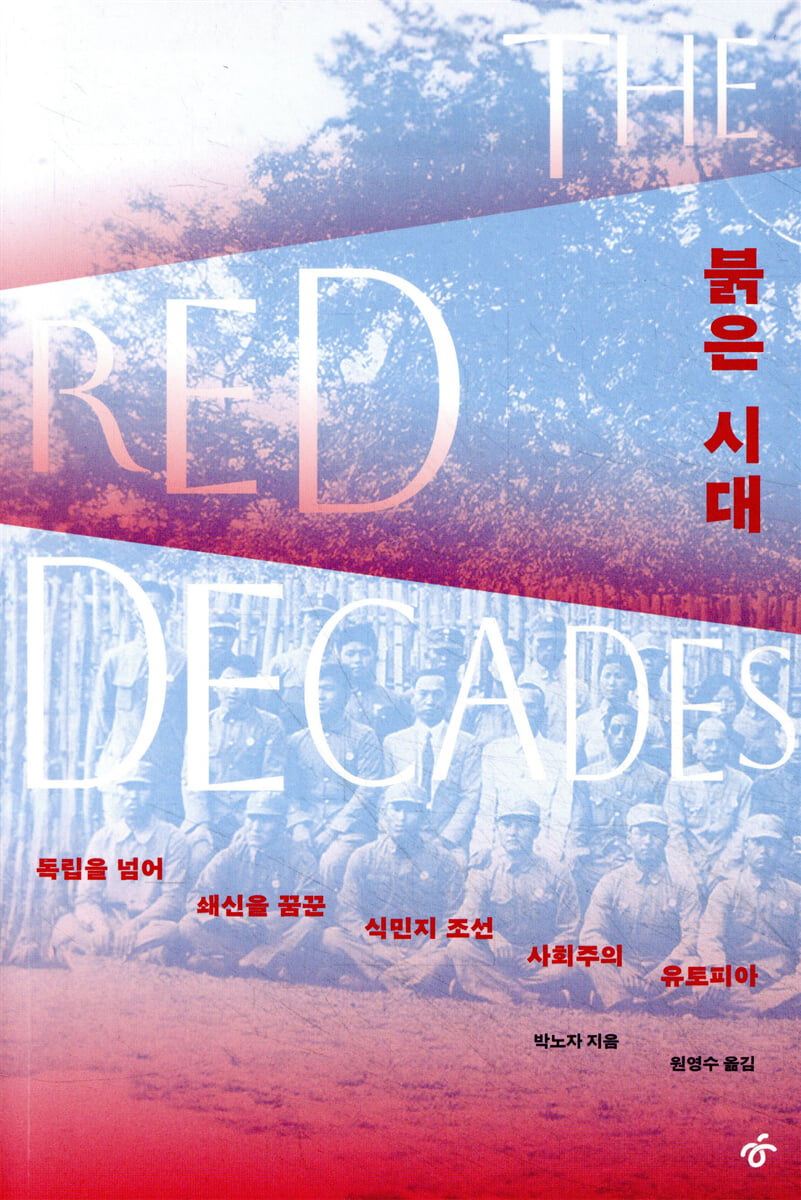
Book Introduction
This year, which marks the 80th anniversary of Liberation Day, also marks the 100th anniversary of the founding of the Communist Party of Korea.
Since its founding, the Communist Party has always fought most fiercely in the anti-Japanese struggle.
Those who believed that we should move beyond reclaiming our country and toward a better society dreamed of and advocated for a new society for the most oppressed, boldly advocating for radical agendas such as 'anti-imperialism, liberation of ethnic minorities, minimum wage guarantees, industrial accident compensation, worker participation in management, land reform, decriminalization of homosexuality, legalization of abortion, and paid maternity leave.'
This book, which revives the Korean communist movement during the interwar period (between World Wars I and II), which can be called the "Red Era," reinterprets the Korean leftist movement in a world historical context and sheds new light on how the Korean communist movement interacted with movements in Russia, Germany, China, and other countries at the time.
It also analyzes the powerful and unique characteristics of the colonial Korean communist movement, which combined national, democratic, and class revolutionary characteristics.
Furthermore, it introduces the intellectual trajectories of those involved in Communist Party activities and the original and pioneering research of Korean Marxist thinkers. It also examines the influence of factional debates within the Party, the Party's program renewal, and the Party's analysis, strategy, and practice of Korean society on the thinking of its contemporaries.
We examine the legacy of the "Red Era," which persisted despite the movement's decline and steady attempts at reconstruction following the dissolution of the Korean Communist Party by the Japanese in 1928, and consider whether a critical continuation of the colonial Korean communist movement is possible in the present context.
Author Park No-ja, born in the Soviet Union and naturalized as a Korean citizen, meticulously restores what we previously did not know about the philosophical, social, and political practices of the "Red Era of Colonial Korea" by examining not only materials from the Comintern archives but also primary sources from Japan, Korea, Russia, and China.
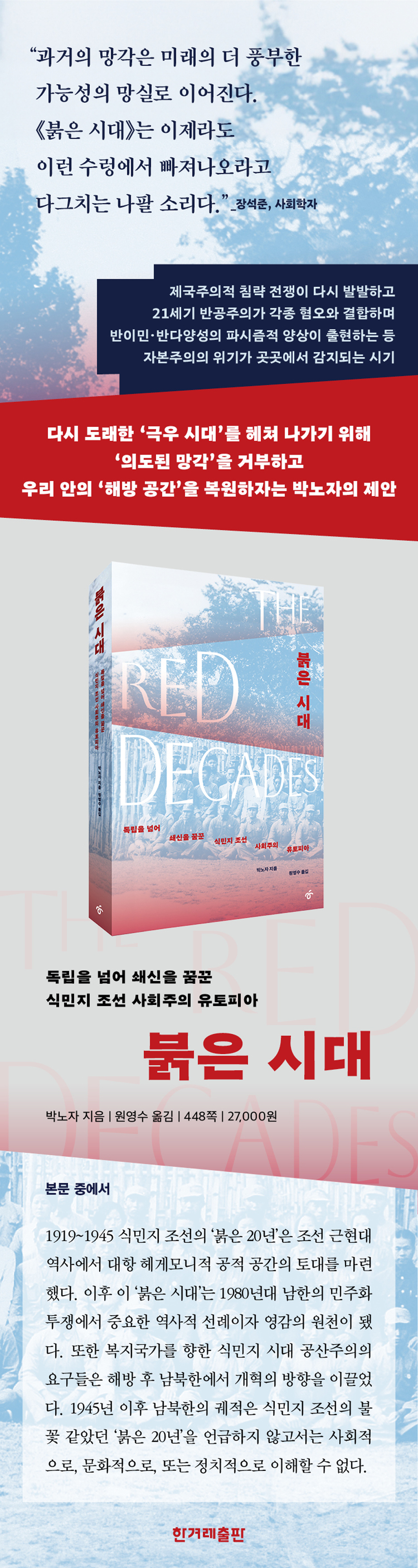
At a time when the crisis of the capitalist system is felt everywhere, with imperialist wars of aggression breaking out again, 21st-century anti-communism emerging in combination with various forms of hatred, and fascist aspects of anti-immigration and anti-diversity emerging worldwide, this book rejects "intentional oblivion" and provides a clue to navigating the "era of the far right."
Since its founding, the Communist Party has always fought most fiercely in the anti-Japanese struggle.
Those who believed that we should move beyond reclaiming our country and toward a better society dreamed of and advocated for a new society for the most oppressed, boldly advocating for radical agendas such as 'anti-imperialism, liberation of ethnic minorities, minimum wage guarantees, industrial accident compensation, worker participation in management, land reform, decriminalization of homosexuality, legalization of abortion, and paid maternity leave.'
This book, which revives the Korean communist movement during the interwar period (between World Wars I and II), which can be called the "Red Era," reinterprets the Korean leftist movement in a world historical context and sheds new light on how the Korean communist movement interacted with movements in Russia, Germany, China, and other countries at the time.
It also analyzes the powerful and unique characteristics of the colonial Korean communist movement, which combined national, democratic, and class revolutionary characteristics.
Furthermore, it introduces the intellectual trajectories of those involved in Communist Party activities and the original and pioneering research of Korean Marxist thinkers. It also examines the influence of factional debates within the Party, the Party's program renewal, and the Party's analysis, strategy, and practice of Korean society on the thinking of its contemporaries.
We examine the legacy of the "Red Era," which persisted despite the movement's decline and steady attempts at reconstruction following the dissolution of the Korean Communist Party by the Japanese in 1928, and consider whether a critical continuation of the colonial Korean communist movement is possible in the present context.
Author Park No-ja, born in the Soviet Union and naturalized as a Korean citizen, meticulously restores what we previously did not know about the philosophical, social, and political practices of the "Red Era of Colonial Korea" by examining not only materials from the Comintern archives but also primary sources from Japan, Korea, Russia, and China.
At a time when the crisis of the capitalist system is felt everywhere, with imperialist wars of aggression breaking out again, 21st-century anti-communism emerging in combination with various forms of hatred, and fascist aspects of anti-immigration and anti-diversity emerging worldwide, this book rejects "intentional oblivion" and provides a clue to navigating the "era of the far right."
index
Introduction_ 1919 to the late 1930s: The global red era and colonial Korea
Part 1.
group
Chapter 1: The Main Players of the Korean Communist Movement
Chapter 2: Factions and Factional Struggles
Chapter 3: The Communist Program
Part 2.
new knowledge
Chapter 4: Park Chi-woo's Marxist Philosophy
Chapter 5: The Concept and History of a Socialist Nation
Chapter 6: Kim Sa-ryang's Observation of the Liberated Areas of China in 1945
Chapter 7: Moscow, the Red Capital Seen Through the Eyes of a Korean Traveler
Postscript_ Socialism in South and North Korea
Conclusion: Joseon's Red Era
Acknowledgements
Translator's Note
Recommendation_Reject forgetting!
main
References
Search
Part 1.
group
Chapter 1: The Main Players of the Korean Communist Movement
Chapter 2: Factions and Factional Struggles
Chapter 3: The Communist Program
Part 2.
new knowledge
Chapter 4: Park Chi-woo's Marxist Philosophy
Chapter 5: The Concept and History of a Socialist Nation
Chapter 6: Kim Sa-ryang's Observation of the Liberated Areas of China in 1945
Chapter 7: Moscow, the Red Capital Seen Through the Eyes of a Korean Traveler
Postscript_ Socialism in South and North Korea
Conclusion: Joseon's Red Era
Acknowledgements
Translator's Note
Recommendation_Reject forgetting!
main
References
Search
Detailed image
Into the book
They also anticipated in many ways the intellectual world after 1945.
In the mid-to-late 1930s, when totalitarian state ideologies were gaining popularity in many European countries, the Japanese Empire, and the Republic of China, pioneering Korean Marxists provided a critical analysis of the intellectual, philosophical, and sociopolitical roots of fascism.
They opposed contemporary cultural nationalism in Joseon, which was heading down a similar path to the conservative essentialization of 'national culture'.
They were the first to fundamentally question the essentialized concept of 'nation' or 'national history', making it clear that nations are born in the process of modern capitalist development, and that the permanent, ahistorical, and immutable characteristics often expressed as 'nationality' in popular nationalist writings are a fiction.
They were a small group of polemicists who pointed out the dangers inherent in the uncritical fetishization of the primitive and primordial "Joseon-ness" of ancient Joseon and the nationalistic worship of Dangun, the mythical founding monarch of Joseon in the 1930s.
--- p.39~40
The welfare state and workers' participation in management are not radical compared to the ultimate goal of 'building socialism', which was the goal of the struggle of communists during the colonial era.
But there is a clear commonality.
As I have made clear before, the radicals of the Red Era wanted their dream party-state to thoroughly democratize society by allowing the socially marginalized masses the possibility of mass social mobility, even to the managerial ranks of the nationalized economic system.
In Korea today, most of the successors to the radicalism of the past no longer dream of building a party-state and nationalizing the economy.
However, they are committed to reforms that will create a more democratic society in a socioeconomic sense.
They want free higher education to ensure social mobility for those from less privileged backgrounds, and workplace democracy to strengthen workers' agency by giving them greater ownership of the production process and the issues at their workplace.
The degree of radicalism in the Korean left movement today, like the global situation, barely approaches that of the "Red Era."
Nonetheless, the two movements are essentially similar or stem from related inspirations.
--- p.44
If there was ever a place where Marx's expression, "the worker has nothing to lose but his chains," was visibly applied, it was colonial Korea.
Unlike Germany or even Russia (where representative democracy was introduced after the 1905 revolution and workers gained limited voting rights), Korean workers were not citizens.
They were ruled without the right to vote and had to pay taxes.
In most cases, employment was precarious, and wages were considerably lower than those of their Japanese colleagues, but Japanese factory laws did not apply to the Japanese colony of Korea, and the first Labor Affairs Division of the Government-General's Internal Affairs Bureau was not established until 1941.
Workers' radicalism was both spontaneous and powerful, and so the vision of the intelligentsia's radicals for an alternative modernity was bound to combine with the natural aspiration of workers to reinvent themselves as masters rather than slaves in the factory production process.
It was the radical tendencies in the factory floor that gave the intelligentsia radicals hope and inspiration for developing a socialist cultural vision in Korea.
--- p.86
Beginning with a debate in the early 1920s between the Irkutsk faction of the Korean Communist Party, which was primarily based overseas, and the Shanghai faction of the Korean Communist Party, the debate over the national versus class approach continued among different factions within the Korean communist movement in the mid-1920s.
The main players in the debate were the (illegal) Tuesday Society, which was directly linked to the Irkutsk faction of communists; the Ilwolhoe, which was founded in 1925 by Korean students studying in Tokyo based on a strict Leninist ideology; the (illegal) Seoul faction and the (illegal) ML (Marxist-Leninist) faction, which were linked to the Shanghai faction.
The ML faction, a loose network of fighters, attempted in late 1926 to organize a unified Korean Communist Party (commonly called the "Third") that would overcome factions and build on orthodox theory.
All factions attempted to contribute to the enormous undertaking of introducing the foundations of Marxism into the public sphere of Joseon.
Jeong Baek (1899–1950), Lee Seong-tae (1901–38), and other Seoul and Shanghai faction activists ran the Marxist publishing house Minjungsa from 1923 to 1925, which published, for example, the first Korean translation of Marx's seminal 1849 work, Wage-Labor and Capital.
Most of it was based on the existing Japanese version.
--- p.105~106
An Gwang-cheon emphasized more positively the role of intellectuals in the Korean communist movement.
At a time when the foundations of the mass movement were still being formed and the working class was just entering the arena of political struggle, An Gwang-cheon emphasized that the term “intelligentsia,” which had specific connotations of Russian origin, should play an “important role” in both the nationalist and communist movements.
While acknowledging the intellectuals' weaknesses—their constant organizational strife and the tendency of more moderate intellectuals to "degenerate into reformists and compromise with the bourgeoisie"—Ahn Gwang-cheon emphasized their strengths.
In any case, unlike intellectuals in “advanced countries,” intellectuals in the less industrially developed colonial Korea did not have much direct connection with the capitalist production process and therefore did not adopt a submissive attitude toward the capitalists.
Conversely, they tended to “harbour relatively strong dissatisfaction with various social contradictions.”
While agreeing that the dominance of intellectuals was a weakness of Joseon communism, An Gwang-cheon acknowledged to some extent the inevitability of the exaggerated role of intellectuals.
--- p.123
The Comintern explicitly viewed anti-colonial nationalisms as potential, if temporary, allies, while condemning as reactionary nationalisms that were too closely tied to the great powers, involved in colonial enterprises, or pursued territorial expansion.
For example, the Comintern and its affiliated Communist Party of Palestine, representing Britain and other colonialists, defined Zionism as a “military force of imperialism” that suppressed the (legitimate and revolutionary) nationalism of the “Arab masses.”
Fully supporting this view, Korean Marxists accused the Zionists of relying on the power of the British Empire.
The Kuomintang was (relatively) progressive until the anti-communist coup of 1927, but after that, its nationalism was naturally redefined as reactionary.
--- p.214
If we look at the course of global history from the time Marx first presented an alternative ideal of modernity to the present, one thing is clear.
Whether in the Euro-American core of the world capitalist system or in the semi-periphery and periphery, where various catch-up development plans are pursued depending on the situation, capitalism as the dominant mode of production has remained and remains so.
Rather, in its core areas, capitalism was strengthened by 20th-century social democratic reforms, which sociopolitically transformed the working class into the most loyal citizens, efficient producers, and savvy consumers in a welfare capitalist society.
If this were the situation in the cradles of Western European industrialism, with their well-established democratic mechanisms and high levels of workers' organization, then the (semi-)peripheral ideological “cousins” of European social democrats – the Bolsheviks or their Chinese and North Korean successors – would find it difficult to move towards the abolition of the capitalist mode of production itself, given the additional task of defending themselves against imperialist encroachments by the core hegemonic powers.
--- p.290
While the Japanese police were able to partially or completely destroy most of the underground groups that had been active for several years, the persistent resurgence of new groups finally allowed Korean communists to link their vision of an alternative modernity to the everyday struggles of the masses of Korean workers and peasants in both urban and rural areas.
What began as a circle of intellectuals evolved into a true grassroots movement by the mid-1930s.
It is not surprising that the Japanese police, in their reports on the situation in Korea, highlighted the red union incidents of sailors and dock workers discovered in Songjin, Busan, Wonsan, and other Korean ports in 1933.19 Communism was growing into a force to be reckoned with, despite the absence of a formally organized party center.
--- p.318
The communist organizing work was crucial in enabling the downtrodden in urban and rural areas, the workers and peasants who participated in night schools and reading groups led by the Red Union and radicals, to establish their own identities as socio-political subjects.
Furthermore, communists helped their grassroots supporters strengthen their agency in the struggles of ordinary life and express their demands and aspirations.
However, the underground communists' methods of operation were inevitably no match for the police apparatus of the colonial state.
--- p.320
The left in wartime Korea was persecuted no differently than in mainland Japan, Germany, or Hungary, but it was never completely eradicated.
As soon as Japanese colonial rule ended, the old leftist networks were revived and joined with the people's committees that emerged everywhere.
South Korea's People's Committees, once again subject to American oppression, eventually became an important support base for the newly formed North Korea.
Numerous domestic communist figures from the colonial era, notably Pak Hon-yong, who became the leader of South Korean communists after 1945 and later North Korea's Foreign Minister, played a very prominent political role after liberation.
Even the South Korean regime's hard-line anti-communism could not prevent the leftists who had survived the colonial era, who now held a social democratic stance, from continuing their political activities in the 1950s and 1960s, strengthening themselves through connections with the emerging labor movement in the 1980s, and giving birth to the left-wing progressive movement that has continued its struggles on the political and social stage of South Korea to this day.
But again, not unlike mainland Japan or many Central European societies, the greatest historical contribution of interwar socialism in Korea can be found in the role of the Left in Korean intellectual life.
It is precisely this role that this study focuses on.
--- p.321~322
As Park Chi-woo sees it, ‘individual freedom’ was invented during the transition to modern capitalism and signifies a break with the pre-modern era, which was dominated by a status system conferred by fate and birth.
However, the contradictions inherent in the liberal capitalist economy (the phenomenon of a decline in the rate of profit due to the imbalance between overproduction and underconsumption by workers, which in turn led to an influx of capital into militarization) brought about, along with the world wars, a command economy and fascist society that were incompatible with and alien to the original form of bourgeois freedom.
Dialectically speaking, the freedom of the bourgeois individual negated itself in the historical development of capitalism.
--- p.324~325
So, should the leftist philosophy, travelogues, and debates of the 1920s and 1930s in Korea, given their obvious limitations of their time, be judged solely as Moscow-centric, exaggerated depictions of "progress" and dogmatic, false prophecies about the inherent self-destruction of "bourgeois culture"? While the limitations were clear, so too were their achievements.
The exaggerated depiction of a new Soviet utopia, stripped of its inconvenient 'non-essential' nuances, served, in any case, as the glue that strengthened the unprecedented mobilization from below, allowing the 'red' workers and peasants (see Chapter 1), inspired by the Soviet narrative of the 'future in the present', to organize, educate, and empower themselves, and to formulate their dreams in modern terms.
They later became an important historical precedent and source of inspiration for radicalized intellectuals leading the democratization struggle in South Korea in the 1980s.
Moreover, colonial-era communist demands for a welfare state, inspired by land reform and Soviet-era ones, drove reforms in post-liberation North Korea, which became one of the first Third World welfare states to officially implement free education and healthcare in the mid-1950s (see Chapter 3).
In the mid-to-late 1930s, when totalitarian state ideologies were gaining popularity in many European countries, the Japanese Empire, and the Republic of China, pioneering Korean Marxists provided a critical analysis of the intellectual, philosophical, and sociopolitical roots of fascism.
They opposed contemporary cultural nationalism in Joseon, which was heading down a similar path to the conservative essentialization of 'national culture'.
They were the first to fundamentally question the essentialized concept of 'nation' or 'national history', making it clear that nations are born in the process of modern capitalist development, and that the permanent, ahistorical, and immutable characteristics often expressed as 'nationality' in popular nationalist writings are a fiction.
They were a small group of polemicists who pointed out the dangers inherent in the uncritical fetishization of the primitive and primordial "Joseon-ness" of ancient Joseon and the nationalistic worship of Dangun, the mythical founding monarch of Joseon in the 1930s.
--- p.39~40
The welfare state and workers' participation in management are not radical compared to the ultimate goal of 'building socialism', which was the goal of the struggle of communists during the colonial era.
But there is a clear commonality.
As I have made clear before, the radicals of the Red Era wanted their dream party-state to thoroughly democratize society by allowing the socially marginalized masses the possibility of mass social mobility, even to the managerial ranks of the nationalized economic system.
In Korea today, most of the successors to the radicalism of the past no longer dream of building a party-state and nationalizing the economy.
However, they are committed to reforms that will create a more democratic society in a socioeconomic sense.
They want free higher education to ensure social mobility for those from less privileged backgrounds, and workplace democracy to strengthen workers' agency by giving them greater ownership of the production process and the issues at their workplace.
The degree of radicalism in the Korean left movement today, like the global situation, barely approaches that of the "Red Era."
Nonetheless, the two movements are essentially similar or stem from related inspirations.
--- p.44
If there was ever a place where Marx's expression, "the worker has nothing to lose but his chains," was visibly applied, it was colonial Korea.
Unlike Germany or even Russia (where representative democracy was introduced after the 1905 revolution and workers gained limited voting rights), Korean workers were not citizens.
They were ruled without the right to vote and had to pay taxes.
In most cases, employment was precarious, and wages were considerably lower than those of their Japanese colleagues, but Japanese factory laws did not apply to the Japanese colony of Korea, and the first Labor Affairs Division of the Government-General's Internal Affairs Bureau was not established until 1941.
Workers' radicalism was both spontaneous and powerful, and so the vision of the intelligentsia's radicals for an alternative modernity was bound to combine with the natural aspiration of workers to reinvent themselves as masters rather than slaves in the factory production process.
It was the radical tendencies in the factory floor that gave the intelligentsia radicals hope and inspiration for developing a socialist cultural vision in Korea.
--- p.86
Beginning with a debate in the early 1920s between the Irkutsk faction of the Korean Communist Party, which was primarily based overseas, and the Shanghai faction of the Korean Communist Party, the debate over the national versus class approach continued among different factions within the Korean communist movement in the mid-1920s.
The main players in the debate were the (illegal) Tuesday Society, which was directly linked to the Irkutsk faction of communists; the Ilwolhoe, which was founded in 1925 by Korean students studying in Tokyo based on a strict Leninist ideology; the (illegal) Seoul faction and the (illegal) ML (Marxist-Leninist) faction, which were linked to the Shanghai faction.
The ML faction, a loose network of fighters, attempted in late 1926 to organize a unified Korean Communist Party (commonly called the "Third") that would overcome factions and build on orthodox theory.
All factions attempted to contribute to the enormous undertaking of introducing the foundations of Marxism into the public sphere of Joseon.
Jeong Baek (1899–1950), Lee Seong-tae (1901–38), and other Seoul and Shanghai faction activists ran the Marxist publishing house Minjungsa from 1923 to 1925, which published, for example, the first Korean translation of Marx's seminal 1849 work, Wage-Labor and Capital.
Most of it was based on the existing Japanese version.
--- p.105~106
An Gwang-cheon emphasized more positively the role of intellectuals in the Korean communist movement.
At a time when the foundations of the mass movement were still being formed and the working class was just entering the arena of political struggle, An Gwang-cheon emphasized that the term “intelligentsia,” which had specific connotations of Russian origin, should play an “important role” in both the nationalist and communist movements.
While acknowledging the intellectuals' weaknesses—their constant organizational strife and the tendency of more moderate intellectuals to "degenerate into reformists and compromise with the bourgeoisie"—Ahn Gwang-cheon emphasized their strengths.
In any case, unlike intellectuals in “advanced countries,” intellectuals in the less industrially developed colonial Korea did not have much direct connection with the capitalist production process and therefore did not adopt a submissive attitude toward the capitalists.
Conversely, they tended to “harbour relatively strong dissatisfaction with various social contradictions.”
While agreeing that the dominance of intellectuals was a weakness of Joseon communism, An Gwang-cheon acknowledged to some extent the inevitability of the exaggerated role of intellectuals.
--- p.123
The Comintern explicitly viewed anti-colonial nationalisms as potential, if temporary, allies, while condemning as reactionary nationalisms that were too closely tied to the great powers, involved in colonial enterprises, or pursued territorial expansion.
For example, the Comintern and its affiliated Communist Party of Palestine, representing Britain and other colonialists, defined Zionism as a “military force of imperialism” that suppressed the (legitimate and revolutionary) nationalism of the “Arab masses.”
Fully supporting this view, Korean Marxists accused the Zionists of relying on the power of the British Empire.
The Kuomintang was (relatively) progressive until the anti-communist coup of 1927, but after that, its nationalism was naturally redefined as reactionary.
--- p.214
If we look at the course of global history from the time Marx first presented an alternative ideal of modernity to the present, one thing is clear.
Whether in the Euro-American core of the world capitalist system or in the semi-periphery and periphery, where various catch-up development plans are pursued depending on the situation, capitalism as the dominant mode of production has remained and remains so.
Rather, in its core areas, capitalism was strengthened by 20th-century social democratic reforms, which sociopolitically transformed the working class into the most loyal citizens, efficient producers, and savvy consumers in a welfare capitalist society.
If this were the situation in the cradles of Western European industrialism, with their well-established democratic mechanisms and high levels of workers' organization, then the (semi-)peripheral ideological “cousins” of European social democrats – the Bolsheviks or their Chinese and North Korean successors – would find it difficult to move towards the abolition of the capitalist mode of production itself, given the additional task of defending themselves against imperialist encroachments by the core hegemonic powers.
--- p.290
While the Japanese police were able to partially or completely destroy most of the underground groups that had been active for several years, the persistent resurgence of new groups finally allowed Korean communists to link their vision of an alternative modernity to the everyday struggles of the masses of Korean workers and peasants in both urban and rural areas.
What began as a circle of intellectuals evolved into a true grassroots movement by the mid-1930s.
It is not surprising that the Japanese police, in their reports on the situation in Korea, highlighted the red union incidents of sailors and dock workers discovered in Songjin, Busan, Wonsan, and other Korean ports in 1933.19 Communism was growing into a force to be reckoned with, despite the absence of a formally organized party center.
--- p.318
The communist organizing work was crucial in enabling the downtrodden in urban and rural areas, the workers and peasants who participated in night schools and reading groups led by the Red Union and radicals, to establish their own identities as socio-political subjects.
Furthermore, communists helped their grassroots supporters strengthen their agency in the struggles of ordinary life and express their demands and aspirations.
However, the underground communists' methods of operation were inevitably no match for the police apparatus of the colonial state.
--- p.320
The left in wartime Korea was persecuted no differently than in mainland Japan, Germany, or Hungary, but it was never completely eradicated.
As soon as Japanese colonial rule ended, the old leftist networks were revived and joined with the people's committees that emerged everywhere.
South Korea's People's Committees, once again subject to American oppression, eventually became an important support base for the newly formed North Korea.
Numerous domestic communist figures from the colonial era, notably Pak Hon-yong, who became the leader of South Korean communists after 1945 and later North Korea's Foreign Minister, played a very prominent political role after liberation.
Even the South Korean regime's hard-line anti-communism could not prevent the leftists who had survived the colonial era, who now held a social democratic stance, from continuing their political activities in the 1950s and 1960s, strengthening themselves through connections with the emerging labor movement in the 1980s, and giving birth to the left-wing progressive movement that has continued its struggles on the political and social stage of South Korea to this day.
But again, not unlike mainland Japan or many Central European societies, the greatest historical contribution of interwar socialism in Korea can be found in the role of the Left in Korean intellectual life.
It is precisely this role that this study focuses on.
--- p.321~322
As Park Chi-woo sees it, ‘individual freedom’ was invented during the transition to modern capitalism and signifies a break with the pre-modern era, which was dominated by a status system conferred by fate and birth.
However, the contradictions inherent in the liberal capitalist economy (the phenomenon of a decline in the rate of profit due to the imbalance between overproduction and underconsumption by workers, which in turn led to an influx of capital into militarization) brought about, along with the world wars, a command economy and fascist society that were incompatible with and alien to the original form of bourgeois freedom.
Dialectically speaking, the freedom of the bourgeois individual negated itself in the historical development of capitalism.
--- p.324~325
So, should the leftist philosophy, travelogues, and debates of the 1920s and 1930s in Korea, given their obvious limitations of their time, be judged solely as Moscow-centric, exaggerated depictions of "progress" and dogmatic, false prophecies about the inherent self-destruction of "bourgeois culture"? While the limitations were clear, so too were their achievements.
The exaggerated depiction of a new Soviet utopia, stripped of its inconvenient 'non-essential' nuances, served, in any case, as the glue that strengthened the unprecedented mobilization from below, allowing the 'red' workers and peasants (see Chapter 1), inspired by the Soviet narrative of the 'future in the present', to organize, educate, and empower themselves, and to formulate their dreams in modern terms.
They later became an important historical precedent and source of inspiration for radicalized intellectuals leading the democratization struggle in South Korea in the 1980s.
Moreover, colonial-era communist demands for a welfare state, inspired by land reform and Soviet-era ones, drove reforms in post-liberation North Korea, which became one of the first Third World welfare states to officially implement free education and healthcare in the mid-1950s (see Chapter 3).
--- p.328
Publisher's Review
“Forgetting the past leads to the loss of richer possibilities for the future.
“The Red Era” is a trumpet call to get out of this swamp, even now.” _Jang Seok-jun, sociologist
Dreaming of renewal beyond independence
1919-1945, colonial Joseon socialist utopia
This year, which marks the 80th anniversary of Liberation Day, also marks the 100th anniversary of the founding of the Communist Party of Korea.
“Since its founding, the Communist Party has always fought most fiercely in anti-Japanese struggles, such as the June 10th Independence Movement and the Gwangju Student Movement.
“Many of those who went in and out of prison during the Japanese colonial period were members of the Communist Party, their supporters, or participants in the movement to rebuild the Communist Party.” (p. 342, Recommendation) Those who dreamed of a better society beyond reclaiming their country boldly put forward radical agendas such as ‘anti-imperialism, liberation of ethnic minorities, minimum wage guarantee, compensation for industrial accidents, workers’ participation in management, guarantee of the right to strike, land reform, and paid maternity leave’, and dreamed of and argued for a society in which the most oppressed were the main actors.
As revealed in Chapter 1 of this book, this is why the nature of the anti-Japanese struggle at the time was an unprecedented movement from below, encompassing Baekjeong, gisaeng, women, and even youth, and why it could expand into transnational solidarity activities such as solidarity with the Chinese revolution, rebellion against Japan's invasion of Manchuria, and support for the liberation of ethnic minorities, including Palestine.
After liberation in 1945, ideological conflict and systemic competition led both North and South Korea to military confrontation and competitive developmental authoritarian politics, leading to the deliberate and forced oblivion of the history of the Korean Marxist movement.
But at the same time, the legacy of this period became the cornerstone of modern and contemporary times and continues to influence our lives to this day.
The Constitution of the Republic of Korea, originally drafted by Yoo Jin-oh, who was originally a Marxist but later converted to the right wing, took “the harmony of political democracy and economic and social democracy” (p. 346) as its basic spirit from the beginning, and “Park Chung-hee’s economic growth feat, which the right wing idolizes” (p. 348), also originated from the concept of a socialist planned economy.
The concept of a "welfare state" that the state should take responsibility for the lives of its citizens, as well as the 1987 workers' struggle that led to the guarantee of the three labor rights, the eight-hour workday, improvements in working conditions, and wage increases, can be seen as inheriting the ideology and practice of the colonial Joseon socialist movement.
This book, which delicately and accurately restores the history and legacy of the colonial Korean socialist movement, makes us realize that it is crucial to restore “the missing link in the intellectual history of the Republic of Korea” (p. 346) in order to understand modern Korean society and dream of “richer possibilities for the future” (p. 348).
Developed in a global context
Strategy and Practice of the Korean Communist Movement
The biggest difference between this book and existing accounts of the history of the Korean communist movement is that it deals with the Korean Marxist movement in the context of its interactions with contemporary Europe, Russia, Japan, and China.
According to this book, the Red Era of colonial Korea was a time of crisis for global capitalism.
Amidst the "state of emergency," which seemed to be fulfilling the Comintern's catastrophic prophecies about the end of the capitalist system, including World War I and the subsequent Great Depression, the outbreak of wars of aggression, and the deepening of poverty, discrimination, and inequality, Korea's crisis also deepened, and with the addition of colonial rule, it was experiencing multiple crises.
“Why did this happen in 1919? The domestic events of that time overlapped with a massive global trend.
Discontent had been building in Korea since Japan's colonization of Korea in 1910. Peasants resented worsening land tenancy conditions, and some landowners and wealthy merchants were appalled by the colonial authorities' restrictions on industrial development.
The urban middle class that emerged after the opening of the port despaired at the lack of progressive and modern development.
Moreover, the discrimination against Koreans formalized by the colonial administration was a remarkable device that made the “people” the subject of history.
Meanwhile, 1919 was a year of rebellion across the globe.
It was more radical than 1968.
In 1968, the "revolts" that took place at the heart of the capitalist world system symbolically attacked the logic of production for profit, capital accumulation, and mass consumption in the public sphere, but they did not truly threaten the very existence of the capitalist system.
But in 1919, after World War II and the Spanish flu pandemic, and amidst the post-war economic depression, there was a distinct sense that the world system was truly on the verge of a final explosion.”
--- From the "Introduction"
Amidst the contradictions and oppression of the masses, the Korean leftists referred to the latest discussions, including those of Marx, reflected the ideology and guidelines of the Comintern in the party platform, and were influenced by anti-imperialist and class struggles in other countries. While placing their struggles within an international and cosmopolitan context, they also kept the unique realities of colonial Korea in mind, devised strategies for the "liberation of Korea," and unfolded their hopes and imaginations for a "liberated Korea."
Chapter 2 illuminates the diverse rather than unified nature of the Korean communist movement in the 1920s and 1930s, characterized by differing positions and strategies regarding the crisis in Korea.
The main point of conflict among the communist groups during this period was the limitation that most of the group's leaders were intellectuals from the petty bourgeoisie, and the relationship with nationalist groups (both communist and non-communist) that prioritized the anti-imperialist struggle over the class struggle.
From the perspective of the orthodox communist group, the class hierarchy within the organization and the direction of the movement, which gave relatively little consideration to the national revolution, were factors that made it difficult to achieve the ultimate goal of 'class revolution.'
However, in a situation where the foundation of the mass struggle was still being formed through the enlightenment and the anti-imperialist struggle enjoyed broader support than the class struggle, most communists in Korea had no choice but to accept these contradictions with a certain degree of tension.
Although the Comintern of the time, as well as later historians, interpreted the factionalism of this period as a negative factor that hindered the implementation of the communist cause, the author reinterprets this factional competition as having “greatly accelerated the ideological, political, and tactical maturation” of the Korean communist movement (p. 127).
The history of that time, where each side clearly expressed its position while fiercely deliberating at every opportunity for compromise and negotiation, also tells a valuable story about how forces with differing views can work together to plan for the future.
Chapter 3 examines the Korean Communist Party's platform chronologically.
Since the platform was both a revolutionary vision for Joseon presented at the party level and a slogan appealing to the masses, the party had to synthesize the “modern and democratic demands” of the various lower classes of colonial society through the platform, harmonize them with a “universalist and post-nationalist worldview,” and demonstrate its intention to “push out conservative elements in mainstream Joseon society” and advance as a “broad anti-colonial alliance” (p. 133).
Thus, the 17 slogans of the Communist Party of Korea included radical agendas even from today's perspective, such as 'an 8-hour workday, minimum wage and unemployment benefits, guaranteed strike rights, maternity benefits and maternity leave for women, prohibition of hazardous labor for women and children, compulsory free education and vocational training, old-age pensions (for men after 60, for women after 55)' and 'confiscation of all landowners' land and redistribution to farmers after Japanese nationalization.'
This platform of the Korean Communist Party also influenced anti-Japanese groups such as the Singanhoe, which had a stronger nationalist tendency than communist ones, and led them to declare their support for the agenda of 'gender equality, abolition of prostitution, and allowing prisoners to read and write freely.'
Surrounding 'Joseon', 'Joseon people', and 'Joseon-ness'
Sharp and fierce debate
As nationalist approaches to social cohesion gained popular acceptance, chapters 4 and 5 focus on contemporary communist discussions of 'nation' and 'nationalism.'
Chapter 4 criticizes the discourse on 'nation' and 'national history', which was becoming increasingly essentialized and nationalistic through the 'Dangun myth' and 'bloodlineism', and deals with the thoughts of Marxist philosopher Park Chi-woo, who predicted that capitalism, which had absorbed extreme right-wing nationalism, would eventually end in 'fascism'.
He predicted and worried about the rise of extreme right-wing nationalism in Joseon, and pointed out the tendency at the time to find the identity of "Joseon people" in irrational and mythical grounds, and attempted to understand the position of "Joseon people" within the context of Marxist historical stages.
Furthermore, he emphasized that in order for society to develop according to the theory of historical stages, it is important to discover the contradictions that clearly exist within society, both “individually” and “collectively,” and emphasized a “subjective” understanding of “the true nature of social contradictions” (p. 178).
This may sound paradoxical to those accustomed to misunderstanding communist ideology as “totalitarian” and “authoritarian,” but to him, a Marxist, fascism was a dangerous system that denied the very premise of dialectics, the theory of historical development, preventing the discovery of contradictions within the system, “allowing” the existence of individuals “only insofar as they are an organic part of the nation,” and “strictly restricting individual freedom” “by the demands of the nation-state” (p. 186).
The concept of 'subjectivity' that he emphasized later led to the concept of 'Juche ideology' in North Korea.
Chapter 5 examines the intellectual world of colonial Korea, where fierce debates raged over definitions of "Koreans," "Korean people," and "Korean things."
Marxists, who viewed the nationalist camp's plan to promote pride and establish a focal point for resistance by "defining the Korean people in terms of the concepts of particularity, originality, unity, and homogeneity" (p. 225) as a "dangerous and ahistorical attempt," understood the "nation" as a product of capitalist development and a type of pre-modern class contradiction (in that it is determined by fate and birth), and tried to "demythologize the absolutized concept of the nation constructed by the nationalists" (p. 225).
The author emphasizes that at a time when anti-communism and nationalism are skillfully combined to amplify their effects, and colonialist and nationalist ideas are reappearing in the extreme violence of war, reexamining the sharp debates surrounding nationalism in colonial Korea can contribute to advancing toward a "post-ethnic-nationalist civil society" (p. 226).
The Dream and Frustration of Socialism in Colonial Korea
And about what the forgotten history leaves behind
If the previous chapters focused on the strategy and implementation of the ‘liberation of Joseon,’ chapters 6 and 7, which mainly deal with the period immediately before and after liberation, focus on the blueprint for ‘liberated Joseon.’
Chapter 6 examines Kim Sa-ryang's "Nomamanri," a work on Korean identity from the perspective of the diaspora, and Chapter 7 examines a Korean's travelogue of Moscow to learn about the imagination and expectations of contemporary leftist intellectuals regarding the "liberated space."
In "Nomamanri," a record of his visit to the "liberated zones" of the Chinese Communist Party, which attempted to build communist quasi-states during the War of Resistance Against Japanese Aggression, the author reads Kim Sa-ryang's perspective, which focuses on "modern enlightenment," "voluntary participation of the masses," "wise use of the market economy," and "an egalitarian alliance between Korea and China against imperialism" (p. 252).
Chapter 7, which introduces a Korean travelogue about Moscow that reflects the longing for a socialist utopia, points out the contradictions of Soviet society (such as the deepening bureaucratic hierarchy under Stalin and the retreat from egalitarianism) that rosy observations consciously or unconsciously omit, and points out the naiveté and idealism of Korean leftist intellectuals regarding their vision of the future of a “liberated Korea.”
At the same time, he adds that a positive, if somewhat idealistic, portrayal of Moscow, the "red capital," may have been necessary to keep the spark of the Korean socialist movement alive in practice.
Finally, in the afterword, the genealogy of the colonial Korean communist movement is traced, including the countless attempts to rebuild the Communist Party after the dissolution of the Korean Communist Party due to Japanese oppression, Cho Bong-am's Progressive Party that gained popular support immediately after liberation and its violent dissolution, the activities of the innovative political parties in 1960-61, the rebirth of the grassroots left under the Yushin regime, the People's Revolutionary Party incident, the 1987 Great Workers' Struggle and the activities of the Nohakyeon Alliance and underground socialist circles in the 1980s, and the founding of the Democratic Labor Party from 2000 to 2008. It also discusses whether there is room to critically inherit the legacy of the colonial Korean socialist movement in the present context.
Rejecting 'intentional forgetting'
A passionate proposal to restore the "liberated space" within us.
Author Park No-ja, born in the Soviet Union and naturalized as a Korean citizen, meticulously examines the Comintern archives as well as primary sources from Japan, Korea, Russia, and China to reconstruct previously unknown aspects of the philosophical, social, and political practices of the "Red Era of Colonial Korea."
The Korean Communist Party was never rebuilt after being dismantled by the Japanese in 1928, but exiled activists, underground fighters, and theoreticians continued to update the party's platform and refine its theories, and continued to operate the Red Labor Union and the Red Peasant Union, seeking revolution from below.
Although that history was forgotten amidst oppression, this book's important attempt is to reveal that the spark of the "Red Era" never extinguished, but continued to live on, forming the political and social foundation of modern South and North Korea.
At a time when the crisis of the capitalist system is felt everywhere, with imperialist wars of aggression breaking out again, 21st-century anti-communism emerging in combination with various forms of hatred, and fascist aspects of anti-immigration and anti-diversity emerging around the world, this book guides us to find within ourselves a clue to navigating the re-emerging "era of the far right."
“The majority of South Korean citizens do not have a proper understanding of the process of forming modern Korean society, which took place alongside the colonial Joseon communist movement.
So we cannot help but be ignorant about ourselves.
Without understanding the history of how the seeds of “agricultural restructuring, decolonization, gender equality, and the welfare state” were sown, the power to consistently develop those achievements is bound to be weak.
Even the right wing fails to realize that even Park Chung-hee's economic growth feat, which he so idolizes, could not have been achieved without the influence of the ideology and movement that made the concept of "economic planning" so familiar.
So now, we are in a situation where we cannot give up neoliberalism more than any other capitalist country.
We are reluctant to boldly redesign our entire economy to address the climate crisis or care issues.
In this way, forgetting the past leads to the loss of richer possibilities for the future.”
--- From "Recommendations"
“The Red Era” is a trumpet call to get out of this swamp, even now.” _Jang Seok-jun, sociologist
Dreaming of renewal beyond independence
1919-1945, colonial Joseon socialist utopia
This year, which marks the 80th anniversary of Liberation Day, also marks the 100th anniversary of the founding of the Communist Party of Korea.
“Since its founding, the Communist Party has always fought most fiercely in anti-Japanese struggles, such as the June 10th Independence Movement and the Gwangju Student Movement.
“Many of those who went in and out of prison during the Japanese colonial period were members of the Communist Party, their supporters, or participants in the movement to rebuild the Communist Party.” (p. 342, Recommendation) Those who dreamed of a better society beyond reclaiming their country boldly put forward radical agendas such as ‘anti-imperialism, liberation of ethnic minorities, minimum wage guarantee, compensation for industrial accidents, workers’ participation in management, guarantee of the right to strike, land reform, and paid maternity leave’, and dreamed of and argued for a society in which the most oppressed were the main actors.
As revealed in Chapter 1 of this book, this is why the nature of the anti-Japanese struggle at the time was an unprecedented movement from below, encompassing Baekjeong, gisaeng, women, and even youth, and why it could expand into transnational solidarity activities such as solidarity with the Chinese revolution, rebellion against Japan's invasion of Manchuria, and support for the liberation of ethnic minorities, including Palestine.
After liberation in 1945, ideological conflict and systemic competition led both North and South Korea to military confrontation and competitive developmental authoritarian politics, leading to the deliberate and forced oblivion of the history of the Korean Marxist movement.
But at the same time, the legacy of this period became the cornerstone of modern and contemporary times and continues to influence our lives to this day.
The Constitution of the Republic of Korea, originally drafted by Yoo Jin-oh, who was originally a Marxist but later converted to the right wing, took “the harmony of political democracy and economic and social democracy” (p. 346) as its basic spirit from the beginning, and “Park Chung-hee’s economic growth feat, which the right wing idolizes” (p. 348), also originated from the concept of a socialist planned economy.
The concept of a "welfare state" that the state should take responsibility for the lives of its citizens, as well as the 1987 workers' struggle that led to the guarantee of the three labor rights, the eight-hour workday, improvements in working conditions, and wage increases, can be seen as inheriting the ideology and practice of the colonial Joseon socialist movement.
This book, which delicately and accurately restores the history and legacy of the colonial Korean socialist movement, makes us realize that it is crucial to restore “the missing link in the intellectual history of the Republic of Korea” (p. 346) in order to understand modern Korean society and dream of “richer possibilities for the future” (p. 348).
Developed in a global context
Strategy and Practice of the Korean Communist Movement
The biggest difference between this book and existing accounts of the history of the Korean communist movement is that it deals with the Korean Marxist movement in the context of its interactions with contemporary Europe, Russia, Japan, and China.
According to this book, the Red Era of colonial Korea was a time of crisis for global capitalism.
Amidst the "state of emergency," which seemed to be fulfilling the Comintern's catastrophic prophecies about the end of the capitalist system, including World War I and the subsequent Great Depression, the outbreak of wars of aggression, and the deepening of poverty, discrimination, and inequality, Korea's crisis also deepened, and with the addition of colonial rule, it was experiencing multiple crises.
“Why did this happen in 1919? The domestic events of that time overlapped with a massive global trend.
Discontent had been building in Korea since Japan's colonization of Korea in 1910. Peasants resented worsening land tenancy conditions, and some landowners and wealthy merchants were appalled by the colonial authorities' restrictions on industrial development.
The urban middle class that emerged after the opening of the port despaired at the lack of progressive and modern development.
Moreover, the discrimination against Koreans formalized by the colonial administration was a remarkable device that made the “people” the subject of history.
Meanwhile, 1919 was a year of rebellion across the globe.
It was more radical than 1968.
In 1968, the "revolts" that took place at the heart of the capitalist world system symbolically attacked the logic of production for profit, capital accumulation, and mass consumption in the public sphere, but they did not truly threaten the very existence of the capitalist system.
But in 1919, after World War II and the Spanish flu pandemic, and amidst the post-war economic depression, there was a distinct sense that the world system was truly on the verge of a final explosion.”
--- From the "Introduction"
Amidst the contradictions and oppression of the masses, the Korean leftists referred to the latest discussions, including those of Marx, reflected the ideology and guidelines of the Comintern in the party platform, and were influenced by anti-imperialist and class struggles in other countries. While placing their struggles within an international and cosmopolitan context, they also kept the unique realities of colonial Korea in mind, devised strategies for the "liberation of Korea," and unfolded their hopes and imaginations for a "liberated Korea."
Chapter 2 illuminates the diverse rather than unified nature of the Korean communist movement in the 1920s and 1930s, characterized by differing positions and strategies regarding the crisis in Korea.
The main point of conflict among the communist groups during this period was the limitation that most of the group's leaders were intellectuals from the petty bourgeoisie, and the relationship with nationalist groups (both communist and non-communist) that prioritized the anti-imperialist struggle over the class struggle.
From the perspective of the orthodox communist group, the class hierarchy within the organization and the direction of the movement, which gave relatively little consideration to the national revolution, were factors that made it difficult to achieve the ultimate goal of 'class revolution.'
However, in a situation where the foundation of the mass struggle was still being formed through the enlightenment and the anti-imperialist struggle enjoyed broader support than the class struggle, most communists in Korea had no choice but to accept these contradictions with a certain degree of tension.
Although the Comintern of the time, as well as later historians, interpreted the factionalism of this period as a negative factor that hindered the implementation of the communist cause, the author reinterprets this factional competition as having “greatly accelerated the ideological, political, and tactical maturation” of the Korean communist movement (p. 127).
The history of that time, where each side clearly expressed its position while fiercely deliberating at every opportunity for compromise and negotiation, also tells a valuable story about how forces with differing views can work together to plan for the future.
Chapter 3 examines the Korean Communist Party's platform chronologically.
Since the platform was both a revolutionary vision for Joseon presented at the party level and a slogan appealing to the masses, the party had to synthesize the “modern and democratic demands” of the various lower classes of colonial society through the platform, harmonize them with a “universalist and post-nationalist worldview,” and demonstrate its intention to “push out conservative elements in mainstream Joseon society” and advance as a “broad anti-colonial alliance” (p. 133).
Thus, the 17 slogans of the Communist Party of Korea included radical agendas even from today's perspective, such as 'an 8-hour workday, minimum wage and unemployment benefits, guaranteed strike rights, maternity benefits and maternity leave for women, prohibition of hazardous labor for women and children, compulsory free education and vocational training, old-age pensions (for men after 60, for women after 55)' and 'confiscation of all landowners' land and redistribution to farmers after Japanese nationalization.'
This platform of the Korean Communist Party also influenced anti-Japanese groups such as the Singanhoe, which had a stronger nationalist tendency than communist ones, and led them to declare their support for the agenda of 'gender equality, abolition of prostitution, and allowing prisoners to read and write freely.'
Surrounding 'Joseon', 'Joseon people', and 'Joseon-ness'
Sharp and fierce debate
As nationalist approaches to social cohesion gained popular acceptance, chapters 4 and 5 focus on contemporary communist discussions of 'nation' and 'nationalism.'
Chapter 4 criticizes the discourse on 'nation' and 'national history', which was becoming increasingly essentialized and nationalistic through the 'Dangun myth' and 'bloodlineism', and deals with the thoughts of Marxist philosopher Park Chi-woo, who predicted that capitalism, which had absorbed extreme right-wing nationalism, would eventually end in 'fascism'.
He predicted and worried about the rise of extreme right-wing nationalism in Joseon, and pointed out the tendency at the time to find the identity of "Joseon people" in irrational and mythical grounds, and attempted to understand the position of "Joseon people" within the context of Marxist historical stages.
Furthermore, he emphasized that in order for society to develop according to the theory of historical stages, it is important to discover the contradictions that clearly exist within society, both “individually” and “collectively,” and emphasized a “subjective” understanding of “the true nature of social contradictions” (p. 178).
This may sound paradoxical to those accustomed to misunderstanding communist ideology as “totalitarian” and “authoritarian,” but to him, a Marxist, fascism was a dangerous system that denied the very premise of dialectics, the theory of historical development, preventing the discovery of contradictions within the system, “allowing” the existence of individuals “only insofar as they are an organic part of the nation,” and “strictly restricting individual freedom” “by the demands of the nation-state” (p. 186).
The concept of 'subjectivity' that he emphasized later led to the concept of 'Juche ideology' in North Korea.
Chapter 5 examines the intellectual world of colonial Korea, where fierce debates raged over definitions of "Koreans," "Korean people," and "Korean things."
Marxists, who viewed the nationalist camp's plan to promote pride and establish a focal point for resistance by "defining the Korean people in terms of the concepts of particularity, originality, unity, and homogeneity" (p. 225) as a "dangerous and ahistorical attempt," understood the "nation" as a product of capitalist development and a type of pre-modern class contradiction (in that it is determined by fate and birth), and tried to "demythologize the absolutized concept of the nation constructed by the nationalists" (p. 225).
The author emphasizes that at a time when anti-communism and nationalism are skillfully combined to amplify their effects, and colonialist and nationalist ideas are reappearing in the extreme violence of war, reexamining the sharp debates surrounding nationalism in colonial Korea can contribute to advancing toward a "post-ethnic-nationalist civil society" (p. 226).
The Dream and Frustration of Socialism in Colonial Korea
And about what the forgotten history leaves behind
If the previous chapters focused on the strategy and implementation of the ‘liberation of Joseon,’ chapters 6 and 7, which mainly deal with the period immediately before and after liberation, focus on the blueprint for ‘liberated Joseon.’
Chapter 6 examines Kim Sa-ryang's "Nomamanri," a work on Korean identity from the perspective of the diaspora, and Chapter 7 examines a Korean's travelogue of Moscow to learn about the imagination and expectations of contemporary leftist intellectuals regarding the "liberated space."
In "Nomamanri," a record of his visit to the "liberated zones" of the Chinese Communist Party, which attempted to build communist quasi-states during the War of Resistance Against Japanese Aggression, the author reads Kim Sa-ryang's perspective, which focuses on "modern enlightenment," "voluntary participation of the masses," "wise use of the market economy," and "an egalitarian alliance between Korea and China against imperialism" (p. 252).
Chapter 7, which introduces a Korean travelogue about Moscow that reflects the longing for a socialist utopia, points out the contradictions of Soviet society (such as the deepening bureaucratic hierarchy under Stalin and the retreat from egalitarianism) that rosy observations consciously or unconsciously omit, and points out the naiveté and idealism of Korean leftist intellectuals regarding their vision of the future of a “liberated Korea.”
At the same time, he adds that a positive, if somewhat idealistic, portrayal of Moscow, the "red capital," may have been necessary to keep the spark of the Korean socialist movement alive in practice.
Finally, in the afterword, the genealogy of the colonial Korean communist movement is traced, including the countless attempts to rebuild the Communist Party after the dissolution of the Korean Communist Party due to Japanese oppression, Cho Bong-am's Progressive Party that gained popular support immediately after liberation and its violent dissolution, the activities of the innovative political parties in 1960-61, the rebirth of the grassroots left under the Yushin regime, the People's Revolutionary Party incident, the 1987 Great Workers' Struggle and the activities of the Nohakyeon Alliance and underground socialist circles in the 1980s, and the founding of the Democratic Labor Party from 2000 to 2008. It also discusses whether there is room to critically inherit the legacy of the colonial Korean socialist movement in the present context.
Rejecting 'intentional forgetting'
A passionate proposal to restore the "liberated space" within us.
Author Park No-ja, born in the Soviet Union and naturalized as a Korean citizen, meticulously examines the Comintern archives as well as primary sources from Japan, Korea, Russia, and China to reconstruct previously unknown aspects of the philosophical, social, and political practices of the "Red Era of Colonial Korea."
The Korean Communist Party was never rebuilt after being dismantled by the Japanese in 1928, but exiled activists, underground fighters, and theoreticians continued to update the party's platform and refine its theories, and continued to operate the Red Labor Union and the Red Peasant Union, seeking revolution from below.
Although that history was forgotten amidst oppression, this book's important attempt is to reveal that the spark of the "Red Era" never extinguished, but continued to live on, forming the political and social foundation of modern South and North Korea.
At a time when the crisis of the capitalist system is felt everywhere, with imperialist wars of aggression breaking out again, 21st-century anti-communism emerging in combination with various forms of hatred, and fascist aspects of anti-immigration and anti-diversity emerging around the world, this book guides us to find within ourselves a clue to navigating the re-emerging "era of the far right."
“The majority of South Korean citizens do not have a proper understanding of the process of forming modern Korean society, which took place alongside the colonial Joseon communist movement.
So we cannot help but be ignorant about ourselves.
Without understanding the history of how the seeds of “agricultural restructuring, decolonization, gender equality, and the welfare state” were sown, the power to consistently develop those achievements is bound to be weak.
Even the right wing fails to realize that even Park Chung-hee's economic growth feat, which he so idolizes, could not have been achieved without the influence of the ideology and movement that made the concept of "economic planning" so familiar.
So now, we are in a situation where we cannot give up neoliberalism more than any other capitalist country.
We are reluctant to boldly redesign our entire economy to address the climate crisis or care issues.
In this way, forgetting the past leads to the loss of richer possibilities for the future.”
--- From "Recommendations"
GOODS SPECIFICS
- Date of issue: August 25, 2025
- Page count, weight, size: 448 pages | 642g | 153*223*22mm
- ISBN13: 9791172133054
- ISBN10: 1172133050
You may also like
카테고리
korean


korean

![GQ KOREA Mark (Monthly): December [2025]](http://librairie.coreenne.fr/cdn/shop/files/8ef265dbbfbf186523ed75ba7319009d.jpg?v=1765340328&width=3840)


