

Red Green Revolution
 |
Description
Book Introduction
A Fierce Encounter Between the Green and Red Revolutions
Crowd Science: The Foundation of China's Rise
A Look Back at China Beyond History
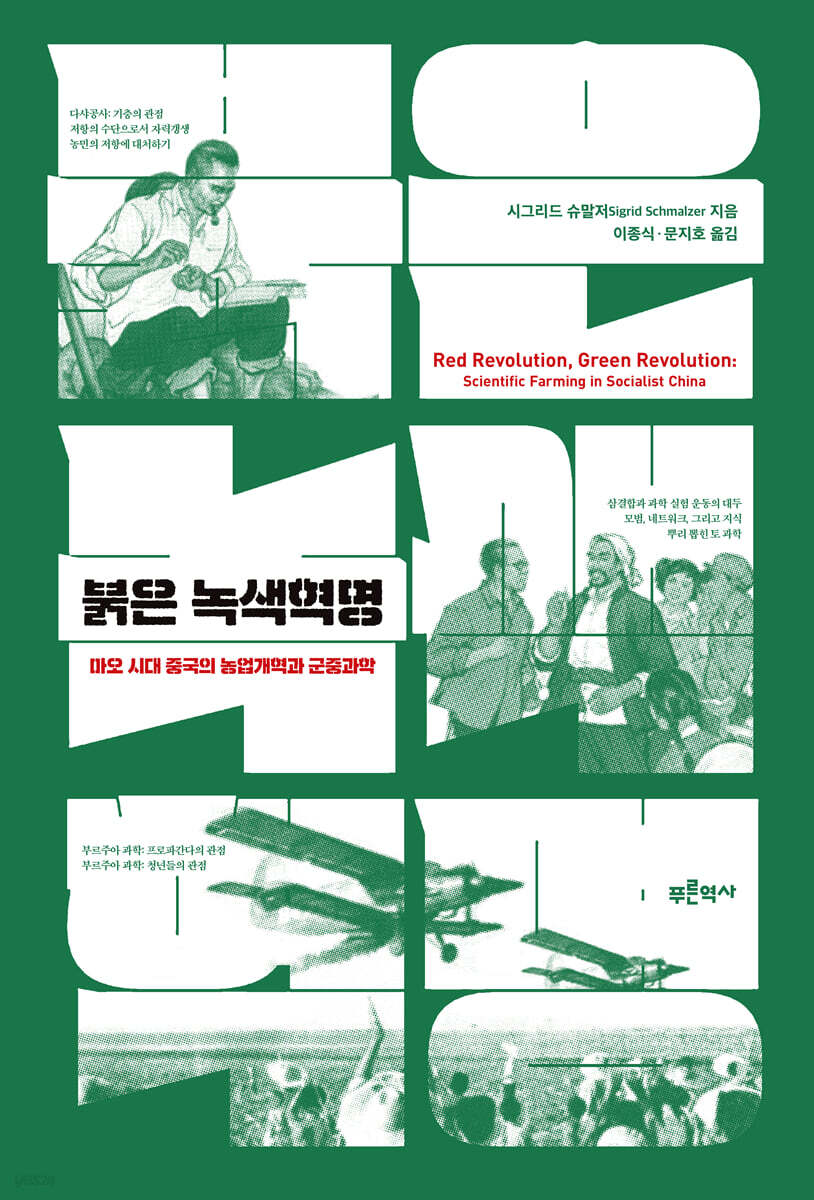
This book, written by a world authority on modern and contemporary Chinese history and the history of science, covers the history of Chinese agricultural science, focusing on the period of Mao Zedong's rule.
Most people will probably say “ah-ah” before even reading it.
This is especially true when we recall the worst 'Great Famine' in human history, which killed tens of millions of people around 1960.
But this book shatters these preconceptions.
Drawing on a variety of sources, including official documents, biographies, press reports, local interviews, and posters, this book vividly and engagingly demonstrates that the Mao era was not an anti-scientific period, but rather a time when the people laid the foundation for a sustainable agricultural model through "crowd science," in which they directly participated, produced, and utilized.
In addition, by raising the fundamental question, “What type of development is sustainable?” and emphasizing that discussions on agricultural science must consider not only productivity improvements but also environmental and social issues, it also presents important implications for Korean society, which is considering sustainable agricultural policies.
Crowd Science: The Foundation of China's Rise
A Look Back at China Beyond History
This book, written by a world authority on modern and contemporary Chinese history and the history of science, covers the history of Chinese agricultural science, focusing on the period of Mao Zedong's rule.
Most people will probably say “ah-ah” before even reading it.
This is especially true when we recall the worst 'Great Famine' in human history, which killed tens of millions of people around 1960.
But this book shatters these preconceptions.
Drawing on a variety of sources, including official documents, biographies, press reports, local interviews, and posters, this book vividly and engagingly demonstrates that the Mao era was not an anti-scientific period, but rather a time when the people laid the foundation for a sustainable agricultural model through "crowd science," in which they directly participated, produced, and utilized.
In addition, by raising the fundamental question, “What type of development is sustainable?” and emphasizing that discussions on agricultural science must consider not only productivity improvements but also environmental and social issues, it also presents important implications for Korean society, which is considering sustainable agricultural policies.
- You can preview some of the book's contents.
Preview
index
ㆍTo Korean readers
Introduction
Chapter 1 Agricultural Science and the Socialist State
introduction
Agricultural knowledge and the nation
Towa and Sheep
The rise of the three-way union and the scientific experiment movement
Examples, networks, and knowledge
Uprooted Soil Science
Chapter 2: Fu Jie Long: The Birth of Socialist Science
A typical story of a modern Chinese scientist: with a twist
The Transnational World of Pest Control in Socialist China
Making a Toe Scientist
The Meaning of Discussion in a Transnational World
The fate of Yang and To in the post-Mao era
Chapter 3: Yuan Longping: A Peasant Intellectual
Yuan Longping in Mao-era historical documents
President Hua Guofeng and Yuan Longping
The History of Hybrid Rice Rewritten in the Post-Socialist Era
Among geneticists and Lysenkoists
“Farmer Intellectual”
The meeting of earth science and American electric guitar
conclusion
Chapter 4: Chinese Peasants: "Experience" and "Backwardness"
The Composition of 'Workers and Peasants', the Composition of Workers and Peasants' Knowledge
Farmers who mastered agricultural science
The Ambiguity of Technological Transformation: Old Technology or New Technology?
Transforming rural communities
conclusion
Chapter 5: Seeing Like a Local Executive
Dasha Construction: Grassroots Perspective
Between top-down and bottom-up
“Developing Talent”
Self-reliance and on-site responsibility
Self-reliance as a means of resistance
Dealing with peasant resistance
The significance of resistance and scientific experimentation
Chapter 6: Lei Feng's Paradox
The politics surrounding learning through books
“Because I had the knowledge.”
Revolutionary Science vs. Bourgeois Science: A Propaganda Perspective
Revolutionary Science and Bourgeois Science: A Young Person's Perspective
What is Bourgeois Science?: The Transformation of Youth and Science Since 1978
Chapter 7 Opportunities and Failures
“A great opportunity”
The scope and limits of opportunity
Leading by example and mobilizing connections
failure
Reexamining the 'Narrative of Failure'
Epilogue
Red and Green Revolutions in Post-Socialist China
Today's model village
Peasants and the Politics of a New Language
Food Sovereignty Movement in China
China, the Global Food Movement, and the Legacy of Mao-era Scientific Farming
ㆍThank you
Translator's Note
ㆍNote
ㆍReferences
ㆍSearch
Introduction
Chapter 1 Agricultural Science and the Socialist State
introduction
Agricultural knowledge and the nation
Towa and Sheep
The rise of the three-way union and the scientific experiment movement
Examples, networks, and knowledge
Uprooted Soil Science
Chapter 2: Fu Jie Long: The Birth of Socialist Science
A typical story of a modern Chinese scientist: with a twist
The Transnational World of Pest Control in Socialist China
Making a Toe Scientist
The Meaning of Discussion in a Transnational World
The fate of Yang and To in the post-Mao era
Chapter 3: Yuan Longping: A Peasant Intellectual
Yuan Longping in Mao-era historical documents
President Hua Guofeng and Yuan Longping
The History of Hybrid Rice Rewritten in the Post-Socialist Era
Among geneticists and Lysenkoists
“Farmer Intellectual”
The meeting of earth science and American electric guitar
conclusion
Chapter 4: Chinese Peasants: "Experience" and "Backwardness"
The Composition of 'Workers and Peasants', the Composition of Workers and Peasants' Knowledge
Farmers who mastered agricultural science
The Ambiguity of Technological Transformation: Old Technology or New Technology?
Transforming rural communities
conclusion
Chapter 5: Seeing Like a Local Executive
Dasha Construction: Grassroots Perspective
Between top-down and bottom-up
“Developing Talent”
Self-reliance and on-site responsibility
Self-reliance as a means of resistance
Dealing with peasant resistance
The significance of resistance and scientific experimentation
Chapter 6: Lei Feng's Paradox
The politics surrounding learning through books
“Because I had the knowledge.”
Revolutionary Science vs. Bourgeois Science: A Propaganda Perspective
Revolutionary Science and Bourgeois Science: A Young Person's Perspective
What is Bourgeois Science?: The Transformation of Youth and Science Since 1978
Chapter 7 Opportunities and Failures
“A great opportunity”
The scope and limits of opportunity
Leading by example and mobilizing connections
failure
Reexamining the 'Narrative of Failure'
Epilogue
Red and Green Revolutions in Post-Socialist China
Today's model village
Peasants and the Politics of a New Language
Food Sovereignty Movement in China
China, the Global Food Movement, and the Legacy of Mao-era Scientific Farming
ㆍThank you
Translator's Note
ㆍNote
ㆍReferences
ㆍSearch
Into the book
A more problematic aspect from China's perspective was that green revolutionaries sought to use the power of science and technology to avoid social and political revolution.
For this reason, socialist China never accepted the term 'green revolution'.
Instead, the same type of agricultural techniques were referred to as 'scientific farming'.
--- p.18
The "rural scientific experiment movement" that began in the mid-1960s was rooted in grassroots "scientific experiment groups" organized throughout rural China, based on the principle of the "three unions": "old workers and peasants" with abundant practical experience, "intellectual youth" with revolutionary enthusiasm, and field cadres who maintained correct political views. They sought to enforce "politics first" in the field of science and technology as well.
--- p.19
The radical argument that prioritizes crowd science and the technocratic position that privileges elite and professional science correspond to the two poles of the so-called dichotomy of the land and the West.
Although the state tried to resolve the issue through slogans such as “Soil and Ocean Combination” and the “Three Union” organizational law that united cadres, technicians, and farmers into a single scientific experiment team,
--- p.50
The term "To" refers to a set of meanings that constitute the radical vision of science in the Mao era: indigenous, Chinese, local, simple, mass, and rustic—science produced by the masses to achieve the goals of socialist revolution.
This was in contrast to the Western—foreign, Western, elite, professional, and ivory-tower.
--- p.75
This was in stark contrast to the specialized (quantitative) sciences that received massive investment under Deng Xiaoping's technocratic line, represented by the 'Four Modernizations'.
With these changes came the end of grassroots scientific experimental groups throughout China and the three-way epistemology they represented.
From this point on, scientific farming became more and more “green revolutionary” and less and less “red revolutionary” in character.
--- p.96
Beginning in 1953, Fu Jielong began research into cultivating Trichogramma parasitic wasps, an internationally accepted biological control agent for controlling sugarcane borers.
--- p.114
In the spring of 1975, the Ministry of Agriculture, Food and Rural Affairs convened a national plant protection conference and decided that “integrated pest control with prevention as the top priority” would be the national policy going forward.… ‘Integrated pest control’ primarily meant maximizing the efficiency of agricultural and manual methods to minimize the use of expensive chemical pesticides.
--- p.116
In the fall of 1972, Fu Zhelong accepted an invitation to visit Dashagongsa to give a lecture on pest control to farmers and officials.
He focused particularly on the use of insect-based pest control and microbe-centric approaches.
Soon after, with the enthusiastic support of local official Mai Baoxiang, Fuzhelong launched a pilot project.
--- p.117
Commune workers were willing to ban the catching of frogs, which were beneficial for catching pests, and to build microbial control facilities and wasp farms.
Additionally, it was decided to educate farmers, establish and train a technical team, and systematize duck farming to control rice field pests.
--- p.118
Lismei perfectly embodied the radical zeitgeist of the time, which emphasized the need to produce “native experts” for China’s development.
For Fu Jielong, sponsoring Lismei was a very effective way to show that he supported the discussion agenda of crowd science without losing his identity as a "foreign-trained expert."
--- p.124
Fu Zhe Rong… took his research to the countryside, where he converted a “squalid hut” into a plausible wasp breeding ground, where he conducted experiments raising Anastathus wasps.
At the same time, he trained more than 30 technical personnel who could carry out pest control work.
The article highly praised the fact that Fu Zhelong lived and worked alongside farmers in the countryside for six months, learning many things and gradually becoming "tempered" like steel being refined in a furnace.
--- p.125
Upon arriving at the scene, Fu Zhelong and his colleagues immersed themselves in life in the people's commune.
In keeping with the discussion's vision of breaking down the barriers between mental and physical labor, scientists engaged in physical labor, attended conferences on agricultural production, built research equipment using the limited resources available at the local commune, and slept alongside workers in a newly built workshop for cultivating microbial agents.
--- p.128
China was no match in both scientific fields.
However, it was entirely possible to lay the foundation for Torah as a unique style of science unique to socialist China that other countries could learn from.
This was linked to China's aspirations during the détente era to offer the world—not only the Third World but also friendly European countries like Sweden—a "third way" beyond the options offered by the superpowers, the United States and the Soviet Union.
--- p.136
One biographer, who wrote three books about Yuan Longping, made sure to include a chapter in each work on “the effect of promoting the study of Party Thought,” or more specifically, on Mao Zedong Thought.
He described Yuan Longping as “not only a renowned breeder, but also a natural philosopher who closely combined Marxism, Leninism, and Mao Zedong Thought with his research on hybrid rice.”
--- p.170
One biography tells that during his early years at Anjang Agricultural School, Yuan Longping used discarded earthenware jars from kilns to grow seedlings.
This can be said to be a specific example of 'self-reliance' and 'frugality', which were commonly seen in propaganda literature at the time.
--- p.184
It was necessary to equip the peasants with the scientific knowledge necessary to build a 'new socialist countryside'.
This process was accomplished through education, exploration of new technologies, participation in scientific laboratory groups, and, in rare instances, interaction with scientists.
--- p.218
By 1965, workers and peasants had joined new agricultural research groups along with technical cadres.
“In the past, workers and peasants only discussed old experiences, but now… they can talk about new things too.
“This has made our understanding of whether farmers can also practice science clearer.”
--- p.220
Many leftist observers saw the potential for scientific reconstruction in China in the 1970s.
But if someone were to say that Maoist science “minimized the element of domination” over nature or over fellow human beings, even those most sympathetic to the ideals of the Mao era would likely find it difficult to agree.
It was undoubtedly a 'matter of struggle'.
But it was never non-violent.
--- p.249
According to a 1971 document from Xinxian County, Shaanxi Province, “the vast majority of the poor peasant masses” said, “To sprout, you must first grow seeds, and to grow seeds, you must first grow people.”
For this reason, revolutionary leaders had to select "sprouts" from among peasants and intellectual youth, encourage them to participate in the three major revolutionary movements, and form scientific experiment groups.
--- p.270
China's grassroots communities were also urged to embrace self-reliance as a principle for community-level economic development.
A widely accepted standard goal of self-reliance was that local communities should become self-sufficient or even export units, without having to import grain.
--- p.276
The state has increasingly encouraged grassroots production of seeds, fertilizers, and pesticides to prevent local communities from having to “call up to higher-ups” for help.
The “four self-helps one” approach was taken for seed production.
That is, local communities are responsible for selecting, distributing, storing, and using their own seeds, and replenish their stocks through appropriate exchanges with neighboring regions.
This slogan was first presented at the 1958 National Seed Work Conference.
--- p.279
“…I was different from the farmers in the production unit who sprayed pesticides everywhere without any thought, whether there were pests or not.
…because I had knowledge.
Farmers would say, 'I've been farming for decades, but you're better than me since you've only been farming for three years.'
That's not what I said.
“That’s what the farmers said.”
--- p.317
A 1974 publication explained it this way:
“From the perspective of the collective production task, failure was a loss.
But for the science team, especially our young people, failure was a great education.
“Our failures forced us to experience the painful process of integrating theory and practice, of re-educating the peasants and reforming their worldview.”
--- p.381
The year after Mao's death and the end of the Cultural Revolution, the new leadership characterized the radical policies pursued in science, youth, the economy, and everything else as "a colossal failure."… A recent historical study of intellectual youth and the Communist Youth League estimates that youth-led scientific experiment groups before the Cultural Revolution achieved only 20 to 30 percent success.
--- p.386
In a situation where the narrative of failure is already firmly established… the stronger the Maoist character, the more likely it is to be perceived as flawed in retrospect.
In particular, only China and the socialist world are criticized for their ‘politics’ and ‘ideology’.
Politics and ideology are ubiquitous, yet… let’s assume that the American economic and political system collapses and something fundamentally different takes over.
How will people of the new era evaluate the USDA's youth program, 4-H?
--- p.388
Agricultural mining and scientific experimentation campaigns were essential in convincing farmers of the value of new technologies and training them in the skills needed to adopt them.
The new technologies adopted made possible a massive increase in food production, which in turn made food widely available at low prices.
This became a very important foundation for economic growth in the post-Mao period.
--- p.396
The Xinxiangcun movement seeks to provide rural China with a space protected from capitalist forces by pursuing an alternative path.
In contrast, the state-led plan to build a new socialist countryside primarily seeks to continuously strengthen the connections between villages and the global market.
--- p.405
Li Changping's call for "farmers' seed sovereignty" reflects a recent trend in which more and more Chinese people are joining the global food sovereignty movement (called plant sovereignty or grain sovereignty in Chinese).
--- p.424
Had there not been the Mao era's affirmation of the science of soil, it is highly probable that the various forms of knowledge that had protected the countryside for so long would have been entirely negated.
Compared to the past, it is much more difficult to find a tone affirming peasant knowledge in official state policy today.
And it is precisely this gap that is being filled by critical social scientists involved in participatory plant breeding projects and people's food sovereignty movements.
--- p.428
The Chinese experience does not suggest that the flaws in the Green Revolution ideology can be miraculously resolved by the Red Revolution.
The environmental harm caused by chemical-intensive agriculture, and the human cost of emphasizing increased production over fair distribution of food and labor, have caused as much damage in China as in any other country on Earth.
For this reason, socialist China never accepted the term 'green revolution'.
Instead, the same type of agricultural techniques were referred to as 'scientific farming'.
--- p.18
The "rural scientific experiment movement" that began in the mid-1960s was rooted in grassroots "scientific experiment groups" organized throughout rural China, based on the principle of the "three unions": "old workers and peasants" with abundant practical experience, "intellectual youth" with revolutionary enthusiasm, and field cadres who maintained correct political views. They sought to enforce "politics first" in the field of science and technology as well.
--- p.19
The radical argument that prioritizes crowd science and the technocratic position that privileges elite and professional science correspond to the two poles of the so-called dichotomy of the land and the West.
Although the state tried to resolve the issue through slogans such as “Soil and Ocean Combination” and the “Three Union” organizational law that united cadres, technicians, and farmers into a single scientific experiment team,
--- p.50
The term "To" refers to a set of meanings that constitute the radical vision of science in the Mao era: indigenous, Chinese, local, simple, mass, and rustic—science produced by the masses to achieve the goals of socialist revolution.
This was in contrast to the Western—foreign, Western, elite, professional, and ivory-tower.
--- p.75
This was in stark contrast to the specialized (quantitative) sciences that received massive investment under Deng Xiaoping's technocratic line, represented by the 'Four Modernizations'.
With these changes came the end of grassroots scientific experimental groups throughout China and the three-way epistemology they represented.
From this point on, scientific farming became more and more “green revolutionary” and less and less “red revolutionary” in character.
--- p.96
Beginning in 1953, Fu Jielong began research into cultivating Trichogramma parasitic wasps, an internationally accepted biological control agent for controlling sugarcane borers.
--- p.114
In the spring of 1975, the Ministry of Agriculture, Food and Rural Affairs convened a national plant protection conference and decided that “integrated pest control with prevention as the top priority” would be the national policy going forward.… ‘Integrated pest control’ primarily meant maximizing the efficiency of agricultural and manual methods to minimize the use of expensive chemical pesticides.
--- p.116
In the fall of 1972, Fu Zhelong accepted an invitation to visit Dashagongsa to give a lecture on pest control to farmers and officials.
He focused particularly on the use of insect-based pest control and microbe-centric approaches.
Soon after, with the enthusiastic support of local official Mai Baoxiang, Fuzhelong launched a pilot project.
--- p.117
Commune workers were willing to ban the catching of frogs, which were beneficial for catching pests, and to build microbial control facilities and wasp farms.
Additionally, it was decided to educate farmers, establish and train a technical team, and systematize duck farming to control rice field pests.
--- p.118
Lismei perfectly embodied the radical zeitgeist of the time, which emphasized the need to produce “native experts” for China’s development.
For Fu Jielong, sponsoring Lismei was a very effective way to show that he supported the discussion agenda of crowd science without losing his identity as a "foreign-trained expert."
--- p.124
Fu Zhe Rong… took his research to the countryside, where he converted a “squalid hut” into a plausible wasp breeding ground, where he conducted experiments raising Anastathus wasps.
At the same time, he trained more than 30 technical personnel who could carry out pest control work.
The article highly praised the fact that Fu Zhelong lived and worked alongside farmers in the countryside for six months, learning many things and gradually becoming "tempered" like steel being refined in a furnace.
--- p.125
Upon arriving at the scene, Fu Zhelong and his colleagues immersed themselves in life in the people's commune.
In keeping with the discussion's vision of breaking down the barriers between mental and physical labor, scientists engaged in physical labor, attended conferences on agricultural production, built research equipment using the limited resources available at the local commune, and slept alongside workers in a newly built workshop for cultivating microbial agents.
--- p.128
China was no match in both scientific fields.
However, it was entirely possible to lay the foundation for Torah as a unique style of science unique to socialist China that other countries could learn from.
This was linked to China's aspirations during the détente era to offer the world—not only the Third World but also friendly European countries like Sweden—a "third way" beyond the options offered by the superpowers, the United States and the Soviet Union.
--- p.136
One biographer, who wrote three books about Yuan Longping, made sure to include a chapter in each work on “the effect of promoting the study of Party Thought,” or more specifically, on Mao Zedong Thought.
He described Yuan Longping as “not only a renowned breeder, but also a natural philosopher who closely combined Marxism, Leninism, and Mao Zedong Thought with his research on hybrid rice.”
--- p.170
One biography tells that during his early years at Anjang Agricultural School, Yuan Longping used discarded earthenware jars from kilns to grow seedlings.
This can be said to be a specific example of 'self-reliance' and 'frugality', which were commonly seen in propaganda literature at the time.
--- p.184
It was necessary to equip the peasants with the scientific knowledge necessary to build a 'new socialist countryside'.
This process was accomplished through education, exploration of new technologies, participation in scientific laboratory groups, and, in rare instances, interaction with scientists.
--- p.218
By 1965, workers and peasants had joined new agricultural research groups along with technical cadres.
“In the past, workers and peasants only discussed old experiences, but now… they can talk about new things too.
“This has made our understanding of whether farmers can also practice science clearer.”
--- p.220
Many leftist observers saw the potential for scientific reconstruction in China in the 1970s.
But if someone were to say that Maoist science “minimized the element of domination” over nature or over fellow human beings, even those most sympathetic to the ideals of the Mao era would likely find it difficult to agree.
It was undoubtedly a 'matter of struggle'.
But it was never non-violent.
--- p.249
According to a 1971 document from Xinxian County, Shaanxi Province, “the vast majority of the poor peasant masses” said, “To sprout, you must first grow seeds, and to grow seeds, you must first grow people.”
For this reason, revolutionary leaders had to select "sprouts" from among peasants and intellectual youth, encourage them to participate in the three major revolutionary movements, and form scientific experiment groups.
--- p.270
China's grassroots communities were also urged to embrace self-reliance as a principle for community-level economic development.
A widely accepted standard goal of self-reliance was that local communities should become self-sufficient or even export units, without having to import grain.
--- p.276
The state has increasingly encouraged grassroots production of seeds, fertilizers, and pesticides to prevent local communities from having to “call up to higher-ups” for help.
The “four self-helps one” approach was taken for seed production.
That is, local communities are responsible for selecting, distributing, storing, and using their own seeds, and replenish their stocks through appropriate exchanges with neighboring regions.
This slogan was first presented at the 1958 National Seed Work Conference.
--- p.279
“…I was different from the farmers in the production unit who sprayed pesticides everywhere without any thought, whether there were pests or not.
…because I had knowledge.
Farmers would say, 'I've been farming for decades, but you're better than me since you've only been farming for three years.'
That's not what I said.
“That’s what the farmers said.”
--- p.317
A 1974 publication explained it this way:
“From the perspective of the collective production task, failure was a loss.
But for the science team, especially our young people, failure was a great education.
“Our failures forced us to experience the painful process of integrating theory and practice, of re-educating the peasants and reforming their worldview.”
--- p.381
The year after Mao's death and the end of the Cultural Revolution, the new leadership characterized the radical policies pursued in science, youth, the economy, and everything else as "a colossal failure."… A recent historical study of intellectual youth and the Communist Youth League estimates that youth-led scientific experiment groups before the Cultural Revolution achieved only 20 to 30 percent success.
--- p.386
In a situation where the narrative of failure is already firmly established… the stronger the Maoist character, the more likely it is to be perceived as flawed in retrospect.
In particular, only China and the socialist world are criticized for their ‘politics’ and ‘ideology’.
Politics and ideology are ubiquitous, yet… let’s assume that the American economic and political system collapses and something fundamentally different takes over.
How will people of the new era evaluate the USDA's youth program, 4-H?
--- p.388
Agricultural mining and scientific experimentation campaigns were essential in convincing farmers of the value of new technologies and training them in the skills needed to adopt them.
The new technologies adopted made possible a massive increase in food production, which in turn made food widely available at low prices.
This became a very important foundation for economic growth in the post-Mao period.
--- p.396
The Xinxiangcun movement seeks to provide rural China with a space protected from capitalist forces by pursuing an alternative path.
In contrast, the state-led plan to build a new socialist countryside primarily seeks to continuously strengthen the connections between villages and the global market.
--- p.405
Li Changping's call for "farmers' seed sovereignty" reflects a recent trend in which more and more Chinese people are joining the global food sovereignty movement (called plant sovereignty or grain sovereignty in Chinese).
--- p.424
Had there not been the Mao era's affirmation of the science of soil, it is highly probable that the various forms of knowledge that had protected the countryside for so long would have been entirely negated.
Compared to the past, it is much more difficult to find a tone affirming peasant knowledge in official state policy today.
And it is precisely this gap that is being filled by critical social scientists involved in participatory plant breeding projects and people's food sovereignty movements.
--- p.428
The Chinese experience does not suggest that the flaws in the Green Revolution ideology can be miraculously resolved by the Red Revolution.
The environmental harm caused by chemical-intensive agriculture, and the human cost of emphasizing increased production over fair distribution of food and labor, have caused as much damage in China as in any other country on Earth.
--- p.431
Publisher's Review
The "different science" Mao Zedong dreamed of
There are two main ways to read this book.
One of them is a reading that focuses on the process by which the 'other science' dreamed of by Mao Zedong accepted the 'Green Revolution', which was born under the leadership of the United States during the Cold War, and grafted it onto the socialist revolution.
This is because the author meticulously examined the process of increasing agricultural yields at the production site through a bottom-up approach centered on the peasant masses, rather than a top-down approach centered on elite scientists and engineers.
Through this, you can come into contact with various realistic concepts such as 'Toyang Chariot (土洋竝擧)' which seeks to harmonize Western science and technology with traditional scientific knowledge, 'Yujeomdomyeon (由點到面)' which means spreading policy experimentation and implementation, and 'Samhapheop (三結合)' which is the cooperation between old farmers, young intellectuals, and field executives for a rural scientific experiment movement.
This will bring back from historical oblivion the diverse and meaningful experiences of "scientific farming" during the Mao era, offering reflections on how science and technology can transform the world into a better place, by improving the conditions of farmers while producing sufficient food.
The struggles of scientists and peasant intellectuals
Another virtue of this book is that, although it deals with the history of science, it is not dry.
This is because the efforts of famous scientists who were active at the intersection of the Green Revolution and the Red Revolution, as well as the farmers' intellectuals and local cadres on the ground, are vividly depicted.
Fu Jielong, who studied taxonomy in the United States but returned to Korea and developed a method of controlling sugarcane borers using parasitic wasps, is a leading figure in 'yang' science.
During the Cultural Revolution, he lived with workers in rural workshops, remodeling "squalid huts" into bespoke wasp breeding grounds for his research. He also discovered Lismay, a farmer who had developed a termite control method, and helped him to become a university professor.
Yuan Longping, a renowned rice breeder who graduated from Southwest Agricultural University and worked as an agricultural school teacher, is a representative 'soil' scientist.
He also used discarded earthenware jars from kilns to grow seedlings during his early days of research at Anjang Agricultural School.
The lives of those who strived for self-reliance through frugality provide a human interest that can easily be overshadowed by the great currents of history.
China is not a "scientific powerhouse"
Late last year, the world was abuzz with news that China had developed a high-performance, low-cost artificial intelligence (AI) called 'DeepSearch'.
Most of our people were also quite shocked.
But this book shows that China is not a nouveau riche, at least in the field of science and technology.
This book vividly demonstrates that the "crowd science" approach, which criticized the elitism of the scientific community since the Mao era and provided workers and peasants with education and employment opportunities to become scientists, was at the root of China's "rise."
According to the author, the new technologies adopted and popularized by the "crowd science" of the Mao era led to a massive increase in food production, making it possible to supply cheap food, which became an important foundation for economic growth in the post-Mao period.
This is why this book is one that our readers cannot just pass over.
There are two main ways to read this book.
One of them is a reading that focuses on the process by which the 'other science' dreamed of by Mao Zedong accepted the 'Green Revolution', which was born under the leadership of the United States during the Cold War, and grafted it onto the socialist revolution.
This is because the author meticulously examined the process of increasing agricultural yields at the production site through a bottom-up approach centered on the peasant masses, rather than a top-down approach centered on elite scientists and engineers.
Through this, you can come into contact with various realistic concepts such as 'Toyang Chariot (土洋竝擧)' which seeks to harmonize Western science and technology with traditional scientific knowledge, 'Yujeomdomyeon (由點到面)' which means spreading policy experimentation and implementation, and 'Samhapheop (三結合)' which is the cooperation between old farmers, young intellectuals, and field executives for a rural scientific experiment movement.
This will bring back from historical oblivion the diverse and meaningful experiences of "scientific farming" during the Mao era, offering reflections on how science and technology can transform the world into a better place, by improving the conditions of farmers while producing sufficient food.
The struggles of scientists and peasant intellectuals
Another virtue of this book is that, although it deals with the history of science, it is not dry.
This is because the efforts of famous scientists who were active at the intersection of the Green Revolution and the Red Revolution, as well as the farmers' intellectuals and local cadres on the ground, are vividly depicted.
Fu Jielong, who studied taxonomy in the United States but returned to Korea and developed a method of controlling sugarcane borers using parasitic wasps, is a leading figure in 'yang' science.
During the Cultural Revolution, he lived with workers in rural workshops, remodeling "squalid huts" into bespoke wasp breeding grounds for his research. He also discovered Lismay, a farmer who had developed a termite control method, and helped him to become a university professor.
Yuan Longping, a renowned rice breeder who graduated from Southwest Agricultural University and worked as an agricultural school teacher, is a representative 'soil' scientist.
He also used discarded earthenware jars from kilns to grow seedlings during his early days of research at Anjang Agricultural School.
The lives of those who strived for self-reliance through frugality provide a human interest that can easily be overshadowed by the great currents of history.
China is not a "scientific powerhouse"
Late last year, the world was abuzz with news that China had developed a high-performance, low-cost artificial intelligence (AI) called 'DeepSearch'.
Most of our people were also quite shocked.
But this book shows that China is not a nouveau riche, at least in the field of science and technology.
This book vividly demonstrates that the "crowd science" approach, which criticized the elitism of the scientific community since the Mao era and provided workers and peasants with education and employment opportunities to become scientists, was at the root of China's "rise."
According to the author, the new technologies adopted and popularized by the "crowd science" of the Mao era led to a massive increase in food production, making it possible to supply cheap food, which became an important foundation for economic growth in the post-Mao period.
This is why this book is one that our readers cannot just pass over.
GOODS SPECIFICS
- Date of issue: July 29, 2025
- Page count, weight, size: 548 pages | 794g | 152*224*27mm
- ISBN13: 9791156122999
- ISBN10: 1156122996
You may also like
카테고리
korean


korean

![GQ KOREA Mark (Monthly): December [2025]](http://librairie.coreenne.fr/cdn/shop/files/8ef265dbbfbf186523ed75ba7319009d.jpg?v=1765340328&width=3840)


