

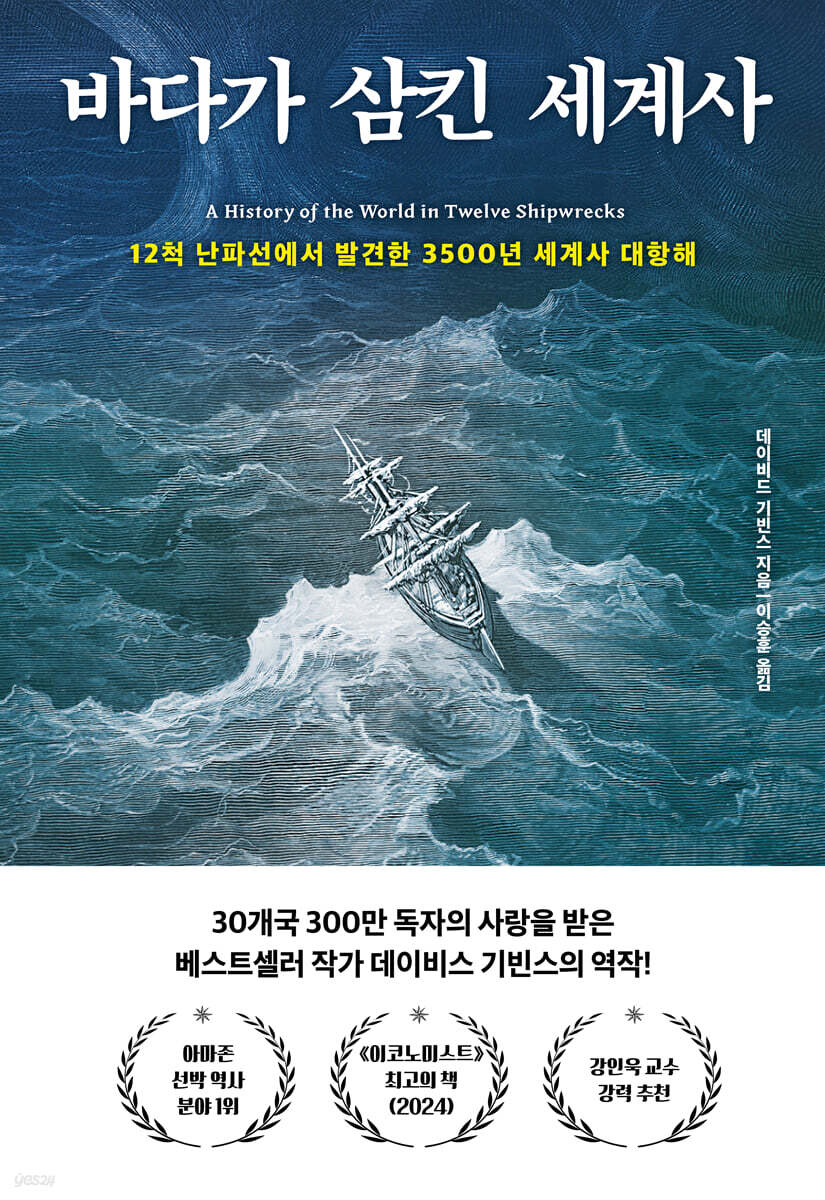
World History Swallowed by the Sea
 |
Description
Book Introduction
From prehistoric times when the first voyages began to World War II
The first textbook on the history of underwater archaeology
“In the deep, dark sea
“The most brilliant world history unfolds!”
The Economist's Book of the Year
★〈Amazon〉#1 in Ship History!★
★Rave reviews from The Wall Street Journal, Publisher's Weekly, and The Times!★
★Highly recommended by Professor Kang In-wook★
The book "A World History Swallowed by the Sea," which was selected as the Economist's Book of the Year and ranked first in the shipping history category on Amazon, has been published and received overwhelming praise from local media.
David Gibbins, the world's leading underwater archaeologist with over 45 years of experience in the ocean and laboratory, and a bestselling author beloved by 3 million readers in 30 countries, has compiled 3,500 years of world history through 12 shipwrecks that influenced each era.
He was fascinated by exploration of unknown places from a young age, and at the age of 16, he made an archaeological achievement by discovering a bottle from a sunken shipwreck in a lake.
As an archaeologist and historian, he wrote this book to tell the fascinating history of the sea.
For thousands of years, human civilization has moved across the oceans, grown through them, and fought fierce battles there.
There are over 250,000 recorded ships sunken in the Earth's oceans and lakes, and an estimated 3 million more, but the secrets they hold remain shrouded in mystery.
The author guides readers into the splendid world beneath the sea that we have never known or been able to see before.
From the wine trade of ancient Rome, the spread of Christianity in the Middle Ages, the colonial expansion of the modern Age of Exploration, to the battles of World War II, the history of human civilization's prosperity, exchange, and war unfolds dynamically as you sail through various historical sites.
Through the stories of twelve of the most significant shipwrecks in human history, you will gain a closer look into the most brilliant history of the sea, one you've never known before.
The first textbook on the history of underwater archaeology
“In the deep, dark sea
“The most brilliant world history unfolds!”
The Economist's Book of the Year
★〈Amazon〉#1 in Ship History!★
★Rave reviews from The Wall Street Journal, Publisher's Weekly, and The Times!★
★Highly recommended by Professor Kang In-wook★
The book "A World History Swallowed by the Sea," which was selected as the Economist's Book of the Year and ranked first in the shipping history category on Amazon, has been published and received overwhelming praise from local media.
David Gibbins, the world's leading underwater archaeologist with over 45 years of experience in the ocean and laboratory, and a bestselling author beloved by 3 million readers in 30 countries, has compiled 3,500 years of world history through 12 shipwrecks that influenced each era.
He was fascinated by exploration of unknown places from a young age, and at the age of 16, he made an archaeological achievement by discovering a bottle from a sunken shipwreck in a lake.
As an archaeologist and historian, he wrote this book to tell the fascinating history of the sea.
For thousands of years, human civilization has moved across the oceans, grown through them, and fought fierce battles there.
There are over 250,000 recorded ships sunken in the Earth's oceans and lakes, and an estimated 3 million more, but the secrets they hold remain shrouded in mystery.
The author guides readers into the splendid world beneath the sea that we have never known or been able to see before.
From the wine trade of ancient Rome, the spread of Christianity in the Middle Ages, the colonial expansion of the modern Age of Exploration, to the battles of World War II, the history of human civilization's prosperity, exchange, and war unfolds dynamically as you sail through various historical sites.
Through the stories of twelve of the most significant shipwrecks in human history, you will gain a closer look into the most brilliant history of the sea, one you've never known before.
- You can preview some of the book's contents.
Preview
index
Recommendation
Prologue - The Sea Opens a Rich Side Path to History
Chapter 1: 16th Century BC (Bronze Age): The Beginning of Human Navigation
Connecting the World with Reusable Boats_Dover Boat
Chapter 2: 14th Century BC (Late Bronze Age): Materials Gather and Disperse
The Golden Uluburun Shipwreck for Pharaoh Tutankhamun
Chapter 3: The 5th Century BC (Iron Age): The Rise and Fall of City-States
Wine for Philosophers_Tektash Shipwreck
Chapter 4: The Second Century (The Heyday of the Roman Empire): Paving the Way to Power
The Great Empire that Absorbs Materials and People_Plemmirio Shipwreck
Chapter 5, 6th century (Early Byzantium): Heavenly Light to Earth
Voyage for God Only_Marzamemi Shipwreck
Chapter 6: The 9th Century (Islam's Golden Age): The Quest for Truth from Cradle to Grave
Blue Dye from Tang to Baghdad_Belitung Shipwreck
Chapter 7: The 11th Century (Viking Age): A Great Challenge for Survival
Vikings, invaders and explorers_Viking longships
Chapter 8: 1545 (Age of Exploration): The Age of Absolute Monarchy Begins
The Flag Carried on Behalf of the King_Mary Rose
Chapter 9: 1667 (The Golden Age): The Dutch East India Company Restructures the World Economy
Aboard the Santo Cristo di Castello, carrying the ambitions of ordinary people
Chapter 10 1721 (Enlightenment): The Shadow of Rationality
Gold, Pirates, and the Slave Trade_Galley Royal Anne
Chapter 11: 1845 (Industrial Revolution): A Fateful Adventure Taken by Latecomers
Exploring the Ends of the Earth_HMS Terror
Chapter 12, 1941 (World War II): Good is Stronger than Evil
In the midst of the maelstrom of war_SS Gersopa
Epilogue - Archaeology is about revealing great documents.
Prologue - The Sea Opens a Rich Side Path to History
Chapter 1: 16th Century BC (Bronze Age): The Beginning of Human Navigation
Connecting the World with Reusable Boats_Dover Boat
Chapter 2: 14th Century BC (Late Bronze Age): Materials Gather and Disperse
The Golden Uluburun Shipwreck for Pharaoh Tutankhamun
Chapter 3: The 5th Century BC (Iron Age): The Rise and Fall of City-States
Wine for Philosophers_Tektash Shipwreck
Chapter 4: The Second Century (The Heyday of the Roman Empire): Paving the Way to Power
The Great Empire that Absorbs Materials and People_Plemmirio Shipwreck
Chapter 5, 6th century (Early Byzantium): Heavenly Light to Earth
Voyage for God Only_Marzamemi Shipwreck
Chapter 6: The 9th Century (Islam's Golden Age): The Quest for Truth from Cradle to Grave
Blue Dye from Tang to Baghdad_Belitung Shipwreck
Chapter 7: The 11th Century (Viking Age): A Great Challenge for Survival
Vikings, invaders and explorers_Viking longships
Chapter 8: 1545 (Age of Exploration): The Age of Absolute Monarchy Begins
The Flag Carried on Behalf of the King_Mary Rose
Chapter 9: 1667 (The Golden Age): The Dutch East India Company Restructures the World Economy
Aboard the Santo Cristo di Castello, carrying the ambitions of ordinary people
Chapter 10 1721 (Enlightenment): The Shadow of Rationality
Gold, Pirates, and the Slave Trade_Galley Royal Anne
Chapter 11: 1845 (Industrial Revolution): A Fateful Adventure Taken by Latecomers
Exploring the Ends of the Earth_HMS Terror
Chapter 12, 1941 (World War II): Good is Stronger than Evil
In the midst of the maelstrom of war_SS Gersopa
Epilogue - Archaeology is about revealing great documents.
Detailed image

Into the book
In the Paleolithic Age, the passage through which souls came and went was through caves.
As we enter the Neolithic period, these artifacts become more common in rivers, ponds, and wetlands.
Looking at the Dover boat, the thin twigs used to hold the planks together had been cut off on both sides, removing the planks at the top and stern, and one of the cleats that held the two lower planks together had also been intentionally removed.
This means that the Dover boat may have been deliberately 'destroyed' and buried in the riverbed.
One intriguing possibility is that the boat was destroyed and buried as part of a funeral ritual for its builder and captain.
The boat was probably stripped of its planks to be used as a funeral pyre and accompanied its owner to the spirit world.
--- From "Chapter 1 16th Century BC (Bronze Age): The Beginning of Human Navigation"
One of the most fascinating artifacts discovered at Uluburun is a folding wooden tablet that has come to be called 'the world's oldest book'.
The size of a popular novel, this tablet is made of two wooden pages joined by cylindrical ivory hinges.
The concave surface on the inside of each page is engraved with vertical and horizontal lines to hold the wax on which the writing is written.
This discovery raises several intriguing questions.
What was the purpose of this tablet? And what language and script was used? Since it could be erased and rewritten, and even folded to protect the text, this tablet would have been ideal for use on ships.
--- From "The Gathering and Dispersion of Materials in the 14th Century BC (Late Bronze Age)"
Occasionally, unexpected artifacts are discovered in shipwrecks, making the story even more exciting.
Just as artifacts found on the Plemmirio shipwreck indicate that a professional surgeon was on board.
As I carefully swept up the sediment beneath the seafloor, I discovered a slender bronze tool, about seven centimeters long, with a willow leaf-shaped tip.
It was the first surgical knife handle ever found in an ancient shipwreck.
--- From "Chapter 4, 2nd Century (The Golden Age of the Roman Empire): Paving the Way to Power"
The reason pocket watches are found in shipwrecks is related to an urgent problem that needed to be solved for navigation: determining longitude.
In 1707, just two years before the Royal Anne Gallley was launched, the British Navy lost four warships and 2,000 sailors off the Isles of Scilly, just 30 miles (48 kilometers) from where the ship was wrecked.
This was the worst disaster that ever occurred in peacetime.
The cause of this terrible accident was a miscalculation of longitude.
--- From "Chapter 10, 1721 (Enlightenment): The Shadow of Rationality"
In the Arctic, some of the crew survived for nearly five years, from their arrival at Beech Island in 1845 until 1850, when the last survivors were sighted by the Inuit.
(…) Analysis of tissue samples showed that their bodies contained lead levels up to 20 times higher than expected at the time.
The culprit was the solder used to seal the can.
The food inside the can was contaminated with lead because of the solder.
(…) Until the end, they faced a terrible problem that they could not solve.
Because the food they ate to survive was killing them.
Just as the canned food was killing them while keeping them alive, the bodies of their comrades contaminated with the poison sealed their fate.
It's hard to imagine a worse ending.
As we enter the Neolithic period, these artifacts become more common in rivers, ponds, and wetlands.
Looking at the Dover boat, the thin twigs used to hold the planks together had been cut off on both sides, removing the planks at the top and stern, and one of the cleats that held the two lower planks together had also been intentionally removed.
This means that the Dover boat may have been deliberately 'destroyed' and buried in the riverbed.
One intriguing possibility is that the boat was destroyed and buried as part of a funeral ritual for its builder and captain.
The boat was probably stripped of its planks to be used as a funeral pyre and accompanied its owner to the spirit world.
--- From "Chapter 1 16th Century BC (Bronze Age): The Beginning of Human Navigation"
One of the most fascinating artifacts discovered at Uluburun is a folding wooden tablet that has come to be called 'the world's oldest book'.
The size of a popular novel, this tablet is made of two wooden pages joined by cylindrical ivory hinges.
The concave surface on the inside of each page is engraved with vertical and horizontal lines to hold the wax on which the writing is written.
This discovery raises several intriguing questions.
What was the purpose of this tablet? And what language and script was used? Since it could be erased and rewritten, and even folded to protect the text, this tablet would have been ideal for use on ships.
--- From "The Gathering and Dispersion of Materials in the 14th Century BC (Late Bronze Age)"
Occasionally, unexpected artifacts are discovered in shipwrecks, making the story even more exciting.
Just as artifacts found on the Plemmirio shipwreck indicate that a professional surgeon was on board.
As I carefully swept up the sediment beneath the seafloor, I discovered a slender bronze tool, about seven centimeters long, with a willow leaf-shaped tip.
It was the first surgical knife handle ever found in an ancient shipwreck.
--- From "Chapter 4, 2nd Century (The Golden Age of the Roman Empire): Paving the Way to Power"
The reason pocket watches are found in shipwrecks is related to an urgent problem that needed to be solved for navigation: determining longitude.
In 1707, just two years before the Royal Anne Gallley was launched, the British Navy lost four warships and 2,000 sailors off the Isles of Scilly, just 30 miles (48 kilometers) from where the ship was wrecked.
This was the worst disaster that ever occurred in peacetime.
The cause of this terrible accident was a miscalculation of longitude.
--- From "Chapter 10, 1721 (Enlightenment): The Shadow of Rationality"
In the Arctic, some of the crew survived for nearly five years, from their arrival at Beech Island in 1845 until 1850, when the last survivors were sighted by the Inuit.
(…) Analysis of tissue samples showed that their bodies contained lead levels up to 20 times higher than expected at the time.
The culprit was the solder used to seal the can.
The food inside the can was contaminated with lead because of the solder.
(…) Until the end, they faced a terrible problem that they could not solve.
Because the food they ate to survive was killing them.
Just as the canned food was killing them while keeping them alive, the bodies of their comrades contaminated with the poison sealed their fate.
It's hard to imagine a worse ending.
--- From "Chapter 11, 1845 (Industrial Revolution): An Adventure of Fate"
Publisher's Review
It unfolds at an average depth of 3600 meters.
Famous scenes of politics, economics, geography, and trade
“This is the best book that shows the world beyond world history!”
Alice Roberts (anthropologist)
Humanity has always been with the sea.
Early humans lived along the coast, forming coastal civilizations. They migrated by sea, developed economies, and engaged in naval warfare. The sea has played a crucial role at every turning point in history.
But history up to now has been overly focused on continental civilization.
Here, David Gibbins, author of "The World Swallowed by the Sea" and the world's leading underwater archaeologist, salvages a piece of history that was empty under the sea and brings it before us.
As French historian Fernand Braudel said, “The sea is the greatest document of past existence.” In particular, objects found in shipwrecks are those that were used at the moment of sinking, allowing for fairly accurate dating.
This book reveals aspects of world history that were not fully revealed through the history of the land alone. It invites us into the midst of civilization's prosperity, exchange, and war, infinitely broadening our perspectives, confined to the continent.
"World History Swallowed by the Sea" presents 12 shipwrecks in chronological order, reflecting the pinnacle of history from prehistoric times to World War II.
From the Dover Boat, the first trading ship of mankind that left in the 16th century BC carrying copper and tin, to the Tektash shipwreck that carried wine for Greek philosophers who discussed the truth and politics of the world, to the Viking longship that risked its life on a voyage due to rapid climate change, to the HMS Terror of World War II that carried out a secret silver bullion transport operation to stand against Nazi Germany, the history of shipwrecks that have accompanied human civilization reconstructs a new context of world history that has never been revealed before.
What is most striking about this book is that it vividly brings the figures of individual characters to life before us today.
The author reconstructs the narratives of individual human beings, including ophthalmologists from ancient Rome, Chinese merchants, and Henry VIII's archers.
Through this book's storytelling, which simultaneously stimulates emotions, imagination, and knowledge, readers will encounter the most dynamic, rich, and three-dimensional history.
#1 on Amazon, The Economist's Book of the Year!
Attention from media and celebrities around the world
World History from a New Perspective
The world's first book to compile 3,500 years of world history into 12 shipwrecks, "A World History Swallowed by the Sea" was recognized for its originality and value, and immediately after its publication, it ranked first in the shipping history category on Amazon and was selected as the Book of the Year by The Economist.
Fascinated by the exploration of unknown places since childhood, David Gibbins has compiled the results of over 40 years of research, both at sea and in the laboratory, into this book.
More than half of the shipwrecks introduced in this book were ones he personally excavated or examined through diving, making them even more vivid, as if he were present at the excavation site.
In recognition of the author's efforts and outstanding achievements, "World History Swallowed by the Sea" received overwhelming praise from local media and celebrities.
It received rave reviews, including “an endlessly fascinating and captivating story” (Irish Independent), “a bold book worthy of its title” (Wall Street Journal), and “a fascinating and challenging book, with a vast and persistent history” (Kirkus Reviews).
Moreover, Professor Kang In-wook, an archaeologist who read the book first, strongly recommended the book to domestic readers, writing, “This book is by far the most fascinating record of the hidden stories in the sea.”
This is a single book that will provide readers interested in hidden history, archaeology, and the humanities with knowledge, imagination, and deep insight.
Famous scenes of politics, economics, geography, and trade
“This is the best book that shows the world beyond world history!”
Alice Roberts (anthropologist)
Humanity has always been with the sea.
Early humans lived along the coast, forming coastal civilizations. They migrated by sea, developed economies, and engaged in naval warfare. The sea has played a crucial role at every turning point in history.
But history up to now has been overly focused on continental civilization.
Here, David Gibbins, author of "The World Swallowed by the Sea" and the world's leading underwater archaeologist, salvages a piece of history that was empty under the sea and brings it before us.
As French historian Fernand Braudel said, “The sea is the greatest document of past existence.” In particular, objects found in shipwrecks are those that were used at the moment of sinking, allowing for fairly accurate dating.
This book reveals aspects of world history that were not fully revealed through the history of the land alone. It invites us into the midst of civilization's prosperity, exchange, and war, infinitely broadening our perspectives, confined to the continent.
"World History Swallowed by the Sea" presents 12 shipwrecks in chronological order, reflecting the pinnacle of history from prehistoric times to World War II.
From the Dover Boat, the first trading ship of mankind that left in the 16th century BC carrying copper and tin, to the Tektash shipwreck that carried wine for Greek philosophers who discussed the truth and politics of the world, to the Viking longship that risked its life on a voyage due to rapid climate change, to the HMS Terror of World War II that carried out a secret silver bullion transport operation to stand against Nazi Germany, the history of shipwrecks that have accompanied human civilization reconstructs a new context of world history that has never been revealed before.
What is most striking about this book is that it vividly brings the figures of individual characters to life before us today.
The author reconstructs the narratives of individual human beings, including ophthalmologists from ancient Rome, Chinese merchants, and Henry VIII's archers.
Through this book's storytelling, which simultaneously stimulates emotions, imagination, and knowledge, readers will encounter the most dynamic, rich, and three-dimensional history.
#1 on Amazon, The Economist's Book of the Year!
Attention from media and celebrities around the world
World History from a New Perspective
The world's first book to compile 3,500 years of world history into 12 shipwrecks, "A World History Swallowed by the Sea" was recognized for its originality and value, and immediately after its publication, it ranked first in the shipping history category on Amazon and was selected as the Book of the Year by The Economist.
Fascinated by the exploration of unknown places since childhood, David Gibbins has compiled the results of over 40 years of research, both at sea and in the laboratory, into this book.
More than half of the shipwrecks introduced in this book were ones he personally excavated or examined through diving, making them even more vivid, as if he were present at the excavation site.
In recognition of the author's efforts and outstanding achievements, "World History Swallowed by the Sea" received overwhelming praise from local media and celebrities.
It received rave reviews, including “an endlessly fascinating and captivating story” (Irish Independent), “a bold book worthy of its title” (Wall Street Journal), and “a fascinating and challenging book, with a vast and persistent history” (Kirkus Reviews).
Moreover, Professor Kang In-wook, an archaeologist who read the book first, strongly recommended the book to domestic readers, writing, “This book is by far the most fascinating record of the hidden stories in the sea.”
This is a single book that will provide readers interested in hidden history, archaeology, and the humanities with knowledge, imagination, and deep insight.
GOODS SPECIFICS
- Date of issue: July 9, 2025
- Page count, weight, size: 516 pages | 824g | 149*215*30mm
- ISBN13: 9791130667577
- ISBN10: 113066757X
You may also like
카테고리
korean


korean

![GQ KOREA Mark (Monthly): December [2025]](http://librairie.coreenne.fr/cdn/shop/files/8ef265dbbfbf186523ed75ba7319009d.jpg?v=1765340328&width=3840)


