

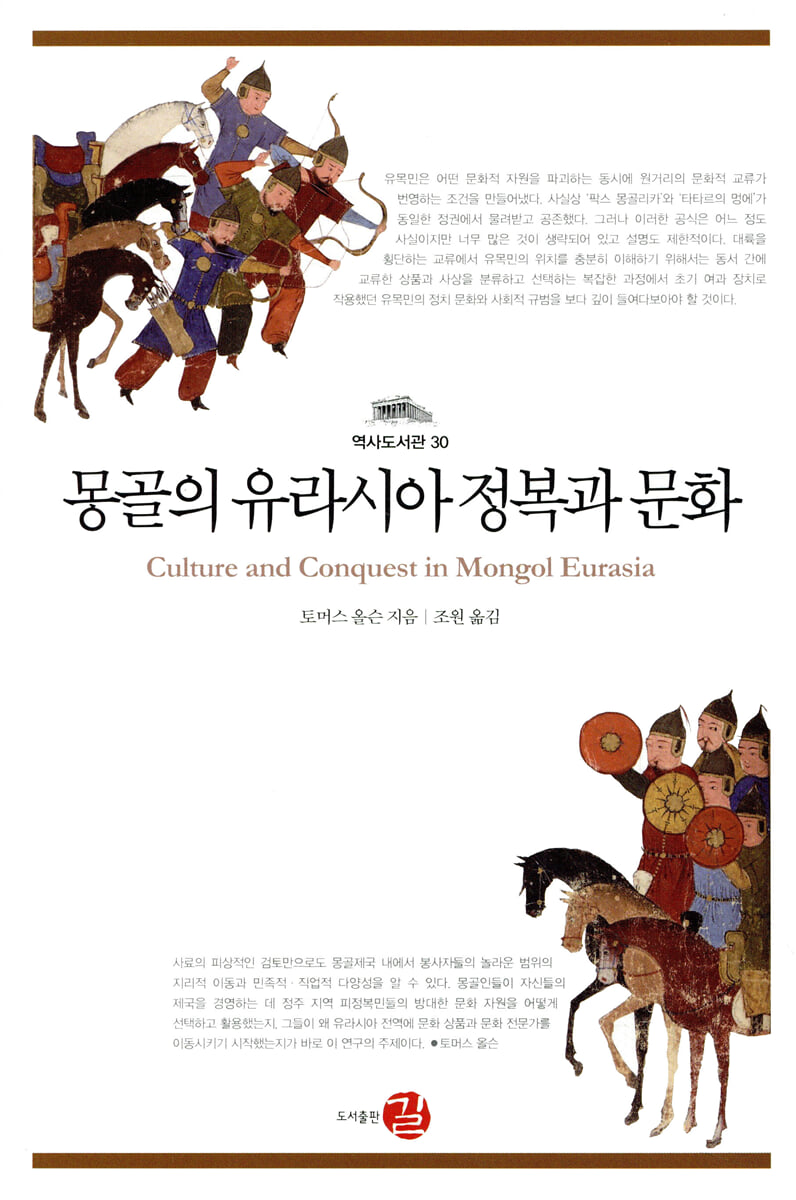
Mongol conquest and culture of Eurasia
 |
Description
Book Introduction
A controversial work that presents a new paradigm for the study of Mongolian history by presenting Mongolian history as a formation of a world system!
It is true that the history of Mongolia's world domination has been depicted as one marked by plunder, murder, and destruction in a political and military context.
In addition, it focused on the fact that the violent domination of the nomadic peoples over the settled civilization led to the Mongolization of many aspects of the existing local culture and ideology, leading to a period of cultural stagnation.
Ultimately, it was emphasized that the Mongol conquests had set back the culture, economy, and institutions of the entire Eurasian civilized world.
However, the perspective on Mongolian history has changed significantly over the past 30 years.
The Mongol Empire brought about the formation of an unprecedented 'world system', which led to a vibrant exchange of people, technology, and intellectuals across Eurasian boundaries.
In fact, the Mongol Empire was a time of extensive migration of diverse ethnic groups, and in accordance with the commercial imperial policy advocated by the Mongol rulers, goods from each region were freely moved and exchanged through the land and sea infrastructure established by the Mongols.
This book by author Thomas Olson is one of the works that has had a significant influence on this paradigm shift in the study of the history of the Mongol Empire.
It is true that the history of Mongolia's world domination has been depicted as one marked by plunder, murder, and destruction in a political and military context.
In addition, it focused on the fact that the violent domination of the nomadic peoples over the settled civilization led to the Mongolization of many aspects of the existing local culture and ideology, leading to a period of cultural stagnation.
Ultimately, it was emphasized that the Mongol conquests had set back the culture, economy, and institutions of the entire Eurasian civilized world.
However, the perspective on Mongolian history has changed significantly over the past 30 years.
The Mongol Empire brought about the formation of an unprecedented 'world system', which led to a vibrant exchange of people, technology, and intellectuals across Eurasian boundaries.
In fact, the Mongol Empire was a time of extensive migration of diverse ethnic groups, and in accordance with the commercial imperial policy advocated by the Mongol rulers, goods from each region were freely moved and exchanged through the land and sea infrastructure established by the Mongols.
This book by author Thomas Olson is one of the works that has had a significant influence on this paradigm shift in the study of the history of the Mongol Empire.
index
Translator's Note 9
Part 1 Background
Chapter 1 Preface 17
Chapter 2: Before the Mongols Appeared 25
Part 2 Political-Economic Relations
Chapter 3: The Formation of the Ilkhan, 1251–65 37
Chapter 4: The Great Khan and the Ilkhan, 1265–95 47
Chapter 5: The Continuity and Change of the Ghazan Period, 1295–1304 58
Chapter 6: The Sultan and the Great Khan, 1304–35
Chapter 7 Economic Solidarity 74
Chapter 8: Overview of Relations between the Chinese and Iranian Regimes 88
Part 3: Brokers
Chapter 9: Marco Polo and Bollard 99
Chapter 10: Kublai Khan and Bolad Akha 105
Part 4 Cultural Exchange
Chapter 12: Compilation of the History 135
Chapter 13: Geography and Cartography 166
Chapter 14 Agriculture 184
Chapter 15 Cooking 202
Chapter 16: Medicine 224
Chapter 17 Astronomy 253
Chapter 18: Printing 277
Part 5: Analysis and Conclusion
Chapter 19: Types and Methodology 295
Chapter 20: Subject 301
Chapter 21 Selection 316
Chapter 22 Summary 327
Abbreviation Table 331
Reference 335
Search 369
Part 1 Background
Chapter 1 Preface 17
Chapter 2: Before the Mongols Appeared 25
Part 2 Political-Economic Relations
Chapter 3: The Formation of the Ilkhan, 1251–65 37
Chapter 4: The Great Khan and the Ilkhan, 1265–95 47
Chapter 5: The Continuity and Change of the Ghazan Period, 1295–1304 58
Chapter 6: The Sultan and the Great Khan, 1304–35
Chapter 7 Economic Solidarity 74
Chapter 8: Overview of Relations between the Chinese and Iranian Regimes 88
Part 3: Brokers
Chapter 9: Marco Polo and Bollard 99
Chapter 10: Kublai Khan and Bolad Akha 105
Part 4 Cultural Exchange
Chapter 12: Compilation of the History 135
Chapter 13: Geography and Cartography 166
Chapter 14 Agriculture 184
Chapter 15 Cooking 202
Chapter 16: Medicine 224
Chapter 17 Astronomy 253
Chapter 18: Printing 277
Part 5: Analysis and Conclusion
Chapter 19: Types and Methodology 295
Chapter 20: Subject 301
Chapter 21 Selection 316
Chapter 22 Summary 327
Abbreviation Table 331
Reference 335
Search 369
Publisher's Review
Proposing to view Mongolian history from a world historical perspective
In particular, this book can be said to be a work that brought about a 'cultural shift' in the study of the history of the Mongol Empire.
This book closely analyzes the exchange of goods, technology, and knowledge between the Mongol regimes of eastern China and western Iran in Eurasia during the Mongol Empire, leading readers into the cultural exchanges of the Mongol Empire.
The author, using a variety of sources including Chinese, Persian, Arabic, and Russian, realistically reveals the reality of the extensive cultural exchange that took place in Eurasia through a detailed narrative.
However, this book is evaluated to have presented a comprehensive research model for the history of exchange by not only showing the aspects of exchange centered on the simple movement of people and goods, but also revealing the political, social, and cultural background of each region where exchange took place, as well as the active role of Mongolians in the process of selecting the subjects of exchange and cultural products.
A dynamic 'era of exchange' and 'era of exchange'
In Part One, the author focuses on the relationship between the two Mongol regimes of China and Iran among the various political entities of Eurasia during the Mongol Empire, focusing on specific cultural products such as astronomy and agriculture, and on the movement and exchange of these, noting the central role of nomads in this exchange.
Furthermore, this book foreshadows that this extensive cultural exchange took place as part of the Mongol empire's management, and that the mechanisms and motivations for selecting Mongol cultural resources will be discussed at the end of the book.
Part 2 details the development of political and economic relations between the Yuan Empire and the Ilkhanate as a backdrop to cultural exchanges within the Mongol Empire.
In other words, the purpose of describing the political relationship between the Great Khan's court and the Ilkhan's by period is to reveal that the cultural exchange between the two, which lasted for nearly a century, was based on this close political solidarity.
Part 3, “The Intermediaries,” highlights the figures who carried out cultural exchanges in the Mongol Empire.
In particular, a representative figure who played the role of a 'broker' in cultural exchange was Bolad (?~1313), who was active in the Yuan Dynasty's court and spent the latter part of his life in the Iranian court.
He reveals the debate surrounding the identity of Bolad, who has been confused with Marco Polo in Chinese historical sources, and introduces readers to Bolad, a Mongolian who is different from Polo.
He was a descendant of the Great Khan's Keshik, and based on Kublai Khan's trust, he took the lead in establishing key institutions of the Yuan court, and held various ministerial posts such as City Councilor, Censor-General, Grand Master, Secretary, Senhui, and Privy Councilor.
This background played an important role in his later activities as a mediator and major transmitter of cultural exchange during his time in the Ilkhanate court of Iran.
Part 4 examines specific examples of 'cultural exchange' that have taken place in earnest, divided into seven chapters.
In particular, Chapter 12, ‘Compilation of History,’ traces the sources of information that made the writing of world history recorded in Rashid ad-Din’s ‘Collected History.’
He showed that through Bolard and his associated sources, a vast and detailed history of eastern Eurasia, including Mongolia and India, could be written.
In addition, Chapter 16, ‘Medicine’, focuses on the medical professionals in conquered territories who were highly regarded by the Mongol Empire and the exchange of medical knowledge that took place through them.
From the early days of the Mongol Empire, Chinese medical personnel accompanied the Mongol rulers, and Chinese medicine was also valued and continuously used in the Il Khan courts of West Asia.
Conversely, Nestorian Christian doctors were active in the Yuan Empire, and the medical knowledge from West Asia introduced through them was utilized in the Yuan Empire.
Part 5 raises and answers the problematic question of how we should understand the aspects of 'cultural exchange', which were richly covered in Part 4.
Author Olson points out the limitations of analyzing cultural exchange during the Mongol Empire within the framework of cultural diffusion and cultural adaptation theories that were popular throughout the 19th and 20th centuries, and presents the concept of 'interregional interaction' that was raised by anthropologists and archaeologists.
This concept, which reveals the global dynamics of cultural exchange, comprehensively addresses cultural and economic exchanges and the dissemination of technology and knowledge through migration and the movement of people. The author demonstrates that this book is the result of comprehensively integrating both advanced and recent theories on cultural exchange.
The final chapter, "Summary," presents six conclusions reached through the material covered in this book, revealing that Mongolian nomads were the initiators, promoters, and actors of this exchange.
Mongolians, the driving force behind world-historical exchanges!
This book is a landmark work in the field of Mongolian history that played a decisive role in the paradigm shift in the perception of Mongolian history, revealing that Mongolian history was an 'era of exchange' and an 'era of exchange.'
Above all, it is evaluated that the nomads, especially the Mongols, who had been perceived as peripheral to world history, played a decisive role in establishing them as proper subjects of world history, not as those who regressed the development of civilization, but as the main players who connected civilizations and regions and activated world-historical exchanges.
In particular, this book can be said to be a work that brought about a 'cultural shift' in the study of the history of the Mongol Empire.
This book closely analyzes the exchange of goods, technology, and knowledge between the Mongol regimes of eastern China and western Iran in Eurasia during the Mongol Empire, leading readers into the cultural exchanges of the Mongol Empire.
The author, using a variety of sources including Chinese, Persian, Arabic, and Russian, realistically reveals the reality of the extensive cultural exchange that took place in Eurasia through a detailed narrative.
However, this book is evaluated to have presented a comprehensive research model for the history of exchange by not only showing the aspects of exchange centered on the simple movement of people and goods, but also revealing the political, social, and cultural background of each region where exchange took place, as well as the active role of Mongolians in the process of selecting the subjects of exchange and cultural products.
A dynamic 'era of exchange' and 'era of exchange'
In Part One, the author focuses on the relationship between the two Mongol regimes of China and Iran among the various political entities of Eurasia during the Mongol Empire, focusing on specific cultural products such as astronomy and agriculture, and on the movement and exchange of these, noting the central role of nomads in this exchange.
Furthermore, this book foreshadows that this extensive cultural exchange took place as part of the Mongol empire's management, and that the mechanisms and motivations for selecting Mongol cultural resources will be discussed at the end of the book.
Part 2 details the development of political and economic relations between the Yuan Empire and the Ilkhanate as a backdrop to cultural exchanges within the Mongol Empire.
In other words, the purpose of describing the political relationship between the Great Khan's court and the Ilkhan's by period is to reveal that the cultural exchange between the two, which lasted for nearly a century, was based on this close political solidarity.
Part 3, “The Intermediaries,” highlights the figures who carried out cultural exchanges in the Mongol Empire.
In particular, a representative figure who played the role of a 'broker' in cultural exchange was Bolad (?~1313), who was active in the Yuan Dynasty's court and spent the latter part of his life in the Iranian court.
He reveals the debate surrounding the identity of Bolad, who has been confused with Marco Polo in Chinese historical sources, and introduces readers to Bolad, a Mongolian who is different from Polo.
He was a descendant of the Great Khan's Keshik, and based on Kublai Khan's trust, he took the lead in establishing key institutions of the Yuan court, and held various ministerial posts such as City Councilor, Censor-General, Grand Master, Secretary, Senhui, and Privy Councilor.
This background played an important role in his later activities as a mediator and major transmitter of cultural exchange during his time in the Ilkhanate court of Iran.
Part 4 examines specific examples of 'cultural exchange' that have taken place in earnest, divided into seven chapters.
In particular, Chapter 12, ‘Compilation of History,’ traces the sources of information that made the writing of world history recorded in Rashid ad-Din’s ‘Collected History.’
He showed that through Bolard and his associated sources, a vast and detailed history of eastern Eurasia, including Mongolia and India, could be written.
In addition, Chapter 16, ‘Medicine’, focuses on the medical professionals in conquered territories who were highly regarded by the Mongol Empire and the exchange of medical knowledge that took place through them.
From the early days of the Mongol Empire, Chinese medical personnel accompanied the Mongol rulers, and Chinese medicine was also valued and continuously used in the Il Khan courts of West Asia.
Conversely, Nestorian Christian doctors were active in the Yuan Empire, and the medical knowledge from West Asia introduced through them was utilized in the Yuan Empire.
Part 5 raises and answers the problematic question of how we should understand the aspects of 'cultural exchange', which were richly covered in Part 4.
Author Olson points out the limitations of analyzing cultural exchange during the Mongol Empire within the framework of cultural diffusion and cultural adaptation theories that were popular throughout the 19th and 20th centuries, and presents the concept of 'interregional interaction' that was raised by anthropologists and archaeologists.
This concept, which reveals the global dynamics of cultural exchange, comprehensively addresses cultural and economic exchanges and the dissemination of technology and knowledge through migration and the movement of people. The author demonstrates that this book is the result of comprehensively integrating both advanced and recent theories on cultural exchange.
The final chapter, "Summary," presents six conclusions reached through the material covered in this book, revealing that Mongolian nomads were the initiators, promoters, and actors of this exchange.
Mongolians, the driving force behind world-historical exchanges!
This book is a landmark work in the field of Mongolian history that played a decisive role in the paradigm shift in the perception of Mongolian history, revealing that Mongolian history was an 'era of exchange' and an 'era of exchange.'
Above all, it is evaluated that the nomads, especially the Mongols, who had been perceived as peripheral to world history, played a decisive role in establishing them as proper subjects of world history, not as those who regressed the development of civilization, but as the main players who connected civilizations and regions and activated world-historical exchanges.
GOODS SPECIFICS
- Date of issue: June 9, 2025
- Format: Hardcover book binding method guide
- Page count, weight, size: 388 pages | 153*224*30mm
- ISBN13: 9788964452974
- ISBN10: 8964452976
You may also like
카테고리
korean


korean

![GQ KOREA Mark (Monthly): December [2025]](http://librairie.coreenne.fr/cdn/shop/files/8ef265dbbfbf186523ed75ba7319009d.jpg?v=1765340328&width=3840)


