

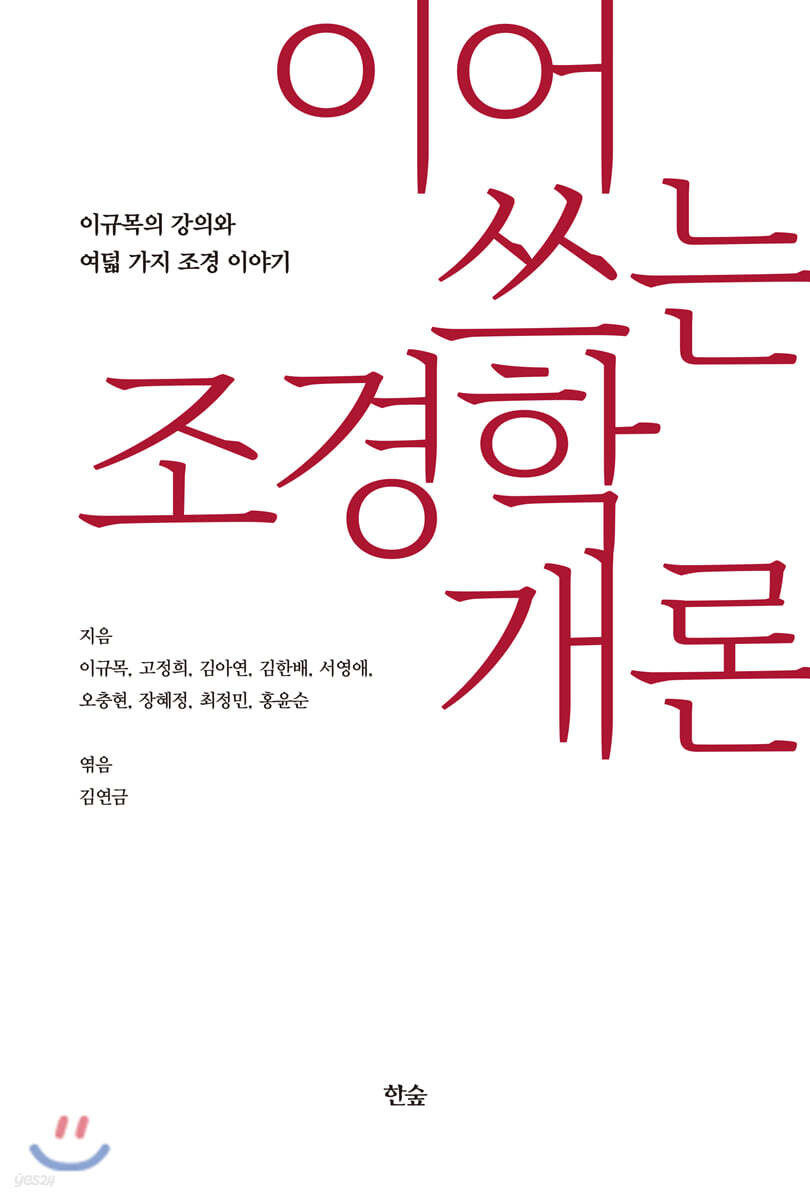
Introduction to Landscape Architecture
 |
Description
Book Introduction
This book began with the last lecture given by Professor Lee Gyu-mok as an honorary professor at Seoul City University.
As the lecture objective states, “This course serves as a guide to the discipline of landscape architecture. Rather than a simple introduction, it focuses on understanding key concepts and principles, exploring connections with basic disciplines that form the foundation of specialized knowledge, and philosophical reflections on landscape architecture as a culture,” this professor’s lecture has the character of an “introduction to landscape architecture.”
The eight topics he covered in his lectures became the eight chapters of this book.
Eight authors, currently actively engaged in research both domestically and internationally, each wrote their own introduction to landscape architecture on eight different topics, and thus, 『Introduction to Landscape Architecture』 was completed.
As the lecture objective states, “This course serves as a guide to the discipline of landscape architecture. Rather than a simple introduction, it focuses on understanding key concepts and principles, exploring connections with basic disciplines that form the foundation of specialized knowledge, and philosophical reflections on landscape architecture as a culture,” this professor’s lecture has the character of an “introduction to landscape architecture.”
The eight topics he covered in his lectures became the eight chapters of this book.
Eight authors, currently actively engaged in research both domestically and internationally, each wrote their own introduction to landscape architecture on eight different topics, and thus, 『Introduction to Landscape Architecture』 was completed.
index
Chapter 1.
Introduction to Landscape Architecture
012 Speaking of 'Landscape' by Lee Gyu-mok
032 The Roots and Reward of Landscape Architecture by Kim Han-bae
Chapter 2.
Form theory
044 Form, Dictionary of Design Lee Gyu-mok
076 Garden Style, The Charm of Limited Edition by Go Jeong-hee
Chapter 3.
Landscape composition theory
092 Weaving space between objects that become aesthetic objects Lee Gyu-mok
108 Dissecting the Beauty of Landscapes by Kim A-yeon
Chapter 4.
Landscape theory
128 Landscape Theory, Visible Landscape and Landscape That Must Be Interpreted by Lee Gyu-mok
148 Historical City Landscape: What and How to Design It? Seo Young-ae
Chapter 5.
Landscape planning theory
162 Lee Gyu-mok, who guides people to reach certain goals
176 Issues in Modern Landscape Planning and Design by Jeongmin Choi
Chapter 6.
Ecosystem Planning Theory
196 Ecosystem Planning: Finding Environmental Stability by Lee Gyu-mok
208 Understanding Urban Ecosystems by Oh Chung-hyun
Chapter 7.
Environmental psychology
218 Environmental Psychology: A Study of the Relationship Between Humans and the Environment by Lee Gyu-mok
236 Design for Humanity: Landscape Architecture that Understands, Feels, and Embraces Jang Hye-jeong
Chapter 8.
Traditional landscaping theory
254 Traditional Landscape Architecture: Reading and Understanding the Land by Lee Gyu-mok
268 Thoughts on the 'Modern Succession of Tradition' by Hong Yun-sun
280 Writers
282 References
286 Search
Introduction to Landscape Architecture
012 Speaking of 'Landscape' by Lee Gyu-mok
032 The Roots and Reward of Landscape Architecture by Kim Han-bae
Chapter 2.
Form theory
044 Form, Dictionary of Design Lee Gyu-mok
076 Garden Style, The Charm of Limited Edition by Go Jeong-hee
Chapter 3.
Landscape composition theory
092 Weaving space between objects that become aesthetic objects Lee Gyu-mok
108 Dissecting the Beauty of Landscapes by Kim A-yeon
Chapter 4.
Landscape theory
128 Landscape Theory, Visible Landscape and Landscape That Must Be Interpreted by Lee Gyu-mok
148 Historical City Landscape: What and How to Design It? Seo Young-ae
Chapter 5.
Landscape planning theory
162 Lee Gyu-mok, who guides people to reach certain goals
176 Issues in Modern Landscape Planning and Design by Jeongmin Choi
Chapter 6.
Ecosystem Planning Theory
196 Ecosystem Planning: Finding Environmental Stability by Lee Gyu-mok
208 Understanding Urban Ecosystems by Oh Chung-hyun
Chapter 7.
Environmental psychology
218 Environmental Psychology: A Study of the Relationship Between Humans and the Environment by Lee Gyu-mok
236 Design for Humanity: Landscape Architecture that Understands, Feels, and Embraces Jang Hye-jeong
Chapter 8.
Traditional landscaping theory
254 Traditional Landscape Architecture: Reading and Understanding the Land by Lee Gyu-mok
268 Thoughts on the 'Modern Succession of Tradition' by Hong Yun-sun
280 Writers
282 References
286 Search
Into the book
The definition of landscape architecture has continually changed over time, place, and circumstances.
First, if we look at the English language, the word 'landscaping' came first.
This 'landscaping' was used to mean 'making a garden', but 'landscape architecture' was first used as the name of the Department of Landscape Architecture at Harvard University in the United States.
Sometimes landscaping is expressed as 'landscape plan', and in relation to this, 'landscape planning' is also used.
Also, in terms of engineering, it is called 'landscape engineering', and all of these are collectively called 'landscape' in Korea, 'garden' in China, and 'garden' in Japan.
---P.12
The East and the West have different landscaping styles. As mentioned earlier, the English landscape garden is a direct copy of nature, while the East creates a unique garden style by attaching symbolic meaning to nature.
These differences can be said to have emerged from different attitudes toward nature.
The attitude toward nature in the East and the West is called ‘natural view’ in Korean.
---P.55
So what's the difference between architecture and landscape architecture? Architecture has a lot of vertical elements, while landscape architecture generally has a lot of horizontal elements.
Because it is spread out flat, it can be larger in scale compared to buildings.
On the other hand, there are limits to the size of buildings.
Another thing is that it is difficult to feel the sense of form, that is, the sense of shape, in landscape architecture.
Because it is spread out flat, the shape is not fixed.
In contrast, architecture is made entirely of form.
In that respect, sculpture and architecture have many similarities.
---P.93
The word 'land' in landscape includes elements of natural scenery.
Natural landscapes are made up of landforms, trees, water, and grasslands.
On the other hand, a cityscape is one that uses words like 'city', 'urban', or 'town' instead of 'land'.
The word 'townscape' first appeared in England.
Because the study of urban landscapes began in small towns in England, this townscape is the most commonly used.
---P.137
However, landscaping does not end with just planning; it requires a process called ‘design.’
Since it is a field that deals with land, it is necessary to create a specific shape for the land.
You have to draw a concrete picture of the physical shape.
To put it simply, a plan is something that is written or spoken, and a design can be seen as a drawing.
We need to draw up a concrete and detailed plan of how roads should be built and where and how green spaces and exercise areas should be created.
Since landscaping is done with the land, the shape of the land must be created specifically.
---P.164
There is a phrase that both ecologists and economists like to quote, in the sense that the two words are the same.
One is “There is no such thing as a free lunch.”
If the party who received the benefit does not pay the cost, someone else must pay for it.
As one side becomes cleaner, another side becomes dirtier, and the economy is such that when one side makes money, the other side makes less money.
There is no such thing as a free lunch.
And both scholars also like the saying, “Nothing is wasted.”
The point is that everything is connected.
The more waste we produce, the more it accumulates and pollutes the environment.
---P.198
So why should landscape architects study environmental psychology? Ultimately, landscape architects design the environments in which people live, so they need to understand how people use their environments.
By observing people's behavior, you can learn where they are talking and how benches are positioned to encourage more conversation.
Observed results can be used to design environments that better suit people's activities.
First, if we look at the English language, the word 'landscaping' came first.
This 'landscaping' was used to mean 'making a garden', but 'landscape architecture' was first used as the name of the Department of Landscape Architecture at Harvard University in the United States.
Sometimes landscaping is expressed as 'landscape plan', and in relation to this, 'landscape planning' is also used.
Also, in terms of engineering, it is called 'landscape engineering', and all of these are collectively called 'landscape' in Korea, 'garden' in China, and 'garden' in Japan.
---P.12
The East and the West have different landscaping styles. As mentioned earlier, the English landscape garden is a direct copy of nature, while the East creates a unique garden style by attaching symbolic meaning to nature.
These differences can be said to have emerged from different attitudes toward nature.
The attitude toward nature in the East and the West is called ‘natural view’ in Korean.
---P.55
So what's the difference between architecture and landscape architecture? Architecture has a lot of vertical elements, while landscape architecture generally has a lot of horizontal elements.
Because it is spread out flat, it can be larger in scale compared to buildings.
On the other hand, there are limits to the size of buildings.
Another thing is that it is difficult to feel the sense of form, that is, the sense of shape, in landscape architecture.
Because it is spread out flat, the shape is not fixed.
In contrast, architecture is made entirely of form.
In that respect, sculpture and architecture have many similarities.
---P.93
The word 'land' in landscape includes elements of natural scenery.
Natural landscapes are made up of landforms, trees, water, and grasslands.
On the other hand, a cityscape is one that uses words like 'city', 'urban', or 'town' instead of 'land'.
The word 'townscape' first appeared in England.
Because the study of urban landscapes began in small towns in England, this townscape is the most commonly used.
---P.137
However, landscaping does not end with just planning; it requires a process called ‘design.’
Since it is a field that deals with land, it is necessary to create a specific shape for the land.
You have to draw a concrete picture of the physical shape.
To put it simply, a plan is something that is written or spoken, and a design can be seen as a drawing.
We need to draw up a concrete and detailed plan of how roads should be built and where and how green spaces and exercise areas should be created.
Since landscaping is done with the land, the shape of the land must be created specifically.
---P.164
There is a phrase that both ecologists and economists like to quote, in the sense that the two words are the same.
One is “There is no such thing as a free lunch.”
If the party who received the benefit does not pay the cost, someone else must pay for it.
As one side becomes cleaner, another side becomes dirtier, and the economy is such that when one side makes money, the other side makes less money.
There is no such thing as a free lunch.
And both scholars also like the saying, “Nothing is wasted.”
The point is that everything is connected.
The more waste we produce, the more it accumulates and pollutes the environment.
---P.198
So why should landscape architects study environmental psychology? Ultimately, landscape architects design the environments in which people live, so they need to understand how people use their environments.
By observing people's behavior, you can learn where they are talking and how benches are positioned to encourage more conversation.
Observed results can be used to design environments that better suit people's activities.
---P.219
Publisher's Review
Introduction to Landscape Architecture, Form Theory, Landscape Composition Theory, Landscape Theory, Landscape Planning Theory,
Topics include ecological planning, environmental psychology, and traditional landscaping.
Eight lectures and eight articles!
This book began with the last lecture given by Professor Lee Gyu-mok as an honorary professor at Seoul City University.
As the lecture objective states, “This course serves as a guide to the discipline of landscape architecture. Rather than a simple introduction, it focuses on understanding key concepts and principles, exploring connections with basic disciplines that form the foundation of specialized knowledge, and philosophical reflections on landscape architecture as a culture,” this professor’s lecture has the character of an “introduction to landscape architecture.”
The eight topics he covered in his lectures became the eight chapters of this book.
Eight authors, currently actively engaged in research both domestically and internationally, each wrote their own introduction to landscape architecture on eight different topics, and thus, 『Introduction to Landscape Architecture』 was completed.
The writings of the eight authors in this book are meaningful in their own right, but when combined with Professor Lee Kyu-mok's lectures, they create even greater meaning.
The eight essays build their own narratives on the foundation of the discourse established by this professor and his generation, and they parallel, overlap, or conflict with Professor Lee Gyu-mok's writings, creating a tense relationship.
From the principles of landscape architecture to theories of form, landscape composition, landscape theory, landscape planning, ecosystem planning, environmental psychology, and traditional landscape architecture, it provides comprehensive information on the sub-disciplines that make up landscape architecture. In addition, the two articles that make up each chapter provide a glimpse into the development and changing aspects of discourse surrounding landscape architecture.
Topics include ecological planning, environmental psychology, and traditional landscaping.
Eight lectures and eight articles!
This book began with the last lecture given by Professor Lee Gyu-mok as an honorary professor at Seoul City University.
As the lecture objective states, “This course serves as a guide to the discipline of landscape architecture. Rather than a simple introduction, it focuses on understanding key concepts and principles, exploring connections with basic disciplines that form the foundation of specialized knowledge, and philosophical reflections on landscape architecture as a culture,” this professor’s lecture has the character of an “introduction to landscape architecture.”
The eight topics he covered in his lectures became the eight chapters of this book.
Eight authors, currently actively engaged in research both domestically and internationally, each wrote their own introduction to landscape architecture on eight different topics, and thus, 『Introduction to Landscape Architecture』 was completed.
The writings of the eight authors in this book are meaningful in their own right, but when combined with Professor Lee Kyu-mok's lectures, they create even greater meaning.
The eight essays build their own narratives on the foundation of the discourse established by this professor and his generation, and they parallel, overlap, or conflict with Professor Lee Gyu-mok's writings, creating a tense relationship.
From the principles of landscape architecture to theories of form, landscape composition, landscape theory, landscape planning, ecosystem planning, environmental psychology, and traditional landscape architecture, it provides comprehensive information on the sub-disciplines that make up landscape architecture. In addition, the two articles that make up each chapter provide a glimpse into the development and changing aspects of discourse surrounding landscape architecture.
GOODS SPECIFICS
- Date of issue: January 17, 2020
- Page count, weight, size: 288 pages | 562g | 152*225*20mm
- ISBN13: 9791187511182
- ISBN10: 1187511188
You may also like
카테고리
korean


korean

![GQ KOREA Mark (Monthly): December [2025]](http://librairie.coreenne.fr/cdn/shop/files/8ef265dbbfbf186523ed75ba7319009d.jpg?v=1765340328&width=3840)


