

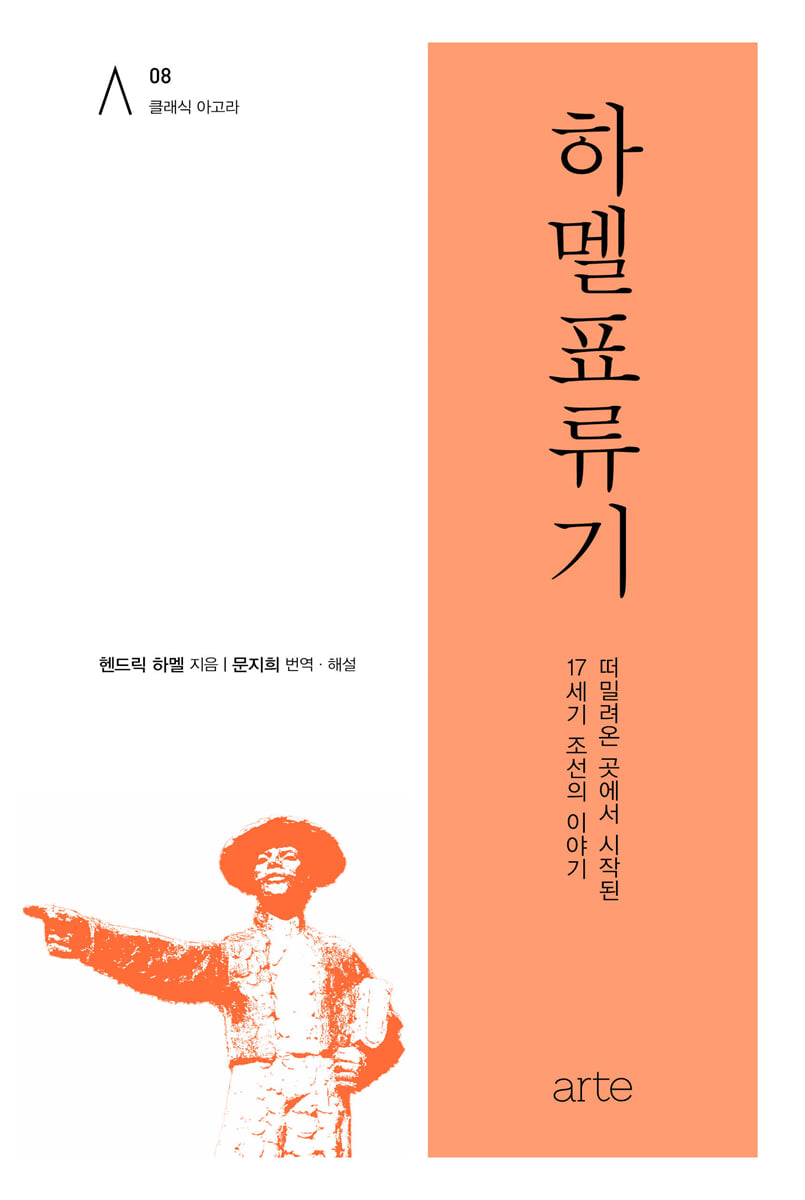
Hamel's Journal
 |
Description
Book Introduction
"Hamel's Journal" is a document that records the experiences of the sailor Hamel during his 13-year stay in Joseon after a Dutch trading ship bound for Japan was wrecked and he arrived there.
This is an important historical record that conveys Joseon's culture and lifestyle from a Western perspective.
This is an important historical record that conveys Joseon's culture and lifestyle from a Western perspective.
- You can preview some of the book's contents.
Preview
index
1.
Hamel's Journal
Hamel's Report
1653
1654
1655
1656
1657
1658
1659
1660
1661-1662
1662-1663
1664
1665
1666
1667
Description of the Joseon Dynasty and its society
Topography and geography of Joseon
The authority of the king
cavalry and infantry
National Defense and Military Service
Joseon's bureaucracy
Sources of income and taxes
Crime and Punishment
religion, temple, monk, sect
House and Furniture
education
funeral
nationality
trade
Weights and Measures and Currency
animal
Language, writing, and calculation methods
The King's Procession
2.
Appendix 1 - Dutch East India Company (VOC) Official Documents
Letters about the Castaway Dutch
Japanese Correspondent's Diary 1
Letters sent from Nagasaki to Batavia
report
Japanese Correspondent's Diary 2
Letter from Nagasaki to Batavia, October 13, 1667
Japanese Correspondent's Diary 3
Letter from Nagasaki to Batavia, October 22, 1667
Resolution of the Governor and Council, December 2, 1667
General Letter, January 25, 1667
General Letter, December 23, 1667
Correspondence from home country
Resolution of the Committee of Seventeen (Heeren XVII)
Report on the liberated shipwrecked
Nagasaki Diary
Letters sent from Nagasaki to Batavia
General Letter, December 13, 1668
Letter from Batavia to Nagasaki, May 20, 1669
Letter from Gasaki to Batavia, October 5, 1669
Letter dated October 19, 1670
Letter from Batavia to Nagasaki, June 16, 1670
Resolution of the 17-member Committee of the Dutch East India Company (VOC), August 29, 1670
Correspondence from home country
3.
Appendix 2 - Commentary on Hutinck
Departure of the Sperwer
What is the origin of the name 'Kelpart'?
Notes on Hendrik Hamel
4.
Translator's Note
Why the Hutink edition and the translation of the Dutch East India Company documents?
Hamel's drift as described in the Annals of the Joseon Dynasty
Who is Drick Hamel?
Who is Jan Jans Weltevrei?
What was the Netherlands like in the 17th century when the Dutchman Hamel was in Joseon?
What kind of company was the Dutch East India Company (VOC) that Hamel belonged to?
Hamel's Journal
Hamel's Report
1653
1654
1655
1656
1657
1658
1659
1660
1661-1662
1662-1663
1664
1665
1666
1667
Description of the Joseon Dynasty and its society
Topography and geography of Joseon
The authority of the king
cavalry and infantry
National Defense and Military Service
Joseon's bureaucracy
Sources of income and taxes
Crime and Punishment
religion, temple, monk, sect
House and Furniture
education
funeral
nationality
trade
Weights and Measures and Currency
animal
Language, writing, and calculation methods
The King's Procession
2.
Appendix 1 - Dutch East India Company (VOC) Official Documents
Letters about the Castaway Dutch
Japanese Correspondent's Diary 1
Letters sent from Nagasaki to Batavia
report
Japanese Correspondent's Diary 2
Letter from Nagasaki to Batavia, October 13, 1667
Japanese Correspondent's Diary 3
Letter from Nagasaki to Batavia, October 22, 1667
Resolution of the Governor and Council, December 2, 1667
General Letter, January 25, 1667
General Letter, December 23, 1667
Correspondence from home country
Resolution of the Committee of Seventeen (Heeren XVII)
Report on the liberated shipwrecked
Nagasaki Diary
Letters sent from Nagasaki to Batavia
General Letter, December 13, 1668
Letter from Batavia to Nagasaki, May 20, 1669
Letter from Gasaki to Batavia, October 5, 1669
Letter dated October 19, 1670
Letter from Batavia to Nagasaki, June 16, 1670
Resolution of the 17-member Committee of the Dutch East India Company (VOC), August 29, 1670
Correspondence from home country
3.
Appendix 2 - Commentary on Hutinck
Departure of the Sperwer
What is the origin of the name 'Kelpart'?
Notes on Hendrik Hamel
4.
Translator's Note
Why the Hutink edition and the translation of the Dutch East India Company documents?
Hamel's drift as described in the Annals of the Joseon Dynasty
Who is Drick Hamel?
Who is Jan Jans Weltevrei?
What was the Netherlands like in the 17th century when the Dutchman Hamel was in Joseon?
What kind of company was the Dutch East India Company (VOC) that Hamel belonged to?
Detailed image

Into the book
The Governor and the Commission at Tayoan ordered us to sail back to Japan.
After loading our luggage and bidding farewell to the governor, we set sail on the 30th of the same month, hoping to continue our voyage as quickly as possible, under the grace of God.
Before noon a man appeared about a cannon shot away from the tent.
(…) We motioned for him to come towards us, but he ran away as soon as he saw us.
After noon, three men appeared about musket range away.
(…) Their clothing was similar to that of the Chinese, but they wore hats made of horsehair, which made me anxious, thinking, ‘Maybe they are pirates or exiled Chinese.’
In the morning we landed on land and were greeted by interpreters from the East India Company at the place where they took us.
The interpreters questioned us about everything that had happened, wrote down the information, and submitted it to the governor.
Japan's Questionnaire
Have you ever asked the King to send you? If so, why did he refuse? We repeatedly asked the King and his court officials to send us to Japan, but they always replied that they do not allow foreigners to leave the country.
Because they didn't want to make their country known to other countries.
--- From the "Hamel Report"
Korean people are pure and trustworthy, so we could make them believe what we wanted.
They also like foreigners, especially monks.
Let me talk about Joseon's domestic and foreign trade.
The only people who come to this country to trade are Japanese from Tsushima Island.
They have a trading base in Busan, a city on the southeastern coast, which is under the jurisdiction of the governor of Tsushima Island.
They bring here pepper, Indonesian timber, alum, buffalo horn, deer skins and crocodile skins, and other goods which we Dutch and Chinese take to Japan and trade.
After loading our luggage and bidding farewell to the governor, we set sail on the 30th of the same month, hoping to continue our voyage as quickly as possible, under the grace of God.
Before noon a man appeared about a cannon shot away from the tent.
(…) We motioned for him to come towards us, but he ran away as soon as he saw us.
After noon, three men appeared about musket range away.
(…) Their clothing was similar to that of the Chinese, but they wore hats made of horsehair, which made me anxious, thinking, ‘Maybe they are pirates or exiled Chinese.’
In the morning we landed on land and were greeted by interpreters from the East India Company at the place where they took us.
The interpreters questioned us about everything that had happened, wrote down the information, and submitted it to the governor.
Japan's Questionnaire
Have you ever asked the King to send you? If so, why did he refuse? We repeatedly asked the King and his court officials to send us to Japan, but they always replied that they do not allow foreigners to leave the country.
Because they didn't want to make their country known to other countries.
--- From the "Hamel Report"
Korean people are pure and trustworthy, so we could make them believe what we wanted.
They also like foreigners, especially monks.
Let me talk about Joseon's domestic and foreign trade.
The only people who come to this country to trade are Japanese from Tsushima Island.
They have a trading base in Busan, a city on the southeastern coast, which is under the jurisdiction of the governor of Tsushima Island.
They bring here pepper, Indonesian timber, alum, buffalo horn, deer skins and crocodile skins, and other goods which we Dutch and Chinese take to Japan and trade.
--- From "Technology and Trade in the Joseon Dynasty and Society"
Publisher's Review
When I asked, “Are you Western Christians (Gu Li Is Duan)?” they all said, “Yes, yes.”
[Hyojong Sillok, Volume 11, Year 4 of King Hyojong, August 6, Mujin 2nd Article, 1653, Year 10 of Cheongsunchi]
A glance at the translation of the Hutinck version of Hamel's Drifting Journal and its background
Hendrick Hamel's Journal, written by the Dutch sailor Hendrick Hamel, is considered the most important historical record of Joseon written by a foreigner.
While many of the existing translations were retranslations of the original English version or edited versions of the original, the text of this book's "Hamel's Journal" is based on the Huttings edition of "Record of the Sperwer's Wreck" published by the Linshouten Society in 1920.
And it is a direct translation of the 『Records of the Experiences of Shipwreck Survivors in Jeju Island and the Joseon Mainland (1653-1666) and Description of the Joseon Kingdom』.
We focused on conveying the content as it is by directly translating the content of the original text.
Additionally, the appendix includes additional material from the 'Dutch East India Company Official Documents' and 'Hutink's Preface'.
In particular, this official document provides a closer look at the relationship between the Netherlands and Japan in the 17th century, when Hamel was stranded in Joseon, and the process by which Hamel and his party returned from Japan to their home country.
This is the first official document translated into Korean, and will be an important resource not only for research on Hamel, but also for insight into the East India Company's perception of Korea, Japan, and China.
In addition, the translator's note briefly summarizes the records of the Annals of the Joseon Dynasty at that time.
From the depiction of the Dutch who drifted to Joseon, to the journey they took to be sent to the court, to Joseon's reaction upon hearing the news of the Dutch who escaped to Japan, we can get a glimpse into Joseon's perspective on the Dutch who drifted to Joseon.
By examining the original translated text of Hamel's Journal along with various supplementary materials and historical materials, we have organized it so that one can view life in 17th-century Joseon and international politics from various angles.
We hope that this translation, which holds historical and academic value beyond a simple record of drift, will provide readers with new insights.
17th-century Joseon seen over 13 years by the foreigner Hamel
In 1663, Hendrick Hamel, a sailor for the Dutch East India Company (VOC), was on his way to Nagasaki when he encountered a storm and was forced to make an emergency landing on Jeju Island.
When they met the Koreans, they used both hand and foot gestures to ask for directions to Nagasaki, but there was no communication at all.
The Dutch sailors, including Hamel, who unintentionally set foot on Joseon soil, ended up serving Joseon for 13 years.
Until then, Joseon had been a country that was very wary of outsiders, and as a result, Hamel and his party had no choice but to always live under the surveillance of local officials.
After a few months of drifting like that, they go from Jeju Island to Hanyang under the orders of the court and meet the king (Hyojong).
After being questioned by the king, they were dispersed to various regions of Jeolla Province and settled there.
Afterwards, Hamel settled in Jeolla Province and lived there for 13 years, experiencing firsthand the daily life, language, etiquette, systems, and administrative system of Joseon.
In particular, if we look at the contents of Hamel's Journal, it records the reality of 17th century Joseon by describing in detail Joseon etiquette, the people's lifestyle, attitudes toward foreigners, and even the government's taxation methods and corrupt structures.
His records show that, despite being constantly under the surveillance of local officials, he was allowed a certain degree of freedom and maintained relationships with the Korean people.
In 1666, Hamel and his party were finally able to escape from the surveillance of the Koreans and escape to their final destination, Nagasaki.
After being interrogated again in Japan, he returned to his home country (the Netherlands) and wrote about his experiences in Joseon, publishing “Hamel’s Journal.”
This report is the first to introduce Joseon to Europe, and is the first empirical record of Joseon seen through the eyes of a 17th-century outsider, offering profound insights into Joseon life, culture, and institutions at the time.
[Hyojong Sillok, Volume 11, Year 4 of King Hyojong, August 6, Mujin 2nd Article, 1653, Year 10 of Cheongsunchi]
A glance at the translation of the Hutinck version of Hamel's Drifting Journal and its background
Hendrick Hamel's Journal, written by the Dutch sailor Hendrick Hamel, is considered the most important historical record of Joseon written by a foreigner.
While many of the existing translations were retranslations of the original English version or edited versions of the original, the text of this book's "Hamel's Journal" is based on the Huttings edition of "Record of the Sperwer's Wreck" published by the Linshouten Society in 1920.
And it is a direct translation of the 『Records of the Experiences of Shipwreck Survivors in Jeju Island and the Joseon Mainland (1653-1666) and Description of the Joseon Kingdom』.
We focused on conveying the content as it is by directly translating the content of the original text.
Additionally, the appendix includes additional material from the 'Dutch East India Company Official Documents' and 'Hutink's Preface'.
In particular, this official document provides a closer look at the relationship between the Netherlands and Japan in the 17th century, when Hamel was stranded in Joseon, and the process by which Hamel and his party returned from Japan to their home country.
This is the first official document translated into Korean, and will be an important resource not only for research on Hamel, but also for insight into the East India Company's perception of Korea, Japan, and China.
In addition, the translator's note briefly summarizes the records of the Annals of the Joseon Dynasty at that time.
From the depiction of the Dutch who drifted to Joseon, to the journey they took to be sent to the court, to Joseon's reaction upon hearing the news of the Dutch who escaped to Japan, we can get a glimpse into Joseon's perspective on the Dutch who drifted to Joseon.
By examining the original translated text of Hamel's Journal along with various supplementary materials and historical materials, we have organized it so that one can view life in 17th-century Joseon and international politics from various angles.
We hope that this translation, which holds historical and academic value beyond a simple record of drift, will provide readers with new insights.
17th-century Joseon seen over 13 years by the foreigner Hamel
In 1663, Hendrick Hamel, a sailor for the Dutch East India Company (VOC), was on his way to Nagasaki when he encountered a storm and was forced to make an emergency landing on Jeju Island.
When they met the Koreans, they used both hand and foot gestures to ask for directions to Nagasaki, but there was no communication at all.
The Dutch sailors, including Hamel, who unintentionally set foot on Joseon soil, ended up serving Joseon for 13 years.
Until then, Joseon had been a country that was very wary of outsiders, and as a result, Hamel and his party had no choice but to always live under the surveillance of local officials.
After a few months of drifting like that, they go from Jeju Island to Hanyang under the orders of the court and meet the king (Hyojong).
After being questioned by the king, they were dispersed to various regions of Jeolla Province and settled there.
Afterwards, Hamel settled in Jeolla Province and lived there for 13 years, experiencing firsthand the daily life, language, etiquette, systems, and administrative system of Joseon.
In particular, if we look at the contents of Hamel's Journal, it records the reality of 17th century Joseon by describing in detail Joseon etiquette, the people's lifestyle, attitudes toward foreigners, and even the government's taxation methods and corrupt structures.
His records show that, despite being constantly under the surveillance of local officials, he was allowed a certain degree of freedom and maintained relationships with the Korean people.
In 1666, Hamel and his party were finally able to escape from the surveillance of the Koreans and escape to their final destination, Nagasaki.
After being interrogated again in Japan, he returned to his home country (the Netherlands) and wrote about his experiences in Joseon, publishing “Hamel’s Journal.”
This report is the first to introduce Joseon to Europe, and is the first empirical record of Joseon seen through the eyes of a 17th-century outsider, offering profound insights into Joseon life, culture, and institutions at the time.
GOODS SPECIFICS
- Date of issue: May 2, 2025
- Page count, weight, size: 224 pages | 135*210*20mm
- ISBN13: 9791173572395
- ISBN10: 1173572392
You may also like
카테고리
korean


korean

![GQ KOREA Mark (Monthly): December [2025]](http://librairie.coreenne.fr/cdn/shop/files/8ef265dbbfbf186523ed75ba7319009d.jpg?v=1765340328&width=3840)


