

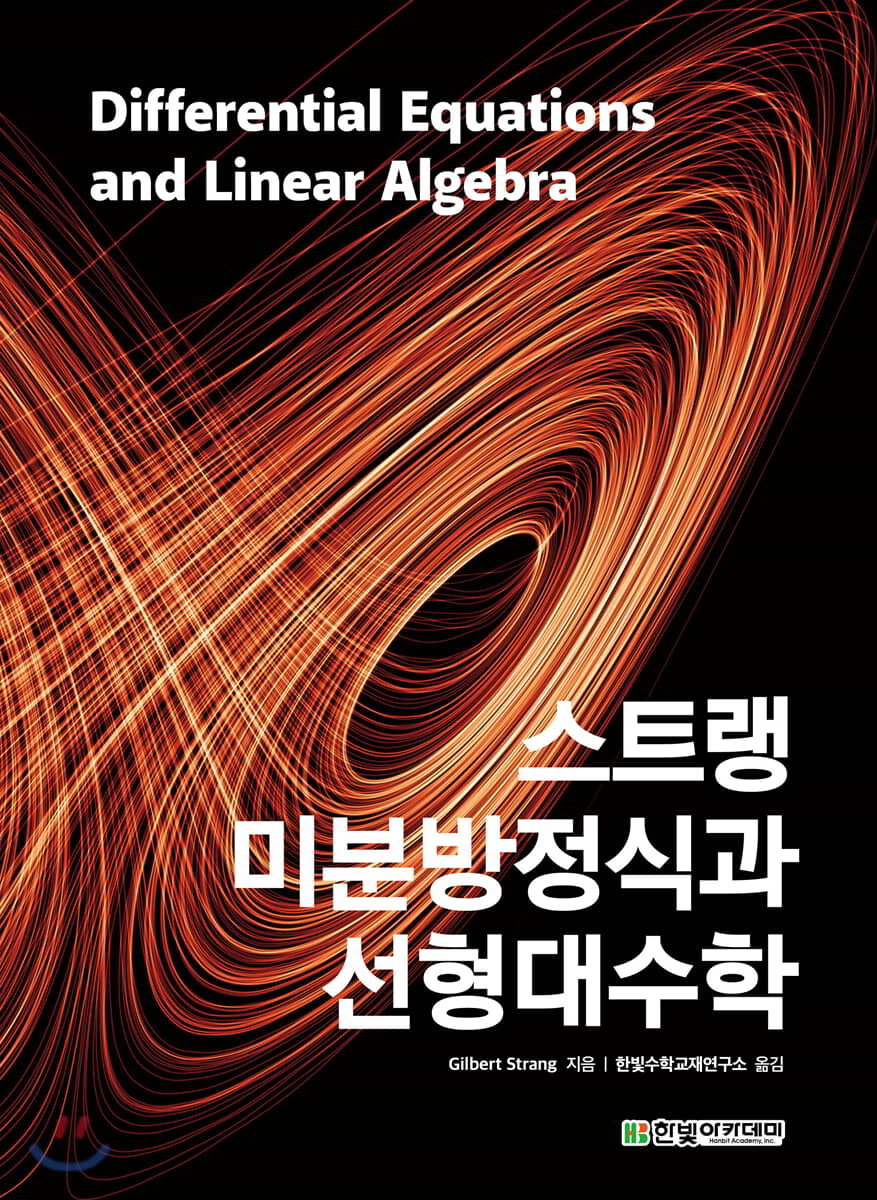
Strang differential equations and linear algebra
 |
Description
Book Introduction
『Strang Differential Equations and Linear Algebra』 is a book for students in natural sciences or engineering fields that require mathematics as an applied discipline.
It covers differential equations and linear algebra together, and explains differential equations by applying linear algebra concepts.
Additionally, we have included a wealth of practice problems for each chapter to help you utilize the concepts you have learned in a variety of ways.
It covers differential equations and linear algebra together, and explains differential equations by applying linear algebra concepts.
Additionally, we have included a wealth of practice problems for each chapter to help you utilize the concepts you have learned in a variety of ways.
- You can preview some of the book's contents.
Preview
index
Chapter 1 First-Order Differential Equations
1.1 Four examples: linear and nonlinear
1.2 Basic Calculus Required
1.3 Exponential functions e^t and e^at
1.4 Four special solutions
1.5 Real sinusoids and complex sinusoids
1.6 Growth and Decline Model
1.7 Logistic Equation
1.8 Separable and Complete Equations
Chapter 2 Second-order differential equations
2.1 Second order derivatives in science and engineering
2.2 Key facts about complex numbers
2.3 Constant coefficients A, B, C
2.4 Forced vibration and exponential response
2.5 Electrical Circuits and Mechanical Systems
2.6 Solutions to second-order differential equations
2.7 Laplace transforms Y(s) and F(s)
Chapter 3: Diagrammatic and Numerical Calculations
3.1 Nonlinear equation y^'=f(t,y)
3.2 Source, suction, saddle, spiral
3.3 Linearization and stability in two and three dimensions
3.4 Basic Euler method
3.5 Higher accuracy using the Runge-Kutta method
Chapter 4 Linear Equations and Inverse Matrices
4.1 Two diagrams of linear equations
4.2 Solving linear equations by elimination
4.3 Matrix Multiplication
4.4 Inverse matrix
4.5 Symmetric and orthogonal matrices
Chapter 5 Vector Spaces and Subspaces
5.1 Column space of a matrix
5.2 Null space of A satisfying Av=0
5.3 Complete solution of Av=b
5.4 Linear independence, basis, and dimension
5.5 Four basic subspaces
5.6 Graphs and Networks
Chapter 6 Eigenvalues and Eigenvectors
6.1 Introduction to Eigenvalues
6.2 Diagonalization of matrices
6.3 Linear system y^'=Ay
6.4 Matrix Exponents
6.5 Second-order systems and symmetric matrices
Chapter 7 Applied Mathematics and A^TA
7.1 Least Squares and Orthogonal Projection
7.2 Positive definite matrices and singular value decomposition
7.3 Boundary conditions replacing initial conditions
7.4 Laplace's Equation and A^TA
7.5 Networks and Graph Laplacians
Chapter 8 Fourier Transform and Laplace Transform
8.1 Fourier series
8.2 Fast Fourier Transform
8.3 Heat equation
8.4 Wave equation
8.5 Laplace Transform
8.6 Convolution (Fourier and Laplace)
supplement
A matrix decomposition
Properties of B determinant
C Linear Algebra Summary: A is an n×n matrix
Search
1.1 Four examples: linear and nonlinear
1.2 Basic Calculus Required
1.3 Exponential functions e^t and e^at
1.4 Four special solutions
1.5 Real sinusoids and complex sinusoids
1.6 Growth and Decline Model
1.7 Logistic Equation
1.8 Separable and Complete Equations
Chapter 2 Second-order differential equations
2.1 Second order derivatives in science and engineering
2.2 Key facts about complex numbers
2.3 Constant coefficients A, B, C
2.4 Forced vibration and exponential response
2.5 Electrical Circuits and Mechanical Systems
2.6 Solutions to second-order differential equations
2.7 Laplace transforms Y(s) and F(s)
Chapter 3: Diagrammatic and Numerical Calculations
3.1 Nonlinear equation y^'=f(t,y)
3.2 Source, suction, saddle, spiral
3.3 Linearization and stability in two and three dimensions
3.4 Basic Euler method
3.5 Higher accuracy using the Runge-Kutta method
Chapter 4 Linear Equations and Inverse Matrices
4.1 Two diagrams of linear equations
4.2 Solving linear equations by elimination
4.3 Matrix Multiplication
4.4 Inverse matrix
4.5 Symmetric and orthogonal matrices
Chapter 5 Vector Spaces and Subspaces
5.1 Column space of a matrix
5.2 Null space of A satisfying Av=0
5.3 Complete solution of Av=b
5.4 Linear independence, basis, and dimension
5.5 Four basic subspaces
5.6 Graphs and Networks
Chapter 6 Eigenvalues and Eigenvectors
6.1 Introduction to Eigenvalues
6.2 Diagonalization of matrices
6.3 Linear system y^'=Ay
6.4 Matrix Exponents
6.5 Second-order systems and symmetric matrices
Chapter 7 Applied Mathematics and A^TA
7.1 Least Squares and Orthogonal Projection
7.2 Positive definite matrices and singular value decomposition
7.3 Boundary conditions replacing initial conditions
7.4 Laplace's Equation and A^TA
7.5 Networks and Graph Laplacians
Chapter 8 Fourier Transform and Laplace Transform
8.1 Fourier series
8.2 Fast Fourier Transform
8.3 Heat equation
8.4 Wave equation
8.5 Laplace Transform
8.6 Convolution (Fourier and Laplace)
supplement
A matrix decomposition
Properties of B determinant
C Linear Algebra Summary: A is an n×n matrix
Search
Publisher's Review
[characteristic]
① As the author's reputation suggests, the theory is explained easily and is developed with a focus on the core.
② Differential equations can be studied alone or together with linear algebra.
③ We have included plenty of practice problems for each chapter so that you can utilize the concepts you have learned in a variety of ways.
④ The main theory of the book is the author Gilbert Strang's lecture, and calculations can be learned using various tools.
Successfully understand differential equations by applying linear algebra.
Mathematics is not about formulas, calculations, or proofs, it's about ideas!
This book was written by Gilbert Strang, a professor of mathematics at MIT and an expert in applied mathematics, and is aimed at students in natural sciences or engineering fields that require mathematics as an applied discipline.
This is the only book in Korea that covers differential equations and linear algebra, which are required subjects in undergraduate courses, and explains differential equations by applying linear algebra concepts.
You can learn the fundamental concepts of the subject and apply key ideas to real-world cases in detail with Strang's characteristically friendly explanations.
① As the author's reputation suggests, the theory is explained easily and is developed with a focus on the core.
② Differential equations can be studied alone or together with linear algebra.
③ We have included plenty of practice problems for each chapter so that you can utilize the concepts you have learned in a variety of ways.
④ The main theory of the book is the author Gilbert Strang's lecture, and calculations can be learned using various tools.
Successfully understand differential equations by applying linear algebra.
Mathematics is not about formulas, calculations, or proofs, it's about ideas!
This book was written by Gilbert Strang, a professor of mathematics at MIT and an expert in applied mathematics, and is aimed at students in natural sciences or engineering fields that require mathematics as an applied discipline.
This is the only book in Korea that covers differential equations and linear algebra, which are required subjects in undergraduate courses, and explains differential equations by applying linear algebra concepts.
You can learn the fundamental concepts of the subject and apply key ideas to real-world cases in detail with Strang's characteristically friendly explanations.
GOODS SPECIFICS
- Date of issue: July 9, 2019
- Page count, weight, size: 552 pages | 1,123g | 188*257*35mm
- ISBN13: 9791156644422
- ISBN10: 1156644429
You may also like
카테고리
korean


korean

![GQ KOREA Mark (Monthly): December [2025]](http://librairie.coreenne.fr/cdn/shop/files/8ef265dbbfbf186523ed75ba7319009d.jpg?v=1765340328&width=3840)


