

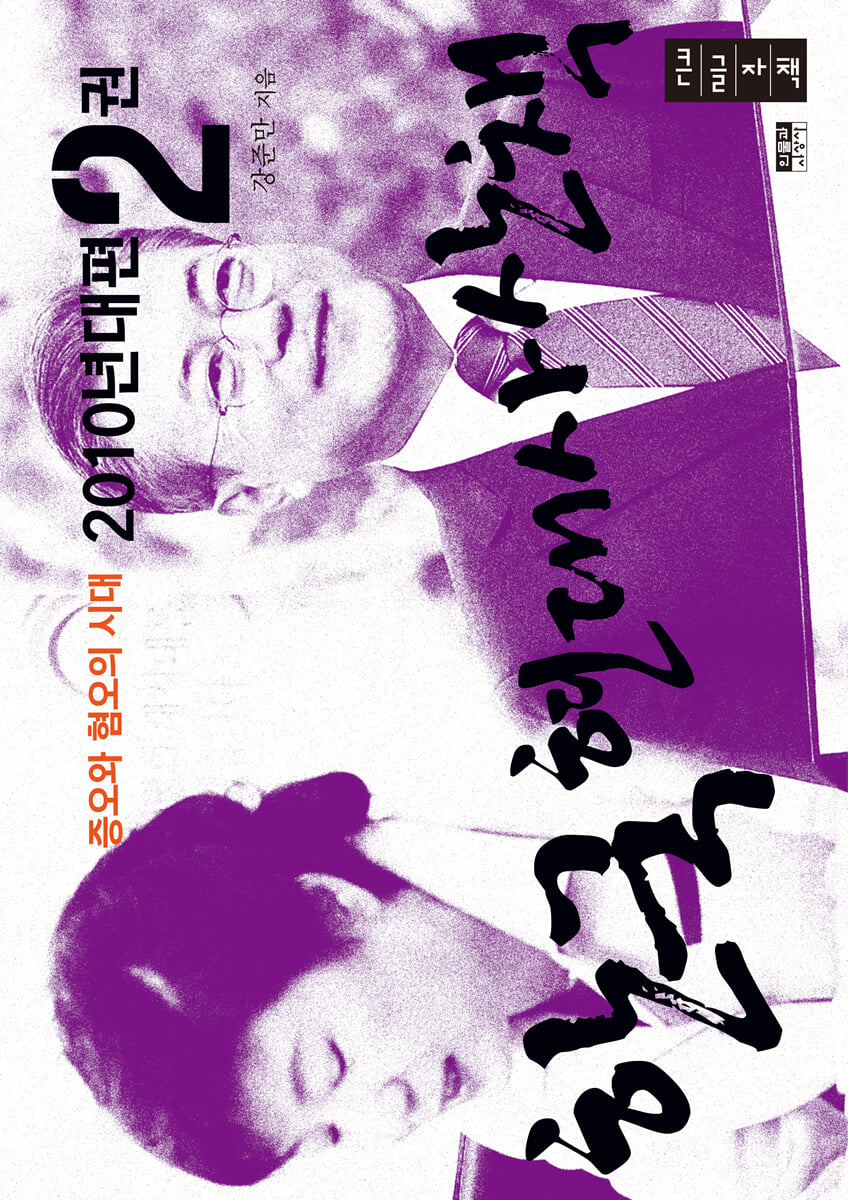
A Walk Through Modern Korean History: 2010s, Part 2 (Large Print Book)
 |
Description
Book Introduction
How have Korea's politics, economy, society, and culture evolved over the past 10 years?
The modern history of Korea, in which we have lived and in which we live now, is the starting point and the finishing point of history.
Because I have to live in a world where I have to make constant choices.
However, modern history has often been treated as a cold meal in the historical community.
Because these are sensitive topics.
Kang Jun-man presents various positions on controversial issues while also offering his own perspective, thereby providing readers with accurate information and a variety of opportunities for participation.
In that respect, the ‘A Walk Through Modern Korean History’ series is unparalleled.
It is like a Korean's 'treasure trove' that contains everything about the Republic of Korea that made up the 'me' of today.
The "A Walk Through Modern Korean History" series, which meticulously captures 75 years of history from noon on August 15, 1945, to Bong Joon-ho's [Parasite], covers a wide range of fields, from politics, economy, and society to popular culture and sports.
And it brought to life the life and historical stage that modern Koreans had to face.
To this end, the 'A Walk Through Modern Korean History' series attempted a three-dimensional approach through extensive annotations, photographs capturing scenes from the time, and a 'History Walk' corner.
The 'A Walk Through Modern Korean History' series is not limited to a simple listing of events.
'Explosion of Han (恨) and Desire' (1940s), 'Age of Extremes' (1950s), 'Birth of an Opportunist Republic' (1960s), 'Nationalization of Exports' (1970s), 'Gwangju Massacre and the Seoul Olympics' (1980s), 'Division is Our Destiny, Solidarity is My Destiny' (1990s), 'The Light and Shadow of the Roh Moo-hyun Era' (2000s), 'The Age of Hatred and Loathing' (2010s), etc. Numerous events and topics are persistently explored amidst a fierce sense of crisis about the emotions and structures that dominated each era.
And he emphasizes that just as the new generation can seize new values in the name of 'progress', it must also embrace the 'pain' of past generations who had to survive times of extremes and poverty.
Kang Jun-man recognizes that modern Korean history is a history that has excluded 'humanity', and is attempting to restore 'humanity' and, on that basis, to achieve a new reconciliation between ideologies and generations.
The modern history of Korea, in which we have lived and in which we live now, is the starting point and the finishing point of history.
Because I have to live in a world where I have to make constant choices.
However, modern history has often been treated as a cold meal in the historical community.
Because these are sensitive topics.
Kang Jun-man presents various positions on controversial issues while also offering his own perspective, thereby providing readers with accurate information and a variety of opportunities for participation.
In that respect, the ‘A Walk Through Modern Korean History’ series is unparalleled.
It is like a Korean's 'treasure trove' that contains everything about the Republic of Korea that made up the 'me' of today.
The "A Walk Through Modern Korean History" series, which meticulously captures 75 years of history from noon on August 15, 1945, to Bong Joon-ho's [Parasite], covers a wide range of fields, from politics, economy, and society to popular culture and sports.
And it brought to life the life and historical stage that modern Koreans had to face.
To this end, the 'A Walk Through Modern Korean History' series attempted a three-dimensional approach through extensive annotations, photographs capturing scenes from the time, and a 'History Walk' corner.
The 'A Walk Through Modern Korean History' series is not limited to a simple listing of events.
'Explosion of Han (恨) and Desire' (1940s), 'Age of Extremes' (1950s), 'Birth of an Opportunist Republic' (1960s), 'Nationalization of Exports' (1970s), 'Gwangju Massacre and the Seoul Olympics' (1980s), 'Division is Our Destiny, Solidarity is My Destiny' (1990s), 'The Light and Shadow of the Roh Moo-hyun Era' (2000s), 'The Age of Hatred and Loathing' (2010s), etc. Numerous events and topics are persistently explored amidst a fierce sense of crisis about the emotions and structures that dominated each era.
And he emphasizes that just as the new generation can seize new values in the name of 'progress', it must also embrace the 'pain' of past generations who had to survive times of extremes and poverty.
Kang Jun-man recognizes that modern Korean history is a history that has excluded 'humanity', and is attempting to restore 'humanity' and, on that basis, to achieve a new reconciliation between ideologies and generations.
index
Part 1 2012
Chapter 1: The Moral Decline of the Lee Myung-bak Administration
Kim Jong-in urges Lee Myung-bak to voluntarily resign from the party · 17 "The president's associates have tarnished conservative values" · 19 "Corruption by nepotism and powerful figures is more widespread than in previous administrations" · 20 "The Lee Myung-bak administration's moral decline shows no end in sight" · 23 Saenuri Party, red, economic democratization · 25
A Walk Through History 1: The Grand National Party Convention Cash Envelope Scatter Incident · 27
A Walk Through History 2: The Illegal Dismissal of KBS President Jeong Yeon-ju · 29
Chapter 2: The Korean Watergate Scandal Directed by the Blue House
"The Blue House ordered the destruction of evidence of illegal surveillance of civilians." · 32 "The illegal surveillance was a Blue House order." · 34 "The adulterous behavior was recorded minute by minute... even spying on private lives." · 36 Moon Jae-in: "MB's Blue House is truly evil and despicable." · 39 "Compared to the surveillance, the grounds for Roh Moo-hyun's impeachment are minor." · 41
Chapter 3: The Saenuri Party's Surprise Victory in the April 11 General Election
What's the reason for the popularity of "Naggomsu"? · 44 "The Eulsa Treaty and the Korea-US FTA are essentially the same." · 46 "Let's rape and kill Rice" Kim Yong-min's remarks spark controversy · 48 "Is the Democratic Party trying to take power by piggybacking on Naggomsu?" · 50 April 11 General Election: Saenuri Party wins 152 seats, Opposition Alliance 140 seats · 52 "Moon Jae-in's 'boomerang' of protecting Kim Yong-min" · 55 "The Naggomsu phenomenon ultimately backfired." · 57 The problem with Democratic Party leadership · 58 Park Geun-hye once again appoints Kim Jong-in as her presidential mentor · 61
Chapter 4: Chaebols, High-ranking Officials, and Various Corruptions
The Emergence of the 'Sundae Chaebol' and the 'Wet Tissue Chaebol' · 63 "The Increase in the Wealth of High-Ranking Officials and the Difficult Lives of the Common People" · 66 Households Spending 40% of Their Income on Debt Repayment · 68 Choi See-joong and Park Young-joon Arrested in Pi City Permit Corruption · 70 "Is Choi See-joong Still the 'Prince of Broadcasting' Even in Prison?" · 72 "Construction Companies Colluded to Swindle Over 1 Trillion Won of Taxpayers' money from the Four Major Rivers Project" · 74 "Inflated Construction Costs Are Dumped on the Public" · 76
A Walk Through History 3: The National Assembly Advancement Act to Prevent Fights · 79
A Walk Through History 4: A Verdict Written with the Spirit of an Independence Movement 82
Historical Walk 5: "Coffee is here" · 85
Chapter 5: Corruption of Brothers Lee Sang-deuk and Lee Myung-bak
Savings Bank Corruption: Lee Myung-bak's Brother Lee Sang-deuk Arrested · 88 "Comprehensive Investigation of MB's Presidential Election Funds" Demand · 90 "The Special Prosecutor's Investigation Halted by the Perfect Collaboration of Lee Myung-bak and Park Geun-hye" · 93 "When Will the President's Family's Ethical Awareness Change?" · 95
A Walk Through History 6: "Criticizing Korea's Progress" · 99
Historical Walk 7: President Lee Myung-bak's Visit to Dokdo · 102
A Walk Through History 8: The Samsung Electronics-Apple Patent Conflict · 105
Chapter 6: “Is Ahn Cheol-soo an avatar raised by the media?”
Ahn Cheol-soo, "The Person Young People Most Want to Be Like" · 107 Ahn Cheol-soo's Entertainment Code · 109 "I'm Neither Conservative nor Progressive" · 112 Yoo Si-min Says "Neutrality Is on the Side of Evil" · 114 Ahn Cheol-soo's "Misunderstanding of Politics" · 116
Chapter 7: The 18th Presidential Election
Democratic Party presidential primary · 119 Moon Jae-in and Ahn Cheol-soo's unification of candidates · 121 "The Roh Moo-hyun administration was a total success" · 123 Park Geun-hye's 'For my father' · 126 "My father's dream was a welfare state" · 128 Conflict between Park Geun-hye and Kim Jong-in over 'economic democratization' · 130 National Intelligence Service opinion manipulation scandal · 134 18th presidential election: Park Geun-hye 51.56%, Moon Jae-in 48.02% · 137 Again, 'unscrupulous progressives' · 140 The 'Park Chung-hee myth' is alive and well · 141 The 18th presidential election was a fight between 'general programming and naggomsu' · 143 Low-income votes: Park Geun-hye 52.7%, Moon Jae-in 36.0% · 145 "Appointment of Yoon Chang-jung, which went in the opposite direction of grand unification" · 147 "Started with lack of communication and self-righteousness "Park Geun-hye's Greetings" · 149 "Park Geun-hye's Style: A Return to the Black-and-White Film Era" · 151
Chapter 8: "The Nakkomsu Bikini-Kopi Incident" and "MBC's Korean War"
"The Democratic Party is shameless" · 155 "We are not cheerleaders for progressivism" · 157 "If there is no inequality of power, it is not sexual harassment"? · 159 Is it okay to do anything if they are on "our side"? · 161 MBC's '170-day strike' incident · 163 The aftermath of 'MBC's Korean War' · 166 Conflict between 'regular reporters' and 'probationary/experienced reporters' · 167
Historical Walk 9: The 'NLL Dialogue Record' Controversy · 170
Chapter 9: Psy's "Gangnam Style": Transforming Korea into a Cultural Exporter
Life in a 'virtual nation' system for real glory · 173 The 'entertainment nation' created by SNS and YouTube · 175 SM's market capitalization exceeds 1 trillion won · 179 Psy's [Gangnam Style] craze · 181 'The power of the Internet that broke down physical barriers of nationality and borders' · 183 [Gangnam Style]'s breathtaking 'record-breaking march' · 185 From a cultural importer to an exporter · 188
A Walk Through History 10: The Beginning of the Xi Jinping Era in China · 191
Part 2 2013
Chapter 1: President Park Geun-hye's Inauguration
"Even the spokesperson knew about the Prime Minister's nomination 30 seconds beforehand." · 197 "Park Geun-hye: Lack of communication, anxiety, and discontent: the three 'nos'" · 199 "The worst privatization of power," 'MB's special pardon' · 202 "We will open a new era of hope" · 204 "It's most comfortable to think of myself as a servant" · 207
Historical Walk 11: The Seoul City Government Official Spy Fabrication Case · 211
A Walk Through History 12: People Who Will "Aggress" at Every Opportunity · 214
A Walk Through History 13: North Korea's Third Nuclear Test and the Second Wave of "NLL Dialogue" Remarks · 216
Chapter 2: The National Intelligence Service's Intervention in the Presidential Election and Yoon Seok-yeol's Rebellion
Prosecutor General Chae Dong-wook, Special Investigation Team Leader Yoon Seok-yeol · 219 Cho Gap-je, “The prosecution is a leftist’s puppet” · 221 Yoon Seok-yeol’s bombshell declaration attacking Won Se-hoon and Hwang Kyo-ahn · 223 Candlelight vigils angry at the National Intelligence Service’s interference in the presidential election · 225 “President Park is performing her duties well” 63% · 227 “Controversy over the Democratic Party’s floor spokesperson’s low-level ‘ghostly’ remark” · 229 Prosecutor General Chae Dong-wook’s ‘extramarital affair’ · 231 ‘National Intelligence Service comment scandal’ and ‘suspicion of presidential election fraud’ · 233 “I am not loyal to anyone” · 234 Life in a ‘country that is loyal to people’ · 237
Chapter 3: “The Four Major Rivers Project Fraud, Dreaming of Restarting the Grand Canal”?
Large-scale nuclear power plant corruption and power crisis · 239 "The Four Major Rivers Project is actually a Grand Canal project" · 240 "I feel a sense of emptiness, not just betrayal" · 242 "The Four Major Rivers Project is a shared responsibility of the two administrations, Lee Myung-bak and Park Geun-hye" · 244 Lee Myung-bak's self-praise for the Four Major Rivers Project · 247 "Camp logic" swallowing "scientific logic" · 249
Historical Walk 14: Sejong Special Self-Governing City and the "Yeongchungho Era" · 252
Historical Walk 15: The Problem Isn't the Apartment, It's the Apartment Complex · 254
Chapter 4: “Park Geun-hye’s Public Fraud by Ditching Her Promises”?
The disappearance of the '200,000 won basic pension' promise · 257 Does this mean 'welfare without tax increases'? · 259 Are the funds being raised by picking off workers' pockets? · 261 The backlash of "plucking goose feathers" · 263 "Park Geun-hye, stop the 'bystander' rhetoric" · 266 The Park Geun-hye administration's increasingly conservative tone · 267 "Is Park Geun-hye's pledge a fraud against the people?" · 270 "The serial disappearance of pro-Park figures" · 272
Chapter 5: “Is the Saenuri Party a Parachute Factory?”
"Kim Ki-choon's Return: A Return to the Blue House's Yushin Era" · 275 Is Park Geun-hye's "Personnel Disaster Season 2"? · 278 "Is the Saenuri Party a Parachute Factory?" · 280 "Half of the New Public Institution Heads Are from the Yeongnam Region" · 282 "'Flower Position Non-Executive Directors' One-Hour Meeting Earns 2.5 Million Won" · 284 "How Are You?" Poster Hanging Campaign · 286
Historical Walk 16: The Unified Progressive Party Incitement to Rebellion and Dissolution Trial Case · 290
Chapter 6: General Programming Channels and Son Seok-hee's Activities
The Heated Conflict Surrounding General Programming Channels · 294 Son Seok-hee Moves to JTBC News Headquarters · 296 "Son Seok-hee Enters the Tiger's Den, Will Eventually Be Eaten" · 297 "Son Seok-hee Chose General Programming Channels? General Programming Channels Swallowed Son Seok-hee!" · 300 "I Still Can't Believe Son Seok-hee's 'Pledge'" · 302 "Son Seok-hee's Gamble: Going to JTBC, All-In on 30 Years of Reputation" · 303 "Am I So Petty to Call Betrayal Betrayal?" · 307 #1 in 'Most Influential Journalists' for 9 Consecutive Years · 310 "Son Seok-hee, Was the Power of His Three Characters Really This Great?" · 312 "He'll Be Kicked Out When the Sweet Water Runs Out" Jeong Cheong-rae and Son Seok-hee's War of Words · 314 Exclusive Report on "Samsung Group's Union-Disrupting Documents" · 315
Historical Walk 17: "Daughter-in-law or a servant? Did I marry you to be this way?" · 317
Chapter 7: Is Ilbe the illegitimate child of Nakkomsu?
"Ilbe is the mirror image of the Nakkomsu phenomenon." · 320 "Why did I, a progressive, become an Ilbe member?" · 322 "A sense of justice, fighting a formidable enemy." · 324 Ilbe is the boomerang of "unscrupulous progressives." · 326 The arrogant desire for self-aggrandizement among progressives. · 327
Chapter 8: "We Are in Favor of Discrimination"
University Rankings: The Basis of Discrimination · 331 The "Religiousization of the College Scholastic Ability Test" Phenomenon · 333 "You Can't Just Try to Become a Regular Employee!" · 335 "If You're Being Injusticed, Get a Job" Meritocracy · 338 Universities Have Become Networking Factories · 341
Chapter 9: Do you know about ‘Gi-gyun-chung’ and ‘Gi-gyun-chung’?
"I'm worried that Wonsei University students will pretend to be Yonsei University students." · 343 The branch school policy that accelerated the colonization of Seoul in the provinces · 345 Seoul National University's 'Ji-gyun-chung' and 'Gi-gyun-chung' · 348 College students' baseball jackets are their ID cards · 351 Prestigious universities are 'companies that sell signals' · 353
Chapter 10: Hallyu: "Cultural Imagination is Food"
"Koreans Know How to Have Fun" · 356 Do Koreans Have a "Gaming Gene"? · 359 A Country at odds with the "Galapagos Syndrome" · 362 The Driving Force of K-Pop: Digital Power and Fandom Power · 363 The Identity of K-Pop: "Collective Moralism" · 367 The Combination of Hallyu Content and Hallyu Business · 369
Historical Walk 18 [The Attorney], a film so raging you won't even have time to cry · 373
Week 375
Chapter 1: The Moral Decline of the Lee Myung-bak Administration
Kim Jong-in urges Lee Myung-bak to voluntarily resign from the party · 17 "The president's associates have tarnished conservative values" · 19 "Corruption by nepotism and powerful figures is more widespread than in previous administrations" · 20 "The Lee Myung-bak administration's moral decline shows no end in sight" · 23 Saenuri Party, red, economic democratization · 25
A Walk Through History 1: The Grand National Party Convention Cash Envelope Scatter Incident · 27
A Walk Through History 2: The Illegal Dismissal of KBS President Jeong Yeon-ju · 29
Chapter 2: The Korean Watergate Scandal Directed by the Blue House
"The Blue House ordered the destruction of evidence of illegal surveillance of civilians." · 32 "The illegal surveillance was a Blue House order." · 34 "The adulterous behavior was recorded minute by minute... even spying on private lives." · 36 Moon Jae-in: "MB's Blue House is truly evil and despicable." · 39 "Compared to the surveillance, the grounds for Roh Moo-hyun's impeachment are minor." · 41
Chapter 3: The Saenuri Party's Surprise Victory in the April 11 General Election
What's the reason for the popularity of "Naggomsu"? · 44 "The Eulsa Treaty and the Korea-US FTA are essentially the same." · 46 "Let's rape and kill Rice" Kim Yong-min's remarks spark controversy · 48 "Is the Democratic Party trying to take power by piggybacking on Naggomsu?" · 50 April 11 General Election: Saenuri Party wins 152 seats, Opposition Alliance 140 seats · 52 "Moon Jae-in's 'boomerang' of protecting Kim Yong-min" · 55 "The Naggomsu phenomenon ultimately backfired." · 57 The problem with Democratic Party leadership · 58 Park Geun-hye once again appoints Kim Jong-in as her presidential mentor · 61
Chapter 4: Chaebols, High-ranking Officials, and Various Corruptions
The Emergence of the 'Sundae Chaebol' and the 'Wet Tissue Chaebol' · 63 "The Increase in the Wealth of High-Ranking Officials and the Difficult Lives of the Common People" · 66 Households Spending 40% of Their Income on Debt Repayment · 68 Choi See-joong and Park Young-joon Arrested in Pi City Permit Corruption · 70 "Is Choi See-joong Still the 'Prince of Broadcasting' Even in Prison?" · 72 "Construction Companies Colluded to Swindle Over 1 Trillion Won of Taxpayers' money from the Four Major Rivers Project" · 74 "Inflated Construction Costs Are Dumped on the Public" · 76
A Walk Through History 3: The National Assembly Advancement Act to Prevent Fights · 79
A Walk Through History 4: A Verdict Written with the Spirit of an Independence Movement 82
Historical Walk 5: "Coffee is here" · 85
Chapter 5: Corruption of Brothers Lee Sang-deuk and Lee Myung-bak
Savings Bank Corruption: Lee Myung-bak's Brother Lee Sang-deuk Arrested · 88 "Comprehensive Investigation of MB's Presidential Election Funds" Demand · 90 "The Special Prosecutor's Investigation Halted by the Perfect Collaboration of Lee Myung-bak and Park Geun-hye" · 93 "When Will the President's Family's Ethical Awareness Change?" · 95
A Walk Through History 6: "Criticizing Korea's Progress" · 99
Historical Walk 7: President Lee Myung-bak's Visit to Dokdo · 102
A Walk Through History 8: The Samsung Electronics-Apple Patent Conflict · 105
Chapter 6: “Is Ahn Cheol-soo an avatar raised by the media?”
Ahn Cheol-soo, "The Person Young People Most Want to Be Like" · 107 Ahn Cheol-soo's Entertainment Code · 109 "I'm Neither Conservative nor Progressive" · 112 Yoo Si-min Says "Neutrality Is on the Side of Evil" · 114 Ahn Cheol-soo's "Misunderstanding of Politics" · 116
Chapter 7: The 18th Presidential Election
Democratic Party presidential primary · 119 Moon Jae-in and Ahn Cheol-soo's unification of candidates · 121 "The Roh Moo-hyun administration was a total success" · 123 Park Geun-hye's 'For my father' · 126 "My father's dream was a welfare state" · 128 Conflict between Park Geun-hye and Kim Jong-in over 'economic democratization' · 130 National Intelligence Service opinion manipulation scandal · 134 18th presidential election: Park Geun-hye 51.56%, Moon Jae-in 48.02% · 137 Again, 'unscrupulous progressives' · 140 The 'Park Chung-hee myth' is alive and well · 141 The 18th presidential election was a fight between 'general programming and naggomsu' · 143 Low-income votes: Park Geun-hye 52.7%, Moon Jae-in 36.0% · 145 "Appointment of Yoon Chang-jung, which went in the opposite direction of grand unification" · 147 "Started with lack of communication and self-righteousness "Park Geun-hye's Greetings" · 149 "Park Geun-hye's Style: A Return to the Black-and-White Film Era" · 151
Chapter 8: "The Nakkomsu Bikini-Kopi Incident" and "MBC's Korean War"
"The Democratic Party is shameless" · 155 "We are not cheerleaders for progressivism" · 157 "If there is no inequality of power, it is not sexual harassment"? · 159 Is it okay to do anything if they are on "our side"? · 161 MBC's '170-day strike' incident · 163 The aftermath of 'MBC's Korean War' · 166 Conflict between 'regular reporters' and 'probationary/experienced reporters' · 167
Historical Walk 9: The 'NLL Dialogue Record' Controversy · 170
Chapter 9: Psy's "Gangnam Style": Transforming Korea into a Cultural Exporter
Life in a 'virtual nation' system for real glory · 173 The 'entertainment nation' created by SNS and YouTube · 175 SM's market capitalization exceeds 1 trillion won · 179 Psy's [Gangnam Style] craze · 181 'The power of the Internet that broke down physical barriers of nationality and borders' · 183 [Gangnam Style]'s breathtaking 'record-breaking march' · 185 From a cultural importer to an exporter · 188
A Walk Through History 10: The Beginning of the Xi Jinping Era in China · 191
Part 2 2013
Chapter 1: President Park Geun-hye's Inauguration
"Even the spokesperson knew about the Prime Minister's nomination 30 seconds beforehand." · 197 "Park Geun-hye: Lack of communication, anxiety, and discontent: the three 'nos'" · 199 "The worst privatization of power," 'MB's special pardon' · 202 "We will open a new era of hope" · 204 "It's most comfortable to think of myself as a servant" · 207
Historical Walk 11: The Seoul City Government Official Spy Fabrication Case · 211
A Walk Through History 12: People Who Will "Aggress" at Every Opportunity · 214
A Walk Through History 13: North Korea's Third Nuclear Test and the Second Wave of "NLL Dialogue" Remarks · 216
Chapter 2: The National Intelligence Service's Intervention in the Presidential Election and Yoon Seok-yeol's Rebellion
Prosecutor General Chae Dong-wook, Special Investigation Team Leader Yoon Seok-yeol · 219 Cho Gap-je, “The prosecution is a leftist’s puppet” · 221 Yoon Seok-yeol’s bombshell declaration attacking Won Se-hoon and Hwang Kyo-ahn · 223 Candlelight vigils angry at the National Intelligence Service’s interference in the presidential election · 225 “President Park is performing her duties well” 63% · 227 “Controversy over the Democratic Party’s floor spokesperson’s low-level ‘ghostly’ remark” · 229 Prosecutor General Chae Dong-wook’s ‘extramarital affair’ · 231 ‘National Intelligence Service comment scandal’ and ‘suspicion of presidential election fraud’ · 233 “I am not loyal to anyone” · 234 Life in a ‘country that is loyal to people’ · 237
Chapter 3: “The Four Major Rivers Project Fraud, Dreaming of Restarting the Grand Canal”?
Large-scale nuclear power plant corruption and power crisis · 239 "The Four Major Rivers Project is actually a Grand Canal project" · 240 "I feel a sense of emptiness, not just betrayal" · 242 "The Four Major Rivers Project is a shared responsibility of the two administrations, Lee Myung-bak and Park Geun-hye" · 244 Lee Myung-bak's self-praise for the Four Major Rivers Project · 247 "Camp logic" swallowing "scientific logic" · 249
Historical Walk 14: Sejong Special Self-Governing City and the "Yeongchungho Era" · 252
Historical Walk 15: The Problem Isn't the Apartment, It's the Apartment Complex · 254
Chapter 4: “Park Geun-hye’s Public Fraud by Ditching Her Promises”?
The disappearance of the '200,000 won basic pension' promise · 257 Does this mean 'welfare without tax increases'? · 259 Are the funds being raised by picking off workers' pockets? · 261 The backlash of "plucking goose feathers" · 263 "Park Geun-hye, stop the 'bystander' rhetoric" · 266 The Park Geun-hye administration's increasingly conservative tone · 267 "Is Park Geun-hye's pledge a fraud against the people?" · 270 "The serial disappearance of pro-Park figures" · 272
Chapter 5: “Is the Saenuri Party a Parachute Factory?”
"Kim Ki-choon's Return: A Return to the Blue House's Yushin Era" · 275 Is Park Geun-hye's "Personnel Disaster Season 2"? · 278 "Is the Saenuri Party a Parachute Factory?" · 280 "Half of the New Public Institution Heads Are from the Yeongnam Region" · 282 "'Flower Position Non-Executive Directors' One-Hour Meeting Earns 2.5 Million Won" · 284 "How Are You?" Poster Hanging Campaign · 286
Historical Walk 16: The Unified Progressive Party Incitement to Rebellion and Dissolution Trial Case · 290
Chapter 6: General Programming Channels and Son Seok-hee's Activities
The Heated Conflict Surrounding General Programming Channels · 294 Son Seok-hee Moves to JTBC News Headquarters · 296 "Son Seok-hee Enters the Tiger's Den, Will Eventually Be Eaten" · 297 "Son Seok-hee Chose General Programming Channels? General Programming Channels Swallowed Son Seok-hee!" · 300 "I Still Can't Believe Son Seok-hee's 'Pledge'" · 302 "Son Seok-hee's Gamble: Going to JTBC, All-In on 30 Years of Reputation" · 303 "Am I So Petty to Call Betrayal Betrayal?" · 307 #1 in 'Most Influential Journalists' for 9 Consecutive Years · 310 "Son Seok-hee, Was the Power of His Three Characters Really This Great?" · 312 "He'll Be Kicked Out When the Sweet Water Runs Out" Jeong Cheong-rae and Son Seok-hee's War of Words · 314 Exclusive Report on "Samsung Group's Union-Disrupting Documents" · 315
Historical Walk 17: "Daughter-in-law or a servant? Did I marry you to be this way?" · 317
Chapter 7: Is Ilbe the illegitimate child of Nakkomsu?
"Ilbe is the mirror image of the Nakkomsu phenomenon." · 320 "Why did I, a progressive, become an Ilbe member?" · 322 "A sense of justice, fighting a formidable enemy." · 324 Ilbe is the boomerang of "unscrupulous progressives." · 326 The arrogant desire for self-aggrandizement among progressives. · 327
Chapter 8: "We Are in Favor of Discrimination"
University Rankings: The Basis of Discrimination · 331 The "Religiousization of the College Scholastic Ability Test" Phenomenon · 333 "You Can't Just Try to Become a Regular Employee!" · 335 "If You're Being Injusticed, Get a Job" Meritocracy · 338 Universities Have Become Networking Factories · 341
Chapter 9: Do you know about ‘Gi-gyun-chung’ and ‘Gi-gyun-chung’?
"I'm worried that Wonsei University students will pretend to be Yonsei University students." · 343 The branch school policy that accelerated the colonization of Seoul in the provinces · 345 Seoul National University's 'Ji-gyun-chung' and 'Gi-gyun-chung' · 348 College students' baseball jackets are their ID cards · 351 Prestigious universities are 'companies that sell signals' · 353
Chapter 10: Hallyu: "Cultural Imagination is Food"
"Koreans Know How to Have Fun" · 356 Do Koreans Have a "Gaming Gene"? · 359 A Country at odds with the "Galapagos Syndrome" · 362 The Driving Force of K-Pop: Digital Power and Fandom Power · 363 The Identity of K-Pop: "Collective Moralism" · 367 The Combination of Hallyu Content and Hallyu Business · 369
Historical Walk 18 [The Attorney], a film so raging you won't even have time to cry · 373
Week 375
Into the book
With Choi See-joong's resignation, all members of the "Group of Six," Lee Myung-bak's core aides, have fallen, thus bringing an end to President Lee Myung-bak's "close-minded politics."
The '6-person council' refers to the highest decision-making body of the presidential campaign during the last presidential election, and included President Lee Myung-bak, 'big brother' Grand National Party lawmaker Lee Sang-deuk, 'powerhouse' lawmaker Lee Jae-oh, 'political ninth dan' National Assembly Speaker Park Hee-tae, Korea Communications Commission Chairman Choi See-joong, and former special presidential advisor Kim Deok-ryong.
The five people, excluding Lee Myung-bak, have been active in their respective fields since the inauguration of the administration, and new words such as "Mansahyeongtong" (萬事兄通) and "MB's confidant" (腹心) have been created.
So, what were their circumstances during this time that led to talk of the "Gathering of Six"'s downfall? While Kim Deok-ryong resigned without much fanfare, the other four were all linked to various power scandals.
---From "Part 1, Chapter 1: The Moral Decline of the Lee Myung-bak Government"
When the Lee Myung-bak administration abolished the total investment limit system in 2009, it cited the fact that "corporate perceptions have changed significantly, making self-discipline possible," but conglomerates openly opposed the activities of the Joint Growth Committee.
What happened as a result? In the four years following the Lee Myung-bak administration, the number of affiliates of the top 30 conglomerates increased by 359, reaching 1,150, with an average annual growth rate of 13.8%, four times the economic growth rate.
In particular, after the abolition of the total investment amount limit system in March 2009, the rate of increase in affiliates accelerated, and there were no limits to the businesses that could be entered through new affiliates.
The proportion of expansion into the service industry, mainly culture, leisure, and distribution, was high, and they were even touching bakeries, confectionery stores, and coffee shops, and the monopoly of conglomerates was deepening even in the alleyway businesses.
So much so that terms like ‘sundae tycoon’ and ‘wet tissue tycoon’ even appeared.
The situation was such that the conglomerates, which account for only 0.1% of the total wealth, were effectively controlling the lives of the 99% of the common people.
---From "Part 1, Chapter 4: Conglomerates, High-ranking Officials, and Various Corruptions"
The 'Nakkomsu Bikini-Kopi Incident' began on December 26, 2011, when Jeong Bong-ju, who had been indicted on charges of violating the Public Official Election Act and spreading false information in connection with raising suspicions about the BBK stock price manipulation case, was sentenced to one year in prison by the Supreme Court on December 22, 2011, and was imprisoned on December 26.
The 'Come Out Jeong Bong-ju National Movement Headquarters' (National Headquarters), which was formed after Jeong Bong-ju's imprisonment, encouraged its members to upload a photo of themselves protesting one-person to demand Jeong Bong-ju's release on its website.
Members of Jeong Bong-ju's fan cafe, 'Jeong Bong-ju and the Future Powers (Mi-kwons),' were active as members of the National Headquarters, and women in their 20s and 30s from the Samguk Cafe were also active in Mi-kwons.
Professor Jeong Hee-jun of Dong-A University, who aggressively defended Nakkomsu, said in one of his arguments for his defense, “They are the non-mainstream of our society.
As they put it, Nakkomsu is a playground for ‘those who are weak’ and ‘bad guys.’”
This image became a shield that provided Kim Eo-jun, the leader of Nakkomsu, with a chance to escape responsibility.
---From "Part 1, Chapter 8, 'The Nakkomsu Bikini-Kopi Incident' and 'MBC's Korean War'"
On June 14, 2013, the Yoon Seok-yeol investigation team announced the results of its investigation into the National Intelligence Service's alleged interference in the election and indicted former National Intelligence Service Director Won Se-hoon without detention on charges of violating the Public Official Election Act and the National Intelligence Service Act, while six psychological warfare unit members were given suspended indictments.
The prosecution determined that from September 19 to December 14, 2012, during the presidential election period, NIS agents, under the direction of former Director Won, posted approximately 1,760 comments supporting or opposing specific candidates and indicating whether they were in favor or against the comments on dozens of internet sites using hundreds of IDs, and that 67 of these comments were related to election interference.
It was revealed that there were three comments directly criticizing then Democratic United Party candidate Moon Jae-in.
The Saenuri Party commented on the investigation results, saying, “Of the articles written by National Intelligence Service employees, the comments uncovered by the prosecution were related to the election, accounting for 3.8%,” and targeting the Democratic Party that raised suspicions, commenting, “It’s like a mountain that makes a lot of noise, but all that comes out is a single mouse.”
---From "Part 2, Chapter 2: The National Intelligence Service's Intervention in the Presidential Election, Rebellion Against Yoon Seok-yeol"
The Democratic Party and other opposition parties unanimously condemned Park Geun-hye's replacement of her Blue House secretaries, calling them "anachronistic appointments," "horrible appointments," and "anti-Yushin and anti-democratic appointments."
Democratic Party floor spokesperson Lee Un-joo criticized the appointment, saying, “It is an anachronistic appointment that leaves one speechless,” and “It leaves the people astonished.”
Hong Sung-kyu, the spokesperson for the Unified Progressive Party, criticized the appointment, saying, “At a time when the political situation is frozen over the National Intelligence Service’s interference in the presidential election, President Park’s appointment of the person responsible for the original political operation as chief of staff shows that she is determined to crush the National Intelligence Service’s interference in the presidential election, which is a rare case of national disruption,” and called it a “horrible appointment.”
Justice Party spokesperson Lee Jeong-mi also commented, “The president is stubbornly pushing forward with a complete Yushin, anti-democratic figure who is not willing to communicate.”
---From Chapter 5 of Part 2, “Is the Saenuri Party a Parachute Factory?”
Because Ilbe is not a single entity united by one mind and one purpose, Ilbe's political claims and the 'Honam curse' need to be viewed separately.
Of course, the two are not unrelated, but there is a big difference in whether they can be recognized as ‘freedom of expression.’
When it comes to political arguments, it is important to recognize that Ilbe can be a boomerang to the ruthless attacks of the progressive left.
A progressive Jeonbuk National University student also wrote this about Ilbe:
“I wonder if we have been too sanctuaryizing the achievements of democratization.
It seems like the language that progressives used to mock and label conservatives as old farts in the early 2000s, when the internet was popular, has returned in its entirety.” There is a clear limit to criticizing Ilbe without considering the question, “Why do they do that?”
Anyone who revealed even the slightest conservative political leanings on the Internet was treated as a human being by self-proclaimed progressive netizens.
The '6-person council' refers to the highest decision-making body of the presidential campaign during the last presidential election, and included President Lee Myung-bak, 'big brother' Grand National Party lawmaker Lee Sang-deuk, 'powerhouse' lawmaker Lee Jae-oh, 'political ninth dan' National Assembly Speaker Park Hee-tae, Korea Communications Commission Chairman Choi See-joong, and former special presidential advisor Kim Deok-ryong.
The five people, excluding Lee Myung-bak, have been active in their respective fields since the inauguration of the administration, and new words such as "Mansahyeongtong" (萬事兄通) and "MB's confidant" (腹心) have been created.
So, what were their circumstances during this time that led to talk of the "Gathering of Six"'s downfall? While Kim Deok-ryong resigned without much fanfare, the other four were all linked to various power scandals.
---From "Part 1, Chapter 1: The Moral Decline of the Lee Myung-bak Government"
When the Lee Myung-bak administration abolished the total investment limit system in 2009, it cited the fact that "corporate perceptions have changed significantly, making self-discipline possible," but conglomerates openly opposed the activities of the Joint Growth Committee.
What happened as a result? In the four years following the Lee Myung-bak administration, the number of affiliates of the top 30 conglomerates increased by 359, reaching 1,150, with an average annual growth rate of 13.8%, four times the economic growth rate.
In particular, after the abolition of the total investment amount limit system in March 2009, the rate of increase in affiliates accelerated, and there were no limits to the businesses that could be entered through new affiliates.
The proportion of expansion into the service industry, mainly culture, leisure, and distribution, was high, and they were even touching bakeries, confectionery stores, and coffee shops, and the monopoly of conglomerates was deepening even in the alleyway businesses.
So much so that terms like ‘sundae tycoon’ and ‘wet tissue tycoon’ even appeared.
The situation was such that the conglomerates, which account for only 0.1% of the total wealth, were effectively controlling the lives of the 99% of the common people.
---From "Part 1, Chapter 4: Conglomerates, High-ranking Officials, and Various Corruptions"
The 'Nakkomsu Bikini-Kopi Incident' began on December 26, 2011, when Jeong Bong-ju, who had been indicted on charges of violating the Public Official Election Act and spreading false information in connection with raising suspicions about the BBK stock price manipulation case, was sentenced to one year in prison by the Supreme Court on December 22, 2011, and was imprisoned on December 26.
The 'Come Out Jeong Bong-ju National Movement Headquarters' (National Headquarters), which was formed after Jeong Bong-ju's imprisonment, encouraged its members to upload a photo of themselves protesting one-person to demand Jeong Bong-ju's release on its website.
Members of Jeong Bong-ju's fan cafe, 'Jeong Bong-ju and the Future Powers (Mi-kwons),' were active as members of the National Headquarters, and women in their 20s and 30s from the Samguk Cafe were also active in Mi-kwons.
Professor Jeong Hee-jun of Dong-A University, who aggressively defended Nakkomsu, said in one of his arguments for his defense, “They are the non-mainstream of our society.
As they put it, Nakkomsu is a playground for ‘those who are weak’ and ‘bad guys.’”
This image became a shield that provided Kim Eo-jun, the leader of Nakkomsu, with a chance to escape responsibility.
---From "Part 1, Chapter 8, 'The Nakkomsu Bikini-Kopi Incident' and 'MBC's Korean War'"
On June 14, 2013, the Yoon Seok-yeol investigation team announced the results of its investigation into the National Intelligence Service's alleged interference in the election and indicted former National Intelligence Service Director Won Se-hoon without detention on charges of violating the Public Official Election Act and the National Intelligence Service Act, while six psychological warfare unit members were given suspended indictments.
The prosecution determined that from September 19 to December 14, 2012, during the presidential election period, NIS agents, under the direction of former Director Won, posted approximately 1,760 comments supporting or opposing specific candidates and indicating whether they were in favor or against the comments on dozens of internet sites using hundreds of IDs, and that 67 of these comments were related to election interference.
It was revealed that there were three comments directly criticizing then Democratic United Party candidate Moon Jae-in.
The Saenuri Party commented on the investigation results, saying, “Of the articles written by National Intelligence Service employees, the comments uncovered by the prosecution were related to the election, accounting for 3.8%,” and targeting the Democratic Party that raised suspicions, commenting, “It’s like a mountain that makes a lot of noise, but all that comes out is a single mouse.”
---From "Part 2, Chapter 2: The National Intelligence Service's Intervention in the Presidential Election, Rebellion Against Yoon Seok-yeol"
The Democratic Party and other opposition parties unanimously condemned Park Geun-hye's replacement of her Blue House secretaries, calling them "anachronistic appointments," "horrible appointments," and "anti-Yushin and anti-democratic appointments."
Democratic Party floor spokesperson Lee Un-joo criticized the appointment, saying, “It is an anachronistic appointment that leaves one speechless,” and “It leaves the people astonished.”
Hong Sung-kyu, the spokesperson for the Unified Progressive Party, criticized the appointment, saying, “At a time when the political situation is frozen over the National Intelligence Service’s interference in the presidential election, President Park’s appointment of the person responsible for the original political operation as chief of staff shows that she is determined to crush the National Intelligence Service’s interference in the presidential election, which is a rare case of national disruption,” and called it a “horrible appointment.”
Justice Party spokesperson Lee Jeong-mi also commented, “The president is stubbornly pushing forward with a complete Yushin, anti-democratic figure who is not willing to communicate.”
---From Chapter 5 of Part 2, “Is the Saenuri Party a Parachute Factory?”
Because Ilbe is not a single entity united by one mind and one purpose, Ilbe's political claims and the 'Honam curse' need to be viewed separately.
Of course, the two are not unrelated, but there is a big difference in whether they can be recognized as ‘freedom of expression.’
When it comes to political arguments, it is important to recognize that Ilbe can be a boomerang to the ruthless attacks of the progressive left.
A progressive Jeonbuk National University student also wrote this about Ilbe:
“I wonder if we have been too sanctuaryizing the achievements of democratization.
It seems like the language that progressives used to mock and label conservatives as old farts in the early 2000s, when the internet was popular, has returned in its entirety.” There is a clear limit to criticizing Ilbe without considering the question, “Why do they do that?”
Anyone who revealed even the slightest conservative political leanings on the Internet was treated as a human being by self-proclaimed progressive netizens.
---From "Part 2, Chapter 7: Is Ilbe the illegitimate child of Nakkomsu?"
Publisher's Review
The 2010s, an era of hatred and loathing
The 2010s were an era of hatred and loathing.
In other words, the 2010s were a time when passion was boiling and eyes were bloodshot.
They faced each other, radiating hostility, and shouted that only their side was right.
Political fandoms and those with a strong interest in politics and society, no matter how noble their intentions, ultimately feed on hatred and loathing toward those who stand in the way of realizing those intentions.
In other words, they justified their hatred and loathing by attempting to 'demonize' the other side to prove that they were the object of hatred.
Their competitiveness depended on who could better incite hatred and loathing, driving people to the point of madness.
Their hatred is only activated by the criteria of whether they are on our side or not.
So, as demand for more opportunities to vent their hatred and loathing, and for more racy content, has exploded, star political strategists have ascended to the ranks of spiritual leaders who not only make money but also command the love and respect of consumers.
The "era of hatred and loathing," a major theme of the 2010s, has continued into the 2020s and is now poised to become a structural characteristic of Korean politics.
A world completely free of hatred and loathing is not possible, but it is difficult to regard a world in which hatred and loathing are the fundamental driving force of politics and daily bread as a normal society.
The Lee Myung-bak, Park Geun-hye, and Moon Jae-in administrations that dominated the 2010s were all characterized by a lack of tolerance and restraint.
Even in the Moon Jae-in administration, which was established by the passionate candlelight vigils of the people to overcome a history of lack of tolerance and restraint, there was no tolerance or restraint.
At the time, there was some basis for the opposition parties calling the Moon Jae-in administration a “soft dictatorship.”
If Yoon Seok-yeol had continued to practice the principles of "fairness and common sense" after taking office in 2022, the heat of hatred and loathing would have begun to subside.
However, Yoon Seok-yeol acted as the embodiment of hypocrisy that surpassed the hypocrisy of the Moon Jae-in administration, thereby contributing to inflaming the heat of hatred and loathing.
『A Walk Through Modern Korean History 2010s』 consists of five volumes.
Volume 1 covers the years 2010 and 2011, Volume 2 covers 2012 and 2013, Volume 3 covers 2014 and 2015, Volume 4 covers 2016 and 2017, and Volume 5 covers 2018 and 2019.
Kang Jun-man says that although this book takes the form of a history book, it has a 'bias' that aims for harmony but difference and putting oneself in another's shoes.
This means that rather than being biased towards either the left or right or progressive or conservative, it is important to consider the other person's perspective and empathize with them.
The 2010s were a time, like no other, of 'maximization' and 'maximization' of politics, rather than 'minimization'.
Depending on the logic of the camps, the perspective on the incident could not help but be extreme depending on which side one was on.
British political scientist Jerry Stocker said, “Politics is not about seeking truth or deciding who is right.
“It is a constructive way to live together,” he said.
What we need now is 'coolness' without hatred and loathing.
It is also about creating a community where people on our side and those who are not on our side can live together.
This is a lesson and an ideology that we must know as we move through the 2010s.
18th Presidential Election, Park Geun-hye Elected
In the presidential election held on December 19, 2012, Park Geun-hye was elected president with 15,773,128 votes (51.56%).
The 18th presidential election was one in which the generational conflict was more intense than in previous presidential elections.
In particular, the votes of those in their 50s received the most attention.
Ten years ago, when they were in their 40s, they were a generation that showed a close approval rating of 48.1% (Roh Moo-hyun) vs. 47.9% (Lee Hoi-chang), but in the 2012 presidential election, they gave Park Geun-hye a landslide vote of 62.5% vs. 37.4%, and the fact that they had the highest voter turnout shows that they actively supported Park Geun-hye.
The walls of regionalism were still thick.
Park Geun-hye barely broke the double-digit mark in Honam with 10.5%, while Moon Jae-in recorded 39.9% in Busan and Gyeongnam.
Park Geun-hye's election as president marked the first female president and the first female president in constitutional history, and the first president to receive a majority vote since the 1987 direct election system amendment.
Park Geun-hye's victory was a victory of image.
However, Park Geun-hye's image politics had different aspects from the image politics studied in previous studies.
As Park Geun-hye was the daughter of Park Chung-hee and a prominent figure imprinted in the minds of all voters, her political style had many elements of both “celebrity politics,” which is swayed by image, and “brand politics,” which involves branding oneself.
The ‘Park Chung-hee myth’ played the biggest role here.
In other words, it was impossible to think of Park Geun-hye and Park Chung-hee separately.
On October 26, 2009, the anniversary of Park Chung-hee's death, Park Geun-hye gave a memorial speech saying, "My father's dream was a welfare state."
Also, in a diary entry dated January 6, 1991, he wrote, “Before I started the memorial project to correct the distortion, my life’s goal was solely for my father.
He also said, “Because of my obsession with correcting that distortion, all of my personal dreams were lost.”
Finally, Park Geun-hye was presented with a golden opportunity to fulfill her long-held dream of "For Father."
MBC's '170-day strike' incident
MBC's '170-day strike' is an event that cannot be missed in Korean broadcasting history, and refers to the strike that took place from January 30 to July 17, 2012.
In February 2010, the Korea Broadcasting Culture Promotion Association, the largest shareholder of MBC, forced MBC President Eom Ki-young to resign and elected Kim Jae-cheol, who had been close friends with President Lee Myung-bak for a long time, as the new president.
Kim Jae-cheol dismissed about ten executives with "pro-North Korean leftist tendencies" and forced "leftist presenters" like Son Seok-hee and Kim Mi-hwa to step down.
In addition, six people, including reporter Park Sung-ho, producer Choi Seung-ho, and reporter Park Sung-je, were fired, and about 200 reporters, producers, announcers, and engineers were kicked out.
At the time, MBC reporters' association president Park Sung-ho said, "The root of the 170-day strike was the Lee Myung-bak administration's decision to appoint Kim Jae-cheol as president."
Kim Do-in, the head of the programming production division at the time, likened the 170-day strike to “MBC’s Korean War,” saying, “It was similar in that it was the result of extreme ideological conflict and was a civil war that caused numerous casualties and left deep scars.”
The tragedy of 'MBC's 6/25 War' was that it was also, to a large extent, a 'war between the powerless.'
At the time, MBC management selected about 30 "trial reporters" in three stages to fill replacement positions in the news division.
The condition was that they would be hired on a trial basis for one year and then converted to full-time employment.
Additionally, the conflict between the 'experienced reporters' who joined after the strike and the existing striking reporters and trial reporters will remain as a painful scar for MBC for a long time.
The organizational culture of “MBC’s unique strong purist system” also played a role here.
After that, MBC experienced internal strife due to divisions among its members, such as ‘public recruitment and career/probation’, ‘strike participants and non-participants’, and ‘union 1 and anti-union’.
Breaking promises of a 200,000 won monthly basic pension and free childcare
Park Geun-hye's rosy campaign promise of a basic pension of 200,000 won per month in the 2012 presidential election has become nothing more than a scrap of paper.
It has been modified to provide differential payments based on property.
The National Pension Service announced a basic pension agreement that represents a significant step back from Park Geun-hye's presidential campaign pledges.
It is largely composed of three parts: differentiated payments of up to 200,000 won per month based on the income recognition amount for the elderly in the bottom 70% of income, differentiated payments of up to 200,000 won per month linked to the national pension for the elderly in the bottom 70% of income, and a flat monthly payment of 200,000 won for the elderly in the bottom 80% of income.
In other words, the promise to 'pay a basic pension of 200,000 won per month to all seniors over 65 years of age' became an empty promise, sparking controversy.
The problem was that there was no way to secure funding for the basic pension.
The Democratic Party directly criticized the differential payment plan for basic pension, calling it “President Park Geun-hye’s campaign promise and a fraud against the people.”
The controversy spread when it was revealed that Minister of Health and Welfare Jin Young had tendered his resignation before he had even completed seven months in office, taking responsibility for his failure to fulfill his campaign promises.
The reason Jinyoung's resignation was discussed was because of public criticism over the repeated reduction in the basic pension.
Jinyoung said, “The basic pension is one of the most important promises.
“I have consistently opposed the linking of the basic pension and the national pension, and I still hold that view,” he said.
The 'National Action to Correct the National Pension System', comprised of 20 social organizations, held a press conference and criticized the government's plan to "differentiate the payment of basic pension based on the period of national pension subscription only to the bottom 70% of income earners, breaking its promise to the people and destroying trust in the public pension."
Park Geun-hye has effectively broken her promise of free childcare, following her promise of a basic pension.
Local governments strongly protested, saying, "The government broke its promise to take responsibility for free childcare for children aged 0-5."
University rankings: the basis for human discrimination
University rankings are not limited to college entrance exam scores or academic achievement evaluations.
It leads to blatant discrimination against people.
Because the CSAT score is the ‘light of truth.’
Could we call this the "religionization of the CSAT" phenomenon? Whether winners or losers in the college entrance exam war, university students who live "a life of, by, and for the CSAT" are opposing the conversion of non-regular workers to regular workers. This mentality among university students suggests that, far from disappearing from our society, the power dynamic and discrimination against non-regular workers are likely to intensify in the future.
It is no exaggeration to say that college students' addiction to university rankings is a dead end example of the "rags to riches" model.
If we interpret their beliefs in a good light, it is an ideology of 'meritocracy'.
But meritocracy is nothing more than a fiction or a fraud.
This is because it has become clear that ability is mainly determined by academic background and school qualifications, and that high education and good school qualifications are mainly determined by the parents' financial power.
We tend to believe that the differences in college entrance exam scores and the abilities of regular and non-regular workers are trivial, but we give great significance to such differences and support discrimination based on them, believing that this is a legitimate meritocracy.
Such a belief fosters a mindset that even sees ‘connections’ as a skill.
The primary reason to go to a good university is to make good connections.
In Korea, a paradise of nepotism, the level of this has become even more severe, and it is no exaggeration to say that universities are 'network factories.'
It may be natural for people who view the university ranking system as a meritocracy to also view personal connections as a meritocracy.
Korea is said to be a society with strong egalitarianism, but egalitarianism is only expressed upwards.
A double-edged sword that cries out for discrimination from below cannot be called true egalitarianism.
This double standard of egalitarianism makes us all victims.
The 2010s were an era of hatred and loathing.
In other words, the 2010s were a time when passion was boiling and eyes were bloodshot.
They faced each other, radiating hostility, and shouted that only their side was right.
Political fandoms and those with a strong interest in politics and society, no matter how noble their intentions, ultimately feed on hatred and loathing toward those who stand in the way of realizing those intentions.
In other words, they justified their hatred and loathing by attempting to 'demonize' the other side to prove that they were the object of hatred.
Their competitiveness depended on who could better incite hatred and loathing, driving people to the point of madness.
Their hatred is only activated by the criteria of whether they are on our side or not.
So, as demand for more opportunities to vent their hatred and loathing, and for more racy content, has exploded, star political strategists have ascended to the ranks of spiritual leaders who not only make money but also command the love and respect of consumers.
The "era of hatred and loathing," a major theme of the 2010s, has continued into the 2020s and is now poised to become a structural characteristic of Korean politics.
A world completely free of hatred and loathing is not possible, but it is difficult to regard a world in which hatred and loathing are the fundamental driving force of politics and daily bread as a normal society.
The Lee Myung-bak, Park Geun-hye, and Moon Jae-in administrations that dominated the 2010s were all characterized by a lack of tolerance and restraint.
Even in the Moon Jae-in administration, which was established by the passionate candlelight vigils of the people to overcome a history of lack of tolerance and restraint, there was no tolerance or restraint.
At the time, there was some basis for the opposition parties calling the Moon Jae-in administration a “soft dictatorship.”
If Yoon Seok-yeol had continued to practice the principles of "fairness and common sense" after taking office in 2022, the heat of hatred and loathing would have begun to subside.
However, Yoon Seok-yeol acted as the embodiment of hypocrisy that surpassed the hypocrisy of the Moon Jae-in administration, thereby contributing to inflaming the heat of hatred and loathing.
『A Walk Through Modern Korean History 2010s』 consists of five volumes.
Volume 1 covers the years 2010 and 2011, Volume 2 covers 2012 and 2013, Volume 3 covers 2014 and 2015, Volume 4 covers 2016 and 2017, and Volume 5 covers 2018 and 2019.
Kang Jun-man says that although this book takes the form of a history book, it has a 'bias' that aims for harmony but difference and putting oneself in another's shoes.
This means that rather than being biased towards either the left or right or progressive or conservative, it is important to consider the other person's perspective and empathize with them.
The 2010s were a time, like no other, of 'maximization' and 'maximization' of politics, rather than 'minimization'.
Depending on the logic of the camps, the perspective on the incident could not help but be extreme depending on which side one was on.
British political scientist Jerry Stocker said, “Politics is not about seeking truth or deciding who is right.
“It is a constructive way to live together,” he said.
What we need now is 'coolness' without hatred and loathing.
It is also about creating a community where people on our side and those who are not on our side can live together.
This is a lesson and an ideology that we must know as we move through the 2010s.
18th Presidential Election, Park Geun-hye Elected
In the presidential election held on December 19, 2012, Park Geun-hye was elected president with 15,773,128 votes (51.56%).
The 18th presidential election was one in which the generational conflict was more intense than in previous presidential elections.
In particular, the votes of those in their 50s received the most attention.
Ten years ago, when they were in their 40s, they were a generation that showed a close approval rating of 48.1% (Roh Moo-hyun) vs. 47.9% (Lee Hoi-chang), but in the 2012 presidential election, they gave Park Geun-hye a landslide vote of 62.5% vs. 37.4%, and the fact that they had the highest voter turnout shows that they actively supported Park Geun-hye.
The walls of regionalism were still thick.
Park Geun-hye barely broke the double-digit mark in Honam with 10.5%, while Moon Jae-in recorded 39.9% in Busan and Gyeongnam.
Park Geun-hye's election as president marked the first female president and the first female president in constitutional history, and the first president to receive a majority vote since the 1987 direct election system amendment.
Park Geun-hye's victory was a victory of image.
However, Park Geun-hye's image politics had different aspects from the image politics studied in previous studies.
As Park Geun-hye was the daughter of Park Chung-hee and a prominent figure imprinted in the minds of all voters, her political style had many elements of both “celebrity politics,” which is swayed by image, and “brand politics,” which involves branding oneself.
The ‘Park Chung-hee myth’ played the biggest role here.
In other words, it was impossible to think of Park Geun-hye and Park Chung-hee separately.
On October 26, 2009, the anniversary of Park Chung-hee's death, Park Geun-hye gave a memorial speech saying, "My father's dream was a welfare state."
Also, in a diary entry dated January 6, 1991, he wrote, “Before I started the memorial project to correct the distortion, my life’s goal was solely for my father.
He also said, “Because of my obsession with correcting that distortion, all of my personal dreams were lost.”
Finally, Park Geun-hye was presented with a golden opportunity to fulfill her long-held dream of "For Father."
MBC's '170-day strike' incident
MBC's '170-day strike' is an event that cannot be missed in Korean broadcasting history, and refers to the strike that took place from January 30 to July 17, 2012.
In February 2010, the Korea Broadcasting Culture Promotion Association, the largest shareholder of MBC, forced MBC President Eom Ki-young to resign and elected Kim Jae-cheol, who had been close friends with President Lee Myung-bak for a long time, as the new president.
Kim Jae-cheol dismissed about ten executives with "pro-North Korean leftist tendencies" and forced "leftist presenters" like Son Seok-hee and Kim Mi-hwa to step down.
In addition, six people, including reporter Park Sung-ho, producer Choi Seung-ho, and reporter Park Sung-je, were fired, and about 200 reporters, producers, announcers, and engineers were kicked out.
At the time, MBC reporters' association president Park Sung-ho said, "The root of the 170-day strike was the Lee Myung-bak administration's decision to appoint Kim Jae-cheol as president."
Kim Do-in, the head of the programming production division at the time, likened the 170-day strike to “MBC’s Korean War,” saying, “It was similar in that it was the result of extreme ideological conflict and was a civil war that caused numerous casualties and left deep scars.”
The tragedy of 'MBC's 6/25 War' was that it was also, to a large extent, a 'war between the powerless.'
At the time, MBC management selected about 30 "trial reporters" in three stages to fill replacement positions in the news division.
The condition was that they would be hired on a trial basis for one year and then converted to full-time employment.
Additionally, the conflict between the 'experienced reporters' who joined after the strike and the existing striking reporters and trial reporters will remain as a painful scar for MBC for a long time.
The organizational culture of “MBC’s unique strong purist system” also played a role here.
After that, MBC experienced internal strife due to divisions among its members, such as ‘public recruitment and career/probation’, ‘strike participants and non-participants’, and ‘union 1 and anti-union’.
Breaking promises of a 200,000 won monthly basic pension and free childcare
Park Geun-hye's rosy campaign promise of a basic pension of 200,000 won per month in the 2012 presidential election has become nothing more than a scrap of paper.
It has been modified to provide differential payments based on property.
The National Pension Service announced a basic pension agreement that represents a significant step back from Park Geun-hye's presidential campaign pledges.
It is largely composed of three parts: differentiated payments of up to 200,000 won per month based on the income recognition amount for the elderly in the bottom 70% of income, differentiated payments of up to 200,000 won per month linked to the national pension for the elderly in the bottom 70% of income, and a flat monthly payment of 200,000 won for the elderly in the bottom 80% of income.
In other words, the promise to 'pay a basic pension of 200,000 won per month to all seniors over 65 years of age' became an empty promise, sparking controversy.
The problem was that there was no way to secure funding for the basic pension.
The Democratic Party directly criticized the differential payment plan for basic pension, calling it “President Park Geun-hye’s campaign promise and a fraud against the people.”
The controversy spread when it was revealed that Minister of Health and Welfare Jin Young had tendered his resignation before he had even completed seven months in office, taking responsibility for his failure to fulfill his campaign promises.
The reason Jinyoung's resignation was discussed was because of public criticism over the repeated reduction in the basic pension.
Jinyoung said, “The basic pension is one of the most important promises.
“I have consistently opposed the linking of the basic pension and the national pension, and I still hold that view,” he said.
The 'National Action to Correct the National Pension System', comprised of 20 social organizations, held a press conference and criticized the government's plan to "differentiate the payment of basic pension based on the period of national pension subscription only to the bottom 70% of income earners, breaking its promise to the people and destroying trust in the public pension."
Park Geun-hye has effectively broken her promise of free childcare, following her promise of a basic pension.
Local governments strongly protested, saying, "The government broke its promise to take responsibility for free childcare for children aged 0-5."
University rankings: the basis for human discrimination
University rankings are not limited to college entrance exam scores or academic achievement evaluations.
It leads to blatant discrimination against people.
Because the CSAT score is the ‘light of truth.’
Could we call this the "religionization of the CSAT" phenomenon? Whether winners or losers in the college entrance exam war, university students who live "a life of, by, and for the CSAT" are opposing the conversion of non-regular workers to regular workers. This mentality among university students suggests that, far from disappearing from our society, the power dynamic and discrimination against non-regular workers are likely to intensify in the future.
It is no exaggeration to say that college students' addiction to university rankings is a dead end example of the "rags to riches" model.
If we interpret their beliefs in a good light, it is an ideology of 'meritocracy'.
But meritocracy is nothing more than a fiction or a fraud.
This is because it has become clear that ability is mainly determined by academic background and school qualifications, and that high education and good school qualifications are mainly determined by the parents' financial power.
We tend to believe that the differences in college entrance exam scores and the abilities of regular and non-regular workers are trivial, but we give great significance to such differences and support discrimination based on them, believing that this is a legitimate meritocracy.
Such a belief fosters a mindset that even sees ‘connections’ as a skill.
The primary reason to go to a good university is to make good connections.
In Korea, a paradise of nepotism, the level of this has become even more severe, and it is no exaggeration to say that universities are 'network factories.'
It may be natural for people who view the university ranking system as a meritocracy to also view personal connections as a meritocracy.
Korea is said to be a society with strong egalitarianism, but egalitarianism is only expressed upwards.
A double-edged sword that cries out for discrimination from below cannot be called true egalitarianism.
This double standard of egalitarianism makes us all victims.
GOODS SPECIFICS
- Date of issue: March 25, 2025
- Page count, weight, size: 408 pages | 210*297*30mm
- ISBN13: 9788959067893
- ISBN10: 895906789X
You may also like
카테고리
korean


korean

![GQ KOREA Mark (Monthly): December [2025]](http://librairie.coreenne.fr/cdn/shop/files/8ef265dbbfbf186523ed75ba7319009d.jpg?v=1765340328&width=3840)


