

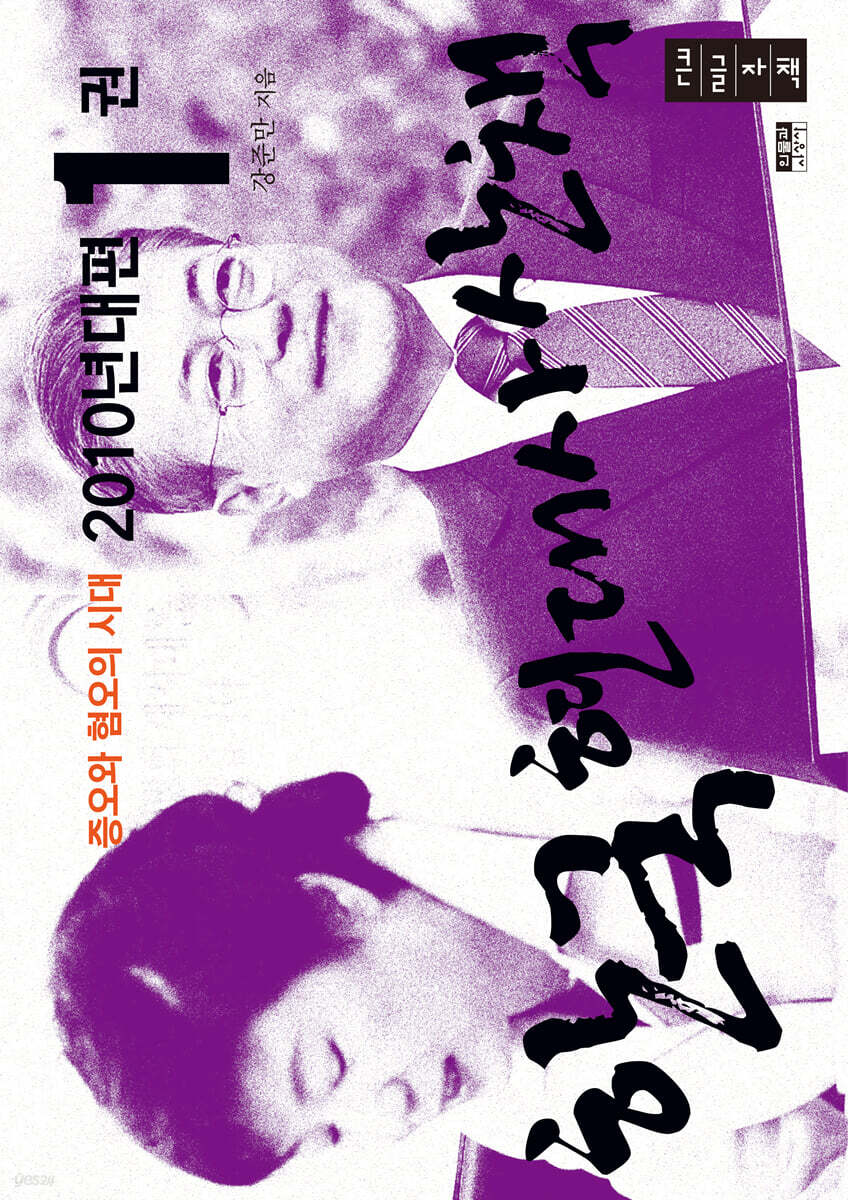
A Walk Through Modern Korean History: 2010s, Volume 1 (Large Print Book)
 |
Description
Book Introduction
How have Korea's politics, economy, society, and culture evolved over the past 10 years?
The modern history of Korea, in which we have lived and in which we live now, is the starting point and the finishing point of history.
Because I have to live in a world where I have to make constant choices.
However, modern history has often been treated as a cold meal in the historical community.
Because these are sensitive topics.
Kang Jun-man presents various positions on controversial issues while also offering his own perspective, thereby providing readers with accurate information and a variety of opportunities for participation.
In that respect, the ‘A Walk Through Modern Korean History’ series is unparalleled.
It is like a Korean's 'treasure trove' that contains everything about the Republic of Korea that made up the 'me' of today.
The "A Walk Through Modern Korean History" series, which meticulously captures 75 years of history from noon on August 15, 1945, to Bong Joon-ho's [Parasite], covers a wide range of fields, from politics, economy, and society to popular culture and sports.
And it brought to life the life and historical stage that modern Koreans had to face.
To this end, the 'A Walk Through Modern Korean History' series attempted a three-dimensional approach through extensive annotations, photographs capturing scenes from the time, and a 'History Walk' corner.
The 'A Walk Through Modern Korean History' series is not limited to a simple listing of events.
'Explosion of Han (恨) and Desire' (1940s), 'Age of Extremes' (1950s), 'Birth of an Opportunist Republic' (1960s), 'Nationalization of Exports' (1970s), 'Gwangju Massacre and the Seoul Olympics' (1980s), 'Division is Our Destiny, Solidarity is My Destiny' (1990s), 'The Light and Shadow of the Roh Moo-hyun Era' (2000s), 'The Age of Hatred and Loathing' (2010s), etc. Numerous events and topics are persistently explored amidst a fierce sense of crisis about the emotions and structures that dominated each era.
And he emphasizes that just as the new generation can seize new values in the name of 'progress', it must also embrace the 'pain' of past generations who had to survive times of extremes and poverty.
Kang Jun-man recognizes that modern Korean history is a history that has excluded 'humanity', and is attempting to restore 'humanity' and, on that basis, to achieve a new reconciliation between ideologies and generations.
The modern history of Korea, in which we have lived and in which we live now, is the starting point and the finishing point of history.
Because I have to live in a world where I have to make constant choices.
However, modern history has often been treated as a cold meal in the historical community.
Because these are sensitive topics.
Kang Jun-man presents various positions on controversial issues while also offering his own perspective, thereby providing readers with accurate information and a variety of opportunities for participation.
In that respect, the ‘A Walk Through Modern Korean History’ series is unparalleled.
It is like a Korean's 'treasure trove' that contains everything about the Republic of Korea that made up the 'me' of today.
The "A Walk Through Modern Korean History" series, which meticulously captures 75 years of history from noon on August 15, 1945, to Bong Joon-ho's [Parasite], covers a wide range of fields, from politics, economy, and society to popular culture and sports.
And it brought to life the life and historical stage that modern Koreans had to face.
To this end, the 'A Walk Through Modern Korean History' series attempted a three-dimensional approach through extensive annotations, photographs capturing scenes from the time, and a 'History Walk' corner.
The 'A Walk Through Modern Korean History' series is not limited to a simple listing of events.
'Explosion of Han (恨) and Desire' (1940s), 'Age of Extremes' (1950s), 'Birth of an Opportunist Republic' (1960s), 'Nationalization of Exports' (1970s), 'Gwangju Massacre and the Seoul Olympics' (1980s), 'Division is Our Destiny, Solidarity is My Destiny' (1990s), 'The Light and Shadow of the Roh Moo-hyun Era' (2000s), 'The Age of Hatred and Loathing' (2010s), etc. Numerous events and topics are persistently explored amidst a fierce sense of crisis about the emotions and structures that dominated each era.
And he emphasizes that just as the new generation can seize new values in the name of 'progress', it must also embrace the 'pain' of past generations who had to survive times of extremes and poverty.
Kang Jun-man recognizes that modern Korean history is a history that has excluded 'humanity', and is attempting to restore 'humanity' and, on that basis, to achieve a new reconciliation between ideologies and generations.
index
Preface: The Age of Hatred and Loathing
In a 'winner-takes-all' world, nothing is visible. · 5 Harmony without dissimilarity and empathy with others. · 7 The political and military industries fostered by the digital revolution. · 9 A time when passion was seething and eyes were bloodshot. · 10 The era of hatred and loathing created by the death of Roh Moo-hyun. · 12
Part 1 2010
Chapter 1: The Dawn of the SNS and Smartphone Revolution
Facebook Surpasses Google · 29 Smartphones and Twitter: The "PC in Your Hand" · 31 The Shock and Dilemma Experiencing the Traditional Media · 33 Social Media That Fosters and Spreads Hatred and Loathing · 34
A Walk Through History 1: The Haiti Earthquake and Social Media · 37
Chapter 2: The Conflicts and Growing Pains Surrounding the Birth of Sejong City
'Administrative City' vs. 'Education, Science, and Economic City' · 39 Is it legitimate publicity or manipulation of public opinion? · 41 The Lee Myung-bak vs. Park Geun-hye confrontation · 43 The victory of the 'Administrative City' · 46
Historical Walk 2: "Where do you live?" The question is a modern-day "hopae" · 49
Chapter 3: The Cheonan Attack That Became a Civil War
The sinking of the Cheonan, which claimed 46 lives · 51 "The Cheonan incident was a military provocation by North Korea." · 53 "71% trust the government's announcement about the Cheonan incident." · 56 The "May 24th Measures" that changed the framework of the "Sunshine Policy." · 57 The conflict between the government and the People's Solidarity for Participatory Democracy. · 59 The Cheonan incident is not over yet. · 61
Chapter 4: The June 2 Local Elections and Seongnam Mayor Lee Jae-myung
The Local Elections Have Become a "Money War" · 64 Is this a showdown between the "North Wind" and the "Roh Wind"? · 66 "The Dead Roh Moo-hyun Beat the Living Lee Myung-bak" · 69 Lee Jae-myung, the Seongnam Mayor Elected on His Fourth Run · 71 Two Perspectives on Lee Jae-myung · 73 Actress Kim Bu-seon: The Beginning of the "Butterfly Effect" · 75
Chapter 5: Yoo Si-min's People's Participation Party, which championed the "Roh Moo-hyun spirit"
The People's Participation Party is the "Yoo Si-min Party" · 78 On the Boundary Between Politicians and Intellectuals · 81 The Gyeonggi Province Gubernatorial Election between Yoo Si-min and Kim Moon-soo · 82 The "Go Beyond the 'Nom-hyeon' Official Business" Incident · 84 An Apology from Yoo Si-min's Longtime Friend Han Hong-gu · 86 A Rebuttal from Kim Seon-ju, a Journalist from the Hankyoreh · 87 A Rebuttal from a Reader Who Supports and Loves Yoo Si-min · 90 Hong Se-hwa's Criticism of the "Fluffiness of Progress" · 92
Chapter 6: The "Civilian Surveillance" and "Political Surveillance" Controversies
The Prime Minister's Office's 'illegal surveillance of civilians' · 94 Jeong Du-eon's lament, who raised suspicions two years ago · 96 "The 'state affairs manipulation by a secret organization' has gone too far" · 98 "Is the president just watching his aides' 'ugly power game'?" · 100 "It feels like we've time-traveled to the Fifth Republic" · 102 "The prosecution covers up state crimes, while the media turns a blind eye" · 104 "The Blue House makes cannon phones and provides them to the ethics office for 'civilian surveillance'" · 106 "The Lee Myung-bak administration is testing the people's patience" · 108
The Reverse Walk 3: The Activities of WikiLeaks, a Website Specializing in Exposure · 111
Chapter 7: "The Democratic Party's Judgment": The July 28th By-elections, and the August 8th Cabinet Reshuffle: "Frictionalization of the Yeongnam Region"
The Grand National Party's July 28th by-election victory · 113 Lee Jae-oh's return, the Four Major Rivers Project gains momentum · 115 "How can we achieve communication and harmony with appointments favored in the Yeongnam region?" · 118 "If you like money, you should be in business. Why do you want to be a minister?" · 120 Lee Myung-bak, a preacher of a "fair society" · 122
Chapter 8: North Korea's shelling of Yeonpyeong Island
North Korea's Establishment of a 'Three-Generation Hereditary System' · 124 North Korea's Atrocities That Killed Four People · 127 "The Lee Myung-bak Administration Has Declined Military Service" · 130 "Is It the People's Army or the 'Yeongpo Line Warlords'?" · 132 The North-South 'Chicken Game' That Has Shifted Into Unpredictable Situations · 135
Chapter 9: The December 8 Budget Crisis and the December 31 Personnel Crisis
Additional Korea-US FTA Negotiations Conclude, Budget and Personnel Disruption · 137 "Lee Sang-deuk Received Over 1 Trillion Won in 'Brother's Budget' Over 3 Years" · 140 "10.2 Trillion Won Needed to Execute 'Brother's Budget' Fully" · 142 "Government Officials Summon Close Aides, Causing Backlash Amongst Others" · 145
Chapter 10: Gangnam Leftist Cho Kuk's "Progressive Power Plan"
Cho Kuk's Gangnam Leftist Image · 147 Is Being Tall and Handsome a Crime? · 150 Why Cho Kuk? · 152 Cho Kuk's 'Strategic Thinking' or 'Grand Design' · 155 Cho Kuk's Transformation: Turning the Prosecution into an Enemy · 158 The 'Yangban Certificate' Remains Alive · 160
Chapter 11: The Second Korean Wave: A Gift from Social Media to Korea
The Korean Wave in Japan, Entering a Stabilizing Phase · 163 When Dramas Stall, Idol Groups Step Up · 165 The Power of Social Media · 168 "'Cuteness' Can't Compete with 'Charisma'" · 170 'Girls' Generation Jisoo' and 'Girls' Generation Management Theory' · 173 "The Second Korean Wave is a Gift from SNS to Korea" · 175 The Story Determines the Success or Failure of a Drama · 177 "Korean Wave Stars Are Too Arrogant" · 179 The 'Idol Exam Fever' That Sees 1.34 Million Audition Participants · 182 'Korean Wave Rogues' and the '7-Year Idol Jinx' · 184
Part 2 2011
Chapter 1: The Lee Myung-bak Administration's "Corruption Scandal"
Corruption Scandals of Four Lee Myung-bak Aides · 189 "Lee Myung-bak's Aides Are 'Partners,' Not 'Political Comrades'" · 191 "MB's Aides, From Journalists, Reek of Remorse" · 193 "Construction of 'Naegok-dong Residence' Stained by Expediencies and Tricks" · 196 Lee Myung-bak: "Our Country is a Noisy Country" · 198 Suspicions of Lee Myung-bak's Private Residence Purchase Top the 'Corruption News' · 200
History Walk 4: Operation Dawn of the Gulf of Aden · 204
Chapter 2: Controversies over the Selection of National Project Sites and the Relocation of Public Enterprises to Local Areas
Controversy over 'Deregulation of the Capital Region' · 207 Controversy over 'Selection of the Science Business Belt Site' · 209 Controversy over 'Construction Site for the New Southeastern Airport' · 211 Lee Myung-bak's 'Rational Perspective' That Sparked a Battle Between North and South Jeolla · 213 "The Lee Myung-bak Administration is a Genius at Dividing Regions" · 215
Chapter 3: Even the "Roh (Moo-hyun) supporters" and "Yoo (Citizen) supporters" are pushed aside by the "Park (Geun-hye) supporters."
Criticism of Park Geun-hye's Silence · 218 "Fear of the 'Park Geun-hye Era'" · 220 The 'Park Geun-hye Backroom Politics' Controversy · 223 The 'Human Curtain' Surrounding Park Geun-hye · 225 "'Pro-Park Secret Organizations' Unknown Even to Park Geun-hye Are Spreading Like Mushrooms After a Rain" · 227
A Walk Through History 5: The Great East Japan Earthquake and the Fukushima Nuclear Accident · 230
Chapter 4: The April 27th By-election and Son Hak-gyu's Resurgence
A Preview of the 2012 Presidential Election? · 232 A Republic of Korea Corrupt in Everywhere · 235 "Son Hak-kyu Returns Alive and the Changing Landscape of the Presidential Election" · 237 Distinguishing Between Progressive and Conservative Is Meaningless · 240
Chapter 5: Why did Moon Jae-in enter politics?
Who Embodies the "Roh Moo-hyun Spirit"? · 243 The "Yoo Si-min is not pro-Roh" Controversy · 245 The "War of Pro-Roh vs. Pro-Roh" in the April 27th By-elections · 247 The "Moon Jae-in Hope" Fueled by "The Fate of Moon Jae-in" · 250 Why the Key Content of "The Fate of Moon Jae-in" Changed · 252
Chapter 6: Fandom Politics: The Meeting of Moon Jae-in and Kim Eo-jun
Moon Jae-in's "Innate Power of Attitude" · 256 Moon Jae-in and Kim Eo-jun's Nationwide Book Concert Tour · 258 The Image of "President Roh Moo-hyun's Chief of Staff" · 261 Kim Eo-jun and Tak Hyun-min, Architects of Moon Jae-in's Fandom Politics · 263
Chapter 7: Seoul Mayor Oh Se-hoon's "Free School Meals" Gamble
The Heated 'Half-Price Tuition' Controversy · 268 What About High School Graduates Who Get Jobs Right Away? · 270 Gambling on the 'Free School Lunch Vote' for the Seoul Mayoralty · 272 Is Oh Se-hoon the 'Right-Wing's Roh Moo-hyun'? · 275 "College Students with Votes, Children in Poverty Without Votes" · 277 The Comedy of "For Free School Lunches: Progressive, Against: Conservative" · 279 "Oh Se-hoon's Self-Righteousness Is Going Too Far" · 283 Oh Se-hoon's Gamble: A Disaster for the Grand National Party · 285
Chapter 8: The Seoul Mayoral By-election and Park Won-soon and Ahn Cheol-soo
Park Won-soon: "I Will Support Hell" · 287 Civic Movements Relying on Samsung's Financial Support · 289 Is Park Won-soon's Role Model Jesus? · 292 Ahn Cheol-soo Emerges as a Preacher of Justice and Fairness · 294 "Ahn Cheol-soo Beats Park Geun-hye" · 296 Park Won-soon 53.40%, Na Kyung-won 46.21% · 299 Launch of Park Geun-hye's Emergency Response Committee · 301
Chapter 9: "I'm a Cheat" Craze, Launch of a General Programming Channel
Is Traffic Broadcasting the spoils of Kim Eo-jun and Park Won-soon? · 304 Kim Eo-jun and Ji Seung-ho's "Shut Up and Do Politics" · 305 "Lee Myung-bak is a Psychopath, Roh Moo-hyun is the Man of Men" · 308 Equating Kwak No-hyun with Roh Moo-hyun · 309 Praise and Criticism of Kim Eo-jun · 312 Why Heo Ji-woong Criticized Kim Eo-jun · 314 "Naggomsu" Is the Extreme of Political Hatred · 315 Is the "Don't Be Afraid" Trap? · 318 Launch of General Programming Channels by Chosun, JoongAng, Donga, and Maeil Business Newspaper · 319
A Walk Through History 6: The Murder of the Mother of the Top Student in the School · 323
Chapter 10: A Country with Eight Property Classes
Homeless people who blame themselves for their own shortcomings · 326 A country where 19% of the population moves every year · 327 Imperial family - royalty - nobles - powerful clans - middle class - commoners - slaves - livestock · 329 "The sorrow of having to live as herbivores on the grasslands" · 331 Land prices in Gangnam, Seoul account for 10% of all land prices · 332
Chapter 11: The Audition Fever and the Hallyu Star Development System
The Birth of CJ E&M and the 'Audition Program Fever' · 336 "I Am a Singer is an Insult to Art" · 337 What Does the Explosive Popularity of [I Am a Singer] Mean? · 339 The Korean Wave Spreads Even to Europe · 343 Lee Soo-man's 'Cultural Technology Theory' and the 'Three-Stage Korean Wave Theory' · 346 SM's Paris Concert and SNS? The Power of YouTube · 349 The 'Shadow of K-Pop' as Seen by the European Media · 353 "Is the Current Idol Training System Good Enough?" · 355 "Negatively Seen Practices Are the Driving Force of the Korean Wave" · 357 "Long-Term Contracts Are the Key to K-Pop's Success" · 360 Is the Media That Ridiculed Lee Soo-man Excessive Remorse? · 362 The Korean Wave and the National Assembly's Passage of the Korea-US FTA Ratification Bill · 364
A Walk Through History 7: Death of North Korean National Defense Commission Chairman Kim Jong-il · 367
A Walk Through History 8: Kim Nan-do's "It Hurts, It's Youth" Craze · 370
Week 372
In a 'winner-takes-all' world, nothing is visible. · 5 Harmony without dissimilarity and empathy with others. · 7 The political and military industries fostered by the digital revolution. · 9 A time when passion was seething and eyes were bloodshot. · 10 The era of hatred and loathing created by the death of Roh Moo-hyun. · 12
Part 1 2010
Chapter 1: The Dawn of the SNS and Smartphone Revolution
Facebook Surpasses Google · 29 Smartphones and Twitter: The "PC in Your Hand" · 31 The Shock and Dilemma Experiencing the Traditional Media · 33 Social Media That Fosters and Spreads Hatred and Loathing · 34
A Walk Through History 1: The Haiti Earthquake and Social Media · 37
Chapter 2: The Conflicts and Growing Pains Surrounding the Birth of Sejong City
'Administrative City' vs. 'Education, Science, and Economic City' · 39 Is it legitimate publicity or manipulation of public opinion? · 41 The Lee Myung-bak vs. Park Geun-hye confrontation · 43 The victory of the 'Administrative City' · 46
Historical Walk 2: "Where do you live?" The question is a modern-day "hopae" · 49
Chapter 3: The Cheonan Attack That Became a Civil War
The sinking of the Cheonan, which claimed 46 lives · 51 "The Cheonan incident was a military provocation by North Korea." · 53 "71% trust the government's announcement about the Cheonan incident." · 56 The "May 24th Measures" that changed the framework of the "Sunshine Policy." · 57 The conflict between the government and the People's Solidarity for Participatory Democracy. · 59 The Cheonan incident is not over yet. · 61
Chapter 4: The June 2 Local Elections and Seongnam Mayor Lee Jae-myung
The Local Elections Have Become a "Money War" · 64 Is this a showdown between the "North Wind" and the "Roh Wind"? · 66 "The Dead Roh Moo-hyun Beat the Living Lee Myung-bak" · 69 Lee Jae-myung, the Seongnam Mayor Elected on His Fourth Run · 71 Two Perspectives on Lee Jae-myung · 73 Actress Kim Bu-seon: The Beginning of the "Butterfly Effect" · 75
Chapter 5: Yoo Si-min's People's Participation Party, which championed the "Roh Moo-hyun spirit"
The People's Participation Party is the "Yoo Si-min Party" · 78 On the Boundary Between Politicians and Intellectuals · 81 The Gyeonggi Province Gubernatorial Election between Yoo Si-min and Kim Moon-soo · 82 The "Go Beyond the 'Nom-hyeon' Official Business" Incident · 84 An Apology from Yoo Si-min's Longtime Friend Han Hong-gu · 86 A Rebuttal from Kim Seon-ju, a Journalist from the Hankyoreh · 87 A Rebuttal from a Reader Who Supports and Loves Yoo Si-min · 90 Hong Se-hwa's Criticism of the "Fluffiness of Progress" · 92
Chapter 6: The "Civilian Surveillance" and "Political Surveillance" Controversies
The Prime Minister's Office's 'illegal surveillance of civilians' · 94 Jeong Du-eon's lament, who raised suspicions two years ago · 96 "The 'state affairs manipulation by a secret organization' has gone too far" · 98 "Is the president just watching his aides' 'ugly power game'?" · 100 "It feels like we've time-traveled to the Fifth Republic" · 102 "The prosecution covers up state crimes, while the media turns a blind eye" · 104 "The Blue House makes cannon phones and provides them to the ethics office for 'civilian surveillance'" · 106 "The Lee Myung-bak administration is testing the people's patience" · 108
The Reverse Walk 3: The Activities of WikiLeaks, a Website Specializing in Exposure · 111
Chapter 7: "The Democratic Party's Judgment": The July 28th By-elections, and the August 8th Cabinet Reshuffle: "Frictionalization of the Yeongnam Region"
The Grand National Party's July 28th by-election victory · 113 Lee Jae-oh's return, the Four Major Rivers Project gains momentum · 115 "How can we achieve communication and harmony with appointments favored in the Yeongnam region?" · 118 "If you like money, you should be in business. Why do you want to be a minister?" · 120 Lee Myung-bak, a preacher of a "fair society" · 122
Chapter 8: North Korea's shelling of Yeonpyeong Island
North Korea's Establishment of a 'Three-Generation Hereditary System' · 124 North Korea's Atrocities That Killed Four People · 127 "The Lee Myung-bak Administration Has Declined Military Service" · 130 "Is It the People's Army or the 'Yeongpo Line Warlords'?" · 132 The North-South 'Chicken Game' That Has Shifted Into Unpredictable Situations · 135
Chapter 9: The December 8 Budget Crisis and the December 31 Personnel Crisis
Additional Korea-US FTA Negotiations Conclude, Budget and Personnel Disruption · 137 "Lee Sang-deuk Received Over 1 Trillion Won in 'Brother's Budget' Over 3 Years" · 140 "10.2 Trillion Won Needed to Execute 'Brother's Budget' Fully" · 142 "Government Officials Summon Close Aides, Causing Backlash Amongst Others" · 145
Chapter 10: Gangnam Leftist Cho Kuk's "Progressive Power Plan"
Cho Kuk's Gangnam Leftist Image · 147 Is Being Tall and Handsome a Crime? · 150 Why Cho Kuk? · 152 Cho Kuk's 'Strategic Thinking' or 'Grand Design' · 155 Cho Kuk's Transformation: Turning the Prosecution into an Enemy · 158 The 'Yangban Certificate' Remains Alive · 160
Chapter 11: The Second Korean Wave: A Gift from Social Media to Korea
The Korean Wave in Japan, Entering a Stabilizing Phase · 163 When Dramas Stall, Idol Groups Step Up · 165 The Power of Social Media · 168 "'Cuteness' Can't Compete with 'Charisma'" · 170 'Girls' Generation Jisoo' and 'Girls' Generation Management Theory' · 173 "The Second Korean Wave is a Gift from SNS to Korea" · 175 The Story Determines the Success or Failure of a Drama · 177 "Korean Wave Stars Are Too Arrogant" · 179 The 'Idol Exam Fever' That Sees 1.34 Million Audition Participants · 182 'Korean Wave Rogues' and the '7-Year Idol Jinx' · 184
Part 2 2011
Chapter 1: The Lee Myung-bak Administration's "Corruption Scandal"
Corruption Scandals of Four Lee Myung-bak Aides · 189 "Lee Myung-bak's Aides Are 'Partners,' Not 'Political Comrades'" · 191 "MB's Aides, From Journalists, Reek of Remorse" · 193 "Construction of 'Naegok-dong Residence' Stained by Expediencies and Tricks" · 196 Lee Myung-bak: "Our Country is a Noisy Country" · 198 Suspicions of Lee Myung-bak's Private Residence Purchase Top the 'Corruption News' · 200
History Walk 4: Operation Dawn of the Gulf of Aden · 204
Chapter 2: Controversies over the Selection of National Project Sites and the Relocation of Public Enterprises to Local Areas
Controversy over 'Deregulation of the Capital Region' · 207 Controversy over 'Selection of the Science Business Belt Site' · 209 Controversy over 'Construction Site for the New Southeastern Airport' · 211 Lee Myung-bak's 'Rational Perspective' That Sparked a Battle Between North and South Jeolla · 213 "The Lee Myung-bak Administration is a Genius at Dividing Regions" · 215
Chapter 3: Even the "Roh (Moo-hyun) supporters" and "Yoo (Citizen) supporters" are pushed aside by the "Park (Geun-hye) supporters."
Criticism of Park Geun-hye's Silence · 218 "Fear of the 'Park Geun-hye Era'" · 220 The 'Park Geun-hye Backroom Politics' Controversy · 223 The 'Human Curtain' Surrounding Park Geun-hye · 225 "'Pro-Park Secret Organizations' Unknown Even to Park Geun-hye Are Spreading Like Mushrooms After a Rain" · 227
A Walk Through History 5: The Great East Japan Earthquake and the Fukushima Nuclear Accident · 230
Chapter 4: The April 27th By-election and Son Hak-gyu's Resurgence
A Preview of the 2012 Presidential Election? · 232 A Republic of Korea Corrupt in Everywhere · 235 "Son Hak-kyu Returns Alive and the Changing Landscape of the Presidential Election" · 237 Distinguishing Between Progressive and Conservative Is Meaningless · 240
Chapter 5: Why did Moon Jae-in enter politics?
Who Embodies the "Roh Moo-hyun Spirit"? · 243 The "Yoo Si-min is not pro-Roh" Controversy · 245 The "War of Pro-Roh vs. Pro-Roh" in the April 27th By-elections · 247 The "Moon Jae-in Hope" Fueled by "The Fate of Moon Jae-in" · 250 Why the Key Content of "The Fate of Moon Jae-in" Changed · 252
Chapter 6: Fandom Politics: The Meeting of Moon Jae-in and Kim Eo-jun
Moon Jae-in's "Innate Power of Attitude" · 256 Moon Jae-in and Kim Eo-jun's Nationwide Book Concert Tour · 258 The Image of "President Roh Moo-hyun's Chief of Staff" · 261 Kim Eo-jun and Tak Hyun-min, Architects of Moon Jae-in's Fandom Politics · 263
Chapter 7: Seoul Mayor Oh Se-hoon's "Free School Meals" Gamble
The Heated 'Half-Price Tuition' Controversy · 268 What About High School Graduates Who Get Jobs Right Away? · 270 Gambling on the 'Free School Lunch Vote' for the Seoul Mayoralty · 272 Is Oh Se-hoon the 'Right-Wing's Roh Moo-hyun'? · 275 "College Students with Votes, Children in Poverty Without Votes" · 277 The Comedy of "For Free School Lunches: Progressive, Against: Conservative" · 279 "Oh Se-hoon's Self-Righteousness Is Going Too Far" · 283 Oh Se-hoon's Gamble: A Disaster for the Grand National Party · 285
Chapter 8: The Seoul Mayoral By-election and Park Won-soon and Ahn Cheol-soo
Park Won-soon: "I Will Support Hell" · 287 Civic Movements Relying on Samsung's Financial Support · 289 Is Park Won-soon's Role Model Jesus? · 292 Ahn Cheol-soo Emerges as a Preacher of Justice and Fairness · 294 "Ahn Cheol-soo Beats Park Geun-hye" · 296 Park Won-soon 53.40%, Na Kyung-won 46.21% · 299 Launch of Park Geun-hye's Emergency Response Committee · 301
Chapter 9: "I'm a Cheat" Craze, Launch of a General Programming Channel
Is Traffic Broadcasting the spoils of Kim Eo-jun and Park Won-soon? · 304 Kim Eo-jun and Ji Seung-ho's "Shut Up and Do Politics" · 305 "Lee Myung-bak is a Psychopath, Roh Moo-hyun is the Man of Men" · 308 Equating Kwak No-hyun with Roh Moo-hyun · 309 Praise and Criticism of Kim Eo-jun · 312 Why Heo Ji-woong Criticized Kim Eo-jun · 314 "Naggomsu" Is the Extreme of Political Hatred · 315 Is the "Don't Be Afraid" Trap? · 318 Launch of General Programming Channels by Chosun, JoongAng, Donga, and Maeil Business Newspaper · 319
A Walk Through History 6: The Murder of the Mother of the Top Student in the School · 323
Chapter 10: A Country with Eight Property Classes
Homeless people who blame themselves for their own shortcomings · 326 A country where 19% of the population moves every year · 327 Imperial family - royalty - nobles - powerful clans - middle class - commoners - slaves - livestock · 329 "The sorrow of having to live as herbivores on the grasslands" · 331 Land prices in Gangnam, Seoul account for 10% of all land prices · 332
Chapter 11: The Audition Fever and the Hallyu Star Development System
The Birth of CJ E&M and the 'Audition Program Fever' · 336 "I Am a Singer is an Insult to Art" · 337 What Does the Explosive Popularity of [I Am a Singer] Mean? · 339 The Korean Wave Spreads Even to Europe · 343 Lee Soo-man's 'Cultural Technology Theory' and the 'Three-Stage Korean Wave Theory' · 346 SM's Paris Concert and SNS? The Power of YouTube · 349 The 'Shadow of K-Pop' as Seen by the European Media · 353 "Is the Current Idol Training System Good Enough?" · 355 "Negatively Seen Practices Are the Driving Force of the Korean Wave" · 357 "Long-Term Contracts Are the Key to K-Pop's Success" · 360 Is the Media That Ridiculed Lee Soo-man Excessive Remorse? · 362 The Korean Wave and the National Assembly's Passage of the Korea-US FTA Ratification Bill · 364
A Walk Through History 7: Death of North Korean National Defense Commission Chairman Kim Jong-il · 367
A Walk Through History 8: Kim Nan-do's "It Hurts, It's Youth" Craze · 370
Week 372
Into the book
When the joint investigation team's findings were released, Lee Myung-bak said, "The scientific and objective investigation by the international investigation team has clearly revealed that the Cheonan incident was a military provocation by North Korea." He added, "We will take firm countermeasures against North Korea, and through strong international cooperation, we must ensure that North Korea admits its wrongdoing and returns to being a responsible member of the international community."
The Blue House said, "The president will soon decide on firm measures to hold North Korea accountable."
The opposition party and civic and unification groups have raised suspicions about the political intentions behind the joint investigation team's announcement, pointing out that it contains a significant logical leap and that the results were a "rigged investigation" conducted ahead of the June 2 local elections.
Democratic Party leader Chung Sye-kyun said, “If it was an attack by North Korea, can we just ignore the security incompetence we experienced at home?
“The President, as the Commander-in-Chief, must take responsibility,” he said, demanding an apology from the President and the resignation of the entire cabinet.
---From “The Cheonan Ship Attack Incident That Became a Civil War, Part 1, Chapter 3”
Lee Myung-bak later said that the reason for nominating Kim Tae-ho was that he “wanted to bring about a generational change throughout society,” but the first thing that struck Kim Tae-ho was the wind of suspicion.
At a confirmation hearing held at the National Assembly on August 24, he admitted that “the problem arose because the property registration was omitted and the information flowed in every year,” and apologized, saying, “Regardless of the reason, it was an oversight that we failed to look into it carefully.”
He also apologized for the alleged abuse of power, including using provincial government employees as housekeepers during his time as governor and allowing his wife to use an official vehicle for personal purposes.
However, he made it clear that he had no intention of resigning voluntarily, saying, “I will strive to communicate with the people to support the President’s philosophy,” citing the “fair society” emphasized by Lee Myung-bak.
---From "Part 1, Chapter 7, "Judgment of the Democratic Party," the July 28th By-election, and the August 8th Cabinet Reshuffle, "Friction of Yeongnam"
This situation can be seen as the background for the need to find new figures outside the established political circles.
With the failure of Moon Kook-hyun, the business card had lost its appeal, so it may have been natural to turn to academia.
Isn't Korea a "university republic" where professors are most actively involved in politics in the world, and the president of Seoul National University is almost guaranteed the position of Prime Minister? With professors like Sohn Hak-kyu achieving great success in politics, what's to say that Cho Kuk can't aim for the presidency? Wouldn't that also be advantageous in attracting female voters? Since democratization, the keyword for elitism has been "charm," and in this regard, Cho Kuk has possessed a remarkable competitive edge.
It seems that was exactly what Oh Yeon-ho noticed.
---From "Part 1, Chapter 10: Gangnam Leftist Cho Kuk's 'Progressive Ruling Plan'"
On February 1, Lee Myung-bak made a statement that reversed his presidential campaign promise regarding the selection of the site for the International Science Business Belt during a "Dialogue with the President" held at the Blue House.
During the presidential election, he promised in his central and South Chungcheong regional pledges, “I will create a city with a population of 500,000 by linking it with the International Science Business Belt to have the functions and self-sufficiency of an administrative complex city.” On this day, he said, “I think I was very interested in getting votes from Chungcheong during the election campaign,” and “Since it is a national centennial plan, it is right to make (the decision) from the perspective of a scientist.”
Daejeon and the Chungcheong region were turned upside down by Lee Myung-bak's remarks about a "blank slate review" regarding the selection of the Science Business Belt site.
South Chungcheong Province Governor Ahn Hee-jung held a press conference at the provincial government building that day and regarded Lee Myung-bak's remarks as a "second Sejong City incident," saying, "I will fight together with the 5 million people of Chungcheong."
Civic groups in the Chungcheong region also strongly opposed it.
---From "Part 2, Chapter 2: Controversies over 'National Project Site Selection' and 'Relocation of Public Enterprises to Local Areas'"
After publishing “The Destiny of Moon Jae-in,” Moon Jae-in held a book concert in Seoul and Busan, and with the launch of the opposition party’s unified organization in the middle of the country, he also showed enthusiasm for concert communication by holding a concert in Changwon, Gwangju, and then again in Seoul under a different name, “Political Concert.”
Supporters who gathered at Moon Jae-in's North Korea concert held at Ewha Girls' High School Concert Hall in Seoul on July 30, 2011, unanimously said, "I don't think I will be betrayed," and "He is serious."
In this position, Kim Eo-jun said that the current political power is “selfish, lies, and does not keep promises.
He claimed, “Moon Jae-in is the sum of the elements that can fill this deficiency,” and Professor Tak Hyun-min of Sungkonghoe University said, “Shouldn’t a righteous person, not someone with a strong will to power, be the president?” and received applause from the audience.
Moon Jae-in resumed the "Moon Jae-in's Destiny" book concerts in Jeonju and Daejeon after Park Won-soon was elected mayor of Seoul in the Seoul mayoral by-election (October 26, 2011), and the response was still enthusiastic.
---From "Part 2, Chapter 6: Fandom Politics, the Meeting of Moon Jae-in and Kim Eo-jun"
While all broadcasters possessed a fiercely competitive mindset, none could surpass the level or intensity of CJ E&M. Perhaps it was only natural that Mnet, a CJ E&M affiliate, would emerge as a leader in "audition programs," where cutthroat competition, a matter of life or death, becomes the driving force.
Mnet had already introduced an audition program called [Superstar K] on July 24, 2009, which drove the Korean pop culture industry into an 'audition fever' for several years.
[Superstar K Season 2] ([Superstar K2]) recorded the highest viewership ratings in cable and satellite channel history in October 2010 (19% for the final episode), which seemed to indicate the future status that CJ E&M would hold in the Korean pop culture industry.
Was it because they were jealous of the success of [Showbiz Korea 2]? In 2011, similar audition programs burst out like a flood on terrestrial and cable broadcasters, including MBC's [The Great Birth], [Sunday Sunday Night - New Employee], SBS's [Miracle Audition], and tvN's [Korea's Got Talent].
The Blue House said, "The president will soon decide on firm measures to hold North Korea accountable."
The opposition party and civic and unification groups have raised suspicions about the political intentions behind the joint investigation team's announcement, pointing out that it contains a significant logical leap and that the results were a "rigged investigation" conducted ahead of the June 2 local elections.
Democratic Party leader Chung Sye-kyun said, “If it was an attack by North Korea, can we just ignore the security incompetence we experienced at home?
“The President, as the Commander-in-Chief, must take responsibility,” he said, demanding an apology from the President and the resignation of the entire cabinet.
---From “The Cheonan Ship Attack Incident That Became a Civil War, Part 1, Chapter 3”
Lee Myung-bak later said that the reason for nominating Kim Tae-ho was that he “wanted to bring about a generational change throughout society,” but the first thing that struck Kim Tae-ho was the wind of suspicion.
At a confirmation hearing held at the National Assembly on August 24, he admitted that “the problem arose because the property registration was omitted and the information flowed in every year,” and apologized, saying, “Regardless of the reason, it was an oversight that we failed to look into it carefully.”
He also apologized for the alleged abuse of power, including using provincial government employees as housekeepers during his time as governor and allowing his wife to use an official vehicle for personal purposes.
However, he made it clear that he had no intention of resigning voluntarily, saying, “I will strive to communicate with the people to support the President’s philosophy,” citing the “fair society” emphasized by Lee Myung-bak.
---From "Part 1, Chapter 7, "Judgment of the Democratic Party," the July 28th By-election, and the August 8th Cabinet Reshuffle, "Friction of Yeongnam"
This situation can be seen as the background for the need to find new figures outside the established political circles.
With the failure of Moon Kook-hyun, the business card had lost its appeal, so it may have been natural to turn to academia.
Isn't Korea a "university republic" where professors are most actively involved in politics in the world, and the president of Seoul National University is almost guaranteed the position of Prime Minister? With professors like Sohn Hak-kyu achieving great success in politics, what's to say that Cho Kuk can't aim for the presidency? Wouldn't that also be advantageous in attracting female voters? Since democratization, the keyword for elitism has been "charm," and in this regard, Cho Kuk has possessed a remarkable competitive edge.
It seems that was exactly what Oh Yeon-ho noticed.
---From "Part 1, Chapter 10: Gangnam Leftist Cho Kuk's 'Progressive Ruling Plan'"
On February 1, Lee Myung-bak made a statement that reversed his presidential campaign promise regarding the selection of the site for the International Science Business Belt during a "Dialogue with the President" held at the Blue House.
During the presidential election, he promised in his central and South Chungcheong regional pledges, “I will create a city with a population of 500,000 by linking it with the International Science Business Belt to have the functions and self-sufficiency of an administrative complex city.” On this day, he said, “I think I was very interested in getting votes from Chungcheong during the election campaign,” and “Since it is a national centennial plan, it is right to make (the decision) from the perspective of a scientist.”
Daejeon and the Chungcheong region were turned upside down by Lee Myung-bak's remarks about a "blank slate review" regarding the selection of the Science Business Belt site.
South Chungcheong Province Governor Ahn Hee-jung held a press conference at the provincial government building that day and regarded Lee Myung-bak's remarks as a "second Sejong City incident," saying, "I will fight together with the 5 million people of Chungcheong."
Civic groups in the Chungcheong region also strongly opposed it.
---From "Part 2, Chapter 2: Controversies over 'National Project Site Selection' and 'Relocation of Public Enterprises to Local Areas'"
After publishing “The Destiny of Moon Jae-in,” Moon Jae-in held a book concert in Seoul and Busan, and with the launch of the opposition party’s unified organization in the middle of the country, he also showed enthusiasm for concert communication by holding a concert in Changwon, Gwangju, and then again in Seoul under a different name, “Political Concert.”
Supporters who gathered at Moon Jae-in's North Korea concert held at Ewha Girls' High School Concert Hall in Seoul on July 30, 2011, unanimously said, "I don't think I will be betrayed," and "He is serious."
In this position, Kim Eo-jun said that the current political power is “selfish, lies, and does not keep promises.
He claimed, “Moon Jae-in is the sum of the elements that can fill this deficiency,” and Professor Tak Hyun-min of Sungkonghoe University said, “Shouldn’t a righteous person, not someone with a strong will to power, be the president?” and received applause from the audience.
Moon Jae-in resumed the "Moon Jae-in's Destiny" book concerts in Jeonju and Daejeon after Park Won-soon was elected mayor of Seoul in the Seoul mayoral by-election (October 26, 2011), and the response was still enthusiastic.
---From "Part 2, Chapter 6: Fandom Politics, the Meeting of Moon Jae-in and Kim Eo-jun"
While all broadcasters possessed a fiercely competitive mindset, none could surpass the level or intensity of CJ E&M. Perhaps it was only natural that Mnet, a CJ E&M affiliate, would emerge as a leader in "audition programs," where cutthroat competition, a matter of life or death, becomes the driving force.
Mnet had already introduced an audition program called [Superstar K] on July 24, 2009, which drove the Korean pop culture industry into an 'audition fever' for several years.
[Superstar K Season 2] ([Superstar K2]) recorded the highest viewership ratings in cable and satellite channel history in October 2010 (19% for the final episode), which seemed to indicate the future status that CJ E&M would hold in the Korean pop culture industry.
Was it because they were jealous of the success of [Showbiz Korea 2]? In 2011, similar audition programs burst out like a flood on terrestrial and cable broadcasters, including MBC's [The Great Birth], [Sunday Sunday Night - New Employee], SBS's [Miracle Audition], and tvN's [Korea's Got Talent].
---From Chapter 11 of Part 2: The Audition Fever and the Korean Wave Star Training System
Publisher's Review
The 2010s, an era of hatred and loathing
The 2010s were an era of hatred and loathing.
In other words, the 2010s were a time when passion was boiling and eyes were bloodshot.
They faced each other, radiating hostility, and shouted that only their side was right.
Political fandoms and those with a strong interest in politics and society, no matter how noble their intentions, ultimately feed on hatred and loathing toward those who stand in the way of realizing those intentions.
In other words, they justified their hatred and loathing by attempting to 'demonize' the other side to prove that they were the object of hatred.
Their competitiveness depended on who could better incite hatred and loathing, driving people to the point of madness.
Their hatred is only activated by the criteria of whether they are on our side or not.
So, as demand for more opportunities to vent their hatred and loathing, and for more racy content, has exploded, star political strategists have ascended to the ranks of spiritual leaders who not only make money but also command the love and respect of consumers.
The "era of hatred and loathing," a major theme of the 2010s, has continued into the 2020s and is now poised to become a structural characteristic of Korean politics.
A world completely free of hatred and loathing is not possible, but it is difficult to regard a world in which hatred and loathing are the fundamental driving force of politics and daily bread as a normal society.
The Lee Myung-bak, Park Geun-hye, and Moon Jae-in administrations that dominated the 2010s were all characterized by a lack of tolerance and restraint.
Even in the Moon Jae-in administration, which was established by the passionate candlelight vigils of the people to overcome a history of lack of tolerance and restraint, there was no tolerance or restraint.
At the time, there was some basis for the opposition parties calling the Moon Jae-in administration a “soft dictatorship.”
If Yoon Seok-yeol had continued to practice the principles of "fairness and common sense" after taking office in 2022, the heat of hatred and loathing would have begun to subside.
However, Yoon Seok-yeol acted as the embodiment of hypocrisy that surpassed the hypocrisy of the Moon Jae-in administration, thereby contributing to inflaming the heat of hatred and loathing.
『A Walk Through Modern Korean History 2010s』 consists of five volumes.
Volume 1 covers the years 2010 and 2011, Volume 2 covers 2012 and 2013, Volume 3 covers 2014 and 2015, Volume 4 covers 2016 and 2017, and Volume 5 covers 2018 and 2019.
Kang Jun-man says that although this book takes the form of a history book, it has a 'bias' that aims for harmony but difference and putting oneself in another's shoes.
This means that rather than being biased towards either the left or right or progressive or conservative, it is important to consider the other person's perspective and empathize with them.
The 2010s were a time of 'maximization' and 'maximization' of politics, more than any other time in the past.
Depending on the logic of the camps, the perspective on the incident could not help but be extreme depending on which side one was on.
British political scientist Jerry Stocker said, “Politics is not about seeking truth or deciding who is right.
“It is a constructive way to live together,” he said.
What we need now is 'coolness' without hatred and loathing.
It is also about creating a community where people on our side and those who are not on our side can live together.
This is a lesson and an ideology that we must know as we move through the 2010s.
Lee Myung-bak declares the original Sejong City plan scrapped.
On the night of November 27, 2009, Lee Myung-bak announced his intention to scrap the original Sejong City plan on the MBC special live broadcast program [Conversation with the People].
Lee Myung-bak's remarks became the epicenter of heated conflict.
While Lee Myung-bak was announcing the scrapping of the Sejong City plan, local residents who had been hoping to become Sejong citizens were holding candlelight vigils, denouncing the scrapping of the administrative city plan.
On January 6, 2010, Prime Minister Chung Un-chan reported to Lee Myung-bak that he would completely change the character of Sejong City from an administrative complex city where nine ministries, two offices, and two agencies would be relocated to a "state-of-the-art education, science, and economic city."
The opposition parties, including the Democratic Party and the Liberty Forward Party, a conservative party in the Chungcheong region, immediately launched a nationwide protest.
Even within the ruling party, the conflict between the pro-Lee and pro-Park factions intensified, and Park Geun-hye emphasized, “The law was created and passed with the fundamental purpose of alleviating overcrowding in the metropolitan area and achieving balanced national development, and the Grand National Party has promised at every election to realize that purpose.”
The conflict surrounding the Sejong City issue entered a period of resolution after the ruling party's defeat in the June 2 local elections.
Lee Myung-bak said, “I ask the National Assembly to make a decision.”
This is a proposal to process it directly through a vote in the National Assembly instead of the method that Lee Myung-bak had maintained of 'decision on the Grand National Party's position → passage through the National Assembly standing committee → vote in the plenary session.'
With this, the controversy over changing the nature of Sejong City's administrative center, which had been going on for about nine months, has come to an end.
Lee Myung-bak said, "I hope that we can leave the evaluation of the National Assembly's decision to history, and move forward together to advance the nation beyond the conflict surrounding Sejong City."
Jeong Un-chan officially announced his intention to resign from the post of Prime Minister after 10 months in office, failing to fulfill his duty of clearing the Sejong City plan.
The 'civilian surveillance' and 'political surveillance' scandals
At the National Assembly's Political Affairs Committee, opposition lawmakers revealed that the Office of the Prime Minister's Ethics Support Office had investigated KB Hanmaeum CEO Kim Jong-ik for posting a video defaming Lee Myung-bak on his personal blog and illegally "searched and seized" his office.
The crux of the matter was that an agency with no authority to conduct surveillance on civilians was turning its sword against the people.
This 'illegal civilian surveillance' scandal spread to the issue of 'Yeongpohoe', a private organization of civil servants.
Lee In-gyu, who conducted the civilian surveillance, is known to have reported the related information to a Blue House official from Yeongpohoe.
The Youngpohoe began to come to the forefront of power when Lee Myung-bak, a native of Pohang, was elected president, and it caused serious controversy in the political world starting in November 2008, the first year of the Lee Myung-bak administration.
The Democratic Party defined the illegal surveillance of civilians as “Yeongpo Gate” and demanded that Lee Myung-bak “disband the Yeongpo Association.”
The 'illegal surveillance of civilians' has spread into a 'political surveillance' controversy after it was revealed that the wife of Nam Kyung-pil, a senior member of the ruling party, was also monitored.
It was also revealed that a comprehensive background check was conducted on other ruling party lawmakers, including Jeong Du-eon and Jeong Tae-geun.
The Seoul Central District Prosecutors' Office's special investigation team announced that it had indicted two people, Lee In-gyu and Kim Chung-gon, and indicted Won Chung-yeon without detention, but the 'victim lawmakers' who were subjected to illegal surveillance, including Nam Gyeong-pil, Jeong Du-eon, and Jeong Tae-geun, and their wives and those around them, expressed strong anger at the prosecution's investigation that only touched on the 'feathers'.
They also publicly named Lee Sang-deuk as the person behind the temple.
Jeong Tae-geun said, “I cannot help but be concerned that Cha Ji-cheol has been living in the Blue House,” and urged the Blue House to hold the person in question accountable.
Oh Se-hoon's "Free School Meals" Gamble
On December 1, 2010, the Seoul Metropolitan Council passed an ordinance providing free school meals to all elementary and middle school students in the Seoul area.
Then, Oh Se-hoon said, “I reject the populist policies that are disguised as welfare policies and are destructive to the country,” and “I will exercise all executive powers of the Seoul mayor to stop the tyranny of the city council.”
Oh Se-hoon, who had proposed a referendum in protest against the Seoul Metropolitan Council's promulgation of an ordinance on free school meals in early 2011, held a press conference immediately after a conservative group submitted a petition to the Seoul Metropolitan Government requesting a referendum on free school meals for students, claiming that "the referendum will be a historic turning point that will put an end to welfare populism."
The strange phenomenon of free school meals emerging as a key issue dividing progressives and conservatives began in the June 2010 local elections.
After that, the political fight continued, with the conservatives splitting into 'selective welfare', which limited free meals to low-income families, and the progressives splitting into 'universal welfare', which provided free meals to everyone.
Oh Se-hoon's opposition to free school meals was due to his 'ambition for power.'
To achieve that ambition, he seemed to think he had to stand out by taking on a huge risk and establishing his own solid brand.
Oh Se-hoon's combative 'frame strategy' faced opposition even within the Grand National Party.
Nam Gyeong-pil, Kim Moon-soo, and others demanded that the referendum on free school meals be halted.
Nam Kyung-pil took a stand against Oh Se-hoon, who is against free welfare, criticizing him for his “self-righteousness going too far.”
Oh Se-hoon officially announced that he would resign from the mayoral position if the voter turnout fell below 33.3%, and the result of the free school lunch referendum was a defeat for Oh Se-hoon with 25.7%, which did not even require counting.
Oh Se-hoon announced his resignation as scheduled at 11 p.m. that night, leaving office after serving only 14 months of his four-year term.
And in the October by-election, he lost the Seoul mayoral seat he had held for nearly 10 years to the Democratic Party, which led to a lot of criticism from within the party, and this became the original sin that greatly hindered his comeback.
A country where 'royalty, royalty, nobles, powerful families, commoners, slaves, and livestock' live
“19% of the population moves every year.
“One in five people, or about 8.7 million people, pack and unpack their belongings each year.” Excluding nomads who move to raise livestock, Koreans have become the world’s largest nomad population.
Community? Society? There was no such thing.
There was only 'my house'.
Apartment owners volunteered for this nomadic life once every five years for profit, but renters were forced into this nomadic life once every three years by the dichotomous demands of “Do you want to lose your bread or raise the rent?”
Apartments were a commodity and a means of financial investment.
In 2007, when the Seoul Metropolitan Government launched its long-term rental housing project, it put forward the slogan, “A home changes from a place to live to a place to live in.” However, it has long been common knowledge that apartments are “things to live in” rather than “places to live in.”
In other words, it is a ‘house for sale’ rather than a ‘house for living’.
So, even though the apartment is on the verge of collapse, a placard saying 'Congratulations! Structural diagnosis passed' is hung.
In the metropolitan area of Korea, there are eight real estate classes: the imperial family, royalty, nobles, powerful families, middle class, commoners, slaves, and livestock.
In February 2011, the 'Metropolitan Area Class Chart' that was circulated online assigned a kind of 'real estate caste' based on the size of the land value in the residential area.
From the 'royal family' at the top, the classes were divided into 'royalty', 'nobles', 'locals', 'commoners', and 'slaves', and the lowest class was considered 'livestock', which could not even be considered human.
Gangnam-gu, Seoul was classified as the most expensive district with land prices exceeding 30 million won per 3.3 square meters, while Gwacheon-si and Songpa-gu, Seocho-gu, and Yongsan-gu, where land prices exceed 22 million won per 3.3 square meters, were included in the "royal" category.
Nowon, Guro, Eunpyeong, Gangbuk, Jungnang, and Ilsandong-gu, which have an income of 11 to 12 million won, were included in the ‘common people’ category.
The residences of the lowest class, 'livestock', with incomes of less than 10 million won were marked as 'Other cities & counties & districts'.
The 2010s were an era of hatred and loathing.
In other words, the 2010s were a time when passion was boiling and eyes were bloodshot.
They faced each other, radiating hostility, and shouted that only their side was right.
Political fandoms and those with a strong interest in politics and society, no matter how noble their intentions, ultimately feed on hatred and loathing toward those who stand in the way of realizing those intentions.
In other words, they justified their hatred and loathing by attempting to 'demonize' the other side to prove that they were the object of hatred.
Their competitiveness depended on who could better incite hatred and loathing, driving people to the point of madness.
Their hatred is only activated by the criteria of whether they are on our side or not.
So, as demand for more opportunities to vent their hatred and loathing, and for more racy content, has exploded, star political strategists have ascended to the ranks of spiritual leaders who not only make money but also command the love and respect of consumers.
The "era of hatred and loathing," a major theme of the 2010s, has continued into the 2020s and is now poised to become a structural characteristic of Korean politics.
A world completely free of hatred and loathing is not possible, but it is difficult to regard a world in which hatred and loathing are the fundamental driving force of politics and daily bread as a normal society.
The Lee Myung-bak, Park Geun-hye, and Moon Jae-in administrations that dominated the 2010s were all characterized by a lack of tolerance and restraint.
Even in the Moon Jae-in administration, which was established by the passionate candlelight vigils of the people to overcome a history of lack of tolerance and restraint, there was no tolerance or restraint.
At the time, there was some basis for the opposition parties calling the Moon Jae-in administration a “soft dictatorship.”
If Yoon Seok-yeol had continued to practice the principles of "fairness and common sense" after taking office in 2022, the heat of hatred and loathing would have begun to subside.
However, Yoon Seok-yeol acted as the embodiment of hypocrisy that surpassed the hypocrisy of the Moon Jae-in administration, thereby contributing to inflaming the heat of hatred and loathing.
『A Walk Through Modern Korean History 2010s』 consists of five volumes.
Volume 1 covers the years 2010 and 2011, Volume 2 covers 2012 and 2013, Volume 3 covers 2014 and 2015, Volume 4 covers 2016 and 2017, and Volume 5 covers 2018 and 2019.
Kang Jun-man says that although this book takes the form of a history book, it has a 'bias' that aims for harmony but difference and putting oneself in another's shoes.
This means that rather than being biased towards either the left or right or progressive or conservative, it is important to consider the other person's perspective and empathize with them.
The 2010s were a time of 'maximization' and 'maximization' of politics, more than any other time in the past.
Depending on the logic of the camps, the perspective on the incident could not help but be extreme depending on which side one was on.
British political scientist Jerry Stocker said, “Politics is not about seeking truth or deciding who is right.
“It is a constructive way to live together,” he said.
What we need now is 'coolness' without hatred and loathing.
It is also about creating a community where people on our side and those who are not on our side can live together.
This is a lesson and an ideology that we must know as we move through the 2010s.
Lee Myung-bak declares the original Sejong City plan scrapped.
On the night of November 27, 2009, Lee Myung-bak announced his intention to scrap the original Sejong City plan on the MBC special live broadcast program [Conversation with the People].
Lee Myung-bak's remarks became the epicenter of heated conflict.
While Lee Myung-bak was announcing the scrapping of the Sejong City plan, local residents who had been hoping to become Sejong citizens were holding candlelight vigils, denouncing the scrapping of the administrative city plan.
On January 6, 2010, Prime Minister Chung Un-chan reported to Lee Myung-bak that he would completely change the character of Sejong City from an administrative complex city where nine ministries, two offices, and two agencies would be relocated to a "state-of-the-art education, science, and economic city."
The opposition parties, including the Democratic Party and the Liberty Forward Party, a conservative party in the Chungcheong region, immediately launched a nationwide protest.
Even within the ruling party, the conflict between the pro-Lee and pro-Park factions intensified, and Park Geun-hye emphasized, “The law was created and passed with the fundamental purpose of alleviating overcrowding in the metropolitan area and achieving balanced national development, and the Grand National Party has promised at every election to realize that purpose.”
The conflict surrounding the Sejong City issue entered a period of resolution after the ruling party's defeat in the June 2 local elections.
Lee Myung-bak said, “I ask the National Assembly to make a decision.”
This is a proposal to process it directly through a vote in the National Assembly instead of the method that Lee Myung-bak had maintained of 'decision on the Grand National Party's position → passage through the National Assembly standing committee → vote in the plenary session.'
With this, the controversy over changing the nature of Sejong City's administrative center, which had been going on for about nine months, has come to an end.
Lee Myung-bak said, "I hope that we can leave the evaluation of the National Assembly's decision to history, and move forward together to advance the nation beyond the conflict surrounding Sejong City."
Jeong Un-chan officially announced his intention to resign from the post of Prime Minister after 10 months in office, failing to fulfill his duty of clearing the Sejong City plan.
The 'civilian surveillance' and 'political surveillance' scandals
At the National Assembly's Political Affairs Committee, opposition lawmakers revealed that the Office of the Prime Minister's Ethics Support Office had investigated KB Hanmaeum CEO Kim Jong-ik for posting a video defaming Lee Myung-bak on his personal blog and illegally "searched and seized" his office.
The crux of the matter was that an agency with no authority to conduct surveillance on civilians was turning its sword against the people.
This 'illegal civilian surveillance' scandal spread to the issue of 'Yeongpohoe', a private organization of civil servants.
Lee In-gyu, who conducted the civilian surveillance, is known to have reported the related information to a Blue House official from Yeongpohoe.
The Youngpohoe began to come to the forefront of power when Lee Myung-bak, a native of Pohang, was elected president, and it caused serious controversy in the political world starting in November 2008, the first year of the Lee Myung-bak administration.
The Democratic Party defined the illegal surveillance of civilians as “Yeongpo Gate” and demanded that Lee Myung-bak “disband the Yeongpo Association.”
The 'illegal surveillance of civilians' has spread into a 'political surveillance' controversy after it was revealed that the wife of Nam Kyung-pil, a senior member of the ruling party, was also monitored.
It was also revealed that a comprehensive background check was conducted on other ruling party lawmakers, including Jeong Du-eon and Jeong Tae-geun.
The Seoul Central District Prosecutors' Office's special investigation team announced that it had indicted two people, Lee In-gyu and Kim Chung-gon, and indicted Won Chung-yeon without detention, but the 'victim lawmakers' who were subjected to illegal surveillance, including Nam Gyeong-pil, Jeong Du-eon, and Jeong Tae-geun, and their wives and those around them, expressed strong anger at the prosecution's investigation that only touched on the 'feathers'.
They also publicly named Lee Sang-deuk as the person behind the temple.
Jeong Tae-geun said, “I cannot help but be concerned that Cha Ji-cheol has been living in the Blue House,” and urged the Blue House to hold the person in question accountable.
Oh Se-hoon's "Free School Meals" Gamble
On December 1, 2010, the Seoul Metropolitan Council passed an ordinance providing free school meals to all elementary and middle school students in the Seoul area.
Then, Oh Se-hoon said, “I reject the populist policies that are disguised as welfare policies and are destructive to the country,” and “I will exercise all executive powers of the Seoul mayor to stop the tyranny of the city council.”
Oh Se-hoon, who had proposed a referendum in protest against the Seoul Metropolitan Council's promulgation of an ordinance on free school meals in early 2011, held a press conference immediately after a conservative group submitted a petition to the Seoul Metropolitan Government requesting a referendum on free school meals for students, claiming that "the referendum will be a historic turning point that will put an end to welfare populism."
The strange phenomenon of free school meals emerging as a key issue dividing progressives and conservatives began in the June 2010 local elections.
After that, the political fight continued, with the conservatives splitting into 'selective welfare', which limited free meals to low-income families, and the progressives splitting into 'universal welfare', which provided free meals to everyone.
Oh Se-hoon's opposition to free school meals was due to his 'ambition for power.'
To achieve that ambition, he seemed to think he had to stand out by taking on a huge risk and establishing his own solid brand.
Oh Se-hoon's combative 'frame strategy' faced opposition even within the Grand National Party.
Nam Gyeong-pil, Kim Moon-soo, and others demanded that the referendum on free school meals be halted.
Nam Kyung-pil took a stand against Oh Se-hoon, who is against free welfare, criticizing him for his “self-righteousness going too far.”
Oh Se-hoon officially announced that he would resign from the mayoral position if the voter turnout fell below 33.3%, and the result of the free school lunch referendum was a defeat for Oh Se-hoon with 25.7%, which did not even require counting.
Oh Se-hoon announced his resignation as scheduled at 11 p.m. that night, leaving office after serving only 14 months of his four-year term.
And in the October by-election, he lost the Seoul mayoral seat he had held for nearly 10 years to the Democratic Party, which led to a lot of criticism from within the party, and this became the original sin that greatly hindered his comeback.
A country where 'royalty, royalty, nobles, powerful families, commoners, slaves, and livestock' live
“19% of the population moves every year.
“One in five people, or about 8.7 million people, pack and unpack their belongings each year.” Excluding nomads who move to raise livestock, Koreans have become the world’s largest nomad population.
Community? Society? There was no such thing.
There was only 'my house'.
Apartment owners volunteered for this nomadic life once every five years for profit, but renters were forced into this nomadic life once every three years by the dichotomous demands of “Do you want to lose your bread or raise the rent?”
Apartments were a commodity and a means of financial investment.
In 2007, when the Seoul Metropolitan Government launched its long-term rental housing project, it put forward the slogan, “A home changes from a place to live to a place to live in.” However, it has long been common knowledge that apartments are “things to live in” rather than “places to live in.”
In other words, it is a ‘house for sale’ rather than a ‘house for living’.
So, even though the apartment is on the verge of collapse, a placard saying 'Congratulations! Structural diagnosis passed' is hung.
In the metropolitan area of Korea, there are eight real estate classes: the imperial family, royalty, nobles, powerful families, middle class, commoners, slaves, and livestock.
In February 2011, the 'Metropolitan Area Class Chart' that was circulated online assigned a kind of 'real estate caste' based on the size of the land value in the residential area.
From the 'royal family' at the top, the classes were divided into 'royalty', 'nobles', 'locals', 'commoners', and 'slaves', and the lowest class was considered 'livestock', which could not even be considered human.
Gangnam-gu, Seoul was classified as the most expensive district with land prices exceeding 30 million won per 3.3 square meters, while Gwacheon-si and Songpa-gu, Seocho-gu, and Yongsan-gu, where land prices exceed 22 million won per 3.3 square meters, were included in the "royal" category.
Nowon, Guro, Eunpyeong, Gangbuk, Jungnang, and Ilsandong-gu, which have an income of 11 to 12 million won, were included in the ‘common people’ category.
The residences of the lowest class, 'livestock', with incomes of less than 10 million won were marked as 'Other cities & counties & districts'.
GOODS SPECIFICS
- Date of issue: March 25, 2025
- Page count, weight, size: 404 pages | 210*297*30mm
- ISBN13: 9788959067886
- ISBN10: 8959067881
You may also like
카테고리
korean


korean

![GQ KOREA Mark (Monthly): December [2025]](http://librairie.coreenne.fr/cdn/shop/files/8ef265dbbfbf186523ed75ba7319009d.jpg?v=1765340328&width=3840)


