

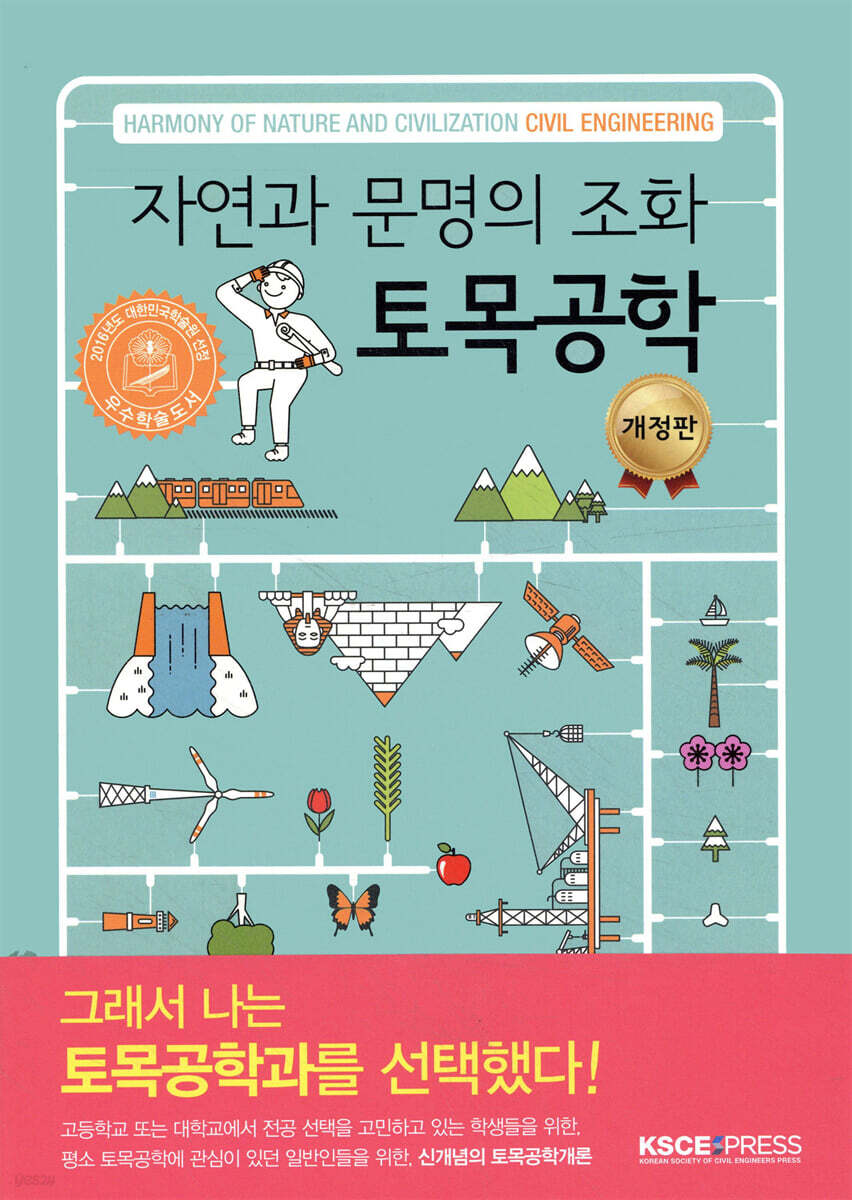
Civil Engineering: Harmony between Nature and Civilization
 |
Description
Book Introduction
For students who are considering choosing a major in high school or college,
A new concept in civil engineering for the general public interested in civil engineering.
This book, produced as part of the Korean Society of Civil Engineers' publication project, was designed to provide knowledge related to civil engineering to new students who have entered the Department of Civil Engineering but have not yet taken major courses and are therefore unsure of what they will study in the future or what career paths they can choose after graduation. However, it has also been created so that anyone interested in civil engineering can easily understand it.
The first edition was written over two years with the efforts of 21 writing committee members and 13 planning committee members. It explains the past, present, and future of civil engineering in 12 topics in an easy-to-understand manner with many photos and illustrations, allowing readers to feel familiar with civil engineering. It is also fun to read as it includes stories of civil engineering encountered in everyday life and examples of interesting phenomena or stories that we often overlook.
The first edition published in this way was recognized for its excellence in content immediately after publication and was selected as an outstanding academic book by the National Academy of Sciences of the Republic of Korea in 2016.
This revised edition, which came out three years after the first edition in 2015, actively reflected the results of an online survey of approximately 340 people about the first edition. New content on construction management majors that had been omitted from the first edition was added, and some content was supplemented or deleted to cover 13 topics. In addition, assignments are included at the end of each chapter so that students can assign them as homework when using the textbook.
In particular, this revised edition will be provided with a lecture PPT that will be helpful to professors who teach introduction to civil engineering at each university and use 'Civil Engineering in Harmony with Nature and Civilization' as a textbook.
A new concept in civil engineering for the general public interested in civil engineering.
This book, produced as part of the Korean Society of Civil Engineers' publication project, was designed to provide knowledge related to civil engineering to new students who have entered the Department of Civil Engineering but have not yet taken major courses and are therefore unsure of what they will study in the future or what career paths they can choose after graduation. However, it has also been created so that anyone interested in civil engineering can easily understand it.
The first edition was written over two years with the efforts of 21 writing committee members and 13 planning committee members. It explains the past, present, and future of civil engineering in 12 topics in an easy-to-understand manner with many photos and illustrations, allowing readers to feel familiar with civil engineering. It is also fun to read as it includes stories of civil engineering encountered in everyday life and examples of interesting phenomena or stories that we often overlook.
The first edition published in this way was recognized for its excellence in content immediately after publication and was selected as an outstanding academic book by the National Academy of Sciences of the Republic of Korea in 2016.
This revised edition, which came out three years after the first edition in 2015, actively reflected the results of an online survey of approximately 340 people about the first edition. New content on construction management majors that had been omitted from the first edition was added, and some content was supplemented or deleted to cover 13 topics. In addition, assignments are included at the end of each chapter so that students can assign them as homework when using the textbook.
In particular, this revised edition will be provided with a lecture PPT that will be helpful to professors who teach introduction to civil engineering at each university and use 'Civil Engineering in Harmony with Nature and Civilization' as a textbook.
- You can preview some of the book's contents.
Preview
index
Chapter 1 I choose.
The Road to Civil Engineering! _ Lim Yun-muk / Moon Ji-young Without civil engineering, there would be no today. See beyond what is visible. It's time to return to nature. Adding happiness and sharing sorrow through civil engineering. The city is on the rise.
Chapter 2: Civil Engineering Technology with the Development of Civilization _ Kim Cheol-yeong / Park Seon-gyu: Civil Engineering Begins with Human History: Korean Construction Expands into the World of Civil Engineering and the Development of Modern Society
Chapter 3: Natural Disasters and the Environment _ Jae-woo Park / Jong-oh Kim Disasters, warnings from nature Disaster prevention, science to prevent disasters Clear and clean water Pleasant and clean air Soil, waste management: recycling of resources
Chapter 4: Communication between People and Goods _ Choi Jae-seong / Lee Dong-min Transportation facilities help people and goods communicate: various forms and facilities of communication
Chapter 5: Connecting Time and Space, Bridges and Structures _ Kim Ho-kyung / Song Jun-ho The Value of Bridges The Form of Bridges The Aesthetics of Bridges The Management of Bridges The Future of Bridges
Chapter 6 Another World, Development of Underground Space _ Kim Byeong-il / Kim Yeong-geun There is no structure without a foundation. Development and utilization of underground space, tunnels and passages dug through the ground.
Chapter 7 Water, the source of life and civilization _ Kang Bu-sik / Yoo Cheol-sang Water, the condition of human survival The formation process of rivers and their future Various means of storing water Various means of supplying water Natural disasters caused by water The impact of global warming and climate change Protect water: Water Security
Chapter 8: Human Life and the Sea _ Won-Cheol Cho / Seong-Won Shin The Sea and Its Role Marine Resources and Energy Sources Coastal Structures and Ports Pollution in the Ocean
Chapter 9: Energy Production and Resource Processing, Power Plants/Plant Sectors _ Sangyoung Kim / Donghoon Kim: What Should We Learn About Plant Civil Engineering? The Definition of Plants: Civil Engineering in Power Generation and Desalination Plants: Civil Engineering in Desalination Plants
Chapter 10 Location Information, Changing the World _ Son Hong-gyu Location observation began with the emergence of civilization. Criteria for location observation. Methods for observing locations. Methods for creating spatial information.
Chapter 11: Construction Management (CM), Increase Project Value _ Seungheon Han / Seokho Ji The Key to Construction Project Success: CM: Preparing for the Future of the Construction Industry, from Construction Project Planning to Maintenance
Chapter 12: Civil Engineering and the Future _ Cho Dae-yeon / Jang Bong-seok Future social outlook and the role of civil engineering Evolution of civil engineering and social systems The future of civil engineering using high technology
Chapter 13: What Do Civil Engineers Do? _ Shim Chang-soo / Kim Young-jin What Do Civil Engineers Do? The Path to Becoming a Civil Engineer What Civil Engineers Need to Learn Future Civil Engineers
The Road to Civil Engineering! _ Lim Yun-muk / Moon Ji-young Without civil engineering, there would be no today. See beyond what is visible. It's time to return to nature. Adding happiness and sharing sorrow through civil engineering. The city is on the rise.
Chapter 2: Civil Engineering Technology with the Development of Civilization _ Kim Cheol-yeong / Park Seon-gyu: Civil Engineering Begins with Human History: Korean Construction Expands into the World of Civil Engineering and the Development of Modern Society
Chapter 3: Natural Disasters and the Environment _ Jae-woo Park / Jong-oh Kim Disasters, warnings from nature Disaster prevention, science to prevent disasters Clear and clean water Pleasant and clean air Soil, waste management: recycling of resources
Chapter 4: Communication between People and Goods _ Choi Jae-seong / Lee Dong-min Transportation facilities help people and goods communicate: various forms and facilities of communication
Chapter 5: Connecting Time and Space, Bridges and Structures _ Kim Ho-kyung / Song Jun-ho The Value of Bridges The Form of Bridges The Aesthetics of Bridges The Management of Bridges The Future of Bridges
Chapter 6 Another World, Development of Underground Space _ Kim Byeong-il / Kim Yeong-geun There is no structure without a foundation. Development and utilization of underground space, tunnels and passages dug through the ground.
Chapter 7 Water, the source of life and civilization _ Kang Bu-sik / Yoo Cheol-sang Water, the condition of human survival The formation process of rivers and their future Various means of storing water Various means of supplying water Natural disasters caused by water The impact of global warming and climate change Protect water: Water Security
Chapter 8: Human Life and the Sea _ Won-Cheol Cho / Seong-Won Shin The Sea and Its Role Marine Resources and Energy Sources Coastal Structures and Ports Pollution in the Ocean
Chapter 9: Energy Production and Resource Processing, Power Plants/Plant Sectors _ Sangyoung Kim / Donghoon Kim: What Should We Learn About Plant Civil Engineering? The Definition of Plants: Civil Engineering in Power Generation and Desalination Plants: Civil Engineering in Desalination Plants
Chapter 10 Location Information, Changing the World _ Son Hong-gyu Location observation began with the emergence of civilization. Criteria for location observation. Methods for observing locations. Methods for creating spatial information.
Chapter 11: Construction Management (CM), Increase Project Value _ Seungheon Han / Seokho Ji The Key to Construction Project Success: CM: Preparing for the Future of the Construction Industry, from Construction Project Planning to Maintenance
Chapter 12: Civil Engineering and the Future _ Cho Dae-yeon / Jang Bong-seok Future social outlook and the role of civil engineering Evolution of civil engineering and social systems The future of civil engineering using high technology
Chapter 13: What Do Civil Engineers Do? _ Shim Chang-soo / Kim Young-jin What Do Civil Engineers Do? The Path to Becoming a Civil Engineer What Civil Engineers Need to Learn Future Civil Engineers
Publisher's Review
This book was written so that anyone interested in civil engineering, as well as students majoring in civil engineering, can easily understand it.
You will be able to feel more familiar with civil engineering by using visual materials such as photographs and drawings.
You will be able to feel more familiar with civil engineering by using visual materials such as photographs and drawings.
GOODS SPECIFICS
- Date of publication: December 21, 2018
- Page count, weight, size: 432 pages | 821g | 176*250*30mm
- ISBN13: 9791156107194
- ISBN10: 1156107199
You may also like
카테고리
korean


korean

![GQ KOREA Mark (Monthly): December [2025]](http://librairie.coreenne.fr/cdn/shop/files/8ef265dbbfbf186523ed75ba7319009d.jpg?v=1765340328&width=3840)


