

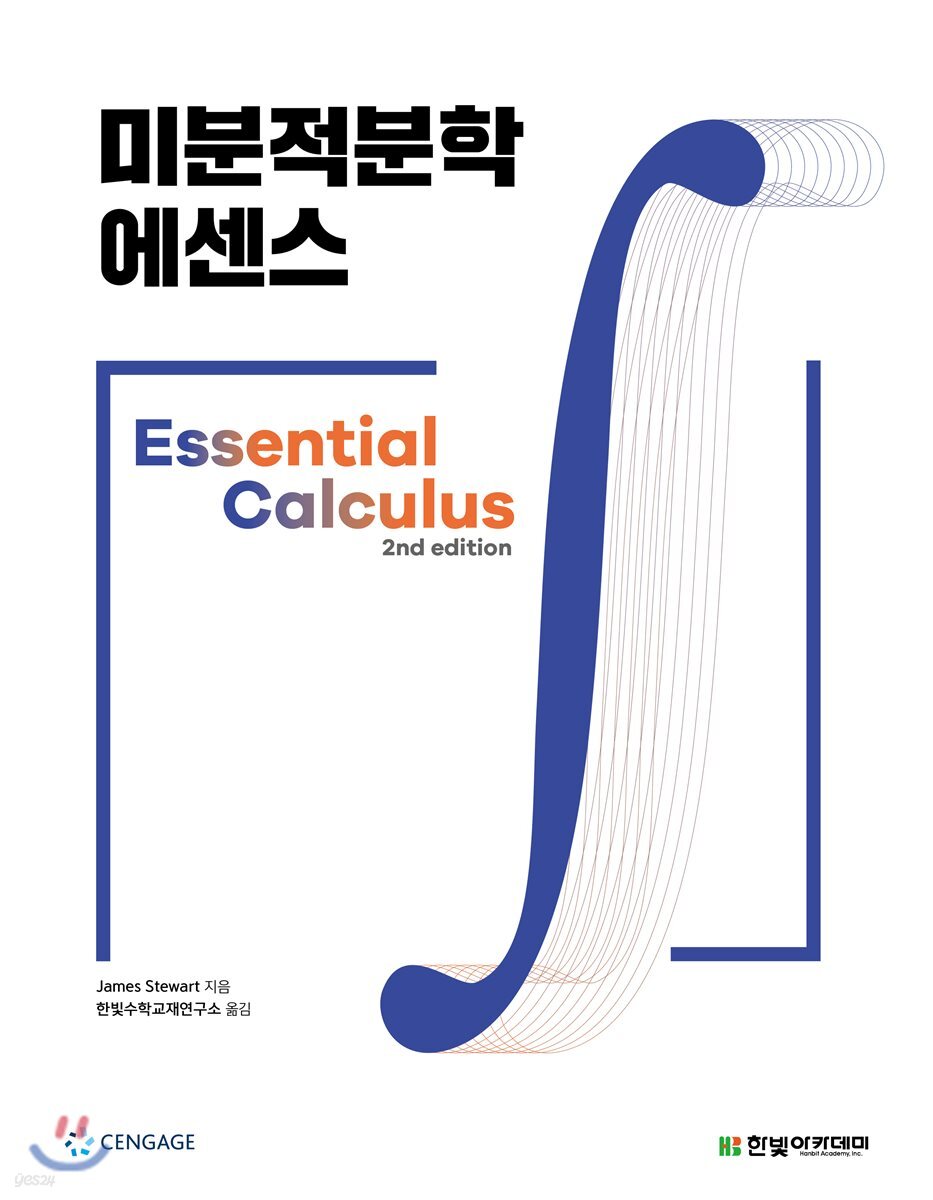
The Essence of Calculus
 |
Description
Book Introduction
A book that reflects the reality of calculus education in Korea and the needs of instructors.
Learn the essentials of calculus with verified content.
This book, written by James Stewart, a best-selling author in the field of differential and integral calculus, is aimed at students in science and engineering fields.
You can systematically learn the basic and comprehensive contents of differentiation and integration with content that has already been verified as much as the author's reputation.
The content is clear, accurate, and full of relevant, real-world examples.
In particular, this book actively reflects feedback from instructors who felt that most calculus textbooks were too thick, and aims to reduce the burden of learning by reducing the volume.
Next, we reorganized the original text's Chapter 5, 'Inverse Functions', Chapter 9, 'Parametric Equations and Polar Coordinates', and Chapter 10, 'Vectors and Spatial Geometry', to make differential and integral calculus easier for students to understand, without damaging the original author's writing philosophy.
Learn the essentials of calculus with verified content.
This book, written by James Stewart, a best-selling author in the field of differential and integral calculus, is aimed at students in science and engineering fields.
You can systematically learn the basic and comprehensive contents of differentiation and integration with content that has already been verified as much as the author's reputation.
The content is clear, accurate, and full of relevant, real-world examples.
In particular, this book actively reflects feedback from instructors who felt that most calculus textbooks were too thick, and aims to reduce the burden of learning by reducing the volume.
Next, we reorganized the original text's Chapter 5, 'Inverse Functions', Chapter 9, 'Parametric Equations and Polar Coordinates', and Chapter 10, 'Vectors and Spatial Geometry', to make differential and integral calculus easier for students to understand, without damaging the original author's writing philosophy.
- You can preview some of the book's contents.
Preview
index
Chapter 1 Functions and Limits
1.1 Definition and expression of functions
1.2 List of essential functions
1.3 Limits of functions
1.4 Limit Calculations
1.5 Continuity
1.6 Limits involving infinity
Review questions
Chapter 2 Inverse Functions: Exponential Functions, Logarithmic Functions, and Inverse Trigonometric Functions
2.1 Inverse function
2.2 Exponential functions
2.3 Logarithmic function
2.4 Inverse trigonometric functions
2.5 Hyperbolic functions
Review questions
Chapter 3 Derivatives
3.1 Differential coefficient and rate of change
3.2 Derivative as a function
3.3 Basic Differentiation Formulas
3.4 Rules of Multiplication and Division
3.5 Chain Law
3.6 Differentiation of implicit functions
3.7 Derivative of the inverse function
3.8 Related ratio
3.9 Linear approximation and differentiation
Review questions
Chapter 4 Applications of Derivatives
4.1 Maximum and Minimum Values
4.2 Mean value theorem
4.3 Derivatives and the Shape of Graphs
4.4 Drawing a Curve
4.5 Indefinite Forms and L'Hopital's Rule
4.6 Optimization Problem
4.7 Inverse derivatives
Review questions
Chapter 5 Integration
5.1 Area
5.2 Definite integral
5.3 Calculating definite integrals
5.4 Fundamental Theorem of Calculus
5.5 Substitution method
Review questions
Chapter 6 Integration
6.1 Integration by parts
6.2 Trigonometric integration and trigonometric substitution
6.3 Partial fraction method
6.4 Approximate integration
6.5 Ideal integral
Review questions
Chapter 7 Applications of Integration
7.1 Area between curves
7.2 Volume
7.3 Volume by cylindrical shell
7.4 Length of the arc
7.5 Surface area of a solid of revolution
Review questions
Chapter 8 series
8.1 Sequences
8.2 series
8.3 Integral and comparative judgment methods
8.4 Other convergence tests
8.5 Power series
8.6 Expressing a function as a power series
8.7 Taylor series and Maclaurin series
8.8 Applications of Taylor polynomials
Review questions
Chapter 9 Parametric Equations and Vectors
9.1 Parameter Curves
9.2 Polar Coordinates
9.3 Matrices and Determinants
9.4 Vectors
9.5 Inner and outer products
9.6 Equations of lines and planes
Review questions
Chapter 10 Partial Derivatives
10.1 Multivariable functions
10.2 Limits and Continuity
10.3 Partial derivatives
10.4 Tangent planes and linear approximations
10.5 Chain Law
10.6 Maximum and Minimum Values
Review questions
Chapter 11 Double Integrals
11.1 Double integrals in rectangular domains
11.2 Double integrals in general domains
11.3 Double integral in polar coordinates
11.4 Triple Integral
11.5 Triple integral in cylindrical coordinates
11.6 Triple integral in spherical coordinates
Review questions
Search
1.1 Definition and expression of functions
1.2 List of essential functions
1.3 Limits of functions
1.4 Limit Calculations
1.5 Continuity
1.6 Limits involving infinity
Review questions
Chapter 2 Inverse Functions: Exponential Functions, Logarithmic Functions, and Inverse Trigonometric Functions
2.1 Inverse function
2.2 Exponential functions
2.3 Logarithmic function
2.4 Inverse trigonometric functions
2.5 Hyperbolic functions
Review questions
Chapter 3 Derivatives
3.1 Differential coefficient and rate of change
3.2 Derivative as a function
3.3 Basic Differentiation Formulas
3.4 Rules of Multiplication and Division
3.5 Chain Law
3.6 Differentiation of implicit functions
3.7 Derivative of the inverse function
3.8 Related ratio
3.9 Linear approximation and differentiation
Review questions
Chapter 4 Applications of Derivatives
4.1 Maximum and Minimum Values
4.2 Mean value theorem
4.3 Derivatives and the Shape of Graphs
4.4 Drawing a Curve
4.5 Indefinite Forms and L'Hopital's Rule
4.6 Optimization Problem
4.7 Inverse derivatives
Review questions
Chapter 5 Integration
5.1 Area
5.2 Definite integral
5.3 Calculating definite integrals
5.4 Fundamental Theorem of Calculus
5.5 Substitution method
Review questions
Chapter 6 Integration
6.1 Integration by parts
6.2 Trigonometric integration and trigonometric substitution
6.3 Partial fraction method
6.4 Approximate integration
6.5 Ideal integral
Review questions
Chapter 7 Applications of Integration
7.1 Area between curves
7.2 Volume
7.3 Volume by cylindrical shell
7.4 Length of the arc
7.5 Surface area of a solid of revolution
Review questions
Chapter 8 series
8.1 Sequences
8.2 series
8.3 Integral and comparative judgment methods
8.4 Other convergence tests
8.5 Power series
8.6 Expressing a function as a power series
8.7 Taylor series and Maclaurin series
8.8 Applications of Taylor polynomials
Review questions
Chapter 9 Parametric Equations and Vectors
9.1 Parameter Curves
9.2 Polar Coordinates
9.3 Matrices and Determinants
9.4 Vectors
9.5 Inner and outer products
9.6 Equations of lines and planes
Review questions
Chapter 10 Partial Derivatives
10.1 Multivariable functions
10.2 Limits and Continuity
10.3 Partial derivatives
10.4 Tangent planes and linear approximations
10.5 Chain Law
10.6 Maximum and Minimum Values
Review questions
Chapter 11 Double Integrals
11.1 Double integrals in rectangular domains
11.2 Double integrals in general domains
11.3 Double integral in polar coordinates
11.4 Triple Integral
11.5 Triple integral in cylindrical coordinates
11.6 Triple integral in spherical coordinates
Review questions
Search
Publisher's Review
① James Stewart's textbook, which has been verified in Korea for many years, has been reconfigured to suit the domestic classroom environment.
② Reduces the vast amount of content in differential and integral calculus to half, providing an easy learning volume.
③ [For learners] All answers to the practice problems in the book are provided in the [Resource Room].
④ [For lecturers] A package of lecture supplementary materials is provided for efficient lectures.
② Reduces the vast amount of content in differential and integral calculus to half, providing an easy learning volume.
③ [For learners] All answers to the practice problems in the book are provided in the [Resource Room].
④ [For lecturers] A package of lecture supplementary materials is provided for efficient lectures.
GOODS SPECIFICS
- Date of issue: March 1, 2018
- Page count, weight, size: 516 pages | 1,227g | 210*270*35mm
- ISBN13: 9791156643685
- ISBN10: 1156643686
You may also like
카테고리
korean


korean

![GQ KOREA Mark (Monthly): December [2025]](http://librairie.coreenne.fr/cdn/shop/files/8ef265dbbfbf186523ed75ba7319009d.jpg?v=1765340328&width=3840)


