

Motherhood Community: Women, Independence, and Activism
 |
Description
Book Introduction
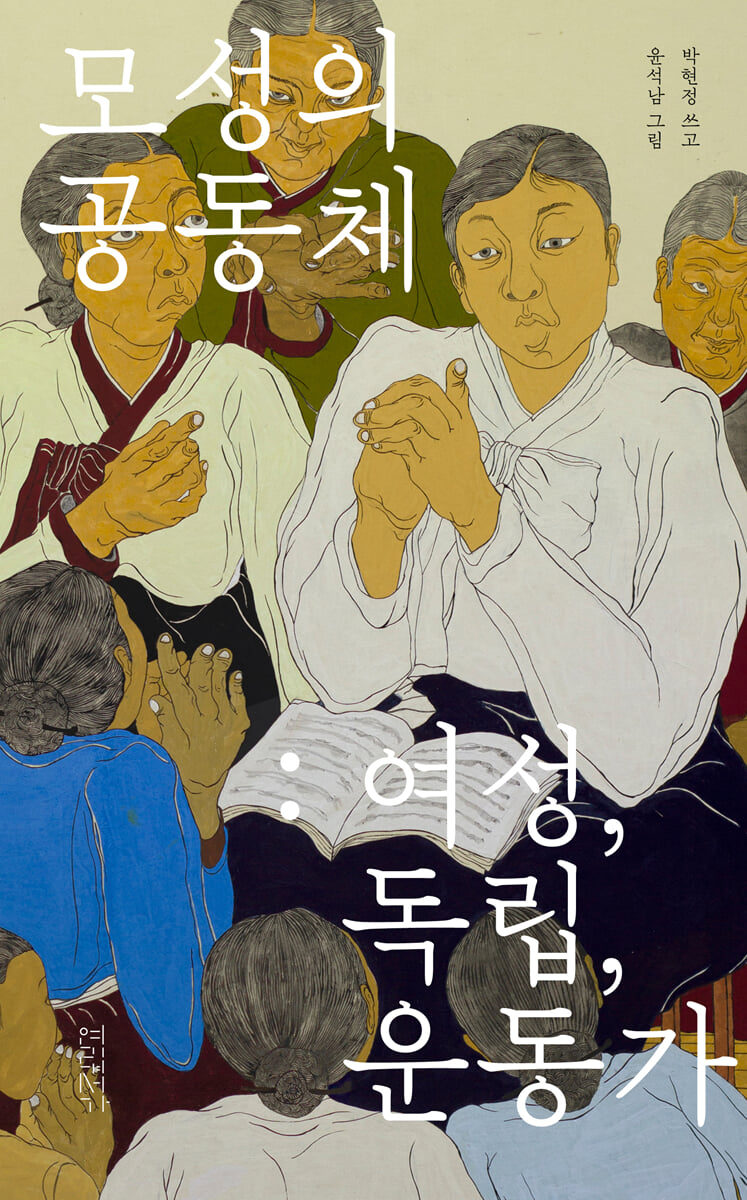
Artist Seoknam Yoon, who is known as the 'godmother of Korean feminist art' and continues to be active, is currently focusing on a series of portraits of '100 female independence activists'.
This book, a sequel to 『Fighting Women, Becoming History』(Hankyoreh Publishing, 2021), is written in the form of letters delivered to female independence activists by visiting their sites, following their trajectories as created by Seoknam Yun.
Yoon Hee-soon, Kim Hyang-hwa, Kwon Ae-ra, Shim Myeong-cheol, Eo Yun-hee, Shin Kwan-bin, Lim Myeong-ae, Yu Gwan-sun, Kaneko Fumiko, Lee Ae-ra, Choi Yong-shin, Cha Mi-ri-sa.
The twelve protagonists of this book tried to embrace those around them and save the weak in a time when women were socially more vulnerable than they are today.
Park Hyeon-jeong's letters, written while visiting Kangwon National University's Central Museum, Deoksugung Palace, Seodaemun Prison History Museum, Mungyeong Saejae Pass, Choi Yong-shin Memorial Hall, and Deoksung Women's University, are a response to the lives of female independence activists and Yun Seok-nam's series of works.
This book, a sequel to 『Fighting Women, Becoming History』(Hankyoreh Publishing, 2021), is written in the form of letters delivered to female independence activists by visiting their sites, following their trajectories as created by Seoknam Yun.
Yoon Hee-soon, Kim Hyang-hwa, Kwon Ae-ra, Shim Myeong-cheol, Eo Yun-hee, Shin Kwan-bin, Lim Myeong-ae, Yu Gwan-sun, Kaneko Fumiko, Lee Ae-ra, Choi Yong-shin, Cha Mi-ri-sa.
The twelve protagonists of this book tried to embrace those around them and save the weak in a time when women were socially more vulnerable than they are today.
Park Hyeon-jeong's letters, written while visiting Kangwon National University's Central Museum, Deoksugung Palace, Seodaemun Prison History Museum, Mungyeong Saejae Pass, Choi Yong-shin Memorial Hall, and Deoksung Women's University, are a response to the lives of female independence activists and Yun Seok-nam's series of works.
- You can preview some of the book's contents.
Preview
index
0.
Invitation letter
1.
A sentence that the righteous army leader Yun Hee-sun did not write in the Haepyeong Yun Clan Records
:The sea of the 『Jasaneobo』 and the Kangwon National University Central Museum in Chuncheon
2.
The parasite Kim Hyang-hwa and the endlessly chilling scenery in front of Suwon Police Station
: Apricot tree in Seogeodang of Deoksugung Palace
3.
To cell number 8, Park Yeon Falls, and Kim Hyang-hwa, Kwon Ae-ra, Sim Myeong-cheol, Eo Yun-hee, Shin Gwan-bin, Lim Myeong-ae, and Yu Gwan-sun
: Seodaemun Prison History Museum, Women's Prison
4.
'No Emperor System', Fumiko Kaneko, 1926
: Passing Seobongchong and Mungyeongsaejae, to Ginza Street, which has entered the Reiwa era.
5.
There is no mountain 7, but there is a baby grave of Iara everywhere.
Arcadia and Ahyeon-dong Manri Reservoir Park found at the used bookstore Manyu Gravity
6.
Choi Yong-shin, "The One and Only Servant, the One and Only Queen"
: Dangjin's beach and Ansan's Choi Yong-shin Memorial Hall
7.
From 'Seobseobi' to 'Kim Mi-ri-sa' and then to 'Cha Mi-ri-sa'
: Gamgodang-gil in Anguk-dong and Deoksung Women's University in Ssangmun-dong
Glossary of Terms
Materials and References
8.
Four notes - Marathon, Mojave, Forty, and Motherhood
: To Professor Yoon Seok-nam
Invitation letter
1.
A sentence that the righteous army leader Yun Hee-sun did not write in the Haepyeong Yun Clan Records
:The sea of the 『Jasaneobo』 and the Kangwon National University Central Museum in Chuncheon
2.
The parasite Kim Hyang-hwa and the endlessly chilling scenery in front of Suwon Police Station
: Apricot tree in Seogeodang of Deoksugung Palace
3.
To cell number 8, Park Yeon Falls, and Kim Hyang-hwa, Kwon Ae-ra, Sim Myeong-cheol, Eo Yun-hee, Shin Gwan-bin, Lim Myeong-ae, and Yu Gwan-sun
: Seodaemun Prison History Museum, Women's Prison
4.
'No Emperor System', Fumiko Kaneko, 1926
: Passing Seobongchong and Mungyeongsaejae, to Ginza Street, which has entered the Reiwa era.
5.
There is no mountain 7, but there is a baby grave of Iara everywhere.
Arcadia and Ahyeon-dong Manri Reservoir Park found at the used bookstore Manyu Gravity
6.
Choi Yong-shin, "The One and Only Servant, the One and Only Queen"
: Dangjin's beach and Ansan's Choi Yong-shin Memorial Hall
7.
From 'Seobseobi' to 'Kim Mi-ri-sa' and then to 'Cha Mi-ri-sa'
: Gamgodang-gil in Anguk-dong and Deoksung Women's University in Ssangmun-dong
Glossary of Terms
Materials and References
8.
Four notes - Marathon, Mojave, Forty, and Motherhood
: To Professor Yoon Seok-nam
Detailed image

Into the book
Even Jeong Yak-jeon, who was fascinated by the new civilization and the world of equality without wages, would have found it difficult to imagine that a woman from a noble family would be manufacturing ammunition just a century later.
When the Joseon army was forcibly disbanded in 1907, you purchased brass and copper with the help of the wife of the Goheung Yu clan and women from a nearby village.
It was amazing that you ran an ammunition factory to supply the volunteer army, but when it comes to your actions, I have to start from 1895.
When Empress Myeongseong was assassinated, you followed your father-in-law, Yu Hong-seok, and decided to join the volunteer army. You were thirty-six years old and the mother of a one-year-old baby.
However, since she decided to leave home with her father-in-law, it is only natural to expect that she would continue the anti-Japanese movement for the next 40 years.
---From "Yoon Hee-soon"
This year I've had the luxury of taking spring walks at Deoksugung Palace several times.
While working on the art gallery catalog, I enjoyed the garden filled with azaleas and rhododendrons, and walked along the stone wall path.
The title of the catalog is ‘Garden of Imagination’.
The artists planned to create a virtual garden by finding traces of modernity remaining throughout Deoksugung Palace and adding their own imagination.
It was a real pleasure to walk through Deoksugung Palace with people from 100 years ago, checking out where the artwork would be placed.
The people who often accompanied me were modern women who carried parasols and wore pointed shoes.
We also looked at the stone garden where author Seoknam Yoon would build a new woman made of abandoned trees.
As I recalled the new era dreamed of by the woman who emerged as a "walker" after being confined to her home, my steps became lighter.
---From "Kim Hyang-hwa"
I went into cell number 8 and looked at your photos lined up next to each other.
Kim Hyang-hwa, who became a gisaeng at the age of 15 due to her family's circumstances, and Kwon Ae-ra, whose father was active in his only daughter's education, had different social statuses.
1 What kind of world would the parasite and the kindergarten teacher, who would never have met if it weren't for the movement, have dreamed of together?
The stories you created when you first met in Cell No. 8, with different backgrounds and places of residence, kept coming to mind.
When Gisaeng Kim Hyang-hwa taught “Gaeseong Nanbongga” to Kwon Ae-ra, a kindergarten teacher, and when Im Myeong-ae, who was imprisoned while nine months pregnant, returned with her newborn baby after giving birth, Yu Gwan-sun put a wet diaper on her body to dry her.
Eo Yun-hee gave up her food to Yu Gwan-sun, who could not sleep due to the pain of hunger.
---From "Cell No. 8"
If you were capable of even a little rational judgment, it would be a joke to think that a secret society was formed in a house with a wooden sign that said 'Bulyeongsa Temple'.
Yet, instead of asserting your innocence from prison, you and Park Yeol devote all your energy and time to fighting the Emperor.
Park Yeol exposed the exploitation of Joseon by Japanese imperialism and predicted the downfall of the imperial state, and you criticize Japan as being nothing more than an empty institution that serves the selfish desires of a small privileged class, even though it calls itself a divine nation based on the imperial system.
---From "Kaneko Fumiko"
The bus driver told everyone to sit down because the bus was about to start going uphill, and to not ask any more questions.
Hearing that made me want to ask even more.
Also for passengers climbing Ahyeon Pass with their bodies tilted backwards at about 15 degrees.
Do you know Lee Ae-ra, an independence activist whose baby was taken away from her somewhere in the mountains?
Even as the baby was lifted from its mother's arms into the hands of the Japanese military police and lifted into the air, it probably didn't know what 'death' was.
When the Japanese military police threw the child to the ground, the slope turned into a steep cliff and in an instant you fell down it.
I see your back as you are dragged away by the military police, your heart shattered.
---From "Lee Ae-ra"
You drop out of school and head to Samgol in 1931, but you are not accepted from the start as a new woman from the city.
When I mentioned the importance of hygiene and improving living conditions, the residents criticized me, saying, “No one has died from fly bites, so what do you know?”
Even Yeom Seok-ju, who later became a strong supporter, confessed that when he first saw you, he looked down on you and said, “In a time when even the best people couldn’t achieve anything in the countryside, what could a girl like you possibly be capable of?”
That's not really surprising.
To them, you were “a young girl who inherited a desk” and “a young woman who didn’t know the ways of the world.”
How common was the deep-rooted discrimination and prejudice against women in the 1930s, like a pebble kicked under one's foot?
---From "Choi Yong-shin"
As I walked back down the road, now with two names, I thought about the many names you had.
A name that was taken away by force, a name you didn't want, a name you created yourself.
The name of the girls' school you founded, 'Geunhwa (Mugunghwa),' was taken away by the Governor-General of Korea for being subversive, and had to be changed to 'Deokseong' in 1938.
Although the chrysanthemum was not designated as the national flower, it was once the national flower of this country.
Starting with the currency produced in 1892, the Geumhwa was engraved on military uniforms and medals, and when Korea was annexed by Japan in 1910, Maecheon Hwang Hyeon, who committed suicide, lamented in his last poem, “The Geumhwa World has fallen.”
Even without that, the name of the school that was a thorn in their side because it was promoting national education was 'Geunhwa', so even if it was the name of a flower, it would have been ominous and unsettling in their eyes.
---From "Cha Mirisa"
This is also the reason why the subtitle of this book is ‘Women’, ‘Independence’, and ‘Activists’.
This is because the 'women' who were the weak were 'activists' who tried to achieve 'independence' not only for Joseon but also for themselves and others.
You have always said, “Art is a question about my existence.”
This is in line with the realization that for female independence activists, finding their country meant finding themselves.
When we think back to a time when it was common for women to not have proper names, to wear swaddling clothes outside, and to have no access to education, we cannot help but be amazed at their courage.
Wouldn't it be right to call it 'motherhood that extends one's love to society'?
Looking at the portraits of female independence activists stacked neatly in the storage room next to the studio, I wondered what stage of ‘evolution of motherhood’ she was going through this time.
When the Joseon army was forcibly disbanded in 1907, you purchased brass and copper with the help of the wife of the Goheung Yu clan and women from a nearby village.
It was amazing that you ran an ammunition factory to supply the volunteer army, but when it comes to your actions, I have to start from 1895.
When Empress Myeongseong was assassinated, you followed your father-in-law, Yu Hong-seok, and decided to join the volunteer army. You were thirty-six years old and the mother of a one-year-old baby.
However, since she decided to leave home with her father-in-law, it is only natural to expect that she would continue the anti-Japanese movement for the next 40 years.
---From "Yoon Hee-soon"
This year I've had the luxury of taking spring walks at Deoksugung Palace several times.
While working on the art gallery catalog, I enjoyed the garden filled with azaleas and rhododendrons, and walked along the stone wall path.
The title of the catalog is ‘Garden of Imagination’.
The artists planned to create a virtual garden by finding traces of modernity remaining throughout Deoksugung Palace and adding their own imagination.
It was a real pleasure to walk through Deoksugung Palace with people from 100 years ago, checking out where the artwork would be placed.
The people who often accompanied me were modern women who carried parasols and wore pointed shoes.
We also looked at the stone garden where author Seoknam Yoon would build a new woman made of abandoned trees.
As I recalled the new era dreamed of by the woman who emerged as a "walker" after being confined to her home, my steps became lighter.
---From "Kim Hyang-hwa"
I went into cell number 8 and looked at your photos lined up next to each other.
Kim Hyang-hwa, who became a gisaeng at the age of 15 due to her family's circumstances, and Kwon Ae-ra, whose father was active in his only daughter's education, had different social statuses.
1 What kind of world would the parasite and the kindergarten teacher, who would never have met if it weren't for the movement, have dreamed of together?
The stories you created when you first met in Cell No. 8, with different backgrounds and places of residence, kept coming to mind.
When Gisaeng Kim Hyang-hwa taught “Gaeseong Nanbongga” to Kwon Ae-ra, a kindergarten teacher, and when Im Myeong-ae, who was imprisoned while nine months pregnant, returned with her newborn baby after giving birth, Yu Gwan-sun put a wet diaper on her body to dry her.
Eo Yun-hee gave up her food to Yu Gwan-sun, who could not sleep due to the pain of hunger.
---From "Cell No. 8"
If you were capable of even a little rational judgment, it would be a joke to think that a secret society was formed in a house with a wooden sign that said 'Bulyeongsa Temple'.
Yet, instead of asserting your innocence from prison, you and Park Yeol devote all your energy and time to fighting the Emperor.
Park Yeol exposed the exploitation of Joseon by Japanese imperialism and predicted the downfall of the imperial state, and you criticize Japan as being nothing more than an empty institution that serves the selfish desires of a small privileged class, even though it calls itself a divine nation based on the imperial system.
---From "Kaneko Fumiko"
The bus driver told everyone to sit down because the bus was about to start going uphill, and to not ask any more questions.
Hearing that made me want to ask even more.
Also for passengers climbing Ahyeon Pass with their bodies tilted backwards at about 15 degrees.
Do you know Lee Ae-ra, an independence activist whose baby was taken away from her somewhere in the mountains?
Even as the baby was lifted from its mother's arms into the hands of the Japanese military police and lifted into the air, it probably didn't know what 'death' was.
When the Japanese military police threw the child to the ground, the slope turned into a steep cliff and in an instant you fell down it.
I see your back as you are dragged away by the military police, your heart shattered.
---From "Lee Ae-ra"
You drop out of school and head to Samgol in 1931, but you are not accepted from the start as a new woman from the city.
When I mentioned the importance of hygiene and improving living conditions, the residents criticized me, saying, “No one has died from fly bites, so what do you know?”
Even Yeom Seok-ju, who later became a strong supporter, confessed that when he first saw you, he looked down on you and said, “In a time when even the best people couldn’t achieve anything in the countryside, what could a girl like you possibly be capable of?”
That's not really surprising.
To them, you were “a young girl who inherited a desk” and “a young woman who didn’t know the ways of the world.”
How common was the deep-rooted discrimination and prejudice against women in the 1930s, like a pebble kicked under one's foot?
---From "Choi Yong-shin"
As I walked back down the road, now with two names, I thought about the many names you had.
A name that was taken away by force, a name you didn't want, a name you created yourself.
The name of the girls' school you founded, 'Geunhwa (Mugunghwa),' was taken away by the Governor-General of Korea for being subversive, and had to be changed to 'Deokseong' in 1938.
Although the chrysanthemum was not designated as the national flower, it was once the national flower of this country.
Starting with the currency produced in 1892, the Geumhwa was engraved on military uniforms and medals, and when Korea was annexed by Japan in 1910, Maecheon Hwang Hyeon, who committed suicide, lamented in his last poem, “The Geumhwa World has fallen.”
Even without that, the name of the school that was a thorn in their side because it was promoting national education was 'Geunhwa', so even if it was the name of a flower, it would have been ominous and unsettling in their eyes.
---From "Cha Mirisa"
This is also the reason why the subtitle of this book is ‘Women’, ‘Independence’, and ‘Activists’.
This is because the 'women' who were the weak were 'activists' who tried to achieve 'independence' not only for Joseon but also for themselves and others.
You have always said, “Art is a question about my existence.”
This is in line with the realization that for female independence activists, finding their country meant finding themselves.
When we think back to a time when it was common for women to not have proper names, to wear swaddling clothes outside, and to have no access to education, we cannot help but be amazed at their courage.
Wouldn't it be right to call it 'motherhood that extends one's love to society'?
Looking at the portraits of female independence activists stacked neatly in the storage room next to the studio, I wondered what stage of ‘evolution of motherhood’ she was going through this time.
---From "Yoon Seok-nam"
Publisher's Review
1) Until Yoon Seok-nam drew a female independence activist
Before I got married, I worked to help my single mother pay for my younger siblings' tuition, and after I got married, I lived as a full-time housewife, taking care of my mother-in-law. But there were days when I couldn't sleep because I kept asking myself, "What am I doing now?"
Eventually, I became so depressed that I would only go grocery shopping when I ran out of food at home.
I decided to become an artist and started drawing and painting.
Then, as if it couldn't be helped, he started talking about his mother.
A mother who lost her husband at the age of 39 and raised six children while building a house out of mud bricks, never once worrying about making a living in front of her children.
Rather, it was the story of Won Jeong-suk, a warm-hearted mother who would invite merchants to her home, feed them, or even let them stay overnight.
After holding her first solo exhibition in 1982, she began to tell her own story through [Pink Room] after completing work on her mother for 10 years.
Even though my husband's business prospered and we had three rooms, the only free space was the chair in front of the dining table.
One day, while walking down the street, I picked up a restaurant chair that someone had thrown away, and while making a wooden model of the woman sitting on it, I met women of this era who were in similar situations.
In addition, through [Heo Nanseolheon], he reached out to women of the past who were sacrificed in a patriarchal society, and continued his gaze toward the weak with [1,025: With and Without People], a wooden sculpture of an abandoned dog.
2) Female independence activists depicted in a new medium called Korean painting
The reason why Seoknam Yoon took on the challenge of a new medium called Korean painting is clear.
He has mentioned in several interviews that he was shocked as if he had been hit by a hammer after seeing Yun Du-seo's "Self-Portrait" at the National Museum of Korea.
"I realized that a painting can shake the soul like this," and as I looked through a book of Korean portraits, I realized it again.
I was surprised to find that there were only two portraits of women in a thick portrait book, and then I felt resentful that "women are treated so poorly."
Nevertheless, I was moved by the fact that women were also angry when their country was falling and risked their lives to fight against the Japanese.
Yoon Seok-nam asks the question, "Where did the strength come from that enabled a socially disadvantaged woman to come forward and fight back?" and obtains the following answer.
"Risking one's life to confidently find oneself." Yun Seok-nam has long said, "Art is a question about my existence."
This is in line with the realization that for female independence activists, finding their country meant finding themselves.
Even though he began painting in his forties, Seoknam Yoon was never conscious of his age.
When I held my first solo exhibition at the Arko Art Center (then the Art Center) at the age of 43, I didn't care that I hadn't graduated from art school or that people called me a "housewife artist."
Age, academic background, and worldly prejudices were of no importance to her, who had already decided to dedicate her life to painting.
Rather, the inner heat that had been building up while confined to the home until the age of forty led him to hold a solo exhibition just two years after he began painting, and then to exhibitions in Tokyo, New York, Beijing, and other places, leading him to become an artist who communicates with many people of this era.
3) Seven letters, twelve recipients, kindness and affection for the underprivileged around them.
The letter included in this book begins with a letter to Yun Hee-sun, the leader of the Righteous Army who composed songs for the Righteous Army and fought in an armed struggle against Japan in China.
The protagonists of the second and third letters are Kim Hyang-hwa, a gisaeng who participated in the independence movement, and Kwon Ae-ra, Shim Myeong-cheol, Eo Yun-hee, Shin Gwan-bin, Lim Myeong-ae, and Yu Gwan-sun, who were imprisoned with her in the women's prison of Seodaemun Prison.
Kim Hyang-hwa was imprisoned in cell number 8 in Suwon, Kwon Ae-ra, Shim Myeong-cheol, Eo Yun-hee, and Shin Gwan-bin in Gaeseong, Lim Myeong-ae in Paju, and Yu Gwan-sun in Seoul and Cheonan on charges of participating in the March 1st Movement (Sim Myeong-cheol was imprisoned as a visually impaired person, Lim Myeong-ae was pregnant, and Yu Gwan-sun was a minor).
The fourth protagonist is Fumiko Kaneko, a Japanese woman who stands on the side of the oppressed and opposes Japanese imperialism and the imperial system.
The remaining letters are addressed to Lee Ae-ra, who lost her child to the Japanese military police while fighting for independence; Choi Yong-shin, the real-life protagonist of the novel “Evergreen Tree” who died young while participating in the rural enlightenment movement; and Cha Mi-ri-sa, who founded Geunhwa Girls’ School, the predecessor of Deoksung Women’s University, and devoted herself to women’s education.
The protagonists of this book tried to help and save the weak in a time when women's social status was incomparably lower than it is today.
Yun Hee-soon, who said to welcome even the common people when they came to your house; Yu Gwan-soon, who wore wet diapers on her body to dry the baby who was imprisoned with its mother; Kim Hyang-hwa, who led a protest for the rights of gisaengs; Kwon Ae-ra, who advocated for free love according to women's will; Choi Yong-shin, who used honorifics even for children; Cha Mi-ri-sa, who gave educational opportunities to gisaengs and their wives...
Their sense of duty to protect their country, their kindness and empathy for the weak, and their conviction and righteousness in resisting injustice even at the cost of their own lives, move our hearts.
4) About the title of this book: Author's Note
“I really want to tell you this, I hope you don’t take the meaning of ‘motherhood’ too passively.
If you interpret the meaning of motherhood narrowly, it can actually have an anti-feminine meaning.
The motherhood I want to talk about is not something as simple as giving birth to and raising a child, but rather the power to restore, love, and cherish the power of nature that is being destroyed by material civilization.
The power that can embrace the contradictory life of the universe itself is motherhood.
“Let me say this again: the motherhood I’m talking about isn’t the kind that means having lots of children and raising them, or sacrificing yourself for your children.” (Yoon Seok-nam)
“Teacher Yoon Seok-nam said, “When you love your children, you end up embracing those around you.
Extending one's love to society.
For example, he has been focusing on women's 'motherhood' by saying, "Being interested in ecological issues is motherhood."
It would be an extension of the same idea to discover and capture on canvas the female independence activist who practiced ‘motherhood that extended her love to society.’
The characters in the book were born in a time when it was taken for granted that they did not have proper names or access to education.
Nevertheless, when I recall that they lived as 'activists' who sought to achieve 'independence' not only for colonial Korea but also for themselves and others, I cannot help but be amazed by their courage.” (Park Hyeon-jeong)
Before I got married, I worked to help my single mother pay for my younger siblings' tuition, and after I got married, I lived as a full-time housewife, taking care of my mother-in-law. But there were days when I couldn't sleep because I kept asking myself, "What am I doing now?"
Eventually, I became so depressed that I would only go grocery shopping when I ran out of food at home.
I decided to become an artist and started drawing and painting.
Then, as if it couldn't be helped, he started talking about his mother.
A mother who lost her husband at the age of 39 and raised six children while building a house out of mud bricks, never once worrying about making a living in front of her children.
Rather, it was the story of Won Jeong-suk, a warm-hearted mother who would invite merchants to her home, feed them, or even let them stay overnight.
After holding her first solo exhibition in 1982, she began to tell her own story through [Pink Room] after completing work on her mother for 10 years.
Even though my husband's business prospered and we had three rooms, the only free space was the chair in front of the dining table.
One day, while walking down the street, I picked up a restaurant chair that someone had thrown away, and while making a wooden model of the woman sitting on it, I met women of this era who were in similar situations.
In addition, through [Heo Nanseolheon], he reached out to women of the past who were sacrificed in a patriarchal society, and continued his gaze toward the weak with [1,025: With and Without People], a wooden sculpture of an abandoned dog.
2) Female independence activists depicted in a new medium called Korean painting
The reason why Seoknam Yoon took on the challenge of a new medium called Korean painting is clear.
He has mentioned in several interviews that he was shocked as if he had been hit by a hammer after seeing Yun Du-seo's "Self-Portrait" at the National Museum of Korea.
"I realized that a painting can shake the soul like this," and as I looked through a book of Korean portraits, I realized it again.
I was surprised to find that there were only two portraits of women in a thick portrait book, and then I felt resentful that "women are treated so poorly."
Nevertheless, I was moved by the fact that women were also angry when their country was falling and risked their lives to fight against the Japanese.
Yoon Seok-nam asks the question, "Where did the strength come from that enabled a socially disadvantaged woman to come forward and fight back?" and obtains the following answer.
"Risking one's life to confidently find oneself." Yun Seok-nam has long said, "Art is a question about my existence."
This is in line with the realization that for female independence activists, finding their country meant finding themselves.
Even though he began painting in his forties, Seoknam Yoon was never conscious of his age.
When I held my first solo exhibition at the Arko Art Center (then the Art Center) at the age of 43, I didn't care that I hadn't graduated from art school or that people called me a "housewife artist."
Age, academic background, and worldly prejudices were of no importance to her, who had already decided to dedicate her life to painting.
Rather, the inner heat that had been building up while confined to the home until the age of forty led him to hold a solo exhibition just two years after he began painting, and then to exhibitions in Tokyo, New York, Beijing, and other places, leading him to become an artist who communicates with many people of this era.
3) Seven letters, twelve recipients, kindness and affection for the underprivileged around them.
The letter included in this book begins with a letter to Yun Hee-sun, the leader of the Righteous Army who composed songs for the Righteous Army and fought in an armed struggle against Japan in China.
The protagonists of the second and third letters are Kim Hyang-hwa, a gisaeng who participated in the independence movement, and Kwon Ae-ra, Shim Myeong-cheol, Eo Yun-hee, Shin Gwan-bin, Lim Myeong-ae, and Yu Gwan-sun, who were imprisoned with her in the women's prison of Seodaemun Prison.
Kim Hyang-hwa was imprisoned in cell number 8 in Suwon, Kwon Ae-ra, Shim Myeong-cheol, Eo Yun-hee, and Shin Gwan-bin in Gaeseong, Lim Myeong-ae in Paju, and Yu Gwan-sun in Seoul and Cheonan on charges of participating in the March 1st Movement (Sim Myeong-cheol was imprisoned as a visually impaired person, Lim Myeong-ae was pregnant, and Yu Gwan-sun was a minor).
The fourth protagonist is Fumiko Kaneko, a Japanese woman who stands on the side of the oppressed and opposes Japanese imperialism and the imperial system.
The remaining letters are addressed to Lee Ae-ra, who lost her child to the Japanese military police while fighting for independence; Choi Yong-shin, the real-life protagonist of the novel “Evergreen Tree” who died young while participating in the rural enlightenment movement; and Cha Mi-ri-sa, who founded Geunhwa Girls’ School, the predecessor of Deoksung Women’s University, and devoted herself to women’s education.
The protagonists of this book tried to help and save the weak in a time when women's social status was incomparably lower than it is today.
Yun Hee-soon, who said to welcome even the common people when they came to your house; Yu Gwan-soon, who wore wet diapers on her body to dry the baby who was imprisoned with its mother; Kim Hyang-hwa, who led a protest for the rights of gisaengs; Kwon Ae-ra, who advocated for free love according to women's will; Choi Yong-shin, who used honorifics even for children; Cha Mi-ri-sa, who gave educational opportunities to gisaengs and their wives...
Their sense of duty to protect their country, their kindness and empathy for the weak, and their conviction and righteousness in resisting injustice even at the cost of their own lives, move our hearts.
4) About the title of this book: Author's Note
“I really want to tell you this, I hope you don’t take the meaning of ‘motherhood’ too passively.
If you interpret the meaning of motherhood narrowly, it can actually have an anti-feminine meaning.
The motherhood I want to talk about is not something as simple as giving birth to and raising a child, but rather the power to restore, love, and cherish the power of nature that is being destroyed by material civilization.
The power that can embrace the contradictory life of the universe itself is motherhood.
“Let me say this again: the motherhood I’m talking about isn’t the kind that means having lots of children and raising them, or sacrificing yourself for your children.” (Yoon Seok-nam)
“Teacher Yoon Seok-nam said, “When you love your children, you end up embracing those around you.
Extending one's love to society.
For example, he has been focusing on women's 'motherhood' by saying, "Being interested in ecological issues is motherhood."
It would be an extension of the same idea to discover and capture on canvas the female independence activist who practiced ‘motherhood that extended her love to society.’
The characters in the book were born in a time when it was taken for granted that they did not have proper names or access to education.
Nevertheless, when I recall that they lived as 'activists' who sought to achieve 'independence' not only for colonial Korea but also for themselves and others, I cannot help but be amazed by their courage.” (Park Hyeon-jeong)
GOODS SPECIFICS
- Date of issue: March 20, 2025
- Page count, weight, size: 206 pages | 382g | 14*225*12mm
- ISBN13: 9791193598061
- ISBN10: 1193598060
You may also like
카테고리
korean


korean

![GQ KOREA Mark (Monthly): December [2025]](http://librairie.coreenne.fr/cdn/shop/files/8ef265dbbfbf186523ed75ba7319009d.jpg?v=1765340328&width=3840)


