

Again, martial law
 |
Description
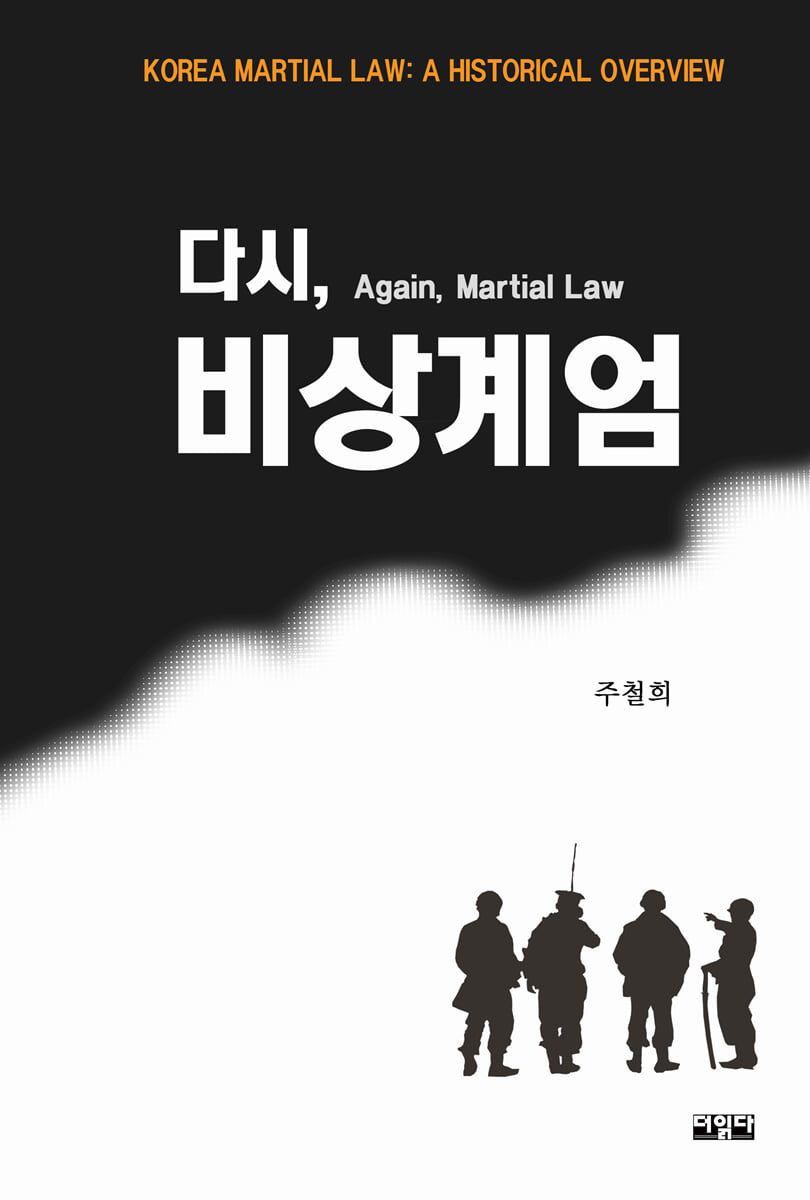
Book Introduction
Martial law may be a necessary means of dealing with a national crisis, but its invocation must be exercised with caution.
And that period should also be minimized.
The declaration of martial law must be subject to strict legal requirements and procedures, as it may restrict the fundamental rights of citizens and undermine democracy and the rule of law.
Furthermore, the purpose of martial law must be to maintain national security and public order, and it must not be abused for political purposes or as a means to maintain power.
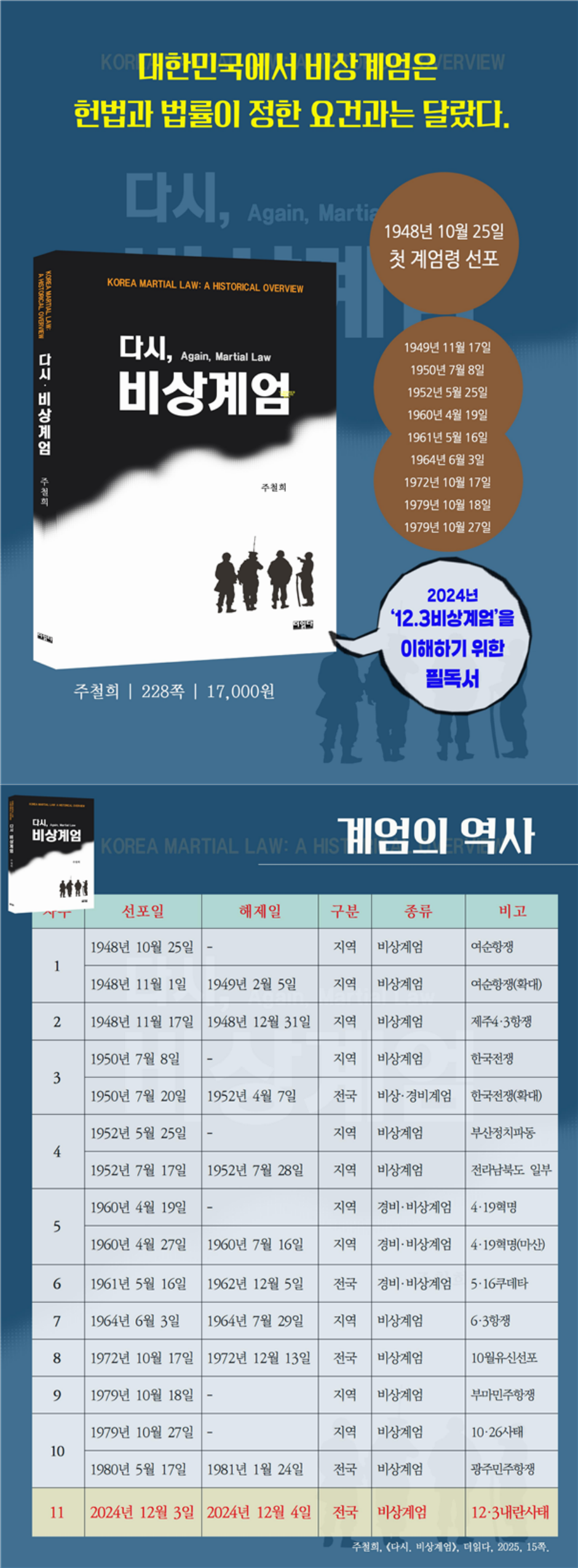
Among the 11 martial laws since the establishment of the Republic of Korea, there are not many that have met the requirements and procedures for martial law stipulated in the Constitution and laws.
Rather, there are more instances in history where martial law was declared as a means to strengthen power.
This means that martial law overlapped with an important historical event in the Republic of Korea.
And that period should also be minimized.
The declaration of martial law must be subject to strict legal requirements and procedures, as it may restrict the fundamental rights of citizens and undermine democracy and the rule of law.
Furthermore, the purpose of martial law must be to maintain national security and public order, and it must not be abused for political purposes or as a means to maintain power.
Among the 11 martial laws since the establishment of the Republic of Korea, there are not many that have met the requirements and procedures for martial law stipulated in the Constitution and laws.
Rather, there are more instances in history where martial law was declared as a means to strengthen power.
This means that martial law overlapped with an important historical event in the Republic of Korea.
- You can preview some of the book's contents.
Preview
index
· Starting the book _04
Chapter 1.
What is martial law? _11
1.
History of Martial Law / 13
2.
The Proclamation and Lifting of Martial Law / 26
Chapter 2.
Syngman Rhee, Martial Law, and the Beginning of Dictatorship_35
1.
The First Declaration of Martial Law: The Yeosu-Suncheon Uprising / 37
2.
Jeju Island declares martial law / 58
3.
The Korean War and Martial Law / 77
4.
The Busan Political Crisis and Martial Law / 85
5.
Permanent Rule, the April 19 Revolution, and Martial Law / 93
Chapter 3.
Park Chung-hee, Martial Law, and Dictators _103
1.
May 16 Coup and Martial Law / 105
2.
June 3rd Uprising and Martial Law / 114
3.
The Yushin Coup and Martial Law / 126
4.
The Buma Democratic Uprising and Martial Law / 138
Chapter 4.
Chun Doo-hwan's Desire and Martial Law _149
1.
The October 26 Incident and Chun Doo-hwan / 151
2.
May 17th Expansion of Martial Law / 160
Chapter 5.
Yoon Seok-yeol's December 3 Martial Law _179
1.
Martial law declared on December 3rd / 181
2.
The Historical Reality of Unconstitutionality and Illegalities / 188
3.
12 · 3 The Goals and Failures of Martial Law / 211
· Ending the Book _222
· References _227
Chapter 1.
What is martial law? _11
1.
History of Martial Law / 13
2.
The Proclamation and Lifting of Martial Law / 26
Chapter 2.
Syngman Rhee, Martial Law, and the Beginning of Dictatorship_35
1.
The First Declaration of Martial Law: The Yeosu-Suncheon Uprising / 37
2.
Jeju Island declares martial law / 58
3.
The Korean War and Martial Law / 77
4.
The Busan Political Crisis and Martial Law / 85
5.
Permanent Rule, the April 19 Revolution, and Martial Law / 93
Chapter 3.
Park Chung-hee, Martial Law, and Dictators _103
1.
May 16 Coup and Martial Law / 105
2.
June 3rd Uprising and Martial Law / 114
3.
The Yushin Coup and Martial Law / 126
4.
The Buma Democratic Uprising and Martial Law / 138
Chapter 4.
Chun Doo-hwan's Desire and Martial Law _149
1.
The October 26 Incident and Chun Doo-hwan / 151
2.
May 17th Expansion of Martial Law / 160
Chapter 5.
Yoon Seok-yeol's December 3 Martial Law _179
1.
Martial law declared on December 3rd / 181
2.
The Historical Reality of Unconstitutionality and Illegalities / 188
3.
12 · 3 The Goals and Failures of Martial Law / 211
· Ending the Book _222
· References _227
Detailed image
Into the book
Martial law is an act of government that mobilizes the military and is within the power of the president.
However, the constitution and laws strictly limit the power to mobilizing the military only in times of war, national emergency, or similar circumstances.
As history has shown, martial law as a means of dealing with national crises has often been declared to suit the interests of those in power.
History records that the declaration of martial law to achieve political goals is an unconstitutional and illegal act of governance that cannot be recognized as legitimate.
--- p.14
The provisional martial law declared on October 22, immediately following the outbreak of the Yeosu-Suncheon Uprising, and the martial law later approved after a State Council resolution on October 25, influenced not only the martial law declared during the Jeju April 3 Incident on November 17, 1948, but also the martial law declared during the Korean War.
And the Yeosu-Suncheon Uprising and the martial law declared at that time had a significant impact on the content and direction of the Martial Law Act (Law No. 69) enacted on November 24, 1949.
--- p.57
What made the April 19 Revolution successful was the citizens' desire for democracy.
It was a resistance against injustice.
Even martial law forces could not take active action in front of the sovereign citizens.
It was possible because up until this point, soldiers had been faithful to their duties as soldiers.
In other words, he was not a political soldier.
With the end of the martial law of the April 19 Revolution, our country rapidly transitioned into an era ruled by political military leaders.
It is the May 16 military coup.
--- p.102
On October 26th, Park Chung-hee died, and at 4:00 a.m. on the 27th, martial law was declared throughout the country except for Jeju Island.
With the establishment of the Joint Investigation Headquarters, which was not included in the Constitution, Martial Law, or Martial Law Command Organization Regulations, Chun Doo-hwan suddenly became known to the world.
And through the 12/12 coup, he seized military power and set out to seize political power.
This is the May 17 Coup, also known as the May 17 Emergency Martial Law Expansion Measure.
--- p.159
The people remembered Chun Doo-hwan's criminal acts that destroyed the constitutional order.
The judiciary's punishment was only half successful because of the people's memory.
In other words, Chun Doo-hwan and Roh Tae-woo received judicial pardons, but not historical pardons.
Chun Doo-hwan died on November 23, 2021.
His body is being kept at his home in Yeonhui-dong as no place to be buried has been found.
History's condemnation of Chun Doo-hwan continues.
The December 3rd martial law must also be remembered and condemned historically.
--- p.177
The Republic of Korea is a democratic republic, and popular sovereignty is the principle of operation of the Constitution.
In that case, it is appropriate to define forces that act and behave against the democratic republic and forces that undermine the constitutional value of popular sovereignty as anti-state forces.
However, the 'anti-state forces' that Yoon Seok-yeol refers to are people who think differently from him, who criticize him, and who belong to different political organizations and parties.
This can be seen as a thought process where the president is trapped within the feudal framework of the state.
--- p.186
The December 3rd martial law was declared, and within two hours, the National Assembly passed a resolution to lift it, and the martial law was lifted six hours later.
When martial law was lifted, it was turned into an act of rebellion, and the National Assembly passed a motion to impeach the president.
And while waiting for the Constitutional Court's ruling, the judiciary is investigating the crime of being a 'leader of rebellion'.
What was the reason martial law failed for the first time in constitutional history?
--- p.216
The December 3 martial law was evaluated as a foolish act that had no political, economic, social, or international credibility benefits for the nation.
But new possibilities were also glimpsed.
It is the resilience of democracy.
The consciousness of democracy, which has been firmly established since 1987, showed its power even during the December 3 martial law incident.
And we discovered the MZ generation as the protagonists of a new history.
The December 3rd martial law incident confirmed that the concerns raised about the social and historical awareness of young people in their 20s and 30s were unfounded.
However, the constitution and laws strictly limit the power to mobilizing the military only in times of war, national emergency, or similar circumstances.
As history has shown, martial law as a means of dealing with national crises has often been declared to suit the interests of those in power.
History records that the declaration of martial law to achieve political goals is an unconstitutional and illegal act of governance that cannot be recognized as legitimate.
--- p.14
The provisional martial law declared on October 22, immediately following the outbreak of the Yeosu-Suncheon Uprising, and the martial law later approved after a State Council resolution on October 25, influenced not only the martial law declared during the Jeju April 3 Incident on November 17, 1948, but also the martial law declared during the Korean War.
And the Yeosu-Suncheon Uprising and the martial law declared at that time had a significant impact on the content and direction of the Martial Law Act (Law No. 69) enacted on November 24, 1949.
--- p.57
What made the April 19 Revolution successful was the citizens' desire for democracy.
It was a resistance against injustice.
Even martial law forces could not take active action in front of the sovereign citizens.
It was possible because up until this point, soldiers had been faithful to their duties as soldiers.
In other words, he was not a political soldier.
With the end of the martial law of the April 19 Revolution, our country rapidly transitioned into an era ruled by political military leaders.
It is the May 16 military coup.
--- p.102
On October 26th, Park Chung-hee died, and at 4:00 a.m. on the 27th, martial law was declared throughout the country except for Jeju Island.
With the establishment of the Joint Investigation Headquarters, which was not included in the Constitution, Martial Law, or Martial Law Command Organization Regulations, Chun Doo-hwan suddenly became known to the world.
And through the 12/12 coup, he seized military power and set out to seize political power.
This is the May 17 Coup, also known as the May 17 Emergency Martial Law Expansion Measure.
--- p.159
The people remembered Chun Doo-hwan's criminal acts that destroyed the constitutional order.
The judiciary's punishment was only half successful because of the people's memory.
In other words, Chun Doo-hwan and Roh Tae-woo received judicial pardons, but not historical pardons.
Chun Doo-hwan died on November 23, 2021.
His body is being kept at his home in Yeonhui-dong as no place to be buried has been found.
History's condemnation of Chun Doo-hwan continues.
The December 3rd martial law must also be remembered and condemned historically.
--- p.177
The Republic of Korea is a democratic republic, and popular sovereignty is the principle of operation of the Constitution.
In that case, it is appropriate to define forces that act and behave against the democratic republic and forces that undermine the constitutional value of popular sovereignty as anti-state forces.
However, the 'anti-state forces' that Yoon Seok-yeol refers to are people who think differently from him, who criticize him, and who belong to different political organizations and parties.
This can be seen as a thought process where the president is trapped within the feudal framework of the state.
--- p.186
The December 3rd martial law was declared, and within two hours, the National Assembly passed a resolution to lift it, and the martial law was lifted six hours later.
When martial law was lifted, it was turned into an act of rebellion, and the National Assembly passed a motion to impeach the president.
And while waiting for the Constitutional Court's ruling, the judiciary is investigating the crime of being a 'leader of rebellion'.
What was the reason martial law failed for the first time in constitutional history?
--- p.216
The December 3 martial law was evaluated as a foolish act that had no political, economic, social, or international credibility benefits for the nation.
But new possibilities were also glimpsed.
It is the resilience of democracy.
The consciousness of democracy, which has been firmly established since 1987, showed its power even during the December 3 martial law incident.
And we discovered the MZ generation as the protagonists of a new history.
The December 3rd martial law incident confirmed that the concerns raised about the social and historical awareness of young people in their 20s and 30s were unfounded.
--- p.225
Publisher's Review
A must-read for understanding the '12/3 Martial Law'
Martial law was declared, something that even the older generation, who had lived breathlessly through modern history, could not have imagined.
This book, once again, presents a refreshing answer to the question, "What should we do?" to avoid a return to the past of military dictatorship and anti-democratic rule, through a wealth of historical data and examples in the present era of martial law.
"Martial Law Again" is written based solely on historical experience, not on any biased personal opinion, thoughts, or "camp logic," and not only provides us with a sense of balance that is not biased toward any one aspect as we learn the truth about the "12?3 Martial Law," but also suggests the direction we should take.
Lessons from the December 3rd Martial Law: Historical Condemnation and Records
With the sitting president on trial as the leader of a civil war, we ask again:
"Why does history keep repeating itself? How can we resolve this issue now, and how can we move forward?" the author addresses the people of this time of renewed martial law.
“The dictators who took many lives and seriously undermined democracy must be condemned, and the facts of their judgment, punishment, and harsh condemnation must be recorded in history.
“We must record the ‘12/3 Martial Law’ in history with the utmost severity so that a coup d’état disguised as martial law never again occurs in this land.”
We will recognize that 'no logic or justice can transcend historical experience.'
Progress in history, history that is achieved
《Again, Martial Law》 always had martial law in place during Syngman Rhee's rigged election, Park Chung-hee's military coup and 18 years of military dictatorship, and Chun Doo-hwan's policies that followed. In the Yeosu-Suncheon Uprising, the Jeju April 3 Uprising, the Busan-Masan Democratic Uprising, and the May 18 Democratic Uprising, there were always countless deaths due to martial law.
Nevertheless, I enjoyed reading this book because it highlighted the shining struggles against dictatorship and for democracy in the modern history of the Republic of Korea, and I was able to read about the people's burning passion for achieving democracy throughout the book.
And the author emphasizes that the democracy achieved was the driving force that enabled us to overcome martial law on December 3, 2024.
It seems to prove the belief that progress in history is something that must be achieved.
Martial law was declared, something that even the older generation, who had lived breathlessly through modern history, could not have imagined.
This book, once again, presents a refreshing answer to the question, "What should we do?" to avoid a return to the past of military dictatorship and anti-democratic rule, through a wealth of historical data and examples in the present era of martial law.
"Martial Law Again" is written based solely on historical experience, not on any biased personal opinion, thoughts, or "camp logic," and not only provides us with a sense of balance that is not biased toward any one aspect as we learn the truth about the "12?3 Martial Law," but also suggests the direction we should take.
Lessons from the December 3rd Martial Law: Historical Condemnation and Records
With the sitting president on trial as the leader of a civil war, we ask again:
"Why does history keep repeating itself? How can we resolve this issue now, and how can we move forward?" the author addresses the people of this time of renewed martial law.
“The dictators who took many lives and seriously undermined democracy must be condemned, and the facts of their judgment, punishment, and harsh condemnation must be recorded in history.
“We must record the ‘12/3 Martial Law’ in history with the utmost severity so that a coup d’état disguised as martial law never again occurs in this land.”
We will recognize that 'no logic or justice can transcend historical experience.'
Progress in history, history that is achieved
《Again, Martial Law》 always had martial law in place during Syngman Rhee's rigged election, Park Chung-hee's military coup and 18 years of military dictatorship, and Chun Doo-hwan's policies that followed. In the Yeosu-Suncheon Uprising, the Jeju April 3 Uprising, the Busan-Masan Democratic Uprising, and the May 18 Democratic Uprising, there were always countless deaths due to martial law.
Nevertheless, I enjoyed reading this book because it highlighted the shining struggles against dictatorship and for democracy in the modern history of the Republic of Korea, and I was able to read about the people's burning passion for achieving democracy throughout the book.
And the author emphasizes that the democracy achieved was the driving force that enabled us to overcome martial law on December 3, 2024.
It seems to prove the belief that progress in history is something that must be achieved.
GOODS SPECIFICS
- Date of issue: February 17, 2025
- Page count, weight, size: 228 pages | 152*225*20mm
- ISBN13: 9791198762245
- ISBN10: 1198762241
You may also like
카테고리
korean


korean

![GQ KOREA Mark (Monthly): December [2025]](http://librairie.coreenne.fr/cdn/shop/files/8ef265dbbfbf186523ed75ba7319009d.jpg?v=1765340328&width=3840)


