

History of Economics
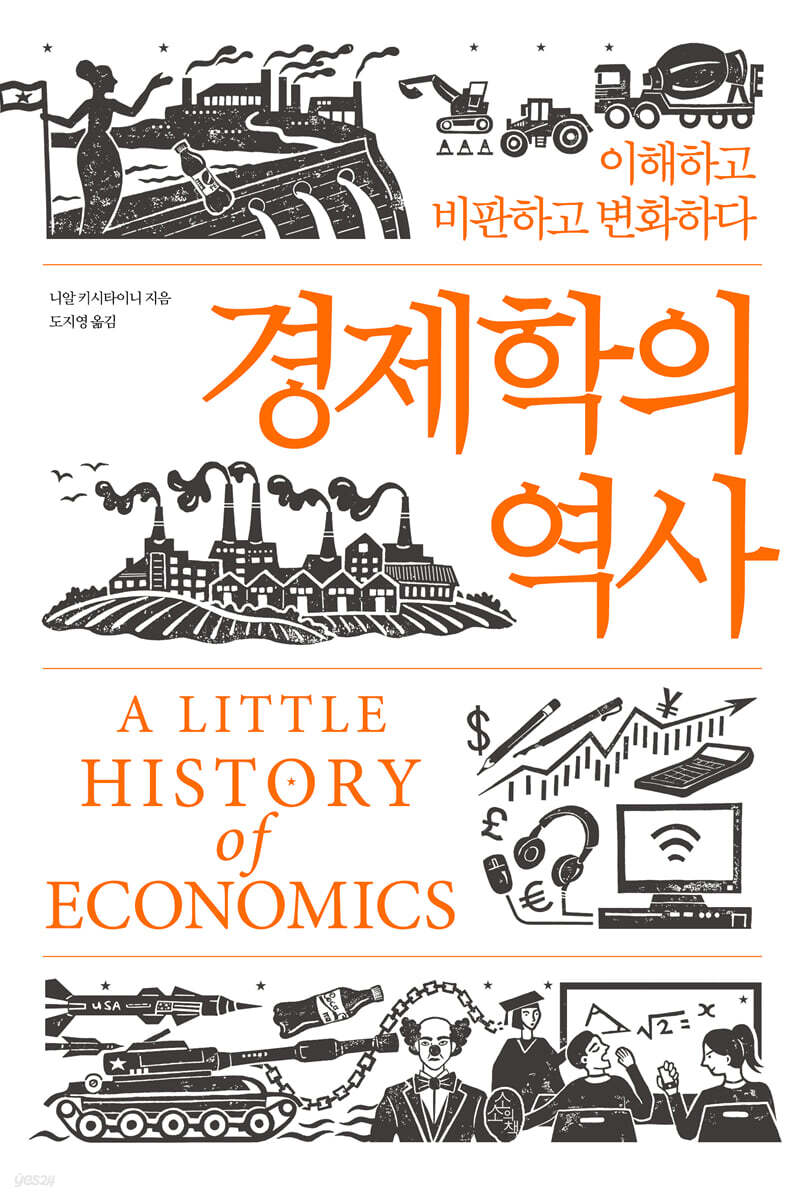 |
Description
Book Introduction
Discuss the core concepts and theories of economics
Digging into the heart of economic problems!
What role has economics played in human life to this day?
The biggest problem for primitive humans who gathered fruits from the forest and hunted animals was finding enough food.
It was soon a basic economic problem of scarcity.
Since then, as nature has been utilized according to needs and civilization has developed, economic life has become more complex, and economic thought has also been newly formed and developed.
This book follows this trend and meets economists who established important concepts, principles, and theories in economics.
We also examine how major historical turning points, such as the invention of money, free trade, the Industrial Revolution, the rise of capitalism, world wars, the Great Depression, and the growth of financial markets, have influenced economics, and through various examples, we examine the nature and solutions to economic problems we face today, and how economic principles are applied to our societies, nations, and individual lives.
Digging into the heart of economic problems!
What role has economics played in human life to this day?
The biggest problem for primitive humans who gathered fruits from the forest and hunted animals was finding enough food.
It was soon a basic economic problem of scarcity.
Since then, as nature has been utilized according to needs and civilization has developed, economic life has become more complex, and economic thought has also been newly formed and developed.
This book follows this trend and meets economists who established important concepts, principles, and theories in economics.
We also examine how major historical turning points, such as the invention of money, free trade, the Industrial Revolution, the rise of capitalism, world wars, the Great Depression, and the growth of financial markets, have influenced economics, and through various examples, we examine the nature and solutions to economic problems we face today, and how economic principles are applied to our societies, nations, and individual lives.
- You can preview some of the book's contents.
Preview
index
1 Cool head and warm heart
2 Soaring Swans
3 God's Economy
4 Finding Gold
5. Good harvest
6 Invisible Hand
7. The meeting of corn and iron
8 Ideal World
9 When there are too many mouths to feed
10 Workers of the World
11 Perfect Balance
12 Block the sun
13 Profits from War
14 Noisy Trumpet Players
15 Coca-Cola or Pepsi?
16 People with plans
17 Show off your wealth
18 Under the drain
19 Creative Destruction
20 Prisoner's Dilemma
21. Tyranny of the government
22 Big Push
23 The Economics of Everything
24 growth
25 Harmonious Economy
26 A World Divided in Two
27 Filling the bathtub
28 The Reign of the Clown
29 Currency Illusion
30 Looking into the future
31 Attack of the Speculators
32 A Hand to Save the Weak
33 Know Me and Know You
34 Broken Promises
35 Missing Women
36 Heart in the Fog
37 Economics in the Real World
38 Runaway Banks
39 Giant in the Sky
40 Why do you want to become an economist?
Translator's Note
Search
2 Soaring Swans
3 God's Economy
4 Finding Gold
5. Good harvest
6 Invisible Hand
7. The meeting of corn and iron
8 Ideal World
9 When there are too many mouths to feed
10 Workers of the World
11 Perfect Balance
12 Block the sun
13 Profits from War
14 Noisy Trumpet Players
15 Coca-Cola or Pepsi?
16 People with plans
17 Show off your wealth
18 Under the drain
19 Creative Destruction
20 Prisoner's Dilemma
21. Tyranny of the government
22 Big Push
23 The Economics of Everything
24 growth
25 Harmonious Economy
26 A World Divided in Two
27 Filling the bathtub
28 The Reign of the Clown
29 Currency Illusion
30 Looking into the future
31 Attack of the Speculators
32 A Hand to Save the Weak
33 Know Me and Know You
34 Broken Promises
35 Missing Women
36 Heart in the Fog
37 Economics in the Real World
38 Runaway Banks
39 Giant in the Sky
40 Why do you want to become an economist?
Translator's Note
Search
Detailed image

Into the book
The first economic thinkers were Greek philosophers, from whom the tradition of Western thought, including economics, originated.
After thousands of years of human struggle to build the first civilization, the ideas of Greek philosophers blossomed.
Long before the Greek thinkers emerged, mankind had sown the seeds of economic life by learning to use nature to suit its needs.
For example, when fire was first discovered, humans were able to use it to create new things.
They made pots out of clay and cooked and ate plants and animals.
Then, about 10,000 years ago, the first economic revolution occurred.
Agriculture began when people discovered how to grow plants and domesticate animals.
More people could live on a certain amount of land, and people gathered together to form villages.
--- From "2 Flying Swan"
When we hear the concept of the 'invisible hand' mentioned by Adam Smith, it is easy to think that 'greed is good'.
But that is a distorted interpretation.
Adam Smith saw commercial society as being associated with many good human qualities.
Bakers and butchers are usually kind to others.
When a friend gets sick or loses money, we mourn together.
That's how people develop a sense of right and wrong.
If people were always completely selfish, commerce wouldn't work.
Because a baker will lie about the weight of his loaves of bread, and a brewer will add water to his beer.
When lies and deception become routine, chaos follows.
When people are honest and trust each other, their actions in pursuing their own self-interest benefit society.
--- From "6 Invisible Hands"
The problem of communism that Mises identified was more serious than information overload.
In a market economy, prices signal where wood can be best utilized.
Without prices, there is no proper way to decide how to use a tree, how many pairs of shoes to make, or how many loaves of bread to make.
Likewise, there is no good way to determine how much a consumer should pay for bread or soap.
There really is no standard.
But when the government sets prices, those prices never work.
Prices for bread and soap are usually set so low that people want to buy much more than they can produce.
That's why people line up outside stores.
According to Mises, Stalin's dictating prices and production levels was nothing more than "groping in the dark."
Mises said, "Socialism has abolished rational economics."
The reason economic problems arose in the Soviet Union was because the socialist system itself was irrational.
--- From "16 People with Plans"
The Korean economy soared.
After developing the textile and clothing industry, it moved on to the steel, automobile, and shipbuilding industries.
In the 1950s, North Korea had a stronger economy, but soon South Korea overtook it.
Not only that, it has outpaced many other developing countries.
In the 20 years since President Park Chung-hee took power, the Korean economy grew tenfold.
Two of South Korea's largest conglomerates, Samsung Electronics and Hyundai Motor Company, have become household names in Europe and the United States.
Today, Korea enjoys a standard of living comparable to that of wealthy countries.
People called this achievement the 'Miracle on the Han River'.
What made Korea different was that the government was able to prevent new industries from becoming complacent.
When the Korean government granted companies loans at low interest rates, it made sure they performed well, and even went so far as to recall the loans if the companies failed to become competitive enough to export their products overseas.
Besides Korea, several Asian countries, including Singapore, Taiwan, and Hong Kong, also achieved successful post-war economic development.
These countries became known as the 'Asian Tigers' because of their outstanding economic performance.
--- From "22 Big Pushes"
According to Polbre, it is women who bear most of the costs of raising children, the future workforce.
The reason why general economics ignores the costs of childcare borne by women is because women do not receive compensation for caring for children.
When a man pays a housekeeper to clean, cook, and care for his children, the housekeeper's labor is included in the national income of that country.
But when the man marries the housekeeper, the housekeeper now becomes a member of the household headed by the man.
Even after becoming a wife, she continues to clean and cook, but she no longer receives wages.
So, the wife's labor is not included in national income.
From the perspective of traditional economics, she has become an 'unproductive housewife'.
After thousands of years of human struggle to build the first civilization, the ideas of Greek philosophers blossomed.
Long before the Greek thinkers emerged, mankind had sown the seeds of economic life by learning to use nature to suit its needs.
For example, when fire was first discovered, humans were able to use it to create new things.
They made pots out of clay and cooked and ate plants and animals.
Then, about 10,000 years ago, the first economic revolution occurred.
Agriculture began when people discovered how to grow plants and domesticate animals.
More people could live on a certain amount of land, and people gathered together to form villages.
--- From "2 Flying Swan"
When we hear the concept of the 'invisible hand' mentioned by Adam Smith, it is easy to think that 'greed is good'.
But that is a distorted interpretation.
Adam Smith saw commercial society as being associated with many good human qualities.
Bakers and butchers are usually kind to others.
When a friend gets sick or loses money, we mourn together.
That's how people develop a sense of right and wrong.
If people were always completely selfish, commerce wouldn't work.
Because a baker will lie about the weight of his loaves of bread, and a brewer will add water to his beer.
When lies and deception become routine, chaos follows.
When people are honest and trust each other, their actions in pursuing their own self-interest benefit society.
--- From "6 Invisible Hands"
The problem of communism that Mises identified was more serious than information overload.
In a market economy, prices signal where wood can be best utilized.
Without prices, there is no proper way to decide how to use a tree, how many pairs of shoes to make, or how many loaves of bread to make.
Likewise, there is no good way to determine how much a consumer should pay for bread or soap.
There really is no standard.
But when the government sets prices, those prices never work.
Prices for bread and soap are usually set so low that people want to buy much more than they can produce.
That's why people line up outside stores.
According to Mises, Stalin's dictating prices and production levels was nothing more than "groping in the dark."
Mises said, "Socialism has abolished rational economics."
The reason economic problems arose in the Soviet Union was because the socialist system itself was irrational.
--- From "16 People with Plans"
The Korean economy soared.
After developing the textile and clothing industry, it moved on to the steel, automobile, and shipbuilding industries.
In the 1950s, North Korea had a stronger economy, but soon South Korea overtook it.
Not only that, it has outpaced many other developing countries.
In the 20 years since President Park Chung-hee took power, the Korean economy grew tenfold.
Two of South Korea's largest conglomerates, Samsung Electronics and Hyundai Motor Company, have become household names in Europe and the United States.
Today, Korea enjoys a standard of living comparable to that of wealthy countries.
People called this achievement the 'Miracle on the Han River'.
What made Korea different was that the government was able to prevent new industries from becoming complacent.
When the Korean government granted companies loans at low interest rates, it made sure they performed well, and even went so far as to recall the loans if the companies failed to become competitive enough to export their products overseas.
Besides Korea, several Asian countries, including Singapore, Taiwan, and Hong Kong, also achieved successful post-war economic development.
These countries became known as the 'Asian Tigers' because of their outstanding economic performance.
--- From "22 Big Pushes"
According to Polbre, it is women who bear most of the costs of raising children, the future workforce.
The reason why general economics ignores the costs of childcare borne by women is because women do not receive compensation for caring for children.
When a man pays a housekeeper to clean, cook, and care for his children, the housekeeper's labor is included in the national income of that country.
But when the man marries the housekeeper, the housekeeper now becomes a member of the household headed by the man.
Even after becoming a wife, she continues to clean and cook, but she no longer receives wages.
So, the wife's labor is not included in national income.
From the perspective of traditional economics, she has become an 'unproductive housewife'.
--- From "35 Missing Women"
Publisher's Review
Read the flow of economics based on everyday examples and major events!
How has economic thought throughout history explained and criticized the world?
How have humans lived until now? How did they find and produce the clothing, food, and shelter necessary for survival, and how did they share them? These questions clearly reveal that human history is a process of economic development.
Ten thousand years ago, the first economic revolution, agriculture, began, allowing more people to live on a given amount of land, and people gathered together to form villages.
In the process, civilizations with complex economies emerged, and people began to think more deeply about what it meant for humans to live in society.
So when did economics, the study of the "economy," begin? Hesiod, the first Greek poet, wrote, "The gods keep food hidden from mankind," which brings to mind the fundamental economic concept of scarcity.
The first people to explore economic thought were ancient Greek philosophers.
They raised the most fundamental questions that permeate life.
It is a problem we struggle with to this day.
What does human society need to thrive? What do people need to feel happy and fulfilled? What truly makes people prosper? Economics began with these questions.
After the fall of the Roman Empire, Christian monks developed economic thought, the most representative figures of which were Augustine and Thomas Aquinas.
Medieval economic life was largely local, centered on ties based on religion and personal friendship rather than money, and the clergy considered lending money at interest to be tantamount to theft.
Meanwhile, in Europe, population growth and the invention of new tools led to increased production of agricultural and processed goods, and trade between village communities flourished, leading to a flourishing financial sector.
From the late 16th century, as major European nations such as Spain, Portugal, England, the Netherlands, and France competed to dominate foreign trade, thinkers turned their attention from medieval religion to reason and science.
They were called mercantilists, emphasizing resources and money over morality and not worrying about whether the pursuit of wealth was in conflict with the teachings of the Bible.
Meanwhile, in 18th-century France, the physiocrats, who regarded agriculture as the source of economic value, emerged and sharply criticized the economic system that gave privileges to artisans and merchants, which later became the fuse that led to a powerful revolution.
The Industrial Revolution in Europe, which began in the late 18th century, transformed the lifestyles of many people through dazzling technological advancements, but it also brought about numerous social and economic problems, including labor issues, social inequality, and overpopulation.
Although some people became rich, many remained poor, and although people flocked to the cities, living conditions were grim.
As the number of victims of a ruthless economy that prioritizes profit over people increases, the capitalist system is being criticized, and thinkers who propose new worlds or experiment with community have emerged.
After the outbreak of World War I, the world's first communist state, the Soviet Union, was born, and countries in Africa and Asia subsequently regained political control of their own countries.
Meanwhile, the debate surrounding capitalism and communism became more intense.
Additionally, as the Great Depression of the 1930s sent shockwaves through the global economy, the theories of Keynes, a leading figure in 20th-century economic policy thought, were established, and many cases of economic development through government intervention in the market were collected.
After World War II, the world economy was hit by the political crisis in the Middle East and the rise in oil prices in the 1970s, but entered a period of recovery from the mid-1980s to 2007.
However, the financial crisis that occurred in 2008 led to a severe economic recession.
It was the result of reckless capitalism that abandoned caution.
In this way, this book provides an overview of economic activities from primitive times to the present day, and each chapter provides everyday examples to help readers clearly understand important concepts and principles in economics.
The 'law of diminishing marginal utility' proposed by Jevons explains the satisfaction felt each time you eat one more caramel, 'welfare economics' founded by Pigou explains the noisy trumpet player next door, and 'government intervention in the market' mentioned by Keynes explains the satisfaction felt each time you eat one more caramel using the example of filling a bathtub with water.
The big and small questions posed by economics and their solutions
Can we create a world where everyone is happy and satisfied?
Adam Smith, known as the 'father of modern economics,' asked the most fundamental question in economics.
The question was, 'Can profit-seeking and a good society coexist?'
Adam Smith argued that society works best when people act in their own self-interest.
Rather than always trying to be nice to each other, if you do what is most helpful to yourself, more people will ultimately benefit.
To explain this situation, Adam Smith proposed the concept of the 'invisible hand', one of the most famous concepts in economics.
He also said that the market should be prioritized above all else, that the government should intervene as little as possible, and that businesses should be allowed to do as they wish.
This book is full of the joy of understanding the big and small questions posed by economics, one by one, as they form a large framework and provide solutions.
'If you were given 20 pounds for your birthday, how would you decide what to spend it on?' 'Why do some people save money so carefully, while others spend it like water on a mansion for their dog?' The scope broadens to 'How should the newly created wealth be distributed between workers and employers?', 'Where do the profits of capitalists come from?', 'How are the prices of goods determined?', 'Where do people's wants come from?', 'Why does government intervention in the market destroy freedom?', etc.
In fact, compared to mathematics or literature, economics is a relatively new discipline.
And much of economics deals with buying, selling, prices, and other things that are important to capitalists.
Much of this book also talks about that kind of economics.
But we also look at economic thought that emerged much earlier.
This book examines the changing thinking about the economy and how the economy itself has changed.
Moreover, today economics can be applied to almost every aspect of life.
This book discusses human behavior theory, auction design, and the problem of global warming, as well as the judicial system, terrorism, and even brushing one's teeth and sumo wrestling in Japan, all of which can be analyzed through economic theory.
Many economists consider this a very desirable development.
Economics has established itself as a very effective analytical technique for explaining all aspects of human behavior.
Meanwhile, in the 1880s, a battle broke out among German-speaking economists to find the essence of economics.
There were economists who believed that economics should be based above all on history and concrete facts, and economists who believed that it should explore abstract theories.
In the end, it became clear that both sides had a point.
Since then, economics has embraced both the world of facts and the world of theory.
However, as economics developed, economists who established new theories gained greater fame than those who meticulously examined historical facts and statistics.
Economists fell in love with mathematics and used it to formulate all sorts of elaborate theories based on general concepts rather than specific facts about the economy.
Of course, not everyone agreed with this.
Even today, critics of economics complain that the subjects it studies are somewhat disconnected from reality and that it has become a game of solving math problems rather than exploring the facts that affect real people's lives.
Where have the 100 million women gone?
A wide range of topics, interesting facts, and the joy of reading economics.
When you hear the word "economics," you think of something rather dry and like a mountain of boring statistics.
But economics is actually a discipline that helps people find ways to survive, live healthy lives, and get educated.
We study how we get what we need to live a fulfilling and happy life, and why some people can't get it.
If we could just answer the fundamental questions that economics poses, everyone could live a better life.
In economics, there is also a discriminatory view toward women and the socially disadvantaged.
In the early 1990s, Indian economist Amartya Sen argued that the economy discriminated against women, claiming that 100 million women had disappeared from the world.
Then a group of economists combined feminism and economics.
Feminist economists have argued that economic discrimination against women means that women are not receiving their fair share of society's resources.
Such discrimination also existed in the way economists viewed the world.
The value of unpaid labor was ignored, and women at home were viewed as unworking people (unproductive housewives).
This was an important issue.
Because the way we view the economy can influence how it actually treats other people.
This book also introduces the story of Korea's successful economic development through Big Push policies.
The Korean government has achieved remarkable economic success by instructing the "chaebol" (conglomerates) with which it has close ties to develop specific industries, providing them with loans at low interest rates, and encouraging exports by making them competitive with foreign companies.
However, in some countries, the big push policy has failed, and what made Korea different was the government's thorough checks to ensure that new industries did not become complacent.
British economist Alfred Marshall said that economists need "a cool head and a warm heart."
This means that economists, like scientists, must explain the world, but they must also have compassion for the suffering people around them.
In addition, the author of this book lists one more ability that an economist must have.
A critical eye for oneself, the ability to look beyond one's own interests and the habitual way one views the world.
It is said that studying the history of economics helps develop such abilities.
By learning how past economic thinkers developed their unique interests into ideas within the context of their time, we can learn how to develop our own thinking on the subject of interest within the context of our present.
Therefore, examining economic thought and history together is extremely interesting and essential to creating a world where more people can live well.
The various economists we meet in this book each presented different theories in response to the problems faced by their respective eras.
In economics, unlike mathematics, there is no single, eternally correct answer.
By examining the different answers offered by scholars throughout history, we can gain new inspiration and develop theories that can help us address the challenges we face today, whether they be extreme inequality, financial crises, or global warming.
If we get the right answer, more people will have the opportunity to live abundantly, and if we get the wrong answer, many people will suffer.
If people cannot get the food and medicine they need, some will die.
This book argues that this is a task not only for professional economists but for all of us.
How has economic thought throughout history explained and criticized the world?
How have humans lived until now? How did they find and produce the clothing, food, and shelter necessary for survival, and how did they share them? These questions clearly reveal that human history is a process of economic development.
Ten thousand years ago, the first economic revolution, agriculture, began, allowing more people to live on a given amount of land, and people gathered together to form villages.
In the process, civilizations with complex economies emerged, and people began to think more deeply about what it meant for humans to live in society.
So when did economics, the study of the "economy," begin? Hesiod, the first Greek poet, wrote, "The gods keep food hidden from mankind," which brings to mind the fundamental economic concept of scarcity.
The first people to explore economic thought were ancient Greek philosophers.
They raised the most fundamental questions that permeate life.
It is a problem we struggle with to this day.
What does human society need to thrive? What do people need to feel happy and fulfilled? What truly makes people prosper? Economics began with these questions.
After the fall of the Roman Empire, Christian monks developed economic thought, the most representative figures of which were Augustine and Thomas Aquinas.
Medieval economic life was largely local, centered on ties based on religion and personal friendship rather than money, and the clergy considered lending money at interest to be tantamount to theft.
Meanwhile, in Europe, population growth and the invention of new tools led to increased production of agricultural and processed goods, and trade between village communities flourished, leading to a flourishing financial sector.
From the late 16th century, as major European nations such as Spain, Portugal, England, the Netherlands, and France competed to dominate foreign trade, thinkers turned their attention from medieval religion to reason and science.
They were called mercantilists, emphasizing resources and money over morality and not worrying about whether the pursuit of wealth was in conflict with the teachings of the Bible.
Meanwhile, in 18th-century France, the physiocrats, who regarded agriculture as the source of economic value, emerged and sharply criticized the economic system that gave privileges to artisans and merchants, which later became the fuse that led to a powerful revolution.
The Industrial Revolution in Europe, which began in the late 18th century, transformed the lifestyles of many people through dazzling technological advancements, but it also brought about numerous social and economic problems, including labor issues, social inequality, and overpopulation.
Although some people became rich, many remained poor, and although people flocked to the cities, living conditions were grim.
As the number of victims of a ruthless economy that prioritizes profit over people increases, the capitalist system is being criticized, and thinkers who propose new worlds or experiment with community have emerged.
After the outbreak of World War I, the world's first communist state, the Soviet Union, was born, and countries in Africa and Asia subsequently regained political control of their own countries.
Meanwhile, the debate surrounding capitalism and communism became more intense.
Additionally, as the Great Depression of the 1930s sent shockwaves through the global economy, the theories of Keynes, a leading figure in 20th-century economic policy thought, were established, and many cases of economic development through government intervention in the market were collected.
After World War II, the world economy was hit by the political crisis in the Middle East and the rise in oil prices in the 1970s, but entered a period of recovery from the mid-1980s to 2007.
However, the financial crisis that occurred in 2008 led to a severe economic recession.
It was the result of reckless capitalism that abandoned caution.
In this way, this book provides an overview of economic activities from primitive times to the present day, and each chapter provides everyday examples to help readers clearly understand important concepts and principles in economics.
The 'law of diminishing marginal utility' proposed by Jevons explains the satisfaction felt each time you eat one more caramel, 'welfare economics' founded by Pigou explains the noisy trumpet player next door, and 'government intervention in the market' mentioned by Keynes explains the satisfaction felt each time you eat one more caramel using the example of filling a bathtub with water.
The big and small questions posed by economics and their solutions
Can we create a world where everyone is happy and satisfied?
Adam Smith, known as the 'father of modern economics,' asked the most fundamental question in economics.
The question was, 'Can profit-seeking and a good society coexist?'
Adam Smith argued that society works best when people act in their own self-interest.
Rather than always trying to be nice to each other, if you do what is most helpful to yourself, more people will ultimately benefit.
To explain this situation, Adam Smith proposed the concept of the 'invisible hand', one of the most famous concepts in economics.
He also said that the market should be prioritized above all else, that the government should intervene as little as possible, and that businesses should be allowed to do as they wish.
This book is full of the joy of understanding the big and small questions posed by economics, one by one, as they form a large framework and provide solutions.
'If you were given 20 pounds for your birthday, how would you decide what to spend it on?' 'Why do some people save money so carefully, while others spend it like water on a mansion for their dog?' The scope broadens to 'How should the newly created wealth be distributed between workers and employers?', 'Where do the profits of capitalists come from?', 'How are the prices of goods determined?', 'Where do people's wants come from?', 'Why does government intervention in the market destroy freedom?', etc.
In fact, compared to mathematics or literature, economics is a relatively new discipline.
And much of economics deals with buying, selling, prices, and other things that are important to capitalists.
Much of this book also talks about that kind of economics.
But we also look at economic thought that emerged much earlier.
This book examines the changing thinking about the economy and how the economy itself has changed.
Moreover, today economics can be applied to almost every aspect of life.
This book discusses human behavior theory, auction design, and the problem of global warming, as well as the judicial system, terrorism, and even brushing one's teeth and sumo wrestling in Japan, all of which can be analyzed through economic theory.
Many economists consider this a very desirable development.
Economics has established itself as a very effective analytical technique for explaining all aspects of human behavior.
Meanwhile, in the 1880s, a battle broke out among German-speaking economists to find the essence of economics.
There were economists who believed that economics should be based above all on history and concrete facts, and economists who believed that it should explore abstract theories.
In the end, it became clear that both sides had a point.
Since then, economics has embraced both the world of facts and the world of theory.
However, as economics developed, economists who established new theories gained greater fame than those who meticulously examined historical facts and statistics.
Economists fell in love with mathematics and used it to formulate all sorts of elaborate theories based on general concepts rather than specific facts about the economy.
Of course, not everyone agreed with this.
Even today, critics of economics complain that the subjects it studies are somewhat disconnected from reality and that it has become a game of solving math problems rather than exploring the facts that affect real people's lives.
Where have the 100 million women gone?
A wide range of topics, interesting facts, and the joy of reading economics.
When you hear the word "economics," you think of something rather dry and like a mountain of boring statistics.
But economics is actually a discipline that helps people find ways to survive, live healthy lives, and get educated.
We study how we get what we need to live a fulfilling and happy life, and why some people can't get it.
If we could just answer the fundamental questions that economics poses, everyone could live a better life.
In economics, there is also a discriminatory view toward women and the socially disadvantaged.
In the early 1990s, Indian economist Amartya Sen argued that the economy discriminated against women, claiming that 100 million women had disappeared from the world.
Then a group of economists combined feminism and economics.
Feminist economists have argued that economic discrimination against women means that women are not receiving their fair share of society's resources.
Such discrimination also existed in the way economists viewed the world.
The value of unpaid labor was ignored, and women at home were viewed as unworking people (unproductive housewives).
This was an important issue.
Because the way we view the economy can influence how it actually treats other people.
This book also introduces the story of Korea's successful economic development through Big Push policies.
The Korean government has achieved remarkable economic success by instructing the "chaebol" (conglomerates) with which it has close ties to develop specific industries, providing them with loans at low interest rates, and encouraging exports by making them competitive with foreign companies.
However, in some countries, the big push policy has failed, and what made Korea different was the government's thorough checks to ensure that new industries did not become complacent.
British economist Alfred Marshall said that economists need "a cool head and a warm heart."
This means that economists, like scientists, must explain the world, but they must also have compassion for the suffering people around them.
In addition, the author of this book lists one more ability that an economist must have.
A critical eye for oneself, the ability to look beyond one's own interests and the habitual way one views the world.
It is said that studying the history of economics helps develop such abilities.
By learning how past economic thinkers developed their unique interests into ideas within the context of their time, we can learn how to develop our own thinking on the subject of interest within the context of our present.
Therefore, examining economic thought and history together is extremely interesting and essential to creating a world where more people can live well.
The various economists we meet in this book each presented different theories in response to the problems faced by their respective eras.
In economics, unlike mathematics, there is no single, eternally correct answer.
By examining the different answers offered by scholars throughout history, we can gain new inspiration and develop theories that can help us address the challenges we face today, whether they be extreme inequality, financial crises, or global warming.
If we get the right answer, more people will have the opportunity to live abundantly, and if we get the wrong answer, many people will suffer.
If people cannot get the food and medicine they need, some will die.
This book argues that this is a task not only for professional economists but for all of us.
GOODS SPECIFICS
- Date of issue: February 24, 2025
- Format: Hardcover book binding method guide
- Page count, weight, size: 384 pages | 644g | 145*218*29mm
- ISBN13: 9791171650224
- ISBN10: 1171650221
You may also like
카테고리
korean


korean

![GQ KOREA Mark (Monthly): December [2025]](http://librairie.coreenne.fr/cdn/shop/files/8ef265dbbfbf186523ed75ba7319009d.jpg?v=1765340328&width=3840)


