

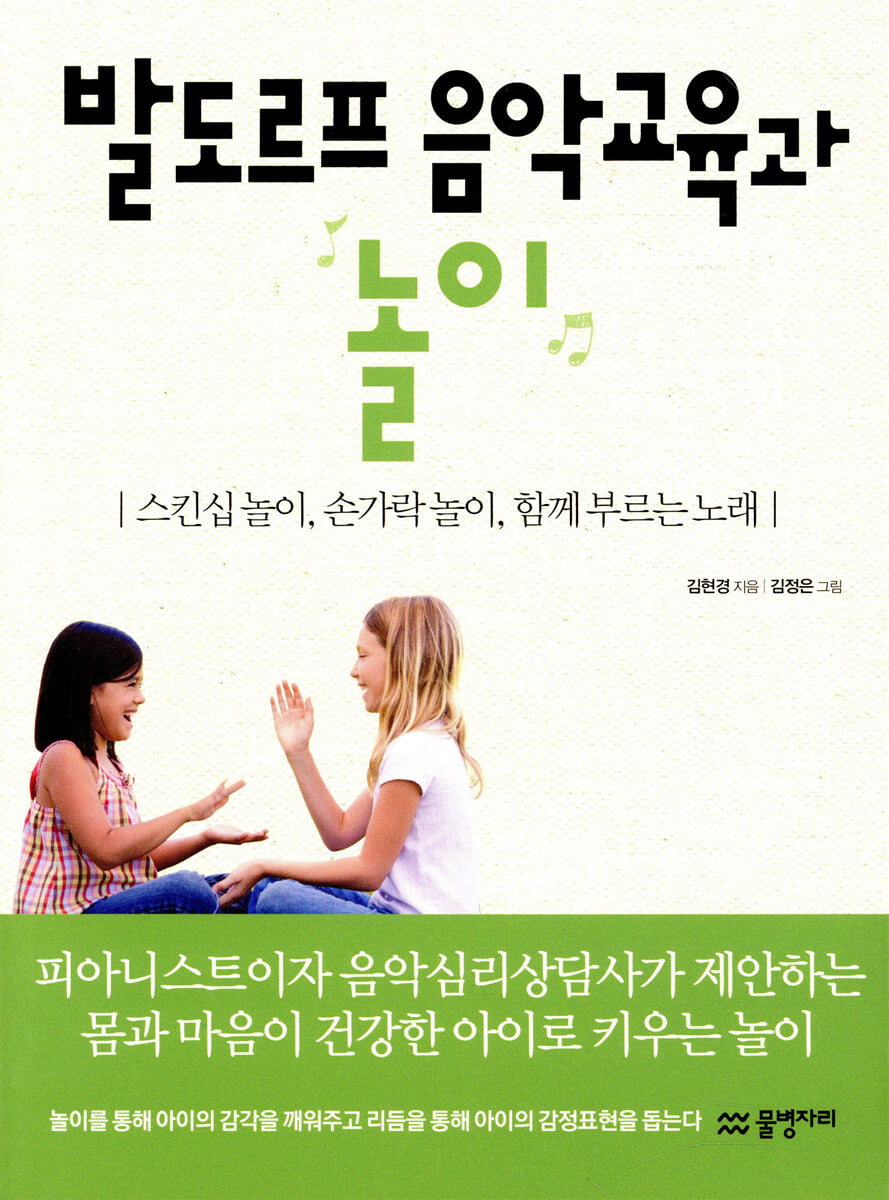
Waldorf Music Education and Play
 |
Description
Book Introduction
A play method suggested by a pianist and music therapist to help children grow up to be healthy in body and mind. From a Waldorf music education perspective, the book includes about 20 types of skin-to-skin play, finger play, and play together, as well as about 10 songs, created by the author in collaboration with teachers working in Waldorf early childhood education for children under the age of 9. Additionally, the author includes cases he personally experienced through counseling, allowing readers to follow the psychology of children, providing practical help not only to parents but also to teachers at daycare centers or elementary school teachers. As a special appendix, the melodies of 10 children's songs written and composed by the author are provided free of charge through the QR code included in the book and the publisher's website, so you can download them and use them right away. |
- You can preview some of the book's contents.
Preview
index
Introduction
Chapter 1 Skinship Play
Why do children hate physical contact?
On Touch: Knowing Yourself
· Skinship Play 1 The wind is blowing
· Skinship Play 2: Squirrel Finding Acorns
· Skinship play 3 Tongtingtong
· Skinship play 4 All round
On parental authority
Authority! Abuse!
· Skinship play 5 Little Mouse
· Skinship play 6 little mice
· Skinship play 7 Raindrop play
Two types of sensitivity: positive sensitivity and negative sensitivity
victim mentality
Chapter 2 Finger Play
Distinguishing between childish and childish
Finger movements influence language development.
· Finger Play 1 The Hungry Mouse
· Finger Play 2 Little Bird
· Finger Play 3 Snails
· Finger Play 4 Spring is here
Chapter 3 Let's Play Together
The freedom children feel
What is sociality?
One-to-one is fine, but what if one-to-many is a problem?
· Play Together 1 Who will sit?
· Play Together 2 Cats Looking for Their Owners
· Play Together 3 Boat on the River
· Play Together 4 Dancing Rabbit
· Play Together 5 If I were an Animal
· Play Together 6 Cat and Mouse
· Play Together 7 Spinning Around
· Play Together 8 Let's go for a walk in the forest!
Chapter 4 Let's sing together
The positive effects of singing
· A fun song to sing together 1 Spring
· A fun song to sing together 2 Summer
· 3 fun songs to sing together in autumn
· 4 Winter Songs to Sing Together
· 5 fun songs to sing together in the morning
Why is my child throwing a tantrum?
· 6 fun songs to sing together
· 7 Fun Songs to Sing Together for Chuseok
· 8 fun songs to sing together Lullaby Star-collecting Baby Angel
· 9 Fun Songs to Sing Together Rainbow
· Let's all listen up to 10 fun songs to sing together.
Conclusion
References
Acknowledgements
Chapter 1 Skinship Play
Why do children hate physical contact?
On Touch: Knowing Yourself
· Skinship Play 1 The wind is blowing
· Skinship Play 2: Squirrel Finding Acorns
· Skinship play 3 Tongtingtong
· Skinship play 4 All round
On parental authority
Authority! Abuse!
· Skinship play 5 Little Mouse
· Skinship play 6 little mice
· Skinship play 7 Raindrop play
Two types of sensitivity: positive sensitivity and negative sensitivity
victim mentality
Chapter 2 Finger Play
Distinguishing between childish and childish
Finger movements influence language development.
· Finger Play 1 The Hungry Mouse
· Finger Play 2 Little Bird
· Finger Play 3 Snails
· Finger Play 4 Spring is here
Chapter 3 Let's Play Together
The freedom children feel
What is sociality?
One-to-one is fine, but what if one-to-many is a problem?
· Play Together 1 Who will sit?
· Play Together 2 Cats Looking for Their Owners
· Play Together 3 Boat on the River
· Play Together 4 Dancing Rabbit
· Play Together 5 If I were an Animal
· Play Together 6 Cat and Mouse
· Play Together 7 Spinning Around
· Play Together 8 Let's go for a walk in the forest!
Chapter 4 Let's sing together
The positive effects of singing
· A fun song to sing together 1 Spring
· A fun song to sing together 2 Summer
· 3 fun songs to sing together in autumn
· 4 Winter Songs to Sing Together
· 5 fun songs to sing together in the morning
Why is my child throwing a tantrum?
· 6 fun songs to sing together
· 7 Fun Songs to Sing Together for Chuseok
· 8 fun songs to sing together Lullaby Star-collecting Baby Angel
· 9 Fun Songs to Sing Together Rainbow
· Let's all listen up to 10 fun songs to sing together.
Conclusion
References
Acknowledgements
Publisher's Review
Suggested by a pianist and music psychologist
Play that raises children to be healthy in body and mind
The child's active movements
It becomes a driving force to develop thinking skills.
“Waldorf Music Education and Play” by pianist Kim Hyeon-gyeong, the only person in Korea who promotes Waldorf music education and also works as a music psychology counselor, has been published.
From a Waldorf music education perspective, the book includes about 20 types of skin-to-skin play, finger play, and play together, as well as about 10 songs, created by the author in collaboration with teachers working in Waldorf early childhood education for children under the age of 9.
Additionally, the author includes cases he personally experienced through counseling, allowing readers to follow the psychology of children, providing practical help not only to parents but also to teachers at daycare centers or elementary school teachers.
As a special appendix, the melodies of 10 children's songs written and composed by the author are provided free of charge through the QR code included in the book and the publisher's website, so you can download them and use them right away.
The biggest problem with modern education is that it only focuses on making people smarter.
This means that from infancy, children are being provided with early English and learning tools that are not appropriate for their developmental stage.
During childhood, the head (thinking), heart (emotions), and limbs (will) must develop evenly so that these three components of thinking, emotion, and will can form a virtuous cycle.
If only the thinking is developed and the feeling is not well developed, mental problems may arise, which may lead to physical illness.
This provides a starting point for understanding the background of the social problems caused by people who are unable to share the emotions of others, who are called sociopaths these days.
Sociopaths, who understand it intellectually but cannot empathize, only rationally understand that they must keep their conscience, but they cannot feel it physically, so they do not feel guilty and commit crimes without hesitation.
A baby who crawls after birth begins to walk on two feet, and as he begins to speak, the child's speech leads to thinking.
If we consider the process of human development, we realize that flexible thinking comes from activities that involve moving the body.
In childhood, more than anything, active movement is essential, and this can be further enhanced through play.
The child expresses his feelings
You have to feel and express it well
Children's movements occur more naturally through rhythm, an element of music.
Rhythm helps movement, so children's play often includes repeated songs or rhythmic words.
Nursery rhymes that contain repetitive elements of the same rhythm and melody provide children with a sense of security in themselves.
When choosing a song to sing with your children among the numerous nursery rhymes, it is important to consider how well the melody and lyrics are unified.
Waldorf educators, especially music educators, consider this very point important.
This is why this book is called "Waldorf Music Education and Play," and the songs and games included in it help with the movements necessary for childhood development.
Waldorf education was founded by Rudolf Steiner in Germany about 100 years ago.
Waldorf education, which was selected as a model for 21st-century reform education, aims to provide education that is appropriate to the human development process, and pursues 'educational art' as its methodology.
‘Educational art’ implies that education should be carried out creatively like art.
Artificial and mechanical spoon-fed education is an educational method that ignores the human development process.
Waldorf education is not a special education, but a natural education that takes into account the stages of human development.
Rudolf Steiner said that music is the only realm that intellect cannot invade.
Music is not something you understand with your head, but something you feel the moment you hear it.
We must pay attention to this point.
Modern life prioritizes intellect and reason over emotions and will.
A life without direct experience and feeling creates a passive life.
In this reality, the education that is needed more than anything else is one that fosters independent human beings whose thoughts, emotions, and will are in harmony.
The childhood days when we could run around and make noise and experience a variety of emotions through play will never come back.
We must work together to protect the bodies and minds of modern children and find ways to help them grow healthily.
This book proposes such a method as a musical element.
It is a game and song that allows children to move freely and enjoyably.
When we play, we can naturally experience a variety of emotions, both pleasant and unpleasant, while making sounds, moving our bodies, and running around together.
For the head to give healthy instructions, what is felt in the heart must be well conveyed to the head.
There are results of a joint study and investigation conducted by the health authorities in Münster, Germany and the University of Bielefeld in 2011.
In that study, doctors looked at the development of 500 toddlers of the same age, and found that children who grew up singing a lot developed more smoothly.
88% of the children who sang a lot developed enough to be able to enter school and study right away.
On the other hand, only 44% of children sang songs infrequently.
This result was completely unrelated to parents' educational background or wealth gap.
These research results provide a reason why children should always be exposed to musical elements.
The younger the child, the more influential the musical elements of the song are than the lyrics.
Rhythmic play is fundamental to Waldorf education.
Skinship play teaches you the power to trust yourself.
Finger play helps language development.
Among the many hand games that are often mentioned, there are some that are taught to children even though they are not suitable for them.
Teach children games that are suitable for adult recreation.
The problem arises from not being able to distinguish between what is childish and what is childish.
This book will also teach you how to distinguish and create such games.
Although the basic philosophy of Waldorf education is to provide creative education above all else, Waldorf education in Korea is still limited to simply imitating the German style.
This book was published in the hope that it will lead to a more creative education for children in their early childhood based on the philosophy of Waldorf education.
In Chapter 1, Skinship Play, we will examine the psychology of children who dislike skinship and the resulting relationship with their parents through examples, and examine the meaning of touch.
Additionally, seven games are included with illustrations so you can try them out with your child.
Through physical contact such as touching the head, holding the child in your arms, or comforting the child, you gain the power to trust yourself.
Chapter 2 Finger Play examines the influence of finger movements on language development and includes lyrics and four play methods with illustrations.
Fine finger movements develop nerves, which greatly influences language development.
Chapter 3, Play Together, explores sociality and includes eight play methods along with song scores.
The dynamics of rhythm and the interplay of primitive movements are play.
Such play becomes a source of joy and strength for children.
Chapter 4, “Fun Songs to Sing Together,” contains sheet music for 10 songs that will help you learn about the positive effects of singing and sing along right away.
Each score includes a brief introduction to the author's background in composing the piece, making it even more interesting.
The melody of the sheet music is provided free of charge through the publisher's website.
This melody is not intended for children, but rather as an exercise for readers who have difficulty reading sheet music.
It is better for children to hear human voices rather than recorded music.
Paying attention to your child's songs can help you get closer to them.
Play awakens a child's senses.
Rhythm helps children express their emotions.
Modern children have a severe lack of space to run around freely due to roads built primarily for cars and conflicts caused by noise between floors.
The lack of movement and the lack of opportunities to move are very serious.
The thoughts of a person who does not move are stagnant.
The stagnant thinking of a person who sits alone at a desk and uses his head without moving and experiencing sometimes manifests as stubbornness.
A study comparing how students in urban and rural schools spend their recess found that urban school children are more than twice as likely to act out, yell, and cause trouble than their rural counterparts.
When we surveyed urban school children about their vacation life, we found that it was similar to when they were in school.
The amount of time spent sitting at the desk during vacation is similar.
Children in rural schools have ample opportunity to move freely even on a regular basis, so they do not do anything special during recess.
Adults must constantly suggest ways to overcome these circumstances.
The author suggests this in a musical way through this book.
Anywhere that is a place where children's individuality is respected, where everyone is loved, and where children are supported to grow and develop the ability to find and wear clothes that fit them, is a Waldorf educational setting.
This book mainly contains games and songs created by the author and teachers who actually work in Waldorf early childhood education, with the aim of showing that anyone can create games and songs, even if they are not a music expert, as long as they have an in-depth understanding of children's development and a keen ability to observe their surroundings.
Play that raises children to be healthy in body and mind
The child's active movements
It becomes a driving force to develop thinking skills.
“Waldorf Music Education and Play” by pianist Kim Hyeon-gyeong, the only person in Korea who promotes Waldorf music education and also works as a music psychology counselor, has been published.
From a Waldorf music education perspective, the book includes about 20 types of skin-to-skin play, finger play, and play together, as well as about 10 songs, created by the author in collaboration with teachers working in Waldorf early childhood education for children under the age of 9.
Additionally, the author includes cases he personally experienced through counseling, allowing readers to follow the psychology of children, providing practical help not only to parents but also to teachers at daycare centers or elementary school teachers.
As a special appendix, the melodies of 10 children's songs written and composed by the author are provided free of charge through the QR code included in the book and the publisher's website, so you can download them and use them right away.
The biggest problem with modern education is that it only focuses on making people smarter.
This means that from infancy, children are being provided with early English and learning tools that are not appropriate for their developmental stage.
During childhood, the head (thinking), heart (emotions), and limbs (will) must develop evenly so that these three components of thinking, emotion, and will can form a virtuous cycle.
If only the thinking is developed and the feeling is not well developed, mental problems may arise, which may lead to physical illness.
This provides a starting point for understanding the background of the social problems caused by people who are unable to share the emotions of others, who are called sociopaths these days.
Sociopaths, who understand it intellectually but cannot empathize, only rationally understand that they must keep their conscience, but they cannot feel it physically, so they do not feel guilty and commit crimes without hesitation.
A baby who crawls after birth begins to walk on two feet, and as he begins to speak, the child's speech leads to thinking.
If we consider the process of human development, we realize that flexible thinking comes from activities that involve moving the body.
In childhood, more than anything, active movement is essential, and this can be further enhanced through play.
The child expresses his feelings
You have to feel and express it well
Children's movements occur more naturally through rhythm, an element of music.
Rhythm helps movement, so children's play often includes repeated songs or rhythmic words.
Nursery rhymes that contain repetitive elements of the same rhythm and melody provide children with a sense of security in themselves.
When choosing a song to sing with your children among the numerous nursery rhymes, it is important to consider how well the melody and lyrics are unified.
Waldorf educators, especially music educators, consider this very point important.
This is why this book is called "Waldorf Music Education and Play," and the songs and games included in it help with the movements necessary for childhood development.
Waldorf education was founded by Rudolf Steiner in Germany about 100 years ago.
Waldorf education, which was selected as a model for 21st-century reform education, aims to provide education that is appropriate to the human development process, and pursues 'educational art' as its methodology.
‘Educational art’ implies that education should be carried out creatively like art.
Artificial and mechanical spoon-fed education is an educational method that ignores the human development process.
Waldorf education is not a special education, but a natural education that takes into account the stages of human development.
Rudolf Steiner said that music is the only realm that intellect cannot invade.
Music is not something you understand with your head, but something you feel the moment you hear it.
We must pay attention to this point.
Modern life prioritizes intellect and reason over emotions and will.
A life without direct experience and feeling creates a passive life.
In this reality, the education that is needed more than anything else is one that fosters independent human beings whose thoughts, emotions, and will are in harmony.
The childhood days when we could run around and make noise and experience a variety of emotions through play will never come back.
We must work together to protect the bodies and minds of modern children and find ways to help them grow healthily.
This book proposes such a method as a musical element.
It is a game and song that allows children to move freely and enjoyably.
When we play, we can naturally experience a variety of emotions, both pleasant and unpleasant, while making sounds, moving our bodies, and running around together.
For the head to give healthy instructions, what is felt in the heart must be well conveyed to the head.
There are results of a joint study and investigation conducted by the health authorities in Münster, Germany and the University of Bielefeld in 2011.
In that study, doctors looked at the development of 500 toddlers of the same age, and found that children who grew up singing a lot developed more smoothly.
88% of the children who sang a lot developed enough to be able to enter school and study right away.
On the other hand, only 44% of children sang songs infrequently.
This result was completely unrelated to parents' educational background or wealth gap.
These research results provide a reason why children should always be exposed to musical elements.
The younger the child, the more influential the musical elements of the song are than the lyrics.
Rhythmic play is fundamental to Waldorf education.
Skinship play teaches you the power to trust yourself.
Finger play helps language development.
Among the many hand games that are often mentioned, there are some that are taught to children even though they are not suitable for them.
Teach children games that are suitable for adult recreation.
The problem arises from not being able to distinguish between what is childish and what is childish.
This book will also teach you how to distinguish and create such games.
Although the basic philosophy of Waldorf education is to provide creative education above all else, Waldorf education in Korea is still limited to simply imitating the German style.
This book was published in the hope that it will lead to a more creative education for children in their early childhood based on the philosophy of Waldorf education.
In Chapter 1, Skinship Play, we will examine the psychology of children who dislike skinship and the resulting relationship with their parents through examples, and examine the meaning of touch.
Additionally, seven games are included with illustrations so you can try them out with your child.
Through physical contact such as touching the head, holding the child in your arms, or comforting the child, you gain the power to trust yourself.
Chapter 2 Finger Play examines the influence of finger movements on language development and includes lyrics and four play methods with illustrations.
Fine finger movements develop nerves, which greatly influences language development.
Chapter 3, Play Together, explores sociality and includes eight play methods along with song scores.
The dynamics of rhythm and the interplay of primitive movements are play.
Such play becomes a source of joy and strength for children.
Chapter 4, “Fun Songs to Sing Together,” contains sheet music for 10 songs that will help you learn about the positive effects of singing and sing along right away.
Each score includes a brief introduction to the author's background in composing the piece, making it even more interesting.
The melody of the sheet music is provided free of charge through the publisher's website.
This melody is not intended for children, but rather as an exercise for readers who have difficulty reading sheet music.
It is better for children to hear human voices rather than recorded music.
Paying attention to your child's songs can help you get closer to them.
Play awakens a child's senses.
Rhythm helps children express their emotions.
Modern children have a severe lack of space to run around freely due to roads built primarily for cars and conflicts caused by noise between floors.
The lack of movement and the lack of opportunities to move are very serious.
The thoughts of a person who does not move are stagnant.
The stagnant thinking of a person who sits alone at a desk and uses his head without moving and experiencing sometimes manifests as stubbornness.
A study comparing how students in urban and rural schools spend their recess found that urban school children are more than twice as likely to act out, yell, and cause trouble than their rural counterparts.
When we surveyed urban school children about their vacation life, we found that it was similar to when they were in school.
The amount of time spent sitting at the desk during vacation is similar.
Children in rural schools have ample opportunity to move freely even on a regular basis, so they do not do anything special during recess.
Adults must constantly suggest ways to overcome these circumstances.
The author suggests this in a musical way through this book.
Anywhere that is a place where children's individuality is respected, where everyone is loved, and where children are supported to grow and develop the ability to find and wear clothes that fit them, is a Waldorf educational setting.
This book mainly contains games and songs created by the author and teachers who actually work in Waldorf early childhood education, with the aim of showing that anyone can create games and songs, even if they are not a music expert, as long as they have an in-depth understanding of children's development and a keen ability to observe their surroundings.
GOODS SPECIFICS
- Date of issue: May 12, 2014
- Page count, weight, size: 172 pages | 279g | 152*203*20mm
- ISBN13: 9788994803258
- ISBN10: 8994803254
You may also like
카테고리
korean


korean

![GQ KOREA Mark (Monthly): December [2025]](http://librairie.coreenne.fr/cdn/shop/files/8ef265dbbfbf186523ed75ba7319009d.jpg?v=1765340328&width=3840)


