

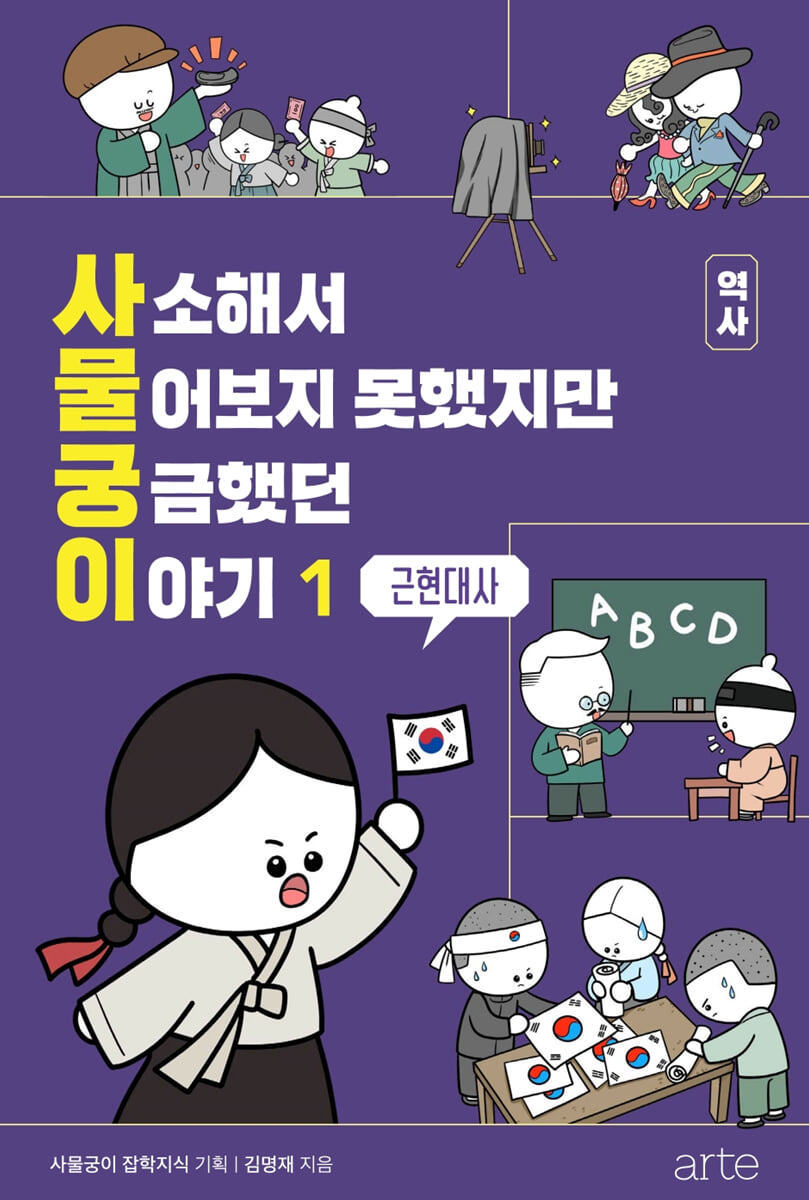
A story I was curious about but never asked because it was trivial: History 1 (Modern and Contemporary History)
 |
Description
Book Introduction
“There is no unimportant question in the world!”
The history section of Korea's largest science channel, "Samulgungi Miscellaneous Knowledge," has been released!
"Samulgungi Miscellaneous Knowledge," a popular knowledge channel that humorously unravels the knowledge contained in trivial everyday curiosities, has returned with a history textbook! The ingenious questions that "make you wonder about things you didn't know before," the delightful and clear explanations that never leave a dull moment, and the lively illustrations naturally lead "subscribers" to become "readers."
The first volume of the 'Samulgungi' history series unfolds an interesting story related to modern and contemporary Korean history.
In the past, people would read aloud, chanting, "Heaven, heaven, heaven, earth," but when did silent reading become the norm? Who selected the 33 representatives of the nation during the harsh Japanese colonial period? When did identification cards begin to replace house badges? It's easy to overlook, but every place in the world has a history and a story!
Let's dive into the world of "history" closely related to daily life, guided by YouTube's curiosity solver, "Gung-i," through the Samulgung History series, which returns with richer materials and colorful explanations, featuring three young historians.
The history section of Korea's largest science channel, "Samulgungi Miscellaneous Knowledge," has been released!
"Samulgungi Miscellaneous Knowledge," a popular knowledge channel that humorously unravels the knowledge contained in trivial everyday curiosities, has returned with a history textbook! The ingenious questions that "make you wonder about things you didn't know before," the delightful and clear explanations that never leave a dull moment, and the lively illustrations naturally lead "subscribers" to become "readers."
The first volume of the 'Samulgungi' history series unfolds an interesting story related to modern and contemporary Korean history.
In the past, people would read aloud, chanting, "Heaven, heaven, heaven, earth," but when did silent reading become the norm? Who selected the 33 representatives of the nation during the harsh Japanese colonial period? When did identification cards begin to replace house badges? It's easy to overlook, but every place in the world has a history and a story!
Let's dive into the world of "history" closely related to daily life, guided by YouTube's curiosity solver, "Gung-i," through the Samulgung History series, which returns with richer materials and colorful explanations, featuring three young historians.
- You can preview some of the book's contents.
Preview
index
Prologue 4
Part 1: A story about modern and contemporary history that was too trivial to ask about.
1 Why did Japan recognize Joseon as an independent nation in the Ganghwa Island Treaty?
Who chose the 33 representatives of the two nations? 17
3 What did the actual March 1st Movement look like? 23
Who made the bombs used in the 4th Righteous Struggle? 29
5 How did the "traitor" Kim Ok-gyun live after the failure of the Gapsin Coup? 35
Why did the Righteous Army call themselves "Righteous Army"? 41
7 What was the worst misinformation in modern Korean history?
Did the pro-Japanese collaborators believe independence was absolutely impossible?
Part 2: A story of modern and contemporary culture that becomes more interesting the more you watch it.
9 I heard people used to read books out loud, but when did that change to reading silently? 61
10 When did the now-out-of-fashion blood type personality theory first become popular?
11 How was news of important events disseminated to people in modern and contemporary times? 75
12 When did photography become popular? 81
13 Why did modern women choose short hair? 87
14 How were rubber shoes made? 93
15 Why were genealogies actively published during the Japanese colonial period?
16 Why did the Japanese believe the rumor that Koreans poisoned the well? 105
Part 3: A story about modern and contemporary society that will immerse you in the story.
17 How did the modern Joseon government respond to infectious diseases? 113
What kind of lives did the despised Baekjeong lead after the abolition of the caste system? 119
How did people communicate with foreigners during the 19th port opening period? 125
How did Japanese civilians living in Korea during the Japanese colonial period interact with Koreans? 131
How did the seven-day week system become popular? 137
22 When did the resident registration card begin to be used instead of the household registration card? 143
23 When did Korea's educational fervor become so intense? 149
Was it difficult to find a home in Gyeongseong during the Japanese colonial period?
Part 4: A Story of Modern and Contemporary Movements That's Even More Interesting Once You Know It
How did the families of the 25 independence activists live? 163
26 What's the interesting story behind Yu Gwan-sun's prison number? 169
27 How were Korean workers treated during the Japanese colonial period? 175
28 Who first developed the seedless watermelon? 181
29 Since when has common sense become common sense? 185
30 Why are there new women but no new men? 191
31 Why was Jeon Bong-jun called "General Green Bean"? 197
32 Did our country declare war on Japan during the Japanese colonial period? 203
Part 5: Stories of modern and contemporary life that you've probably been curious about at least once
33 When did free love begin? 211
34 Where did trot originate? 215
35 Why is it so difficult to reclaim our cultural assets overseas? 221
36 What was Korea's first comic book? 229
How did the 37 Summer Cooldown Special begin? 235
Is UNESCO World Heritage Site Registration Really a Good Thing? 241
39 What was Korea's first modern advertisement? 247
40 How Did Christmas Spread to Korea? 253
Reference 258
Part 1: A story about modern and contemporary history that was too trivial to ask about.
1 Why did Japan recognize Joseon as an independent nation in the Ganghwa Island Treaty?
Who chose the 33 representatives of the two nations? 17
3 What did the actual March 1st Movement look like? 23
Who made the bombs used in the 4th Righteous Struggle? 29
5 How did the "traitor" Kim Ok-gyun live after the failure of the Gapsin Coup? 35
Why did the Righteous Army call themselves "Righteous Army"? 41
7 What was the worst misinformation in modern Korean history?
Did the pro-Japanese collaborators believe independence was absolutely impossible?
Part 2: A story of modern and contemporary culture that becomes more interesting the more you watch it.
9 I heard people used to read books out loud, but when did that change to reading silently? 61
10 When did the now-out-of-fashion blood type personality theory first become popular?
11 How was news of important events disseminated to people in modern and contemporary times? 75
12 When did photography become popular? 81
13 Why did modern women choose short hair? 87
14 How were rubber shoes made? 93
15 Why were genealogies actively published during the Japanese colonial period?
16 Why did the Japanese believe the rumor that Koreans poisoned the well? 105
Part 3: A story about modern and contemporary society that will immerse you in the story.
17 How did the modern Joseon government respond to infectious diseases? 113
What kind of lives did the despised Baekjeong lead after the abolition of the caste system? 119
How did people communicate with foreigners during the 19th port opening period? 125
How did Japanese civilians living in Korea during the Japanese colonial period interact with Koreans? 131
How did the seven-day week system become popular? 137
22 When did the resident registration card begin to be used instead of the household registration card? 143
23 When did Korea's educational fervor become so intense? 149
Was it difficult to find a home in Gyeongseong during the Japanese colonial period?
Part 4: A Story of Modern and Contemporary Movements That's Even More Interesting Once You Know It
How did the families of the 25 independence activists live? 163
26 What's the interesting story behind Yu Gwan-sun's prison number? 169
27 How were Korean workers treated during the Japanese colonial period? 175
28 Who first developed the seedless watermelon? 181
29 Since when has common sense become common sense? 185
30 Why are there new women but no new men? 191
31 Why was Jeon Bong-jun called "General Green Bean"? 197
32 Did our country declare war on Japan during the Japanese colonial period? 203
Part 5: Stories of modern and contemporary life that you've probably been curious about at least once
33 When did free love begin? 211
34 Where did trot originate? 215
35 Why is it so difficult to reclaim our cultural assets overseas? 221
36 What was Korea's first comic book? 229
How did the 37 Summer Cooldown Special begin? 235
Is UNESCO World Heritage Site Registration Really a Good Thing? 241
39 What was Korea's first modern advertisement? 247
40 How Did Christmas Spread to Korea? 253
Reference 258
Detailed image

Publisher's Review
“There is no unimportant question in the world!”
1.56 million subscribers, 320 million cumulative views
The history section of Korea's largest science channel, "Samulgungi Miscellaneous Knowledge," has been released!
“Who made the bombs used in the Righteous Struggle?” “What kind of lives did the Baekjeong, who were looked down upon after the abolition of the caste system, live?” “Why are there new women but no new men?” The popular knowledge channel “Samulgungi Miscellaneous Knowledge,” which unravels great knowledge contained in trivial curiosities through animation, has published volumes 1, 2, and 3 of the history series at the same time.
Based on the planning and supervision of YouTuber 'Samulgungi', three young historians who teach students in the Department of Korean History at Seoul National University participate as writers to solve historical curiosities in everyday life.
Volume 1 of the 'History' series addresses fascinating questions surrounding 'modern and contemporary history' in Korean history.
'Samulgungi', an abbreviation for 'a story that was so trivial that I couldn't ask, but was curious', is a knowledge channel that uses animation to easily and funnily explain the trivial curiosities that cross our minds in everyday life and the not-so-trivial knowledge contained within them.
As of February 2025, 'Samulgungi', which has a whopping 1.56 million subscribers, has a unique difference in that it asks novel and unique questions and supports them with solid historical research.
If you click on the video, captivated by the unexpected questions that make you curious about things you weren't curious about, you'll find historical facts and contexts explained in a fun and engaging way, organized through meticulous research and expert advice.
In recognition of this sincerity and high quality, 'Samulgungi' has established itself as a 'trusted and watched' knowledge channel recommended by teachers, students, various media, and education offices, and has proven its excellence by winning the Korea Foundation for the Advancement of Science and Creativity's Outstanding Science and Culture Content and the Youth Recommended YouTube Channel Award.
Recently, thanks to its popularity, it has established itself as an unrivaled knowledge channel by providing videos to public transportation such as Seoul and Gyeonggi buses, Seoul Subway Line 2, and Kakao T taxis.
The new "History" series of "Samulgungi" published by Arte Publishing faithfully embodies the channel's concept by inheriting the strengths of the existing "Science" series.
The video goes through a meticulous editing process to provide readers with a captivating reading experience, allowing them to grasp historical facts and context that are easily missed at a glance.
Let's embark on a journey into the world of "history" that is closely related to everyday life with YouTube's curiosity solver, "Gung-i."
- Topics that are 200% curious and not covered in the video
- A reliable and educational history textbook written by young historians
- Historical facts and context that are easily missed in textbooks at a glance
The history section of 'Stories I Was Curious About But Never Asked About' was planned and supervised by YouTuber 'Samulgungi', and three young historians participated as writers to provide fresher and richer content and friendly and colorful explanations.
The first volume of 'Samulgungi' History was compiled by Kim Myeong-jae, a young historian who teaches at the Department of Korean History at Seoul National University, by selecting 40 historical questions that readers are most curious about and confused about, with the theme of modern and contemporary history.
The surprising charm of 'Samulgungi' is that no matter how trivial the question, the reason and history contained in it are by no means trivial.
For example, to understand “Where did trot originate?”, we need to know the cultural history of mankind, which has developed by adapting foreign cultures and products of previous eras. To answer “How did the summer cool-down special begin?”, we need to look back at the anxious public sentiment and the history of the media during the Japanese colonial period.
Immerse yourself in a world of history that is closely related to your daily life, with novel questions that “make you wonder about things you weren’t curious about,” delightful and clear explanations that never leave you bored, lively illustrations, and the quirky and cute character Gung-i.
“There is no unimportant question in the world!”
The power of small questions that can change history
We usually ignore the 'trivial' questions that suddenly arise while walking down the street.
However, whether a question is judged as 'important' is usually just a judgment of the 'majority' living in the 'present', and a question that was considered unimportant can suddenly become a question that everyone is curious about.
For example, until November 2024, the question, “Will I be able to go to work under martial law?” was considered a trivial curiosity, a relic of the past, but now it has become a pressing, real-world issue for countless people.
The unification of the Three Kingdoms, the rise and fall of Goryeo and Joseon, the Japanese colonial period, the Korean War, and military regimes—the countless questions raised by our history are easily dismissed as stories of the past.
But history teaches us an important lesson: today's trivial questions can quickly become tomorrow's pressing questions, suggesting that the current majority view isn't necessarily the right one.
I hope that readers of this book will step outside the present and the majority's perspectives and listen to all questions, thereby gaining a deeper understanding of our history and each other.
1.56 million subscribers, 320 million cumulative views
The history section of Korea's largest science channel, "Samulgungi Miscellaneous Knowledge," has been released!
“Who made the bombs used in the Righteous Struggle?” “What kind of lives did the Baekjeong, who were looked down upon after the abolition of the caste system, live?” “Why are there new women but no new men?” The popular knowledge channel “Samulgungi Miscellaneous Knowledge,” which unravels great knowledge contained in trivial curiosities through animation, has published volumes 1, 2, and 3 of the history series at the same time.
Based on the planning and supervision of YouTuber 'Samulgungi', three young historians who teach students in the Department of Korean History at Seoul National University participate as writers to solve historical curiosities in everyday life.
Volume 1 of the 'History' series addresses fascinating questions surrounding 'modern and contemporary history' in Korean history.
'Samulgungi', an abbreviation for 'a story that was so trivial that I couldn't ask, but was curious', is a knowledge channel that uses animation to easily and funnily explain the trivial curiosities that cross our minds in everyday life and the not-so-trivial knowledge contained within them.
As of February 2025, 'Samulgungi', which has a whopping 1.56 million subscribers, has a unique difference in that it asks novel and unique questions and supports them with solid historical research.
If you click on the video, captivated by the unexpected questions that make you curious about things you weren't curious about, you'll find historical facts and contexts explained in a fun and engaging way, organized through meticulous research and expert advice.
In recognition of this sincerity and high quality, 'Samulgungi' has established itself as a 'trusted and watched' knowledge channel recommended by teachers, students, various media, and education offices, and has proven its excellence by winning the Korea Foundation for the Advancement of Science and Creativity's Outstanding Science and Culture Content and the Youth Recommended YouTube Channel Award.
Recently, thanks to its popularity, it has established itself as an unrivaled knowledge channel by providing videos to public transportation such as Seoul and Gyeonggi buses, Seoul Subway Line 2, and Kakao T taxis.
The new "History" series of "Samulgungi" published by Arte Publishing faithfully embodies the channel's concept by inheriting the strengths of the existing "Science" series.
The video goes through a meticulous editing process to provide readers with a captivating reading experience, allowing them to grasp historical facts and context that are easily missed at a glance.
Let's embark on a journey into the world of "history" that is closely related to everyday life with YouTube's curiosity solver, "Gung-i."
- Topics that are 200% curious and not covered in the video
- A reliable and educational history textbook written by young historians
- Historical facts and context that are easily missed in textbooks at a glance
The history section of 'Stories I Was Curious About But Never Asked About' was planned and supervised by YouTuber 'Samulgungi', and three young historians participated as writers to provide fresher and richer content and friendly and colorful explanations.
The first volume of 'Samulgungi' History was compiled by Kim Myeong-jae, a young historian who teaches at the Department of Korean History at Seoul National University, by selecting 40 historical questions that readers are most curious about and confused about, with the theme of modern and contemporary history.
The surprising charm of 'Samulgungi' is that no matter how trivial the question, the reason and history contained in it are by no means trivial.
For example, to understand “Where did trot originate?”, we need to know the cultural history of mankind, which has developed by adapting foreign cultures and products of previous eras. To answer “How did the summer cool-down special begin?”, we need to look back at the anxious public sentiment and the history of the media during the Japanese colonial period.
Immerse yourself in a world of history that is closely related to your daily life, with novel questions that “make you wonder about things you weren’t curious about,” delightful and clear explanations that never leave you bored, lively illustrations, and the quirky and cute character Gung-i.
“There is no unimportant question in the world!”
The power of small questions that can change history
We usually ignore the 'trivial' questions that suddenly arise while walking down the street.
However, whether a question is judged as 'important' is usually just a judgment of the 'majority' living in the 'present', and a question that was considered unimportant can suddenly become a question that everyone is curious about.
For example, until November 2024, the question, “Will I be able to go to work under martial law?” was considered a trivial curiosity, a relic of the past, but now it has become a pressing, real-world issue for countless people.
The unification of the Three Kingdoms, the rise and fall of Goryeo and Joseon, the Japanese colonial period, the Korean War, and military regimes—the countless questions raised by our history are easily dismissed as stories of the past.
But history teaches us an important lesson: today's trivial questions can quickly become tomorrow's pressing questions, suggesting that the current majority view isn't necessarily the right one.
I hope that readers of this book will step outside the present and the majority's perspectives and listen to all questions, thereby gaining a deeper understanding of our history and each other.
GOODS SPECIFICS
- Date of issue: February 5, 2025
- Page count, weight, size: 268 pages | 145*215*20mm
- ISBN13: 9791173570827
- ISBN10: 1173570829
You may also like
카테고리
korean


korean

![GQ KOREA Mark (Monthly): December [2025]](http://librairie.coreenne.fr/cdn/shop/files/8ef265dbbfbf186523ed75ba7319009d.jpg?v=1765340328&width=3840)


