

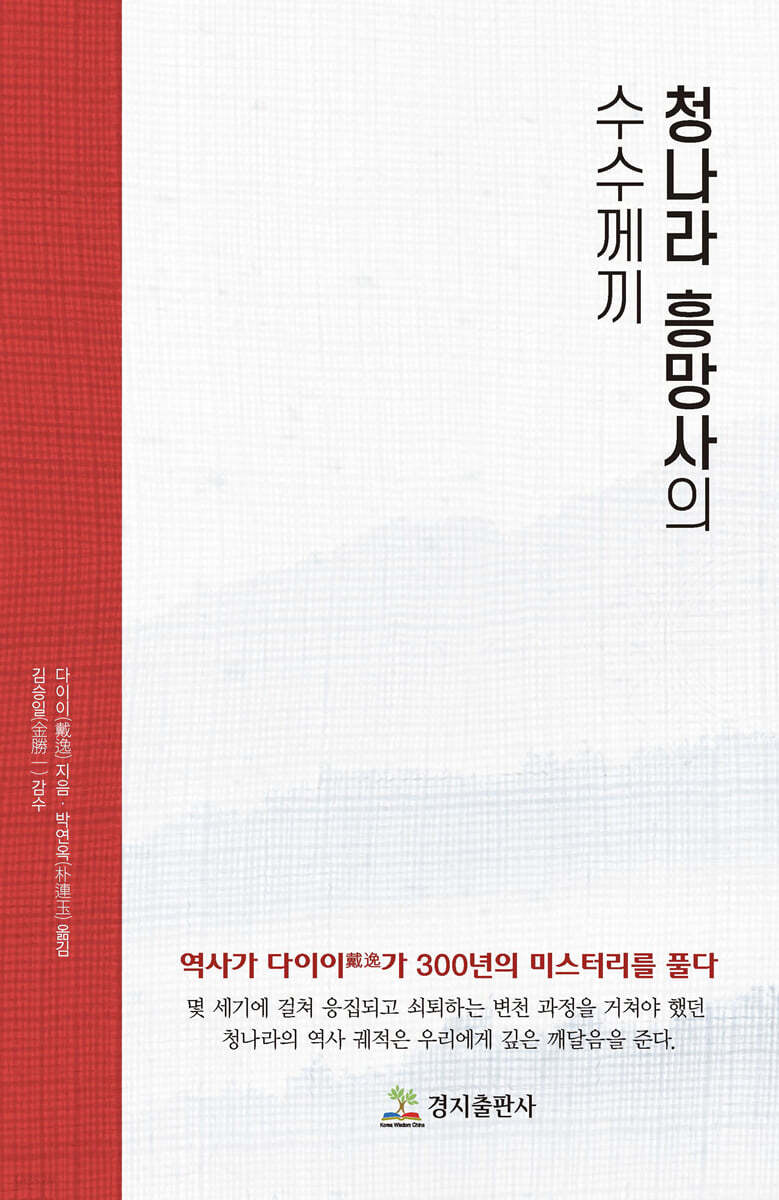
The Mystery of the Rise and Fall of the Qing Dynasty 1
 |
Description
Book Introduction
The Manchu spirit can be summarized into four elements: first, the “spirit of horseback riding and martial arts” that created the strength of a brave, tenacious, and strong-willed nation; second, the “cohesion of the nation” that controls the scope and depth of conflict and pays attention to the overall situation of the nation; third, the “spirit of unity and inclusion” that strengthens unity within the nation, embraces other ethnicities, and strengthens capabilities to defeat the strong with weak force; and fourth, the “spirit of advancement” that devotes itself to learning, absorbs advanced cultures, combines them with Manchu characteristics, and creates a cultural heritage and system that fits the flow of historical development.
- You can preview some of the book's contents.
Preview
index
The spiritual power that led to the development of the Manchu people
Emperor Kangxi's wise operation to eliminate the five dwarfs
The historical stage of Emperor Yongzheng
Historical Mystery Concerning the Yongzheng Emperor's Succession to the Imperial Throne
Emperor Qianlong and the Qianlong Dynasty
Empress Qianlong's funeral and the ensuing political turmoil
A War of More Losses Than Gains - On the Battle of Jinchuan during the Qianlong Dynasty
Emperor Qianlong, who left behind the most poems in China
The Climax Before Decline - The Prosperous Era of Kang, Yong, and Qian
A grand garden from the Kang, Ong, and Geon eras - Piseosanjang (避暑山莊)
The story of the struggle between Cixi and Hyeokheun
The rise and fall of the first Yangwu faction
Causes and Results of the Sino-Japanese War
Historical Lessons from the Sino-Japanese War
Liu Ming's Contributions and Significance in the Defense and Construction of Taiwan from the Perspective of Qing Dynasty History
The merits and demerits of the martial arts reform 100 years ago
Death of Emperor Guangxu
The relationship between China's modern machine industry and ancient handicrafts
Tan Si-dong, a patriotic and progressive reformer and thinker
May 4th Movement and Traditional Culture
Emperor Kangxi's wise operation to eliminate the five dwarfs
The historical stage of Emperor Yongzheng
Historical Mystery Concerning the Yongzheng Emperor's Succession to the Imperial Throne
Emperor Qianlong and the Qianlong Dynasty
Empress Qianlong's funeral and the ensuing political turmoil
A War of More Losses Than Gains - On the Battle of Jinchuan during the Qianlong Dynasty
Emperor Qianlong, who left behind the most poems in China
The Climax Before Decline - The Prosperous Era of Kang, Yong, and Qian
A grand garden from the Kang, Ong, and Geon eras - Piseosanjang (避暑山莊)
The story of the struggle between Cixi and Hyeokheun
The rise and fall of the first Yangwu faction
Causes and Results of the Sino-Japanese War
Historical Lessons from the Sino-Japanese War
Liu Ming's Contributions and Significance in the Defense and Construction of Taiwan from the Perspective of Qing Dynasty History
The merits and demerits of the martial arts reform 100 years ago
Death of Emperor Guangxu
The relationship between China's modern machine industry and ancient handicrafts
Tan Si-dong, a patriotic and progressive reformer and thinker
May 4th Movement and Traditional Culture
GOODS SPECIFICS
- Date of issue: January 15, 2025
- Page count, weight, size: 372 pages | 152*225*30mm
- ISBN13: 9791194570004
- ISBN10: 1194570003
You may also like
카테고리
korean


korean

![GQ KOREA Mark (Monthly): December [2025]](http://librairie.coreenne.fr/cdn/shop/files/8ef265dbbfbf186523ed75ba7319009d.jpg?v=1765340328&width=3840)


