

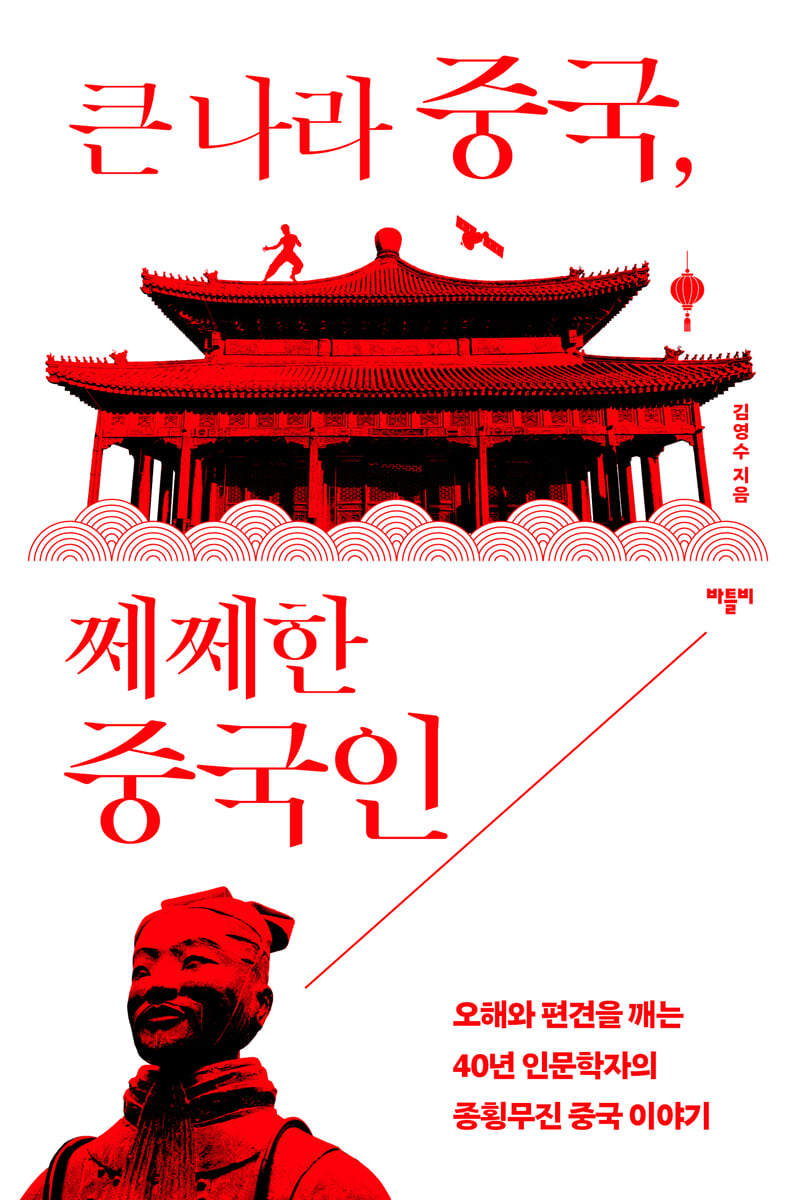
Big country China, petty Chinese people
 |
Description
Book Introduction
Is the China we know the real China?
- A new perspective that transcends misunderstandings and prejudices and allows us to see China and the Chinese people correctly.
Understanding China Correctly with Kim Young-soo, a Humanist with 40 Years of Experience
These days, there isn't a single day that goes by where we don't use Chinese products.
Our country and China have enjoyed a deep historical, cultural, and economic relationship for thousands of years, and even today, as North and South Korea confront each other, China exerts significant political influence.
Geopolitically and economically, we and China are inseparable.
But how much do we really know about China? Aren't we mired in misunderstandings and prejudices, along with the current trend of "anti-China" sentiment, and deluded into believing we don't need to know anything about China?
In a rapidly changing international situation, shouldn't we properly understand China's existence if we are to use it as a lever for our own development?
However, surprisingly few books exist that comprehensively introduce various fields related to China and analyze its inside and out to reveal its true nature.
This book, "Great China, Stingy Chinese," is the result of Kim Young-soo, a humanities scholar with 40 years of experience studying Chinese classics and visiting China on foot more than 150 times, to find multi-layered clues about China and the Chinese people.
In doing so, it vividly presents the diverse history of China, which has continued for over 5,000 years, its current state, and the background of the Chinese people's psychology.
- A new perspective that transcends misunderstandings and prejudices and allows us to see China and the Chinese people correctly.
Understanding China Correctly with Kim Young-soo, a Humanist with 40 Years of Experience
These days, there isn't a single day that goes by where we don't use Chinese products.
Our country and China have enjoyed a deep historical, cultural, and economic relationship for thousands of years, and even today, as North and South Korea confront each other, China exerts significant political influence.
Geopolitically and economically, we and China are inseparable.
But how much do we really know about China? Aren't we mired in misunderstandings and prejudices, along with the current trend of "anti-China" sentiment, and deluded into believing we don't need to know anything about China?
In a rapidly changing international situation, shouldn't we properly understand China's existence if we are to use it as a lever for our own development?
However, surprisingly few books exist that comprehensively introduce various fields related to China and analyze its inside and out to reveal its true nature.
This book, "Great China, Stingy Chinese," is the result of Kim Young-soo, a humanities scholar with 40 years of experience studying Chinese classics and visiting China on foot more than 150 times, to find multi-layered clues about China and the Chinese people.
In doing so, it vividly presents the diverse history of China, which has continued for over 5,000 years, its current state, and the background of the Chinese people's psychology.
- You can preview some of the book's contents.
Preview
index
Prologue: The illusion of knowing China well
Knowing China and the Chinese people
Chinese people are originally stingy(?)
Chapter 1: Differences arising from space and time
Such a big country
Are Chinese people born liars?
The root of pettiness
The Yellow River, which swallowed the most lives and property
The Yangtze River, which split China in two
The sacred Samsan and Oak
Chapter 2: History, Culture, Chinese Characters, and People
Are you not digging the tomb of Qin Shi Huang, or are you not able to dig it?
Qin Shi Huang's Mausoleum, a Treasure Trove of Imagination
Xi'an, the future cultural capital of China
Why did it rain and ghosts cry when we invented writing?
Yin Ruins, a relic that rewrote Chinese history
There is no creation myth in China?
Hangzhou, the heavenly city praised by Marco Polo
Soha makes it and Jocham follows it
Hyeon-go, the merchant who saved the country with 12 cows
Coquetry is a condition for a handsome Chinese man(?)
Chapter 3: The Psychological Roots of the Chinese and Their Concept of Numbers
Even if you just look at it, it will retaliate
Hanshin, who paid off a thousand gold coins with one meal
A promise made in the heart is a promise
Grudges are repaid even if it takes generations to pass them down.
Why there are only 99 tigers on Baekho Island
Symbolize everything with numbers
Numbers tell it all
Chapter 4: China, People, and Population
We are the center of the world, China
The flower that blooms at the center of the world, Junghwa
He who conquers the Central Plains gains the world.
Are there that many nicknames for China?
China, a multi-ethnic country
Uyghurs enjoy dancing and singing
How did the population of 1.4 billion come to be?
Chapter 5 Chinese Food and Drink
World-renowned Peking Duck
Cooking on everything except airplanes and tables?
Who is the god of Chinese cuisine, not found in Greek or Roman mythology?
Wansanti, the pork feet dish that changed the fortunes of a wealthy man
Chinese Liquor, What I Want to Know
The Hidden Story of Pearls: Maotai and Wuliangye
The politics of drinking and dining that changed history
Say only half, sing only one verse
Chapter 6: Practical Knowledge for Understanding China and the Chinese People
Why Jiang Taigong has so many nicknames
Masters who carved 5,000 years of history
The charm of Confucius in 38 characters
Basic information about the 34 cities
Beijing, famous for its history and culture
Are there jajangmyeon and jjambbong in China?
Chapter 7: Practical Tips for Localization
What should I do first to understand China?
Why is the lunar exploration project a rocket science project?
Why satellites are named after philosophers
If you know how to ride a train, you know half of China.
Short-distance transportation: taxi story
All roads lead to WeChat
How KFC Became an Unstoppable Fast Food Restaurant
How did Lock & Lock succeed in localization?
Chapter 8: China's Leaders and the Future
A Chinese leader who has been tested for decades
Mao Zedong, who never put down his history books
Wen Jiabao, who had a deep understanding of the humanities
Xi Jinping armed with a pragmatic understanding of history
Xi Jinping's 30 Years and Three Thirties
The Belt and Road Initiative: The Largest Project in Human History
Conclusion
Knowing China and the Chinese people
Chinese people are originally stingy(?)
Chapter 1: Differences arising from space and time
Such a big country
Are Chinese people born liars?
The root of pettiness
The Yellow River, which swallowed the most lives and property
The Yangtze River, which split China in two
The sacred Samsan and Oak
Chapter 2: History, Culture, Chinese Characters, and People
Are you not digging the tomb of Qin Shi Huang, or are you not able to dig it?
Qin Shi Huang's Mausoleum, a Treasure Trove of Imagination
Xi'an, the future cultural capital of China
Why did it rain and ghosts cry when we invented writing?
Yin Ruins, a relic that rewrote Chinese history
There is no creation myth in China?
Hangzhou, the heavenly city praised by Marco Polo
Soha makes it and Jocham follows it
Hyeon-go, the merchant who saved the country with 12 cows
Coquetry is a condition for a handsome Chinese man(?)
Chapter 3: The Psychological Roots of the Chinese and Their Concept of Numbers
Even if you just look at it, it will retaliate
Hanshin, who paid off a thousand gold coins with one meal
A promise made in the heart is a promise
Grudges are repaid even if it takes generations to pass them down.
Why there are only 99 tigers on Baekho Island
Symbolize everything with numbers
Numbers tell it all
Chapter 4: China, People, and Population
We are the center of the world, China
The flower that blooms at the center of the world, Junghwa
He who conquers the Central Plains gains the world.
Are there that many nicknames for China?
China, a multi-ethnic country
Uyghurs enjoy dancing and singing
How did the population of 1.4 billion come to be?
Chapter 5 Chinese Food and Drink
World-renowned Peking Duck
Cooking on everything except airplanes and tables?
Who is the god of Chinese cuisine, not found in Greek or Roman mythology?
Wansanti, the pork feet dish that changed the fortunes of a wealthy man
Chinese Liquor, What I Want to Know
The Hidden Story of Pearls: Maotai and Wuliangye
The politics of drinking and dining that changed history
Say only half, sing only one verse
Chapter 6: Practical Knowledge for Understanding China and the Chinese People
Why Jiang Taigong has so many nicknames
Masters who carved 5,000 years of history
The charm of Confucius in 38 characters
Basic information about the 34 cities
Beijing, famous for its history and culture
Are there jajangmyeon and jjambbong in China?
Chapter 7: Practical Tips for Localization
What should I do first to understand China?
Why is the lunar exploration project a rocket science project?
Why satellites are named after philosophers
If you know how to ride a train, you know half of China.
Short-distance transportation: taxi story
All roads lead to WeChat
How KFC Became an Unstoppable Fast Food Restaurant
How did Lock & Lock succeed in localization?
Chapter 8: China's Leaders and the Future
A Chinese leader who has been tested for decades
Mao Zedong, who never put down his history books
Wen Jiabao, who had a deep understanding of the humanities
Xi Jinping armed with a pragmatic understanding of history
Xi Jinping's 30 Years and Three Thirties
The Belt and Road Initiative: The Largest Project in Human History
Conclusion
Detailed image

Into the book
If we look at the history of Korea and China, there was a time when both countries enjoyed their golden age almost simultaneously.
It was a period of about 150 years, starting around the 8th century and ending in the mid-9th century.
We were after Silla unified the three kingdoms in 676, and China was under the Tang Dynasty.
The biggest commonality between the two countries during this golden age was that there was no war between them, and there was almost no war within each country.
In short, the most important prerequisite for the two countries to develop together is the absence of serious conflicts, including war.
--- p.14
When the THAAD issue was raised and China's various retaliations were taking place in all directions, one of the questions I received most frequently from businesspeople was why such a "big country" was "retaliating" so "pettily."
My answer to that question was very simple.
“That’s how it is!”
--- p.22
The land is vast, and the products that exist or grow on it are countless.
From the biggest to the smallest, from the most to the least, there is everything.
The same goes for the remaining ruins and relics.
They range from bronze artifacts weighing nearly a ton and dating back thousands of years to letters engraved on rice grains or hair.
This is expressed in another way as ‘Bakdaejeongsim (博大精深)’.
It means 'broad, large, sophisticated, and profound.'
--- p.35
When asked to name the cultural relics that symbolize Xi'an, a 3,000-year-old ancient capital city visited by people from all over the world, many people would name the Mausoleum of the First Qin Emperor and the Terracotta Army.
Local people shorten the name of Terracotta Army by one character to 'Terrain Horse', and shorten the name of Qin Shi Huang Mausoleum by one or two characters to 'Shi Huang Mausoleum' or 'Huang Mausoleum'.
On the other hand, some Koreans who have visited Xi'an mistake the Terracotta Army for the Mausoleum of Qin Shi Huang, the tomb of Qin Shi Huang.
--- p.56
Sima Qian recorded the history of the Yin Dynasty in the third volume of the Records of the Grand Historian, “Yin Benji (殷本記),” but most scholars did not believe it to be true until the early 20th century.
That is, the reality of the award was not acknowledged.
Meanwhile, as oracle bones and the characters engraved on them began to circulate, Yin Ruins came into the spotlight as their source, and starting in 1928, they were officially excavated and their true nature was revealed.
--- p.79
What surprised people the most during the excavations of Yin Ruins was the tomb of a wealthy man.
This tomb was excavated without being robbed, and while the sheer quantity of grave goods was impressive, there was something even more surprising.
The surprising thing about the appearance of the symbol seen through the treasures is that it was a female warrior.
Records such as oracle bone inscriptions also state that Buho was a warrior of both wisdom and courage, leading 3,000 elite soldiers and 10,000 warriors to conquer various regions and subjugate around 20 small countries.
--- p.81
There is a Chinese proverb that says, “A gentleman’s revenge is not too late, even if it takes ten years.”
There is also a slightly creepy proverb that says, “Repay kindness and enmity even if it takes generations to repay.”
The themes of Chinese films and dramas, especially historical dramas and martial arts films, are mostly filled with betrayal, resentment, grace, and revenge.
This is evidence that the concept of favor and enmity, the concept of yinyuan, is deeply rooted in the Chinese people's mentality.
'Eunwon-gwan' is a cultural phenomenon that is engraved in the DNA of the Chinese, just as it is for Koreans and people of other countries.
--- p.117
Chinese idioms, which are characterized by metaphors, analogies, and symbols instead of direct speech, are deeply ingrained in the language habits of the Chinese people.
To properly understand this, we must read the historical background of the words and writings and the cultural characteristics latent therein.
Even though it may be cumbersome and difficult, if you learn it properly, you can achieve great results in your relationships with Chinese people.
This is because the Chinese have a language habit of quoting poems and classical passages, including idioms.
--- p.138~139
When it comes to Chinese alcohol, eight out of ten people will choose 'Maotai'.
Maotai is a famous liquor that has even earned the honor of being called the "national liquor," and its reputation has been passed down since the 16th century.
Maotai is named after a small village called Maotai Village in Guizhou Province.
This rural village produces this exquisite liquor by combining water, climate, and a unique yeast, which contains dozens of minerals.
It is said that in different regions, the same ingredients were brewed in the same way, but the same taste was not achieved.
--- p.199
China has almost no secondary culture.
Although it has changed somewhat recently, in Chinese drinking culture, there is basically no second round.
End conversation and business at the dinner table.
The reason why a meal usually lasts two hours, or sometimes more than three hours, is because there is no secondary culture.
Therefore, insisting on a second round is both drunkenness and rudeness.
--- p.201
When dealing with or doing business with Chinese people, I would advise you to 'say only half' and 'sing only one verse'.
Chinese people have a habit of not revealing everything about themselves or their thoughts.
Because of this, you may feel a bit frustrated and impatient at times, but you must know how to be patient and wait.
No boasting.
Boasting at a drinking party is even more taboo.
Chinese people enjoy drinking as much as anyone else, but they rarely get drunk.
Even at a drinking party, I am used to observing others and figuring out their intentions.
--- p.216
Approach it with history and culture.
Most failures in business in China are due to a failed localization strategy.
In other words, even with a good location and good goods, he could not win the hearts of the Chinese people.
Only by knowing the culture and history can one properly understand the temperament and character of the Chinese people, as well as the regional sentiments and customs.
It is an essential element of localization strategy.
--- p.280~281
It has become a common practice for Chinese political leaders to indirectly convey their political views and positions by using historical and classical quotes and the sayings of famous figures.
If you do not properly understand the true intention or metaphor behind the lines, you may face difficulties in conversations or negotiations.
--- p.292
China has completed three of the largest and best projects in world history.
One is the Great Wall of China, which stretches for a whopping 5,000 kilometers, and the other is the Grand Canal, which connects the north and south, which stretches for approximately 1,800 kilometers.
The Great Wall we see today is the result of a truly grand undertaking that continued to expand for over two thousand years, from the Spring and Autumn Period to the Ming Dynasty.
The Grand Canal is a massive waterway that began around the 6th century BC and took approximately 1,700 years to complete by the 13th century.
--- p.305
For Korea-China relations to change in that way, understanding must be a prerequisite.
You have to know to understand.
You need to know that too.
To know, you must study.
Another thing I realized while reading related books is that the commonality among those who promote anti-China sentiment is that they do not even try to understand China, let alone learn about it.
Even if you try to learn, you only focus on one-sided studies.
What's more serious is that they are so mired in confirmation bias that they don't even try to think about the other side.
The problem is that these are the forces that lead public opinion.
It was a period of about 150 years, starting around the 8th century and ending in the mid-9th century.
We were after Silla unified the three kingdoms in 676, and China was under the Tang Dynasty.
The biggest commonality between the two countries during this golden age was that there was no war between them, and there was almost no war within each country.
In short, the most important prerequisite for the two countries to develop together is the absence of serious conflicts, including war.
--- p.14
When the THAAD issue was raised and China's various retaliations were taking place in all directions, one of the questions I received most frequently from businesspeople was why such a "big country" was "retaliating" so "pettily."
My answer to that question was very simple.
“That’s how it is!”
--- p.22
The land is vast, and the products that exist or grow on it are countless.
From the biggest to the smallest, from the most to the least, there is everything.
The same goes for the remaining ruins and relics.
They range from bronze artifacts weighing nearly a ton and dating back thousands of years to letters engraved on rice grains or hair.
This is expressed in another way as ‘Bakdaejeongsim (博大精深)’.
It means 'broad, large, sophisticated, and profound.'
--- p.35
When asked to name the cultural relics that symbolize Xi'an, a 3,000-year-old ancient capital city visited by people from all over the world, many people would name the Mausoleum of the First Qin Emperor and the Terracotta Army.
Local people shorten the name of Terracotta Army by one character to 'Terrain Horse', and shorten the name of Qin Shi Huang Mausoleum by one or two characters to 'Shi Huang Mausoleum' or 'Huang Mausoleum'.
On the other hand, some Koreans who have visited Xi'an mistake the Terracotta Army for the Mausoleum of Qin Shi Huang, the tomb of Qin Shi Huang.
--- p.56
Sima Qian recorded the history of the Yin Dynasty in the third volume of the Records of the Grand Historian, “Yin Benji (殷本記),” but most scholars did not believe it to be true until the early 20th century.
That is, the reality of the award was not acknowledged.
Meanwhile, as oracle bones and the characters engraved on them began to circulate, Yin Ruins came into the spotlight as their source, and starting in 1928, they were officially excavated and their true nature was revealed.
--- p.79
What surprised people the most during the excavations of Yin Ruins was the tomb of a wealthy man.
This tomb was excavated without being robbed, and while the sheer quantity of grave goods was impressive, there was something even more surprising.
The surprising thing about the appearance of the symbol seen through the treasures is that it was a female warrior.
Records such as oracle bone inscriptions also state that Buho was a warrior of both wisdom and courage, leading 3,000 elite soldiers and 10,000 warriors to conquer various regions and subjugate around 20 small countries.
--- p.81
There is a Chinese proverb that says, “A gentleman’s revenge is not too late, even if it takes ten years.”
There is also a slightly creepy proverb that says, “Repay kindness and enmity even if it takes generations to repay.”
The themes of Chinese films and dramas, especially historical dramas and martial arts films, are mostly filled with betrayal, resentment, grace, and revenge.
This is evidence that the concept of favor and enmity, the concept of yinyuan, is deeply rooted in the Chinese people's mentality.
'Eunwon-gwan' is a cultural phenomenon that is engraved in the DNA of the Chinese, just as it is for Koreans and people of other countries.
--- p.117
Chinese idioms, which are characterized by metaphors, analogies, and symbols instead of direct speech, are deeply ingrained in the language habits of the Chinese people.
To properly understand this, we must read the historical background of the words and writings and the cultural characteristics latent therein.
Even though it may be cumbersome and difficult, if you learn it properly, you can achieve great results in your relationships with Chinese people.
This is because the Chinese have a language habit of quoting poems and classical passages, including idioms.
--- p.138~139
When it comes to Chinese alcohol, eight out of ten people will choose 'Maotai'.
Maotai is a famous liquor that has even earned the honor of being called the "national liquor," and its reputation has been passed down since the 16th century.
Maotai is named after a small village called Maotai Village in Guizhou Province.
This rural village produces this exquisite liquor by combining water, climate, and a unique yeast, which contains dozens of minerals.
It is said that in different regions, the same ingredients were brewed in the same way, but the same taste was not achieved.
--- p.199
China has almost no secondary culture.
Although it has changed somewhat recently, in Chinese drinking culture, there is basically no second round.
End conversation and business at the dinner table.
The reason why a meal usually lasts two hours, or sometimes more than three hours, is because there is no secondary culture.
Therefore, insisting on a second round is both drunkenness and rudeness.
--- p.201
When dealing with or doing business with Chinese people, I would advise you to 'say only half' and 'sing only one verse'.
Chinese people have a habit of not revealing everything about themselves or their thoughts.
Because of this, you may feel a bit frustrated and impatient at times, but you must know how to be patient and wait.
No boasting.
Boasting at a drinking party is even more taboo.
Chinese people enjoy drinking as much as anyone else, but they rarely get drunk.
Even at a drinking party, I am used to observing others and figuring out their intentions.
--- p.216
Approach it with history and culture.
Most failures in business in China are due to a failed localization strategy.
In other words, even with a good location and good goods, he could not win the hearts of the Chinese people.
Only by knowing the culture and history can one properly understand the temperament and character of the Chinese people, as well as the regional sentiments and customs.
It is an essential element of localization strategy.
--- p.280~281
It has become a common practice for Chinese political leaders to indirectly convey their political views and positions by using historical and classical quotes and the sayings of famous figures.
If you do not properly understand the true intention or metaphor behind the lines, you may face difficulties in conversations or negotiations.
--- p.292
China has completed three of the largest and best projects in world history.
One is the Great Wall of China, which stretches for a whopping 5,000 kilometers, and the other is the Grand Canal, which connects the north and south, which stretches for approximately 1,800 kilometers.
The Great Wall we see today is the result of a truly grand undertaking that continued to expand for over two thousand years, from the Spring and Autumn Period to the Ming Dynasty.
The Grand Canal is a massive waterway that began around the 6th century BC and took approximately 1,700 years to complete by the 13th century.
--- p.305
For Korea-China relations to change in that way, understanding must be a prerequisite.
You have to know to understand.
You need to know that too.
To know, you must study.
Another thing I realized while reading related books is that the commonality among those who promote anti-China sentiment is that they do not even try to understand China, let alone learn about it.
Even if you try to learn, you only focus on one-sided studies.
What's more serious is that they are so mired in confirmation bias that they don't even try to think about the other side.
The problem is that these are the forces that lead public opinion.
--- p.310~311
Publisher's Review
If you want to know the future, you must know China!
How much do we really know about China and the Chinese people?
A guide to China filled with historical and practical knowledge about Chinese society, history, and the Chinese people!
Is the China we know the real China?
- A book for new perspectives on China and the Chinese people.
These days, there isn't a single day that goes by where we don't use Chinese products.
From everyday necessities to home appliances and their components, products from China are deeply ingrained in the lives of not only Koreans but also people around the world.
Today, China is a powerful country that exerts influence on the world both economically and politically.
Leaders of many countries are closely monitoring the movements of Chinese companies, such as Huawei, Xiaomi, and BYD, known for its electric vehicles, and are paying close attention to the comments of Chinese political and economic leaders.
The Korean Peninsula and China have been neighbors for thousands of years and have shared a lot of history.
Even as North and South Korea stand face to face, we and China remain inseparable.
China, our neighbor for thousands of years and a country that has grown at a remarkable rate, literally standing tall as one of the centers of the world, is a partner whose importance cannot be overemphasized.
Given its importance, how much do we really know about China? If you think about it, it's surprisingly little.
For a long time, China was often thought of as a noisy, populous country.
Have we not been caught up in misunderstandings and prejudices, along with the current trend of anti-China sentiment, and fallen into the delusion that we don't need to know anything about China?
So, in this rapidly changing international situation, shouldn't we now properly understand China's existence in order to leverage it as a lever for our own development?
However, surprisingly few books exist that comprehensively introduce various fields related to China and analyze its inside and out to reveal its true nature.
This book, "Great China, Stingy Chinese," is the result of Kim Young-su, a humanist who has studied Chinese classics for over 30 years, exploring China on foot more than 150 times and finding multi-layered clues about China and the Chinese people.
Chinese history and culture, the psychological roots of the Chinese people, food and alcohol, the origins of Sinocentrism,
Practical business knowledge and information, a thorough look at China from past leaders to the future!
To fully understand China and its people, we must first understand the diversity and differences that come from its size, which is approximately 95 times the size of South Korea.
In addition, we must understand the national character and cultural characteristics of the Chinese people, which have been accumulated layer by layer over a history of over 5,000 years.
To do so, it is necessary to analyze the inside and outside of the Chinese people across geography, history, culture, economy, and people.
The author, an authority on Chinese classics and an expert on the Records of the Grand Historian, has carefully selected basic knowledge about China in this book, Great China, Petty Chinese.
Rather than simply showing one aspect of China, it clearly addresses and explains key issues across history, culture, economy, and society.
By doing so, it comprehensively presents the information and knowledge necessary to understand not only modern Chinese society but also the profound psychology of the Chinese people and the cultural roots that form its foundation.
It covers everything from Chinese mythology to geographical features, history, and classics, as well as practical information useful for doing business or traveling in China.
First, Chapter 1 examines the historical and cultural roots that gave birth to the unique Chinese psychology, and introduces the human geography of China, including its representative rivers and mountains.
Chapter 2 examines aspects of ancient civilization, including the story surrounding the Qin Shi Huang Mausoleum, ancient great cities such as Xi'an, the ruins of Yin Ruins, the origins of Chinese characters, creation myths, and aesthetics.
Chapter 3 explores the Chinese people's deep psychology of resentment, revenge, and gratitude, as well as their obsession with numbers.
Chapter 4 examines the historical and cultural roots of Sinocentrism and examines the formation and population of China as a multi-ethnic nation.
Chapter 5 explores China's famous foods, drinks, and drinking politics.
Chapters 6 and 7 discuss a variety of practical information for localization, travel, and business.
Chapter 8 discusses the humanistic spirit of past Chinese leaders and their large-scale national projects.
Only by properly understanding China can we see Korea's future!
- What direction should Korea take amid the power struggle between the US and China?
The United States is taking a confrontational stance on every issue, trying to contain China's rise.
Now that Donald Trump has returned as US president, the power struggle between the US and China will intensify.
In this gap, our country is walking a precarious tightrope, deciding which side to take: China or the United States.
What position should we maintain and what diplomatic strategy should we pursue? While economic relations between Korea and China remain close, political and cultural relations have deteriorated.
However, for the sake of our country's peace, we must move forward with a cooperative relationship with China.
The understanding of China and the Chinese people, consistently emphasized throughout this book, is of great practical significance in order to capitalize on the US's containment of China.
This book, which comprehensively covers various aspects of China, will serve as a stepping stone to overcoming vague misunderstandings and ignorance and truly understanding Chinese culture and its people.
How much do we really know about China and the Chinese people?
A guide to China filled with historical and practical knowledge about Chinese society, history, and the Chinese people!
Is the China we know the real China?
- A book for new perspectives on China and the Chinese people.
These days, there isn't a single day that goes by where we don't use Chinese products.
From everyday necessities to home appliances and their components, products from China are deeply ingrained in the lives of not only Koreans but also people around the world.
Today, China is a powerful country that exerts influence on the world both economically and politically.
Leaders of many countries are closely monitoring the movements of Chinese companies, such as Huawei, Xiaomi, and BYD, known for its electric vehicles, and are paying close attention to the comments of Chinese political and economic leaders.
The Korean Peninsula and China have been neighbors for thousands of years and have shared a lot of history.
Even as North and South Korea stand face to face, we and China remain inseparable.
China, our neighbor for thousands of years and a country that has grown at a remarkable rate, literally standing tall as one of the centers of the world, is a partner whose importance cannot be overemphasized.
Given its importance, how much do we really know about China? If you think about it, it's surprisingly little.
For a long time, China was often thought of as a noisy, populous country.
Have we not been caught up in misunderstandings and prejudices, along with the current trend of anti-China sentiment, and fallen into the delusion that we don't need to know anything about China?
So, in this rapidly changing international situation, shouldn't we now properly understand China's existence in order to leverage it as a lever for our own development?
However, surprisingly few books exist that comprehensively introduce various fields related to China and analyze its inside and out to reveal its true nature.
This book, "Great China, Stingy Chinese," is the result of Kim Young-su, a humanist who has studied Chinese classics for over 30 years, exploring China on foot more than 150 times and finding multi-layered clues about China and the Chinese people.
Chinese history and culture, the psychological roots of the Chinese people, food and alcohol, the origins of Sinocentrism,
Practical business knowledge and information, a thorough look at China from past leaders to the future!
To fully understand China and its people, we must first understand the diversity and differences that come from its size, which is approximately 95 times the size of South Korea.
In addition, we must understand the national character and cultural characteristics of the Chinese people, which have been accumulated layer by layer over a history of over 5,000 years.
To do so, it is necessary to analyze the inside and outside of the Chinese people across geography, history, culture, economy, and people.
The author, an authority on Chinese classics and an expert on the Records of the Grand Historian, has carefully selected basic knowledge about China in this book, Great China, Petty Chinese.
Rather than simply showing one aspect of China, it clearly addresses and explains key issues across history, culture, economy, and society.
By doing so, it comprehensively presents the information and knowledge necessary to understand not only modern Chinese society but also the profound psychology of the Chinese people and the cultural roots that form its foundation.
It covers everything from Chinese mythology to geographical features, history, and classics, as well as practical information useful for doing business or traveling in China.
First, Chapter 1 examines the historical and cultural roots that gave birth to the unique Chinese psychology, and introduces the human geography of China, including its representative rivers and mountains.
Chapter 2 examines aspects of ancient civilization, including the story surrounding the Qin Shi Huang Mausoleum, ancient great cities such as Xi'an, the ruins of Yin Ruins, the origins of Chinese characters, creation myths, and aesthetics.
Chapter 3 explores the Chinese people's deep psychology of resentment, revenge, and gratitude, as well as their obsession with numbers.
Chapter 4 examines the historical and cultural roots of Sinocentrism and examines the formation and population of China as a multi-ethnic nation.
Chapter 5 explores China's famous foods, drinks, and drinking politics.
Chapters 6 and 7 discuss a variety of practical information for localization, travel, and business.
Chapter 8 discusses the humanistic spirit of past Chinese leaders and their large-scale national projects.
Only by properly understanding China can we see Korea's future!
- What direction should Korea take amid the power struggle between the US and China?
The United States is taking a confrontational stance on every issue, trying to contain China's rise.
Now that Donald Trump has returned as US president, the power struggle between the US and China will intensify.
In this gap, our country is walking a precarious tightrope, deciding which side to take: China or the United States.
What position should we maintain and what diplomatic strategy should we pursue? While economic relations between Korea and China remain close, political and cultural relations have deteriorated.
However, for the sake of our country's peace, we must move forward with a cooperative relationship with China.
The understanding of China and the Chinese people, consistently emphasized throughout this book, is of great practical significance in order to capitalize on the US's containment of China.
This book, which comprehensively covers various aspects of China, will serve as a stepping stone to overcoming vague misunderstandings and ignorance and truly understanding Chinese culture and its people.
GOODS SPECIFICS
- Date of issue: January 20, 2025
- Page count, weight, size: 312 pages | 468g | 140*210*22mm
- ISBN13: 9791191959383
- ISBN10: 1191959384
You may also like
카테고리
korean


korean

![GQ KOREA Mark (Monthly): December [2025]](http://librairie.coreenne.fr/cdn/shop/files/8ef265dbbfbf186523ed75ba7319009d.jpg?v=1765340328&width=3840)


