

Reading Development and Reading Disabilities
 |
Description
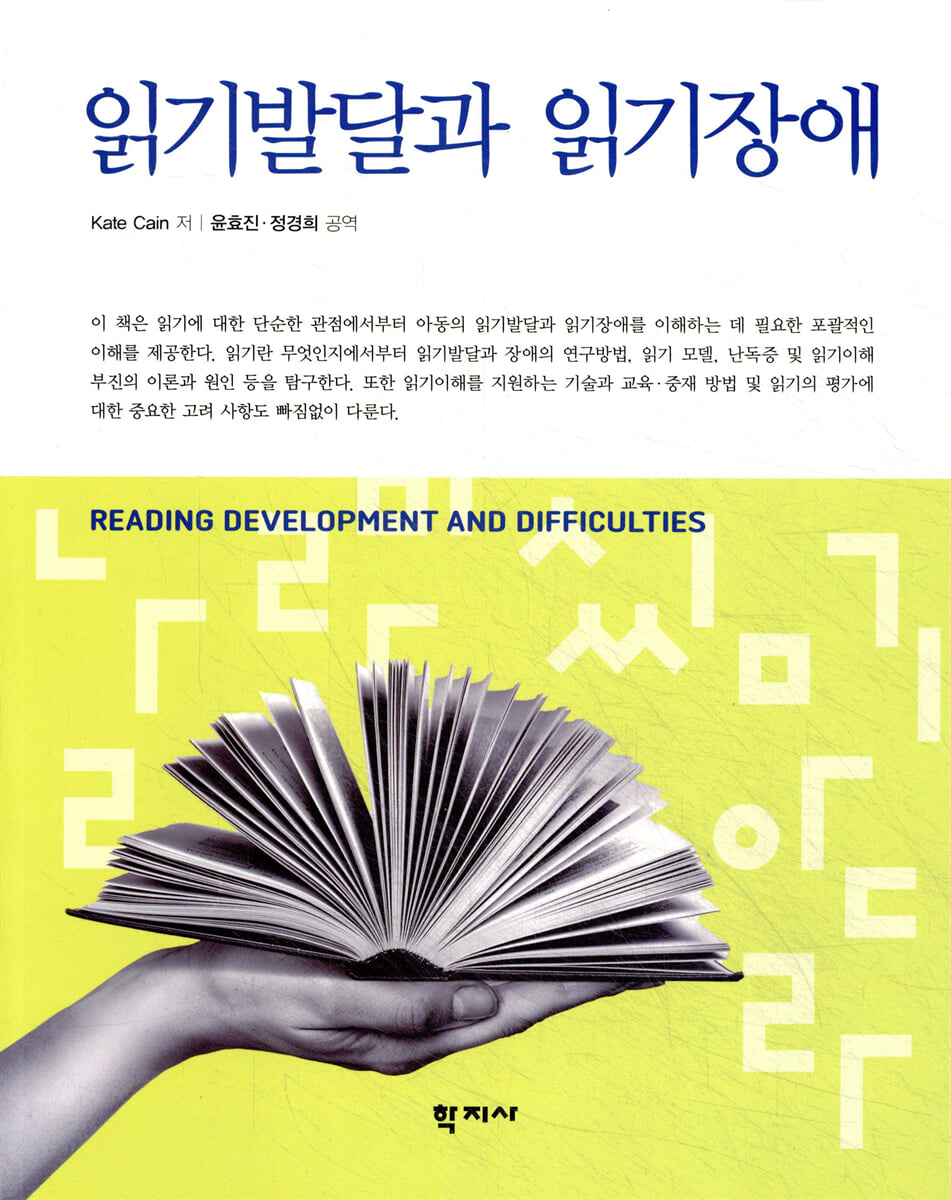
Book Introduction
Interest in reading is growing in Korea.
The media is highlighting ways to restore literacy skills through a variety of captivating stimuli, and provincial and municipal offices of education and schools are also developing and providing educational support for students struggling with reading.
In line with this movement, universities are also covering language disorders, reading development, and reading disabilities in school-age children, but they are having difficulties due to the lack of introductory books for undergraduates and non-specialists who do not have background knowledge.
In response to this demand, Dr. Kate Cain's book, Reading Development and Reading Disabilities, has been translated and published.
To become a 'good reader', you need to grasp the meaning of words well and mix them appropriately to understand the overall meaning of the text.
In this way, reading is a 'complex cognitive and language processing process'.
Therefore, understanding reading requires dealing with language and cognitive skills, knowledge, and complex processing processes and models.
This book provides comprehensive information necessary for understanding reading, in a way that can be understood without specialized knowledge.
For non-specialists interested in reading difficulties or undergraduates without sufficient background knowledge, this book will serve as an appropriate introduction to understanding complex reading.
Beginning with the concepts of word decoding and reading comprehension, this book explores research methods for reading development and disorders, models of reading, and the theories and causes of dyslexia and reading comprehension difficulties.
It also covers technologies that support reading comprehension, instructional and intervention methods, and important considerations for assessing reading.
Discover this book, which offers everything from a simple perspective on reading to a comprehensive understanding of children's reading development and reading disabilities.
The media is highlighting ways to restore literacy skills through a variety of captivating stimuli, and provincial and municipal offices of education and schools are also developing and providing educational support for students struggling with reading.
In line with this movement, universities are also covering language disorders, reading development, and reading disabilities in school-age children, but they are having difficulties due to the lack of introductory books for undergraduates and non-specialists who do not have background knowledge.
In response to this demand, Dr. Kate Cain's book, Reading Development and Reading Disabilities, has been translated and published.
To become a 'good reader', you need to grasp the meaning of words well and mix them appropriately to understand the overall meaning of the text.
In this way, reading is a 'complex cognitive and language processing process'.
Therefore, understanding reading requires dealing with language and cognitive skills, knowledge, and complex processing processes and models.
This book provides comprehensive information necessary for understanding reading, in a way that can be understood without specialized knowledge.
For non-specialists interested in reading difficulties or undergraduates without sufficient background knowledge, this book will serve as an appropriate introduction to understanding complex reading.
Beginning with the concepts of word decoding and reading comprehension, this book explores research methods for reading development and disorders, models of reading, and the theories and causes of dyslexia and reading comprehension difficulties.
It also covers technologies that support reading comprehension, instructional and intervention methods, and important considerations for assessing reading.
Discover this book, which offers everything from a simple perspective on reading to a comprehensive understanding of children's reading development and reading disabilities.
index
Translator's Preface
Author's Preface
Chapter 1: Reading Research Overview
1.
What is reading?
2.
The relationship between written language and spoken language
1) What is unique about reading?
2) Physical form of the signal
3) Designing messages that take social situations into account
4) What problems do students face when they begin to learn to read?
5) Summary
3.
How to Study Reading Development and Reading Disabilities
1) How to assess reading
2) Experimental design for studying reading development and reading disorders.
3) Summary
An overview of the rest of this book
Key Summary
Additional Reading
Definition of terms
Chapter 2: Reading Words Proficiently
1.
Reading Words: Assessment and Sources of Variation
1) Meaning of reading words
2) Lexical factors affecting word recognition: frequency and age of acquisition
3) Lexical subfactors affecting word recognition: regularity, consistency, and morphology
4) The influence of context on word recognition
5) Summary
2.
Skilled word recognition model
1) Dual-path chain model
2) Triple Model: Connectionist Model of Reading
3) Comparison of two models
4) Summary
Key Summary
Additional Reading
Definition of terms
Chapter 3: The Proficient Reader
1.
What we forget and what we remember
1) What do we forget?
2) What do we remember?
3) Summary
2.
Local cohesion and global cohesion
1) Binding devices: pronouns and interclause conjunctions
2) Inference
3) Background knowledge
4) Summary
3.
Text representation model
1) Characteristics of representation
2) The role of language input
3) Cycle of processing
4) Are the processing and mechanisms used to understand text language specific?
5) Summary
Key Summary
Additional Reading
Definition of terms
Chapter 4: Learning to Read Words
1.
How to read words
1) Reading words at first glance
2) Phonological recoding
3) Reading by analogy
4) Prediction through context
5) Summary
2.
Skills and knowledge that help develop word reading
1) Print recognition
2) The importance of literacy
3) Phonological processing ability
4) Morphological knowledge
5) Summary
3.
Word Reading Development Stages
1) Pre-alphabet stage
2) Partial alphabet stage
3) Complete alphabet stage
4) Integrated Alphabet Stage
5) Summary
4.
What Drives Reading Development
1) Evidence that phonological awareness is a prerequisite or facilitator of word reading
2) Evidence that phonological awareness is a result of reading learning
3) Summary
Key Summary
Additional Reading
Definition of terms
Chapter 5: Reading Comprehension Development
1.
The relationship between word reading, listening comprehension, and reading comprehension
1) Word reading and reading comprehension
2) Reading comprehension and listening comprehension
3) Summary
2.
Skills and knowledge that support reading comprehension
1) Word
2) Sentence comprehension
3) Conversational skills
4) Summary
3.
Reading comprehension development
1) Evidence from longitudinal studies: Which skills predict reading comprehension development?
2) Evidence of reciprocal relationships
3) Summary
Key Summary
Additional Reading
Definition of terms
Chapter 6 Developmental Dyslexia
1.
Developmental Dyslexia: Definition and Characteristics
1) Developmental dyslexia: Definition
2) Developmental dyslexia: characteristics
3) Summary
2.
Dyslexia theory
1) Language-based explanation: phonological deficit theory
2) Sensory theory of developmental dyslexia
3) Summary
3.
A Look at Subtypes: Are All Dyslexic Children the Same, or Are There Different Types of Dyslexia?
1) Single-deficit vs. double-deficit dyslexia
2) Surface versus phonological dyslexia
3) Summary
4.
Dyslexia Across the Lifespan: Prodromes, Compensation, and Outcomes
1) Confirmation of prodromal symptoms: Family history study
2) Dyslexia across the lifespan: Evidence for compensation.
3) Consequences of dyslexia: The Matthew Effect
4) Summary
Key Summary
Additional Reading
Definition of terms
Chapter 7 Difficulties in Reading Comprehension
1.
What is reading comprehension difficulty?
1) Difficulty in reading comprehension or speaking comprehension
2) Failure to understand text: Where do the problems arise?
3) Summary
2.
Factors contributing to discourse comprehension failure
1) Foundations of discourse comprehension: Understanding words and sentences
2) Integrating content: constructing a textual representation of meaning.
3) Summary
3.
Causes of discourse comprehension failure
1) Causality: Research design issues
2) Causality: Evidence
3) Summary
4.
Consequences of poor discourse comprehension
1) Once you become a poor reader, do you continue to be a poor reader?
2) Broad implications of the understanding deficit
3) Summary
Key Summary
Additional Reading
Definition of terms
Chapter 8 Education and Mediation
1.
Word Reading Instruction and Intervention
1) Education on skills and knowledge that support word reading
2) Training on how to read words
3) Summary
2.
Reading comprehension instruction and intervention
1) Mediation of specific discourse comprehension skills and knowledge
2) General reading comprehension strategy training
3) Summary
3.
Reading Development Support and Education
1) Formal Education: What Should Be Included in Reading Instruction?
2) Informal education: How to support language and literacy development at home
3) Summary
Key Summary
Additional Reading
Definition of terms
Chapter 9 Reading Assessment
1.
Important issues in evaluation
1) Purpose of evaluation
2) Reliability and validity
3) Summary
2.
Assessing Vocabulary Reading: What, When, and How to Assess
1) Which aspects of word reading should be assessed: words, nonwords, and fluency?
2) When can word reading and its precursors be assessed?
3) How should word reading be assessed?
4) Validity issues related to word reading assessments
5) Summary
3.
Assessing Reading Comprehension: What, When, and How to Assess
1) What aspects of reading comprehension should be assessed?
2) When can reading comprehension and its precursors be assessed?
3) How should reading comprehension be assessed?
4) Validity of reading comprehension assessment
5) Summary
Key Summary
Additional Reading
Definition of terms
Chapter 10: A Simple View of Reading: A Framework for Research on Reading Development and Reading Disabilities
1.
A Simple View of Reading: An Overview
2.
A Simple View of Reading and Reading Development
1) Proficient reading
2) Reading Development: Basic Skills
3) Simple reading perspective and reading development
3.
A simple view of reading and reading disorders
4.
A Simple View of Reading: Evaluation
5.
Reading Development and Reading Disabilities: Clinical Implications
conclusion
Additional Reading
Definition of terms
References
Search
Author's Preface
Chapter 1: Reading Research Overview
1.
What is reading?
2.
The relationship between written language and spoken language
1) What is unique about reading?
2) Physical form of the signal
3) Designing messages that take social situations into account
4) What problems do students face when they begin to learn to read?
5) Summary
3.
How to Study Reading Development and Reading Disabilities
1) How to assess reading
2) Experimental design for studying reading development and reading disorders.
3) Summary
An overview of the rest of this book
Key Summary
Additional Reading
Definition of terms
Chapter 2: Reading Words Proficiently
1.
Reading Words: Assessment and Sources of Variation
1) Meaning of reading words
2) Lexical factors affecting word recognition: frequency and age of acquisition
3) Lexical subfactors affecting word recognition: regularity, consistency, and morphology
4) The influence of context on word recognition
5) Summary
2.
Skilled word recognition model
1) Dual-path chain model
2) Triple Model: Connectionist Model of Reading
3) Comparison of two models
4) Summary
Key Summary
Additional Reading
Definition of terms
Chapter 3: The Proficient Reader
1.
What we forget and what we remember
1) What do we forget?
2) What do we remember?
3) Summary
2.
Local cohesion and global cohesion
1) Binding devices: pronouns and interclause conjunctions
2) Inference
3) Background knowledge
4) Summary
3.
Text representation model
1) Characteristics of representation
2) The role of language input
3) Cycle of processing
4) Are the processing and mechanisms used to understand text language specific?
5) Summary
Key Summary
Additional Reading
Definition of terms
Chapter 4: Learning to Read Words
1.
How to read words
1) Reading words at first glance
2) Phonological recoding
3) Reading by analogy
4) Prediction through context
5) Summary
2.
Skills and knowledge that help develop word reading
1) Print recognition
2) The importance of literacy
3) Phonological processing ability
4) Morphological knowledge
5) Summary
3.
Word Reading Development Stages
1) Pre-alphabet stage
2) Partial alphabet stage
3) Complete alphabet stage
4) Integrated Alphabet Stage
5) Summary
4.
What Drives Reading Development
1) Evidence that phonological awareness is a prerequisite or facilitator of word reading
2) Evidence that phonological awareness is a result of reading learning
3) Summary
Key Summary
Additional Reading
Definition of terms
Chapter 5: Reading Comprehension Development
1.
The relationship between word reading, listening comprehension, and reading comprehension
1) Word reading and reading comprehension
2) Reading comprehension and listening comprehension
3) Summary
2.
Skills and knowledge that support reading comprehension
1) Word
2) Sentence comprehension
3) Conversational skills
4) Summary
3.
Reading comprehension development
1) Evidence from longitudinal studies: Which skills predict reading comprehension development?
2) Evidence of reciprocal relationships
3) Summary
Key Summary
Additional Reading
Definition of terms
Chapter 6 Developmental Dyslexia
1.
Developmental Dyslexia: Definition and Characteristics
1) Developmental dyslexia: Definition
2) Developmental dyslexia: characteristics
3) Summary
2.
Dyslexia theory
1) Language-based explanation: phonological deficit theory
2) Sensory theory of developmental dyslexia
3) Summary
3.
A Look at Subtypes: Are All Dyslexic Children the Same, or Are There Different Types of Dyslexia?
1) Single-deficit vs. double-deficit dyslexia
2) Surface versus phonological dyslexia
3) Summary
4.
Dyslexia Across the Lifespan: Prodromes, Compensation, and Outcomes
1) Confirmation of prodromal symptoms: Family history study
2) Dyslexia across the lifespan: Evidence for compensation.
3) Consequences of dyslexia: The Matthew Effect
4) Summary
Key Summary
Additional Reading
Definition of terms
Chapter 7 Difficulties in Reading Comprehension
1.
What is reading comprehension difficulty?
1) Difficulty in reading comprehension or speaking comprehension
2) Failure to understand text: Where do the problems arise?
3) Summary
2.
Factors contributing to discourse comprehension failure
1) Foundations of discourse comprehension: Understanding words and sentences
2) Integrating content: constructing a textual representation of meaning.
3) Summary
3.
Causes of discourse comprehension failure
1) Causality: Research design issues
2) Causality: Evidence
3) Summary
4.
Consequences of poor discourse comprehension
1) Once you become a poor reader, do you continue to be a poor reader?
2) Broad implications of the understanding deficit
3) Summary
Key Summary
Additional Reading
Definition of terms
Chapter 8 Education and Mediation
1.
Word Reading Instruction and Intervention
1) Education on skills and knowledge that support word reading
2) Training on how to read words
3) Summary
2.
Reading comprehension instruction and intervention
1) Mediation of specific discourse comprehension skills and knowledge
2) General reading comprehension strategy training
3) Summary
3.
Reading Development Support and Education
1) Formal Education: What Should Be Included in Reading Instruction?
2) Informal education: How to support language and literacy development at home
3) Summary
Key Summary
Additional Reading
Definition of terms
Chapter 9 Reading Assessment
1.
Important issues in evaluation
1) Purpose of evaluation
2) Reliability and validity
3) Summary
2.
Assessing Vocabulary Reading: What, When, and How to Assess
1) Which aspects of word reading should be assessed: words, nonwords, and fluency?
2) When can word reading and its precursors be assessed?
3) How should word reading be assessed?
4) Validity issues related to word reading assessments
5) Summary
3.
Assessing Reading Comprehension: What, When, and How to Assess
1) What aspects of reading comprehension should be assessed?
2) When can reading comprehension and its precursors be assessed?
3) How should reading comprehension be assessed?
4) Validity of reading comprehension assessment
5) Summary
Key Summary
Additional Reading
Definition of terms
Chapter 10: A Simple View of Reading: A Framework for Research on Reading Development and Reading Disabilities
1.
A Simple View of Reading: An Overview
2.
A Simple View of Reading and Reading Development
1) Proficient reading
2) Reading Development: Basic Skills
3) Simple reading perspective and reading development
3.
A simple view of reading and reading disorders
4.
A Simple View of Reading: Evaluation
5.
Reading Development and Reading Disabilities: Clinical Implications
conclusion
Additional Reading
Definition of terms
References
Search
GOODS SPECIFICS
- Date of issue: July 10, 2024
- Format: Paperback book binding method guide
- Page count, weight, size: 392 pages | 188*235*16mm
- ISBN13: 9788999731464
You may also like
카테고리
korean


korean

![GQ KOREA Mark (Monthly): December [2025]](http://librairie.coreenne.fr/cdn/shop/files/8ef265dbbfbf186523ed75ba7319009d.jpg?v=1765340328&width=3840)


