

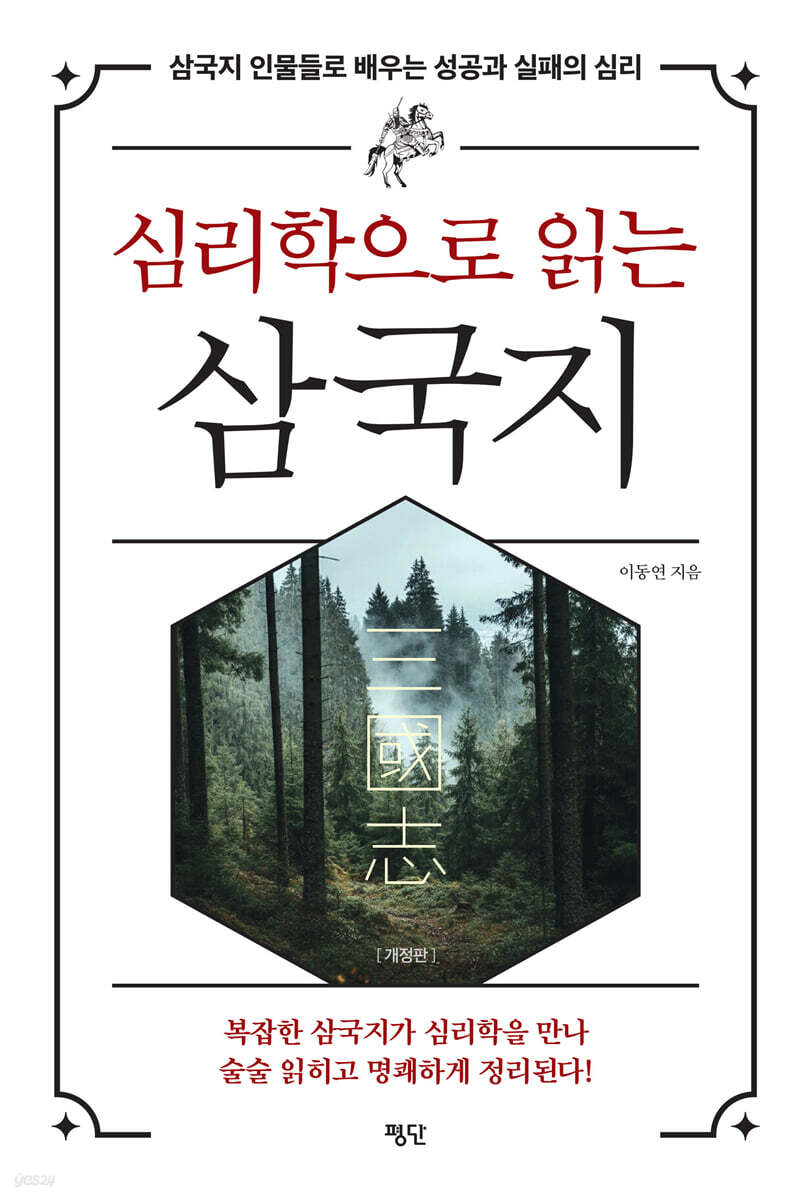
Reading the Romance of the Three Kingdoms through Psychology
 |
Description
Book Introduction
Understand the psychology of success of the protagonists of Romance of the Three Kingdoms!
The psychological battle between successful people and unsuccessful people,
All kinds of strategies, tricks, and tolerance
It unfolds in an interesting way based on psychology!
“I must read it all at least once before I die!”
“If an easy-to-read book comes out, I will definitely try!”
“I’ve heard of it, but I don’t know what it’s about!”
“I know the gist of it, but I can’t quite grasp what it means to me!”
The author, who had already recognized the readers' desire for the 'Romance of the Three Kingdoms', spent over two years researching, writing, and revising the material, and then published 'Reading the Romance of the Three Kingdoms through Psychology'.
The author, who has already presented fusion works such as 『Greek and Roman Mythology through Psychology』, 『Reading the Annals of the Goryeo Dynasty through Psychology』, and 『Business Strategy Learning from Goguryeo』, has now presented a book that combines the complex and difficult Romance of the Three Kingdoms with psychology, a product of the 20th century.
Beginner readers of Romance of the Three Kingdoms will enjoy an easy and fun reinterpretation of the Three Kingdoms based on modern psychology, while intermediate and advanced readers will enjoy a unique fusion of Romance of the Three Kingdoms and psychology.
It allows us to learn the psychology of success and failure, which is necessary for us living in an era of infinite competition, through episodes and characters that must be known in the Romance of the Three Kingdoms, the psychology of the people hidden behind the events, and the psychological warfare in the Romance of the Three Kingdoms that we were previously unaware of.
Another interesting aspect of this book is that when you look at the world's greatest warrior or the most insignificant person through a psychological lens, you discover the human figures in Yojikyung who can fall and rise again due to a small psychological factor.
The psychological battle between successful people and unsuccessful people,
All kinds of strategies, tricks, and tolerance
It unfolds in an interesting way based on psychology!
“I must read it all at least once before I die!”
“If an easy-to-read book comes out, I will definitely try!”
“I’ve heard of it, but I don’t know what it’s about!”
“I know the gist of it, but I can’t quite grasp what it means to me!”
The author, who had already recognized the readers' desire for the 'Romance of the Three Kingdoms', spent over two years researching, writing, and revising the material, and then published 'Reading the Romance of the Three Kingdoms through Psychology'.
The author, who has already presented fusion works such as 『Greek and Roman Mythology through Psychology』, 『Reading the Annals of the Goryeo Dynasty through Psychology』, and 『Business Strategy Learning from Goguryeo』, has now presented a book that combines the complex and difficult Romance of the Three Kingdoms with psychology, a product of the 20th century.
Beginner readers of Romance of the Three Kingdoms will enjoy an easy and fun reinterpretation of the Three Kingdoms based on modern psychology, while intermediate and advanced readers will enjoy a unique fusion of Romance of the Three Kingdoms and psychology.
It allows us to learn the psychology of success and failure, which is necessary for us living in an era of infinite competition, through episodes and characters that must be known in the Romance of the Three Kingdoms, the psychology of the people hidden behind the events, and the psychological warfare in the Romance of the Three Kingdoms that we were previously unaware of.
Another interesting aspect of this book is that when you look at the world's greatest warrior or the most insignificant person through a psychological lens, you discover the human figures in Yojikyung who can fall and rise again due to a small psychological factor.
- You can preview some of the book's contents.
Preview
index
01 The Yellow Turban Rebellion and the Rise of Liu Bei - The Massive Regression of the 400-Year Han Dynasty
ㆍIntro: Yellow Turban Rebellion, Peach Garden Oath
Peach Garden Oath and Crowd Psychology
Successful serialization of the director
Yubi, a popular fantasy, and the birth of superstition.
Liu Bei's water lord equipment, the rational Guan Yu
02 The Ten Great Rebellions and the Fisherman's Journey - Sadism in Power
ㆍIntro: The Gold of the Danggo, The Ten Sangsi's Rebellion
The Emperor of Dependent Tendencies and Cognitive Biases
Hajin's indecisive handling of state affairs
The Ten Rebellions, Rising Star Dong Zhuo
Tip 8 Personality Types
03 Heroes Created by the Anti-Dong Zhuo Coalition: Laughing and Crying Over Inferiority and Self-Esteem
ㆍIntro: The Battle of Dong Zhuo, Key Figures of the Anti-Dong Zhuo Coalition
Cao Cao's uniqueness as a former eunuch
Yuan Shu, the Pheasant of Nanyang, and Sun Jian, the Tiger of Jiangdong
How Cao Cao Overcame His Inferiority Complex: Cao Cao Pursues Dong Zhuo, and Sun Jian Dies in Battle
04 Dong Zhuo and Lu Bu, the Sons Embroiled in Scandal - The Pleasure Principle and the Desire to Show Off
ㆍIntro: Diaochan, one of the four beauties of China, and the Black Bandit Rebellion
Dong Zhuo and Lu Bu's affair
The ruling power and limitations of the great scholar Wang Yun
Lu Bu, the traitor who drifted with the wind
05 Liu Bei above Tao Qian, Sun Ce above Liu Yao - Saint Complex and Delusion
ㆍIntro: Cao Cao's invasion of Xuzhou, the Battle of Fuyang
Sociopath Do-gyeom, Heo So who sees through the truth
Tao Qian, a gangster who became Liu Bei's patron
Sun Ce, the Lesser King of Jiangdong
Yuyo, who is caught up in a good person complex
Heo So's trick that blocked the relationship between Taesaja and Yuyo
The conspiracy of religious merchants Chakryong
06 Cao Cao, the winner of the Emperor's War, and Liu Bei, who mastered the two tigers - Sanguine temperament and positive psychology
ㆍIntro: Emperor Xian reclaims Luoyang
The Li Jue Four, who jointly ruled the capital Chang'an
Dong Seung, who gave the world to Cao Cao
Tip: The Tendencies That Make Up a Personality Model_Ocean Five
Cao Cao pits Liu Bei and Lu Bu against each other
Self-esteem as seen in the assault incident on equipment
07 The Tall Liu Bei, the Sinking Yuan Shu and Lu Bu - Narcissism and Psychological Constancy
ㆍIntro: Battle of Gyegyo, the Three Treasures Rebellion
Yuan Shu's attempt to divide Liu Bei and Lu Bu
Yuan Shu, who claimed to be emperor, laughed at Lu Bu.
Cao Cao and Jia Xu exchanged one win and one loss.
Gongsun Zan, who turned into a hermit, and Yuan Shao, who rose to prominence
The end of Lu Bu, who loved flattery
The different dreams of Emperor Xian and Dong Cheng, Cao Cao and Liu Bei
Cao Cao's confrontation with Liu Bei plunges him into chaos.
From the Battle of Guandu to the Battle of Red Cliffs: A Mental Battle of Leaders, More Than Strategy
ㆍIntro: Battle of the White Horse, Battle of Guandu
The White Horse Battle, the prelude to the Battle of Guandu
What was the difference between Cao Cao, the victor of the Battle of Guandu, and Yuan Shao?
Between the Battle of Guandu and the Battle of Red Cliffs
Liu Bei sends Xu Shu to get Zhuge Liang
The Eve of the Battle of Red Cliffs: Liu Bei and Lu Su's Secret Meeting
The Flower of the Battle of Red Cliffs: The Chain of Fang Tong
09 Zhuge Liang's Spear and Sima Yi's Shield - The Power to Endure Uncertainty
ㆍIntro: Battle of Yiling, Jaogok Strategy
Sun Quan marries Liu Bei
A mere leader of the Odumi religion covets Son Kwon-gyeop
Liu Bei, who ate Xu Shu raw, is about to open the Three Kingdoms era.
Liu Bei's vain confidence left alone
The perfectionist Zhuge Liang, the meticulous Sima Yi
ㆍIntro: Yellow Turban Rebellion, Peach Garden Oath
Peach Garden Oath and Crowd Psychology
Successful serialization of the director
Yubi, a popular fantasy, and the birth of superstition.
Liu Bei's water lord equipment, the rational Guan Yu
02 The Ten Great Rebellions and the Fisherman's Journey - Sadism in Power
ㆍIntro: The Gold of the Danggo, The Ten Sangsi's Rebellion
The Emperor of Dependent Tendencies and Cognitive Biases
Hajin's indecisive handling of state affairs
The Ten Rebellions, Rising Star Dong Zhuo
Tip 8 Personality Types
03 Heroes Created by the Anti-Dong Zhuo Coalition: Laughing and Crying Over Inferiority and Self-Esteem
ㆍIntro: The Battle of Dong Zhuo, Key Figures of the Anti-Dong Zhuo Coalition
Cao Cao's uniqueness as a former eunuch
Yuan Shu, the Pheasant of Nanyang, and Sun Jian, the Tiger of Jiangdong
How Cao Cao Overcame His Inferiority Complex: Cao Cao Pursues Dong Zhuo, and Sun Jian Dies in Battle
04 Dong Zhuo and Lu Bu, the Sons Embroiled in Scandal - The Pleasure Principle and the Desire to Show Off
ㆍIntro: Diaochan, one of the four beauties of China, and the Black Bandit Rebellion
Dong Zhuo and Lu Bu's affair
The ruling power and limitations of the great scholar Wang Yun
Lu Bu, the traitor who drifted with the wind
05 Liu Bei above Tao Qian, Sun Ce above Liu Yao - Saint Complex and Delusion
ㆍIntro: Cao Cao's invasion of Xuzhou, the Battle of Fuyang
Sociopath Do-gyeom, Heo So who sees through the truth
Tao Qian, a gangster who became Liu Bei's patron
Sun Ce, the Lesser King of Jiangdong
Yuyo, who is caught up in a good person complex
Heo So's trick that blocked the relationship between Taesaja and Yuyo
The conspiracy of religious merchants Chakryong
06 Cao Cao, the winner of the Emperor's War, and Liu Bei, who mastered the two tigers - Sanguine temperament and positive psychology
ㆍIntro: Emperor Xian reclaims Luoyang
The Li Jue Four, who jointly ruled the capital Chang'an
Dong Seung, who gave the world to Cao Cao
Tip: The Tendencies That Make Up a Personality Model_Ocean Five
Cao Cao pits Liu Bei and Lu Bu against each other
Self-esteem as seen in the assault incident on equipment
07 The Tall Liu Bei, the Sinking Yuan Shu and Lu Bu - Narcissism and Psychological Constancy
ㆍIntro: Battle of Gyegyo, the Three Treasures Rebellion
Yuan Shu's attempt to divide Liu Bei and Lu Bu
Yuan Shu, who claimed to be emperor, laughed at Lu Bu.
Cao Cao and Jia Xu exchanged one win and one loss.
Gongsun Zan, who turned into a hermit, and Yuan Shao, who rose to prominence
The end of Lu Bu, who loved flattery
The different dreams of Emperor Xian and Dong Cheng, Cao Cao and Liu Bei
Cao Cao's confrontation with Liu Bei plunges him into chaos.
From the Battle of Guandu to the Battle of Red Cliffs: A Mental Battle of Leaders, More Than Strategy
ㆍIntro: Battle of the White Horse, Battle of Guandu
The White Horse Battle, the prelude to the Battle of Guandu
What was the difference between Cao Cao, the victor of the Battle of Guandu, and Yuan Shao?
Between the Battle of Guandu and the Battle of Red Cliffs
Liu Bei sends Xu Shu to get Zhuge Liang
The Eve of the Battle of Red Cliffs: Liu Bei and Lu Su's Secret Meeting
The Flower of the Battle of Red Cliffs: The Chain of Fang Tong
09 Zhuge Liang's Spear and Sima Yi's Shield - The Power to Endure Uncertainty
ㆍIntro: Battle of Yiling, Jaogok Strategy
Sun Quan marries Liu Bei
A mere leader of the Odumi religion covets Son Kwon-gyeop
Liu Bei, who ate Xu Shu raw, is about to open the Three Kingdoms era.
Liu Bei's vain confidence left alone
The perfectionist Zhuge Liang, the meticulous Sima Yi
Detailed image

Into the book
The representative symbol of this 'chivalrous Confucianism' was Liu Bei, who captured the public's subconscious with chivalry and moved the cause of intellectuals with Confucianism.
There is a saying that the times create heroes, which means that to be precise, one must conform to the spirit of the times or embrace the spirit of the times in order to become a hero.
In other words, when you gain representation by riding the wave of a representative spirit of the times, you can become a leading figure of that era.
--- p.13
Any personality has its strengths and weaknesses, but personality itself cannot be said to be good or bad.
Of course, there can be no superiority or inferiority between personalities.
The equipment took advantage of the opponent's weaknesses to win.
It was thanks to Liu Bei that the equipment became like that.
Even Zhang Fei himself knew very well that the only person in the world who could control Zhang Fei's 'easily irritable temperament' in a positive way was Liu Bei.
No matter how angry he was, as soon as he stood in front of Yu-bi, Zhang Fei's anger subsided like melting snow.
--- p.39
Sadistic tendencies tend to develop when anxiety becomes entrenched and there is no hope of escaping from it.
Once such tendencies gain power and begin to act sadistically, they are hard to stop.
Moreover, they devise other sadistic methods to make others crave mercy on them and create an atmosphere in which they maintain control.
Even during the reign of Emperor Ling, the eunuchs who held power were more ruthless than anyone else.
During the Tang Dynasty, when the power of the eunuchs was in power, over a thousand Qingliu faction scholars suffered great harm, and a system of eunuch dictatorship was established.
--- p.59~60
Cao Cao was not a warlord like Dong Zhuo, Ma Teng, Gongsun Zan, or the Sun family, nor was he from a prestigious family like Yuan Shao and Yuan Shu.
However, he was not a legitimate grandson of the imperial family like Liu Bei or Liu Biao.
Cao Cao came from a family of eunuchs who inherited the throne through adopted sons.
Although his family had a lot of wealth, the image of a despised family followed him even more severely, especially after the Ten Eunuchs' Rebellion.
But paradoxically, such an environment became the background for Cao Cao to develop wit and affinity.
--- p.95
Sun Jian, who stood tall in the world with his bravery, met a vain end due to his reckless boldness.
He was like a racehorse running blindfolded, looking only ahead.
If you run like that on a racetrack without obstacles, you might win first place, but the world is different from a racetrack and has many variables.
To get ahead in such a world, you need a systems-based way of thinking that sees the whole picture.
--- p.134~135
These events occurred less than a month and a half after Wang Yun killed Dong Zhuo and seized power.
What if Wang Yun had recruited Sun Jian's Four Heavenly Kings (Bao Zheng, Huang Gai, Han Tang, and Cao Wu) as his generals? Or, had he even embraced Cai Yong, the Three Kingdoms period might not have been so easily ushered in.
Now the Later Han Dynasty is under the control of Sun Jian's Four Heavenly Kings.
--- p.154
Looking at the character of Yu-bi, Martin E. Seligman
It seems like we are looking at an example of Seligman's positive psychology.
No matter how difficult or depressing it was, Yubi did not dwell on the cause of it, but instead focused more on what brought happiness.
Rather than looking for weaknesses that everyone has, I was passionate about finding strengths and virtues and applying them to my life.
For such people, happiness becomes something that can be learned like playing an instrument.
--- p.184
Both Taesaja and Yeobu are of the same type, but if Yeobu is a 'romantic lock', Taesaja is a 'prestigious lock'.
The prince was particularly notable for his 'prestige character', which placed great importance on social prestige.
When faced with a choice, people with this personality first and foremost consider whether it will help them maintain or improve their social prestige or standing.
--- p.209
From a young age, Guo Jia was gifted with great talent and insight.
What is unique is that he met the world's greatest heroes anonymously, hiding his abilities.
However, Guo Jia did not have any idle associations with anyone.
Meanwhile, he went to see Won So, who was the most famous person of his time, and saw that Won So only cared about form and had no substance. He decided that it was wrong to achieve the 'karma of a tyrant' and returned to his hometown.
--- p.237
Among the figures from the Three Kingdoms period, the strategist with the most similar personality to Cao Cao was Jia Xu.
To that extent, Cao Cao understood Jiahou's intentions well.
However, unlike Cao Cao, Jiahou was not a lord, and had no intention of becoming one.
Moreover, unlike other generals, he lacked martial arts skills and physical strength, so he had to prove his worth with only his three-inch tongue.
Indeed, Gahu created a strategy that turned the tide in times of chaos, and the secret to this can be found in his personality.
--- p.288
The less capable you are, the more you tend to focus on political tactics to survive.
Although the strategies of Jeo-su and Jeon-pung were clearly more advantageous than those of Sim-bae and Gwak-do, Sim-bae and Gwak-do's worldly conduct and communication skills surpassed those of Jeo-su and Jeon-pung.
Cao Cao and Liu Bei valued invisible skills over visible actions, but Yuan Shao did not.
The element was more concerned with its own pride than with practicality.
So, he easily became jealous of others and could not accept the advice of his staff.
Although the long-term war advocated by Jeo-su and Jeon-pung was a realistic plan, Yuan Shao misunderstood it as praise for Cao Cao.
On the other hand, he was tempted by the words of Simbae and Gwakdo, which stimulated his vanity.
--- p.337~338
Chen Shou, who wrote the Romance of the Three Kingdoms, evaluated Liu Biao as a figure similar to Yuan Shao.
Both Yuan Shao and Liu Biao were portrayed as men of great generosity and insight, possessing a majestic presence that emanated from their families.
But the reality was different.
Both were shy, favoritism, and enjoyed plotting, but lacked decisiveness.
The only difference between the two was that Yuan Shao had the ambition to conquer the world, while Liu Biao pursued an idyllic life while developing his literary talent.
--- p.360
Joo-yu clearly had high emotional intelligence and great sensitivity.
However, such abilities only worked in situations where one's own superiority was acknowledged.
It was also a public situation that allowed him to be lenient with his senior intelligence officer instead of strictly enforcing military orders.
Even if you have excellent emotional intelligence, if you compare yourself to others and feel inferior, your emotional intelligence will decline.
--- p.400
Lu Xun, who had been entrusted with full authority, went out with 200,000 soldiers to defend Liu Bei's army.
Yuk Son was a person with a soft exterior and strong interior.
He never rushes anything and solves things step by step, which is similar to Liu Bei's personality before he lost Guan Yu and Zhang Fei.
However, because he had no experience in major wars, he was not recognized by the veterans who served the Son clan.
The old generals who were displeased with Yuk Son said, “That little bastard Yuk Son is trying to drag out the war.
A barrage of petitions were submitted saying, “This must be concluded in a short period of time.”
--- p.421
Zhuge Liang of Shu clashed with Sima Yi while conducting five northern expeditions over seven years with the aim of subduing Wei.
Zhuge Liang, a perfectionist, was afraid of making mistakes, so he chose the safe route and followed the rules.
As a result, the Northern Expedition became a protracted war, placing a great burden on the people.
Sima Yi, who knew Zhuge Liang well, chose a war of attrition rather than a strategy of annihilating the enemy, which angered Zhuge Liang.
There is a saying that the times create heroes, which means that to be precise, one must conform to the spirit of the times or embrace the spirit of the times in order to become a hero.
In other words, when you gain representation by riding the wave of a representative spirit of the times, you can become a leading figure of that era.
--- p.13
Any personality has its strengths and weaknesses, but personality itself cannot be said to be good or bad.
Of course, there can be no superiority or inferiority between personalities.
The equipment took advantage of the opponent's weaknesses to win.
It was thanks to Liu Bei that the equipment became like that.
Even Zhang Fei himself knew very well that the only person in the world who could control Zhang Fei's 'easily irritable temperament' in a positive way was Liu Bei.
No matter how angry he was, as soon as he stood in front of Yu-bi, Zhang Fei's anger subsided like melting snow.
--- p.39
Sadistic tendencies tend to develop when anxiety becomes entrenched and there is no hope of escaping from it.
Once such tendencies gain power and begin to act sadistically, they are hard to stop.
Moreover, they devise other sadistic methods to make others crave mercy on them and create an atmosphere in which they maintain control.
Even during the reign of Emperor Ling, the eunuchs who held power were more ruthless than anyone else.
During the Tang Dynasty, when the power of the eunuchs was in power, over a thousand Qingliu faction scholars suffered great harm, and a system of eunuch dictatorship was established.
--- p.59~60
Cao Cao was not a warlord like Dong Zhuo, Ma Teng, Gongsun Zan, or the Sun family, nor was he from a prestigious family like Yuan Shao and Yuan Shu.
However, he was not a legitimate grandson of the imperial family like Liu Bei or Liu Biao.
Cao Cao came from a family of eunuchs who inherited the throne through adopted sons.
Although his family had a lot of wealth, the image of a despised family followed him even more severely, especially after the Ten Eunuchs' Rebellion.
But paradoxically, such an environment became the background for Cao Cao to develop wit and affinity.
--- p.95
Sun Jian, who stood tall in the world with his bravery, met a vain end due to his reckless boldness.
He was like a racehorse running blindfolded, looking only ahead.
If you run like that on a racetrack without obstacles, you might win first place, but the world is different from a racetrack and has many variables.
To get ahead in such a world, you need a systems-based way of thinking that sees the whole picture.
--- p.134~135
These events occurred less than a month and a half after Wang Yun killed Dong Zhuo and seized power.
What if Wang Yun had recruited Sun Jian's Four Heavenly Kings (Bao Zheng, Huang Gai, Han Tang, and Cao Wu) as his generals? Or, had he even embraced Cai Yong, the Three Kingdoms period might not have been so easily ushered in.
Now the Later Han Dynasty is under the control of Sun Jian's Four Heavenly Kings.
--- p.154
Looking at the character of Yu-bi, Martin E. Seligman
It seems like we are looking at an example of Seligman's positive psychology.
No matter how difficult or depressing it was, Yubi did not dwell on the cause of it, but instead focused more on what brought happiness.
Rather than looking for weaknesses that everyone has, I was passionate about finding strengths and virtues and applying them to my life.
For such people, happiness becomes something that can be learned like playing an instrument.
--- p.184
Both Taesaja and Yeobu are of the same type, but if Yeobu is a 'romantic lock', Taesaja is a 'prestigious lock'.
The prince was particularly notable for his 'prestige character', which placed great importance on social prestige.
When faced with a choice, people with this personality first and foremost consider whether it will help them maintain or improve their social prestige or standing.
--- p.209
From a young age, Guo Jia was gifted with great talent and insight.
What is unique is that he met the world's greatest heroes anonymously, hiding his abilities.
However, Guo Jia did not have any idle associations with anyone.
Meanwhile, he went to see Won So, who was the most famous person of his time, and saw that Won So only cared about form and had no substance. He decided that it was wrong to achieve the 'karma of a tyrant' and returned to his hometown.
--- p.237
Among the figures from the Three Kingdoms period, the strategist with the most similar personality to Cao Cao was Jia Xu.
To that extent, Cao Cao understood Jiahou's intentions well.
However, unlike Cao Cao, Jiahou was not a lord, and had no intention of becoming one.
Moreover, unlike other generals, he lacked martial arts skills and physical strength, so he had to prove his worth with only his three-inch tongue.
Indeed, Gahu created a strategy that turned the tide in times of chaos, and the secret to this can be found in his personality.
--- p.288
The less capable you are, the more you tend to focus on political tactics to survive.
Although the strategies of Jeo-su and Jeon-pung were clearly more advantageous than those of Sim-bae and Gwak-do, Sim-bae and Gwak-do's worldly conduct and communication skills surpassed those of Jeo-su and Jeon-pung.
Cao Cao and Liu Bei valued invisible skills over visible actions, but Yuan Shao did not.
The element was more concerned with its own pride than with practicality.
So, he easily became jealous of others and could not accept the advice of his staff.
Although the long-term war advocated by Jeo-su and Jeon-pung was a realistic plan, Yuan Shao misunderstood it as praise for Cao Cao.
On the other hand, he was tempted by the words of Simbae and Gwakdo, which stimulated his vanity.
--- p.337~338
Chen Shou, who wrote the Romance of the Three Kingdoms, evaluated Liu Biao as a figure similar to Yuan Shao.
Both Yuan Shao and Liu Biao were portrayed as men of great generosity and insight, possessing a majestic presence that emanated from their families.
But the reality was different.
Both were shy, favoritism, and enjoyed plotting, but lacked decisiveness.
The only difference between the two was that Yuan Shao had the ambition to conquer the world, while Liu Biao pursued an idyllic life while developing his literary talent.
--- p.360
Joo-yu clearly had high emotional intelligence and great sensitivity.
However, such abilities only worked in situations where one's own superiority was acknowledged.
It was also a public situation that allowed him to be lenient with his senior intelligence officer instead of strictly enforcing military orders.
Even if you have excellent emotional intelligence, if you compare yourself to others and feel inferior, your emotional intelligence will decline.
--- p.400
Lu Xun, who had been entrusted with full authority, went out with 200,000 soldiers to defend Liu Bei's army.
Yuk Son was a person with a soft exterior and strong interior.
He never rushes anything and solves things step by step, which is similar to Liu Bei's personality before he lost Guan Yu and Zhang Fei.
However, because he had no experience in major wars, he was not recognized by the veterans who served the Son clan.
The old generals who were displeased with Yuk Son said, “That little bastard Yuk Son is trying to drag out the war.
A barrage of petitions were submitted saying, “This must be concluded in a short period of time.”
--- p.421
Zhuge Liang of Shu clashed with Sima Yi while conducting five northern expeditions over seven years with the aim of subduing Wei.
Zhuge Liang, a perfectionist, was afraid of making mistakes, so he chose the safe route and followed the rules.
As a result, the Northern Expedition became a protracted war, placing a great burden on the people.
Sima Yi, who knew Zhuge Liang well, chose a war of attrition rather than a strategy of annihilating the enemy, which angered Zhuge Liang.
--- p.437
Publisher's Review
By combining the Romance of the Three Kingdoms and modern psychology, we can understand ancient history.
What does it mean to readers now?
Clearly and fun to organize!
From the Oath of the Peach Garden between the three brothers Liu Bei, Guan Yu, and Zhang Fei during the Yellow Turban Rebellion, to the formation and collapse of the anti-Dong Zhuo coalition, the battles of strategy and psychology in major battles such as the Battle of White Horse, the Battle of Guandu, the Battle of Red Cliffs, and the Battle of Yiling, to the eve of the unification era that the final victors, Cao Cao and Sima Yi, the episodes from the end of the Eastern Han Dynasty to the Three Kingdoms of Wei, Shu, and Wu, and the founding of the Qin Dynasty that unified them, are neatly organized in one volume in nine chapters.
Although it is based on several history books, it maintains a novel-like dramatic tension by borrowing the setting of the novel 『Romance of the Three Kingdoms』, pursues intuitive understanding with interpretations and expressions that fit modern sensibilities, and supplements parts that require background explanation with footnotes, so that it is just as good as a history book.
The characters of the Three Kingdoms were analyzed based on the theories of psychoanalysts such as Freud and Carl Jung, as well as modern psychologists such as Martin Seligman, Henry Murray, Briggs Myers, George Herbert Mead, and Walter Mischel.
The introduction to each chapter outlines the main historical events separately, and at the end of each subheading, the psychology of the characters' success is summarized, providing devices to help readers understand and organize the difficult and complex Romance of the Three Kingdoms in their own way.
This book is perfect for readers who want to record the key points of the Romance of the Three Kingdoms and use them over and over again, rather than reading it for fun and then forgetting it right away.
The charming points of the characters in Romance of the Three Kingdoms: winning psychology vs. losing psychology!
There is nothing wrong with the psychology itself, such as anger, greed, hatred, jealousy, and arrogance!
Success or failure depends on how you overcome your complex.
Background such as family, education, and wealth do not determine success or failure!
The one who controls his twisted mind is the ultimate winner!
Jojo's charming point!
“Even if I abandon the world, I will never allow the world to abandon me again.”
Cao Cao, who was adopted into a eunuch's family and was treated with contempt and coldness his entire life, makes this decision.
Cao Cao's attempt to assassinate Dong Zhuo failed and he became a fugitive, but he resolved to create his own course of history rather than follow the course of history led by those in power, such as Dong Zhuo and the Ten Eunuchs.
Cao Cao was always labeled as the “son of a dirty eunuch” from a young age, and this sense of family inferiority could have become a lifelong trauma.
However, Cao Cao did not avoid that reality and instead of complaining about his fate, he quietly honed his skills and developed his sociability to make friends with talented people.
Instead of relying on others, I believed in myself and faced and analyzed reality more clearly.
He acknowledged his own limitations and listened to and accepted the opinions of his subordinates with an open mind.
Because he lived his life without worrying about what others thought, he achieved the feat of conquering the world in his own way even at a time when success was impossible without flattery and bribery.
Cao Cao established Wei, the most powerful of the Three Kingdoms of Wei, Shu, and Wu.
Yubi's charming point!
Liu Bei, who had a particularly difficult and depressing life due to his poverty and indecisive personality.
However, Liu Bei did not dwell on the irreversible events of the past, but focused only on the present that brought him happiness.
Even though Zhang Fei caused a major accident by drinking and being a guest, giving all of Yizhou to Lu Bu and even handing over Liu Bei's wife and children to the enemy, Liu Bei embraced him instead of resenting him.
When looking at people, I focused on their strengths rather than their weaknesses, and I was keen to find virtues in everyone.
Even in the most difficult of circumstances, he maintained a positive outlook and remained centered in the cause of restoring the Chinese imperial family.
He had an excellent eye for people, but he was also very good at dealing with people, rarely showing his bad side when he saw something bad.
He never readily accepted positions without merit, and although his desire for power and fame was by no means small, he always tried to follow the natural order.
Among the sworn brothers Liu Bei, Guan Yu, and Zhang Fei, Liu Bei, who was neither the oldest nor the most skilled in martial arts or academics, became the eldest brother and later achieved the great feat of founding Shu thanks to his positive mindset and humility.
Sun Ce's attractive points!
Sun Ce, the son of Sun Jian and the older brother of Sun Quan, was once under the command of Yuan Shu after his father Sun Jian died, but upon learning of Yuan Shu's true nature, he became independent at the young age of 19 and took control of the eastern and southern regions of the Jiangsu River, laying the foundation for the Wu Dynasty at an early age.
Sun Ce, who had served as a low-ranking official for generations in his family and was extremely easygoing, treated his subordinate generals with openness, and his close associates also freely offered him ideas.
The secret to Sun Jian's success was that he was not obsessed with the jade seal, which he valued as much as his life, to the point of putting it on the negotiating table with Yuan Shu.
Sun Ce did not discriminate against anyone and treated everyone with respect. As a result, many talented people, regardless of social status, risked their lives to follow him.
His younger brother, Sun Quan, also inherited the family tradition and became the first emperor of Wu.
In the Battle of Yiling, he appointed the young Lu Xun as a general against the veteran Liu Bei, and trusted him until the end, placing him in the vanguard. Despite the jealousy of the veteran generals, he steadfastly believed in and supported Lu Xun.
Thanks to this, Lu Xun defeated Liu Bei in the Battle of Yiling, and Liu Bei's Shu, which fell ill at that time, slowly began to decline.
Elemental mistake!
As the eldest son of a prestigious family and a member of the Sase Samgong clan, Won So was a superstar known to everyone at the time.
He was the savior who could compensate for the inferiority complex of the family of the ten eunuchs who were at the peak of power, and it was only natural that he would be the leader of the anti-Dong Zhuo coalition.
However, the element was so lacking in perception of reality due to such a good background.
He was a typical example of 'if things go well, it's my fault, if things don't go well, it's someone else's fault', and he believed that he was the way, the truth, and the life.
His excessive narcissism led him to engage in unproductive competition with his half-brother Yuan Shu, which led to the division of the anti-Dong Zhuo coalition.
They were only good at creating and inciting public opinion, but neglected to develop their own abilities.
He was blind to the times due to his narcissism, lacked wit and decisiveness, and did not listen to the advice of his advisors.
Talented people like Guo Jia saw that Yuan Shao only cared about form and had no substance, so they all left him and went to Cao Cao.
Dong Zhuo's mistake!
Dong Zhuo, who happened to get his hands on the young emperor who was wandering the streets during the Ten Eunuchs' Rebellion, returned to the capital and took power with the emperor on his back.
Before entering Luoyang, he was a 'generous general', but after the Yellow Turban Rebellion, he tasted promotion through bribery and reached the pinnacle of power, and his person changed.
He eliminated all the forces that could restrain him, and without clear principles for rewards and punishments, he placed absolute trust in his son-in-law, causing all talented people to abandon him.
He was ultimately assassinated by his disgruntled subordinates, Li Shu and Lu Bu. Dong Zhuo, an Introverted Sensing and Feeling Perceiving (ISFP) personality type, was a typical artist, reminiscent of Nero and Hitler.
He usually displayed warm emotions, but when he reached the pinnacle of power, he became reckless.
He was an introvert, with his arms bent inward, and was very picky and did not trust anyone except his family and relatives.
His son-in-law, Lee Yu, followed the path of tyranny by doing as he was told, and he left politics to Wang Yun, enjoying drinking and dancing every day until he was hit in the back of the head by his subordinate.
Sun Jian's mistake!
He was so skilled in martial arts and brave that he earned the nickname 'Tiger of Gangdong'.
Although he was not from a prestigious family, he achieved the high position of Jangsa Taesu solely through his abilities, and was appointed as a vanguard in the anti-Dong Zhuo coalition.
However, he had a severe inferiority complex about his family, and he was particularly cowardly in front of Won-sul.
Although he was bold and courageous, he lacked composure and caution and was simple.
By chance, he obtained the jade seal of the Warring States period and became so proud that he left Yuan Shao and became independent. However, he fell for Yuan Shu's trick, who was in a competitive relationship with Yuan Shao, and went into battle, but he died in vain.
What does it mean to readers now?
Clearly and fun to organize!
From the Oath of the Peach Garden between the three brothers Liu Bei, Guan Yu, and Zhang Fei during the Yellow Turban Rebellion, to the formation and collapse of the anti-Dong Zhuo coalition, the battles of strategy and psychology in major battles such as the Battle of White Horse, the Battle of Guandu, the Battle of Red Cliffs, and the Battle of Yiling, to the eve of the unification era that the final victors, Cao Cao and Sima Yi, the episodes from the end of the Eastern Han Dynasty to the Three Kingdoms of Wei, Shu, and Wu, and the founding of the Qin Dynasty that unified them, are neatly organized in one volume in nine chapters.
Although it is based on several history books, it maintains a novel-like dramatic tension by borrowing the setting of the novel 『Romance of the Three Kingdoms』, pursues intuitive understanding with interpretations and expressions that fit modern sensibilities, and supplements parts that require background explanation with footnotes, so that it is just as good as a history book.
The characters of the Three Kingdoms were analyzed based on the theories of psychoanalysts such as Freud and Carl Jung, as well as modern psychologists such as Martin Seligman, Henry Murray, Briggs Myers, George Herbert Mead, and Walter Mischel.
The introduction to each chapter outlines the main historical events separately, and at the end of each subheading, the psychology of the characters' success is summarized, providing devices to help readers understand and organize the difficult and complex Romance of the Three Kingdoms in their own way.
This book is perfect for readers who want to record the key points of the Romance of the Three Kingdoms and use them over and over again, rather than reading it for fun and then forgetting it right away.
The charming points of the characters in Romance of the Three Kingdoms: winning psychology vs. losing psychology!
There is nothing wrong with the psychology itself, such as anger, greed, hatred, jealousy, and arrogance!
Success or failure depends on how you overcome your complex.
Background such as family, education, and wealth do not determine success or failure!
The one who controls his twisted mind is the ultimate winner!
Jojo's charming point!
“Even if I abandon the world, I will never allow the world to abandon me again.”
Cao Cao, who was adopted into a eunuch's family and was treated with contempt and coldness his entire life, makes this decision.
Cao Cao's attempt to assassinate Dong Zhuo failed and he became a fugitive, but he resolved to create his own course of history rather than follow the course of history led by those in power, such as Dong Zhuo and the Ten Eunuchs.
Cao Cao was always labeled as the “son of a dirty eunuch” from a young age, and this sense of family inferiority could have become a lifelong trauma.
However, Cao Cao did not avoid that reality and instead of complaining about his fate, he quietly honed his skills and developed his sociability to make friends with talented people.
Instead of relying on others, I believed in myself and faced and analyzed reality more clearly.
He acknowledged his own limitations and listened to and accepted the opinions of his subordinates with an open mind.
Because he lived his life without worrying about what others thought, he achieved the feat of conquering the world in his own way even at a time when success was impossible without flattery and bribery.
Cao Cao established Wei, the most powerful of the Three Kingdoms of Wei, Shu, and Wu.
Yubi's charming point!
Liu Bei, who had a particularly difficult and depressing life due to his poverty and indecisive personality.
However, Liu Bei did not dwell on the irreversible events of the past, but focused only on the present that brought him happiness.
Even though Zhang Fei caused a major accident by drinking and being a guest, giving all of Yizhou to Lu Bu and even handing over Liu Bei's wife and children to the enemy, Liu Bei embraced him instead of resenting him.
When looking at people, I focused on their strengths rather than their weaknesses, and I was keen to find virtues in everyone.
Even in the most difficult of circumstances, he maintained a positive outlook and remained centered in the cause of restoring the Chinese imperial family.
He had an excellent eye for people, but he was also very good at dealing with people, rarely showing his bad side when he saw something bad.
He never readily accepted positions without merit, and although his desire for power and fame was by no means small, he always tried to follow the natural order.
Among the sworn brothers Liu Bei, Guan Yu, and Zhang Fei, Liu Bei, who was neither the oldest nor the most skilled in martial arts or academics, became the eldest brother and later achieved the great feat of founding Shu thanks to his positive mindset and humility.
Sun Ce's attractive points!
Sun Ce, the son of Sun Jian and the older brother of Sun Quan, was once under the command of Yuan Shu after his father Sun Jian died, but upon learning of Yuan Shu's true nature, he became independent at the young age of 19 and took control of the eastern and southern regions of the Jiangsu River, laying the foundation for the Wu Dynasty at an early age.
Sun Ce, who had served as a low-ranking official for generations in his family and was extremely easygoing, treated his subordinate generals with openness, and his close associates also freely offered him ideas.
The secret to Sun Jian's success was that he was not obsessed with the jade seal, which he valued as much as his life, to the point of putting it on the negotiating table with Yuan Shu.
Sun Ce did not discriminate against anyone and treated everyone with respect. As a result, many talented people, regardless of social status, risked their lives to follow him.
His younger brother, Sun Quan, also inherited the family tradition and became the first emperor of Wu.
In the Battle of Yiling, he appointed the young Lu Xun as a general against the veteran Liu Bei, and trusted him until the end, placing him in the vanguard. Despite the jealousy of the veteran generals, he steadfastly believed in and supported Lu Xun.
Thanks to this, Lu Xun defeated Liu Bei in the Battle of Yiling, and Liu Bei's Shu, which fell ill at that time, slowly began to decline.
Elemental mistake!
As the eldest son of a prestigious family and a member of the Sase Samgong clan, Won So was a superstar known to everyone at the time.
He was the savior who could compensate for the inferiority complex of the family of the ten eunuchs who were at the peak of power, and it was only natural that he would be the leader of the anti-Dong Zhuo coalition.
However, the element was so lacking in perception of reality due to such a good background.
He was a typical example of 'if things go well, it's my fault, if things don't go well, it's someone else's fault', and he believed that he was the way, the truth, and the life.
His excessive narcissism led him to engage in unproductive competition with his half-brother Yuan Shu, which led to the division of the anti-Dong Zhuo coalition.
They were only good at creating and inciting public opinion, but neglected to develop their own abilities.
He was blind to the times due to his narcissism, lacked wit and decisiveness, and did not listen to the advice of his advisors.
Talented people like Guo Jia saw that Yuan Shao only cared about form and had no substance, so they all left him and went to Cao Cao.
Dong Zhuo's mistake!
Dong Zhuo, who happened to get his hands on the young emperor who was wandering the streets during the Ten Eunuchs' Rebellion, returned to the capital and took power with the emperor on his back.
Before entering Luoyang, he was a 'generous general', but after the Yellow Turban Rebellion, he tasted promotion through bribery and reached the pinnacle of power, and his person changed.
He eliminated all the forces that could restrain him, and without clear principles for rewards and punishments, he placed absolute trust in his son-in-law, causing all talented people to abandon him.
He was ultimately assassinated by his disgruntled subordinates, Li Shu and Lu Bu. Dong Zhuo, an Introverted Sensing and Feeling Perceiving (ISFP) personality type, was a typical artist, reminiscent of Nero and Hitler.
He usually displayed warm emotions, but when he reached the pinnacle of power, he became reckless.
He was an introvert, with his arms bent inward, and was very picky and did not trust anyone except his family and relatives.
His son-in-law, Lee Yu, followed the path of tyranny by doing as he was told, and he left politics to Wang Yun, enjoying drinking and dancing every day until he was hit in the back of the head by his subordinate.
Sun Jian's mistake!
He was so skilled in martial arts and brave that he earned the nickname 'Tiger of Gangdong'.
Although he was not from a prestigious family, he achieved the high position of Jangsa Taesu solely through his abilities, and was appointed as a vanguard in the anti-Dong Zhuo coalition.
However, he had a severe inferiority complex about his family, and he was particularly cowardly in front of Won-sul.
Although he was bold and courageous, he lacked composure and caution and was simple.
By chance, he obtained the jade seal of the Warring States period and became so proud that he left Yuan Shao and became independent. However, he fell for Yuan Shu's trick, who was in a competitive relationship with Yuan Shao, and went into battle, but he died in vain.
GOODS SPECIFICS
- Date of issue: December 20, 2024
- Page count, weight, size: 448 pages | 152*225*30mm
- ISBN13: 9788973435791
- ISBN10: 8973435795
You may also like
카테고리
korean


korean

![GQ KOREA Mark (Monthly): December [2025]](http://librairie.coreenne.fr/cdn/shop/files/8ef265dbbfbf186523ed75ba7319009d.jpg?v=1765340328&width=3840)


