

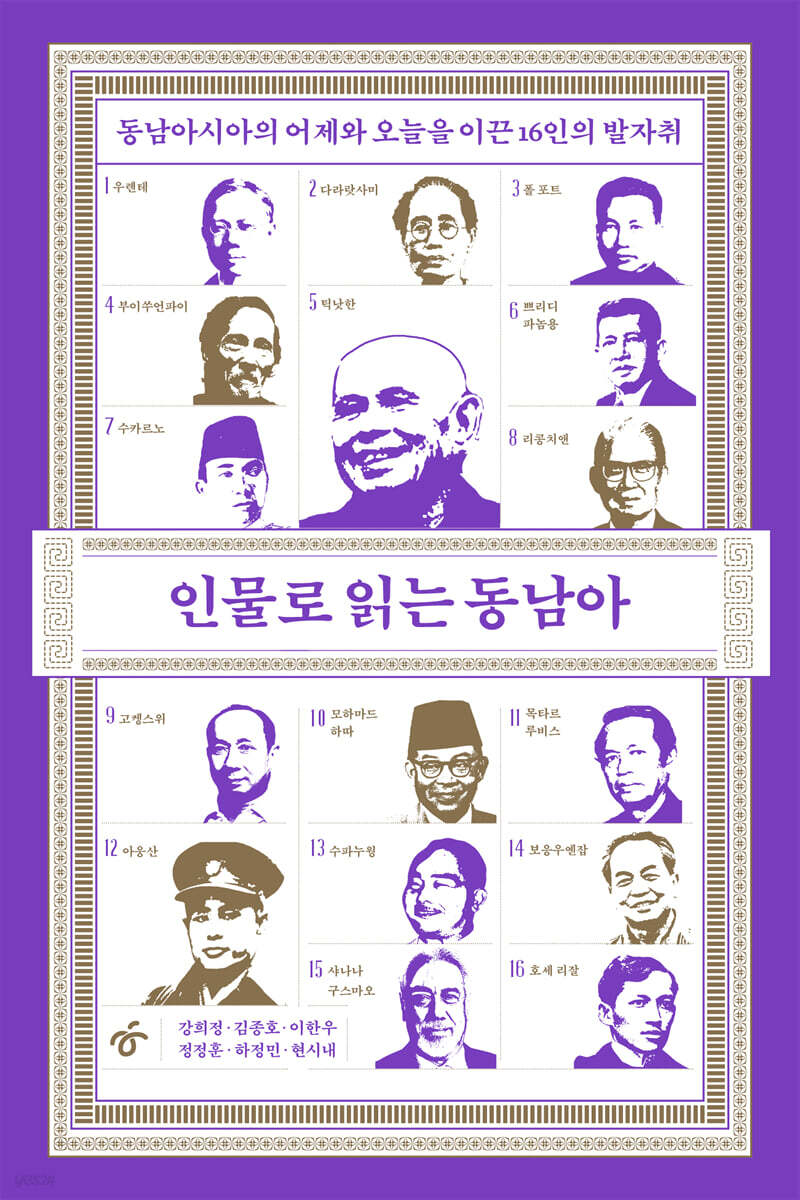
Southeast Asia through Characters
 |
Description
Book Introduction
The second installment of the Southeast Asia series from Sogang University's East Asian Studies Institute.
Through the eventful lives of 16 people
Discover the "real" modern and contemporary history of Southeast Asia.
Current and former researchers at Sogang University's Institute of East Asian Studies, which is the first domestic research institute to publish an academic journal through Cambridge University Press and has published various popular books, have come together to publish the second book in the Southeast Asia series, "Reading Southeast Asia through People."
If the previous work, "Keyword Southeast Asia," introduced the politics, culture, and history of Southeast Asia with 30 keywords such as infectious diseases, rice, traditional clothing, religion, coffee, and millennial solidarity, the new work depicts the intense modern and contemporary history of Southeast Asia through the lives of 16 people carefully selected by the authors, including Indonesian politician Sukarno, Singaporean merchant Lee Kong Chien, Vietnamese monk Thich Nhat Hanh, Burmese independence activist Aung San, East Timor's first president Gusmao, and Philippine writer Jose Rizal.
Southeast Asia is one of Korea's most popular travel destinations and a major trading partner and investment partner.
It was also the setting for the first-ever North Korea-US summit, and is the birthplace of our favorite dishes: rice noodles, pad thai, and Vietnamese spring rolls.
In this way, Korea and Southeast Asia have close relationships in many ways, and exchanges are expected to expand further in the future.
Above all, there are a large number of foreigners from Southeast Asia residing in our country.
It is now natural to encounter them in our daily lives, whether at work, at shelters, or on the streets.
But how much do we really know about Southeast Asia? This book dramatically recounts the life stories of 16 individuals who shaped Southeast Asia's great legacy.
Thanks to this, both adult and young readers can explore the diverse aspects of Southeast Asia as if they were watching a historical drama.
And Southeast Asia, which still felt unfamiliar and difficult, will become more familiar.
Through the eventful lives of 16 people
Discover the "real" modern and contemporary history of Southeast Asia.
Current and former researchers at Sogang University's Institute of East Asian Studies, which is the first domestic research institute to publish an academic journal through Cambridge University Press and has published various popular books, have come together to publish the second book in the Southeast Asia series, "Reading Southeast Asia through People."
If the previous work, "Keyword Southeast Asia," introduced the politics, culture, and history of Southeast Asia with 30 keywords such as infectious diseases, rice, traditional clothing, religion, coffee, and millennial solidarity, the new work depicts the intense modern and contemporary history of Southeast Asia through the lives of 16 people carefully selected by the authors, including Indonesian politician Sukarno, Singaporean merchant Lee Kong Chien, Vietnamese monk Thich Nhat Hanh, Burmese independence activist Aung San, East Timor's first president Gusmao, and Philippine writer Jose Rizal.
Southeast Asia is one of Korea's most popular travel destinations and a major trading partner and investment partner.
It was also the setting for the first-ever North Korea-US summit, and is the birthplace of our favorite dishes: rice noodles, pad thai, and Vietnamese spring rolls.
In this way, Korea and Southeast Asia have close relationships in many ways, and exchanges are expected to expand further in the future.
Above all, there are a large number of foreigners from Southeast Asia residing in our country.
It is now natural to encounter them in our daily lives, whether at work, at shelters, or on the streets.
But how much do we really know about Southeast Asia? This book dramatically recounts the life stories of 16 individuals who shaped Southeast Asia's great legacy.
Thanks to this, both adult and young readers can explore the diverse aspects of Southeast Asia as if they were watching a historical drama.
And Southeast Asia, which still felt unfamiliar and difficult, will become more familiar.
- You can preview some of the book's contents.
Preview
index
Preface: A Journey to Discover Strange Figures in a Familiar East
Chapter 1: People Who Led Southeast Asian History
1.
The Modernization Journey of Diaspora Intellectuals: Wu Lien-te
A promising colonial scholarship student's first return home | A young doctor from Penang embarks on modernization reforms | Fighting the plague and opium during imperial rule: Kang Hee-jeong
2.
The Last Princess of Chiang Mai Who Pursued Modernity: Dararatsamy
From Chiang Mai Princess to "Lao Woman" | The Life of Dararatsamy, Hostage and Diplomat | A Reform Leader Who Loved Tradition: Hyunsinae
3.
A Radical Idealist Becomes a Tragedy: Pol Pot
The Extreme Egalitarianism of 'Red Cambodia' | The Atrocities and Massacres of the Khmer Rouge | A Polite and Smiling Upper-Class Boy | The Rise of a Right-Wing, Pro-American Regime and the Fall of Phnom Penh | The Tragedy of the Wrong Beliefs of a Small Elite: Ha Jeong-min
4.
Bui Xuan Phai, a painter who loved Hanoi's old streets and people
The Last Graduate of the Indochina School of Fine Arts | Rejecting the Mainstream Art World and Pursuing Freedom | The Face of Vietnam, Overcoming Hardship: Lee Han-woo
5.
Teachings of Peace and Reversal that Shared the Pain of the Times: Thich Nhat Hanh
Thich Nhat Hanh's New Experiment | Engaged Buddhism: Into the Pain of War and Poverty | Anti-War Peace Movement in Exile | Peace Here and Now: Ha Jung-min
6.
Pridi Phanomyong, the symbol of Thai democracy founded on the first constitution
A young man who dreamed of constitutional democracy | The passion of revolution as a driving force for reform | From regent of the Chakri Dynasty to exile | Life as a democrat, the glory reclaimed: Hyun Si-nae
Chapter 2.
The crossroads of modernity and democracy
7.
Sukarno, the nationalist who led Indonesia to unity
Javanese Youth Awakened to Nationalism | Sukarno's Speech Politics That Moved the Masses | Joining Hands with the Military and Communists to Implement a Powerful Dictatorship | The End of Military Dictatorship and the Beginning of the Megawati Era: Kang Hee-jung
8.
The Last Chinese Merchant of the Colonial Era, Opening the Modern Era: Lee Kong-Chian
Heir to a Southeast Asian Chinese business group | Rising to the top by establishing a giant financial company | The life of Lee Kong-chien, a beacon during the formation of a nation-state: Kim Jong-ho
9.
The architect of the mighty city-state of Singapore: Goh Keng Swee
Singapore, a nation of immigrants who became a newly independent nation | Laying the foundation for Singapore as a manufacturing powerhouse | A new mission: establishing self-reliant national defense and a new education system | The philosophy of Goh Keng Swee, who built a strong small nation in Singapore: Kim Jong-ho
10.
Building Indonesia's Independence Through Pragmatic Diplomacy: Mohammad Hatta
The Founder of Third World Diplomacy Strategy | The Elite Youth of the Minangkabau | The Anti-Imperialist Movement in the Netherlands | The Second-in-Command of a Newly Independent Nation Who Embarked on Reform and Integration | The Hero of the Diarchy: Abandoning Power and Gaining Respect: Jeong Jeong-hun
11.
Journalist and writer who yearned for democracy: Moktar Rubis
The Korean War Through Indonesian Eyes | A Young Man from a Remote Island Encounters Nationalism | Journalism After Independence: Criticizing and Repressing Sukarno | Communicating with the World Through Literature During House Arrest: Jeong Jeong-hun
Chapter 3.
Dreaming of Independence, Drawing a Blueprint for Our Nation
12.
Aung San, the independence hero who drew the blueprint for modern Burma
Student Activism and Armed Struggle in Youth | Burmese People Against British Colonialism | International Reputation Gained Through Anti-Imperialism Movements | Pacific War-Era Alliance and Integration Strategy | Is the Dream of Unification and Coexistence Valid?: Kim Jong-ho
13.
The Red Prince of Laos, Who Led Independence and Democracy: Souphanouvong
Prince Luang Prabang Meets Leninism | The Princes' Power Struggle and Communism | Independence Without Peace, Peace Without Independence: Hyunsinae
14.
Vietnam's Eternal General Who Defeated the Empire: Vo Nguyen Giap
A revolutionary nationalist who challenged the French colonial government | Anti-Japanese guerrilla warfare and the Indochina War | Sharing the history of division and unification: Lee Han-woo
15.
The first president of the first independent nation of the 21st century: Shanana Gusmao
The Portuguese Carnation Revolution and East Timor's Independence | Organizing Resistance Against Indonesian Intervention | The Inaugural Gwangju Human Rights Prize Winner's Independence Struggle | A Special Encounter Between South Korea and East Timor | From Great Independence Activist to Politician: Jeong Jeong-hun
16.
Asia's first nationalist, the first Filipino: Jose Rizal
The Reality of Colonial Philippines Through the Eyes of a Writer | Filipinos, the Beautiful Hope of Their Nation | The Literary Achievements of Jose Rizal, Who Moved an Empire: Kim Jong-ho
Chapter 1: People Who Led Southeast Asian History
1.
The Modernization Journey of Diaspora Intellectuals: Wu Lien-te
A promising colonial scholarship student's first return home | A young doctor from Penang embarks on modernization reforms | Fighting the plague and opium during imperial rule: Kang Hee-jeong
2.
The Last Princess of Chiang Mai Who Pursued Modernity: Dararatsamy
From Chiang Mai Princess to "Lao Woman" | The Life of Dararatsamy, Hostage and Diplomat | A Reform Leader Who Loved Tradition: Hyunsinae
3.
A Radical Idealist Becomes a Tragedy: Pol Pot
The Extreme Egalitarianism of 'Red Cambodia' | The Atrocities and Massacres of the Khmer Rouge | A Polite and Smiling Upper-Class Boy | The Rise of a Right-Wing, Pro-American Regime and the Fall of Phnom Penh | The Tragedy of the Wrong Beliefs of a Small Elite: Ha Jeong-min
4.
Bui Xuan Phai, a painter who loved Hanoi's old streets and people
The Last Graduate of the Indochina School of Fine Arts | Rejecting the Mainstream Art World and Pursuing Freedom | The Face of Vietnam, Overcoming Hardship: Lee Han-woo
5.
Teachings of Peace and Reversal that Shared the Pain of the Times: Thich Nhat Hanh
Thich Nhat Hanh's New Experiment | Engaged Buddhism: Into the Pain of War and Poverty | Anti-War Peace Movement in Exile | Peace Here and Now: Ha Jung-min
6.
Pridi Phanomyong, the symbol of Thai democracy founded on the first constitution
A young man who dreamed of constitutional democracy | The passion of revolution as a driving force for reform | From regent of the Chakri Dynasty to exile | Life as a democrat, the glory reclaimed: Hyun Si-nae
Chapter 2.
The crossroads of modernity and democracy
7.
Sukarno, the nationalist who led Indonesia to unity
Javanese Youth Awakened to Nationalism | Sukarno's Speech Politics That Moved the Masses | Joining Hands with the Military and Communists to Implement a Powerful Dictatorship | The End of Military Dictatorship and the Beginning of the Megawati Era: Kang Hee-jung
8.
The Last Chinese Merchant of the Colonial Era, Opening the Modern Era: Lee Kong-Chian
Heir to a Southeast Asian Chinese business group | Rising to the top by establishing a giant financial company | The life of Lee Kong-chien, a beacon during the formation of a nation-state: Kim Jong-ho
9.
The architect of the mighty city-state of Singapore: Goh Keng Swee
Singapore, a nation of immigrants who became a newly independent nation | Laying the foundation for Singapore as a manufacturing powerhouse | A new mission: establishing self-reliant national defense and a new education system | The philosophy of Goh Keng Swee, who built a strong small nation in Singapore: Kim Jong-ho
10.
Building Indonesia's Independence Through Pragmatic Diplomacy: Mohammad Hatta
The Founder of Third World Diplomacy Strategy | The Elite Youth of the Minangkabau | The Anti-Imperialist Movement in the Netherlands | The Second-in-Command of a Newly Independent Nation Who Embarked on Reform and Integration | The Hero of the Diarchy: Abandoning Power and Gaining Respect: Jeong Jeong-hun
11.
Journalist and writer who yearned for democracy: Moktar Rubis
The Korean War Through Indonesian Eyes | A Young Man from a Remote Island Encounters Nationalism | Journalism After Independence: Criticizing and Repressing Sukarno | Communicating with the World Through Literature During House Arrest: Jeong Jeong-hun
Chapter 3.
Dreaming of Independence, Drawing a Blueprint for Our Nation
12.
Aung San, the independence hero who drew the blueprint for modern Burma
Student Activism and Armed Struggle in Youth | Burmese People Against British Colonialism | International Reputation Gained Through Anti-Imperialism Movements | Pacific War-Era Alliance and Integration Strategy | Is the Dream of Unification and Coexistence Valid?: Kim Jong-ho
13.
The Red Prince of Laos, Who Led Independence and Democracy: Souphanouvong
Prince Luang Prabang Meets Leninism | The Princes' Power Struggle and Communism | Independence Without Peace, Peace Without Independence: Hyunsinae
14.
Vietnam's Eternal General Who Defeated the Empire: Vo Nguyen Giap
A revolutionary nationalist who challenged the French colonial government | Anti-Japanese guerrilla warfare and the Indochina War | Sharing the history of division and unification: Lee Han-woo
15.
The first president of the first independent nation of the 21st century: Shanana Gusmao
The Portuguese Carnation Revolution and East Timor's Independence | Organizing Resistance Against Indonesian Intervention | The Inaugural Gwangju Human Rights Prize Winner's Independence Struggle | A Special Encounter Between South Korea and East Timor | From Great Independence Activist to Politician: Jeong Jeong-hun
16.
Asia's first nationalist, the first Filipino: Jose Rizal
The Reality of Colonial Philippines Through the Eyes of a Writer | Filipinos, the Beautiful Hope of Their Nation | The Literary Achievements of Jose Rizal, Who Moved an Empire: Kim Jong-ho
Detailed image

Into the book
Wu Liante's three journeys and returns to his hometown show the history of hardship and conflict experienced by Chinese Malaysians.
His identity was as complex as his name, which was pronounced differently by different people.
As a descendant of Chinese immigrants, born in the British colony of Penang and active in Malaysia, it was an inevitable consequence.
This had a great impact on Wu Lien-te's life, causing him to struggle at every crossroads in his life.
--- p.16
Chiang Mai is geographically surrounded by Burma to the west, the Shan people, China, Laos to the north, and Vietnam to the east.
With the expansion of Britain and France into the surrounding area, Chiang Mai became a truly international city, absorbing the influences of various cultures and ethnicities.
Born and raised in such a place, Dararatsamy was very active in learning and accepting new cultures as he had experienced a multicultural society.
--- p.34
We must remember how much misfortune the world is brought about by the erroneous and insane ideology of a small number of intellectuals.
Pol Pot's Khmer Rouge leadership consisted of only about ten people.
Almost all of them were from upper-class families and were leading intellectuals of their time who had studied abroad or attended university in France.
These people were extremist communists and nationalists who seized power through violence and forced their false beliefs on the people.
--- p.56
In the art world, anti-war and socialist realism became mainstream.
There were very few painters who did not follow the call of the state. Most of them were 'revolutionary painters.'
But Pie did not go along with this trend of the times.
The female militiamen he painted were few in number and were not represented as heroic warriors.
He was just a soldier with the expression of an ordinary person.
Pai warmly portrayed the lives of the Vietnamese people without following socialist art guidelines.
--- p.63
Thich Nhat Hanh and other leading intellectuals wrote to prominent Western humanitarians to inform them that the Vietnamese did not want war.
Meanwhile, Thich Nhat Hanh left Vietnam on May 11, 1966, with the intention of going to the United States himself to urge an end to the violence.
Although he had planned a short trip, it took a long time, 39 years, before he set foot on Vietnamese soil again.
--- p.75
At the back entrance of Thammasat University, it is written like this:
“I love Thammasat.
Because Thammasat teaches me how to love people.” The goal Pridi wanted to achieve through Thammasat University was to spread democracy, especially democracy for the common people.
This remains the fundamental spirit of Thammasat University to this day, and students continue to fight for democracy in Thailand.
--- p.93
Hata's diplomatic philosophy is clearly revealed in his 1948 speech "The Clash of Two Rocks" and in his 1953 article in the diplomatic journal Foreign Affairs.
After World War II, he emphasized that Indonesia should maximize its interests while emphasizing its independence and not being entangled with either side in the Cold War between the United States and the Soviet Union.
He advocated independent diplomacy.
He also believed that diplomacy should be actively utilized to maintain peace and resolve conflicts.
--- p.156
Born in 1915 in a rural village in central Burma, Aung San dreamed of independence for Burma, which was suffering under British colonial rule, from an early age.
As a university student, and after graduation, as a leader of the resistance forces, as a general of the resistance forces, he fought tirelessly for Burma's independence.
In this process, he extended a helping hand to anyone, including socialist forces, ethnic minorities, Japan, and Britain, as long as it helped achieve independence.
Having defeated Britain with Japan's help, he was a pragmatic man who immediately reached out to Britain when Japan betrayed him.
--- p.186
Vo Nguyen Giap is less well known to us than Ho Chi Minh, but he is known as the 'Red Napoleon' and is recognized as a world-class general.
Although he studied law at university, he was interested in military strategy from a young age, and read The Art of War and Napoleon, and obtained information about various weapons from encyclopedias.
Afterwards, he dedicated his life to the independence and unification of Vietnam, proposing the concept of 'people's war, people's army', and after his death, he remained in the memories of the Vietnamese people as an eternal general.
--- p.206
A figure who cannot be left out in the meeting between Korea and East Timor is Gusmao, the commander of the Revolutionary Front Palintil.
He was the first recipient of the Gwangju Human Rights Award.
This award, established by the Gwangju May 18 Memorial Foundation in 2000, is presented annually to individuals or organizations that have made significant contributions to human rights, unification, and peace for humanity.
The following year, on May 25, 2001, Gusmao personally visited the Sangnoksu Unit and expressed his deep gratitude for Korea's deployment of troops and its efforts to maintain public order and rebuild after the war.
--- p.224
This is why he is called Asia's first nationalist and the first Filipino.
His short but fiery life of 35 years had a great influence on the nationalist movements that arose not only in Southeast Asia but throughout Asia.
Above all, his death, which marked the end of the 19th century, heralded the birth of figures who led 20th-century Southeast Asian nationalism, such as Sukarno, Ho Chi Minh, and Aung San.
His identity was as complex as his name, which was pronounced differently by different people.
As a descendant of Chinese immigrants, born in the British colony of Penang and active in Malaysia, it was an inevitable consequence.
This had a great impact on Wu Lien-te's life, causing him to struggle at every crossroads in his life.
--- p.16
Chiang Mai is geographically surrounded by Burma to the west, the Shan people, China, Laos to the north, and Vietnam to the east.
With the expansion of Britain and France into the surrounding area, Chiang Mai became a truly international city, absorbing the influences of various cultures and ethnicities.
Born and raised in such a place, Dararatsamy was very active in learning and accepting new cultures as he had experienced a multicultural society.
--- p.34
We must remember how much misfortune the world is brought about by the erroneous and insane ideology of a small number of intellectuals.
Pol Pot's Khmer Rouge leadership consisted of only about ten people.
Almost all of them were from upper-class families and were leading intellectuals of their time who had studied abroad or attended university in France.
These people were extremist communists and nationalists who seized power through violence and forced their false beliefs on the people.
--- p.56
In the art world, anti-war and socialist realism became mainstream.
There were very few painters who did not follow the call of the state. Most of them were 'revolutionary painters.'
But Pie did not go along with this trend of the times.
The female militiamen he painted were few in number and were not represented as heroic warriors.
He was just a soldier with the expression of an ordinary person.
Pai warmly portrayed the lives of the Vietnamese people without following socialist art guidelines.
--- p.63
Thich Nhat Hanh and other leading intellectuals wrote to prominent Western humanitarians to inform them that the Vietnamese did not want war.
Meanwhile, Thich Nhat Hanh left Vietnam on May 11, 1966, with the intention of going to the United States himself to urge an end to the violence.
Although he had planned a short trip, it took a long time, 39 years, before he set foot on Vietnamese soil again.
--- p.75
At the back entrance of Thammasat University, it is written like this:
“I love Thammasat.
Because Thammasat teaches me how to love people.” The goal Pridi wanted to achieve through Thammasat University was to spread democracy, especially democracy for the common people.
This remains the fundamental spirit of Thammasat University to this day, and students continue to fight for democracy in Thailand.
--- p.93
Hata's diplomatic philosophy is clearly revealed in his 1948 speech "The Clash of Two Rocks" and in his 1953 article in the diplomatic journal Foreign Affairs.
After World War II, he emphasized that Indonesia should maximize its interests while emphasizing its independence and not being entangled with either side in the Cold War between the United States and the Soviet Union.
He advocated independent diplomacy.
He also believed that diplomacy should be actively utilized to maintain peace and resolve conflicts.
--- p.156
Born in 1915 in a rural village in central Burma, Aung San dreamed of independence for Burma, which was suffering under British colonial rule, from an early age.
As a university student, and after graduation, as a leader of the resistance forces, as a general of the resistance forces, he fought tirelessly for Burma's independence.
In this process, he extended a helping hand to anyone, including socialist forces, ethnic minorities, Japan, and Britain, as long as it helped achieve independence.
Having defeated Britain with Japan's help, he was a pragmatic man who immediately reached out to Britain when Japan betrayed him.
--- p.186
Vo Nguyen Giap is less well known to us than Ho Chi Minh, but he is known as the 'Red Napoleon' and is recognized as a world-class general.
Although he studied law at university, he was interested in military strategy from a young age, and read The Art of War and Napoleon, and obtained information about various weapons from encyclopedias.
Afterwards, he dedicated his life to the independence and unification of Vietnam, proposing the concept of 'people's war, people's army', and after his death, he remained in the memories of the Vietnamese people as an eternal general.
--- p.206
A figure who cannot be left out in the meeting between Korea and East Timor is Gusmao, the commander of the Revolutionary Front Palintil.
He was the first recipient of the Gwangju Human Rights Award.
This award, established by the Gwangju May 18 Memorial Foundation in 2000, is presented annually to individuals or organizations that have made significant contributions to human rights, unification, and peace for humanity.
The following year, on May 25, 2001, Gusmao personally visited the Sangnoksu Unit and expressed his deep gratitude for Korea's deployment of troops and its efforts to maintain public order and rebuild after the war.
--- p.224
This is why he is called Asia's first nationalist and the first Filipino.
His short but fiery life of 35 years had a great influence on the nationalist movements that arose not only in Southeast Asia but throughout Asia.
Above all, his death, which marked the end of the 19th century, heralded the birth of figures who led 20th-century Southeast Asian nationalism, such as Sukarno, Ho Chi Minh, and Aung San.
--- p.246
Publisher's Review
Who created the great legacy of Southeast Asia today?
If we look into the history of Southeast Asia, we can see that it is very similar to Korea.
This is because Southeast Asia, like our country, experienced the turbulent 20th century, with its colonial rule, independence, modernization, and the establishment of democracy.
In Chapter 1, "People Who Led Southeast Asian History," we meet representative figures who have had a significant influence on the culture, spirit, and values of Southeast Asia today.
Thailand was the first country in Southeast Asia to introduce a constitutional democratic system.
The 1932 People's Party Revolution ended the absolute monarchy of the Chakri Dynasty and introduced a constitutional monarchy and a cabinet system. The main figure of this revolution was Pridi Phanomyong, known as the "father of Thai democracy."
However, he was also accused of being a communist and of being involved in the assassination of the king.
In 1933, Pridi, then Minister of the Interior, was asked this question by a special committee.
“Under the dictatorship of the proletariat, shall we fight forever against the forces and traditions of the old society and the new bourgeoisie that will emerge?” he answered.
“I hate not only the dictatorship of the proletariat, but also the dictatorship of any class.” The committee recognized that Pridi was not a communist (p. 80).
Unlike Pridi, who opposed military dictatorship his entire life, Cambodia's Pol Pot is considered one of the worst dictators and mass murderers in history, comparable to Hitler and Stalin.
He led the Khmer Rouge, a radical communist regime that pursued a "self-sufficient, agricultural utopia" and implemented extreme egalitarian policies.
During the three years and nine months he was in power (April 1975 to January 1979), he committed heinous human rights violations and mass killings, killing two million people, a quarter of Cambodia's total population at the time.
History called this disaster the "Killing Fields" and convicted Pol Pot.
But in reality, he never went to prison; he remained under house arrest and died at the age of 73. (p. 44)
Vietnamese monk Thich Nhat Hanh shared the pain of the times and preached a message of peace, harmony, and non-violence.
He spread the teachings of Buddha throughout Vietnam and around the world, advocating for the practical participation of Buddhism. American black activist Martin Luther King Jr. called him an “apostle of peace and nonviolence,” and Tibetan spiritual master Dalai Lama called him a “friend and spiritual brother.”
In 1966, Thich Nhat Hanh coined the term "Interbeing," which signifies the interdependence and coexistence of all things in the world, and which contained a stern rebuke to those who wage war.
Even while witnessing the horrors of the Vietnam War and facing political persecution in his homeland, he lived in exile for a long time. His message of global unity and solidarity resonates deeply with us today, transcending generations and regions. (p. 68)
Fierce and meticulous challenges for modernization and democratization
The independent countries of Southeast Asia, freed from colonial rule, soon faced the challenges of modernization and the establishment of democracy.
And in the process of achieving this, there were many trials and errors, such as political confrontation and conflict, coups, and dictatorships.
Chapter 2, “The Crossroads of Modernity and Democracy,” covers the figures who worked for the modernization and democratization of Southeast Asia, each with their own philosophy and methods.
Indonesia, which consists of over 18,000 islands, is home to 275 million people divided into 1,300 ethnic groups who speak over 300 languages.
Because there are so many different traditions and cultures, it was extremely difficult to create a nation that shared a single history and culture.
Sukarno, the first president of Indonesia and known as the father of the nation, implemented a strong dictatorial policy by advocating for a patriarchal democracy that combined nationalism, religion, and communism to establish a unified nation-state.
Today's assessment of his actions is mixed, as the saying goes, "Sukarno's charm, his cunning, his unpredictable rugby ball-like ability aroused both admiration and anger, dividing people into those who admired him and those who despised him."
However, it cannot be denied that Sukarno's ideology was a political current in modern Indonesian history, and that his leadership itself was a part of history. (p. 97)
Journalist and world-renowned author Moktar Lubis was angry and hostile towards Sukarno.
Moktar, as a war correspondent during the Korean War, jumped into the middle of the battlefield and recorded the horrors of war as well as the pain and sorrow of the Korean people, making them known to the world.
When Indonesia gained independence from the Netherlands in 1949, he founded the newspaper Indonesia Raya, aiming for an independent press not tied to any particular political group, and he criticized Sukarno's dictatorship and worked for democratization.
However, due to government oppression, the newspaper was shut down and Moktar was imprisoned.
The window he chose to communicate with the world was novels.
Through works such as "Twilight in Jakarta," "Tiger! Tiger!" and "Humans in Anger," he portrayed the reality of Indonesia, sometimes satirically and sometimes realistically. (p. 158)
In Singapore, a country with a complex ethnic and cultural makeup as Indonesian, there is a figure who has strived for modernization and democratization in a different way than Sukarno.
Gok Keng Swee, the administrator who established the foundations of Singapore's economic and social system.
In Singapore, which gained independence in August 1965, the top priorities were how to define and protect national territory, what proportion of industries would be given, how to transform community members into "citizens," educate them, and get them working, and how to collect taxes and where to spend them.
At this time, Goksewe served as the Minister of Finance, Minister of National Defense, Minister of Education, Deputy Prime Minister, and head of the Central Bank, laying the foundation for the establishment of the nation in all areas including the economy, education, and the military.
His philosophy of pursuing economic survival, self-defense, and practical education laid the foundation for Singapore's modernization and its rise to become Asia's wealthiest nation in the 21st century, a tourism powerhouse, a financial hub, and a mediator of US-China relations. (p. 129)
The goal of independence was the same, but the paths we took were different.
Since the Age of Exploration, Southeast Asia has long been under colonial rule by Western powers seeking to seize its rich natural resources and interests, and was also invaded by Japan during World War II.
Chapter 3, "Dream of Independence, Drawing a Blueprint for the Nation," introduces those who dedicated their lives to the history of nationalism and ideological conflict, revolution and coup, Cold War and resistance for the independence of their country during this period.
In 1886, Britain annexed Burma (formerly Myanmar) as a province of British India.
Myanmar's independence hero Aung San argued that sacrifice was necessary for the independence of the country and people and that no means or methods, including force, should be used.
So, he extended a helping hand to anyone, including socialist forces, ethnic minorities, Japan, and Britain, if it would help his country's independence.
For example, during the Pacific War, they joined hands with Japan to oppose Britain, and later, when Japan betrayed them, they extended their hand to Britain again, using pragmatic strategies.
In doing so, Aung San honestly confessed his mistake in bringing in Japan, which also gives us a glimpse into how fervent his desire for independence was.
And his daughter, Nobel Peace Prize laureate Aung San Suu Kyi, has become a symbol of democracy in Myanmar. (p. 173)
Xhanana Gusmao of East Timor, the first independent nation of the 21st century, pursued his dream of independence along a slightly different path than Aung San.
East Timor was under Portuguese colonial rule for over 400 years and then under Indonesian military rule for 25 years.
In 1980, Gusmao, who became the commander of the Liberation Army, gave media interviews to expose Indonesia's military rule and genocide to the world.
Numerous countries responded, and in 1997, then-South African President Nelson Mandela personally visited Indonesia to meet with and demand the release of the imprisoned Gusmao.
Finally, East Timor gained independence in 1999, taking its first steps as a democratic nation, and Gusmao took office as its first president.
He was also selected as the first recipient of the Gwangju Human Rights Award, established by the Gwangju May 18 Memorial Foundation in 2000.
However, after serving as the first president for five years and then as prime minister for eight years, he returned to the prime ministerial post in 2023 at the age of 77, drawing strong criticism that this move represents a continuation of authoritarian rule. (p. 217)
If Aung San used force and Gusmao used the media and politics as a means of independence movement, then Jose Rizal, the world-renowned Filipino author, used his novels as a weapon.
He believed that the contradictions had to be corrected by exposing the structure of exploitation and discrimination that had accumulated over hundreds of years of Spanish colonial rule, and as a result of his efforts, he published “Don’t Touch Me” in 1887.
The Spanish colonial authorities, sensing the danger of this work, banned it and persecuted Jose Rizal, but he continued his work for the suffering Filipino serfs.
Although he preferred a moderate and peaceful approach, he was considered to be behind radical revolutions and armed uprisings, and was eventually arrested and executed in 1896.
Jose Rizal is considered the national hero of the Philippines, a symbol of the nationalist movement, Asia's first nationalist, and the first Filipino.
Rizal was born in the same year as Tagore, five years before Sun Yat-sen, and eight years before Gandhi, and was the first to be executed by the empire on charges of nationalism.
His short but fiery life had a profound impact on nationalist movements not only in Southeast Asia but throughout Asia as a whole. (p. 234)
Reflecting on Southeast Asia's past and present, we contemplate our future.
Why are these diverse figures from Southeast Asia over the past century—businessmen, painters, novelists, journalists, monks, revolutionaries, soldiers, doctors, royalty—collected in one book? It's because of the resonance and message of their efforts and sacrifices.
They were revolutionaries who sacrificed their lives for the independence of their country, artists who loved the people, and humanists who led the community.
On one hand, there are mass murderers who committed war crimes, on the other hand, there are dictators who tried to maintain power, and on the other hand, there are contradictory figures whose deaths have been met with mixed reviews.
The author explains why this book did not only select great people with great character:
“There is no grand intention to highlight these people as examples of morally excellent character or of human beings with an indomitable will.
(…) It can be a small lesson for some and a guide for life for others.
“Other people’s lives may not become my own, but they can be a comfort.” - From the preface
Today, many countries in Southeast Asia suffer from discrimination, conflict, and suppression of democracy.
This is also connected to the problems that Korean society must solve today.
The history of colonization, independence movements and revolutions, wars and ideological conflicts, military coups and dictatorships is not unfamiliar to us.
This is why we need to look into the history and present of our neighboring Southeast Asian countries.
If we look into the history of Southeast Asia, we can see that it is very similar to Korea.
This is because Southeast Asia, like our country, experienced the turbulent 20th century, with its colonial rule, independence, modernization, and the establishment of democracy.
In Chapter 1, "People Who Led Southeast Asian History," we meet representative figures who have had a significant influence on the culture, spirit, and values of Southeast Asia today.
Thailand was the first country in Southeast Asia to introduce a constitutional democratic system.
The 1932 People's Party Revolution ended the absolute monarchy of the Chakri Dynasty and introduced a constitutional monarchy and a cabinet system. The main figure of this revolution was Pridi Phanomyong, known as the "father of Thai democracy."
However, he was also accused of being a communist and of being involved in the assassination of the king.
In 1933, Pridi, then Minister of the Interior, was asked this question by a special committee.
“Under the dictatorship of the proletariat, shall we fight forever against the forces and traditions of the old society and the new bourgeoisie that will emerge?” he answered.
“I hate not only the dictatorship of the proletariat, but also the dictatorship of any class.” The committee recognized that Pridi was not a communist (p. 80).
Unlike Pridi, who opposed military dictatorship his entire life, Cambodia's Pol Pot is considered one of the worst dictators and mass murderers in history, comparable to Hitler and Stalin.
He led the Khmer Rouge, a radical communist regime that pursued a "self-sufficient, agricultural utopia" and implemented extreme egalitarian policies.
During the three years and nine months he was in power (April 1975 to January 1979), he committed heinous human rights violations and mass killings, killing two million people, a quarter of Cambodia's total population at the time.
History called this disaster the "Killing Fields" and convicted Pol Pot.
But in reality, he never went to prison; he remained under house arrest and died at the age of 73. (p. 44)
Vietnamese monk Thich Nhat Hanh shared the pain of the times and preached a message of peace, harmony, and non-violence.
He spread the teachings of Buddha throughout Vietnam and around the world, advocating for the practical participation of Buddhism. American black activist Martin Luther King Jr. called him an “apostle of peace and nonviolence,” and Tibetan spiritual master Dalai Lama called him a “friend and spiritual brother.”
In 1966, Thich Nhat Hanh coined the term "Interbeing," which signifies the interdependence and coexistence of all things in the world, and which contained a stern rebuke to those who wage war.
Even while witnessing the horrors of the Vietnam War and facing political persecution in his homeland, he lived in exile for a long time. His message of global unity and solidarity resonates deeply with us today, transcending generations and regions. (p. 68)
Fierce and meticulous challenges for modernization and democratization
The independent countries of Southeast Asia, freed from colonial rule, soon faced the challenges of modernization and the establishment of democracy.
And in the process of achieving this, there were many trials and errors, such as political confrontation and conflict, coups, and dictatorships.
Chapter 2, “The Crossroads of Modernity and Democracy,” covers the figures who worked for the modernization and democratization of Southeast Asia, each with their own philosophy and methods.
Indonesia, which consists of over 18,000 islands, is home to 275 million people divided into 1,300 ethnic groups who speak over 300 languages.
Because there are so many different traditions and cultures, it was extremely difficult to create a nation that shared a single history and culture.
Sukarno, the first president of Indonesia and known as the father of the nation, implemented a strong dictatorial policy by advocating for a patriarchal democracy that combined nationalism, religion, and communism to establish a unified nation-state.
Today's assessment of his actions is mixed, as the saying goes, "Sukarno's charm, his cunning, his unpredictable rugby ball-like ability aroused both admiration and anger, dividing people into those who admired him and those who despised him."
However, it cannot be denied that Sukarno's ideology was a political current in modern Indonesian history, and that his leadership itself was a part of history. (p. 97)
Journalist and world-renowned author Moktar Lubis was angry and hostile towards Sukarno.
Moktar, as a war correspondent during the Korean War, jumped into the middle of the battlefield and recorded the horrors of war as well as the pain and sorrow of the Korean people, making them known to the world.
When Indonesia gained independence from the Netherlands in 1949, he founded the newspaper Indonesia Raya, aiming for an independent press not tied to any particular political group, and he criticized Sukarno's dictatorship and worked for democratization.
However, due to government oppression, the newspaper was shut down and Moktar was imprisoned.
The window he chose to communicate with the world was novels.
Through works such as "Twilight in Jakarta," "Tiger! Tiger!" and "Humans in Anger," he portrayed the reality of Indonesia, sometimes satirically and sometimes realistically. (p. 158)
In Singapore, a country with a complex ethnic and cultural makeup as Indonesian, there is a figure who has strived for modernization and democratization in a different way than Sukarno.
Gok Keng Swee, the administrator who established the foundations of Singapore's economic and social system.
In Singapore, which gained independence in August 1965, the top priorities were how to define and protect national territory, what proportion of industries would be given, how to transform community members into "citizens," educate them, and get them working, and how to collect taxes and where to spend them.
At this time, Goksewe served as the Minister of Finance, Minister of National Defense, Minister of Education, Deputy Prime Minister, and head of the Central Bank, laying the foundation for the establishment of the nation in all areas including the economy, education, and the military.
His philosophy of pursuing economic survival, self-defense, and practical education laid the foundation for Singapore's modernization and its rise to become Asia's wealthiest nation in the 21st century, a tourism powerhouse, a financial hub, and a mediator of US-China relations. (p. 129)
The goal of independence was the same, but the paths we took were different.
Since the Age of Exploration, Southeast Asia has long been under colonial rule by Western powers seeking to seize its rich natural resources and interests, and was also invaded by Japan during World War II.
Chapter 3, "Dream of Independence, Drawing a Blueprint for the Nation," introduces those who dedicated their lives to the history of nationalism and ideological conflict, revolution and coup, Cold War and resistance for the independence of their country during this period.
In 1886, Britain annexed Burma (formerly Myanmar) as a province of British India.
Myanmar's independence hero Aung San argued that sacrifice was necessary for the independence of the country and people and that no means or methods, including force, should be used.
So, he extended a helping hand to anyone, including socialist forces, ethnic minorities, Japan, and Britain, if it would help his country's independence.
For example, during the Pacific War, they joined hands with Japan to oppose Britain, and later, when Japan betrayed them, they extended their hand to Britain again, using pragmatic strategies.
In doing so, Aung San honestly confessed his mistake in bringing in Japan, which also gives us a glimpse into how fervent his desire for independence was.
And his daughter, Nobel Peace Prize laureate Aung San Suu Kyi, has become a symbol of democracy in Myanmar. (p. 173)
Xhanana Gusmao of East Timor, the first independent nation of the 21st century, pursued his dream of independence along a slightly different path than Aung San.
East Timor was under Portuguese colonial rule for over 400 years and then under Indonesian military rule for 25 years.
In 1980, Gusmao, who became the commander of the Liberation Army, gave media interviews to expose Indonesia's military rule and genocide to the world.
Numerous countries responded, and in 1997, then-South African President Nelson Mandela personally visited Indonesia to meet with and demand the release of the imprisoned Gusmao.
Finally, East Timor gained independence in 1999, taking its first steps as a democratic nation, and Gusmao took office as its first president.
He was also selected as the first recipient of the Gwangju Human Rights Award, established by the Gwangju May 18 Memorial Foundation in 2000.
However, after serving as the first president for five years and then as prime minister for eight years, he returned to the prime ministerial post in 2023 at the age of 77, drawing strong criticism that this move represents a continuation of authoritarian rule. (p. 217)
If Aung San used force and Gusmao used the media and politics as a means of independence movement, then Jose Rizal, the world-renowned Filipino author, used his novels as a weapon.
He believed that the contradictions had to be corrected by exposing the structure of exploitation and discrimination that had accumulated over hundreds of years of Spanish colonial rule, and as a result of his efforts, he published “Don’t Touch Me” in 1887.
The Spanish colonial authorities, sensing the danger of this work, banned it and persecuted Jose Rizal, but he continued his work for the suffering Filipino serfs.
Although he preferred a moderate and peaceful approach, he was considered to be behind radical revolutions and armed uprisings, and was eventually arrested and executed in 1896.
Jose Rizal is considered the national hero of the Philippines, a symbol of the nationalist movement, Asia's first nationalist, and the first Filipino.
Rizal was born in the same year as Tagore, five years before Sun Yat-sen, and eight years before Gandhi, and was the first to be executed by the empire on charges of nationalism.
His short but fiery life had a profound impact on nationalist movements not only in Southeast Asia but throughout Asia as a whole. (p. 234)
Reflecting on Southeast Asia's past and present, we contemplate our future.
Why are these diverse figures from Southeast Asia over the past century—businessmen, painters, novelists, journalists, monks, revolutionaries, soldiers, doctors, royalty—collected in one book? It's because of the resonance and message of their efforts and sacrifices.
They were revolutionaries who sacrificed their lives for the independence of their country, artists who loved the people, and humanists who led the community.
On one hand, there are mass murderers who committed war crimes, on the other hand, there are dictators who tried to maintain power, and on the other hand, there are contradictory figures whose deaths have been met with mixed reviews.
The author explains why this book did not only select great people with great character:
“There is no grand intention to highlight these people as examples of morally excellent character or of human beings with an indomitable will.
(…) It can be a small lesson for some and a guide for life for others.
“Other people’s lives may not become my own, but they can be a comfort.” - From the preface
Today, many countries in Southeast Asia suffer from discrimination, conflict, and suppression of democracy.
This is also connected to the problems that Korean society must solve today.
The history of colonization, independence movements and revolutions, wars and ideological conflicts, military coups and dictatorships is not unfamiliar to us.
This is why we need to look into the history and present of our neighboring Southeast Asian countries.
GOODS SPECIFICS
- Date of issue: October 31, 2024
- Page count, weight, size: 248 pages | 330g | 140*210*16mm
- ISBN13: 9791172131449
You may also like
카테고리
korean


korean

![GQ KOREA Mark (Monthly): December [2025]](http://librairie.coreenne.fr/cdn/shop/files/8ef265dbbfbf186523ed75ba7319009d.jpg?v=1765340328&width=3840)


