

Korean history that crosses the line
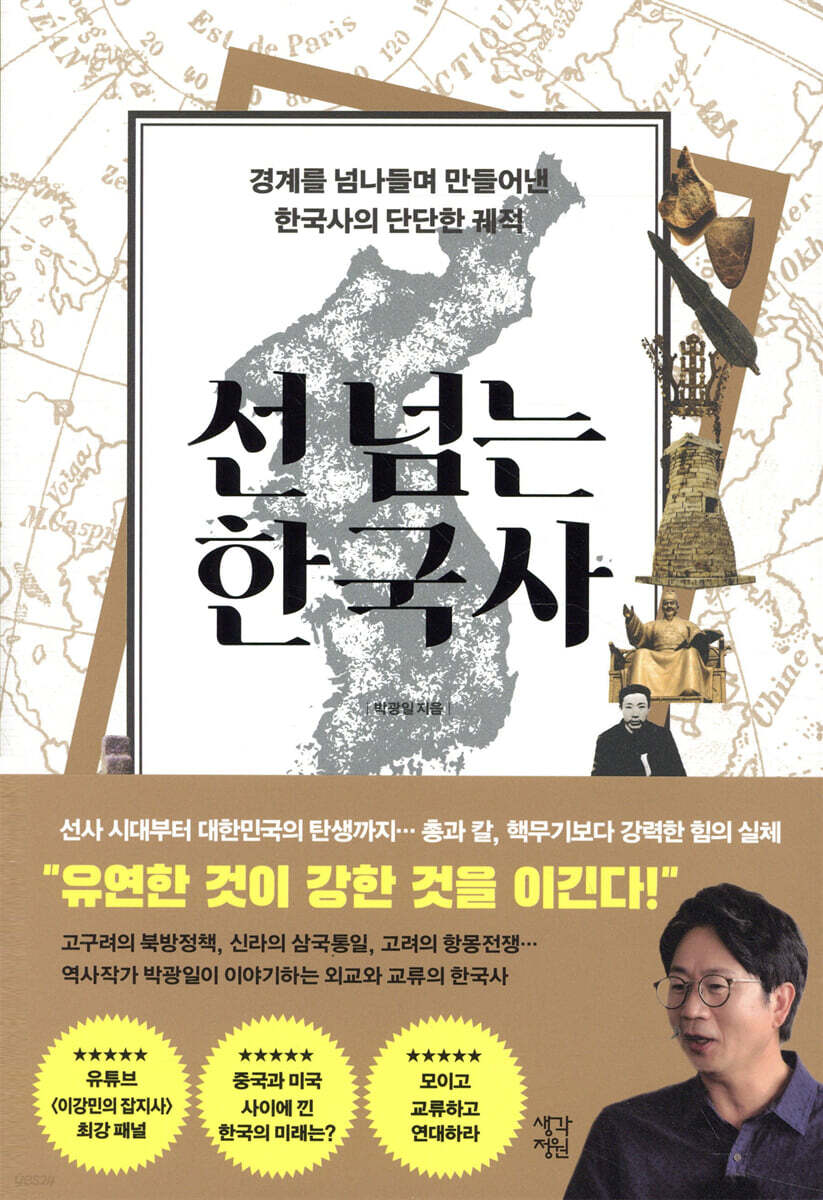 |
Description
Book Introduction
If you look beyond the borders, you will see solid Korean history!
Korean history read with long breaths, not short knowledge!
From prehistoric times to the birth of the Republic of Korea,
A comprehensive history of Korea that covers the flow and context that you should never miss!
The first Korean history story by Park Gwang-il, a historical storyteller and a top panelist on YouTube's "Lee Kang-min's Magazine."
Korean history issues are a regular on YouTube, entertainment shows, and even social media.
South Korea is so serious about history that it is difficult to have a conversation if you don't know the history.
But amidst the fervent Korean history craze, aren't we missing something?
The author recommends reading a "long-term Korean history" that approaches the overall flow and broad perspective, rather than a "short Korean history" that is understood in fragments.
《Korean History Beyond the Line》 covers Korean history from prehistoric times to the birth of the Republic of Korea, and its relationship with the Korean Peninsula, East Asia, and the world.
It illuminates the dynamics surrounding the Korean Peninsula and East Asia, including China's intentions to include Goguryeo history in its own history, the reason the United States is actively pursuing peace on the Korean Peninsula, and Japan's basis for insisting on Dokdo. At the same time, it shows how far the boundaries of Korean history can expand through events and people that transcend national borders, such as the meeting between Silla and Persia, the activities of Dr. Schofield who helped the Korean independence movement, and the story of Korean workers in Cuba sending independence funds.
This book reaffirms the position of the Republic of Korea and its national identity today through Korean history within diverse cultural and political currents, rather than confined to the Korean Peninsula.
While emphasizing the fervent nationalism of the Korean people, who have maintained a history of 5,000 years, we cautiously guard against any sense of superiority, as we must break free from the fixed prejudice that interprets history from only one perspective.
History is not the past.
It still continues today and into the future.
Korean history now approaches us as a barometer that cultivates our perspective on the world, ourselves, and others, and as wisdom that looks to the future.
Korean history read with long breaths, not short knowledge!
From prehistoric times to the birth of the Republic of Korea,
A comprehensive history of Korea that covers the flow and context that you should never miss!
The first Korean history story by Park Gwang-il, a historical storyteller and a top panelist on YouTube's "Lee Kang-min's Magazine."
Korean history issues are a regular on YouTube, entertainment shows, and even social media.
South Korea is so serious about history that it is difficult to have a conversation if you don't know the history.
But amidst the fervent Korean history craze, aren't we missing something?
The author recommends reading a "long-term Korean history" that approaches the overall flow and broad perspective, rather than a "short Korean history" that is understood in fragments.
《Korean History Beyond the Line》 covers Korean history from prehistoric times to the birth of the Republic of Korea, and its relationship with the Korean Peninsula, East Asia, and the world.
It illuminates the dynamics surrounding the Korean Peninsula and East Asia, including China's intentions to include Goguryeo history in its own history, the reason the United States is actively pursuing peace on the Korean Peninsula, and Japan's basis for insisting on Dokdo. At the same time, it shows how far the boundaries of Korean history can expand through events and people that transcend national borders, such as the meeting between Silla and Persia, the activities of Dr. Schofield who helped the Korean independence movement, and the story of Korean workers in Cuba sending independence funds.
This book reaffirms the position of the Republic of Korea and its national identity today through Korean history within diverse cultural and political currents, rather than confined to the Korean Peninsula.
While emphasizing the fervent nationalism of the Korean people, who have maintained a history of 5,000 years, we cautiously guard against any sense of superiority, as we must break free from the fixed prejudice that interprets history from only one perspective.
History is not the past.
It still continues today and into the future.
Korean history now approaches us as a barometer that cultivates our perspective on the world, ourselves, and others, and as wisdom that looks to the future.
- You can preview some of the book's contents.
Preview
index
Part 1: Descendants of the Korean Peninsula, Traveling Across East Asia
_ The birth of Korean history in all its glory
1.
5,000 Years of History Isn't Everything | Prehistoric Times and the Jeongok-ri Site |
2.
The first leader in Korean history to wield a bronze sword | Gojoseon and Dangun |
3.
Caught between great powers, Buyeo's secret to outliving Joseon? | Buyeo's Diplomacy with China |
4.
East Asia's dark horse that stands up to the world's order | Goguryeo's balanced diplomacy |
5.
The primordial Gangnam people, the struggle for survival | Baekje's Hanseong period |
6.
Why did Silla have to be serious about diplomacy? | Silla's All-Round Diplomacy |
7.
The Iron Kingdom: What is the true nature of a weapon more fearsome than the sword? | Coexistence with the Gaya Confederacy |
8.
The Secret of the East Sea Kingdom, Which Doubled Goguryeo's Territory | Balhae's Multi-Ethnic Unification |
9.
Mongolia conquered the continent, Goryeo stood up to Mongolia | Goryeo found opportunity in crisis |
10.
Joseon's Approach to an Ideal State VS East Asia's Opening Eyes to the World | Joseon's Neo-Confucianism and Diplomacy with Four Great Powers |
Part 2: From Baekdu to Halla: How was the Korean Peninsula completed?
- A space of Korean history that has been expanded, endured, and reclaimed
1.
What are the hot spots for reclaiming Gojoseon's vast territory? | King Micheon's Occupation of Seoanpyeong |
2.
Clear evidence that Goguryeo is part of Korean history | King Jangsu's move of the capital to Pyongyang |
3.
Why did Silla gain control of the East Sea? | King Jijeung's Subjugation of Usan-guk |
4.
The only way for a weak country to defeat a powerful country | Kim Chun-chu's Unification of the Three Kingdoms |
5.
Goryeo's Outstanding Duet on Dealing with the Khitan | Seohui and Kangdong 6 Joo |
6.
Why didn't the Jin Dynasty, which had become an empire, go to war with Goryeo? |Yun Gwan's Nine Provinces of the Northeast|
7.
Why did Mongolia and the Ming Dynasty covet Tamna? | Tamna and Horses |
8.
Sejong, completing the line of today's Korean Peninsula | Sejong and the Four Commanderies and Six Garrisons |
9.
The last naval battle that changed East Asian history | Yi Sun-sin's Battle of Noryang |
10.
The final event that ended the Dokdo dispute | San Francisco Peace Treaty |
Part 3: Koreans Outside the Border, Foreigners Inside the Border
- A strong Korean history created across borders
1.
The Three Kingdoms' Project to Build a Strong Nation, Risking Their Lives | The Three Kingdoms' Naturalization Policy |
2.
Why did Cheoyong and the Persian prince come to Basil? | Silla's Western Exchange |
3.
Why didn't Joseon and the Netherlands meet? | Hamel arrives in Jeju Island |
4.
The truth about the secret network Jang Bogo created in the Tang Dynasty | Silla people in Shandong Province |
5.
Why did 121 Koreans leave for Hawaii, a place with no winter? | Ahn Chang-ho and the Korean Synthesis Association |
6.
Koreans in Cuba send independence funds to the Provisional Government | Im Cheon-taek and the Korean National Association |
7.
A runaway boy becomes the godfather of the Russian independence movement | Choi Jae-hyung and the Primorsky Krai Metropolitan Office |
8.
Stalin's brutal forced migration, the 6,000-kilometer Korean long march | Koryo-saram of Central Asia |
9.
What led 35 Korean workers to settle in Paris? | Hwang Ki-hwan and the Korean National Association in Paris |
10.
The place where Yun Dong-ju and Song Mong-gyu were born, raised, and buried | Myeongdong School in Yanbian Korean Autonomous Prefecture |
Part 4: The Ideas That Crossed the Line of "Empire" and Gave Birth to "Republic"
- A bold challenge toward freedom, independence, and a humane life
1.
The Wonju Girl's Journey, Ready for 100 Strokes | Joseon's Law on the Prohibition of Women's Movement |
2.
What kind of world did Min Yeong-hwan see in New York in 1896? | The Desire for Joseon's Modernization |
3.
Why Jeon Bong-jun Forced a Trial at the Risk of Death | The Right to Freedom and Human Rights |
4.
Live as a slave or die as a free man | The nation dreamed of by the Jeongmi Righteous Army |
5.
How did Avison become Joseon's quarantine chief? | Modern Medicine and Avison's Humanity |
6.
The man called the 34th national representative, Seok Ho-pil | Schofield's independence movement |
7.
Japanese lawyer who declared that the annexation of Joseon was wrong | Fuse Tatsuji's defense of conscience |
8.
Why did a colonial youth want to establish a flight school? | Ahn Chang-nam's unfulfilled dream |
9.
Why did Japan try to assassinate a Korean female pilot? | Kwon Ki-ok and the Korean Air Force Operation Plan |
10.
Grant voting rights to Korean women | Na Hye-seok and European women's suffrage |
Part 5: The Secret of the Most Korean Thing Created by Small Differences
- Korean culture created through cross-border exchanges
1.
World Documentary Heritage Created by the East Asian Buddhist Network | Tripitaka Koreana |
2.
Why the Korean Peninsula Is Not a Male-Oriented Society | The Evolution of Surnames and Genealogy |
3.
What is the originality of Hunminjeongeum, mastered by Joseon's linguistic genius? | Choi Se-jin's "Hunmongjahoe" |
4.
How did King Sejong capture Joseon's sky in his calendar and clock? | Chiljeongsan Mountain and Angbuilgu |
5.
Joseon's representative product recognized not only in China and Japan but also around the world | Ginseng and Gaeseong merchants |
6.
Why did UNESCO focus on the Joseon royal tombs? | The aesthetics of simplicity |
7.
Breaking free from the world's order and announcing that Joseon is an independent nation | The meaning of the Taegeukgi |
8.
Why did Emperor Gojong, a "modern monarch," spend 40% of the national budget on defense? | The Korean Empire's Military |
9.
A way to remember foreigners who dedicated themselves to the modernization of Joseon | Yanghwajin Foreigners' Cemetery |
10.
A unique Korean Christmas celebration that connects the end of the year and the holiday season |The origin of Korean Christmas|
_ The birth of Korean history in all its glory
1.
5,000 Years of History Isn't Everything | Prehistoric Times and the Jeongok-ri Site |
2.
The first leader in Korean history to wield a bronze sword | Gojoseon and Dangun |
3.
Caught between great powers, Buyeo's secret to outliving Joseon? | Buyeo's Diplomacy with China |
4.
East Asia's dark horse that stands up to the world's order | Goguryeo's balanced diplomacy |
5.
The primordial Gangnam people, the struggle for survival | Baekje's Hanseong period |
6.
Why did Silla have to be serious about diplomacy? | Silla's All-Round Diplomacy |
7.
The Iron Kingdom: What is the true nature of a weapon more fearsome than the sword? | Coexistence with the Gaya Confederacy |
8.
The Secret of the East Sea Kingdom, Which Doubled Goguryeo's Territory | Balhae's Multi-Ethnic Unification |
9.
Mongolia conquered the continent, Goryeo stood up to Mongolia | Goryeo found opportunity in crisis |
10.
Joseon's Approach to an Ideal State VS East Asia's Opening Eyes to the World | Joseon's Neo-Confucianism and Diplomacy with Four Great Powers |
Part 2: From Baekdu to Halla: How was the Korean Peninsula completed?
- A space of Korean history that has been expanded, endured, and reclaimed
1.
What are the hot spots for reclaiming Gojoseon's vast territory? | King Micheon's Occupation of Seoanpyeong |
2.
Clear evidence that Goguryeo is part of Korean history | King Jangsu's move of the capital to Pyongyang |
3.
Why did Silla gain control of the East Sea? | King Jijeung's Subjugation of Usan-guk |
4.
The only way for a weak country to defeat a powerful country | Kim Chun-chu's Unification of the Three Kingdoms |
5.
Goryeo's Outstanding Duet on Dealing with the Khitan | Seohui and Kangdong 6 Joo |
6.
Why didn't the Jin Dynasty, which had become an empire, go to war with Goryeo? |Yun Gwan's Nine Provinces of the Northeast|
7.
Why did Mongolia and the Ming Dynasty covet Tamna? | Tamna and Horses |
8.
Sejong, completing the line of today's Korean Peninsula | Sejong and the Four Commanderies and Six Garrisons |
9.
The last naval battle that changed East Asian history | Yi Sun-sin's Battle of Noryang |
10.
The final event that ended the Dokdo dispute | San Francisco Peace Treaty |
Part 3: Koreans Outside the Border, Foreigners Inside the Border
- A strong Korean history created across borders
1.
The Three Kingdoms' Project to Build a Strong Nation, Risking Their Lives | The Three Kingdoms' Naturalization Policy |
2.
Why did Cheoyong and the Persian prince come to Basil? | Silla's Western Exchange |
3.
Why didn't Joseon and the Netherlands meet? | Hamel arrives in Jeju Island |
4.
The truth about the secret network Jang Bogo created in the Tang Dynasty | Silla people in Shandong Province |
5.
Why did 121 Koreans leave for Hawaii, a place with no winter? | Ahn Chang-ho and the Korean Synthesis Association |
6.
Koreans in Cuba send independence funds to the Provisional Government | Im Cheon-taek and the Korean National Association |
7.
A runaway boy becomes the godfather of the Russian independence movement | Choi Jae-hyung and the Primorsky Krai Metropolitan Office |
8.
Stalin's brutal forced migration, the 6,000-kilometer Korean long march | Koryo-saram of Central Asia |
9.
What led 35 Korean workers to settle in Paris? | Hwang Ki-hwan and the Korean National Association in Paris |
10.
The place where Yun Dong-ju and Song Mong-gyu were born, raised, and buried | Myeongdong School in Yanbian Korean Autonomous Prefecture |
Part 4: The Ideas That Crossed the Line of "Empire" and Gave Birth to "Republic"
- A bold challenge toward freedom, independence, and a humane life
1.
The Wonju Girl's Journey, Ready for 100 Strokes | Joseon's Law on the Prohibition of Women's Movement |
2.
What kind of world did Min Yeong-hwan see in New York in 1896? | The Desire for Joseon's Modernization |
3.
Why Jeon Bong-jun Forced a Trial at the Risk of Death | The Right to Freedom and Human Rights |
4.
Live as a slave or die as a free man | The nation dreamed of by the Jeongmi Righteous Army |
5.
How did Avison become Joseon's quarantine chief? | Modern Medicine and Avison's Humanity |
6.
The man called the 34th national representative, Seok Ho-pil | Schofield's independence movement |
7.
Japanese lawyer who declared that the annexation of Joseon was wrong | Fuse Tatsuji's defense of conscience |
8.
Why did a colonial youth want to establish a flight school? | Ahn Chang-nam's unfulfilled dream |
9.
Why did Japan try to assassinate a Korean female pilot? | Kwon Ki-ok and the Korean Air Force Operation Plan |
10.
Grant voting rights to Korean women | Na Hye-seok and European women's suffrage |
Part 5: The Secret of the Most Korean Thing Created by Small Differences
- Korean culture created through cross-border exchanges
1.
World Documentary Heritage Created by the East Asian Buddhist Network | Tripitaka Koreana |
2.
Why the Korean Peninsula Is Not a Male-Oriented Society | The Evolution of Surnames and Genealogy |
3.
What is the originality of Hunminjeongeum, mastered by Joseon's linguistic genius? | Choi Se-jin's "Hunmongjahoe" |
4.
How did King Sejong capture Joseon's sky in his calendar and clock? | Chiljeongsan Mountain and Angbuilgu |
5.
Joseon's representative product recognized not only in China and Japan but also around the world | Ginseng and Gaeseong merchants |
6.
Why did UNESCO focus on the Joseon royal tombs? | The aesthetics of simplicity |
7.
Breaking free from the world's order and announcing that Joseon is an independent nation | The meaning of the Taegeukgi |
8.
Why did Emperor Gojong, a "modern monarch," spend 40% of the national budget on defense? | The Korean Empire's Military |
9.
A way to remember foreigners who dedicated themselves to the modernization of Joseon | Yanghwajin Foreigners' Cemetery |
10.
A unique Korean Christmas celebration that connects the end of the year and the holiday season |The origin of Korean Christmas|
Detailed image

Into the book
Mr. Hwang Gi-hwan, who rescued Korean workers from Russia and settled them in Paris.
For a while, his activities and even his existence were not well known in Korea.
However, Pastor Jang Cheol-woo of the New York Korean Church happened to confirm that Mr. Hwang Gi-hwan's grave was in New York while organizing the church's membership list.
Pastor Jang Cheol-woo searched for the grave of Mr. Hwang Gi-hwan in several places and finally found it at Mount Olivet Cemetery in Queens, New York.
The tombstone read:
'Dyanain Hwang Gi-hwan Ji-myo died on the 18th day of the 4th month of the 5th year of the Republic of Korea' Although no one recognized him, he lived as a dynasty Korean until the very end.
---From "Why did 35 Korean workers settle in Paris?"
The following is written on the stone monument in front of the birthplace of poet Yun Dong-ju.
'Birthplace of Yun Dong-ju, a patriotic poet of the Chinese Korean ethnic group' If you are Korean, you will be shocked by the words 'Yun Dong-ju, a patriotic poet of the Chinese Korean ethnic group'.
(Omitted) Restoring the nationality and honor of those who contributed to independence is something that must be done.
It is a matter of helping them discover their identity and paying tribute to those who have dedicated themselves to their country.
---From "Where Yun Dong-ju and Song Mong-gyu were born, raised, and buried"
When Kim Geum-won was 14 years old, he decided to go on a trip and disguised himself as a man.
This wasn't just for travel convenience.
This is because women in the Joseon Dynasty were punished simply for ‘traveling.’
(Omitted) As can be guessed from its name, “Hodongseorakgi” includes the areas that Kim Geum-won traveled to.
'Ho' refers to the Hoseo region, which includes Jecheon and Danyang, 'Dong' refers to the Gwandong region, which includes Geumgangsan Mountain and the Eight Scenic Views of Gwandong, 'Seo' refers to the Gwanseo region, which includes Pyongyang and Uiju, and lastly, 'Nak' refers to Nanyang and Seoul.
Kim Geum-won wrote the reason for writing the book as follows.
“If it were not written down and conveyed, who would know today that there was a gold coin?”
---From "The Wonju Boy's Journey of Crossing the Line, Ready for 100 Strokes"
The Min Yeong-hwan delegation realized that Joseon was slower to change than Japan and China.
But he was even more shocked when he saw Canada and the United States firsthand.
If you were amazed by your first elevator ride in Vancouver, Canada, you'd be amazed by the fact that New York City boasts 3 million people living in a city with Broadway musicals, buildings, trains, hotels, big-box stores, and Central Park.
And the place where Min Young-hwan was truly shocked was Europe.
He wrote about London:
“There are 5 million people living in this city.
The streets and shops, houses, cars and horses of the city are similar to those of New York, but with more grandeur.
The land was narrow and there were many people, so they dug up the ground above the streets and built several levels of underground passages.
“There is also a house in it where people live.”
---From "What kind of world did Min Yeong-hwan see in New York in 1896?"
In 1907, British war correspondent Mackenzie, after much searching, met the Jeongmi Righteous Army in Yangpyeong, Gyeonggi Province.
There is a passage that is most impressive from the conversations Mackenzie had with the volunteers.
Mackenzie had a question for the volunteers.
Do you think that the seemingly insignificant volunteer army could fight and win compared to the Japanese army that defeated the world's strongest nation, Russia, in the Russo-Japanese War?
In response to this question, the volunteer soldiers revealed their desperate feelings as they entered the front lines of the war for independence.
“We are going to die anyway.
But that's okay.
“It is far better to die a free man than to live as a slave of Japan.”
---From "To Live as a Slave, or to Die as a Free Man"
Dr. Schofield took photographs during the March 1st Movement and the Je-am-ri Massacre to inform the world of Japan's injustice.
Known as the 34th representative of the nation, he maintained his connection with Korea by working as a professor at Seoul National University's College of Veterinary Medicine and caring for children at orphanages.
And in April 1970, he passed away at the National Medical Center.
A month before his death, the Chosun Ilbo published an article he wrote titled “A Message to the Korean People.”
“‘Do not forget the great debt you owe to the young and old of 1919.’ These are the words I want to convey to the youth of Joseon today.
There are times when citizens must protest against injustice and risk their lives.
By doing so, we can be freed from a kind of slavery and regain a little light.” The grave of Dr. Park, a Korean independence activist, was designated as a patriotic graveyard at the Seoul National Cemetery in Dongjak-dong.
---From "The man called the 34th national representative, Seok Ho-pil"
An Chang-nam, the first person in Korea to fly in the Joseon sky.
He realized that he was Korean while flying in his home country.
This can be seen in the part where he summarizes his impressions of flying.
“The Independence Gate looked very lonely, and I could see a person in white slowly climbing up the Muakjae Pass.
(Omitted) Even in Seodaemun Prison, it must have seemed like it was floating above their heads, but how many of my brothers who were imprisoned would have shown my will and my body to those who went all the way there?
(Omitted) I wanted to shout out to him from the air, “How are you doing?” but I had no choice but to just turn around.”
---From "Why did a colonial youth want to establish a flight school?"
Na Hye-seok witnessed the British women's suffrage movement demonstrations on the spot and contributed articles to inform Joseon society.
He suffered from all kinds of attacks for his remarks that were ahead of their time.
But it wasn't that he saw his life as meaningless.
Na Hye-seok left behind a piece of writing that seemed to evaluate her life.
“Even if my body burns to ashes, someday in the distant future, my blood and cries will be scattered across this land, and our descendants, the women of tomorrow, will live more humane lives and remember my name.”
---From "Allow women in Joseon to vote"
During the Korean War, in order to suppress guerrillas, the US military, which had operational control at the time, ordered Colonel Kim Young-hwan, an Air Force bomber pilot, to bomb Haeinsa Temple.
However, Colonel Kim Young-hwan returned after attacking only the enemy's supply depot beyond the mountain behind Haeinsa Temple.
He was summoned to his superiors for disobeying orders, but he is said to have spoken proudly.
“The British people said, ‘You can’t trade Shakespeare for India.’
“The Tripitaka Koreana is a treasure that cannot be exchanged for Shakespeare or all of India, and we could not burn it in the war.” The US military is said to have agreed with Colonel Kim Young-hwan’s answer.
For a while, his activities and even his existence were not well known in Korea.
However, Pastor Jang Cheol-woo of the New York Korean Church happened to confirm that Mr. Hwang Gi-hwan's grave was in New York while organizing the church's membership list.
Pastor Jang Cheol-woo searched for the grave of Mr. Hwang Gi-hwan in several places and finally found it at Mount Olivet Cemetery in Queens, New York.
The tombstone read:
'Dyanain Hwang Gi-hwan Ji-myo died on the 18th day of the 4th month of the 5th year of the Republic of Korea' Although no one recognized him, he lived as a dynasty Korean until the very end.
---From "Why did 35 Korean workers settle in Paris?"
The following is written on the stone monument in front of the birthplace of poet Yun Dong-ju.
'Birthplace of Yun Dong-ju, a patriotic poet of the Chinese Korean ethnic group' If you are Korean, you will be shocked by the words 'Yun Dong-ju, a patriotic poet of the Chinese Korean ethnic group'.
(Omitted) Restoring the nationality and honor of those who contributed to independence is something that must be done.
It is a matter of helping them discover their identity and paying tribute to those who have dedicated themselves to their country.
---From "Where Yun Dong-ju and Song Mong-gyu were born, raised, and buried"
When Kim Geum-won was 14 years old, he decided to go on a trip and disguised himself as a man.
This wasn't just for travel convenience.
This is because women in the Joseon Dynasty were punished simply for ‘traveling.’
(Omitted) As can be guessed from its name, “Hodongseorakgi” includes the areas that Kim Geum-won traveled to.
'Ho' refers to the Hoseo region, which includes Jecheon and Danyang, 'Dong' refers to the Gwandong region, which includes Geumgangsan Mountain and the Eight Scenic Views of Gwandong, 'Seo' refers to the Gwanseo region, which includes Pyongyang and Uiju, and lastly, 'Nak' refers to Nanyang and Seoul.
Kim Geum-won wrote the reason for writing the book as follows.
“If it were not written down and conveyed, who would know today that there was a gold coin?”
---From "The Wonju Boy's Journey of Crossing the Line, Ready for 100 Strokes"
The Min Yeong-hwan delegation realized that Joseon was slower to change than Japan and China.
But he was even more shocked when he saw Canada and the United States firsthand.
If you were amazed by your first elevator ride in Vancouver, Canada, you'd be amazed by the fact that New York City boasts 3 million people living in a city with Broadway musicals, buildings, trains, hotels, big-box stores, and Central Park.
And the place where Min Young-hwan was truly shocked was Europe.
He wrote about London:
“There are 5 million people living in this city.
The streets and shops, houses, cars and horses of the city are similar to those of New York, but with more grandeur.
The land was narrow and there were many people, so they dug up the ground above the streets and built several levels of underground passages.
“There is also a house in it where people live.”
---From "What kind of world did Min Yeong-hwan see in New York in 1896?"
In 1907, British war correspondent Mackenzie, after much searching, met the Jeongmi Righteous Army in Yangpyeong, Gyeonggi Province.
There is a passage that is most impressive from the conversations Mackenzie had with the volunteers.
Mackenzie had a question for the volunteers.
Do you think that the seemingly insignificant volunteer army could fight and win compared to the Japanese army that defeated the world's strongest nation, Russia, in the Russo-Japanese War?
In response to this question, the volunteer soldiers revealed their desperate feelings as they entered the front lines of the war for independence.
“We are going to die anyway.
But that's okay.
“It is far better to die a free man than to live as a slave of Japan.”
---From "To Live as a Slave, or to Die as a Free Man"
Dr. Schofield took photographs during the March 1st Movement and the Je-am-ri Massacre to inform the world of Japan's injustice.
Known as the 34th representative of the nation, he maintained his connection with Korea by working as a professor at Seoul National University's College of Veterinary Medicine and caring for children at orphanages.
And in April 1970, he passed away at the National Medical Center.
A month before his death, the Chosun Ilbo published an article he wrote titled “A Message to the Korean People.”
“‘Do not forget the great debt you owe to the young and old of 1919.’ These are the words I want to convey to the youth of Joseon today.
There are times when citizens must protest against injustice and risk their lives.
By doing so, we can be freed from a kind of slavery and regain a little light.” The grave of Dr. Park, a Korean independence activist, was designated as a patriotic graveyard at the Seoul National Cemetery in Dongjak-dong.
---From "The man called the 34th national representative, Seok Ho-pil"
An Chang-nam, the first person in Korea to fly in the Joseon sky.
He realized that he was Korean while flying in his home country.
This can be seen in the part where he summarizes his impressions of flying.
“The Independence Gate looked very lonely, and I could see a person in white slowly climbing up the Muakjae Pass.
(Omitted) Even in Seodaemun Prison, it must have seemed like it was floating above their heads, but how many of my brothers who were imprisoned would have shown my will and my body to those who went all the way there?
(Omitted) I wanted to shout out to him from the air, “How are you doing?” but I had no choice but to just turn around.”
---From "Why did a colonial youth want to establish a flight school?"
Na Hye-seok witnessed the British women's suffrage movement demonstrations on the spot and contributed articles to inform Joseon society.
He suffered from all kinds of attacks for his remarks that were ahead of their time.
But it wasn't that he saw his life as meaningless.
Na Hye-seok left behind a piece of writing that seemed to evaluate her life.
“Even if my body burns to ashes, someday in the distant future, my blood and cries will be scattered across this land, and our descendants, the women of tomorrow, will live more humane lives and remember my name.”
---From "Allow women in Joseon to vote"
During the Korean War, in order to suppress guerrillas, the US military, which had operational control at the time, ordered Colonel Kim Young-hwan, an Air Force bomber pilot, to bomb Haeinsa Temple.
However, Colonel Kim Young-hwan returned after attacking only the enemy's supply depot beyond the mountain behind Haeinsa Temple.
He was summoned to his superiors for disobeying orders, but he is said to have spoken proudly.
“The British people said, ‘You can’t trade Shakespeare for India.’
“The Tripitaka Koreana is a treasure that cannot be exchanged for Shakespeare or all of India, and we could not burn it in the war.” The US military is said to have agreed with Colonel Kim Young-hwan’s answer.
---From "World Documentary Heritage Created by the East Asian Buddhist Network"
Publisher's Review
If you look beyond the borders, you will see solid Korean history!
How to Read Korean History Broadly and Deeply
The Republic of Korea, a country that is true to its history, is now living in an 'age of history.'
Korean history is a required subject, and Korean history issues are a regular topic on YouTube, entertainment shows, and social media. If you don't have a good understanding of current issues, you will have difficulty engaging in conversations.
Historical knowledge has become essential common sense in our society, to the point that there is a saying, "Those who do not know history."
There are two main ways to easily understand Korean history.
One is to see it from the perspective of wisdom, beyond knowledge.
Korean history is the story of the people who lived on the Korean Peninsula for hundreds of thousands of years.
If we listen to their stories 'as they were' rather than evaluating and memorizing their lives, we will be able to understand Korean history better.
Another thing is that history is not about the right answer, but about perspective.
Historian E.
H. Cardo goes so far as to say that historical facts are 'created by historians'.
Ultimately, this means that even when looking at the same incident, how you interpret it is important.
《Korean History Beyond the Line》 contains 'stories of the people of the Korean Peninsula' written to enrich the understanding of Korean history.
Parts 1 and 2 go beyond the boundaries of the "Korean Peninsula" and examine how the nations of the Korean Peninsula grew and declined within international relations with China, northern nomadic peoples, and Japan, creating the topography of the Korean Peninsula as it exists today.
"Goguryeo is Chinese history?" "Why did Japan desperately try to obtain the Tripitaka Koreana?" "Who did King Wonjong of Goryeo choose as the next Mongol emperor?" Among the powerful forces that did not hesitate to wage war for their own interests, "survival" was of the utmost importance, and we can see that the power of a nation's survival comes not only from military power but also from various options such as diplomacy and culture.
Parts 3 and 4 contain the stories of 'border people' who influenced Korean history.
'Why did the Persian prince come to Basil (Silla)?' 'What were the activities of Schofield, called the 34th national representative?' 'What is the story of Korean workers in Cuba sending independence funds?' It goes beyond the line of 'Koreans on the Korean Peninsula' and contains stories of foreigners who had a great influence on Korean history and Koreans who lived around the world and made Korea known.
Through the stories of the "border people" who cried out for freedom, independence, and human rights both inside and outside the Korean Peninsula, we can encounter a more solid and strong Korean history.
Part 5 contains the most Korean culture created through exchanges between the East and the West.
"What world heritage was created by the East Asian Buddhist network?" "How did the Taegeukgi break the Sino-centric order?" "What did Joseon create to commemorate foreigners who dedicated themselves to independence?" Korean history is a history of countless human and material exchanges.
Understanding Korea historically in the context of exchange provides insight into how Korea should relate to and move forward with the nations of the world today.
The interpretation of history is up to the readers.
However, the author of this book recommends reading 'long-term Korean history' rather than 'short Korean history' to develop a correct perspective on history.
By looking broadly and deeply into history, from the Korean Peninsula to East Asia, and from foreigners and Koreans inside and outside the Korean Peninsula, we can break free from our own fixed prejudices and superiority complex, and gain a broad and deep perspective that allows us to read the world, ourselves, and others.
The power of survival comes not from strength, but from flexibility.
Viewing History from a Geopolitical Perspective: Northeast Asia _ A Long History of Korea Part 1
The history of the Korean Peninsula can only be properly understood within the context of East Asia.
The Korean Peninsula did not exist alone on an uninhabited island, but rather experienced fierce growth and decline in its history amidst relations with China and northern nomadic tribes to the north and Japan to the south.
As neighboring powers rose and fell, we faced numerous unexpected crises, and beyond a strong military and just cause, we needed a multifaceted approach to survival and growth.
Looking at history from this geopolitical perspective of East Asia, we can see that the power of a nation does not simply depend on military power.
The rise and fall of the nations of the Korean Peninsula depended not only on military power but also on how they utilized various diplomatic strategies, such as alliances with weaker nations, self-interest, and just cause.
The assessment that 'Silla's unification of the three kingdoms was the result of betraying its own people and relying on the Tang Dynasty, and Goryeo's history was one of suffering under the power of the Mongols' is the result of viewing history simply through the logic of military power.
But from a survival perspective, it looks different.
Silla, the weakest of the three kingdoms, proposed an alliance with Goguryeo and Wa under the threat of Baekje, but it did not come to fruition.
The alliance with Tang was Silla's last resort to save its country and people.
Moreover, Mongolia was the most powerful country that encompassed not only Asia but also Europe.
Goryeo's diplomatic prowess, which prevented its country from being taken over by the powerful Mongol military, must be highly evaluated.
From ancient times to the present, the nations of the Korean Peninsula have survived by fighting a major war once every hundred years against the powerful forces of not only Japan but also China and the northern nomadic tribes.
Diplomatic power was just as important as military power in creating such a solid Korean history.
From a survival perspective, it was not always the country with the strongest military that won.
History proves that flexible multilateral dialogue and diplomacy, such as alliances with weaker nations and negotiations based on practicality and justification, determine a nation's strength.
A solid Korean history that expands time from ancient times to the present.
What You See When You Look Beyond the Perspective of 'Modern Korean History' _ Long-Breaking Korean History 2
From the perspective of relics, the history of the Korean Peninsula begins 700,000 years ago, when Paleolithic relics were handed down. From the perspective of records, it begins about 5,000 years ago, as records of Gojoseon remain in Chinese historical records.
However, we tend to be partial to modern Korean history, that is, Joseon history and the history of the Japanese colonial period.
It is the closest time to us today and has connections to current issues, so we cannot help but pay attention to it. However, it is unreasonable to highlight the identity of the Korean people based on the history of this period.
Korean history is not the 700 years from Joseon to the present. Even if we exclude Gojoseon, which is a Chinese source, it is a history of more than 2,000 years from the Three Kingdoms period, for which we have records, to the present. If we understand Korean history through this flow, our identity is quite different.
Korean history is often said to be a male-centered, patriarchal history.
This is a misconception that arose from generalizing the primogeniture and male superiority over females, which began in earnest with the introduction of Confucianism during the Joseon Dynasty, as our traditional order.
For example, during the Three Kingdoms period, there were guidelines for changing surnames.
First, they were made to take their mother's surname, then their paternal grandmother's, and if they still had the same surname, then their maternal grandmother's surname.
It is the continuation of the maternal surname.
Additionally, during the Goryeo Dynasty, children inherited their parents' property equally, regardless of gender.
Although there are many examples of matriarchy and gender equality, we can see that just as we cannot say that Korean history is a matriarchal society, we cannot say that it is a patriarchal society either.
Another example is that the Korean Peninsula had a strong image of being a closed country.
It originated from the fact that in the late Joseon Dynasty, in order to realize the ideal state of Neo-Confucianism, the country was subservient to the Ming Dynasty, its relations with neighboring countries were conservative, and the isolationist policy implemented during the Korean Empire.
But this is also only a part of the long history of Korea.
Goguryeo, Baekje, and Silla implemented a naturalization policy to build strong nations.
Advanced civilization was imported by employing capable people from China and northern nomadic countries.
During the Goryeo Dynasty, the Buddhist Tripitaka Koreana was compiled through active exchanges with East Asia and Mongolian culture was also accepted.
The nations of the Korean Peninsula have grown over a long period of time, with flawed systems and ideologies disappearing and being replaced by new ones.
The idea that Korea or Korean identity is patriarchal and closed stems from a misguided historical understanding that seeks to generalize by highlighting a specific period, and it must be discarded for the sake of our future.
Koreans outside the border, foreigners inside the border
People Who Influenced Korean History Beyond National and Territorial Boundaries _ A Long History of Korea 3
In addition to the 'Koreans of the Korean Peninsula,' there are people who have had a great influence on Korean history.
The first is a foreigner who stayed in the Korean Peninsula.
They include Dr. Avison, who introduced modern medicine to Joseon; Japanese lawyer Tatsuji, who declared that "the annexation of Joseon was Japan's fault"; Bethel, president of the Daehan Maeil Shinbo, who covered the atrocities of the Japanese; and Eckert, who composed the national anthem of the Korean Empire.
In particular, Dr. Schofield, known as the 34th national representative, is a figure whom Koreans should remember, as he took photographs during the March 1st Movement and the Je-am-ri Massacre to inform the world of Japan's injustice.
In April 1970, a month before his death, he published an article titled “A Message to the Korean People” in a newspaper, urging Korean youth not to forget “the great debt we owe to the young and old of 1919.”
The second is Koreans who influenced Korea from outside the Korean Peninsula.
There were many people, including Choi Jae-hyung, who supported the Righteous Army in Russia, Im Cheon-taek, who sent independence funds to Korea from Cuba, and Jang In-hwan, who assassinated Japanese diplomatic advisor Stevenson in San Francisco.
In particular, Mr. Hwang Gi-hwan, who was in charge of the provisional government's diplomatic affairs, rescued 35 Korean workers from Russia and helped them settle in Paris, France.
His whereabouts were unknown for some time, and it was later confirmed that he died in New York at the young age of thirty-seven.
The tombstone read, 'Dyanain Hwang Gi-hwan, died on the 18th day of the 4th month of the 5th year of the reign of King Myeong-guk.'
Although Korea did not recognize him, he lived as a Korean until the end.
In this way, Korean history is a sum total of diverse histories that transcend national and territorial boundaries.
It is very meaningful to examine how today's Korea was formed through the stories of "border people," foreigners and Koreans inside and outside the border who burned themselves to return the Korean Peninsula from Japanese colonial rule.
The ideas that crossed the line of taboo and shaped Korea
A Relentless Challenge to Freedom, Independence, and a Humane Life _ A Long History of Korea 4
In any era, there are ways and morals to live by.
But as times change, these rules become outdated and new ways of life are required.
During the reign of King Sejong of Joseon, women were punished with 100 lashes just for ‘traveling.’
It was because it was said to be detrimental to public morals and to encourage luxury.
But there is a woman who bravely attempted a journey despite the punishment.
Kim Geum-won began traveling when he was 14 years old, and later wrote a travelogue called “Hodongseorakgi.”
He also wrote the reason for writing the book, saying, “If I don’t write it down and tell you, who will know today that there was a gold coin?”
The challenge to taboos can also be found in the work of Na Hye-seok, a painter from the Japanese colonial period.
While staying in England, he witnessed demonstrations for the women's suffrage movement and wrote an article arguing that women should also be granted the right to vote in Joseon.
His remarks had a great impact on Joseon society, and he suffered from all kinds of attacks.
Although he suffered from a nervous breakdown and died as an orphan in his old age, he did not think that his life was meaningless.
Na Hye-seok left behind a piece of writing that seemed to evaluate her life.
“Even if my body burns to ashes, someday in the distant future, my blood and cries will be scattered across this land, and our descendants, the women of tomorrow, will live more humane lives and remember my name.”
In addition to Kim Geum-won and Na Hye-seok, challenges to the taboos that restrict freedom, independence, and human rights have taken many forms.
Representative examples include Jeon Bong-jun and the Donghak Peasant Army, who fought against corrupt officials and the Japanese, and Ahn Chang-nam and Kwon Gi-ok, who learned flying, a powerful weapon, to fight against the Japanese in order to achieve independence for their colony.
People who were not afraid of punishment or even death to cross the line of taboo.
It is difficult to imagine today's Korea without their relentless challenges.
The birth of something most Korean, created across borders
Korean culture born from East-West exchanges _ A long history of Korea, Part 5
There is a saying, “There is nothing new under the sun.”
Even before Silla's Seokguram Grotto, there were Chinese cave temples, and even before Goryeo's Tripitaka Koreana, there were Tripitaka Koreana.
But there is a difference between the two.
Because they were created in different natural and cultural environments, there were many great cultural artifacts that were impossible or inefficient to apply as is.
In this process, there are legacies that have been refined and modified to fit our reality, creating the most Korean things.
These include the Korean alphabet, which was created with consideration for a language system different from that of other countries; the Joseon royal tombs, which embody the frugality of the Joseon people; the Tripitaka Koreana, which compiles the Buddhist network of East Asia; Chiljeongsan Mountain and Angbuilgu, which tell the date and time according to Korea's natural environment; and Seokguram Grotto, which was designed to fit the granite mountainous terrain.
What makes these legacies so great is that they can be enjoyed and used by everyone, rather than being for the benefit of a select few.
Regardless of social status, people could learn to read and write and develop their abilities, and they could sow seeds and harvest crops according to the time and season.
Moreover, any common people could receive comfort from the suffering of countless wars and diseases by reciting the Buddha's words.
《Korean History Beyond the Line》 examines Korean history within the context of geopolitical relations with China, northern nomadic peoples, and Japan, and tells the stories of "borderline people" who called for freedom, independence, and human rights both inside and outside the Korean Peninsula.
It also contains the most Korean culture that was born from numerous human and material exchanges.
By examining history in this way amidst the various relationships surrounding the Korean Peninsula, we can soon encounter a more solid Korean history.
Author's Note
“What is the correct view of history?
This book expands our awareness and knowledge, suggesting an attitude of looking at the past and present with an open mind.
To "cross the line" means to break free from the prejudices and border-building superiority complex within us, and to have a broader and deeper perspective on the world, ourselves, and others.
“Our lives today are history, and we make history, so we must learn history correctly.”
How to Read Korean History Broadly and Deeply
The Republic of Korea, a country that is true to its history, is now living in an 'age of history.'
Korean history is a required subject, and Korean history issues are a regular topic on YouTube, entertainment shows, and social media. If you don't have a good understanding of current issues, you will have difficulty engaging in conversations.
Historical knowledge has become essential common sense in our society, to the point that there is a saying, "Those who do not know history."
There are two main ways to easily understand Korean history.
One is to see it from the perspective of wisdom, beyond knowledge.
Korean history is the story of the people who lived on the Korean Peninsula for hundreds of thousands of years.
If we listen to their stories 'as they were' rather than evaluating and memorizing their lives, we will be able to understand Korean history better.
Another thing is that history is not about the right answer, but about perspective.
Historian E.
H. Cardo goes so far as to say that historical facts are 'created by historians'.
Ultimately, this means that even when looking at the same incident, how you interpret it is important.
《Korean History Beyond the Line》 contains 'stories of the people of the Korean Peninsula' written to enrich the understanding of Korean history.
Parts 1 and 2 go beyond the boundaries of the "Korean Peninsula" and examine how the nations of the Korean Peninsula grew and declined within international relations with China, northern nomadic peoples, and Japan, creating the topography of the Korean Peninsula as it exists today.
"Goguryeo is Chinese history?" "Why did Japan desperately try to obtain the Tripitaka Koreana?" "Who did King Wonjong of Goryeo choose as the next Mongol emperor?" Among the powerful forces that did not hesitate to wage war for their own interests, "survival" was of the utmost importance, and we can see that the power of a nation's survival comes not only from military power but also from various options such as diplomacy and culture.
Parts 3 and 4 contain the stories of 'border people' who influenced Korean history.
'Why did the Persian prince come to Basil (Silla)?' 'What were the activities of Schofield, called the 34th national representative?' 'What is the story of Korean workers in Cuba sending independence funds?' It goes beyond the line of 'Koreans on the Korean Peninsula' and contains stories of foreigners who had a great influence on Korean history and Koreans who lived around the world and made Korea known.
Through the stories of the "border people" who cried out for freedom, independence, and human rights both inside and outside the Korean Peninsula, we can encounter a more solid and strong Korean history.
Part 5 contains the most Korean culture created through exchanges between the East and the West.
"What world heritage was created by the East Asian Buddhist network?" "How did the Taegeukgi break the Sino-centric order?" "What did Joseon create to commemorate foreigners who dedicated themselves to independence?" Korean history is a history of countless human and material exchanges.
Understanding Korea historically in the context of exchange provides insight into how Korea should relate to and move forward with the nations of the world today.
The interpretation of history is up to the readers.
However, the author of this book recommends reading 'long-term Korean history' rather than 'short Korean history' to develop a correct perspective on history.
By looking broadly and deeply into history, from the Korean Peninsula to East Asia, and from foreigners and Koreans inside and outside the Korean Peninsula, we can break free from our own fixed prejudices and superiority complex, and gain a broad and deep perspective that allows us to read the world, ourselves, and others.
The power of survival comes not from strength, but from flexibility.
Viewing History from a Geopolitical Perspective: Northeast Asia _ A Long History of Korea Part 1
The history of the Korean Peninsula can only be properly understood within the context of East Asia.
The Korean Peninsula did not exist alone on an uninhabited island, but rather experienced fierce growth and decline in its history amidst relations with China and northern nomadic tribes to the north and Japan to the south.
As neighboring powers rose and fell, we faced numerous unexpected crises, and beyond a strong military and just cause, we needed a multifaceted approach to survival and growth.
Looking at history from this geopolitical perspective of East Asia, we can see that the power of a nation does not simply depend on military power.
The rise and fall of the nations of the Korean Peninsula depended not only on military power but also on how they utilized various diplomatic strategies, such as alliances with weaker nations, self-interest, and just cause.
The assessment that 'Silla's unification of the three kingdoms was the result of betraying its own people and relying on the Tang Dynasty, and Goryeo's history was one of suffering under the power of the Mongols' is the result of viewing history simply through the logic of military power.
But from a survival perspective, it looks different.
Silla, the weakest of the three kingdoms, proposed an alliance with Goguryeo and Wa under the threat of Baekje, but it did not come to fruition.
The alliance with Tang was Silla's last resort to save its country and people.
Moreover, Mongolia was the most powerful country that encompassed not only Asia but also Europe.
Goryeo's diplomatic prowess, which prevented its country from being taken over by the powerful Mongol military, must be highly evaluated.
From ancient times to the present, the nations of the Korean Peninsula have survived by fighting a major war once every hundred years against the powerful forces of not only Japan but also China and the northern nomadic tribes.
Diplomatic power was just as important as military power in creating such a solid Korean history.
From a survival perspective, it was not always the country with the strongest military that won.
History proves that flexible multilateral dialogue and diplomacy, such as alliances with weaker nations and negotiations based on practicality and justification, determine a nation's strength.
A solid Korean history that expands time from ancient times to the present.
What You See When You Look Beyond the Perspective of 'Modern Korean History' _ Long-Breaking Korean History 2
From the perspective of relics, the history of the Korean Peninsula begins 700,000 years ago, when Paleolithic relics were handed down. From the perspective of records, it begins about 5,000 years ago, as records of Gojoseon remain in Chinese historical records.
However, we tend to be partial to modern Korean history, that is, Joseon history and the history of the Japanese colonial period.
It is the closest time to us today and has connections to current issues, so we cannot help but pay attention to it. However, it is unreasonable to highlight the identity of the Korean people based on the history of this period.
Korean history is not the 700 years from Joseon to the present. Even if we exclude Gojoseon, which is a Chinese source, it is a history of more than 2,000 years from the Three Kingdoms period, for which we have records, to the present. If we understand Korean history through this flow, our identity is quite different.
Korean history is often said to be a male-centered, patriarchal history.
This is a misconception that arose from generalizing the primogeniture and male superiority over females, which began in earnest with the introduction of Confucianism during the Joseon Dynasty, as our traditional order.
For example, during the Three Kingdoms period, there were guidelines for changing surnames.
First, they were made to take their mother's surname, then their paternal grandmother's, and if they still had the same surname, then their maternal grandmother's surname.
It is the continuation of the maternal surname.
Additionally, during the Goryeo Dynasty, children inherited their parents' property equally, regardless of gender.
Although there are many examples of matriarchy and gender equality, we can see that just as we cannot say that Korean history is a matriarchal society, we cannot say that it is a patriarchal society either.
Another example is that the Korean Peninsula had a strong image of being a closed country.
It originated from the fact that in the late Joseon Dynasty, in order to realize the ideal state of Neo-Confucianism, the country was subservient to the Ming Dynasty, its relations with neighboring countries were conservative, and the isolationist policy implemented during the Korean Empire.
But this is also only a part of the long history of Korea.
Goguryeo, Baekje, and Silla implemented a naturalization policy to build strong nations.
Advanced civilization was imported by employing capable people from China and northern nomadic countries.
During the Goryeo Dynasty, the Buddhist Tripitaka Koreana was compiled through active exchanges with East Asia and Mongolian culture was also accepted.
The nations of the Korean Peninsula have grown over a long period of time, with flawed systems and ideologies disappearing and being replaced by new ones.
The idea that Korea or Korean identity is patriarchal and closed stems from a misguided historical understanding that seeks to generalize by highlighting a specific period, and it must be discarded for the sake of our future.
Koreans outside the border, foreigners inside the border
People Who Influenced Korean History Beyond National and Territorial Boundaries _ A Long History of Korea 3
In addition to the 'Koreans of the Korean Peninsula,' there are people who have had a great influence on Korean history.
The first is a foreigner who stayed in the Korean Peninsula.
They include Dr. Avison, who introduced modern medicine to Joseon; Japanese lawyer Tatsuji, who declared that "the annexation of Joseon was Japan's fault"; Bethel, president of the Daehan Maeil Shinbo, who covered the atrocities of the Japanese; and Eckert, who composed the national anthem of the Korean Empire.
In particular, Dr. Schofield, known as the 34th national representative, is a figure whom Koreans should remember, as he took photographs during the March 1st Movement and the Je-am-ri Massacre to inform the world of Japan's injustice.
In April 1970, a month before his death, he published an article titled “A Message to the Korean People” in a newspaper, urging Korean youth not to forget “the great debt we owe to the young and old of 1919.”
The second is Koreans who influenced Korea from outside the Korean Peninsula.
There were many people, including Choi Jae-hyung, who supported the Righteous Army in Russia, Im Cheon-taek, who sent independence funds to Korea from Cuba, and Jang In-hwan, who assassinated Japanese diplomatic advisor Stevenson in San Francisco.
In particular, Mr. Hwang Gi-hwan, who was in charge of the provisional government's diplomatic affairs, rescued 35 Korean workers from Russia and helped them settle in Paris, France.
His whereabouts were unknown for some time, and it was later confirmed that he died in New York at the young age of thirty-seven.
The tombstone read, 'Dyanain Hwang Gi-hwan, died on the 18th day of the 4th month of the 5th year of the reign of King Myeong-guk.'
Although Korea did not recognize him, he lived as a Korean until the end.
In this way, Korean history is a sum total of diverse histories that transcend national and territorial boundaries.
It is very meaningful to examine how today's Korea was formed through the stories of "border people," foreigners and Koreans inside and outside the border who burned themselves to return the Korean Peninsula from Japanese colonial rule.
The ideas that crossed the line of taboo and shaped Korea
A Relentless Challenge to Freedom, Independence, and a Humane Life _ A Long History of Korea 4
In any era, there are ways and morals to live by.
But as times change, these rules become outdated and new ways of life are required.
During the reign of King Sejong of Joseon, women were punished with 100 lashes just for ‘traveling.’
It was because it was said to be detrimental to public morals and to encourage luxury.
But there is a woman who bravely attempted a journey despite the punishment.
Kim Geum-won began traveling when he was 14 years old, and later wrote a travelogue called “Hodongseorakgi.”
He also wrote the reason for writing the book, saying, “If I don’t write it down and tell you, who will know today that there was a gold coin?”
The challenge to taboos can also be found in the work of Na Hye-seok, a painter from the Japanese colonial period.
While staying in England, he witnessed demonstrations for the women's suffrage movement and wrote an article arguing that women should also be granted the right to vote in Joseon.
His remarks had a great impact on Joseon society, and he suffered from all kinds of attacks.
Although he suffered from a nervous breakdown and died as an orphan in his old age, he did not think that his life was meaningless.
Na Hye-seok left behind a piece of writing that seemed to evaluate her life.
“Even if my body burns to ashes, someday in the distant future, my blood and cries will be scattered across this land, and our descendants, the women of tomorrow, will live more humane lives and remember my name.”
In addition to Kim Geum-won and Na Hye-seok, challenges to the taboos that restrict freedom, independence, and human rights have taken many forms.
Representative examples include Jeon Bong-jun and the Donghak Peasant Army, who fought against corrupt officials and the Japanese, and Ahn Chang-nam and Kwon Gi-ok, who learned flying, a powerful weapon, to fight against the Japanese in order to achieve independence for their colony.
People who were not afraid of punishment or even death to cross the line of taboo.
It is difficult to imagine today's Korea without their relentless challenges.
The birth of something most Korean, created across borders
Korean culture born from East-West exchanges _ A long history of Korea, Part 5
There is a saying, “There is nothing new under the sun.”
Even before Silla's Seokguram Grotto, there were Chinese cave temples, and even before Goryeo's Tripitaka Koreana, there were Tripitaka Koreana.
But there is a difference between the two.
Because they were created in different natural and cultural environments, there were many great cultural artifacts that were impossible or inefficient to apply as is.
In this process, there are legacies that have been refined and modified to fit our reality, creating the most Korean things.
These include the Korean alphabet, which was created with consideration for a language system different from that of other countries; the Joseon royal tombs, which embody the frugality of the Joseon people; the Tripitaka Koreana, which compiles the Buddhist network of East Asia; Chiljeongsan Mountain and Angbuilgu, which tell the date and time according to Korea's natural environment; and Seokguram Grotto, which was designed to fit the granite mountainous terrain.
What makes these legacies so great is that they can be enjoyed and used by everyone, rather than being for the benefit of a select few.
Regardless of social status, people could learn to read and write and develop their abilities, and they could sow seeds and harvest crops according to the time and season.
Moreover, any common people could receive comfort from the suffering of countless wars and diseases by reciting the Buddha's words.
《Korean History Beyond the Line》 examines Korean history within the context of geopolitical relations with China, northern nomadic peoples, and Japan, and tells the stories of "borderline people" who called for freedom, independence, and human rights both inside and outside the Korean Peninsula.
It also contains the most Korean culture that was born from numerous human and material exchanges.
By examining history in this way amidst the various relationships surrounding the Korean Peninsula, we can soon encounter a more solid Korean history.
Author's Note
“What is the correct view of history?
This book expands our awareness and knowledge, suggesting an attitude of looking at the past and present with an open mind.
To "cross the line" means to break free from the prejudices and border-building superiority complex within us, and to have a broader and deeper perspective on the world, ourselves, and others.
“Our lives today are history, and we make history, so we must learn history correctly.”
GOODS SPECIFICS
- Date of issue: October 11, 2024
- Page count, weight, size: 396 pages | 590g | 153*225*20mm
- ISBN13: 9791193811290
You may also like
카테고리
korean


korean

![GQ KOREA Mark (Monthly): December [2025]](http://librairie.coreenne.fr/cdn/shop/files/8ef265dbbfbf186523ed75ba7319009d.jpg?v=1765340328&width=3840)


