

Why America Sides with Israel
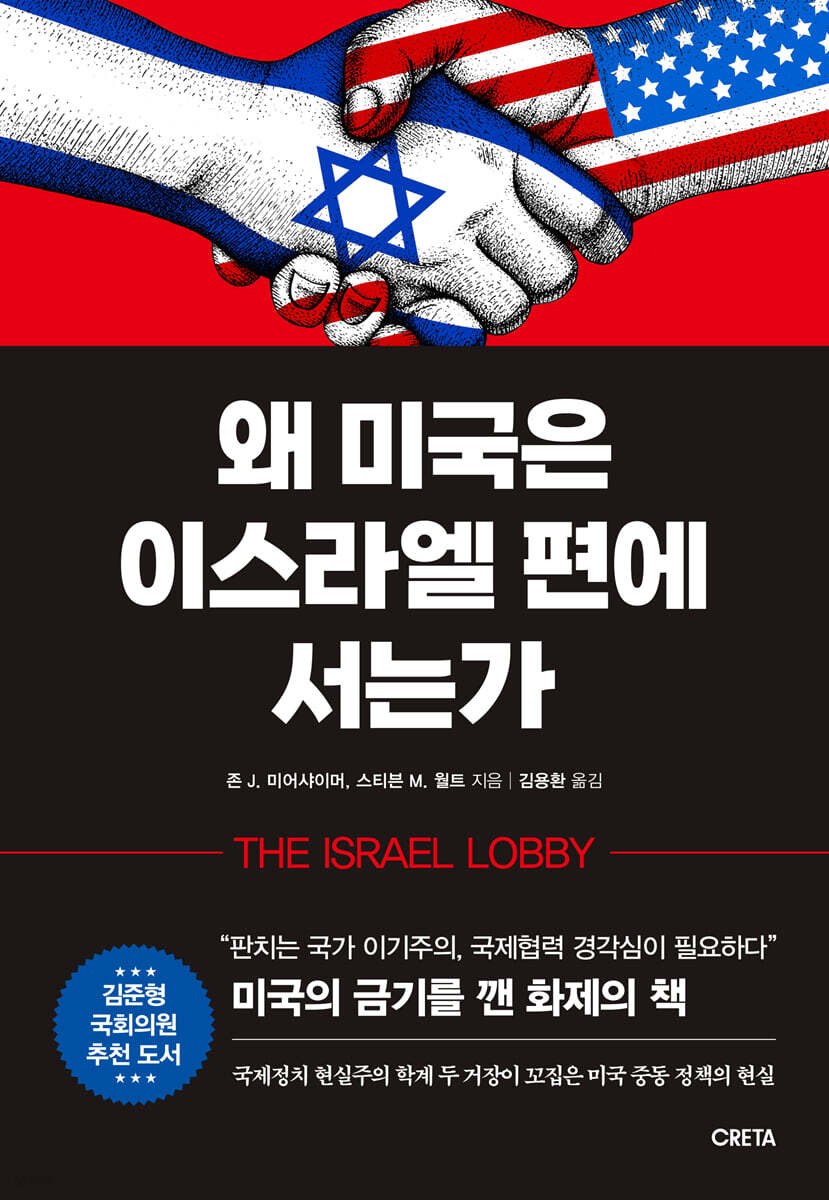 |
Description
Book Introduction
"Punching requires vigilance against national egoism and international cooperation."
Books recommended by National Assemblyman Kim Jun-hyung
A hot topic book that broke America's taboo
Two leading figures in international political realism examine the reality of US Middle East policy.
“This Hamas-Israel conflict, like the Iraq War and the termination of the nuclear deal with Iran, is being orchestrated by Israel, and the United States is not only not preventing the war, but is also aiding and abetting it.
“America’s leadership on the international stage is plummeting due to a series of diplomatic failures.”
_Representative Kim Jun-hyung
John J., an aggressive realist international relations scholar, tackles America's most taboo topic head-on, and tells the stories of real-life figures about America's biased foreign policy toward Israel.
Mearsheimer and the leading figure in alliance theory, Stephen M.
A popular book co-authored by Walt.
The authors argue that despite the "anti-Semitic" slurs of the time, American diplomacy with Israel and the political influence of Jewish, elite, and lobbying groups at the forefront of it are detrimental to both Israel and the United States.
Israel, which has been supported by the world's superpower, the United States, is continuing its war with Hamas, which began a year ago, with American support and an optimistic attitude.
But with the presidential election just around the corner, Israel's unilateral military action is embarrassing for the United States and serves as clear evidence that it has no advantage.
With the world watching, why does the United States side with Israel? Is America's support for Israel truly a sound foreign policy? Representative Kim Jun-hyung, who recommended the book, calls it "a new attempt to attribute the failure of American foreign policy to lobbying."
We can also examine the process by which Israel, once a scapegoat for the Nazis, transformed into a far-right country that is a prime example of racism today.
Moreover, it will open up a horizon of thought that will allow South Korea to make a cool-headed judgment about what kind of diplomacy it should pursue in its national interest amid the US-China hegemony war.
Books recommended by National Assemblyman Kim Jun-hyung
A hot topic book that broke America's taboo
Two leading figures in international political realism examine the reality of US Middle East policy.
“This Hamas-Israel conflict, like the Iraq War and the termination of the nuclear deal with Iran, is being orchestrated by Israel, and the United States is not only not preventing the war, but is also aiding and abetting it.
“America’s leadership on the international stage is plummeting due to a series of diplomatic failures.”
_Representative Kim Jun-hyung
John J., an aggressive realist international relations scholar, tackles America's most taboo topic head-on, and tells the stories of real-life figures about America's biased foreign policy toward Israel.
Mearsheimer and the leading figure in alliance theory, Stephen M.
A popular book co-authored by Walt.
The authors argue that despite the "anti-Semitic" slurs of the time, American diplomacy with Israel and the political influence of Jewish, elite, and lobbying groups at the forefront of it are detrimental to both Israel and the United States.
Israel, which has been supported by the world's superpower, the United States, is continuing its war with Hamas, which began a year ago, with American support and an optimistic attitude.
But with the presidential election just around the corner, Israel's unilateral military action is embarrassing for the United States and serves as clear evidence that it has no advantage.
With the world watching, why does the United States side with Israel? Is America's support for Israel truly a sound foreign policy? Representative Kim Jun-hyung, who recommended the book, calls it "a new attempt to attribute the failure of American foreign policy to lobbying."
We can also examine the process by which Israel, once a scapegoat for the Nazis, transformed into a far-right country that is a prime example of racism today.
Moreover, it will open up a horizon of thought that will allow South Korea to make a cool-headed judgment about what kind of diplomacy it should pursue in its national interest amid the US-China hegemony war.
- You can preview some of the book's contents.
Preview
index
Recommender's introduction (Representative Kim Jun-hyung)
preface
introduction
PART Ⅰ | The United States, Israel, and the Lobby
Chapter 1: The Huge Beneficiary
Chapter 2: Is Israel a Strategic Asset or a Liability?
Chapter 3: The Moral Basis Losing Persuasiveness
Chapter 4: What is the Israel Lobby?
Chapter 5: Leading the Policy Process
Chapter 6: Dominating Public Discourse
PART Ⅱ | The Reality of Lobbying
introduction
Chapter 7: Lobby and the Palestinians
Chapter 8: The Dream of Transformation in Iraq and the Middle East
Chapter 9: Targeting Syria
Chapter 10: Iran in the Crosshairs
Chapter 11: Lobbying and the Second Lebanon War
Conclusion | What should we do?
Americas
preface
introduction
PART Ⅰ | The United States, Israel, and the Lobby
Chapter 1: The Huge Beneficiary
Chapter 2: Is Israel a Strategic Asset or a Liability?
Chapter 3: The Moral Basis Losing Persuasiveness
Chapter 4: What is the Israel Lobby?
Chapter 5: Leading the Policy Process
Chapter 6: Dominating Public Discourse
PART Ⅱ | The Reality of Lobbying
introduction
Chapter 7: Lobby and the Palestinians
Chapter 8: The Dream of Transformation in Iraq and the Middle East
Chapter 9: Targeting Syria
Chapter 10: Iran in the Crosshairs
Chapter 11: Lobbying and the Second Lebanon War
Conclusion | What should we do?
Americas
Detailed image

Into the book
It is not my intention to highlight any animosity toward Israel supporters in the United States or to highlight Israel's wrongdoings.
Because it forms the core of the moral justification for exceptional support for Israel.
In other words, the focus is on Israel's actions because the United States supports Israel at an exceptional level.
The issue of dual loyalty, which adds to the controversy, is an issue left out of the original article.
--- p.21~22
Some say Israel is an absolute strategic asset to the United States.
Some argue that it is indeed a necessary partner in the war on terror.
Some argue that there is a strong moral justification for supporting Israel, as it is the only country that shares American values.
These are not all fair claims.
--- p.25~26
The reason why lobbying's political power is important is because it has a serious impact on American foreign policy, especially in the Middle East.
America's actions have serious consequences not only for unpredictable regions but also for the world and the people who live there.
The war unleashed by the Bush administration has left Iraqis suffering for years in a devastated environment.
Tens of thousands of people died and hundreds of thousands fled.
The conflict continued for a long time with no end in sight.
The war not only brought strategic disaster to the United States, but also endangered its allies.
This vividly illustrates the negative effects that can arise when the United States uses its power arbitrarily, regardless of whether it is right or wrong.
--- p.27
In June 2000, when calls were raised to cut aid to Israel over arms sales to China, an AIPAC spokesman said:
“We oppose linking the issue of support for Israel to any situation.
Because once you start linking, it will continue.” Even the moderate group Americans for Peace now supports economic and military aid to Israel and opposes cuts or conditionality on U.S. aid.
They only try to prevent American aid from being used to support settlement construction within the occupied territories.
--- p.183
Some might think they're catching a glimpse of a conspiracy (or a right-wing conspiracy), but that's not the case.
Conversely, the think tanks, committees, funds, and publishing houses that have fostered neoconservatism operate no differently from other policy networks.
Rather than avoiding publicity or engaging in hidden conspiracies, they promote themselves with the aim of shaping public opinion and guiding American foreign policy.
The neoconservative network resembles networks that have emerged in areas such as tax reform, the environment, and immigration.
Neoconservatives are concerned about the security of Israel and the United States.
They believe that the policies they prescribe will benefit both countries.
--- p.198
The United States has the potential to wield enormous influence in dealing with Israeli-Palestinian relations.
They could threaten to cut off all economic and diplomatic support to Israel.
If that's not enough, it's not difficult to isolate Israel by mobilizing international cooperation.
--- p.327
Those who favored war believed that toppling Hussein would not only make the United States an unstoppable power, but would also convince rogue states that they could bring to their knees any regime that refused to obey America's will.
Before the war, the United States was a powerful nation, confident in its military prowess, and deeply concerned about its security.
It was a dangerous combination.
--- p.333
The story is simple.
Without lobbying influence, the Syria Accountability Act would not have existed, and U.S. policy toward Syria would have been consistent with U.S. national interests.
A different US policy would have resulted in a peace treaty between Syria and Israel that would have reduced international support for Israel's most stubborn, relentless, and violent enemies—Hamas, Hezbollah, and Islamic Jihad—while guaranteeing Israel's legitimacy and regional dominance.
--- p.400
Historical evidence and scholarly writings have shown that inflicting suffering on the civilian population of an enemy nation does not make the opposing nation give in to the demands of the aggressor.
Conversely, the occurrence of casualties typically leads to anger toward the aggressor and increased support for one's own government.
--- p.447
A generation of efforts to kill, imprison, and isolate Palestinian leaders has allowed groups like Hamas to rise to power, leaving fewer Palestinian leaders willing and able to pursue a negotiated resolution to the conflict.
The US invasion of Iraq, supported jointly by Israel and the lobby, ultimately resulted in enormous benefits for Iran, the country Israel fears most.
Because it forms the core of the moral justification for exceptional support for Israel.
In other words, the focus is on Israel's actions because the United States supports Israel at an exceptional level.
The issue of dual loyalty, which adds to the controversy, is an issue left out of the original article.
--- p.21~22
Some say Israel is an absolute strategic asset to the United States.
Some argue that it is indeed a necessary partner in the war on terror.
Some argue that there is a strong moral justification for supporting Israel, as it is the only country that shares American values.
These are not all fair claims.
--- p.25~26
The reason why lobbying's political power is important is because it has a serious impact on American foreign policy, especially in the Middle East.
America's actions have serious consequences not only for unpredictable regions but also for the world and the people who live there.
The war unleashed by the Bush administration has left Iraqis suffering for years in a devastated environment.
Tens of thousands of people died and hundreds of thousands fled.
The conflict continued for a long time with no end in sight.
The war not only brought strategic disaster to the United States, but also endangered its allies.
This vividly illustrates the negative effects that can arise when the United States uses its power arbitrarily, regardless of whether it is right or wrong.
--- p.27
In June 2000, when calls were raised to cut aid to Israel over arms sales to China, an AIPAC spokesman said:
“We oppose linking the issue of support for Israel to any situation.
Because once you start linking, it will continue.” Even the moderate group Americans for Peace now supports economic and military aid to Israel and opposes cuts or conditionality on U.S. aid.
They only try to prevent American aid from being used to support settlement construction within the occupied territories.
--- p.183
Some might think they're catching a glimpse of a conspiracy (or a right-wing conspiracy), but that's not the case.
Conversely, the think tanks, committees, funds, and publishing houses that have fostered neoconservatism operate no differently from other policy networks.
Rather than avoiding publicity or engaging in hidden conspiracies, they promote themselves with the aim of shaping public opinion and guiding American foreign policy.
The neoconservative network resembles networks that have emerged in areas such as tax reform, the environment, and immigration.
Neoconservatives are concerned about the security of Israel and the United States.
They believe that the policies they prescribe will benefit both countries.
--- p.198
The United States has the potential to wield enormous influence in dealing with Israeli-Palestinian relations.
They could threaten to cut off all economic and diplomatic support to Israel.
If that's not enough, it's not difficult to isolate Israel by mobilizing international cooperation.
--- p.327
Those who favored war believed that toppling Hussein would not only make the United States an unstoppable power, but would also convince rogue states that they could bring to their knees any regime that refused to obey America's will.
Before the war, the United States was a powerful nation, confident in its military prowess, and deeply concerned about its security.
It was a dangerous combination.
--- p.333
The story is simple.
Without lobbying influence, the Syria Accountability Act would not have existed, and U.S. policy toward Syria would have been consistent with U.S. national interests.
A different US policy would have resulted in a peace treaty between Syria and Israel that would have reduced international support for Israel's most stubborn, relentless, and violent enemies—Hamas, Hezbollah, and Islamic Jihad—while guaranteeing Israel's legitimacy and regional dominance.
--- p.400
Historical evidence and scholarly writings have shown that inflicting suffering on the civilian population of an enemy nation does not make the opposing nation give in to the demands of the aggressor.
Conversely, the occurrence of casualties typically leads to anger toward the aggressor and increased support for one's own government.
--- p.447
A generation of efforts to kill, imprison, and isolate Palestinian leaders has allowed groups like Hamas to rise to power, leaving fewer Palestinian leaders willing and able to pursue a negotiated resolution to the conflict.
The US invasion of Iraq, supported jointly by Israel and the lobby, ultimately resulted in enormous benefits for Iran, the country Israel fears most.
--- p.476~477
Publisher's Review
Why is the free nation of America dependent on the 'Israel lobby'?
Are you not free and are you on Israel's side?
No matter which country you look at around the world, the United States is considered the land of 'freedom.'
America, founded on the ideals of "liberty and equality," is free to form alliances with the press, but when taboos are touched, it turns cold and uses mainstream media public discourse to denigrate or isolate those who touch it as "anti-Semites" or "Nazis."
It is the political dynamics of the lobbying interest groups comprised of Jews and immigrants that make this happen.
These are individuals and organizations that actively and broadly mobilize to steer domestic policy in a pro-Israel direction.
The United States began supporting Israel to check the Soviet Union (Russia).
But now that the Cold War has ended, has the United States acted rationally? Israel demands a rational foreign policy from the United States to ensure its national governance and survival.
Even if it is irrational to begin with, American Jews and pro-Israel groups force the decision-maker, the American President, to do as they wish.
The lobby's goal is to strengthen the US-Israel relationship, and the ultimate goal of American Jews and the president is 'peace.'
But are Israel's military actions against its neighbors justified? Is the US support for these actions moral? The authors argue that "neither strategic interests nor moral imperatives justify the US's continued generous and unrestricted support for Israel."
Although some international political scientists warn of foreign policy problems between the United States and Israel, even these are often silenced by the power of the elite and lobbying groups.
Lobbying influences not only U.S. foreign policy but also policy decisions, the executive branch, and other departments.
The Israel lobby has many advantages in the competition for influence.
American Jews are relatively wealthy, well-educated, and have an admirable tradition of philanthropy.
They donate generously to political parties and exhibit high levels of political participation.
Of course, some American Jewish groups may not be committed to Israel.
But the majority are involved, and a significant number of smaller groups are willing to step up when it comes to Israel.
(Page 211)
The influence of lobbying can be seen more clearly in Israel's Middle East wars.
Israel has been engaged in a constant war of attrition since the 1948 War of Establishment (First Middle East War), the 1956 Suez War (Second Middle East War), the 1967 Six-Day War (Third Middle East War), and the 1973 Yom Kippur War (Fourth War).
Since the Yom Kippur War, up to 2024, Israel has been waging repeated, bloody wars with Lebanon and Hamas, fueled by deep-rooted mistrust and hostility.
Each time, the United States provided economic and military aid to Israel on favorable terms.
The United States has pursued a broad Middle East policy under the pretext of deterring adversaries, maintaining friendly relations with Arab League countries like Egypt and Jordan, and keeping Israel's interests in mind, and this was clearly revealed in the presidential election.
On one topic, all candidates will speak with the same voice.
Candidates seeking supreme power have voted to fully support the Jewish state of Israel.
Each candidate fully recognizes the threats facing Israel and has made it clear that, if elected president, they will defend Israel's interests under any circumstances.
No one criticizes Israel or argues that the United States should pursue an equitable policy in the Middle East.
Such a person will fail.
(Page 23)
'American Passing' 'Beep Explosion'
Israel, the Goliath of the Middle East
Shaking up the US presidential election
As of 2024, the United States is waging a fierce presidential election campaign, campaigning on the slogans of "strengthening border policies" and "providing continued security support to Israel."
However, despite the US's call for a ceasefire, Israel refused and attacked Hezbollah, becoming a variable in the Middle East crisis management issue.
Who suffers most from this influence exerted by lobbyists and interest groups, and Israel's response of "passing America"? It's the civilians who serve as shields, including hospitals, schools, and media outlets used as military strongholds.
This can never be a moral strategy for supporting Israel.
Furthermore, America's Middle East policy is assessed to have transformed Israel into a representative far-right state today, and as a result, America's leadership has fallen to rock bottom.
This book focuses on the negative impact of lobbying on American foreign policy, and it is written from a realistic perspective on cases of military and diplomatic conflicts with Israel and incidents between lobbying groups and the United States.
This book is divided into two parts.
Part I, a total of six chapters, argues that uncritical and unconditional support for Israel, both material and diplomatic, runs counter to America's national interests.
Chapter 1 (The Huge Beneficiary) describes the economic and military assistance the United States provides to Israel, as well as the diplomatic support Washington offers. Chapter 2 (Is Israel a Strategic Asset or a Liability?) examines the argument that Israel is a valuable strategic asset and therefore worthy of support.
Chapter 3 (Losing Moral Rationale) examines the moral rationale commonly used by Israeli and American supporters to explain American support for the Jewish state.
Chapter 4 (What is the Israel Lobby?) examines the various constituents of the lobby and how broad coalitions emerge, while Chapters 5 (Guiding the Policy Process) and 6 (Dominating Public Discourse) describe the various strategies the lobby group deploys to advance Israel's interests.
Part II, consisting of five chapters, traces the role of lobbying in shaping Middle East policy.
It emphasizes that lobbying is not the only factor influencing decision-making in the United States.
Chapter 7 (Lobbying and the Palestinians) discusses how the United States supported Israeli efforts to suppress or limit Palestinian aspirations.
Chapter 8 (Iraq and the Dream of Transforming the Middle East) examines whether the lobbying efforts of neoconservatives were a major factor in the 2003 invasion of Iraq.
Chapter 9 (Targeting Syria) addresses the uneasy relationship between the United States and the Assad regime, examining the influence of lobbying that helped shape Washington's Syria policy in line with the Israeli government's wishes.
Chapter 10 (Iran in the Crosshairs) traces the role of lobbying in shaping U.S. policy toward Iran.
Chapter 11 (Lobbying and the Second Lebanon War) focuses on Lebanon and describes typical cases in which lobbying adversely affected the interests of the United States and Israel.
Finally, in the conclusion (and what should be done about it?), we discuss alternatives to improve the overall situation, examine the advantages the United States can gain in the Middle East, and outline the theory of an offshore balancer that can effectively achieve these advantages.
What we need now is an honest and sober discussion about the influence of lobbying.
It is also a public debate about the benefits the United States can gain from a key region, the Middle East.
While Israel's well-being may be seen as special from a moral standpoint, its continued occupation of the Occupied Territories is not moral.
When open debate is possible and widespread media coverage takes place, the problems inherent in the current special relationship will be exposed, and the United States can focus on policies that serve the interests of the countries in the region and its national interests.
We firmly believe that it will also serve Israel's national interests.
(Page 503)
The harm caused by lobbying
America, face reality
After its publication in the United States, John J.
Mearsheimer personally experienced the influence of the 'Israel Lobby', which even led to his being banned from entering Israel.
Nonetheless, the book is once again receiving attention not only from readers but also from academia.
The reality of America's Middle East policy, as pointed out by two scholars in the international political realist academic community, deserves a second look.
Kim Jun-hyung, a member of the National Assembly who recommended this book, also said, “In order to resolve the Middle East issue and achieve world peace, the US Israel lobby is harming US foreign policy, and we must correct this as soon as possible. However, judging from the current point in time, 17 years later in 2024, it is difficult to find any change or improvement.”
Ultimately, we must see that the era of strategic competition between the US and China and multipolarization are progressing simultaneously.
The problem is that multipolarity and multilateralism are different.
The former is a chaotic order where each country survives for itself, while the latter is a well-ordered order where international cooperation works.
While a hegemonic conflict between the United States and China, a new Cold War, is not at all desirable for world peace and prosperity, a world dominated by national egoism driven by self-preservation is also extremely dangerous.
The world must be alert to this problem and restore international cooperation.
Because peace, the climate crisis, and the proliferation of nuclear weapons can never be solved without cooperation.
(Page 17)
The United States still favors Israel, but this has caused it embarrassment and has recently been pressuring the mediators to negotiate.
For South Korea, a friendly nation of the United States and a member of the armistice, is the Middle East war simply a foreign affair? Rather, we should heighten our awareness of international cooperation in the US-China hegemony struggle and soberly confront the inner workings of a world at war.
Since a weak or middle-sized nation cannot become a great power, it will also foster critical thinking about which powerful powers are supporting an opponent perceived as weak, and with whom the nation will form alliances to shift the balance of power in its favor for its survival.
Are you not free and are you on Israel's side?
No matter which country you look at around the world, the United States is considered the land of 'freedom.'
America, founded on the ideals of "liberty and equality," is free to form alliances with the press, but when taboos are touched, it turns cold and uses mainstream media public discourse to denigrate or isolate those who touch it as "anti-Semites" or "Nazis."
It is the political dynamics of the lobbying interest groups comprised of Jews and immigrants that make this happen.
These are individuals and organizations that actively and broadly mobilize to steer domestic policy in a pro-Israel direction.
The United States began supporting Israel to check the Soviet Union (Russia).
But now that the Cold War has ended, has the United States acted rationally? Israel demands a rational foreign policy from the United States to ensure its national governance and survival.
Even if it is irrational to begin with, American Jews and pro-Israel groups force the decision-maker, the American President, to do as they wish.
The lobby's goal is to strengthen the US-Israel relationship, and the ultimate goal of American Jews and the president is 'peace.'
But are Israel's military actions against its neighbors justified? Is the US support for these actions moral? The authors argue that "neither strategic interests nor moral imperatives justify the US's continued generous and unrestricted support for Israel."
Although some international political scientists warn of foreign policy problems between the United States and Israel, even these are often silenced by the power of the elite and lobbying groups.
Lobbying influences not only U.S. foreign policy but also policy decisions, the executive branch, and other departments.
The Israel lobby has many advantages in the competition for influence.
American Jews are relatively wealthy, well-educated, and have an admirable tradition of philanthropy.
They donate generously to political parties and exhibit high levels of political participation.
Of course, some American Jewish groups may not be committed to Israel.
But the majority are involved, and a significant number of smaller groups are willing to step up when it comes to Israel.
(Page 211)
The influence of lobbying can be seen more clearly in Israel's Middle East wars.
Israel has been engaged in a constant war of attrition since the 1948 War of Establishment (First Middle East War), the 1956 Suez War (Second Middle East War), the 1967 Six-Day War (Third Middle East War), and the 1973 Yom Kippur War (Fourth War).
Since the Yom Kippur War, up to 2024, Israel has been waging repeated, bloody wars with Lebanon and Hamas, fueled by deep-rooted mistrust and hostility.
Each time, the United States provided economic and military aid to Israel on favorable terms.
The United States has pursued a broad Middle East policy under the pretext of deterring adversaries, maintaining friendly relations with Arab League countries like Egypt and Jordan, and keeping Israel's interests in mind, and this was clearly revealed in the presidential election.
On one topic, all candidates will speak with the same voice.
Candidates seeking supreme power have voted to fully support the Jewish state of Israel.
Each candidate fully recognizes the threats facing Israel and has made it clear that, if elected president, they will defend Israel's interests under any circumstances.
No one criticizes Israel or argues that the United States should pursue an equitable policy in the Middle East.
Such a person will fail.
(Page 23)
'American Passing' 'Beep Explosion'
Israel, the Goliath of the Middle East
Shaking up the US presidential election
As of 2024, the United States is waging a fierce presidential election campaign, campaigning on the slogans of "strengthening border policies" and "providing continued security support to Israel."
However, despite the US's call for a ceasefire, Israel refused and attacked Hezbollah, becoming a variable in the Middle East crisis management issue.
Who suffers most from this influence exerted by lobbyists and interest groups, and Israel's response of "passing America"? It's the civilians who serve as shields, including hospitals, schools, and media outlets used as military strongholds.
This can never be a moral strategy for supporting Israel.
Furthermore, America's Middle East policy is assessed to have transformed Israel into a representative far-right state today, and as a result, America's leadership has fallen to rock bottom.
This book focuses on the negative impact of lobbying on American foreign policy, and it is written from a realistic perspective on cases of military and diplomatic conflicts with Israel and incidents between lobbying groups and the United States.
This book is divided into two parts.
Part I, a total of six chapters, argues that uncritical and unconditional support for Israel, both material and diplomatic, runs counter to America's national interests.
Chapter 1 (The Huge Beneficiary) describes the economic and military assistance the United States provides to Israel, as well as the diplomatic support Washington offers. Chapter 2 (Is Israel a Strategic Asset or a Liability?) examines the argument that Israel is a valuable strategic asset and therefore worthy of support.
Chapter 3 (Losing Moral Rationale) examines the moral rationale commonly used by Israeli and American supporters to explain American support for the Jewish state.
Chapter 4 (What is the Israel Lobby?) examines the various constituents of the lobby and how broad coalitions emerge, while Chapters 5 (Guiding the Policy Process) and 6 (Dominating Public Discourse) describe the various strategies the lobby group deploys to advance Israel's interests.
Part II, consisting of five chapters, traces the role of lobbying in shaping Middle East policy.
It emphasizes that lobbying is not the only factor influencing decision-making in the United States.
Chapter 7 (Lobbying and the Palestinians) discusses how the United States supported Israeli efforts to suppress or limit Palestinian aspirations.
Chapter 8 (Iraq and the Dream of Transforming the Middle East) examines whether the lobbying efforts of neoconservatives were a major factor in the 2003 invasion of Iraq.
Chapter 9 (Targeting Syria) addresses the uneasy relationship between the United States and the Assad regime, examining the influence of lobbying that helped shape Washington's Syria policy in line with the Israeli government's wishes.
Chapter 10 (Iran in the Crosshairs) traces the role of lobbying in shaping U.S. policy toward Iran.
Chapter 11 (Lobbying and the Second Lebanon War) focuses on Lebanon and describes typical cases in which lobbying adversely affected the interests of the United States and Israel.
Finally, in the conclusion (and what should be done about it?), we discuss alternatives to improve the overall situation, examine the advantages the United States can gain in the Middle East, and outline the theory of an offshore balancer that can effectively achieve these advantages.
What we need now is an honest and sober discussion about the influence of lobbying.
It is also a public debate about the benefits the United States can gain from a key region, the Middle East.
While Israel's well-being may be seen as special from a moral standpoint, its continued occupation of the Occupied Territories is not moral.
When open debate is possible and widespread media coverage takes place, the problems inherent in the current special relationship will be exposed, and the United States can focus on policies that serve the interests of the countries in the region and its national interests.
We firmly believe that it will also serve Israel's national interests.
(Page 503)
The harm caused by lobbying
America, face reality
After its publication in the United States, John J.
Mearsheimer personally experienced the influence of the 'Israel Lobby', which even led to his being banned from entering Israel.
Nonetheless, the book is once again receiving attention not only from readers but also from academia.
The reality of America's Middle East policy, as pointed out by two scholars in the international political realist academic community, deserves a second look.
Kim Jun-hyung, a member of the National Assembly who recommended this book, also said, “In order to resolve the Middle East issue and achieve world peace, the US Israel lobby is harming US foreign policy, and we must correct this as soon as possible. However, judging from the current point in time, 17 years later in 2024, it is difficult to find any change or improvement.”
Ultimately, we must see that the era of strategic competition between the US and China and multipolarization are progressing simultaneously.
The problem is that multipolarity and multilateralism are different.
The former is a chaotic order where each country survives for itself, while the latter is a well-ordered order where international cooperation works.
While a hegemonic conflict between the United States and China, a new Cold War, is not at all desirable for world peace and prosperity, a world dominated by national egoism driven by self-preservation is also extremely dangerous.
The world must be alert to this problem and restore international cooperation.
Because peace, the climate crisis, and the proliferation of nuclear weapons can never be solved without cooperation.
(Page 17)
The United States still favors Israel, but this has caused it embarrassment and has recently been pressuring the mediators to negotiate.
For South Korea, a friendly nation of the United States and a member of the armistice, is the Middle East war simply a foreign affair? Rather, we should heighten our awareness of international cooperation in the US-China hegemony struggle and soberly confront the inner workings of a world at war.
Since a weak or middle-sized nation cannot become a great power, it will also foster critical thinking about which powerful powers are supporting an opponent perceived as weak, and with whom the nation will form alliances to shift the balance of power in its favor for its survival.
GOODS SPECIFICS
- Date of issue: October 23, 2024
- Page count, weight, size: 508 pages | 788g | 152*220*28mm
- ISBN13: 9791192742366
- ISBN10: 1192742362
You may also like
카테고리
korean


korean

![GQ KOREA Mark (Monthly): December [2025]](http://librairie.coreenne.fr/cdn/shop/files/8ef265dbbfbf186523ed75ba7319009d.jpg?v=1765340328&width=3840)


