

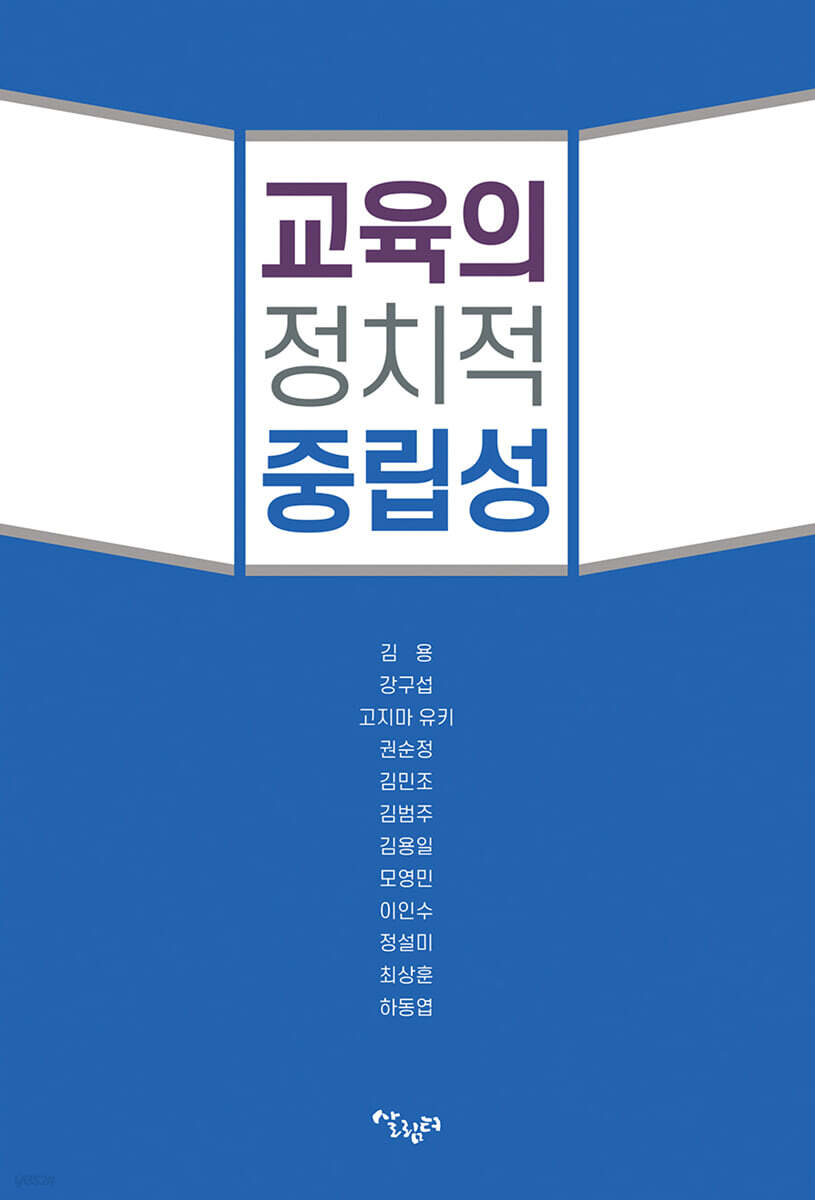
Political neutrality of education
 |
Description
Book Introduction
Political neutrality in education: Examining it through diagnosis, comparison, analysis, and discussion.
Beyond the 'myth of apolitical education', towards education that fosters subjectivity!
'The quality of maintaining a fair attitude without being biased towards either side'
The Korean dictionary defines 'neutrality' as follows:
Because of its impartiality and fairness, this term is perceived and used with a relatively positive meaning in our society.
Although it sometimes carries negative connotations with the image of being 'neither here nor there' or 'gray', it is used in connection with specific fields and can lead to controversial discourse.
‘Political neutrality’ is one such example.
Especially in education, political neutrality has been considered synonymous with ‘depoliticization’ and ‘non-politics.’
If you say, 'I talk freely about real-life issues related to politics in class and school life,' most people will tilt their heads and say, 'Well...'
It might seem like a story that could happen in any other country.
In our society, it has been assumed that "neutrality" should be maintained when it comes to politics, especially in the educational field. However, what should we do if this attitude hinders the desirable behavior of democratic citizens and causes them to ignore or fail to face reality?
The principle of political neutrality in education is a major source of conflict in Korean society.
This book compiles arguments and research findings from various perspectives on the political neutrality of education. While each chapter presents a clear argument, it also highlights the need to identify and analyze new issues raised in the course of the argument and previously unaddressed content.
The authors hope that by addressing various questions and understanding the unresolved facts, a forum for discussion will be opened to resolve the conflict.
Beyond the 'myth of apolitical education', towards education that fosters subjectivity!
'The quality of maintaining a fair attitude without being biased towards either side'
The Korean dictionary defines 'neutrality' as follows:
Because of its impartiality and fairness, this term is perceived and used with a relatively positive meaning in our society.
Although it sometimes carries negative connotations with the image of being 'neither here nor there' or 'gray', it is used in connection with specific fields and can lead to controversial discourse.
‘Political neutrality’ is one such example.
Especially in education, political neutrality has been considered synonymous with ‘depoliticization’ and ‘non-politics.’
If you say, 'I talk freely about real-life issues related to politics in class and school life,' most people will tilt their heads and say, 'Well...'
It might seem like a story that could happen in any other country.
In our society, it has been assumed that "neutrality" should be maintained when it comes to politics, especially in the educational field. However, what should we do if this attitude hinders the desirable behavior of democratic citizens and causes them to ignore or fail to face reality?
The principle of political neutrality in education is a major source of conflict in Korean society.
This book compiles arguments and research findings from various perspectives on the political neutrality of education. While each chapter presents a clear argument, it also highlights the need to identify and analyze new issues raised in the course of the argument and previously unaddressed content.
The authors hope that by addressing various questions and understanding the unresolved facts, a forum for discussion will be opened to resolve the conflict.
- You can preview some of the book's contents.
Preview
index
Introduction: The Political Neutrality of Education: A Rethink / Kim Yong
Chapter 1: How has the political neutrality of education been understood in Korean society? / Choi Sang-hoon
Chapter 2: The Constitutional Incorporation and Institutionalization of Political Neutrality in Education / Kim Yong-il
Chapter 3: Case Law and Decisions on the Political Neutrality of Teachers / Ha Dong-yeop
Chapter 4: Case Law and Decisions on the Political Neutrality of Educational Content and Educational Administration / Kim Beom-ju
Chapter 5: Examining the Debate on the Political Neutrality of German Teachers / Kang Gu-seop
Chapter 6: Japan's 18-Year-Old Voting Rights and the Political Neutrality of Education / Yuki Kojima
Chapter 7: Teachers' Political Fundamental Rights: An International Comparison / Kim Min-jo
Chapter 8: How is the Political Neutrality of Education Understood?: The Meaning of Political Neutrality in Education as Seen Through Critical Discourse Analysis / Kwon Soon-jung
Chapter 9: Student Political Party Membership and Political Education in Schools after the Lowering of the Voting Age / Lee In-su
Chapter 10: A Study on the Perceptions and Practices of Elementary and Secondary School Teachers Regarding Political Neutrality in Education / Jeong Seol-mi, Mo Yeong-min
Chapter 1: How has the political neutrality of education been understood in Korean society? / Choi Sang-hoon
Chapter 2: The Constitutional Incorporation and Institutionalization of Political Neutrality in Education / Kim Yong-il
Chapter 3: Case Law and Decisions on the Political Neutrality of Teachers / Ha Dong-yeop
Chapter 4: Case Law and Decisions on the Political Neutrality of Educational Content and Educational Administration / Kim Beom-ju
Chapter 5: Examining the Debate on the Political Neutrality of German Teachers / Kang Gu-seop
Chapter 6: Japan's 18-Year-Old Voting Rights and the Political Neutrality of Education / Yuki Kojima
Chapter 7: Teachers' Political Fundamental Rights: An International Comparison / Kim Min-jo
Chapter 8: How is the Political Neutrality of Education Understood?: The Meaning of Political Neutrality in Education as Seen Through Critical Discourse Analysis / Kwon Soon-jung
Chapter 9: Student Political Party Membership and Political Education in Schools after the Lowering of the Voting Age / Lee In-su
Chapter 10: A Study on the Perceptions and Practices of Elementary and Secondary School Teachers Regarding Political Neutrality in Education / Jeong Seol-mi, Mo Yeong-min
Into the book
Political neutrality in education is not simply a matter of ideological exclusion or distancing from politics; rather, it is a concept that demands political responsibility, given that education is a field that embodies political publicness.
While political neutrality served as a justification for educational control under past authoritarian regimes, in today's democratic societies, the legitimacy of educational policy must be secured through the participation of diverse educational stakeholders and the consultation of pluralistic values.
In other words, the political neutrality of education should be established as a minimum norm for education to function as a place that implements democracy and as a practical discipline for coordinating values in a pluralistic society.
Rather than leaving the political neutrality of education as a constitutional clause, we face the task of re-establishing it as an institutional and cultural foundation for practicing democracy in actual educational settings.
It is the future of education, and it is also the future of democracy.
--- From "Chapter 1"
In Korea, while issues regarding teachers' neutrality and bias frequently arise due to differences in political orientation and values in the process of implementing democratic citizenship education and unification education, there are no properly established principles or directions for systematically responding to these issues.
This significantly limits teachers' ability to address politically controversial issues or topics, which in turn leads teachers to be reluctant to address such topics in their educational activities.
In this respect, we must create a foundation that allows teachers to actively engage in various educational activities on a stable basis, based on the concept of teachers' political neutrality.
--- From Chapter 5
There was a discourse about the violation of teachers' fundamental rights and the debate about it, but this again led to a discourse about the biased perspective of progressives, and the discourse about lowering the voting age only reinforced the discourse that it would only throw schools into chaos.
Ultimately, isn't the shackles of political neutrality being further strengthened by the message that "not maintaining political neutrality is wrong" through headlines that say that teachers who display political tendencies are disciplined for breach of duty?
--- From Chapter 8
Our country is one of the countries that strictly regulates teachers' fundamental political rights internationally.
Accordingly, demands for expansion of basic political rights have been raised for a long time, mainly among teachers.
However, under the constitutional principle of 'political neutrality of education,' teachers in our country have a complex status as ordinary citizens, educational civil servants, and educational experts, and therefore, interpretations and understandings of the content, scope, and level of political neutrality of education are diverse.
Despite ongoing debate, empirical research on how Korean teachers perceive and practice political neutrality in education remains lacking.
To achieve political neutrality in education in the future, we need open discussion and joint exploration of how to understand and practice teachers' political participation and political education, rather than simply restricting or regulating them.
This chapter is a starting point for that journey and will serve as a valuable foundation for teachers to explore ways to engage in educationally meaningful practices while maintaining political neutrality.
While political neutrality served as a justification for educational control under past authoritarian regimes, in today's democratic societies, the legitimacy of educational policy must be secured through the participation of diverse educational stakeholders and the consultation of pluralistic values.
In other words, the political neutrality of education should be established as a minimum norm for education to function as a place that implements democracy and as a practical discipline for coordinating values in a pluralistic society.
Rather than leaving the political neutrality of education as a constitutional clause, we face the task of re-establishing it as an institutional and cultural foundation for practicing democracy in actual educational settings.
It is the future of education, and it is also the future of democracy.
--- From "Chapter 1"
In Korea, while issues regarding teachers' neutrality and bias frequently arise due to differences in political orientation and values in the process of implementing democratic citizenship education and unification education, there are no properly established principles or directions for systematically responding to these issues.
This significantly limits teachers' ability to address politically controversial issues or topics, which in turn leads teachers to be reluctant to address such topics in their educational activities.
In this respect, we must create a foundation that allows teachers to actively engage in various educational activities on a stable basis, based on the concept of teachers' political neutrality.
--- From Chapter 5
There was a discourse about the violation of teachers' fundamental rights and the debate about it, but this again led to a discourse about the biased perspective of progressives, and the discourse about lowering the voting age only reinforced the discourse that it would only throw schools into chaos.
Ultimately, isn't the shackles of political neutrality being further strengthened by the message that "not maintaining political neutrality is wrong" through headlines that say that teachers who display political tendencies are disciplined for breach of duty?
--- From Chapter 8
Our country is one of the countries that strictly regulates teachers' fundamental political rights internationally.
Accordingly, demands for expansion of basic political rights have been raised for a long time, mainly among teachers.
However, under the constitutional principle of 'political neutrality of education,' teachers in our country have a complex status as ordinary citizens, educational civil servants, and educational experts, and therefore, interpretations and understandings of the content, scope, and level of political neutrality of education are diverse.
Despite ongoing debate, empirical research on how Korean teachers perceive and practice political neutrality in education remains lacking.
To achieve political neutrality in education in the future, we need open discussion and joint exploration of how to understand and practice teachers' political participation and political education, rather than simply restricting or regulating them.
This chapter is a starting point for that journey and will serve as a valuable foundation for teachers to explore ways to engage in educationally meaningful practices while maintaining political neutrality.
--- From Chapter 10
Publisher's Review
In the global era of education, where change occurs at the speed of light,
Finding milestones for a desirable political stance
This book is designed to reexamine the principle of political neutrality in education.
The authors review the historical evolution of this principle, compare it with other cases, and reexamine related issues while paying attention to various aspects of reality.
In particular, we examine the historical process through which the principle of political neutrality in education was raised and developed in Korean society, and compare it with recent examples in Germany and Japan and the political neutrality systems of teachers in various countries around the world.
Additionally, we diagnose the phenomenon of political neutrality in education by analyzing court decisions, media reports, and teachers' perceptions.
First, we analyze the changes in the discourse on political neutrality in education by looking back at historical events closely related to the discussion on political neutrality in education in Korean society.
We analyze the major events and debates that influenced the concept of political neutrality in education and examine how political neutrality in education has been utilized over time (Chapter 1).
We analyze the circumstances under which the political neutrality of education was incorporated into the Constitution and its institutional and practical implications (Chapter 2). We also examine how the Supreme Court and the Constitutional Court understand the political neutrality of education in relation to teachers (Chapter 3). We also analyze constitutional court rulings and court decisions related to educational content and local educational autonomy (Chapter 4).
Meanwhile, we examine recent German cases regarding the political neutrality of education (Chapter 5) and issues that have emerged in Japanese society since the lowering of the voting age for public office (Chapter 6), and compare the political fundamental rights of teachers in Korea, Japan, the United States, Germany, and France (Chapter 7).
The latter part analyzes controversial incidents related to the political neutrality of education—the Inheon High School incident and media reports on the lowering of the voting age—to show how the political neutrality of education is understood (Chapter 8). It also examines recent changes in youth participation in politics and introduces relevant overseas cases (Chapter 9).
The final ten chapters analyze how Korean teachers perceive and practice the political neutrality of teachers and the curriculum.
Finding milestones for a desirable political stance
This book is designed to reexamine the principle of political neutrality in education.
The authors review the historical evolution of this principle, compare it with other cases, and reexamine related issues while paying attention to various aspects of reality.
In particular, we examine the historical process through which the principle of political neutrality in education was raised and developed in Korean society, and compare it with recent examples in Germany and Japan and the political neutrality systems of teachers in various countries around the world.
Additionally, we diagnose the phenomenon of political neutrality in education by analyzing court decisions, media reports, and teachers' perceptions.
First, we analyze the changes in the discourse on political neutrality in education by looking back at historical events closely related to the discussion on political neutrality in education in Korean society.
We analyze the major events and debates that influenced the concept of political neutrality in education and examine how political neutrality in education has been utilized over time (Chapter 1).
We analyze the circumstances under which the political neutrality of education was incorporated into the Constitution and its institutional and practical implications (Chapter 2). We also examine how the Supreme Court and the Constitutional Court understand the political neutrality of education in relation to teachers (Chapter 3). We also analyze constitutional court rulings and court decisions related to educational content and local educational autonomy (Chapter 4).
Meanwhile, we examine recent German cases regarding the political neutrality of education (Chapter 5) and issues that have emerged in Japanese society since the lowering of the voting age for public office (Chapter 6), and compare the political fundamental rights of teachers in Korea, Japan, the United States, Germany, and France (Chapter 7).
The latter part analyzes controversial incidents related to the political neutrality of education—the Inheon High School incident and media reports on the lowering of the voting age—to show how the political neutrality of education is understood (Chapter 8). It also examines recent changes in youth participation in politics and introduces relevant overseas cases (Chapter 9).
The final ten chapters analyze how Korean teachers perceive and practice the political neutrality of teachers and the curriculum.
GOODS SPECIFICS
- Date of issue: November 22, 2025
- Page count, weight, size: 416 pages | 152*225*30mm
- ISBN13: 9791159303395
- ISBN10: 1159303398
You may also like
카테고리
korean


korean

![GQ KOREA Mark (Monthly): December [2025]](http://librairie.coreenne.fr/cdn/shop/files/8ef265dbbfbf186523ed75ba7319009d.jpg?v=1765340328&width=3840)


