

Chinese Story 10
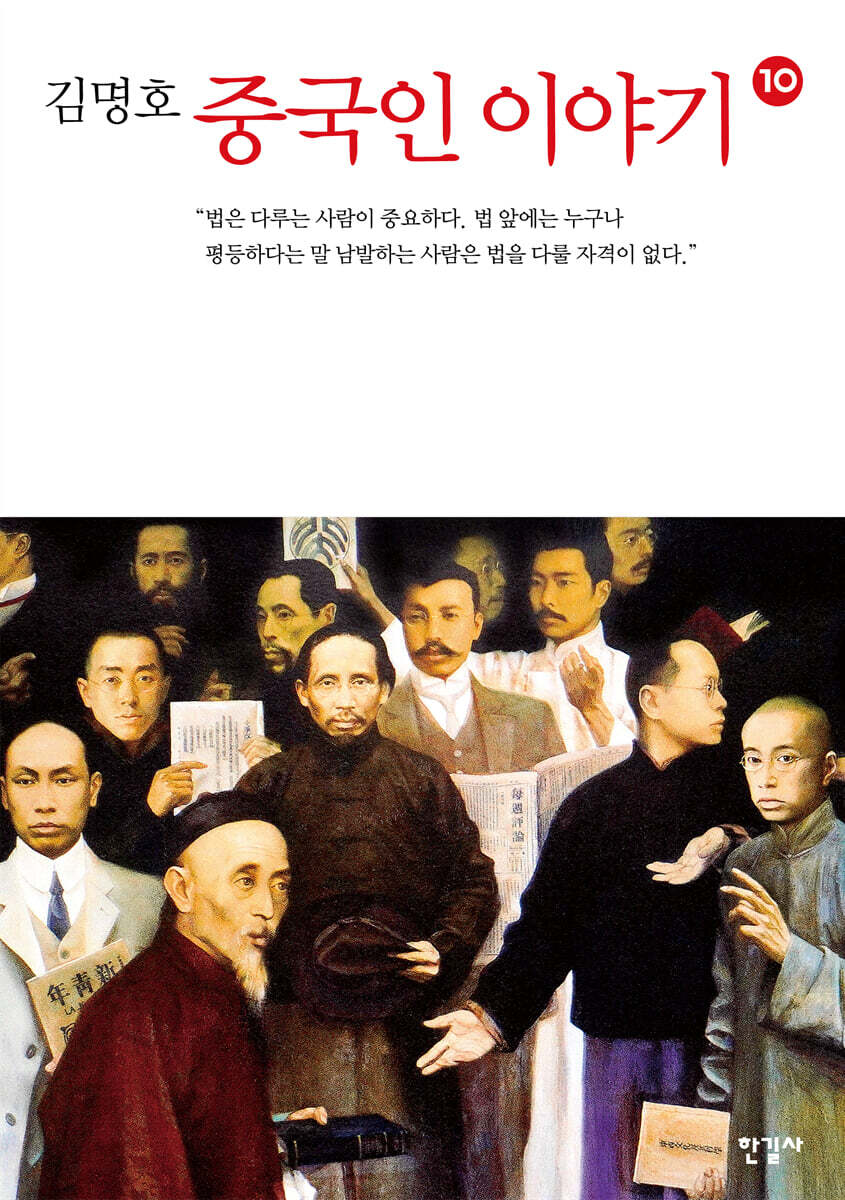 |
Description
Book Introduction
The seemingly never-ending story, "The Chinese Story," has finally come to a grand conclusion.
Author Kim Myeong-ho, who has never written a diary or a letter, has accomplished the remarkable feat of publishing ten volumes of the large-scale project 『Chinese Stories』.
The large-scale project "Chinese Stories" series, which took 17 years to write, featured over 2,000 photographs, and introduced over 1,000 characters, has concluded its epic journey in ten volumes.
In the "Chinese Stories" series, which unfolds as "Chinese Nights" rather than "Arabian Nights," author Myung-ho Kim unfolds the turbulent stories of the Chinese people with his unique perspective and outstanding writing skills.
Author Kim Myeong-ho, who has never written a diary or a letter, has accomplished the remarkable feat of publishing ten volumes of the large-scale project 『Chinese Stories』.
The large-scale project "Chinese Stories" series, which took 17 years to write, featured over 2,000 photographs, and introduced over 1,000 characters, has concluded its epic journey in ten volumes.
In the "Chinese Stories" series, which unfolds as "Chinese Nights" rather than "Arabian Nights," author Myung-ho Kim unfolds the turbulent stories of the Chinese people with his unique perspective and outstanding writing skills.
- You can preview some of the book's contents.
Preview
Into the book
“You have to look carefully to the left and right.
The left is good at telling empty words and lies.
He is a crying opportunist.
“Diplomacy is getting the other person to offer what we want.”
--- p.40
“I have seen the proposed document.
The agreement reached with President Nixon five years ago was the starting point for the normalization of relations between the two countries.
Instead of progressing, we have regressed.
The Taiwan issue is a problem for the Chinese to solve among themselves.
The Chinese have the ability to solve problems.
Our American friends have no reason to worry for us.
The United States wants assurances from us that we will not liberate Taiwan by force.
Strictly speaking, it is interference in internal affairs.
“America’s strategy only benefits the polar bear (the Soviet Union).”
--- p.64
“It is not socialism if everyone suffers from poverty equally.
The goal of true socialism is for everyone to live well.
If we all want to live well, we must adopt Western science and advanced technology.
“There is no reason to hesitate about the inflow of Western capital.”
--- p.111
During his time on the mainland, Chiang Ching-kuo had a secret he couldn't tell anyone.
He had twin sons born to a Chinese woman he had lived with for three years without telling his decent, unassuming Soviet wife, whom he had married in the Soviet Union.
Wang Sheng's utmost devotion was absolutely crucial for his two sons, who he neglected because they were too concerned about their father and the world, to grow up well.
--- p.134
Chiang Kai-shek was the most important and complex person in modern Chinese history.
In his youth, he was a revolutionary, a Confucian scholar, a playboy in the Shanghai Concession, a stock market speculator, and a debaucher who spent his nights in a brothel.
The young Chiang Kai-shek knew that he was a bundle of contradictions.
I used my diary to struggle with myself and try to fix my pathologically reckless and absurd private life.
My son hoped so too.
Sometimes, I would secretly read Chiang Ching-kuo's diary.
--- p.139
Russia and Japan competed in the Northeast, which is Chinese territory.
The Qing government did not intervene in the fight between polar bears and island monkeys that took place within its territory.
He declared neutrality and stood by.
Only the people of the northeast suffered.
As the tide turned in Japan's favor, the United States stepped in to mediate.
A peace conference between Russia and Japan was held in Portsmouth, a small military port city.
The Treaty of Portsmouth was a way for Russia and Japan to share the interests in Northeast China.
--- p.163
On the morning of November 10th, a dilapidated passenger car left the Japanese Concession in Tianjin.
No one could have imagined that the last emperor of the Qing Empire would be crouching like a piece of luggage in a trunk.
--- p.196
“Chairman Mao said that the Chinese and Japanese people are united in that they have only one enemy.
He asserted that the enemy of the Japanese people is Japanese imperialism, and the enemy of the Chinese people is the traitors of the Chinese nation.
“These people, who have become skeletons, do not even know what imperialism is.”
--- p.256
“I was born in Manchuria and grew up in Manchuria.
I knew nothing about Japan until I took a short trip to Tokyo in the fall of the year I turned 18.
When I was around Japanese people, I spoke Japanese, but after I got the Chinese name Li Xianglan, I spoke, sang, and acted in Chinese.
Even if the nationality is not clear, there is nothing to say.
Because one is the fatherland and the other is the homeland.
If you ask me where my homeland is and where my home country is, I can't answer.
It's been a long time since crying and moaning became a habit.
“I have been loved in two countries, and I love both countries.”
--- p.278
“My classmates and teachers didn’t know I was Japanese.
Even when I attended school assemblies, I just sat there.
When I encountered protesters on the street, I ran into an alley.
When I saw a Chinese man fall to the ground after being hit by a police baton, I buried my head against the wall and cried.
“I resented my father for making me a mixed-race child.”
--- p.297
“The enemy is strong and we are weak.
Our unit is made up of troops from all directions.
Everyone has different thoughts.
Rest and education are desperately needed.
A full-scale war has not yet been fought.
It is not a retreat of defeated soldiers.
General Du Yuming commanded a long-term reinforcement force in the tropical region of Southeast Asia.
It's hard to endure the cold wave from the northeast.
“The day when our opportunity will come is not far off.”
--- p.365
“The communist guerrillas have everything I want and everything our party lacks: organization, discipline, and morality.
Whatever it is, we thoroughly research, discuss, and put it into practice.
“Most of our term agents hate to use their brains and don’t think about doing research.”
--- p.425
“I want to talk to the other person when he or she comes.
It's okay if the pent-up tension is relieved through words, or it's okay if it isn't.
The approaching fire is fierce.
Important items must be taken out quickly.
If you wait for the wind to stop, everything will turn to ashes.
The Prime Minister hopes that Prime Minister Tanaka and Foreign Minister Ohira will come to Beijing and meet with Premier Zhou Enlai.”
--- p.450
“Whether academic or literary, books that follow the trend are no different from propaganda.
A few dozen books will suffice as a source of reflection.
A person without thought is rough and shameless in his actions.
Meditation does not allow thoughts to settle in one place.
“People who define themselves as progressive or conservative are no better than maggots wriggling in a toilet.”
--- p.464
“Meet with many of the Japanese military and political figures with whom you were close friends during your youth.
Sino-Japanese relations are complex.
There are more than one or two difficult problems.
I don't know what will happen in the future.
Diplomacy is about exploiting the opponent's weaknesses and taking advantage of them.
Remember that there is truth in jokes.
“Come and dance a dazzling sword dance.”
The left is good at telling empty words and lies.
He is a crying opportunist.
“Diplomacy is getting the other person to offer what we want.”
--- p.40
“I have seen the proposed document.
The agreement reached with President Nixon five years ago was the starting point for the normalization of relations between the two countries.
Instead of progressing, we have regressed.
The Taiwan issue is a problem for the Chinese to solve among themselves.
The Chinese have the ability to solve problems.
Our American friends have no reason to worry for us.
The United States wants assurances from us that we will not liberate Taiwan by force.
Strictly speaking, it is interference in internal affairs.
“America’s strategy only benefits the polar bear (the Soviet Union).”
--- p.64
“It is not socialism if everyone suffers from poverty equally.
The goal of true socialism is for everyone to live well.
If we all want to live well, we must adopt Western science and advanced technology.
“There is no reason to hesitate about the inflow of Western capital.”
--- p.111
During his time on the mainland, Chiang Ching-kuo had a secret he couldn't tell anyone.
He had twin sons born to a Chinese woman he had lived with for three years without telling his decent, unassuming Soviet wife, whom he had married in the Soviet Union.
Wang Sheng's utmost devotion was absolutely crucial for his two sons, who he neglected because they were too concerned about their father and the world, to grow up well.
--- p.134
Chiang Kai-shek was the most important and complex person in modern Chinese history.
In his youth, he was a revolutionary, a Confucian scholar, a playboy in the Shanghai Concession, a stock market speculator, and a debaucher who spent his nights in a brothel.
The young Chiang Kai-shek knew that he was a bundle of contradictions.
I used my diary to struggle with myself and try to fix my pathologically reckless and absurd private life.
My son hoped so too.
Sometimes, I would secretly read Chiang Ching-kuo's diary.
--- p.139
Russia and Japan competed in the Northeast, which is Chinese territory.
The Qing government did not intervene in the fight between polar bears and island monkeys that took place within its territory.
He declared neutrality and stood by.
Only the people of the northeast suffered.
As the tide turned in Japan's favor, the United States stepped in to mediate.
A peace conference between Russia and Japan was held in Portsmouth, a small military port city.
The Treaty of Portsmouth was a way for Russia and Japan to share the interests in Northeast China.
--- p.163
On the morning of November 10th, a dilapidated passenger car left the Japanese Concession in Tianjin.
No one could have imagined that the last emperor of the Qing Empire would be crouching like a piece of luggage in a trunk.
--- p.196
“Chairman Mao said that the Chinese and Japanese people are united in that they have only one enemy.
He asserted that the enemy of the Japanese people is Japanese imperialism, and the enemy of the Chinese people is the traitors of the Chinese nation.
“These people, who have become skeletons, do not even know what imperialism is.”
--- p.256
“I was born in Manchuria and grew up in Manchuria.
I knew nothing about Japan until I took a short trip to Tokyo in the fall of the year I turned 18.
When I was around Japanese people, I spoke Japanese, but after I got the Chinese name Li Xianglan, I spoke, sang, and acted in Chinese.
Even if the nationality is not clear, there is nothing to say.
Because one is the fatherland and the other is the homeland.
If you ask me where my homeland is and where my home country is, I can't answer.
It's been a long time since crying and moaning became a habit.
“I have been loved in two countries, and I love both countries.”
--- p.278
“My classmates and teachers didn’t know I was Japanese.
Even when I attended school assemblies, I just sat there.
When I encountered protesters on the street, I ran into an alley.
When I saw a Chinese man fall to the ground after being hit by a police baton, I buried my head against the wall and cried.
“I resented my father for making me a mixed-race child.”
--- p.297
“The enemy is strong and we are weak.
Our unit is made up of troops from all directions.
Everyone has different thoughts.
Rest and education are desperately needed.
A full-scale war has not yet been fought.
It is not a retreat of defeated soldiers.
General Du Yuming commanded a long-term reinforcement force in the tropical region of Southeast Asia.
It's hard to endure the cold wave from the northeast.
“The day when our opportunity will come is not far off.”
--- p.365
“The communist guerrillas have everything I want and everything our party lacks: organization, discipline, and morality.
Whatever it is, we thoroughly research, discuss, and put it into practice.
“Most of our term agents hate to use their brains and don’t think about doing research.”
--- p.425
“I want to talk to the other person when he or she comes.
It's okay if the pent-up tension is relieved through words, or it's okay if it isn't.
The approaching fire is fierce.
Important items must be taken out quickly.
If you wait for the wind to stop, everything will turn to ashes.
The Prime Minister hopes that Prime Minister Tanaka and Foreign Minister Ohira will come to Beijing and meet with Premier Zhou Enlai.”
--- p.450
“Whether academic or literary, books that follow the trend are no different from propaganda.
A few dozen books will suffice as a source of reflection.
A person without thought is rough and shameless in his actions.
Meditation does not allow thoughts to settle in one place.
“People who define themselves as progressive or conservative are no better than maggots wriggling in a toilet.”
--- p.464
“Meet with many of the Japanese military and political figures with whom you were close friends during your youth.
Sino-Japanese relations are complex.
There are more than one or two difficult problems.
I don't know what will happen in the future.
Diplomacy is about exploiting the opponent's weaknesses and taking advantage of them.
Remember that there is truth in jokes.
“Come and dance a dazzling sword dance.”
--- p.519
Publisher's Review
In the "Chinese Stories" series, author Kim Myeong-ho did not list the unique characters and cultures, and the historical events behind them, in chronological order, but rather added his imagination to create a unique and distinctive literary aesthetic.
As you follow the tangled human paths of countless revolutionaries, intellectuals, artists, and other figures hidden in grand narratives, the complex puzzle of modern and contemporary Chinese history begins to unravel in your mind.
Even though it is a ten-volume series, you can understand the content no matter where you open it.
Just as Mao Zedong said, “The more you revise a piece of writing, the better it becomes,” author Kim Myung-ho also revises and re-revises his writings over and over again, leaving readers spellbound.
While books about China are pouring out to help us understand the country, few provide as much human-like, engaging information and photographic material as the "Chinese Stories" series.
Author Kim Myeong-ho, who fell in love with Chinese literature after seeing the beautiful phrase “Like fallen leaves floating down the flowing water” at the beginning of Guo Moruo’s short story “Fallen Leaves” (落葉) at a Chinese bookstore in Myeongdong, traveled all over China, Taiwan, and Hong Kong to find primary sources, such as photographs.
I once paid $3,000 for a single photo.
Among the 1,000 people, the most impressive one was Lin Biao.
He is the greatest soldier in Chinese history, but he never used a weapon in his entire life.
Kim Myung-ho, who is sometimes suspected of being "not Chinese" because he knows the Chinese situation better than the Chinese themselves, said that we need to change the perception that China is culturally and politically behind us and look at the international situation with a discerning perspective, and that he hopes that this will be an opportunity for intellectuals and politicians to learn about China's culture and political structure.
These days, the relationship between Korea and China is not smooth.
As Mao Zedong said, “When you get tired of fighting, you become friends,” he also urged both countries to be wise, saying that they would be happier if they met after fighting properly.
Reform is something that happens naturally when you open up.
“Chinese people like to fight.
I am one of them.
“Even without war, there are enemies.”_Page 48
Wars are raging all over the world today.
China also lived in the midst of war for over 100 years starting in the 19th century.
After World War II, the world was divided into an East-West Cold War system centered on the United States and the Soviet Union.
China, which had been diplomatically isolated since the 1969 Sino-Soviet border dispute, invited the U.S. table tennis team.
It's ping-pong diplomacy.
With this as a prelude, the curtain begins to slowly open on the normalization of relations between the two countries.
China believed that forming an alliance with the United States would enable it to counter the Soviet Union, while the United States believed that establishing a relationship with China would not only give it a strategic advantage over the Soviet Union but also serve its national interests.
The greatest contributors to creating an atmosphere of reconciliation were America's diplomatic tsar, Henry Kissinger, and China's top diplomat, Zhou Enla.
Thanks to their breathtaking 007 operation, the United States and China ended their hostilities.
On January 1, 1979, the United States and China established formal diplomatic relations.
China's reform and opening up also begins.
Three weeks after the ink dried on the signing of the diplomatic agreement, Deng Xiaoping made a nine-day visit to the United States, becoming the first Chinese leader to do so.
It was a major incident that shook the world.
Even though Deng Xiaoping was sick, he maintained his dignity and took care of everything he could.
Chiang Ching-kuo's two wives and twin sons
Chiang Kai-shek's eldest son, Chiang Ching-kuo, had three sons and one daughter with a Soviet woman he met while studying in the Soviet Union.
Chiang Kai-shek favored his frugal and unassuming Soviet daughter-in-law and named her Jiang Fangliang.
Despite having such a wife, Chiang Ching-kuo lived with Zhang Yaruo, a young and pretty widow who was a graduate of the first training class of the Three People's Youth League, for three years and had twin sons.
When Zhang Yaluo mysteriously dies six months after giving birth, Wang Sheng, one of Chiang Ching-kuo's closest associates, brings his twin sons to Taiwan and raises them well.
Although Chiang Ching-kuo's three sons and one daughter all lived in poverty, the twin brothers who were abandoned rose through the ranks of diplomacy and education.
One became the Minister of Foreign Affairs, and the other became the president of a prestigious university.
The imperialist powers' struggle for the Northeast
The northeast (Manchuria) was a vast land.
It had enormous hydropower resources and reserves of oil, coal, and metals, and a well-developed railway network.
The Northeast, which was a border region of China, was invaded by imperialist powers in the 20th century.
After winning the Russo-Japanese War in 1905, Japan gained control of the railway from Dalian and Lushun to Changchun and established the South Manchuria Railway Company (Mancheol), a state-run company in the northeast.
The Manchurian Railway, which even had a railway defense force called the Kwantung Army, represented the first step in the political, economic, and cultural infiltration of Japanese militarism into China.
On September 18, 1931, the Japanese Kwantung Army staged the Manchurian Incident by blowing up the Manchurian Railway tracks at Liutiao Lake and blaming the Northeast Army for the incident, marking the beginning of the Sino-Japanese War that lasted for 15 years.
Behind the Manchurian Incident, there was strong support from Manchurian Railway.
Although Mancheol was merely a tool of Japanese colonial rule, it excelled in talent cultivation and management methods.
As long as you had talent, it didn't matter whether you were male or female or had any level of education.
In 1932, Japan separated Manchuria from mainland China as a historically and geographically separate region and established the artificial state of Manchukuo. Japan then set its sights on Puyi, the last emperor of the Qing Dynasty, as the head of state who would become their puppet.
Masahiko Amakasu takes charge and brings Puyi to Manchuria, where he controls him to his heart's content.
In order to be called emperor, Puyi gave up all of the territory and sovereignty in the northeast to Japan, and the Japanese Kwantung Army indirectly ruled Manchukuo for 14 years with Puyi at the forefront.
After the Xinhai Revolution in 1911, Zhang Xueliang took control of Manchuria and commanded the Northeast Army, China's most powerful force.
However, he was given the infamous reputation of being a non-resisting general who gave up the Northeast without even putting up a single resistance to the Kwantung Army.
This incident developed into a full-scale Manchurian Incident in Japan.
“On the night of September 18, 1931, I gave the order not to respond to the Kwantung Army’s provocation.
It was a misjudgment that did not anticipate the monster's mad behavior.
“I am a sinner of history.”_Page 180
Occupy the Northeast, Japan's lifeline.
In September 1931, the Japanese Manchuria Development Company (Manchuria Development Company), which occupied the vast northeastern region, encouraged immigration to Manchuria.
Because Japanese people going to Japanese territory was not considered immigration, immigration was transformed into pioneers, immigration groups into pioneer groups, and immigration projects into pioneer projects.
Manchukuo was a land of hope for Japanese farmers.
It was once a laundromat for Japanese men and women who worked in the shadows.
But on August 15, 1945, Japan, having fallen to the fiery furnace of the atomic bomb, demanded mass suicide from the pioneers, and the surviving pioneers were forced to form families with Chinese women or marry Chinese men.
The Japanese immigration and pioneering groups were tools of Japan's aggression policy, perpetrators of disasters brought upon the Chinese people, and victims of Japan's war of aggression.
Li Xianglan, a mixed-race child
The Kwantung Army established the Manchurian Film Association (Manyong), a state-run propaganda agency, to promote the superiority of the Japanese people, and Masahiko Amakasu took over as chairman and spearheaded cultural and artistic efforts.
Amakasu wielded enormous influence, as evidenced by the assessment that “during the 14 years of Manchukuo, the daytime in Manchuria was ruled by the Kwantung Army, and the nighttime was ruled by Amakasu.”
Amakasu said, “Propaganda films must be fun and clever first and foremost,” and created the best film production environment in the East and recruited Li Xianglan as an actor.
Li Xianglan, born in Manchuria but whose homeland was Japan, had a complicated name and unclear nationality.
Li Xianglan, Yamaguchi Yoshiko, Li Korang, Li Xianglan, and Pan Shuhua were the same person.
I thought he was Chinese, but he was actually Japanese, and his surname was complex, and his upbringing was both simple and complex.
During the 14 years of Manchukuo's existence, Li Xianglan captivated the Chinese people with her singing and acting, and contributed to boosting the morale of Japanese troops on the front lines.
Li Xianglan was almost executed as a Han traitor, but it was proven that he was Japanese, so he returned to Japan and was elected to the House of Councilors (upper house).
Movies and dramas about his life have also been made.
The Northeast has become a battleground between the Communist and Kuomintang factions.
“Depending on who the commander is, it is easier for the weak to become strong than for the strong to become weak.”_Page 360
As the Soviet troops withdrew, the Northeast (Manchuria) soon became a battlefield between the Kuomintang and the Communists.
Chiang Kai-shek and Mao Zedong held peace talks to discuss what kind of country to build, but in reality, they were just stalling for time to start a civil war.
In order to achieve hegemony in the Northeast, Lin Biao insists that the Northeast issue must be resolved by the Chinese themselves.
Mao Zedong also agrees with this.
The Kuomintang's Du Yuming Army, armed with the latest weapons provided by the United States, and Lin Biao's Eighth Route Army, which was little more than a ragtag army, fought at the Shushui River.
Lin Biao annihilates Du Yuming's army in three days.
Lin Biao wins the first round, Chen Mingren wins the second and third rounds, and Lin Biao wins the third round.
A warm breeze blowing through Japan and China
“The flames that are coming in are fierce.
Important items must be taken out quickly.
If you wait for the wind to stop, everything will turn to ashes.”_Page 435
In April 1952, Japan established diplomatic relations with the Republic of China in Taiwan, and maintained a honeymoon relationship for nearly 20 years.
As the United States and China joined hands, Japan also reached out to China.
The stepping stone for the normalization of Sino-Japanese relations was laid by the 'Pro-Japan Work Committee' led by Liao Chengzhi.
Japan's Liberal Democratic Party, which has many pro-Taiwan factions, only supported the normalization of relations with the mainland, not the severance of diplomatic ties with Taiwan.
However, with the inauguration of Prime Minister Kakuei Tanaka, who had been advocating for the establishment of diplomatic relations with China, the relationship between China and Japan became closer.
Tanaka, a civil engineer who barely finished middle school and worked as a reporter for a third-rate magazine, said, “No matter what you do, it has to be done through the back door to be effective.
The official line was excluded, saying, “It is because public officials are corrupt.”
Just as ping-pong diplomacy helped create an atmosphere of reconciliation between the U.S. and China, China sought to achieve results no less impressive than ping-pong diplomacy through ballet diplomacy.
The Shanghai Ballet, led by Sun Pinghua, sent 208 dancers to Japan to bring forward Tanaka's visit to China.
Arriving at Beijing Airport with the fear of being assassinated, Tanaka receives a grander welcome than Nixon.
A feast for intellectuals
In Hae-gwang, a peerless liberal thinker, was an idol for young intellectuals.
Politically, he supported and worshipped Chiang Kai-shek, and academically, he was guided by Jin Weilin.
In Ha-gwang, editor-in-chief of the JoongAng Ilbo, the organ of the Kuomintang, enjoyed freedom of the press while singing songs about democracy and human rights.
Nie Hualing, who moved from mainland China to Taiwan, started working for the magazine "Free China" and ended up living in the same house as Yin Haiguang.
When Raytheon founded the magazine “Free China,” he listed Hu Shi’s name as publisher.
The magazine captivated young soldiers and intellectuals.
Shifuguan and Inhaiguang, who were popular in their time, were enemies and friends.
In Hae-gwang has hated Shifu-kwan for 20 years, but praises him as the best person he knows.
His companion, Shajunru, also introduces him to Shiga.
In 1960, the Taiwan Garrison Command (GCC) blockaded the liberal stronghold of Free China and imprisoned its president, Lei Zhen.
In Hae-gwang was unable to stand on the podium, and Nie Hualing also became unemployed.
Wang Zengchi, the last pure literary figure in China and the last scholar-official in China, had an unusual view of women.
He liked young, intelligent, and sickly women.
The Western Literature Department of Southwest United University, a gathering place for progressive students, exuded a sense of sickness and illness.
Su Songqing marries Wang Zengqi, who has talents that no one can surpass.
Wang Zengqi, who loved Hemingway's works and Nie Hualing's writings, made peace with hardship by sketching potatoes and nature at the Highland Potato Research Institute.
Ye Gongchao, a world-renowned genius who risked her life to protect the Maogong Ding, the best of China's ten treasures, marries Yuan Yongxi, a scientist of exceptional talent.
Yuan Yongshi completely breaks up with Ye Gongchao because of the rumor that Ye Gongchao and Ye Chongfan are not cousins but a man and woman.
Taiwan's White Terror
The White Terror period was a time of political oppression of the Taiwanese people.
It refers to the period of one-party dictatorship of the Kuomintang from the 1949 National Taiwan University and Taiwan Normal University student incidents to 1992, when true freedom of the press began.
At that time, prisons across Taiwan were overflowing because of opposition to the Kuomintang.
Taiwan's first Chief Executive, Chen Yi, was also shot.
It was a time when iron-fisted politics ran rampant.
Feng Ming-min, the leader of the pro-Taiwan faction advocating for Taiwanese independence, is imprisoned for writing a statement criticizing the Kuomintang, but escapes from prison for suspicious reasons.
Influenced by Hu Shi and Ren Haiguang, Liao contributed a fierce attack to the Wencheng newspaper on the Kuomintang's suppression of the press.
Liao also ends up in prison.
But Liao said, “The Wencheng era has passed into history.
“Forget the past,” he grits his teeth and endures.
As you follow the tangled human paths of countless revolutionaries, intellectuals, artists, and other figures hidden in grand narratives, the complex puzzle of modern and contemporary Chinese history begins to unravel in your mind.
Even though it is a ten-volume series, you can understand the content no matter where you open it.
Just as Mao Zedong said, “The more you revise a piece of writing, the better it becomes,” author Kim Myung-ho also revises and re-revises his writings over and over again, leaving readers spellbound.
While books about China are pouring out to help us understand the country, few provide as much human-like, engaging information and photographic material as the "Chinese Stories" series.
Author Kim Myeong-ho, who fell in love with Chinese literature after seeing the beautiful phrase “Like fallen leaves floating down the flowing water” at the beginning of Guo Moruo’s short story “Fallen Leaves” (落葉) at a Chinese bookstore in Myeongdong, traveled all over China, Taiwan, and Hong Kong to find primary sources, such as photographs.
I once paid $3,000 for a single photo.
Among the 1,000 people, the most impressive one was Lin Biao.
He is the greatest soldier in Chinese history, but he never used a weapon in his entire life.
Kim Myung-ho, who is sometimes suspected of being "not Chinese" because he knows the Chinese situation better than the Chinese themselves, said that we need to change the perception that China is culturally and politically behind us and look at the international situation with a discerning perspective, and that he hopes that this will be an opportunity for intellectuals and politicians to learn about China's culture and political structure.
These days, the relationship between Korea and China is not smooth.
As Mao Zedong said, “When you get tired of fighting, you become friends,” he also urged both countries to be wise, saying that they would be happier if they met after fighting properly.
Reform is something that happens naturally when you open up.
“Chinese people like to fight.
I am one of them.
“Even without war, there are enemies.”_Page 48
Wars are raging all over the world today.
China also lived in the midst of war for over 100 years starting in the 19th century.
After World War II, the world was divided into an East-West Cold War system centered on the United States and the Soviet Union.
China, which had been diplomatically isolated since the 1969 Sino-Soviet border dispute, invited the U.S. table tennis team.
It's ping-pong diplomacy.
With this as a prelude, the curtain begins to slowly open on the normalization of relations between the two countries.
China believed that forming an alliance with the United States would enable it to counter the Soviet Union, while the United States believed that establishing a relationship with China would not only give it a strategic advantage over the Soviet Union but also serve its national interests.
The greatest contributors to creating an atmosphere of reconciliation were America's diplomatic tsar, Henry Kissinger, and China's top diplomat, Zhou Enla.
Thanks to their breathtaking 007 operation, the United States and China ended their hostilities.
On January 1, 1979, the United States and China established formal diplomatic relations.
China's reform and opening up also begins.
Three weeks after the ink dried on the signing of the diplomatic agreement, Deng Xiaoping made a nine-day visit to the United States, becoming the first Chinese leader to do so.
It was a major incident that shook the world.
Even though Deng Xiaoping was sick, he maintained his dignity and took care of everything he could.
Chiang Ching-kuo's two wives and twin sons
Chiang Kai-shek's eldest son, Chiang Ching-kuo, had three sons and one daughter with a Soviet woman he met while studying in the Soviet Union.
Chiang Kai-shek favored his frugal and unassuming Soviet daughter-in-law and named her Jiang Fangliang.
Despite having such a wife, Chiang Ching-kuo lived with Zhang Yaruo, a young and pretty widow who was a graduate of the first training class of the Three People's Youth League, for three years and had twin sons.
When Zhang Yaluo mysteriously dies six months after giving birth, Wang Sheng, one of Chiang Ching-kuo's closest associates, brings his twin sons to Taiwan and raises them well.
Although Chiang Ching-kuo's three sons and one daughter all lived in poverty, the twin brothers who were abandoned rose through the ranks of diplomacy and education.
One became the Minister of Foreign Affairs, and the other became the president of a prestigious university.
The imperialist powers' struggle for the Northeast
The northeast (Manchuria) was a vast land.
It had enormous hydropower resources and reserves of oil, coal, and metals, and a well-developed railway network.
The Northeast, which was a border region of China, was invaded by imperialist powers in the 20th century.
After winning the Russo-Japanese War in 1905, Japan gained control of the railway from Dalian and Lushun to Changchun and established the South Manchuria Railway Company (Mancheol), a state-run company in the northeast.
The Manchurian Railway, which even had a railway defense force called the Kwantung Army, represented the first step in the political, economic, and cultural infiltration of Japanese militarism into China.
On September 18, 1931, the Japanese Kwantung Army staged the Manchurian Incident by blowing up the Manchurian Railway tracks at Liutiao Lake and blaming the Northeast Army for the incident, marking the beginning of the Sino-Japanese War that lasted for 15 years.
Behind the Manchurian Incident, there was strong support from Manchurian Railway.
Although Mancheol was merely a tool of Japanese colonial rule, it excelled in talent cultivation and management methods.
As long as you had talent, it didn't matter whether you were male or female or had any level of education.
In 1932, Japan separated Manchuria from mainland China as a historically and geographically separate region and established the artificial state of Manchukuo. Japan then set its sights on Puyi, the last emperor of the Qing Dynasty, as the head of state who would become their puppet.
Masahiko Amakasu takes charge and brings Puyi to Manchuria, where he controls him to his heart's content.
In order to be called emperor, Puyi gave up all of the territory and sovereignty in the northeast to Japan, and the Japanese Kwantung Army indirectly ruled Manchukuo for 14 years with Puyi at the forefront.
After the Xinhai Revolution in 1911, Zhang Xueliang took control of Manchuria and commanded the Northeast Army, China's most powerful force.
However, he was given the infamous reputation of being a non-resisting general who gave up the Northeast without even putting up a single resistance to the Kwantung Army.
This incident developed into a full-scale Manchurian Incident in Japan.
“On the night of September 18, 1931, I gave the order not to respond to the Kwantung Army’s provocation.
It was a misjudgment that did not anticipate the monster's mad behavior.
“I am a sinner of history.”_Page 180
Occupy the Northeast, Japan's lifeline.
In September 1931, the Japanese Manchuria Development Company (Manchuria Development Company), which occupied the vast northeastern region, encouraged immigration to Manchuria.
Because Japanese people going to Japanese territory was not considered immigration, immigration was transformed into pioneers, immigration groups into pioneer groups, and immigration projects into pioneer projects.
Manchukuo was a land of hope for Japanese farmers.
It was once a laundromat for Japanese men and women who worked in the shadows.
But on August 15, 1945, Japan, having fallen to the fiery furnace of the atomic bomb, demanded mass suicide from the pioneers, and the surviving pioneers were forced to form families with Chinese women or marry Chinese men.
The Japanese immigration and pioneering groups were tools of Japan's aggression policy, perpetrators of disasters brought upon the Chinese people, and victims of Japan's war of aggression.
Li Xianglan, a mixed-race child
The Kwantung Army established the Manchurian Film Association (Manyong), a state-run propaganda agency, to promote the superiority of the Japanese people, and Masahiko Amakasu took over as chairman and spearheaded cultural and artistic efforts.
Amakasu wielded enormous influence, as evidenced by the assessment that “during the 14 years of Manchukuo, the daytime in Manchuria was ruled by the Kwantung Army, and the nighttime was ruled by Amakasu.”
Amakasu said, “Propaganda films must be fun and clever first and foremost,” and created the best film production environment in the East and recruited Li Xianglan as an actor.
Li Xianglan, born in Manchuria but whose homeland was Japan, had a complicated name and unclear nationality.
Li Xianglan, Yamaguchi Yoshiko, Li Korang, Li Xianglan, and Pan Shuhua were the same person.
I thought he was Chinese, but he was actually Japanese, and his surname was complex, and his upbringing was both simple and complex.
During the 14 years of Manchukuo's existence, Li Xianglan captivated the Chinese people with her singing and acting, and contributed to boosting the morale of Japanese troops on the front lines.
Li Xianglan was almost executed as a Han traitor, but it was proven that he was Japanese, so he returned to Japan and was elected to the House of Councilors (upper house).
Movies and dramas about his life have also been made.
The Northeast has become a battleground between the Communist and Kuomintang factions.
“Depending on who the commander is, it is easier for the weak to become strong than for the strong to become weak.”_Page 360
As the Soviet troops withdrew, the Northeast (Manchuria) soon became a battlefield between the Kuomintang and the Communists.
Chiang Kai-shek and Mao Zedong held peace talks to discuss what kind of country to build, but in reality, they were just stalling for time to start a civil war.
In order to achieve hegemony in the Northeast, Lin Biao insists that the Northeast issue must be resolved by the Chinese themselves.
Mao Zedong also agrees with this.
The Kuomintang's Du Yuming Army, armed with the latest weapons provided by the United States, and Lin Biao's Eighth Route Army, which was little more than a ragtag army, fought at the Shushui River.
Lin Biao annihilates Du Yuming's army in three days.
Lin Biao wins the first round, Chen Mingren wins the second and third rounds, and Lin Biao wins the third round.
A warm breeze blowing through Japan and China
“The flames that are coming in are fierce.
Important items must be taken out quickly.
If you wait for the wind to stop, everything will turn to ashes.”_Page 435
In April 1952, Japan established diplomatic relations with the Republic of China in Taiwan, and maintained a honeymoon relationship for nearly 20 years.
As the United States and China joined hands, Japan also reached out to China.
The stepping stone for the normalization of Sino-Japanese relations was laid by the 'Pro-Japan Work Committee' led by Liao Chengzhi.
Japan's Liberal Democratic Party, which has many pro-Taiwan factions, only supported the normalization of relations with the mainland, not the severance of diplomatic ties with Taiwan.
However, with the inauguration of Prime Minister Kakuei Tanaka, who had been advocating for the establishment of diplomatic relations with China, the relationship between China and Japan became closer.
Tanaka, a civil engineer who barely finished middle school and worked as a reporter for a third-rate magazine, said, “No matter what you do, it has to be done through the back door to be effective.
The official line was excluded, saying, “It is because public officials are corrupt.”
Just as ping-pong diplomacy helped create an atmosphere of reconciliation between the U.S. and China, China sought to achieve results no less impressive than ping-pong diplomacy through ballet diplomacy.
The Shanghai Ballet, led by Sun Pinghua, sent 208 dancers to Japan to bring forward Tanaka's visit to China.
Arriving at Beijing Airport with the fear of being assassinated, Tanaka receives a grander welcome than Nixon.
A feast for intellectuals
In Hae-gwang, a peerless liberal thinker, was an idol for young intellectuals.
Politically, he supported and worshipped Chiang Kai-shek, and academically, he was guided by Jin Weilin.
In Ha-gwang, editor-in-chief of the JoongAng Ilbo, the organ of the Kuomintang, enjoyed freedom of the press while singing songs about democracy and human rights.
Nie Hualing, who moved from mainland China to Taiwan, started working for the magazine "Free China" and ended up living in the same house as Yin Haiguang.
When Raytheon founded the magazine “Free China,” he listed Hu Shi’s name as publisher.
The magazine captivated young soldiers and intellectuals.
Shifuguan and Inhaiguang, who were popular in their time, were enemies and friends.
In Hae-gwang has hated Shifu-kwan for 20 years, but praises him as the best person he knows.
His companion, Shajunru, also introduces him to Shiga.
In 1960, the Taiwan Garrison Command (GCC) blockaded the liberal stronghold of Free China and imprisoned its president, Lei Zhen.
In Hae-gwang was unable to stand on the podium, and Nie Hualing also became unemployed.
Wang Zengchi, the last pure literary figure in China and the last scholar-official in China, had an unusual view of women.
He liked young, intelligent, and sickly women.
The Western Literature Department of Southwest United University, a gathering place for progressive students, exuded a sense of sickness and illness.
Su Songqing marries Wang Zengqi, who has talents that no one can surpass.
Wang Zengqi, who loved Hemingway's works and Nie Hualing's writings, made peace with hardship by sketching potatoes and nature at the Highland Potato Research Institute.
Ye Gongchao, a world-renowned genius who risked her life to protect the Maogong Ding, the best of China's ten treasures, marries Yuan Yongxi, a scientist of exceptional talent.
Yuan Yongshi completely breaks up with Ye Gongchao because of the rumor that Ye Gongchao and Ye Chongfan are not cousins but a man and woman.
Taiwan's White Terror
The White Terror period was a time of political oppression of the Taiwanese people.
It refers to the period of one-party dictatorship of the Kuomintang from the 1949 National Taiwan University and Taiwan Normal University student incidents to 1992, when true freedom of the press began.
At that time, prisons across Taiwan were overflowing because of opposition to the Kuomintang.
Taiwan's first Chief Executive, Chen Yi, was also shot.
It was a time when iron-fisted politics ran rampant.
Feng Ming-min, the leader of the pro-Taiwan faction advocating for Taiwanese independence, is imprisoned for writing a statement criticizing the Kuomintang, but escapes from prison for suspicious reasons.
Influenced by Hu Shi and Ren Haiguang, Liao contributed a fierce attack to the Wencheng newspaper on the Kuomintang's suppression of the press.
Liao also ends up in prison.
But Liao said, “The Wencheng era has passed into history.
“Forget the past,” he grits his teeth and endures.
GOODS SPECIFICS
- Date of issue: September 9, 2024
- Page count, weight, size: 572 pages | 148*210*31mm
- ISBN13: 9788935678617
You may also like
카테고리
korean


korean

![GQ KOREA Mark (Monthly): December [2025]](http://librairie.coreenne.fr/cdn/shop/files/8ef265dbbfbf186523ed75ba7319009d.jpg?v=1765340328&width=3840)


