

A Decisive World History in Five Elements
 |
Description
Book Introduction
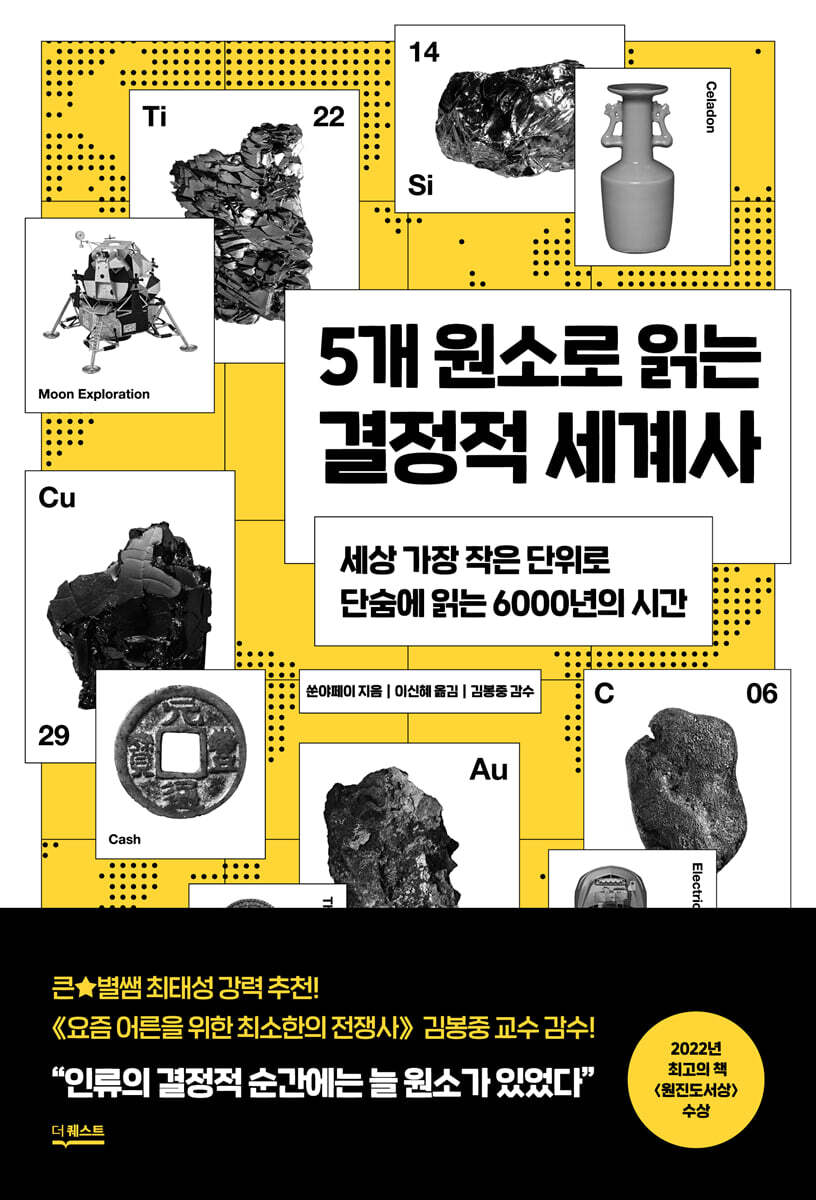
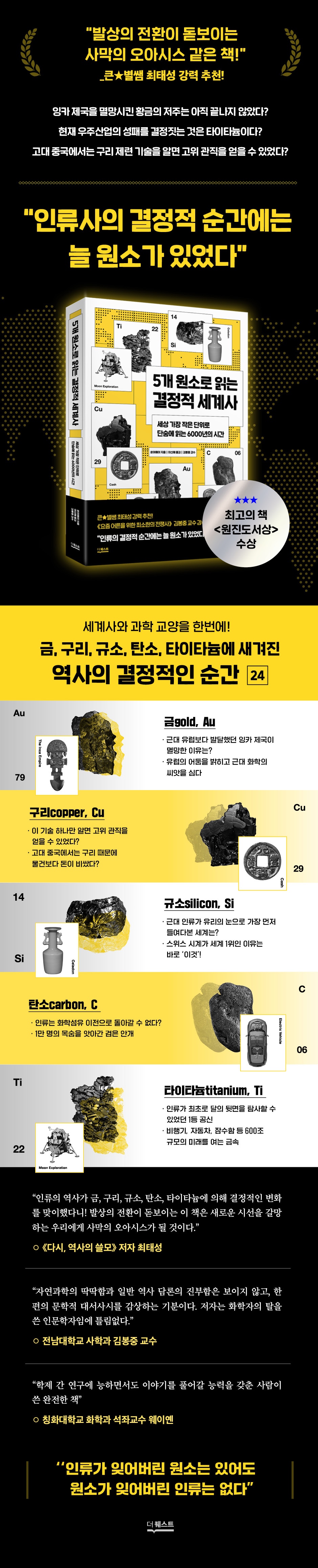
*Winner of the Yuanjin Book Award, China's best book* Big*Star Teacher Choi Tae-seong highly recommended Professor Bong-Jung Kim, author of "A Minimum History of War for Adults Today" “There has always been an element at humanity’s defining moments.” 6,000 years of time, read in one breath, in the world's smallest units. "Did copper cause deflation in ancient China?" "Is silicon crucial for humanity's ability to use tools?" "Is titanium the factor that determines the success or failure of the current space industry?" History unfolds in a new and expedited way when read through the lens of elements! "A Critical World History in Five Elements," a book that stands out for its innovative perspective, records 24 defining moments in history etched into the elements, a collection of indivisible units. The author of this book, Sun Yafei, is currently a promising new energy chemist and popular science communicator in China. The chemistry lecture series posted on the Chinese knowledge audio service platform was loved by over 23,000 people, and his book, "A Decisive World History in Five Elements," was also evaluated by readers as being easy and interesting to read even if they had forgotten the basic concepts of science or had not read a history textbook in a long time. In addition, upon publication, it was selected as an excellent book by the China Book Critics Association and as a recommended book for liberal arts and science by the state-owned China Publishing Group. It also won the Yuanjin Book Award, given to the best book of the year, which was previously awarded to books such as Yuval Harari's Sapiens. Following the 24 defining moments of history, unraveled in elements, you will feel as if you are reading a novel rather than a dry history textbook. This book, which combines literary sensibility with expertise, is like the icing on the cake. Let's gain history, fun, and scientific knowledge all in one go. |
- You can preview some of the book's contents.
Preview
index
Recommendation 1: Memories of the Elements, Recorded as a Literary Epic
Recommendation 2: Without Elements, There Is No History
Entering_The song of the smallest unit to understand the world
Part 1: The Curse of Gold That Changed History
1.
The Temptation of Gold and the Rough Waves of the Pacific
Heading for the Golden Paradise┃The Cruelty of the Gold-Seeking Cruelty┃The Ambition of the Pillagers is Crushed┃Balboa's Dream, the Birth of the Canal
2.
The Glory of Gold and the Fall of the Golden Empire
Gold and the Atomic Model┃How did the beautiful color of gold come about?┃The Golden Kingdom, the Inca Empire┃The Curse of Gold on the Inca Empire
3.
Opening the door to modernity, lured by gold
The Seeds of Alchemy | Alchemy: Illuminating Europe's Darkness | Alchemy: Driving the Modern Era
4.
If the desire continues, the curse continues.
The Element of Symbolism: Gold | The Modern Uses of Gold | The Curse of Gold Continues
Part 2: Copper┃The Real Bronze Age Reflected in the Mirror of Elements
5.
Even rusty copper is not at fault.
The Statue of Liberty was originally yellow.┃Iron was the problem, not copper.┃The signal flare of the Bronze Age.
6.
Tin and copper meet to change the landscape of war
The Spring and Autumn Period and the Warring States Period: The Rising of Frontier Countries Through a Single Weapon | A Golden Age Made Possible Through Unity
7.
An Encyclopedia of Ancient Technology in Copper
The most beautiful lantern made of copper┃A lock with better security than iron┃The element that creates sound┃An unexpected way to use a bronze mirror
8.
In an age where money is more valuable than goods, grab copper.
The Discovery of Copper Plating┃The Long-Pending Concerns of the Chinese Emperors┃The Root Cause of the Currency Shortage┃The Young Emperor's Dream Ended
Part 3: Silicon┃Sharing a Decisive Moment Over 10,000 Years
9.
Why did human art begin with rocks?
In Search of Rock Art┃Homo Faber Made Possible Thanks to Silicon┃A Flexible Element Embraces History
10.
A handful of dirt that connects time and space
Why the Ming Dynasty Built the Great Wall of China with Bricks | Uncovering 1,000 Years of Maritime Trade | The Evolution of Beauty Created by Chemical Reactions
11.
Glass eyes and rational thinking meet
Phoenicians and Transparent Stone┃Looking Deep and Far Through Glass Eyes┃Fragile Glass Supports a Great City
12.
From tiny wrist-sized machines to the heart of the AI industry.
The Swiss Watch Industry Was Overconfident: Further, More Accurately: A Brief History of Silicon Chips
Part 4: Carbon┃High-Carbon Life Cycles of Carbon-Based Lifeforms
13.
Humanity cannot return to the pre-chemical fiber era.
The Tragedy of the Pancreas: A Progress Made Possible | Why We Can't Escape Synthetic Fibers
14.
The history of sweetness created by evolutionary instinct
The human genome is hardwired for sweetness. Finding a cheap and efficient source of sweetness. What is the price of fooling the brain?
15.
The Great Transformation Brought About by the Carbon Tragedy
The Carbon Fog That Killed 10,000 People | Declaring War on Global Warming | Humanity's Endless Desire Is Opening the Gates of Hell
16.
Carbon is opening up the future
We need to change our car fuels first. The dawn of the low-carbon car era. Riding carbon into space.
Part 5: Titanium: The Strongest Metal That Turns the Impossible into Reality
17.
Titanium Becomes Human Wings
The first contributor to a milestone in lunar exploration┃The airplane that became a time bomb in the sky┃A new skyway opened with titanium
18.
From the metals of the universe to the metals of the sea
Conquer the Salty Sea ┃The Cold War's Balance Almost Broken ┃Resolve Humanity's New Fight ┃An Undersea Exploration with Titanium
19.
China's Titanium Revolution Started with One Building
Build a National Symbol┃The Connection Between French Architects and Titanium┃The Architectural Value of Titanium
20.
Will the day come when carbon-based life forms transform into titanium-based life forms?
World Records Made with Titanium Alloys | 3D Printing Meets Titanium | A New Definition of Humanity
Song of the Elements, Part 6
21.
prelude
22.
Movement 1: Escape from the Shadows of the Middle Ages
The blank space in the predicted score┃The law is proven one after another┃Mendeleev's mistake
23.
Second Movement, The Birth of the Law
The Efforts of Giants┃The Birth of the Scale to Express the Law┃Until the Law of Elemental Periodicity was Completed
24.
Third Movement, Scientific Synthesis of All Humanity
Why I've Believe in the Four Elements Theory for So Long┃Western Four Elements Theory vs. Eastern Five Elements Theory┃The Sprout of Doubt┃The Law of Periodicity Becomes a Law of the World
25.
Movement 4, Completion of the 118 Elemental Names
The structure of the atom is completed┃The last column of the periodic table┃When will element 119 be discovered?
26.
Postlude
References
Search
Recommendation 2: Without Elements, There Is No History
Entering_The song of the smallest unit to understand the world
Part 1: The Curse of Gold That Changed History
1.
The Temptation of Gold and the Rough Waves of the Pacific
Heading for the Golden Paradise┃The Cruelty of the Gold-Seeking Cruelty┃The Ambition of the Pillagers is Crushed┃Balboa's Dream, the Birth of the Canal
2.
The Glory of Gold and the Fall of the Golden Empire
Gold and the Atomic Model┃How did the beautiful color of gold come about?┃The Golden Kingdom, the Inca Empire┃The Curse of Gold on the Inca Empire
3.
Opening the door to modernity, lured by gold
The Seeds of Alchemy | Alchemy: Illuminating Europe's Darkness | Alchemy: Driving the Modern Era
4.
If the desire continues, the curse continues.
The Element of Symbolism: Gold | The Modern Uses of Gold | The Curse of Gold Continues
Part 2: Copper┃The Real Bronze Age Reflected in the Mirror of Elements
5.
Even rusty copper is not at fault.
The Statue of Liberty was originally yellow.┃Iron was the problem, not copper.┃The signal flare of the Bronze Age.
6.
Tin and copper meet to change the landscape of war
The Spring and Autumn Period and the Warring States Period: The Rising of Frontier Countries Through a Single Weapon | A Golden Age Made Possible Through Unity
7.
An Encyclopedia of Ancient Technology in Copper
The most beautiful lantern made of copper┃A lock with better security than iron┃The element that creates sound┃An unexpected way to use a bronze mirror
8.
In an age where money is more valuable than goods, grab copper.
The Discovery of Copper Plating┃The Long-Pending Concerns of the Chinese Emperors┃The Root Cause of the Currency Shortage┃The Young Emperor's Dream Ended
Part 3: Silicon┃Sharing a Decisive Moment Over 10,000 Years
9.
Why did human art begin with rocks?
In Search of Rock Art┃Homo Faber Made Possible Thanks to Silicon┃A Flexible Element Embraces History
10.
A handful of dirt that connects time and space
Why the Ming Dynasty Built the Great Wall of China with Bricks | Uncovering 1,000 Years of Maritime Trade | The Evolution of Beauty Created by Chemical Reactions
11.
Glass eyes and rational thinking meet
Phoenicians and Transparent Stone┃Looking Deep and Far Through Glass Eyes┃Fragile Glass Supports a Great City
12.
From tiny wrist-sized machines to the heart of the AI industry.
The Swiss Watch Industry Was Overconfident: Further, More Accurately: A Brief History of Silicon Chips
Part 4: Carbon┃High-Carbon Life Cycles of Carbon-Based Lifeforms
13.
Humanity cannot return to the pre-chemical fiber era.
The Tragedy of the Pancreas: A Progress Made Possible | Why We Can't Escape Synthetic Fibers
14.
The history of sweetness created by evolutionary instinct
The human genome is hardwired for sweetness. Finding a cheap and efficient source of sweetness. What is the price of fooling the brain?
15.
The Great Transformation Brought About by the Carbon Tragedy
The Carbon Fog That Killed 10,000 People | Declaring War on Global Warming | Humanity's Endless Desire Is Opening the Gates of Hell
16.
Carbon is opening up the future
We need to change our car fuels first. The dawn of the low-carbon car era. Riding carbon into space.
Part 5: Titanium: The Strongest Metal That Turns the Impossible into Reality
17.
Titanium Becomes Human Wings
The first contributor to a milestone in lunar exploration┃The airplane that became a time bomb in the sky┃A new skyway opened with titanium
18.
From the metals of the universe to the metals of the sea
Conquer the Salty Sea ┃The Cold War's Balance Almost Broken ┃Resolve Humanity's New Fight ┃An Undersea Exploration with Titanium
19.
China's Titanium Revolution Started with One Building
Build a National Symbol┃The Connection Between French Architects and Titanium┃The Architectural Value of Titanium
20.
Will the day come when carbon-based life forms transform into titanium-based life forms?
World Records Made with Titanium Alloys | 3D Printing Meets Titanium | A New Definition of Humanity
Song of the Elements, Part 6
21.
prelude
22.
Movement 1: Escape from the Shadows of the Middle Ages
The blank space in the predicted score┃The law is proven one after another┃Mendeleev's mistake
23.
Second Movement, The Birth of the Law
The Efforts of Giants┃The Birth of the Scale to Express the Law┃Until the Law of Elemental Periodicity was Completed
24.
Third Movement, Scientific Synthesis of All Humanity
Why I've Believe in the Four Elements Theory for So Long┃Western Four Elements Theory vs. Eastern Five Elements Theory┃The Sprout of Doubt┃The Law of Periodicity Becomes a Law of the World
25.
Movement 4, Completion of the 118 Elemental Names
The structure of the atom is completed┃The last column of the periodic table┃When will element 119 be discovered?
26.
Postlude
References
Search
Detailed image
Into the book
The power of this delicious narrative does not come solely from his extensive knowledge of the five elements and his ability to connect them to human civilization.
The rigidity of natural science and the banality of general historical discourse are not visible, and literary sensibility has been added to the expertise of knowledge to the point where one feels as if one is appreciating a literary epic.
Moreover, the way he talks to readers is refreshing.
The same goes for expressions like, “Even you who read this book will laugh at me” before an obvious development, or paradoxically scolding the European conquerors who massacred American Indians as “these sophisticated colonial rulers.”
There are knee-slapping, laugh-out-loud narratives scattered throughout.
---「Recommendation 1.
From “The Memory of the Elements, Recorded as a Literary Epic”
Despite hundreds of years of effort, not a speck of gold was visible.
However, in the course of their alchemy studies, the Arabs invented many new experimental tools, such as the distillation flask for distilling liquids and the swan-necked flask with a long, thin S-shaped neck.
(Omitted) Above all, alchemy had a great influence on the philosophical system.
In the process of developing alchemy, a new ideology called positivism emerged, which was completely different from classical Greek philosophy.
To prove whether a study is right or wrong, it must be quantified.
Alchemy emphasized the precise weighing and gathering of gases, and its influence planted the seeds of modern science.
Now the Arabs were on the verge of entering the realm of science through alchemy.
---「3.
From “Lured by Gold, Opening the Door to Modernity”
With the advent of bronze, productivity increased significantly, and at the same time, the demand for craftsmen who could make bronze increased, leading to a social division of labor.
Looking at the “Gonggi” (Gonggi), we can see how specifically the Bronze Age Chinese society classified artisans.
There is a record that the craftsman who makes cart wheels is called 'Yunin', the craftsman who makes cart compartments is called 'Yeoin', and the craftsman who makes the long poles that are attached to both sides of the cart is called 'Jooin'.
The metallurgical professions were further classified.
Since the Shang and Zhou Dynasties, craftsmen engaged in bronzeware production have been classified into at least six categories.
---「6.
From “The meeting of tin and copper changes the landscape of war”
Silicon and oxygen have the ability to hold almost every element, making them a natural team for any mineral on Earth. However, no matter how they are combined, their basic tetrahedral structure remains unchanged, so most rocks made of silicates are very hard and have high melting points.
Additionally, because of its dense structure, it does not corrode or dissolve unless it comes into contact with extremely alkaline water, so it can last a long time.
It is precisely because of these characteristics of silicate rocks that we can still admire rock art created by ancient people today.
---「9.
From "Why did human art begin with rocks?"
It was not Hayek who saved the Swiss watch industry, but the crystal watch technology they had abandoned.
Crystal resonance technology is becoming increasingly popular as time goes by, becoming essential for powering the timekeeping functions of smartphones, GPS systems, and remote control systems that most modern people own.
Even at the very moment when humanity entered the information age, silicon once again extended a helping hand, recording every minute and second like a timer, ensuring the accuracy of our information, allowing us to remember the past with greater detail and accuracy.
---「12.
From the small machine on your wrist to the backbone of the AI industry
Today, natural fibers are still used to make clothing, but they are losing ground compared to the rapidly developing synthetic fibers.
This is because the land necessary for natural fiber production is insufficient and performance is limited.
Synthetic fibers can be made to have a variety of properties, including warmth, coolness, a comfortable fit, breathability, and softness, by changing their molecular structure.
Military equipment such as bulletproof vests can now be made of a special fiber called polyethylene, which boasts a strong structure due to its extremely high molecular weight, rather than being made of metal like chainmail of the past.
Ultimately, whether we like it or not, we are already surrounded by synthetic organic materials, and clothes are just one of them.
---「13.
From "Humanity cannot return to the pre-chemical fiber era"
Ultimately, any city would be in trouble if the fundamental problem was not addressed.
From this time on, the relationship between air pollution and humanity emerged as an important agenda that attracted the attention of both politicians and scientists.
In 1989, the World Health Organization defined 'total volatile organic compounds' as organic compounds with a melting point below room temperature and a boiling point between 50 and 260 degrees Celsius.
The reason why the scope of hazardous organic substances has been specifically defined in this way is because, if not strongly managed and controlled, there is a possibility that the foundation of our lives will be destroyed by substances that threaten human health.
---「15.
From “The Great Transformation Brought About by the Carbon Tragedy”
The designers of the Witu-2 made the filter mesh out of a shape-memory alloy made of titanium and molybdenum.
The shape memory effect refers to the phenomenon in which a metal, even if deformed, returns to its original shape when the external force is removed.
Thanks to these characteristics, the filter net of the Witu 2 was able to maintain its round shape permanently.
This resulted in the creation of the Witu No. 2 wheel, which was 300 millimeters in diameter and 150 millimeters wide.
Although it is made of a very complex material, its total mass is only 735 grams, which is about the weight of an ordinary book, and thus titanium has earned the honorable title of the metal of the universe.
---「17.
From "Titanium Becomes Human Wings"
In 1958, Boeing successfully built a titanium alloy airplane using 81.6 kilograms of titanium alloy for the entire fuselage of the Boeing 707.
Titanium alloys are not only lightweight but also resistant to metal fatigue in high-temperature environments, making them a far more suitable aircraft fuselage material than steel and aluminum.
As aerospace engineers developed titanium alloy processing techniques, more and more titanium alloy parts began to be used in airplanes.
The fact that the Comet, the first jet airliner, crashed three times and yet people's patience for jets remained unshaken is all thanks to the titanium alloy.
---「17.
From "Titanium Becomes Human Wings"
Although all elements from the 1st to 7th periods have been filled, it seems that scientists' efforts to create new artificial elements will not stop here.
There are two reasons for this.
First, to explore a ‘small universe’ from Earth, transcending time and space.
The process of creating artificial elements has many similarities to the movement of celestial bodies in space.
Second, to discover new artificial elements with high commercial value, such as technetium, which is widely used in medicine and nuclear energy.
The rigidity of natural science and the banality of general historical discourse are not visible, and literary sensibility has been added to the expertise of knowledge to the point where one feels as if one is appreciating a literary epic.
Moreover, the way he talks to readers is refreshing.
The same goes for expressions like, “Even you who read this book will laugh at me” before an obvious development, or paradoxically scolding the European conquerors who massacred American Indians as “these sophisticated colonial rulers.”
There are knee-slapping, laugh-out-loud narratives scattered throughout.
---「Recommendation 1.
From “The Memory of the Elements, Recorded as a Literary Epic”
Despite hundreds of years of effort, not a speck of gold was visible.
However, in the course of their alchemy studies, the Arabs invented many new experimental tools, such as the distillation flask for distilling liquids and the swan-necked flask with a long, thin S-shaped neck.
(Omitted) Above all, alchemy had a great influence on the philosophical system.
In the process of developing alchemy, a new ideology called positivism emerged, which was completely different from classical Greek philosophy.
To prove whether a study is right or wrong, it must be quantified.
Alchemy emphasized the precise weighing and gathering of gases, and its influence planted the seeds of modern science.
Now the Arabs were on the verge of entering the realm of science through alchemy.
---「3.
From “Lured by Gold, Opening the Door to Modernity”
With the advent of bronze, productivity increased significantly, and at the same time, the demand for craftsmen who could make bronze increased, leading to a social division of labor.
Looking at the “Gonggi” (Gonggi), we can see how specifically the Bronze Age Chinese society classified artisans.
There is a record that the craftsman who makes cart wheels is called 'Yunin', the craftsman who makes cart compartments is called 'Yeoin', and the craftsman who makes the long poles that are attached to both sides of the cart is called 'Jooin'.
The metallurgical professions were further classified.
Since the Shang and Zhou Dynasties, craftsmen engaged in bronzeware production have been classified into at least six categories.
---「6.
From “The meeting of tin and copper changes the landscape of war”
Silicon and oxygen have the ability to hold almost every element, making them a natural team for any mineral on Earth. However, no matter how they are combined, their basic tetrahedral structure remains unchanged, so most rocks made of silicates are very hard and have high melting points.
Additionally, because of its dense structure, it does not corrode or dissolve unless it comes into contact with extremely alkaline water, so it can last a long time.
It is precisely because of these characteristics of silicate rocks that we can still admire rock art created by ancient people today.
---「9.
From "Why did human art begin with rocks?"
It was not Hayek who saved the Swiss watch industry, but the crystal watch technology they had abandoned.
Crystal resonance technology is becoming increasingly popular as time goes by, becoming essential for powering the timekeeping functions of smartphones, GPS systems, and remote control systems that most modern people own.
Even at the very moment when humanity entered the information age, silicon once again extended a helping hand, recording every minute and second like a timer, ensuring the accuracy of our information, allowing us to remember the past with greater detail and accuracy.
---「12.
From the small machine on your wrist to the backbone of the AI industry
Today, natural fibers are still used to make clothing, but they are losing ground compared to the rapidly developing synthetic fibers.
This is because the land necessary for natural fiber production is insufficient and performance is limited.
Synthetic fibers can be made to have a variety of properties, including warmth, coolness, a comfortable fit, breathability, and softness, by changing their molecular structure.
Military equipment such as bulletproof vests can now be made of a special fiber called polyethylene, which boasts a strong structure due to its extremely high molecular weight, rather than being made of metal like chainmail of the past.
Ultimately, whether we like it or not, we are already surrounded by synthetic organic materials, and clothes are just one of them.
---「13.
From "Humanity cannot return to the pre-chemical fiber era"
Ultimately, any city would be in trouble if the fundamental problem was not addressed.
From this time on, the relationship between air pollution and humanity emerged as an important agenda that attracted the attention of both politicians and scientists.
In 1989, the World Health Organization defined 'total volatile organic compounds' as organic compounds with a melting point below room temperature and a boiling point between 50 and 260 degrees Celsius.
The reason why the scope of hazardous organic substances has been specifically defined in this way is because, if not strongly managed and controlled, there is a possibility that the foundation of our lives will be destroyed by substances that threaten human health.
---「15.
From “The Great Transformation Brought About by the Carbon Tragedy”
The designers of the Witu-2 made the filter mesh out of a shape-memory alloy made of titanium and molybdenum.
The shape memory effect refers to the phenomenon in which a metal, even if deformed, returns to its original shape when the external force is removed.
Thanks to these characteristics, the filter net of the Witu 2 was able to maintain its round shape permanently.
This resulted in the creation of the Witu No. 2 wheel, which was 300 millimeters in diameter and 150 millimeters wide.
Although it is made of a very complex material, its total mass is only 735 grams, which is about the weight of an ordinary book, and thus titanium has earned the honorable title of the metal of the universe.
---「17.
From "Titanium Becomes Human Wings"
In 1958, Boeing successfully built a titanium alloy airplane using 81.6 kilograms of titanium alloy for the entire fuselage of the Boeing 707.
Titanium alloys are not only lightweight but also resistant to metal fatigue in high-temperature environments, making them a far more suitable aircraft fuselage material than steel and aluminum.
As aerospace engineers developed titanium alloy processing techniques, more and more titanium alloy parts began to be used in airplanes.
The fact that the Comet, the first jet airliner, crashed three times and yet people's patience for jets remained unshaken is all thanks to the titanium alloy.
---「17.
From "Titanium Becomes Human Wings"
Although all elements from the 1st to 7th periods have been filled, it seems that scientists' efforts to create new artificial elements will not stop here.
There are two reasons for this.
First, to explore a ‘small universe’ from Earth, transcending time and space.
The process of creating artificial elements has many similarities to the movement of celestial bodies in space.
Second, to discover new artificial elements with high commercial value, such as technetium, which is widely used in medicine and nuclear energy.
---「25.
From the 4th movement, "Completion of the 118 Elemental Names"
From the 4th movement, "Completion of the 118 Elemental Names"
Publisher's Review
“There are elements that humanity has forgotten, but there is no humanity that an element has forgotten.”
A new history seen through the eyes of the elements!
Elements are excellent historical mediators that clearly demonstrate human desires.
Humanity has become accustomed to wearing clothes made of high-carbon fibers and can no longer escape from synthetic fibers. As they instinctively seek out sweetness, they have begun to artificially create cheaper and sweeter foods.
But the high-carbon life cycle of carbon-based life forms that began that way was a disaster.
On December 5, 1952, a massive black fog descended on London.
The fog that had been engulfing London for four days was a toxic gas that could knock down even the largest cows.
The dense fog killed at least 6,000 people and caused nearly 10,000 deaths from respiratory illnesses in a month.
This black fog was smog created by industrial pollution caused by burning coal.
Ultimately, if the fundamental problem was not addressed, this tragedy would repeat itself.
From this time on, the war between carbon and humanity began, and now we are calling for low carbon.
In this way, human history moves in tandem with the history of carbon and, furthermore, the history of elements.
Copper met tin and ushered in the Bronze Age, and gold met copper and brought the modern semiconductor industry to its peak.
The course of human history is determined by how we handle the elements.
Defining moments of humanity etched in the elements
#1.
The ancient Chinese emperors had a long-standing dilemma.
As society stabilized and commerce developed, the shortage of currency became increasingly serious.
This was a deflationary phenomenon caused by copper.
#2.
Europeans, chasing gold, massacred Indians wherever they went, even destroying the Inca Empire, which was much more prosperous than their own at the time.
And even in the 21st century, the curse of gold did not end.
#3.
In 2019, Chang'e 4 became the first space probe to reach the far side of the moon, and the Yutu 2 probe set a milestone in space exploration by traveling 600 meters over two years.
All this is thanks to titanium, the strongest metal on Earth, which is stronger than iron but lighter due to its lower density.
#4.
What was the decisive factor that allowed humanity to enter a world of tool-using civilization? It was the properties of silicon.
Rocks made of silicon have very high hardness and melting point and do not erode or dissolve unless exposed to alkaline water.
Thanks to this, we were able to go through the Stone Age, build the Great Wall of China with bricks, leave behind beautiful porcelain that remains unchanged for thousands of years, and enjoy the advancement of biology and the watch industry.
#5.
Even in the 1970s, China did not have enough clothes to cover the entire population.
However, with the full support of the government, the country was able to rise to the top of the world's textile industry by developing synthetic fibers.
The global textile industry paradigm has changed depending on how carbon is utilized.
History and science all in one!
For modern people living in the world of elements
Minimum liberal arts classes
For tens of millions of years, humanity has lived through a bloody and barbaric age of gold raids, a splendid Bronze Age when copper and tin met, and even now, we live a high-carbon life, reading the records left by silicon, which continues to write its story, even as it eats away at us.
And now we dream and imagine the future that titanium will bring.
Research is still ongoing to discover the 119th element.
What kind of past will be revealed to us and what kind of future will unfold on the day that this element is discovered?
It is thanks to the scientific consensus on the origin of matter centered on the periodic table that we can read the past, present, and future through elements.
Let's conclude this book by following the footsteps of the giants who discovered the law of periodicity and contributed to the creation of today's periodic table, gaining a deeper understanding of both history and scientific knowledge.
A new history seen through the eyes of the elements!
Elements are excellent historical mediators that clearly demonstrate human desires.
Humanity has become accustomed to wearing clothes made of high-carbon fibers and can no longer escape from synthetic fibers. As they instinctively seek out sweetness, they have begun to artificially create cheaper and sweeter foods.
But the high-carbon life cycle of carbon-based life forms that began that way was a disaster.
On December 5, 1952, a massive black fog descended on London.
The fog that had been engulfing London for four days was a toxic gas that could knock down even the largest cows.
The dense fog killed at least 6,000 people and caused nearly 10,000 deaths from respiratory illnesses in a month.
This black fog was smog created by industrial pollution caused by burning coal.
Ultimately, if the fundamental problem was not addressed, this tragedy would repeat itself.
From this time on, the war between carbon and humanity began, and now we are calling for low carbon.
In this way, human history moves in tandem with the history of carbon and, furthermore, the history of elements.
Copper met tin and ushered in the Bronze Age, and gold met copper and brought the modern semiconductor industry to its peak.
The course of human history is determined by how we handle the elements.
Defining moments of humanity etched in the elements
#1.
The ancient Chinese emperors had a long-standing dilemma.
As society stabilized and commerce developed, the shortage of currency became increasingly serious.
This was a deflationary phenomenon caused by copper.
#2.
Europeans, chasing gold, massacred Indians wherever they went, even destroying the Inca Empire, which was much more prosperous than their own at the time.
And even in the 21st century, the curse of gold did not end.
#3.
In 2019, Chang'e 4 became the first space probe to reach the far side of the moon, and the Yutu 2 probe set a milestone in space exploration by traveling 600 meters over two years.
All this is thanks to titanium, the strongest metal on Earth, which is stronger than iron but lighter due to its lower density.
#4.
What was the decisive factor that allowed humanity to enter a world of tool-using civilization? It was the properties of silicon.
Rocks made of silicon have very high hardness and melting point and do not erode or dissolve unless exposed to alkaline water.
Thanks to this, we were able to go through the Stone Age, build the Great Wall of China with bricks, leave behind beautiful porcelain that remains unchanged for thousands of years, and enjoy the advancement of biology and the watch industry.
#5.
Even in the 1970s, China did not have enough clothes to cover the entire population.
However, with the full support of the government, the country was able to rise to the top of the world's textile industry by developing synthetic fibers.
The global textile industry paradigm has changed depending on how carbon is utilized.
History and science all in one!
For modern people living in the world of elements
Minimum liberal arts classes
For tens of millions of years, humanity has lived through a bloody and barbaric age of gold raids, a splendid Bronze Age when copper and tin met, and even now, we live a high-carbon life, reading the records left by silicon, which continues to write its story, even as it eats away at us.
And now we dream and imagine the future that titanium will bring.
Research is still ongoing to discover the 119th element.
What kind of past will be revealed to us and what kind of future will unfold on the day that this element is discovered?
It is thanks to the scientific consensus on the origin of matter centered on the periodic table that we can read the past, present, and future through elements.
Let's conclude this book by following the footsteps of the giants who discovered the law of periodicity and contributed to the creation of today's periodic table, gaining a deeper understanding of both history and scientific knowledge.
GOODS SPECIFICS
- Date of issue: August 21, 2024
- Page count, weight, size: 368 pages | 568g | 153*225*24mm
- ISBN13: 9791140710522
- ISBN10: 1140710524
You may also like
카테고리
korean


korean

![GQ KOREA Mark (Monthly): December [2025]](http://librairie.coreenne.fr/cdn/shop/files/8ef265dbbfbf186523ed75ba7319009d.jpg?v=1765340328&width=3840)


