

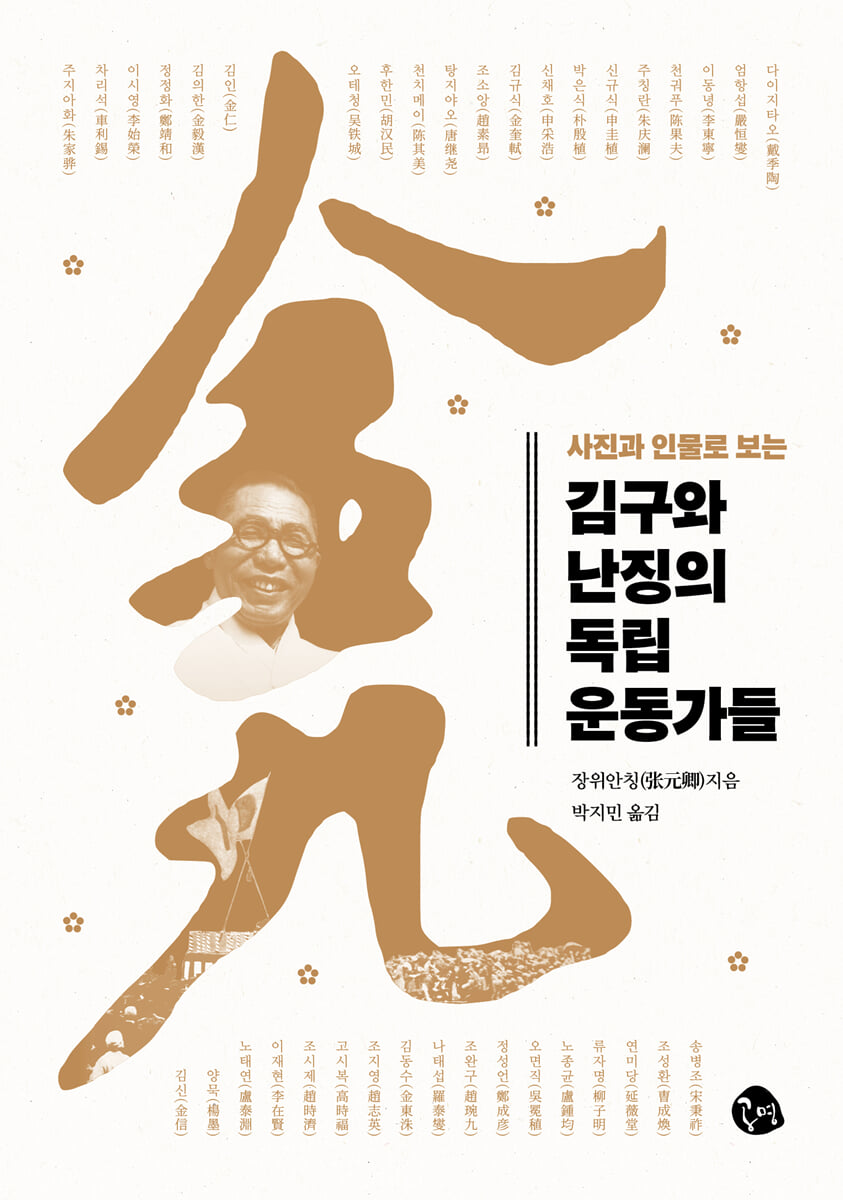
Kim Gu and the independence activists of Nanjing
 |
Description
Book Introduction
Excavated through thorough historical research and photographs
The story of Kim Gu and the hidden independence activists in Nanjing!
Nanjing is a city with a long history in China and was one of the stages of activity for the Provisional Government of the Republic of Korea.
Mr. Kim Gu and the Provisional Government of the Republic of Korea were active in Nanjing to escape Japanese oppression, and this was also where they laid the foundation for the independence movement.
Activities in Nanjing played a significant role in the diplomatic and military activities of the Provisional Government of the Republic of Korea, and provided the strength to continue the independence movement through solidarity and cooperation with China.
The new book, “Kim Gu and the Independence Activists of Nanjing,” contains the stories of Kim Gu and the independence activists surrounding him who were active in Nanjing.
Although many books have already been published about Kim Gu, this latest book can be said to be a historical document that was personally observed and researched by urban researcher Dr. Jang Wi-wan-qing, who was interested in the period when Kim Gu stayed in Nanjing, while actually staying in Nanjing.
Through his research on Nanjing, Dr. Jang pointed out the problems with many existing studies on Kim Gu and the Provisional Government of the Republic of Korea, and thoroughly researched and revealed the details of history using historical records and photographic materials.
The story of Kim Gu and the hidden independence activists in Nanjing!
Nanjing is a city with a long history in China and was one of the stages of activity for the Provisional Government of the Republic of Korea.
Mr. Kim Gu and the Provisional Government of the Republic of Korea were active in Nanjing to escape Japanese oppression, and this was also where they laid the foundation for the independence movement.
Activities in Nanjing played a significant role in the diplomatic and military activities of the Provisional Government of the Republic of Korea, and provided the strength to continue the independence movement through solidarity and cooperation with China.
The new book, “Kim Gu and the Independence Activists of Nanjing,” contains the stories of Kim Gu and the independence activists surrounding him who were active in Nanjing.
Although many books have already been published about Kim Gu, this latest book can be said to be a historical document that was personally observed and researched by urban researcher Dr. Jang Wi-wan-qing, who was interested in the period when Kim Gu stayed in Nanjing, while actually staying in Nanjing.
Through his research on Nanjing, Dr. Jang pointed out the problems with many existing studies on Kim Gu and the Provisional Government of the Republic of Korea, and thoroughly researched and revealed the details of history using historical records and photographic materials.
- You can preview some of the book's contents.
Preview
index
introduction
Prologue: The story begins in Hongkou Park
Chapter 1: The Day of the Shanghai Hongkou Park Uprising
Kim Gu and the Hongkou Park Bombing Incident
Kim Gu's rise to prominence and the relocation of the Provisional Government of the Republic of Korea
The prelude to the joint venture between the National Government and the Provisional Government of the Republic of Korea opens.
Chapter 2: A Vivid Story of Kim Gu's Rescue
Park Chan-ik asks the National Government for help.
Chiang Kai-shek's strong support activities
Why Chen Guofu took active steps to save Kim Gu
Why Xiao Zheng was chosen to protect Kim Gu
George Ashmore Fitch, the first runner to save Kim Gu
Chu Fuqing takes Kim Gu into exile in Jiaxing
Chapter 3: Kim Gu, under protection in Jasing
Living as a Cantonese Zhang Chenqiu
Protection of the Chufu-cheng family
The secret protection of the national government
The role of the boatman Zhu Aibao
Chapter 4: Meeting Chiang Kai-shek for the First Time in Nanjing
Ask for a meeting
Chiang Kai-shek sends a reply agreeing to the meeting.
The meeting between Kim Gu and Chiang Kai-shek
The detailed story of the meeting
Draft an activity plan at the central branch
Chen Guofu invites Kim Gu
The National Government and the Provisional Government of the Republic of Korea begin cooperation.
Chapter 5: Kim Gu Conducts Secret Activities in Nanjing
Korean Special Forces vs. Kim Gu Special Forces
Student Training Center vs. Mengjang Training Center
Korean National Party Youth Group Activities
Information gathering activities regarding Japan
Chapter 6: The National Government's Economic Support for Kim Gu
Comprehensive assistance: from covert operations to everyday life
How were the expenses spent?
Support for the independence movement through Xiaozheng
Kim Gu's thoughts in his farewell letter
Chapter 7: Kim Gu's Life in Nanjing 1
A life wandering around Nanjing
Kim Gu's mother's life in Nanjing
Was Pucheng Xinchun No. 8 really Kim Gu's residence?
Chapter 8: Kim Gu's Life in Nanjing 2
Chen Guofu, Chen Lifu's official residence and Fucheng New Town No. 10
Did Kim Shin attend Anhui Tunxi Middle School?
The reason I lived near Huaiqingqiao
Chapter 9: Leaving Nanjing in a Hurry
When was Kim Gu's house bombed?
The date on which Tian Guofu wrote the letter to Xiao Zheng
Activities before leaving Nanjing
Leaving Nanjing on a British ship
The drowning of a Chinese handyman
Break up with Zhu Aibao
Chapter 10: The South Korean Delegation to China in Nanjing
Puqing New Year's Eve Issue 5
Min Pil-ho, head of the Korean delegation to China
Epilogue: Xiao Zheng Visits Kim Gu's Grave
Appendix Kim Gu and Historical Figures
Prologue: The story begins in Hongkou Park
Chapter 1: The Day of the Shanghai Hongkou Park Uprising
Kim Gu and the Hongkou Park Bombing Incident
Kim Gu's rise to prominence and the relocation of the Provisional Government of the Republic of Korea
The prelude to the joint venture between the National Government and the Provisional Government of the Republic of Korea opens.
Chapter 2: A Vivid Story of Kim Gu's Rescue
Park Chan-ik asks the National Government for help.
Chiang Kai-shek's strong support activities
Why Chen Guofu took active steps to save Kim Gu
Why Xiao Zheng was chosen to protect Kim Gu
George Ashmore Fitch, the first runner to save Kim Gu
Chu Fuqing takes Kim Gu into exile in Jiaxing
Chapter 3: Kim Gu, under protection in Jasing
Living as a Cantonese Zhang Chenqiu
Protection of the Chufu-cheng family
The secret protection of the national government
The role of the boatman Zhu Aibao
Chapter 4: Meeting Chiang Kai-shek for the First Time in Nanjing
Ask for a meeting
Chiang Kai-shek sends a reply agreeing to the meeting.
The meeting between Kim Gu and Chiang Kai-shek
The detailed story of the meeting
Draft an activity plan at the central branch
Chen Guofu invites Kim Gu
The National Government and the Provisional Government of the Republic of Korea begin cooperation.
Chapter 5: Kim Gu Conducts Secret Activities in Nanjing
Korean Special Forces vs. Kim Gu Special Forces
Student Training Center vs. Mengjang Training Center
Korean National Party Youth Group Activities
Information gathering activities regarding Japan
Chapter 6: The National Government's Economic Support for Kim Gu
Comprehensive assistance: from covert operations to everyday life
How were the expenses spent?
Support for the independence movement through Xiaozheng
Kim Gu's thoughts in his farewell letter
Chapter 7: Kim Gu's Life in Nanjing 1
A life wandering around Nanjing
Kim Gu's mother's life in Nanjing
Was Pucheng Xinchun No. 8 really Kim Gu's residence?
Chapter 8: Kim Gu's Life in Nanjing 2
Chen Guofu, Chen Lifu's official residence and Fucheng New Town No. 10
Did Kim Shin attend Anhui Tunxi Middle School?
The reason I lived near Huaiqingqiao
Chapter 9: Leaving Nanjing in a Hurry
When was Kim Gu's house bombed?
The date on which Tian Guofu wrote the letter to Xiao Zheng
Activities before leaving Nanjing
Leaving Nanjing on a British ship
The drowning of a Chinese handyman
Break up with Zhu Aibao
Chapter 10: The South Korean Delegation to China in Nanjing
Puqing New Year's Eve Issue 5
Min Pil-ho, head of the Korean delegation to China
Epilogue: Xiao Zheng Visits Kim Gu's Grave
Appendix Kim Gu and Historical Figures
Into the book
There are already numerous papers on Kim Gu and the Provisional Government of the Republic of Korea.
Because of that, there seems to be no more meaningful or fresh topics to deal with.
However, from the perspective of Nanjing's urban history, the existing studies have common problems with their meaning and thorough research.
Because there are still many facts that have not been clearly revealed, it is not uncommon to find contradictory parts even in the same book.
There are also quite a few fields that are very important but have not yet attracted the attention of researchers.
Because of this, the materials I encountered in the early stages of my research consisted of vague and divided opinions and confusing and incoherent writings.
Of course, there was still a lot of room for research within that.
As I delved deeper into my research, I discovered that the scope of this research was very broad.
After sorting out various relationships, days continued that felt like seeing the sun hidden behind clouds, and the fun and joy deepened.
---From the "Preface"
That day, Kim Gu took the last local train on the Hohang Line.
Kim Gu initially disguised himself as a Western man to pretend to be a married couple with Geraldine Fitch.
And on the way to the station, I changed my clothes again in the car, and when I got off, I looked completely different.
He dressed up as a businessman, wearing a black hat, a long black shirt, and black leather shoes that were worn to a certain length.
Kim Gu and others got out of the car and walked straight across the wooden bridge toward the train station without looking back.
The Peach couple watched them from inside the car, their eyes glued to the car until they completely disappeared.
Even if you search related books, there is no information about when the Peach couple and Kim Gu met again after their separation.
However, Kim Gu wrote in Baekbeom Ilji that 'Later, Mrs. Peach used the home phone indiscriminately, which aroused suspicion and revealed her location', and this 'later' can be related to three times.
---From Chapter 2
Kim Gu believed that if he lived with a well-educated intellectual woman, his social status would be easily revealed.
So I thought it would be better to get help from the illiterate boatman, Zhu Ai Bao.
After coming to Jiaxing in 1932, Kim Gu lived with Zhu Aibao.
Later, he went to Nanjing with Zhu Aibao, and the two separated only when Kim Gu suddenly had to leave Nanjing in 1937.
Since the 1990s, novels and plays based on the stories of Kim Gu and Zhu Aibao have been published in China.
In 1999, the novel “Seonwol (船月)” was published by People’s Literature Publishing House.
The book also attracted attention in Korea, and a Korean edition was published.
---From Chapter 3
After meeting Kim Gu, Chiang Kai-shek agreed to the Provisional Government of the Republic of Korea's plan to train students as military officers.
On February 22, 1933, Chen Guofu sent a telegram to Xiao Zheng.
It was decided to open a class to train Korean comrades at the Luoyang Military Academy, and since Chiang Kai-shek had already given his approval, he was to immediately inform the Korean side.
Kim Gu immediately began recruiting students and seeking instructors.
In this way, the meeting between Chiang Kai-shek and Kim Gu is an important symbol of the cooperation between the National Government and the Provisional Government of the Republic of Korea in the anti-Japanese struggle.
From that day on, Kim Gu organized the Korean National Party in 1935 with financial support from the National Government, and supported the provisional government, which was on the verge of collapse.
On November 3, 1935, the Provisional Government was reorganized, and seven of its members were executives of the Korean National Party.
Kim Gu assumed the position of Minister of Foreign Affairs and seized control of the provisional government.
After that, the cooperative relationship between the National Government and the Provisional Government of the Republic of Korea began to become closer and deeper.
---From Chapter 4
On February 22, 1973, Xiao Zheng arrived in Seoul by plane.
After receiving an honorary doctorate in economics from Konkuk University on the 23rd, I went straight to Kim Gu's grave to pay my respects.
Later, Xiao Zheng wrote in his memoir:
“The reason I went to Korea to get my degree was actually because I wanted to pay my respects to the deceased.
After Kim Gu returned to Korea and was assassinated shortly thereafter, key figures in the provisional government, such as An Gong-geun, Park Chan-ik, Lee Cheong-cheon, Jo So-ang, and Min Pil-ho, also passed away.
Aside from the frequent correspondence with General Kim Shin over the past 20 years, I have no old friends in Korea that I can find, so I have not been able to come to Korea.
This trip to Korea is to visit Mr. Kim's grave and see where he lived.
General Kim Shin, now the Minister of Transportation, gave me a warm welcome when I arrived, and the day after I arrived, he accompanied me to Kim Gu's grave.
As I thought of my old friend in front of the grave, tears flowed without me realizing it.
Because of that, there seems to be no more meaningful or fresh topics to deal with.
However, from the perspective of Nanjing's urban history, the existing studies have common problems with their meaning and thorough research.
Because there are still many facts that have not been clearly revealed, it is not uncommon to find contradictory parts even in the same book.
There are also quite a few fields that are very important but have not yet attracted the attention of researchers.
Because of this, the materials I encountered in the early stages of my research consisted of vague and divided opinions and confusing and incoherent writings.
Of course, there was still a lot of room for research within that.
As I delved deeper into my research, I discovered that the scope of this research was very broad.
After sorting out various relationships, days continued that felt like seeing the sun hidden behind clouds, and the fun and joy deepened.
---From the "Preface"
That day, Kim Gu took the last local train on the Hohang Line.
Kim Gu initially disguised himself as a Western man to pretend to be a married couple with Geraldine Fitch.
And on the way to the station, I changed my clothes again in the car, and when I got off, I looked completely different.
He dressed up as a businessman, wearing a black hat, a long black shirt, and black leather shoes that were worn to a certain length.
Kim Gu and others got out of the car and walked straight across the wooden bridge toward the train station without looking back.
The Peach couple watched them from inside the car, their eyes glued to the car until they completely disappeared.
Even if you search related books, there is no information about when the Peach couple and Kim Gu met again after their separation.
However, Kim Gu wrote in Baekbeom Ilji that 'Later, Mrs. Peach used the home phone indiscriminately, which aroused suspicion and revealed her location', and this 'later' can be related to three times.
---From Chapter 2
Kim Gu believed that if he lived with a well-educated intellectual woman, his social status would be easily revealed.
So I thought it would be better to get help from the illiterate boatman, Zhu Ai Bao.
After coming to Jiaxing in 1932, Kim Gu lived with Zhu Aibao.
Later, he went to Nanjing with Zhu Aibao, and the two separated only when Kim Gu suddenly had to leave Nanjing in 1937.
Since the 1990s, novels and plays based on the stories of Kim Gu and Zhu Aibao have been published in China.
In 1999, the novel “Seonwol (船月)” was published by People’s Literature Publishing House.
The book also attracted attention in Korea, and a Korean edition was published.
---From Chapter 3
After meeting Kim Gu, Chiang Kai-shek agreed to the Provisional Government of the Republic of Korea's plan to train students as military officers.
On February 22, 1933, Chen Guofu sent a telegram to Xiao Zheng.
It was decided to open a class to train Korean comrades at the Luoyang Military Academy, and since Chiang Kai-shek had already given his approval, he was to immediately inform the Korean side.
Kim Gu immediately began recruiting students and seeking instructors.
In this way, the meeting between Chiang Kai-shek and Kim Gu is an important symbol of the cooperation between the National Government and the Provisional Government of the Republic of Korea in the anti-Japanese struggle.
From that day on, Kim Gu organized the Korean National Party in 1935 with financial support from the National Government, and supported the provisional government, which was on the verge of collapse.
On November 3, 1935, the Provisional Government was reorganized, and seven of its members were executives of the Korean National Party.
Kim Gu assumed the position of Minister of Foreign Affairs and seized control of the provisional government.
After that, the cooperative relationship between the National Government and the Provisional Government of the Republic of Korea began to become closer and deeper.
---From Chapter 4
On February 22, 1973, Xiao Zheng arrived in Seoul by plane.
After receiving an honorary doctorate in economics from Konkuk University on the 23rd, I went straight to Kim Gu's grave to pay my respects.
Later, Xiao Zheng wrote in his memoir:
“The reason I went to Korea to get my degree was actually because I wanted to pay my respects to the deceased.
After Kim Gu returned to Korea and was assassinated shortly thereafter, key figures in the provisional government, such as An Gong-geun, Park Chan-ik, Lee Cheong-cheon, Jo So-ang, and Min Pil-ho, also passed away.
Aside from the frequent correspondence with General Kim Shin over the past 20 years, I have no old friends in Korea that I can find, so I have not been able to come to Korea.
This trip to Korea is to visit Mr. Kim's grave and see where he lived.
General Kim Shin, now the Minister of Transportation, gave me a warm welcome when I arrived, and the day after I arrived, he accompanied me to Kim Gu's grave.
As I thought of my old friend in front of the grave, tears flowed without me realizing it.
---From the "Epilogue"
Publisher's Review
The persistent findings of urban history researcher Dr. Jang Wi-wan-qing
The author of this book began researching Pucheng Xinchun (?成新村), an old residential area in Nanjing from the Republic of China era, after discovering that Kim Gu and the history of Nanjing were closely related.
And it turned out to be false.
Dr. Zhang Weiwanqing's research process was published under the title "Jin Jiu in Nanjing."
On December 15, 2019, Guangxi Normal University Press held a new book sharing event at Nanjing Wanxiang Bookstore.
At the event, Professor Miao Huaiming of Nanjing University's College of Literature praised the book's strong historical research and said it offered a new breakthrough in the study of micro-urban history.
The book then aroused the interest of the Consulate General of the Republic of Korea in Shanghai.
One day in 2020, the Foreign Affairs Office of the Nanjing Municipal People's Government received a letter from the Consulate General of the Republic of Korea in Shanghai stating that the house in Nanjing, "No. 8 Pucheng Xinchun," was not "Kim Gu's former house," but rather "the headquarters of the Provisional Government of the Republic of Korea's delegation in China."
On September 13, 2021, the Nanjing Municipal Bureau of Planning and Natural Resources held the "Expert Advisory Meeting on Historical and Cultural Information on the Modern and Contemporary Architecture Area of Fucheng New Village, Nanjing City." Dr. Zhang Yuanqing also attended the meeting and confirmed that "No. 10 Fucheng New Village" was the "Headquarters of the Delegation of the Provisional Government of the Republic of Korea in China."
On September 26, 2021, Dr. Zhang Yuanqing wrote the "Guidelines for Historical Site Verification and Explanation for the Korean Delegation to China" at the request of the Nanjing Municipal Planning and Natural Resources Bureau.
In February 2022, the Nanjing Municipal Planning Bureau, upon receiving a response from the Consulate General of the Republic of Korea in Shanghai, agreed to install a sign at No. 10 Fucheng New Village, reading “The Former Site of the Headquarters of the Korean Delegation to China.”
A vivid record of independence activists who worked with Kim Gu
“Kim Gu and the Independence Activists of Nanjing” is a book that records in detail the efforts Kim Gu made in the independence movement, focusing on the period when he was active in Nanjing.
Through years of research and fieldwork, the author sheds new light on the life of Kim Gu, viewing his life and history from a new perspective.
This book also includes Kim Gu's activities in Nanjing, his independence movement strategy, the historical background of the independence movement at the time and Kim Gu's role, a new perspective through unpublished materials and photos, and the appendix [Kim Gu and Historical Figures] with portraits of independence activists who were active in Nanjing.
In order to shed new light on the life and achievements of Kim Gu, an indispensable figure in the history of the Korean independence movement, we have published “Kim Gu and the Independence Activists of Nanjing.”
I hope that through the recently published “Kim Gu and the Independence Activists of Nanjing,” many readers will be able to once again reflect on the life of Mr. Kim Gu and the spirit of the independence movement.
The author of this book began researching Pucheng Xinchun (?成新村), an old residential area in Nanjing from the Republic of China era, after discovering that Kim Gu and the history of Nanjing were closely related.
And it turned out to be false.
Dr. Zhang Weiwanqing's research process was published under the title "Jin Jiu in Nanjing."
On December 15, 2019, Guangxi Normal University Press held a new book sharing event at Nanjing Wanxiang Bookstore.
At the event, Professor Miao Huaiming of Nanjing University's College of Literature praised the book's strong historical research and said it offered a new breakthrough in the study of micro-urban history.
The book then aroused the interest of the Consulate General of the Republic of Korea in Shanghai.
One day in 2020, the Foreign Affairs Office of the Nanjing Municipal People's Government received a letter from the Consulate General of the Republic of Korea in Shanghai stating that the house in Nanjing, "No. 8 Pucheng Xinchun," was not "Kim Gu's former house," but rather "the headquarters of the Provisional Government of the Republic of Korea's delegation in China."
On September 13, 2021, the Nanjing Municipal Bureau of Planning and Natural Resources held the "Expert Advisory Meeting on Historical and Cultural Information on the Modern and Contemporary Architecture Area of Fucheng New Village, Nanjing City." Dr. Zhang Yuanqing also attended the meeting and confirmed that "No. 10 Fucheng New Village" was the "Headquarters of the Delegation of the Provisional Government of the Republic of Korea in China."
On September 26, 2021, Dr. Zhang Yuanqing wrote the "Guidelines for Historical Site Verification and Explanation for the Korean Delegation to China" at the request of the Nanjing Municipal Planning and Natural Resources Bureau.
In February 2022, the Nanjing Municipal Planning Bureau, upon receiving a response from the Consulate General of the Republic of Korea in Shanghai, agreed to install a sign at No. 10 Fucheng New Village, reading “The Former Site of the Headquarters of the Korean Delegation to China.”
A vivid record of independence activists who worked with Kim Gu
“Kim Gu and the Independence Activists of Nanjing” is a book that records in detail the efforts Kim Gu made in the independence movement, focusing on the period when he was active in Nanjing.
Through years of research and fieldwork, the author sheds new light on the life of Kim Gu, viewing his life and history from a new perspective.
This book also includes Kim Gu's activities in Nanjing, his independence movement strategy, the historical background of the independence movement at the time and Kim Gu's role, a new perspective through unpublished materials and photos, and the appendix [Kim Gu and Historical Figures] with portraits of independence activists who were active in Nanjing.
In order to shed new light on the life and achievements of Kim Gu, an indispensable figure in the history of the Korean independence movement, we have published “Kim Gu and the Independence Activists of Nanjing.”
I hope that through the recently published “Kim Gu and the Independence Activists of Nanjing,” many readers will be able to once again reflect on the life of Mr. Kim Gu and the spirit of the independence movement.
GOODS SPECIFICS
- Date of issue: August 15, 2024
- Page count, weight, size: 284 pages | 372g | 130*185*18mm
- ISBN13: 9788997870813
- ISBN10: 8997870815
You may also like
카테고리
korean


korean

![GQ KOREA Mark (Monthly): December [2025]](http://librairie.coreenne.fr/cdn/shop/files/8ef265dbbfbf186523ed75ba7319009d.jpg?v=1765340328&width=3840)


