

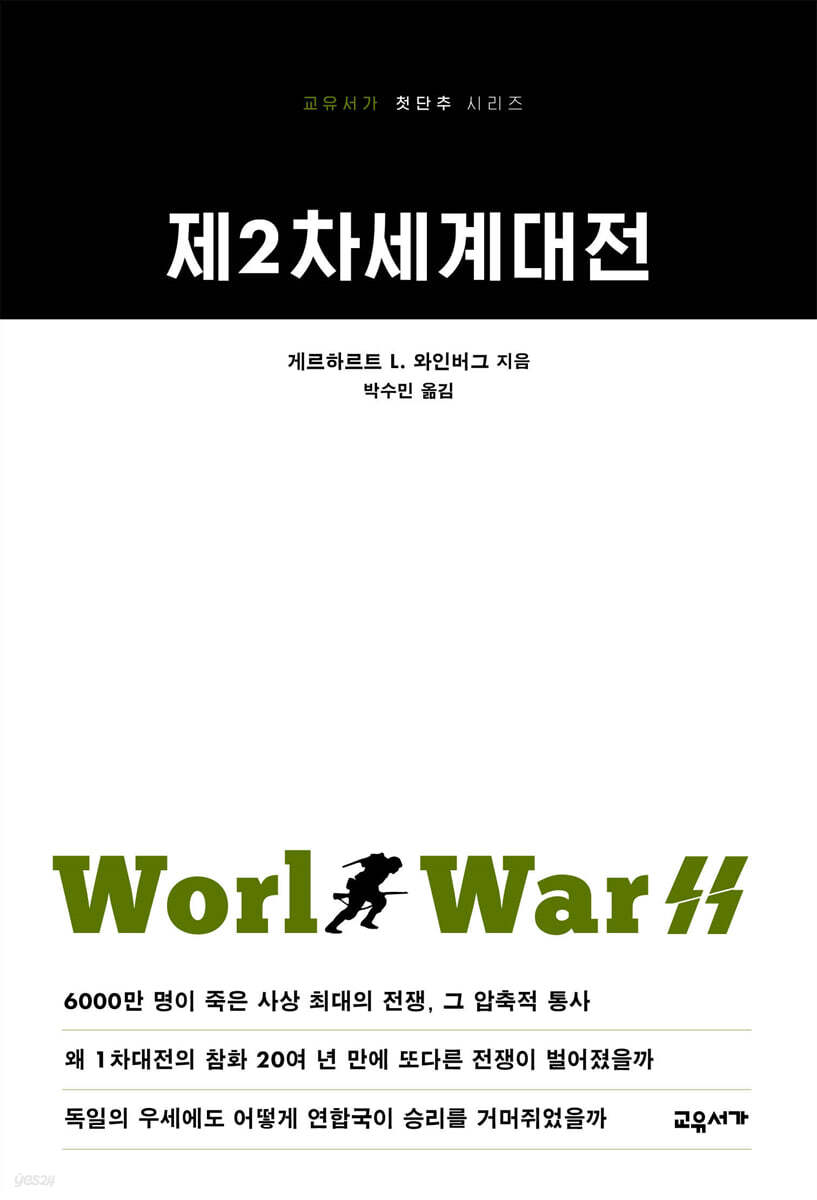
World War II
 |
Description
Book Introduction
A Catastrophic Folly: The Reshaping of the Modern World
Why did another war break out just 20 years after World War I?
How did the Allies achieve victory despite Germany's superiority?
A concise summary of the largest war in history, with 60 million dead.
※ This book is a re-release of 『World War II』 (Kyoyuseoga, 2018).
The world was engulfed in a war that caused twice as many casualties as the First World War, just 21 years after the devastating loss of life and physical destruction it had suffered.
Author Gerhard L.
Weinberg offers a very interesting account of World War II.
It details the stages leading up to the war, followed by strategic developments, key events, and key technological developments in Europe and around the world.
We examine the impact of World War II on veterans and civilians, and examine its continuing impact to this day.
With the memories of the horrific First World War so vivid, how could another war break out? How did the Allies achieve victory in a war that seemed destined for Germany? To answer these questions, the author minimizes details about minor anecdotes, character profiles, and weapon systems.
Instead, it focuses on the bigger picture, beginning with the Paris Peace Conference and the rise of Hitler in Germany, which was dissatisfied with its outcome, and the war gradually expanding to the Western Front, the Eastern Front, and the Asia-Pacific, and ultimately to the Allied victory.
Why did another war break out just 20 years after World War I?
How did the Allies achieve victory despite Germany's superiority?
A concise summary of the largest war in history, with 60 million dead.
※ This book is a re-release of 『World War II』 (Kyoyuseoga, 2018).
The world was engulfed in a war that caused twice as many casualties as the First World War, just 21 years after the devastating loss of life and physical destruction it had suffered.
Author Gerhard L.
Weinberg offers a very interesting account of World War II.
It details the stages leading up to the war, followed by strategic developments, key events, and key technological developments in Europe and around the world.
We examine the impact of World War II on veterans and civilians, and examine its continuing impact to this day.
With the memories of the horrific First World War so vivid, how could another war break out? How did the Allies achieve victory in a war that seemed destined for Germany? To answer these questions, the author minimizes details about minor anecdotes, character profiles, and weapon systems.
Instead, it focuses on the bigger picture, beginning with the Paris Peace Conference and the rise of Hitler in Germany, which was dissatisfied with its outcome, and the war gradually expanding to the Western Front, the Eastern Front, and the Asia-Pacific, and ultimately to the Allied victory.
index
introduction
1.
The period between the two world wars
2.
World War II begins
3.
Western Front: 1940
4.
Operation Barbarossa: Germany's invasion of the Soviet Union
5.
Japan escalates its war with China
6.
Turning the tide: Fall 1942–Spring 1944
7.
Domestic situations and technological and medical developments in each country
8.
Allied victory: 1944–45
conclusion
Reading Guide/Translator's Note/Map List
1.
The period between the two world wars
2.
World War II begins
3.
Western Front: 1940
4.
Operation Barbarossa: Germany's invasion of the Soviet Union
5.
Japan escalates its war with China
6.
Turning the tide: Fall 1942–Spring 1944
7.
Domestic situations and technological and medical developments in each country
8.
Allied victory: 1944–45
conclusion
Reading Guide/Translator's Note/Map List
Into the book
Another very important aspect was the debate surrounding Germany's western border and the way the Peace Conference dealt with this issue.
Germany invaded France twice, in 1870 and 1914.
Because of this, France was concerned about the possibility of another German provocation.
It was as if many European countries in 1815 were worried about French provocation.
The idea of separating the Rhineland from Germany and making it a separate state was seriously considered.
--- p.20
The German invasion of Poland is noteworthy in several respects.
The operation, which involved large-scale armored forces supported by the Luftwaffe, helped to rapidly break through enemy lines and advance, but the unique Polish terrain and poor roads and airfields also caused significant damage to military equipment, something the German military command had not taken into account when preparing for the invasion of the Soviet Union.
(…) Before the attack, German troops were ordered to kill most of the Polish clergy and power elite.
Ultimately, the entire Polish population was to be replaced by German immigrants, so anyone who might organize resistance had to be eliminated as quickly as possible.
--- p.39
Hitler secretly gave numerous bribes and tax-exempt allowances to high-ranking military officers in the army, navy, and air force, and after the victory over France, he promoted generals and admirals to gain their trust in his judgment.
German unity during the remainder of World War II cannot be understood without this immense support for the Nazi regime, and this support was further strengthened by identifying the enthusiasm following victory with the individual figure of Adolf Hitler.
--- p.71∼72
The German army massacred Soviet citizens in large numbers.
Prisoners of war were systematically starved to death, and massacres also took place in hospitals and psychiatric institutions.
Residents who gave food and water to prisoners were also shot.
This fact immediately reminded the Soviet people that they had to fight to survive.
--- p.96∼97
Japan's conquest of the Malay Peninsula and the Philippines was initially a prelude to the intended conquest of the Dutch East Indies.
Japanese forces had already landed on Borneo Island on December 15th.
Borneo was a region divided between Britain and the Netherlands.
In the weeks that followed, Japanese forces landed on a succession of islands in the region.
--- p.118
The clear turn of events also influenced the actions of some countries that had previously remained neutral.
Turkey reduced its chrome exports to Germany and declared war on Germany in February 1945.
Portugal did not object strongly to the Allies' use of the Azores in the Battle of the Atlantic, and Spain reduced its troops fighting on the German side on the Eastern Front.
Sweden also gradually reduced its support for Germany, and only Switzerland continued to support Germany economically until the last weeks of the war.
--- p.151∼152
In all the major belligerents, technological advances in military and medical fields were made during the war, which were of considerable importance in the postwar period.
New tanks, aircraft, battleships, and cannons were developed and put into operation during the war.
Radar, jet aircraft, ballistic missiles, and nuclear weapons were among the most dramatic innovations of wartime, and even greater advances followed after the war.
The most extreme attack attempt was the incendiary bomb attack carried out by Japan.
Germany invaded France twice, in 1870 and 1914.
Because of this, France was concerned about the possibility of another German provocation.
It was as if many European countries in 1815 were worried about French provocation.
The idea of separating the Rhineland from Germany and making it a separate state was seriously considered.
--- p.20
The German invasion of Poland is noteworthy in several respects.
The operation, which involved large-scale armored forces supported by the Luftwaffe, helped to rapidly break through enemy lines and advance, but the unique Polish terrain and poor roads and airfields also caused significant damage to military equipment, something the German military command had not taken into account when preparing for the invasion of the Soviet Union.
(…) Before the attack, German troops were ordered to kill most of the Polish clergy and power elite.
Ultimately, the entire Polish population was to be replaced by German immigrants, so anyone who might organize resistance had to be eliminated as quickly as possible.
--- p.39
Hitler secretly gave numerous bribes and tax-exempt allowances to high-ranking military officers in the army, navy, and air force, and after the victory over France, he promoted generals and admirals to gain their trust in his judgment.
German unity during the remainder of World War II cannot be understood without this immense support for the Nazi regime, and this support was further strengthened by identifying the enthusiasm following victory with the individual figure of Adolf Hitler.
--- p.71∼72
The German army massacred Soviet citizens in large numbers.
Prisoners of war were systematically starved to death, and massacres also took place in hospitals and psychiatric institutions.
Residents who gave food and water to prisoners were also shot.
This fact immediately reminded the Soviet people that they had to fight to survive.
--- p.96∼97
Japan's conquest of the Malay Peninsula and the Philippines was initially a prelude to the intended conquest of the Dutch East Indies.
Japanese forces had already landed on Borneo Island on December 15th.
Borneo was a region divided between Britain and the Netherlands.
In the weeks that followed, Japanese forces landed on a succession of islands in the region.
--- p.118
The clear turn of events also influenced the actions of some countries that had previously remained neutral.
Turkey reduced its chrome exports to Germany and declared war on Germany in February 1945.
Portugal did not object strongly to the Allies' use of the Azores in the Battle of the Atlantic, and Spain reduced its troops fighting on the German side on the Eastern Front.
Sweden also gradually reduced its support for Germany, and only Switzerland continued to support Germany economically until the last weeks of the war.
--- p.151∼152
In all the major belligerents, technological advances in military and medical fields were made during the war, which were of considerable importance in the postwar period.
New tanks, aircraft, battleships, and cannons were developed and put into operation during the war.
Radar, jet aircraft, ballistic missiles, and nuclear weapons were among the most dramatic innovations of wartime, and even greater advances followed after the war.
The most extreme attack attempt was the incendiary bomb attack carried out by Japan.
--- p.170
Publisher's Review
Germany started World War II first.
Regarding the subject of the war, the author first assumes that while there has been ongoing debate over who was responsible for starting World War I, few people disagree that Germany started World War II.
Another thing is that, while it is true that Japan deliberately joined the war started by Germany in 1939 in December 1941, Japan's decision to do so was by no means made in advance.
Immediately after the war began, Canada, Australia, and New Zealand entered the war as Allied powers, and South Africa joined shortly thereafter.
French and British colonial states also participated in the war from the beginning.
Wars at sea have been fought all over the world since the beginning.
Hitler, who viewed the occupation of Poland as a necessary prerequisite for attacking France and Britain, intended to fight only against Poland first.
Since Hitler had scheduled the invasion of Poland for the fall, he expected that a full-scale counteroffensive by Western countries would not be possible until after the winter.
Moreover, he believed that an open alliance with Italy or negotiations with Japan would be the only way to discourage Britain and France from intervening.
However, due to issues such as the Manchurian puppet state and the Nomonhan incident, Japan had no capacity to worry about other issues.
From Germany's perspective, the obvious alternative to negotiating with Japan was the Soviet Union.
The Soviet Union sought to gain large territorial gains in Poland and could also help Germany bypass the blockade if it went to war with the Western powers.
Battle of Britain: Germany's first major defeat
The fighting, later called the Battle of Britain, took place from late June to early August 1940.
It was the first major defeat Germany had ever suffered.
Although both sides suffered heavy losses, the British Air Force, which enjoyed popular support, could not hastily choose peace while giving in to excessive demands.
The Luftwaffe bombed British cities throughout the winter, but failed to break British morale.
Rather, it boosted the fighting spirit of the British army, which was reorganizing and rearming.
The British also created commando units to raid German-held coasts.
Meanwhile, in 1940, Hitler finally postponed his invasion of the Soviet Union.
Large German forces had to be moved from the west to eastern Germany and the already occupied areas of Poland, equipment had to be repaired and secured, and transport and storage facilities had to be improved in the eastern areas where large numbers of troops were stationed and supplies were to be supplied to the armies advancing eastward.
Although these essential preparations were finally completed by the end of July 1940, the approaching winter made it too late to launch an invasion, so Hitler postponed it until the spring of 1941.
The Allies demanded Japan's surrender at Potsdam.
In July 1945, in Potsdam, the Allied Powers demanded the Japanese government's surrender.
However, when this demand was rejected, US President Truman, with the prior consent of the British and Soviet governments, decided to use the atomic bomb on Japan.
Japan, believing that the Allies would withdraw their demand for surrender if it showed a willingness to incur 20 million casualties in the defense of its home islands, tried, but failed, to get the Soviet Union to support the armistice and side with the Axis powers.
The Japanese leadership remained unmoved even in the face of massive air raids by US aircraft, most of which took off from the Mariana Islands.
The air raids destroyed most of Japan's major cities and caused heavy casualties, especially in Tokyo, but the second nuclear attack caused divisions in the Imperial Council.
The Allied Powers believed that this nuclear bomb could kill all or nearly all of the people living on the Japanese mainland, and therefore there was no need to attack.
The Japanese government ultimately decided that surrender was better and abandoned its defense plan.
“In this situation, perhaps influenced by advice expressing concern about the possibility of internal unrest and the possibility of the Soviet Union entering the Pacific War, Emperor Hirohito personally gave the order for surrender.”
The advent of the nuclear bomb and the mass migration of populations
The author estimates that about 60 million people died in World War II, most of them civilians.
25 million people died in the Soviet Union and at least 15 million in China.
But no country has suffered as much destruction, plunder, and mass murder as Poland.
Mass destruction and economic chaos occurred around the world.
New weapons, such as the newly developed German V-2 ballistic missile and the American nuclear bomb, raised concerns that a subsequent war between the great powers could bring about the end of humanity.
World War II brought about massive population movements.
Some Eastern Europeans were reluctant to return to their Soviet-controlled homelands, and Polish Jewish survivors, finding their return unwelcome or even dangerous, preferred to emigrate to Palestine.
Millions more Europeans were forcibly relocated along the new borders drawn by the victorious powers.
On the one hand, the Allies faced the problem of dealing with war criminals, while the newly liberated countries faced not only the problem of large-scale reconstruction but also the problem of dealing with those who had served the occupying forces.
World War II also brought about the development of the jet engine, which transformed future air transport, as well as new pharmaceuticals and accelerated the process of decolonization.
Regarding the subject of the war, the author first assumes that while there has been ongoing debate over who was responsible for starting World War I, few people disagree that Germany started World War II.
Another thing is that, while it is true that Japan deliberately joined the war started by Germany in 1939 in December 1941, Japan's decision to do so was by no means made in advance.
Immediately after the war began, Canada, Australia, and New Zealand entered the war as Allied powers, and South Africa joined shortly thereafter.
French and British colonial states also participated in the war from the beginning.
Wars at sea have been fought all over the world since the beginning.
Hitler, who viewed the occupation of Poland as a necessary prerequisite for attacking France and Britain, intended to fight only against Poland first.
Since Hitler had scheduled the invasion of Poland for the fall, he expected that a full-scale counteroffensive by Western countries would not be possible until after the winter.
Moreover, he believed that an open alliance with Italy or negotiations with Japan would be the only way to discourage Britain and France from intervening.
However, due to issues such as the Manchurian puppet state and the Nomonhan incident, Japan had no capacity to worry about other issues.
From Germany's perspective, the obvious alternative to negotiating with Japan was the Soviet Union.
The Soviet Union sought to gain large territorial gains in Poland and could also help Germany bypass the blockade if it went to war with the Western powers.
Battle of Britain: Germany's first major defeat
The fighting, later called the Battle of Britain, took place from late June to early August 1940.
It was the first major defeat Germany had ever suffered.
Although both sides suffered heavy losses, the British Air Force, which enjoyed popular support, could not hastily choose peace while giving in to excessive demands.
The Luftwaffe bombed British cities throughout the winter, but failed to break British morale.
Rather, it boosted the fighting spirit of the British army, which was reorganizing and rearming.
The British also created commando units to raid German-held coasts.
Meanwhile, in 1940, Hitler finally postponed his invasion of the Soviet Union.
Large German forces had to be moved from the west to eastern Germany and the already occupied areas of Poland, equipment had to be repaired and secured, and transport and storage facilities had to be improved in the eastern areas where large numbers of troops were stationed and supplies were to be supplied to the armies advancing eastward.
Although these essential preparations were finally completed by the end of July 1940, the approaching winter made it too late to launch an invasion, so Hitler postponed it until the spring of 1941.
The Allies demanded Japan's surrender at Potsdam.
In July 1945, in Potsdam, the Allied Powers demanded the Japanese government's surrender.
However, when this demand was rejected, US President Truman, with the prior consent of the British and Soviet governments, decided to use the atomic bomb on Japan.
Japan, believing that the Allies would withdraw their demand for surrender if it showed a willingness to incur 20 million casualties in the defense of its home islands, tried, but failed, to get the Soviet Union to support the armistice and side with the Axis powers.
The Japanese leadership remained unmoved even in the face of massive air raids by US aircraft, most of which took off from the Mariana Islands.
The air raids destroyed most of Japan's major cities and caused heavy casualties, especially in Tokyo, but the second nuclear attack caused divisions in the Imperial Council.
The Allied Powers believed that this nuclear bomb could kill all or nearly all of the people living on the Japanese mainland, and therefore there was no need to attack.
The Japanese government ultimately decided that surrender was better and abandoned its defense plan.
“In this situation, perhaps influenced by advice expressing concern about the possibility of internal unrest and the possibility of the Soviet Union entering the Pacific War, Emperor Hirohito personally gave the order for surrender.”
The advent of the nuclear bomb and the mass migration of populations
The author estimates that about 60 million people died in World War II, most of them civilians.
25 million people died in the Soviet Union and at least 15 million in China.
But no country has suffered as much destruction, plunder, and mass murder as Poland.
Mass destruction and economic chaos occurred around the world.
New weapons, such as the newly developed German V-2 ballistic missile and the American nuclear bomb, raised concerns that a subsequent war between the great powers could bring about the end of humanity.
World War II brought about massive population movements.
Some Eastern Europeans were reluctant to return to their Soviet-controlled homelands, and Polish Jewish survivors, finding their return unwelcome or even dangerous, preferred to emigrate to Palestine.
Millions more Europeans were forcibly relocated along the new borders drawn by the victorious powers.
On the one hand, the Allies faced the problem of dealing with war criminals, while the newly liberated countries faced not only the problem of large-scale reconstruction but also the problem of dealing with those who had served the occupying forces.
World War II also brought about the development of the jet engine, which transformed future air transport, as well as new pharmaceuticals and accelerated the process of decolonization.
GOODS SPECIFICS
- Date of issue: July 15, 2024
- Page count, weight, size: 212 pages | 128*188*15mm
- ISBN13: 9791193710432
You may also like
카테고리
korean


korean

![GQ KOREA Mark (Monthly): December [2025]](http://librairie.coreenne.fr/cdn/shop/files/8ef265dbbfbf186523ed75ba7319009d.jpg?v=1765340328&width=3840)


