

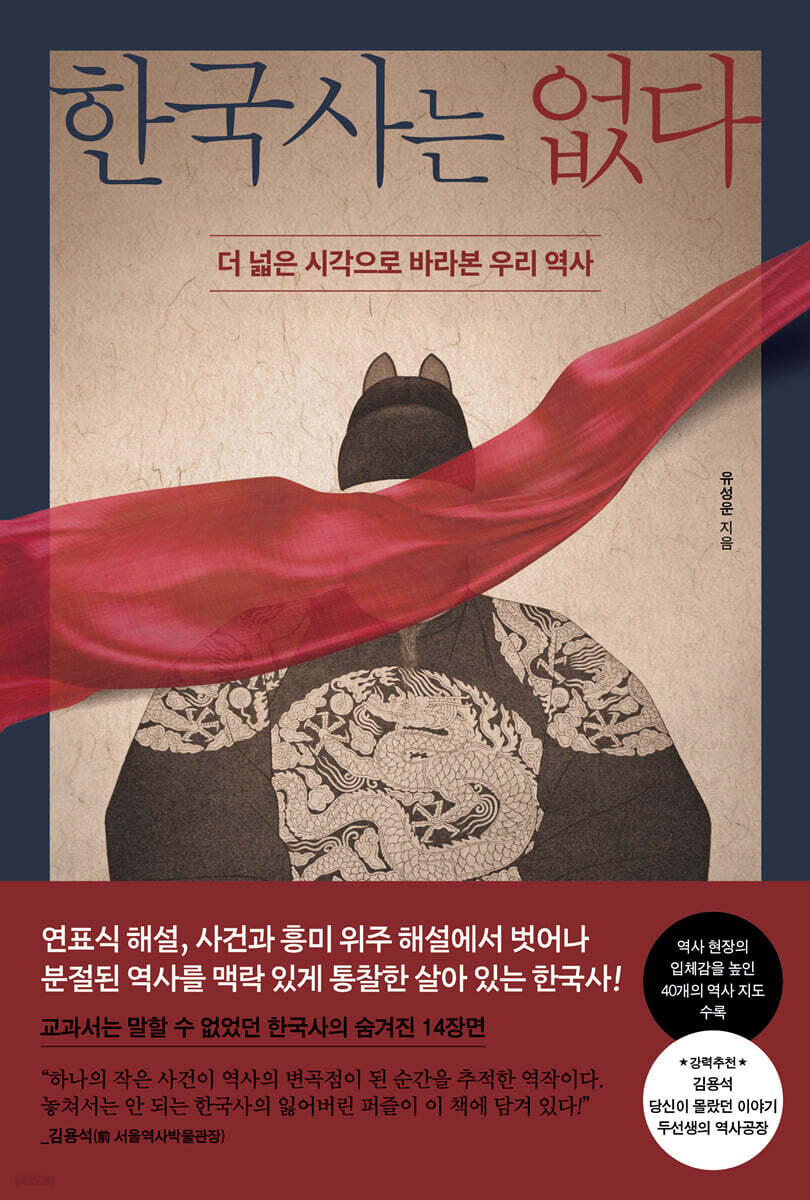
There is no Korean history
 |
Description
Book Introduction
Beyond ‘history known’ to ‘history used’
A masterpiece of Korean history that pioneered new territory!
14 Crucial Events That Made a Turning Point in East Asian and Korean History
And the inevitable laws that guarantee the presentness of history
It is only natural to want to know the past actions of key figures who are directly or indirectly related to me.
Past history contains a wealth of information about a person, which serves as a criterion for judging the truth of his words and actions, current situation, and abilities.
The reason for exploring history is similar.
The true role of the discipline of history is to understand the reality of this world and the meaning hidden behind various phenomena by looking into events that occurred in the past.
But if you focus only on events and people, it is not a proper study of history.
Education and learning that involves memorizing historical timelines may be helpful for showing off knowledge, but it has limitations in applying the past to the present.
Yet most history books focus on the achievements of major kings and great men, only covering the surface of events and repeating a boringly similar repertoire.
This is because most authors describe history within the framework of history without considering the various variables that move history.
"There is no Korean history" does not limit the driving force of history to conflicts between nations and peoples or the political intentions of the powers that represent the times.
The decisions of some leaders, including kings, and the wars and new endeavors that followed were just one of the many wheels that moved history.
More importantly, it is important to understand the background of which leadership group made such a decision and the events that followed.
Only by examining the cause, process, and outcome of an event, including its impact on the near future, can the past, called history, acquire a sense of the present.
Furthermore, we can grasp the inevitable laws and directions inherent in the flow of history and apply them to the present and future.
This book interprets Korean history from a broad perspective, including non-historical factors such as climatology, geography, and sociology, as well as the contemporary world situation and changes in the times.
It takes a chronological look at the five thousand years of our history from Hwanung and Dangun to the Japanese colonial period, and then delves deeper into the decisive events that changed the course of Korean history.
Rather than simply covering the incident itself, it first examines the inevitable conditions that made it inevitable, presents the cause and background, and even reveals the impact the incident had on later generations.
When we look at our history from this perspective of world history, from a global perspective, things that were previously invisible begin to become visible, and issues that were never resolved within the framework of Korean history are resolved.
And the perspective on phenomena becomes broader and deeper.
Readers who open this book will have the curious experience of history becoming a useful tool in reality.
A masterpiece of Korean history that pioneered new territory!
14 Crucial Events That Made a Turning Point in East Asian and Korean History
And the inevitable laws that guarantee the presentness of history
It is only natural to want to know the past actions of key figures who are directly or indirectly related to me.
Past history contains a wealth of information about a person, which serves as a criterion for judging the truth of his words and actions, current situation, and abilities.
The reason for exploring history is similar.
The true role of the discipline of history is to understand the reality of this world and the meaning hidden behind various phenomena by looking into events that occurred in the past.
But if you focus only on events and people, it is not a proper study of history.
Education and learning that involves memorizing historical timelines may be helpful for showing off knowledge, but it has limitations in applying the past to the present.
Yet most history books focus on the achievements of major kings and great men, only covering the surface of events and repeating a boringly similar repertoire.
This is because most authors describe history within the framework of history without considering the various variables that move history.
"There is no Korean history" does not limit the driving force of history to conflicts between nations and peoples or the political intentions of the powers that represent the times.
The decisions of some leaders, including kings, and the wars and new endeavors that followed were just one of the many wheels that moved history.
More importantly, it is important to understand the background of which leadership group made such a decision and the events that followed.
Only by examining the cause, process, and outcome of an event, including its impact on the near future, can the past, called history, acquire a sense of the present.
Furthermore, we can grasp the inevitable laws and directions inherent in the flow of history and apply them to the present and future.
This book interprets Korean history from a broad perspective, including non-historical factors such as climatology, geography, and sociology, as well as the contemporary world situation and changes in the times.
It takes a chronological look at the five thousand years of our history from Hwanung and Dangun to the Japanese colonial period, and then delves deeper into the decisive events that changed the course of Korean history.
Rather than simply covering the incident itself, it first examines the inevitable conditions that made it inevitable, presents the cause and background, and even reveals the impact the incident had on later generations.
When we look at our history from this perspective of world history, from a global perspective, things that were previously invisible begin to become visible, and issues that were never resolved within the framework of Korean history are resolved.
And the perspective on phenomena becomes broader and deeper.
Readers who open this book will have the curious experience of history becoming a useful tool in reality.
- You can preview some of the book's contents.
Preview
index
Recommendation 1: I've found a proper Korean history book! (Kim Yong-seok)
Recommendation 2: Korean History for the Developed Republic of Korea and for Global Citizens (Han Young-jun)
Recommendation 3: No history book has ever recreated the past more vividly! (Park Jun-hong)
Author's Note: Looking at Korean History Beyond Korean History
Chapter 1: Why is the tiger, not the bear, the animal that symbolizes our people?
: Historical facts told by the Dangun legend
Is Hwanung the real protagonist of the Dangun legend? │ The 4.2ka event collapses the ancient world │ The changes brought about by Hwanung's forces with advanced agricultural knowledge │ The Dangun legend shows the changes in the ruling power of the Korean Peninsula │ So why did the tiger become the symbol of our people?
Chapter 2: The Truth Behind the History of Lelang Commandery, the Ancient Chinese Empire of the Korean Peninsula
: The legacy that Hansagun left in our history
Han (漢) attacks Gojoseon and establishes the Four Commanderies of Han│Why did Emperor Wu of Han attack Gojoseon 1: Decoupling│Why did Emperor Wu of Han attack Gojoseon 2: Isolate the Huns│Where were the Four Commanderies of Han?│Nakrang, the cosmopolis of ancient East Asia│The legacy of the Nakrang Commanderies│Is the Nakrang Commanderies a shameful part of our nation's history?
Chapter 3: The Decisive Event that Led to the Rapid Rise of Silla, a Weak State on the Frontier
: The Trojan War on the Korean Peninsula, the Rebellion of the Eight Kingdoms
The Southwest Coastal Sea Route, National Route 1 of the Three Kingdoms Period│Trade Routes Blocked by the Destruction of Lelang Commandery│Geumgwan Gaya, the Jewel of East Asia│The Trojan War of East Asia, the Rebellion of the Eight Kingdoms of Posang│The Reversed Status of Silla and Geumgwan Gaya
Chapter 4 Why did King Jangsu abandon the vast Manchuria and head south?
: The diplomatic power of Goguryeo, a military powerhouse
The era of the boring Jangsu King│Go South│The cold spell and Goguryeo's southward advance│Block Goguryeo: Baekje's version of the 'Quad'│Neutralizing Goguryeo's 'Quad'│King Gaero's bold gamble│King Jangsu takes action│Unification of the Sui Dynasty, Goguryeo's crisis│The last spark of Goguryeo diplomacy│What the Afrasiab murals tell us
Chapter 5: The Ancient Mysteries Hidden in Japanese Tombs and Chinese Customs Remaining in Our Land
: What do the uncomfortable traces engraved on our land tell us?
The birth story of King Muryeong, like a soap opera│Was Wa a weak, underdeveloped nation?│The mysterious tomb│Jeollanam-do stuck in the tomb?│The era of the Japanese kings│Corpses discovered in Gyeongju│The Qin people who came to Silla
Chapter 6: The Habsburg Dynasty of the Korean Peninsula and the Goryeo Dynasty's Ruling Strategy
: Observing the international situation with a businessman's mindset
A Merchant Family│Why Did Wang Geon Go to Naju?│Goryeo's Habsburg Strategy│Was Goryeo a Free Trade Nation?│The Multipolar International Environment That Created Goryeo
Chapter 7: Pax Mongolica's Legacy in Goryeo and Joseon
: Is the Mongol intervention a history of shame?
Wang Jeon's Gamble Against the Mongols│A Successful Gamble Saves Goryeo│Kublai Khan's Gift│Goryeo's Abandonment of Resistance Against the Mongols and the Invasion of Japan│The Legend of Mukuri and Kokuri│Was Goryeo's Abandonment of Resistance Against the Mongols a Humiliation?│Was All Mongol Intervention in Politics Bad?│The Benefits of Pax Mongolica
Chapter 8: World Affairs and Climate Change That Made the Founding of Joseon Inevitable
: A climate story that shook the medieval history of the Korean Peninsula
Pax Mongolica, swept by the 14th-century cold snap. The cold snap's scarcity sparked innovations in land use. Jeong Do-jeon's land reforms. The Japanese pirates, a greater threat than the Mongols. The end of the free trade system.
Chapter 9: Why King Sejong the Great, a Monarch Who Loved the People, Was Passive in His Policy of Suppressing Slavery
: Why did the slave system develop so much in the late Goryeo and Joseon societies?
The Global Slave Market of the 16th Century│Joseon Slaves of Jewish Portuguese Merchants│40% of Joseon's Population Were Slaves│Why Did the Number of Slaves Increase So Rapidly in the Late Goryeo Dynasty?│The Age of Large Farms│The Concentration and Selection of the Founding Powers of Joseon│Yi Hwang, the Man Who Increased the Number of Slaves through Yangcheon Marriage│The King Who Tried to Reduce the Number of Slaves, and the Nobles Who Tried to Increase It
Chapter 10: The Age of Exploration: A Crucial Event That Reversed the Positions of Joseon and Japan
: The rapid changes in the world situation after Pax Mongolica
The closed trade system of the Ming Dynasty│The secret behind tribute diplomacy│The Iwami Silver Mine│Was the Imjin War an economic war?│Why did China withdraw from the sea?│“One jin of lead can make two dong of silver.”│A huge amount of silver came from Japan│The silver-lead separation law blossomed in Japan│Whose specialty is ginseng?│To Japan instead of China
Chapter 11: Unsung Heroes of Korean History Who Overcame Climate Disaster
: The Byeongja Horan and the Daedong Law brought about by the Little Ice Age
The Imjin War was a trailer│The Byeongja War staged by the Little Ice Age│The starving Jurchens target Joseon│Joseon becomes the rear supply base of the Later Jin Dynasty│Forests disappear with the spread of Ondol│The final crisis│The emergence of the Daedong Law│The Little Ice Age revives the Daedong Law│Hyeonjong did his best
Chapter 12 Why did the Koreans who were taken to Japan during the Imjin War not return to their homeland?
: Changes in Japan as seen through the eyes of Joseon Tongsinsa
Why did Joseon potters go to Kyushu? │Nabeshima or Shimazu, the conflicting fates of potters│Naeshirogawa, a small Joseon in Japan│The Meiji Restoration and the dissolution of Naeshirogawa│From potter to foreign minister, the journey of Park Pyeong's family│Why didn't the potters return to their home country?│Joseon and Japan needed to reestablish diplomatic relations│"Will there be no international missions in your country?"│The meeting of the Keimi envoy and Kamei Nanmei│Japan is a 'country of heresy'│The end of the envoy
Chapter 13: When did the sentiment of preferring Seoul begin?
: The origins of the Hanyang monopoly era and the concentration phenomenon in Seoul
From the TK Heyday to the Hanyang Heyday │ The Beginning of Seoul's Dominance │ Seoul's Allure and Soft Power That Captured Choi Han-ki │ Why Did Yoo Man-joo Go to Mapo to Borrow Money? │ East End and Mapo │ Seoul's Soaring Housing Prices
Chapter 14: The Value of the Korean Peninsula and the Fate of Joseon as Seen by Modern Powers
: The crossroads chosen by Korea and Japan in the face of the massive waves of imperialism
The Strange Cohabitation of the Islanders of Geomundo and the British Navy│Russia's Expansion into the Ocean and Britain's Confrontation to Block It│The Value of Geomundo That the Great Powers Pay Attention to│Joseon's Unintentional 'Gamble': Ina Geocheong│Japan and Joseon's Attitudes to the Great Powers│Japan's Anti-Russian Fear and the Eulmi Incident│The Anglo-Japanese Alliance That Gave Japan Wings
Recommendation 2: Korean History for the Developed Republic of Korea and for Global Citizens (Han Young-jun)
Recommendation 3: No history book has ever recreated the past more vividly! (Park Jun-hong)
Author's Note: Looking at Korean History Beyond Korean History
Chapter 1: Why is the tiger, not the bear, the animal that symbolizes our people?
: Historical facts told by the Dangun legend
Is Hwanung the real protagonist of the Dangun legend? │ The 4.2ka event collapses the ancient world │ The changes brought about by Hwanung's forces with advanced agricultural knowledge │ The Dangun legend shows the changes in the ruling power of the Korean Peninsula │ So why did the tiger become the symbol of our people?
Chapter 2: The Truth Behind the History of Lelang Commandery, the Ancient Chinese Empire of the Korean Peninsula
: The legacy that Hansagun left in our history
Han (漢) attacks Gojoseon and establishes the Four Commanderies of Han│Why did Emperor Wu of Han attack Gojoseon 1: Decoupling│Why did Emperor Wu of Han attack Gojoseon 2: Isolate the Huns│Where were the Four Commanderies of Han?│Nakrang, the cosmopolis of ancient East Asia│The legacy of the Nakrang Commanderies│Is the Nakrang Commanderies a shameful part of our nation's history?
Chapter 3: The Decisive Event that Led to the Rapid Rise of Silla, a Weak State on the Frontier
: The Trojan War on the Korean Peninsula, the Rebellion of the Eight Kingdoms
The Southwest Coastal Sea Route, National Route 1 of the Three Kingdoms Period│Trade Routes Blocked by the Destruction of Lelang Commandery│Geumgwan Gaya, the Jewel of East Asia│The Trojan War of East Asia, the Rebellion of the Eight Kingdoms of Posang│The Reversed Status of Silla and Geumgwan Gaya
Chapter 4 Why did King Jangsu abandon the vast Manchuria and head south?
: The diplomatic power of Goguryeo, a military powerhouse
The era of the boring Jangsu King│Go South│The cold spell and Goguryeo's southward advance│Block Goguryeo: Baekje's version of the 'Quad'│Neutralizing Goguryeo's 'Quad'│King Gaero's bold gamble│King Jangsu takes action│Unification of the Sui Dynasty, Goguryeo's crisis│The last spark of Goguryeo diplomacy│What the Afrasiab murals tell us
Chapter 5: The Ancient Mysteries Hidden in Japanese Tombs and Chinese Customs Remaining in Our Land
: What do the uncomfortable traces engraved on our land tell us?
The birth story of King Muryeong, like a soap opera│Was Wa a weak, underdeveloped nation?│The mysterious tomb│Jeollanam-do stuck in the tomb?│The era of the Japanese kings│Corpses discovered in Gyeongju│The Qin people who came to Silla
Chapter 6: The Habsburg Dynasty of the Korean Peninsula and the Goryeo Dynasty's Ruling Strategy
: Observing the international situation with a businessman's mindset
A Merchant Family│Why Did Wang Geon Go to Naju?│Goryeo's Habsburg Strategy│Was Goryeo a Free Trade Nation?│The Multipolar International Environment That Created Goryeo
Chapter 7: Pax Mongolica's Legacy in Goryeo and Joseon
: Is the Mongol intervention a history of shame?
Wang Jeon's Gamble Against the Mongols│A Successful Gamble Saves Goryeo│Kublai Khan's Gift│Goryeo's Abandonment of Resistance Against the Mongols and the Invasion of Japan│The Legend of Mukuri and Kokuri│Was Goryeo's Abandonment of Resistance Against the Mongols a Humiliation?│Was All Mongol Intervention in Politics Bad?│The Benefits of Pax Mongolica
Chapter 8: World Affairs and Climate Change That Made the Founding of Joseon Inevitable
: A climate story that shook the medieval history of the Korean Peninsula
Pax Mongolica, swept by the 14th-century cold snap. The cold snap's scarcity sparked innovations in land use. Jeong Do-jeon's land reforms. The Japanese pirates, a greater threat than the Mongols. The end of the free trade system.
Chapter 9: Why King Sejong the Great, a Monarch Who Loved the People, Was Passive in His Policy of Suppressing Slavery
: Why did the slave system develop so much in the late Goryeo and Joseon societies?
The Global Slave Market of the 16th Century│Joseon Slaves of Jewish Portuguese Merchants│40% of Joseon's Population Were Slaves│Why Did the Number of Slaves Increase So Rapidly in the Late Goryeo Dynasty?│The Age of Large Farms│The Concentration and Selection of the Founding Powers of Joseon│Yi Hwang, the Man Who Increased the Number of Slaves through Yangcheon Marriage│The King Who Tried to Reduce the Number of Slaves, and the Nobles Who Tried to Increase It
Chapter 10: The Age of Exploration: A Crucial Event That Reversed the Positions of Joseon and Japan
: The rapid changes in the world situation after Pax Mongolica
The closed trade system of the Ming Dynasty│The secret behind tribute diplomacy│The Iwami Silver Mine│Was the Imjin War an economic war?│Why did China withdraw from the sea?│“One jin of lead can make two dong of silver.”│A huge amount of silver came from Japan│The silver-lead separation law blossomed in Japan│Whose specialty is ginseng?│To Japan instead of China
Chapter 11: Unsung Heroes of Korean History Who Overcame Climate Disaster
: The Byeongja Horan and the Daedong Law brought about by the Little Ice Age
The Imjin War was a trailer│The Byeongja War staged by the Little Ice Age│The starving Jurchens target Joseon│Joseon becomes the rear supply base of the Later Jin Dynasty│Forests disappear with the spread of Ondol│The final crisis│The emergence of the Daedong Law│The Little Ice Age revives the Daedong Law│Hyeonjong did his best
Chapter 12 Why did the Koreans who were taken to Japan during the Imjin War not return to their homeland?
: Changes in Japan as seen through the eyes of Joseon Tongsinsa
Why did Joseon potters go to Kyushu? │Nabeshima or Shimazu, the conflicting fates of potters│Naeshirogawa, a small Joseon in Japan│The Meiji Restoration and the dissolution of Naeshirogawa│From potter to foreign minister, the journey of Park Pyeong's family│Why didn't the potters return to their home country?│Joseon and Japan needed to reestablish diplomatic relations│"Will there be no international missions in your country?"│The meeting of the Keimi envoy and Kamei Nanmei│Japan is a 'country of heresy'│The end of the envoy
Chapter 13: When did the sentiment of preferring Seoul begin?
: The origins of the Hanyang monopoly era and the concentration phenomenon in Seoul
From the TK Heyday to the Hanyang Heyday │ The Beginning of Seoul's Dominance │ Seoul's Allure and Soft Power That Captured Choi Han-ki │ Why Did Yoo Man-joo Go to Mapo to Borrow Money? │ East End and Mapo │ Seoul's Soaring Housing Prices
Chapter 14: The Value of the Korean Peninsula and the Fate of Joseon as Seen by Modern Powers
: The crossroads chosen by Korea and Japan in the face of the massive waves of imperialism
The Strange Cohabitation of the Islanders of Geomundo and the British Navy│Russia's Expansion into the Ocean and Britain's Confrontation to Block It│The Value of Geomundo That the Great Powers Pay Attention to│Joseon's Unintentional 'Gamble': Ina Geocheong│Japan and Joseon's Attitudes to the Great Powers│Japan's Anti-Russian Fear and the Eulmi Incident│The Anglo-Japanese Alliance That Gave Japan Wings
Detailed image
.jpg)
Into the book
It was no coincidence.
King Jangsu's southward expansion policy, the beginning of the Five Kingdoms and Sixteen States period, and the fall of the Roman Empire (476 AD) were all scenes of history orchestrated by climate.
In this way, history is closely intertwined with climate, environment, and world affairs.
The space that can be created by the will of any individual or political force is very narrow.
Therefore, if we only look at our own country's history, we will miss these links.
---From “Author’s Note: Looking at Korean History Beyond Korean History”
As the population grew, food shortages began to arise.
To solve this problem, mankind chose agriculture.
Agriculture allowed us to support a growing population by maximizing food production in a limited area.
The Çatalhöyük ruins, excavated in Turkey in the late 20th century, clearly illustrate this human process.
Archaeologists have confirmed that the people who lived here initially made a living by hunting, gathering, and raising livestock, but when faced with food shortages, they supplemented their food with primitive agriculture.
Schools teach the pattern of 'beginning of agriculture → settling down', but the excavation of the Çatalhöyük ruins has led archaeologists to listen to the new argument of 'settling down → start of agriculture'.
---From "Why is the animal that symbolizes our people a tiger and not a bear?"
Hunting and gathering solve the food problem in a short period of time.
On the other hand, farming requires labor to sow seeds, water them, and remove weeds, and a long time for the crops to grow.
The transition from hunter-gatherers to farmers must have been as arduous as going without sunlight for 100 days and surviving solely on mugwort and garlic.
In the end, the tribe symbolized by the tiger could not endure this arduous process and was thrown out.
And the remaining bear tribe joined forces with Hwanung's forces and established a nation (Gojoseon).
---From "Why is the animal that symbolizes our people a tiger and not a bear?"
After Caesar's conquest, Britain was under Roman rule for about 400 years.
In some ways, it was a time of humiliation and could be called a dark age in British history.
But the British people didn't seem to think that way.
Not only is this place well preserved and promoted as a major tourist attraction, but the year I visited, 2022, was also the British Heritage Foundation's designated Hadrian's Wall Visit Year.
---From "Historical Truths Concerning the Ancient Chinese and Lelang Commanderies of the Korean Peninsula"
The background to the Sui and Tang Dynasties' repeated invasions of Goguryeo, despite the enormous expenditure of national power, was not much different from that of this time.
This is usually the process.
① After a unified nation was established on the continent and ② internal chaos was resolved, ③ their gaze naturally turned to the Korean Peninsula.
China's perception of the Korean Peninsula, which has persisted since Emperor Wu of Han, has been that it cannot be left alone unless it serves as a fence protecting the China-centered Sino-Korean system.
Is it a coincidence that tensions between South Korea and China are rising as the Xi Jinping era solidifies?
---From "Historical Truths Concerning the Ancient Chinese and Lelang Commanderies of the Korean Peninsula"
The 400-year history of Nakrang Commandery had a great impact on the Korean Peninsula.
It is known that Gojoseon was governed by eight articles of law, but during the Nakrang Commandery period, the number of articles of law increased to a whopping 60.
This is because the social structure became more complex, including the introduction of a monetary economy as it was incorporated into the administrative system of one country.
During this period, Nakrang Commandery was the most advanced region in civilization compared to other regions of the Korean Peninsula.
So, the Nakrang Commandery played the role of a messenger who spread advanced civilization to each country on the Korean Peninsula.
---From "Historical Truths Concerning the Ancient Chinese and Lelang Commanderies of the Korean Peninsula"
Textbooks often explain the rise of a nation primarily through the success of centralization, suppression of vested interests such as the nobility, and unification of public opinion through religion.
But isn't this explanation too politically driven? In fact, if these conditions were true, the countries that should be most prosperous in the world today might be Saudi Arabia and a few other Islamic nations.
King Jangsu's southward expansion policy, the beginning of the Five Kingdoms and Sixteen States period, and the fall of the Roman Empire (476 AD) were all scenes of history orchestrated by climate.
In this way, history is closely intertwined with climate, environment, and world affairs.
The space that can be created by the will of any individual or political force is very narrow.
Therefore, if we only look at our own country's history, we will miss these links.
---From “Author’s Note: Looking at Korean History Beyond Korean History”
As the population grew, food shortages began to arise.
To solve this problem, mankind chose agriculture.
Agriculture allowed us to support a growing population by maximizing food production in a limited area.
The Çatalhöyük ruins, excavated in Turkey in the late 20th century, clearly illustrate this human process.
Archaeologists have confirmed that the people who lived here initially made a living by hunting, gathering, and raising livestock, but when faced with food shortages, they supplemented their food with primitive agriculture.
Schools teach the pattern of 'beginning of agriculture → settling down', but the excavation of the Çatalhöyük ruins has led archaeologists to listen to the new argument of 'settling down → start of agriculture'.
---From "Why is the animal that symbolizes our people a tiger and not a bear?"
Hunting and gathering solve the food problem in a short period of time.
On the other hand, farming requires labor to sow seeds, water them, and remove weeds, and a long time for the crops to grow.
The transition from hunter-gatherers to farmers must have been as arduous as going without sunlight for 100 days and surviving solely on mugwort and garlic.
In the end, the tribe symbolized by the tiger could not endure this arduous process and was thrown out.
And the remaining bear tribe joined forces with Hwanung's forces and established a nation (Gojoseon).
---From "Why is the animal that symbolizes our people a tiger and not a bear?"
After Caesar's conquest, Britain was under Roman rule for about 400 years.
In some ways, it was a time of humiliation and could be called a dark age in British history.
But the British people didn't seem to think that way.
Not only is this place well preserved and promoted as a major tourist attraction, but the year I visited, 2022, was also the British Heritage Foundation's designated Hadrian's Wall Visit Year.
---From "Historical Truths Concerning the Ancient Chinese and Lelang Commanderies of the Korean Peninsula"
The background to the Sui and Tang Dynasties' repeated invasions of Goguryeo, despite the enormous expenditure of national power, was not much different from that of this time.
This is usually the process.
① After a unified nation was established on the continent and ② internal chaos was resolved, ③ their gaze naturally turned to the Korean Peninsula.
China's perception of the Korean Peninsula, which has persisted since Emperor Wu of Han, has been that it cannot be left alone unless it serves as a fence protecting the China-centered Sino-Korean system.
Is it a coincidence that tensions between South Korea and China are rising as the Xi Jinping era solidifies?
---From "Historical Truths Concerning the Ancient Chinese and Lelang Commanderies of the Korean Peninsula"
The 400-year history of Nakrang Commandery had a great impact on the Korean Peninsula.
It is known that Gojoseon was governed by eight articles of law, but during the Nakrang Commandery period, the number of articles of law increased to a whopping 60.
This is because the social structure became more complex, including the introduction of a monetary economy as it was incorporated into the administrative system of one country.
During this period, Nakrang Commandery was the most advanced region in civilization compared to other regions of the Korean Peninsula.
So, the Nakrang Commandery played the role of a messenger who spread advanced civilization to each country on the Korean Peninsula.
---From "Historical Truths Concerning the Ancient Chinese and Lelang Commanderies of the Korean Peninsula"
Textbooks often explain the rise of a nation primarily through the success of centralization, suppression of vested interests such as the nobility, and unification of public opinion through religion.
But isn't this explanation too politically driven? In fact, if these conditions were true, the countries that should be most prosperous in the world today might be Saudi Arabia and a few other Islamic nations.
---From "The Decisive Event That Led to the Rapid Rise of Silla, a Weak Country on the Frontier"
Publisher's Review
“You can never properly understand Korean history within the framework of Korean history!”
Why did King Jangsu of Goguryeo, the nomadic peoples of China, and the Germanic peoples of Northern Europe move south at similar times?
Every citizen of the Republic of Korea studied ‘Korean History’, which was a required subject during their school years.
Even if you have built a wall with Korean history after graduating from school, you will probably remember some events.
Among them, there may be scenes that bring about regret, such as, ‘If only it had been like that back then…’
Perhaps one such example is King Jangsu of Goguryeo's southward expansion policy. King Jangsu's decision to abandon the vast territory his father, King Gwanggaeto the Great, a rare conqueror in Korean history, had expanded into northern Manchuria and instead turn his attention to the Han River region of the Korean Peninsula is bound to leave a deep regret for modern Koreans, who live in the hustle and bustle of the narrow Korean Peninsula.
But did you know that around the time King Jangsu abandoned Manchuria and headed for the Han River, similar events unfolded in China and Europe? In China, five nomadic tribes from the northern grasslands invaded the Central Plains in the south, pushing back the Chinese dynasties and ushering in the Five Hu and Sixteen Kingdoms period.
In Europe, Germanic tribes who had been living in Northern Europe migrated south in large numbers and shook the Roman Empire.
This is an event we learned about in school as the 'Great Migration of the Germanic Peoples'.
What caused the northern powers of the Korean Peninsula, China, and Europe to move south during such a similar period? The answer is climate.
Around the 4th to 5th centuries, a cold period occurred across the globe, lowering the average temperature. Grain production in the northern regions became difficult. King Jangsu of Goguryeo, the nomadic peoples of northern China, and the Germanic peoples of Northern Europe had no choice but to move their bases to the warm south, which brought about a historical transformation that cracked the existing order.
Without incorporating the variable of ‘climate’, there is no way to explain the flow of history that occurred during this period.
In Europe, the United States, China, and other countries, climatology, geography, and sociology are already being applied to interpret history.
On the other hand, our historical research still uses only the results of research within Korean history as data, and thus uses the political decisions of specific groups or territorial disputes as the most important yardstick.
But if we look at it from such a narrow perspective, there are so many unresolved issues.
It is a mistake to blame the isolationist policy of Heungseon Daewongun entirely for the reason that Joseon's modernization was later than that of Japan.
In fact, the biggest reason was that the slave system, which began in the late Goryeo Dynasty and was strengthened and expanded during the Joseon Dynasty, prevented the country's main labor force from being incorporated into merchants and urban workers.
“Making Korean history clearer
“An in-depth analysis of 14 cases!”
Expanding Korean history into world history while simultaneously bringing it into the daily lives of modern people.
This book comprehensively covers five thousand years of history from Gojoseon to the Japanese colonial period.
In doing so, it hits on 14 key points that must be addressed.
These 14 historical events are turning points that changed the course of Korean history, and at the same time, they are also points that resolve questions that have been difficult to resolve while studying Korean history.
Why did the Gom tribe, which united with Hwanung's forces, possessing advanced agricultural knowledge, and became part of Gojoseon, disappear from our history? What impact did the Hansa Commandery (Nangnang Commandery), which entered our land after the fall of Gojoseon, have on our nation-states on the Korean Peninsula? Why did Silla, the most backward of the three kingdoms of the Three Kingdoms period, become the driving force behind unification? Why did the Korean Peninsula, despite suffering numerous invasions, not become part of China or Japan? How did the Korean people's obsession with real estate originate? What is the connection between the Age of Exploration, which began in Europe, and the Imjin War? Why did Koreans taken to Japan during the Imjin War not return home? Why did the TK (Daegu/Gyeongbuk) region, a hideout for influential families, decline, giving way to the golden age of Hanyang (Seoul)? What was the geopolitical value of Joseon that modern powers coveted?
To answer questions that can never be overlooked while studying Korean history, this book covers 14 topics in depth, while not losing sight of the chronological structure that continues from 'Gojoseon - ancient states of the Korean Peninsula - Three Kingdoms Period - Unified Silla - Later Three Kingdoms Period - Goryeo - Joseon - Japanese Colonial Period.'
This structure is not only useful for reflecting on the historical significance of each event within the overall context of Korean history, but also opens up an easily accessible path for beginners in Korean history.
As previously stated, this book interprets our history by applying various elements such as climatology, geography, sociology, world affairs, changes in the times, and group psychology.
This attempt is a unique strength of this book that cannot be found in any other book on Korean history.
However, this does not mean that a new attempt to interpret history is a virtue in itself.
The true virtue of this book is that it uses a variety of tools to uncover the "real facts" hidden beneath the surface of historical events.
The facts unearthed in this way are not so simple as to be summarized in just a few lines, but they share a common thread: the struggles of the people of that time to survive by overcoming or adapting to changing times.
Because these struggles and efforts in life transcend space and race, the major events in Korean history are inevitably connected to world history.
The somewhat provocative title, “There Is No Korean History,” does not deny Korean history, but rather reveals that the time and events accumulated by our ancestors as they sought to overcome changing times and environments were an important trend that shaped world history and cannot be confined to the framework of Korean history.
Why did King Jangsu of Goguryeo, the nomadic peoples of China, and the Germanic peoples of Northern Europe move south at similar times?
Every citizen of the Republic of Korea studied ‘Korean History’, which was a required subject during their school years.
Even if you have built a wall with Korean history after graduating from school, you will probably remember some events.
Among them, there may be scenes that bring about regret, such as, ‘If only it had been like that back then…’
Perhaps one such example is King Jangsu of Goguryeo's southward expansion policy. King Jangsu's decision to abandon the vast territory his father, King Gwanggaeto the Great, a rare conqueror in Korean history, had expanded into northern Manchuria and instead turn his attention to the Han River region of the Korean Peninsula is bound to leave a deep regret for modern Koreans, who live in the hustle and bustle of the narrow Korean Peninsula.
But did you know that around the time King Jangsu abandoned Manchuria and headed for the Han River, similar events unfolded in China and Europe? In China, five nomadic tribes from the northern grasslands invaded the Central Plains in the south, pushing back the Chinese dynasties and ushering in the Five Hu and Sixteen Kingdoms period.
In Europe, Germanic tribes who had been living in Northern Europe migrated south in large numbers and shook the Roman Empire.
This is an event we learned about in school as the 'Great Migration of the Germanic Peoples'.
What caused the northern powers of the Korean Peninsula, China, and Europe to move south during such a similar period? The answer is climate.
Around the 4th to 5th centuries, a cold period occurred across the globe, lowering the average temperature. Grain production in the northern regions became difficult. King Jangsu of Goguryeo, the nomadic peoples of northern China, and the Germanic peoples of Northern Europe had no choice but to move their bases to the warm south, which brought about a historical transformation that cracked the existing order.
Without incorporating the variable of ‘climate’, there is no way to explain the flow of history that occurred during this period.
In Europe, the United States, China, and other countries, climatology, geography, and sociology are already being applied to interpret history.
On the other hand, our historical research still uses only the results of research within Korean history as data, and thus uses the political decisions of specific groups or territorial disputes as the most important yardstick.
But if we look at it from such a narrow perspective, there are so many unresolved issues.
It is a mistake to blame the isolationist policy of Heungseon Daewongun entirely for the reason that Joseon's modernization was later than that of Japan.
In fact, the biggest reason was that the slave system, which began in the late Goryeo Dynasty and was strengthened and expanded during the Joseon Dynasty, prevented the country's main labor force from being incorporated into merchants and urban workers.
“Making Korean history clearer
“An in-depth analysis of 14 cases!”
Expanding Korean history into world history while simultaneously bringing it into the daily lives of modern people.
This book comprehensively covers five thousand years of history from Gojoseon to the Japanese colonial period.
In doing so, it hits on 14 key points that must be addressed.
These 14 historical events are turning points that changed the course of Korean history, and at the same time, they are also points that resolve questions that have been difficult to resolve while studying Korean history.
Why did the Gom tribe, which united with Hwanung's forces, possessing advanced agricultural knowledge, and became part of Gojoseon, disappear from our history? What impact did the Hansa Commandery (Nangnang Commandery), which entered our land after the fall of Gojoseon, have on our nation-states on the Korean Peninsula? Why did Silla, the most backward of the three kingdoms of the Three Kingdoms period, become the driving force behind unification? Why did the Korean Peninsula, despite suffering numerous invasions, not become part of China or Japan? How did the Korean people's obsession with real estate originate? What is the connection between the Age of Exploration, which began in Europe, and the Imjin War? Why did Koreans taken to Japan during the Imjin War not return home? Why did the TK (Daegu/Gyeongbuk) region, a hideout for influential families, decline, giving way to the golden age of Hanyang (Seoul)? What was the geopolitical value of Joseon that modern powers coveted?
To answer questions that can never be overlooked while studying Korean history, this book covers 14 topics in depth, while not losing sight of the chronological structure that continues from 'Gojoseon - ancient states of the Korean Peninsula - Three Kingdoms Period - Unified Silla - Later Three Kingdoms Period - Goryeo - Joseon - Japanese Colonial Period.'
This structure is not only useful for reflecting on the historical significance of each event within the overall context of Korean history, but also opens up an easily accessible path for beginners in Korean history.
As previously stated, this book interprets our history by applying various elements such as climatology, geography, sociology, world affairs, changes in the times, and group psychology.
This attempt is a unique strength of this book that cannot be found in any other book on Korean history.
However, this does not mean that a new attempt to interpret history is a virtue in itself.
The true virtue of this book is that it uses a variety of tools to uncover the "real facts" hidden beneath the surface of historical events.
The facts unearthed in this way are not so simple as to be summarized in just a few lines, but they share a common thread: the struggles of the people of that time to survive by overcoming or adapting to changing times.
Because these struggles and efforts in life transcend space and race, the major events in Korean history are inevitably connected to world history.
The somewhat provocative title, “There Is No Korean History,” does not deny Korean history, but rather reveals that the time and events accumulated by our ancestors as they sought to overcome changing times and environments were an important trend that shaped world history and cannot be confined to the framework of Korean history.
GOODS SPECIFICS
- Date of issue: August 5, 2024
- Page count, weight, size: 356 pages | 618g | 152*226*21mm
- ISBN13: 9791169850926
- ISBN10: 1169850928
You may also like
카테고리
korean


korean

![GQ KOREA Mark (Monthly): December [2025]](http://librairie.coreenne.fr/cdn/shop/files/8ef265dbbfbf186523ed75ba7319009d.jpg?v=1765340328&width=3840)


