

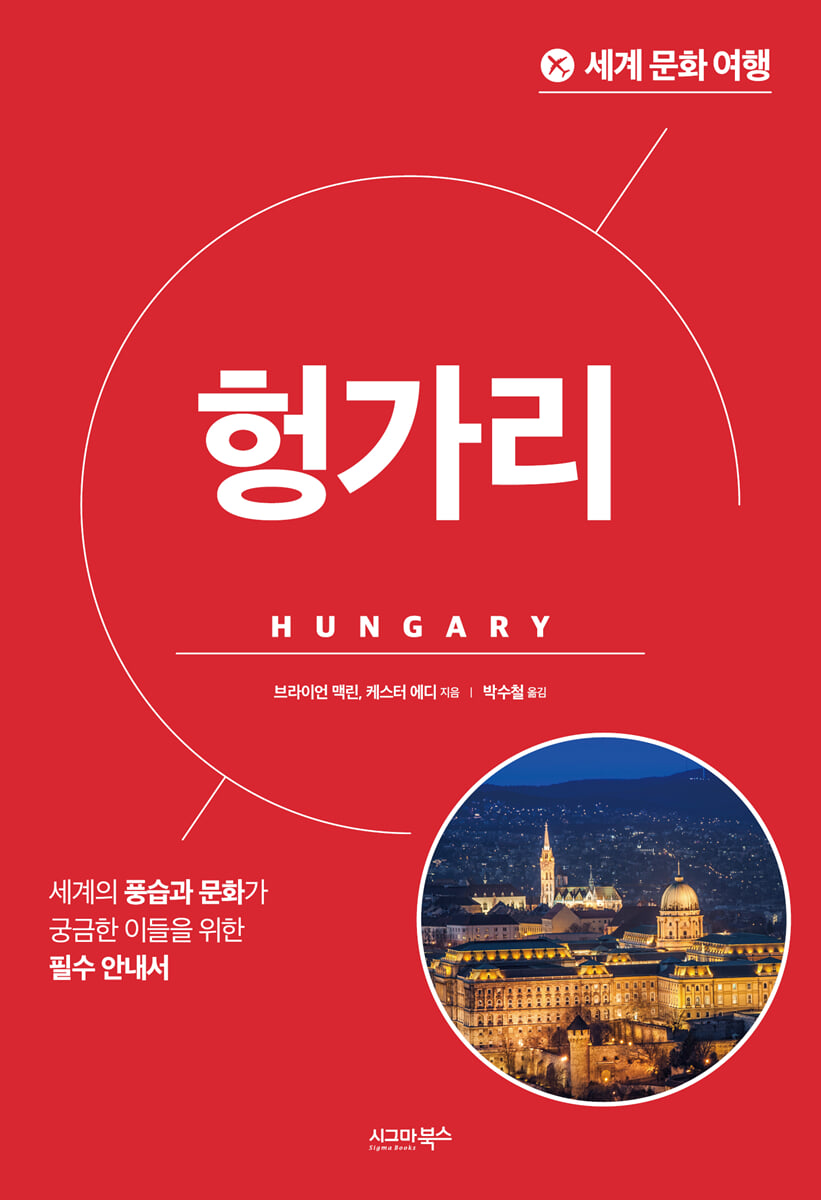
World Cultural Journey - Hungary
 |
Description
Book Introduction
Hungarian customs, history, culture, lifestyle, and life
This book is the Hungary (revised edition) edition of the World Cultural Journey series, and covers the overall aspects of Hungarian customs, history, culture, lifestyle, and life.
Whether you're visiting Hungary for business or simply for pleasure, we'll help you make your time in Hungary richer and more memorable.
This book contains information on Hungarian local customs and traditions, history, religion, politics, Hungarian families, work, leisure, food, clothing, shelter, and communication.
This book is the Hungary (revised edition) edition of the World Cultural Journey series, and covers the overall aspects of Hungarian customs, history, culture, lifestyle, and life.
Whether you're visiting Hungary for business or simply for pleasure, we'll help you make your time in Hungary richer and more memorable.
This book contains information on Hungarian local customs and traditions, history, religion, politics, Hungarian families, work, leisure, food, clothing, shelter, and communication.
- You can preview some of the book's contents.
Preview
index
Hungary evangelism
Entering
Basic information
01 Territory and People
Geographic information
Climate and Weather
Historical Overview
form of government
politics
economy
Budapest
02 Values and mindset
Image and self-image
culture
The aftermath of communism
Fear and Change
Professional ethics
hierarchy and status
social fragmentation
expenditure
patriotism
Attitudes toward Gypsies
Attitude toward government authorities
Man and woman
Courtship and extramarital affairs
Church attendance
Attitudes toward sexual minorities
03 Customs and Traditions
Festivals and Holidays
family events
Name Day
From birth to death
04 Making Friends with Hungarians
A smile for a smile
Dialogue and Culture
Making friends
language problems
conduct
When you don't know what to say
Title
Nod slightly and say hello
When you are invited to a house
05 Family Life
Housing and Housing
daily lesson
Cost of living
home
education
Graduation ceremony
Love and sex
marriage
06 Leisure Life
Return to dust
Food and drinks
Eating out
bar
Popular performances
folk, rock, jazz
Art galleries and museums
Sports and Entertainment
Savings and Spending
shopping
To the countryside
a place with few people
Lake Balaton
Bathing and swimming
07 Travel, Health, and Safety
airplane
public transportation
Various means of transportation
taxi
road name
Driving culture
Suburban travel
health
police
08 Business Status
economy
Efforts to promote the growth and development of domestic companies
Business environment
business relationship
order
Good manners
Silent service
Presentation and negotiation
contract
Connections and creativity
09 Communication
Hungarian
media
Phone and Internet
Postal Service
conclusion
References
Entering
Basic information
01 Territory and People
Geographic information
Climate and Weather
Historical Overview
form of government
politics
economy
Budapest
02 Values and mindset
Image and self-image
culture
The aftermath of communism
Fear and Change
Professional ethics
hierarchy and status
social fragmentation
expenditure
patriotism
Attitudes toward Gypsies
Attitude toward government authorities
Man and woman
Courtship and extramarital affairs
Church attendance
Attitudes toward sexual minorities
03 Customs and Traditions
Festivals and Holidays
family events
Name Day
From birth to death
04 Making Friends with Hungarians
A smile for a smile
Dialogue and Culture
Making friends
language problems
conduct
When you don't know what to say
Title
Nod slightly and say hello
When you are invited to a house
05 Family Life
Housing and Housing
daily lesson
Cost of living
home
education
Graduation ceremony
Love and sex
marriage
06 Leisure Life
Return to dust
Food and drinks
Eating out
bar
Popular performances
folk, rock, jazz
Art galleries and museums
Sports and Entertainment
Savings and Spending
shopping
To the countryside
a place with few people
Lake Balaton
Bathing and swimming
07 Travel, Health, and Safety
airplane
public transportation
Various means of transportation
taxi
road name
Driving culture
Suburban travel
health
police
08 Business Status
economy
Efforts to promote the growth and development of domestic companies
Business environment
business relationship
order
Good manners
Silent service
Presentation and negotiation
contract
Connections and creativity
09 Communication
Hungarian
media
Phone and Internet
Postal Service
conclusion
References
Into the book
Hungarians call the fall of communism and the transformation of their country from a Soviet satellite state to an independent parliamentary democracy with a booming market economy "regime change" (Lendsservaltaš).
Hungary has passed a major economic and political test.
Economically, Hungary pursued a gradual approach rather than the "shock therapy" (transferring most state assets to ordinary citizens) favored by some former communist countries.
---From "Chapter 1 Territory and People"
The fact is that the image of Hungary in Central and Eastern Europe is different from the image in other regions.
Just as Hungarians often resent their neighbors, neighboring countries often dislike Hungary.
In the eyes of the peoples of neighboring countries, Hungary has not left a very honorable history in relation to the neighboring peoples it once ruled.
Currently, the Hungarian minority communities in neighboring countries sometimes become the focus of controversy.
Of course, the mutual hostility between the country's mainstream and Hungarian minority communities manifests itself in varying degrees.
Mutual hostility is relatively strong in Slovakia, Romania, and Serbia, and very weak in Austria, Croatia, and Slovenia.
---From "Chapter 2: Values and Way of Thinking"
Hungarian babies must be registered with the state within eight days of birth.
Most parents give their babies just one name, but about 5% of babies have two names.
The surname comes before the given name, but when introducing themselves in a foreign language, Hungarians prefer to put the surname after the given name.
Therefore, when introducing himself in English, Yano Kovac becomes Yano Kovac.
Some people use two surnames together.
Two surnames may or may not be hyphenated.
There is a custom of naming a boy after his father or grandfather.
---From "Chapter 3 Customs and Traditions"
Good manners begin with a greeting.
Please stand up! In Hungary, only older people greet each other while seated.
Generally, men greet women first, younger people greet older people, subordinates greet superiors, salespeople greet customers, and those who arrive later greet those who were there before.
Not greeting is bad behavior, but not returning a greeting is worse.
---From "Chapter 4: Becoming Friends with Hungarians"
Hungarian families raise their children with a level of pampering that might seem strange to Western Europeans or North Americans.
Hungarian parents pay close attention to their children's studies, often providing them with private tutoring or helping them with homework.
Teenagers from middle-class families participate in sports and music activities or take supplementary classes on weekday afternoons.
As a result, teenagers have relatively little time to form youth subcultures like those in Western Europe and North America.
On weekends, they usually help with housework, go out, or participate in certain activities.
---From "Chapter 5 Family Life"
Budapest is a paradise for opera, ballet and classical music lovers.
Considering the quality of the performance, the admission fee is very reasonable.
There are no additional fees, except for a few hundred forints tip when you leave the cloakroom after finishing your tour and picking up your belongings.
The Hungarian State Opera House is renowned as one of the world's finest late 19th-century theater buildings.
The list of works performed here in their original language includes works by Mozart, Verdi, Puccini, Wagner and others, all sung beautifully by Hungarian and foreign special guests; works by famous Hungarian composers such as Erkel, Bartók and Ranki; works by 20th-century composers such as Janáček, Prokofiev, Shostakovich and Britten; classical and modern ballets and contemporary musicals.
---From "Chapter 6 Leisure Life"
Licensed taxis are yellow.
There is heating and cooling, and you can pay with a bank card.
The fares are fixed rates, but they are not as cheap as they used to be.
The basic fare is $2, plus $1 per kilometer.
It's better not to hail a taxi on the street.
Because foreigners can use the baggage fee.
Tipping is generally 10% of the bill, but since bills have recently increased, there is no need to tip more.
Taxis can be chartered for half a day or a full day.
---From "Chapter 7 Travel, Health, and Safety"
Hungary has a number of leading domestic companies.
First, we can mention Mol, an oil company that recorded sales of $15 billion in 2015.
Mol plans to explore from the North Sea to Pakistan, has petrol stations across Europe and operates complex refineries in Croatia and Slovakia.
Meanwhile, OTP Bank is busy with acquisitions, and pharmaceutical company Gedeon Richter is exporting to North America, Russia, and other countries.
---From "Chapter 8 Business Status"
Hungarians are cheerful, fun, creative and friendly.
This characteristic has the effect of quickly breaking down the walls between people of all ages and genders.
Hungarians have a deep attachment to their homeland and its shining assets.
The Hungarian mindset that moves even foreigners is something worth cultivating.
Books written by Hungarians are worth reading, paintings drawn by Hungarians are worth looking at, and music composed by Hungarians is worth listening to.
The climate is pleasant nine months out of the year.
There are many opportunities to enjoy various cultural events and sports, and to engage in outdoor activities.
In Hungary, you can enjoy some of the most precious pleasures, such as drinking wine and eating, at affordable prices.
Hungary has passed a major economic and political test.
Economically, Hungary pursued a gradual approach rather than the "shock therapy" (transferring most state assets to ordinary citizens) favored by some former communist countries.
---From "Chapter 1 Territory and People"
The fact is that the image of Hungary in Central and Eastern Europe is different from the image in other regions.
Just as Hungarians often resent their neighbors, neighboring countries often dislike Hungary.
In the eyes of the peoples of neighboring countries, Hungary has not left a very honorable history in relation to the neighboring peoples it once ruled.
Currently, the Hungarian minority communities in neighboring countries sometimes become the focus of controversy.
Of course, the mutual hostility between the country's mainstream and Hungarian minority communities manifests itself in varying degrees.
Mutual hostility is relatively strong in Slovakia, Romania, and Serbia, and very weak in Austria, Croatia, and Slovenia.
---From "Chapter 2: Values and Way of Thinking"
Hungarian babies must be registered with the state within eight days of birth.
Most parents give their babies just one name, but about 5% of babies have two names.
The surname comes before the given name, but when introducing themselves in a foreign language, Hungarians prefer to put the surname after the given name.
Therefore, when introducing himself in English, Yano Kovac becomes Yano Kovac.
Some people use two surnames together.
Two surnames may or may not be hyphenated.
There is a custom of naming a boy after his father or grandfather.
---From "Chapter 3 Customs and Traditions"
Good manners begin with a greeting.
Please stand up! In Hungary, only older people greet each other while seated.
Generally, men greet women first, younger people greet older people, subordinates greet superiors, salespeople greet customers, and those who arrive later greet those who were there before.
Not greeting is bad behavior, but not returning a greeting is worse.
---From "Chapter 4: Becoming Friends with Hungarians"
Hungarian families raise their children with a level of pampering that might seem strange to Western Europeans or North Americans.
Hungarian parents pay close attention to their children's studies, often providing them with private tutoring or helping them with homework.
Teenagers from middle-class families participate in sports and music activities or take supplementary classes on weekday afternoons.
As a result, teenagers have relatively little time to form youth subcultures like those in Western Europe and North America.
On weekends, they usually help with housework, go out, or participate in certain activities.
---From "Chapter 5 Family Life"
Budapest is a paradise for opera, ballet and classical music lovers.
Considering the quality of the performance, the admission fee is very reasonable.
There are no additional fees, except for a few hundred forints tip when you leave the cloakroom after finishing your tour and picking up your belongings.
The Hungarian State Opera House is renowned as one of the world's finest late 19th-century theater buildings.
The list of works performed here in their original language includes works by Mozart, Verdi, Puccini, Wagner and others, all sung beautifully by Hungarian and foreign special guests; works by famous Hungarian composers such as Erkel, Bartók and Ranki; works by 20th-century composers such as Janáček, Prokofiev, Shostakovich and Britten; classical and modern ballets and contemporary musicals.
---From "Chapter 6 Leisure Life"
Licensed taxis are yellow.
There is heating and cooling, and you can pay with a bank card.
The fares are fixed rates, but they are not as cheap as they used to be.
The basic fare is $2, plus $1 per kilometer.
It's better not to hail a taxi on the street.
Because foreigners can use the baggage fee.
Tipping is generally 10% of the bill, but since bills have recently increased, there is no need to tip more.
Taxis can be chartered for half a day or a full day.
---From "Chapter 7 Travel, Health, and Safety"
Hungary has a number of leading domestic companies.
First, we can mention Mol, an oil company that recorded sales of $15 billion in 2015.
Mol plans to explore from the North Sea to Pakistan, has petrol stations across Europe and operates complex refineries in Croatia and Slovakia.
Meanwhile, OTP Bank is busy with acquisitions, and pharmaceutical company Gedeon Richter is exporting to North America, Russia, and other countries.
---From "Chapter 8 Business Status"
Hungarians are cheerful, fun, creative and friendly.
This characteristic has the effect of quickly breaking down the walls between people of all ages and genders.
Hungarians have a deep attachment to their homeland and its shining assets.
The Hungarian mindset that moves even foreigners is something worth cultivating.
Books written by Hungarians are worth reading, paintings drawn by Hungarians are worth looking at, and music composed by Hungarians is worth listening to.
The climate is pleasant nine months out of the year.
There are many opportunities to enjoy various cultural events and sports, and to engage in outdoor activities.
In Hungary, you can enjoy some of the most precious pleasures, such as drinking wine and eating, at affordable prices.
---From Chapter 9: Communication
Publisher's Review
Hungary, the heart of Eastern Europe, where romance flows
If you're planning a trip to Eastern Europe, you can't miss Hungary.
Just one photo of the Danube River in Budapest, considered one of the world's three greatest night views, is enough reason to visit Hungary.
And what about the Széchenyi Baths, said to be the largest thermal baths in Europe? After a relaxing soak in the Neo-Baroque-style thermal facilities, enjoy a glass of wine with a plate of poggers, a freshwater fish dish, at a nearby restaurant, and you'll experience a sense of relaxation unlike any other.
The neo-Gothic Parliament Building, the second largest in the world after the Houses of Parliament in the UK, is impressive, but it would also be quite meaningful to stroll through Kossuth Square in front of it and recite the poem "Death of a Girl in Budapest" by poet Kim Chun-su, which originated here.
Other attractions that attract travelers from around the world include the Fisherman's Bastion, also known as the White Fortress; Matthias Church, with its Gothic spires where the coronations and weddings of past kings were held; and the Renaissance-style Buda Castle, a center of culture and art.
A country of culture where you can experience classical music and famous paintings!
Hungary's charm is not limited to its famous tourist destinations.
There is a reason why Hungary is called the cultural center of Eastern Europe.
Geographically part of Europe, yet with an oriental feel, Hungary's captivating culture captivates people from all over the world.
While you can enjoy classical works by Mozart, Verdi, and Puccini, as well as classical ballet and opera in Hungary, you can't say you've truly experienced Hungarian culture without experiencing works by famous Hungarian composers like Erkel, Bartók, and Ranki, a lively folk dance performance at the Hungarian Folk Theatre, or a performance by the Budapest Gypsy Symphony Orchestra, nicknamed the "Gypsy Hundred Orchestra."
Another must-see attraction is the performance of a Gypsy band, which offers the surprising experience of transforming any tune in the world into Hungarian Gypsy music on the spot.
Moreover, Hungary has art museums where you can see famous paintings by Raphael, Goya, Monet, Manet, Cézanne, Renoir, Gauguin, Chagall, and Rembrandt, as well as museums with diverse themes such as socialist realist sculptures from the communist era, railways, textile production processes, and beer.
Hungary is still a strange country to us.
Not only is it geographically distant, but it is also because we have lived under a different system for the past 40 years.
But if you turn away from Hungary simply because you're unfamiliar with it, you're missing out on a chance to experience something new and fascinating.
This book will help you understand Hungary to some extent through its society, economy, politics, history, Hungarian values and way of thinking, customs and traditions, family life, and leisure activities.
You can see as much as you know, and find joy as much as you see.
Let's discover Hungary, a country that becomes more fascinating the more you learn about it through this book!
An essential guide for those curious about world customs and cultures.
The "World Cultural Journey" series is a guidebook that introduces the customs, culture, lifestyle, and life of various countries around the world.
It contains information about the beliefs, attitudes, and behaviors of people from various countries, allowing you to understand local etiquette and sensitive issues.
It will also help you avoid embarrassing mistakes abroad, build better relationships with locals, and maximize the effectiveness of your visit.
The 『World Cultural Journey』 series currently has 39 volumes published in Japan, China, Turkey, Portugal, Mongolia, Switzerland, Vietnam, Italy, Spain, Hong Kong, Cuba, Greece, New Zealand, Israel, Mexico, Austria, Hungary, Denmark, Norway, Netherlands, Singapore, Morocco, Laos, United Arab Emirates, Germany, France, Russia, Finland, Sweden, Iceland, Thailand, Philippines, Czech Republic, Belgium, Ethiopia, Canada, Poland, United States, and Bulgaria.
If you're planning a trip to Eastern Europe, you can't miss Hungary.
Just one photo of the Danube River in Budapest, considered one of the world's three greatest night views, is enough reason to visit Hungary.
And what about the Széchenyi Baths, said to be the largest thermal baths in Europe? After a relaxing soak in the Neo-Baroque-style thermal facilities, enjoy a glass of wine with a plate of poggers, a freshwater fish dish, at a nearby restaurant, and you'll experience a sense of relaxation unlike any other.
The neo-Gothic Parliament Building, the second largest in the world after the Houses of Parliament in the UK, is impressive, but it would also be quite meaningful to stroll through Kossuth Square in front of it and recite the poem "Death of a Girl in Budapest" by poet Kim Chun-su, which originated here.
Other attractions that attract travelers from around the world include the Fisherman's Bastion, also known as the White Fortress; Matthias Church, with its Gothic spires where the coronations and weddings of past kings were held; and the Renaissance-style Buda Castle, a center of culture and art.
A country of culture where you can experience classical music and famous paintings!
Hungary's charm is not limited to its famous tourist destinations.
There is a reason why Hungary is called the cultural center of Eastern Europe.
Geographically part of Europe, yet with an oriental feel, Hungary's captivating culture captivates people from all over the world.
While you can enjoy classical works by Mozart, Verdi, and Puccini, as well as classical ballet and opera in Hungary, you can't say you've truly experienced Hungarian culture without experiencing works by famous Hungarian composers like Erkel, Bartók, and Ranki, a lively folk dance performance at the Hungarian Folk Theatre, or a performance by the Budapest Gypsy Symphony Orchestra, nicknamed the "Gypsy Hundred Orchestra."
Another must-see attraction is the performance of a Gypsy band, which offers the surprising experience of transforming any tune in the world into Hungarian Gypsy music on the spot.
Moreover, Hungary has art museums where you can see famous paintings by Raphael, Goya, Monet, Manet, Cézanne, Renoir, Gauguin, Chagall, and Rembrandt, as well as museums with diverse themes such as socialist realist sculptures from the communist era, railways, textile production processes, and beer.
Hungary is still a strange country to us.
Not only is it geographically distant, but it is also because we have lived under a different system for the past 40 years.
But if you turn away from Hungary simply because you're unfamiliar with it, you're missing out on a chance to experience something new and fascinating.
This book will help you understand Hungary to some extent through its society, economy, politics, history, Hungarian values and way of thinking, customs and traditions, family life, and leisure activities.
You can see as much as you know, and find joy as much as you see.
Let's discover Hungary, a country that becomes more fascinating the more you learn about it through this book!
An essential guide for those curious about world customs and cultures.
The "World Cultural Journey" series is a guidebook that introduces the customs, culture, lifestyle, and life of various countries around the world.
It contains information about the beliefs, attitudes, and behaviors of people from various countries, allowing you to understand local etiquette and sensitive issues.
It will also help you avoid embarrassing mistakes abroad, build better relationships with locals, and maximize the effectiveness of your visit.
The 『World Cultural Journey』 series currently has 39 volumes published in Japan, China, Turkey, Portugal, Mongolia, Switzerland, Vietnam, Italy, Spain, Hong Kong, Cuba, Greece, New Zealand, Israel, Mexico, Austria, Hungary, Denmark, Norway, Netherlands, Singapore, Morocco, Laos, United Arab Emirates, Germany, France, Russia, Finland, Sweden, Iceland, Thailand, Philippines, Czech Republic, Belgium, Ethiopia, Canada, Poland, United States, and Bulgaria.
GOODS SPECIFICS
- Date of issue: June 3, 2024
- Page count, weight, size: 260 pages | 130*190*20mm
- ISBN13: 9791168622494
- ISBN10: 1168622492
You may also like
카테고리
korean


korean

![GQ KOREA Mark (Monthly): December [2025]](http://librairie.coreenne.fr/cdn/shop/files/8ef265dbbfbf186523ed75ba7319009d.jpg?v=1765340328&width=3840)


