

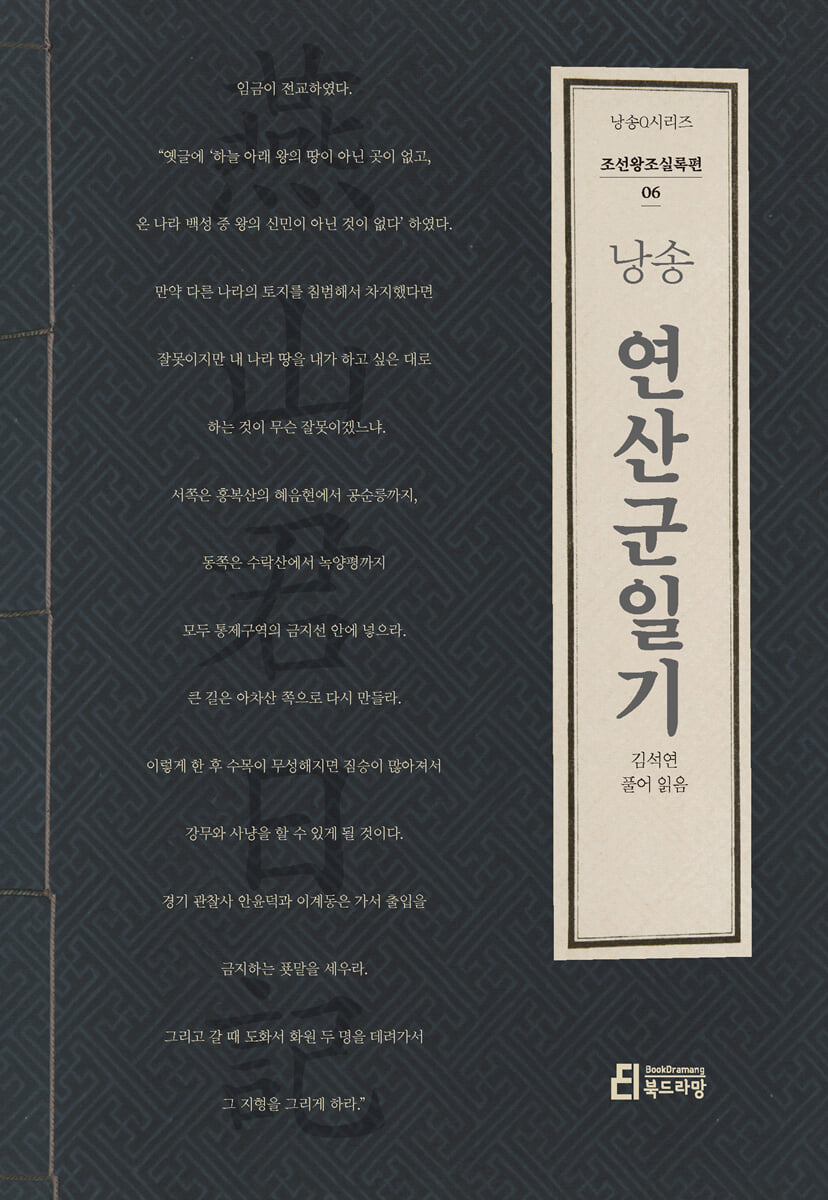
Recitation of the Diary of King Yeonsangun
 |
Description
Book Introduction
King Yeonsangun, possessing a tenacious personality, brought about his own downfall through fear. Meet all the Yeonsanguns before and after their 'blackening'! The story of King Yeonsangun from the Annals of the Joseon Dynasty, a recitation series that recounts the history of Joseon. Yeonsangun, the epitome of a tyrant who was ousted by the Jungjong Rebellion, also left behind records of the 12 years he reigned as a king under the name of a ‘diary’ rather than an ‘annual record.’ However, if you look at the full articles in the 『Diary of King Yeonsangun』, the character of King Yeonsangun during his first ten years on the throne is far from that of a tyrant. He may not be a great ruler, but he is not a tyrant either. He is an ordinary person, and this ordinariness is what makes him feel special. What made Yeonsangun a great tyrant? 『The Diary of King Yeonsangun』 is written to trace King Yeonsangun's innate limitations, innate personality, and the changes he went through along with this question. In 『The Diary of King Yeonsangun』, readers can encounter both the figure of a man with rich emotions who ascended to the throne with the innate limitations of being the eldest son of King Seongjong but also the son of a criminal (the deposed Queen Yun, who was expelled from the queen's position and executed), and the figure of an isolated tyrant who eventually expanded fear with his tenacious personality and brought about his own downfall. |
- You can preview some of the book's contents.
Preview
index
Preface: 『Recitation of the Diary of King Yeonsangun』? History as a Boundary
Part 1: Young King Yeonsangun
1-1.
The eldest son, who was eight years old and became crown prince
1-2.
Crown Prince Education Diligently Carried Out
1-3.
ascended the throne at the age of eighteen
1-4.
Buddhist Water and Land Disaster Wave 1
1-5.
Buddhist Water and Land Disaster Wave 2
1-6.
Heed the rebuke of heaven
1-7.
He is not a good king, but he is not a bad king either.
Part 2: Yeonsangun's Family Love
2-1.
Fallen maternal family
2-2.
Restoring Mother's Honor
2-3.
Lifelong lover, Queen Shin
2-4.
The joy of seeing atoms
2-5.
daughter fool
2-6.
Grandmother Park
2-7.
Generous spending towards siblings
2-8.
Take care of Prince Jinseong (Jungjong)
Part 3: The Bloody Wind Brought by Grandfather, the Muosahwa
3-1.
Kim Jong-jik's 'Condolence Message'
3-2.
Yu Ja-gwang, who opened the floodgates
3-3.
Bring me Kim Il-son's notes
3-4.
An atmosphere of imminent adjustment
3-5.
The secret story behind Kim Il-son's private collection
3-6.
This is a letter for Nosangun (Danjong)!
3-7.
Cut off the heads of five people, including Kim Il-son
3-8.
Burn their grass
Part 4: Gapjasahwa 1.
Yeonsangun, who opened the gates of hell
4-1.
A king who finds fault with everything and insults everything
4-2.
Lee Se-jwa pouring alcohol into Yongpo
4-3.
I am even more furious at the protection of my subjects.
4-4.
It's not a small mistake to have a glass of alcohol
4-5.
The exile and release of Lee Se-jwa
4-6.
Hong Gwi-dal, who poured oil on the fire
4-7.
Drive out Hong Gwi-dal
4-8.
The re-summoned Lee Se-jwa
4-9.
Those who do not impeach this throne should be imprisoned.
4-10.
Cut off the head of the mastermind of the blasphemy, Lee Se-jwa
4-11.
Beat Hong Gwi-dal with a stick and kill him
Part 5: Gapjasahwa 2.
Runaway operations
5-1.
Im Sa-hong instigates Yeonsangun
5-2.
King Seongjong's concubines who became pickled seafood
5-3.
As the conspirators who falsely accused the deposed queen said,
5-4.
Grandma, why did you kill mother?
5-5.
Reduce the number of days until Grandma's funeral
5-6.
My grandmother was not able to become the queen of the nation.
5-7.
The blade of anger directed towards the adjustment
5-8.
After examining the adjutant, crush the bones.
5-9.
Kill all those who were spared in the year of the Ox.
5-10.
be driven mad
Part 6: The Empire of Sense and Pleasure
6-1.
Poet Yeonsangun, who left behind over a hundred poems.
6-2.
Dancer Yeonsan's love for Cheoyongmu
6-3.
Designer Operations
6-4.
Owner of a sensitive palate
6-5.
The completion of the era of peace is music
6-6.
Managed gisaeng and musician
6-7.
Excitement exists only for me
6-8.
Heungcheong's suffocating daily life
Part 7: Reign of Terror and Dethronement
7-1.
Remove the license according to the law
7-2.
The word of the king is law
7-3.
Those who break the golden sign, destroy their entire clan.
7-4.
People whose lives were ruined by the gold standard
7-5.
Don't let anyone see inside the palace.
7-6.
Don't talk nonsense
7-7.
The subjects who became herders
7-8.
No need for competition
7-9.
Rebellion, driven out by trusted subjects
7-10.
A lonely ending
7-11.
A wife left alone with her young sons who were killed
7-12.
The death of the chieftains
7-13.
Various stories about Yeonsangun
People who lived during the 8th Yeonsangun era
8-1.
No Sa-shin, the mainstay of Yeonsangun
8-2.
Eunuch Kim Cheo-seon, who died after giving advice
8-3.
Im Sa-hong, the villain of the times
8-4.
The real villain is Im Sung-jae
8-5.
Yu Ja-gwang, born to a concubine
8-6.
The True Cause of the Rebellion: Sharpshooter Lee Jang-gon
8-7.
Hong Gil-dong, a thief who ran wild wearing the clothes of a high-ranking official
8-8.
Hong Gil-dong's master, Eom Gwi-son
8-9.
Jang Nok-su, who wielded tyranny by manipulating Yeonsangun
8-10.
A battle that is not inferior to that of Jang Nok-su
8-11.
Wolhamae, a young gisaeng from Wonju
Reference material: Official titles in the Annals of the Joseon Dynasty
Part 1: Young King Yeonsangun
1-1.
The eldest son, who was eight years old and became crown prince
1-2.
Crown Prince Education Diligently Carried Out
1-3.
ascended the throne at the age of eighteen
1-4.
Buddhist Water and Land Disaster Wave 1
1-5.
Buddhist Water and Land Disaster Wave 2
1-6.
Heed the rebuke of heaven
1-7.
He is not a good king, but he is not a bad king either.
Part 2: Yeonsangun's Family Love
2-1.
Fallen maternal family
2-2.
Restoring Mother's Honor
2-3.
Lifelong lover, Queen Shin
2-4.
The joy of seeing atoms
2-5.
daughter fool
2-6.
Grandmother Park
2-7.
Generous spending towards siblings
2-8.
Take care of Prince Jinseong (Jungjong)
Part 3: The Bloody Wind Brought by Grandfather, the Muosahwa
3-1.
Kim Jong-jik's 'Condolence Message'
3-2.
Yu Ja-gwang, who opened the floodgates
3-3.
Bring me Kim Il-son's notes
3-4.
An atmosphere of imminent adjustment
3-5.
The secret story behind Kim Il-son's private collection
3-6.
This is a letter for Nosangun (Danjong)!
3-7.
Cut off the heads of five people, including Kim Il-son
3-8.
Burn their grass
Part 4: Gapjasahwa 1.
Yeonsangun, who opened the gates of hell
4-1.
A king who finds fault with everything and insults everything
4-2.
Lee Se-jwa pouring alcohol into Yongpo
4-3.
I am even more furious at the protection of my subjects.
4-4.
It's not a small mistake to have a glass of alcohol
4-5.
The exile and release of Lee Se-jwa
4-6.
Hong Gwi-dal, who poured oil on the fire
4-7.
Drive out Hong Gwi-dal
4-8.
The re-summoned Lee Se-jwa
4-9.
Those who do not impeach this throne should be imprisoned.
4-10.
Cut off the head of the mastermind of the blasphemy, Lee Se-jwa
4-11.
Beat Hong Gwi-dal with a stick and kill him
Part 5: Gapjasahwa 2.
Runaway operations
5-1.
Im Sa-hong instigates Yeonsangun
5-2.
King Seongjong's concubines who became pickled seafood
5-3.
As the conspirators who falsely accused the deposed queen said,
5-4.
Grandma, why did you kill mother?
5-5.
Reduce the number of days until Grandma's funeral
5-6.
My grandmother was not able to become the queen of the nation.
5-7.
The blade of anger directed towards the adjustment
5-8.
After examining the adjutant, crush the bones.
5-9.
Kill all those who were spared in the year of the Ox.
5-10.
be driven mad
Part 6: The Empire of Sense and Pleasure
6-1.
Poet Yeonsangun, who left behind over a hundred poems.
6-2.
Dancer Yeonsan's love for Cheoyongmu
6-3.
Designer Operations
6-4.
Owner of a sensitive palate
6-5.
The completion of the era of peace is music
6-6.
Managed gisaeng and musician
6-7.
Excitement exists only for me
6-8.
Heungcheong's suffocating daily life
Part 7: Reign of Terror and Dethronement
7-1.
Remove the license according to the law
7-2.
The word of the king is law
7-3.
Those who break the golden sign, destroy their entire clan.
7-4.
People whose lives were ruined by the gold standard
7-5.
Don't let anyone see inside the palace.
7-6.
Don't talk nonsense
7-7.
The subjects who became herders
7-8.
No need for competition
7-9.
Rebellion, driven out by trusted subjects
7-10.
A lonely ending
7-11.
A wife left alone with her young sons who were killed
7-12.
The death of the chieftains
7-13.
Various stories about Yeonsangun
People who lived during the 8th Yeonsangun era
8-1.
No Sa-shin, the mainstay of Yeonsangun
8-2.
Eunuch Kim Cheo-seon, who died after giving advice
8-3.
Im Sa-hong, the villain of the times
8-4.
The real villain is Im Sung-jae
8-5.
Yu Ja-gwang, born to a concubine
8-6.
The True Cause of the Rebellion: Sharpshooter Lee Jang-gon
8-7.
Hong Gil-dong, a thief who ran wild wearing the clothes of a high-ranking official
8-8.
Hong Gil-dong's master, Eom Gwi-son
8-9.
Jang Nok-su, who wielded tyranny by manipulating Yeonsangun
8-10.
A battle that is not inferior to that of Jang Nok-su
8-11.
Wolhamae, a young gisaeng from Wonju
Reference material: Official titles in the Annals of the Joseon Dynasty
Into the book
The king said.
“I did not say that this thunder and lightning was not a disaster.
It is now the first month of the year, after the beginning of spring, so it cannot be considered a disaster compared to the thunderstorm that strikes in October.
Moreover, just because the deposed queen committed a crime against the former king, should I, as his son, forget the kindness of my kin? Therefore, it is impossible to pinpoint the exact cause of this calamity.
If you say, 'Something went wrong and this disaster occurred because of someone's fault,' then this is stubbornness.
These days, the censors have been standing in the palace courtyard for a long time, asking for their requests to be heard, and doing nothing else.
So the people's resentment is great.
That's why I said this too could bring about a disaster.
This is not to say that the censors are not fulfilling their duties.”
Lee Soo-gong reported.
“The shrine of the deposed queen Yun is on a par with the shrine of Queen Sinui of the Han clan, the wife of King Taejo, and it is a grave mistake to move the tomb by even setting up a royal tomb office.”
The king said.
“Your words are excessive.
“Even if the son does not uphold the will of the former king, what fault can there be in building a shrine for his mother?”
---From "January 25, Year 3 of King Yeonsangun's Reign (1497)" (Part 2: King Yeonsangun's Love for His Family)
The contents of Kim Il-son's public offering are as follows.
“A month had passed since Nosangun’s body was dumped in the forest, and no one came to bury it, so crows and magpies came and pecked at it.
This is what Choi Maeng-han wrote: 'At night, a man ran away carrying a body, but it is not known whether he threw the body into the water or into the fire.'
God recorded this and then wrote, ‘Before Kim Jong-jik took the civil service examination, he had a dream and felt something, so he wrote the ‘Condolence Message’ and filled it in.’
---From "July 13, Year 4 of King Yeonsan (1498)" ('The bloody storm brought by the grandfather of the third generation, the Muosahwa')
The king gave the order.
“Kim Jong-jik was a humble scholar from a humble background who passed the state examination during the reign of King Sejo. During the reign of King Seongjong, he served the king as a royal inspector for a long time and later rose to the position of Minister of Justice.
When he became ill and asked to step down from the government, King Seongjong appointed him as the governor of the local area and gave him special grain, allowing him to live in peace and die.
Although he received such great grace from the king, his disciple Kim Il-son recorded the events of the previous dynasty with absurd and unreasonable words and included his teacher Kim Jong-jik's "Condolences" in the original text.
---From "July 17, 1498, the 4th year of King Yeonsangun's reign ('The bloody storm brought by the 3rd grandfather, the Muosahwa')"
The king went to Injeongjeon Hall, held a banquet for the elderly, and then gave his decree.
“Today, I poured drinks for the ministers who offered me their drinks, and there was a minister who spilled more than half of his drink.
What do you think about this?"
The Office of the Inspector General reported.
“If you spill it, it would be very rude.
How could such a thing happen to a subject?"
The king preached.
“When I was pouring wine for Lee Se-jwa, the Minister of Rites, he spilled more than half of the wine even though I was holding the glass, and it even wet my clothes.
“Make sure to translate it into Korean.”
---From "Yeonsan 9th year (1503), September 11th (Part 4 'Gapjasahwa 1 - Yeonsangun who opened the gates of hell')"
The king preached.
“Hong Gwi-dal had previously reported that his granddaughter was unable to enter the palace due to illness, and said, ‘Even if I were to order her to enter the palace immediately, she would not be able to do so.’
“That is a very blasphemous statement, so it would be useless to keep such a person alive.”
Yusun and others reported.
“If you follow the orders of the superior, you should be treated as a mortal sin.
However, when determining the crime of Isejwa, he previously said, 'Hong Gwi-dal's words are a mistake.'
Now, what law would you like me to use to punish you?”
The king preached.
“At that time, I just said it was a slip of the tongue because there was a difference in comparing Hong Gwi-dal’s crimes to Lee Se-jwa’s.
Hong Gwi-dal spoke to the king with great arrogance.
Now is the time to correct customs, so I cannot help but punish the prime minister.
“Punish him by hanging.”
---「From the obituary of Hong Gwi-dal on June 16, 10th year of King Yeonsangun (1504) (Part 4, ‘Gapjasahwa 1 - King Yeonsangun who opened the gates of hell’)」
The king preached.
“It is said in the old text, ‘There is no place under heaven that is not the king’s land, and among the people of the whole country, there is no one that is not the king’s subject.’
If you invade and occupy another country's land, it is wrong, but what is wrong with doing whatever you want with your own land?
In the west, from Hyeumhyeon in Hongbok Mountain to Gongsunneung: Gongneung and Sunneung in Paju, and in the east, from Surak Mountain to Nokyangpyeong, all must be placed within the restricted area's prohibited line.
Rebuild the main road towards Achasan Mountain.
After doing this, when the trees grow thick, the number of animals will increase, allowing for hunting and foraging.
Gyeonggi Provincial Governors Ahn Yun-deok and Lee Gye-dong were to go and erect a sign prohibiting entry.
And when you go, take two painters from the Dohwaseo and have them draw the terrain.”
---From "August 16, 1504 (Year 10 of King Yeonsangun's reign) ('The Seven Reigns of Terror and Dethronement')"
The king preached.
“Only eunuchs wore plaques with the words, ‘The mouth is the gateway to misfortune, and the tongue is a sword that cuts the body. If you keep your mouth shut and your tongue deep, your body will be at ease and your whole being will be at peace.’
From now on, all the officials who appear in court must wear this badge.”
---From "January 29, 1505, the 11th year of King Yeonsangun's reign ('The Seven Reigns of Terror and Dethronement')"
When they learned that a rebellion had occurred, the generals, servants, and eunuchs who had been guarding the palace rushed to escape through sewers and holes.
The palace was empty in an instant.
When Seungji Yun Jang, Jo Gye-hyeong, and Lee Woo reported the situation with bewildered faces, the startled king ran out and grabbed Seungji's hand, but his chin was shaking so much that he could not speak properly.
Yun Jang and the others made an excuse to go check on the situation and ran away to the sewer, but some of them stumbled and fell into the sewer.
“I did not say that this thunder and lightning was not a disaster.
It is now the first month of the year, after the beginning of spring, so it cannot be considered a disaster compared to the thunderstorm that strikes in October.
Moreover, just because the deposed queen committed a crime against the former king, should I, as his son, forget the kindness of my kin? Therefore, it is impossible to pinpoint the exact cause of this calamity.
If you say, 'Something went wrong and this disaster occurred because of someone's fault,' then this is stubbornness.
These days, the censors have been standing in the palace courtyard for a long time, asking for their requests to be heard, and doing nothing else.
So the people's resentment is great.
That's why I said this too could bring about a disaster.
This is not to say that the censors are not fulfilling their duties.”
Lee Soo-gong reported.
“The shrine of the deposed queen Yun is on a par with the shrine of Queen Sinui of the Han clan, the wife of King Taejo, and it is a grave mistake to move the tomb by even setting up a royal tomb office.”
The king said.
“Your words are excessive.
“Even if the son does not uphold the will of the former king, what fault can there be in building a shrine for his mother?”
---From "January 25, Year 3 of King Yeonsangun's Reign (1497)" (Part 2: King Yeonsangun's Love for His Family)
The contents of Kim Il-son's public offering are as follows.
“A month had passed since Nosangun’s body was dumped in the forest, and no one came to bury it, so crows and magpies came and pecked at it.
This is what Choi Maeng-han wrote: 'At night, a man ran away carrying a body, but it is not known whether he threw the body into the water or into the fire.'
God recorded this and then wrote, ‘Before Kim Jong-jik took the civil service examination, he had a dream and felt something, so he wrote the ‘Condolence Message’ and filled it in.’
---From "July 13, Year 4 of King Yeonsan (1498)" ('The bloody storm brought by the grandfather of the third generation, the Muosahwa')
The king gave the order.
“Kim Jong-jik was a humble scholar from a humble background who passed the state examination during the reign of King Sejo. During the reign of King Seongjong, he served the king as a royal inspector for a long time and later rose to the position of Minister of Justice.
When he became ill and asked to step down from the government, King Seongjong appointed him as the governor of the local area and gave him special grain, allowing him to live in peace and die.
Although he received such great grace from the king, his disciple Kim Il-son recorded the events of the previous dynasty with absurd and unreasonable words and included his teacher Kim Jong-jik's "Condolences" in the original text.
---From "July 17, 1498, the 4th year of King Yeonsangun's reign ('The bloody storm brought by the 3rd grandfather, the Muosahwa')"
The king went to Injeongjeon Hall, held a banquet for the elderly, and then gave his decree.
“Today, I poured drinks for the ministers who offered me their drinks, and there was a minister who spilled more than half of his drink.
What do you think about this?"
The Office of the Inspector General reported.
“If you spill it, it would be very rude.
How could such a thing happen to a subject?"
The king preached.
“When I was pouring wine for Lee Se-jwa, the Minister of Rites, he spilled more than half of the wine even though I was holding the glass, and it even wet my clothes.
“Make sure to translate it into Korean.”
---From "Yeonsan 9th year (1503), September 11th (Part 4 'Gapjasahwa 1 - Yeonsangun who opened the gates of hell')"
The king preached.
“Hong Gwi-dal had previously reported that his granddaughter was unable to enter the palace due to illness, and said, ‘Even if I were to order her to enter the palace immediately, she would not be able to do so.’
“That is a very blasphemous statement, so it would be useless to keep such a person alive.”
Yusun and others reported.
“If you follow the orders of the superior, you should be treated as a mortal sin.
However, when determining the crime of Isejwa, he previously said, 'Hong Gwi-dal's words are a mistake.'
Now, what law would you like me to use to punish you?”
The king preached.
“At that time, I just said it was a slip of the tongue because there was a difference in comparing Hong Gwi-dal’s crimes to Lee Se-jwa’s.
Hong Gwi-dal spoke to the king with great arrogance.
Now is the time to correct customs, so I cannot help but punish the prime minister.
“Punish him by hanging.”
---「From the obituary of Hong Gwi-dal on June 16, 10th year of King Yeonsangun (1504) (Part 4, ‘Gapjasahwa 1 - King Yeonsangun who opened the gates of hell’)」
The king preached.
“It is said in the old text, ‘There is no place under heaven that is not the king’s land, and among the people of the whole country, there is no one that is not the king’s subject.’
If you invade and occupy another country's land, it is wrong, but what is wrong with doing whatever you want with your own land?
In the west, from Hyeumhyeon in Hongbok Mountain to Gongsunneung: Gongneung and Sunneung in Paju, and in the east, from Surak Mountain to Nokyangpyeong, all must be placed within the restricted area's prohibited line.
Rebuild the main road towards Achasan Mountain.
After doing this, when the trees grow thick, the number of animals will increase, allowing for hunting and foraging.
Gyeonggi Provincial Governors Ahn Yun-deok and Lee Gye-dong were to go and erect a sign prohibiting entry.
And when you go, take two painters from the Dohwaseo and have them draw the terrain.”
---From "August 16, 1504 (Year 10 of King Yeonsangun's reign) ('The Seven Reigns of Terror and Dethronement')"
The king preached.
“Only eunuchs wore plaques with the words, ‘The mouth is the gateway to misfortune, and the tongue is a sword that cuts the body. If you keep your mouth shut and your tongue deep, your body will be at ease and your whole being will be at peace.’
From now on, all the officials who appear in court must wear this badge.”
---From "January 29, 1505, the 11th year of King Yeonsangun's reign ('The Seven Reigns of Terror and Dethronement')"
When they learned that a rebellion had occurred, the generals, servants, and eunuchs who had been guarding the palace rushed to escape through sewers and holes.
The palace was empty in an instant.
When Seungji Yun Jang, Jo Gye-hyeong, and Lee Woo reported the situation with bewildered faces, the startled king ran out and grabbed Seungji's hand, but his chin was shaking so much that he could not speak properly.
Yun Jang and the others made an excuse to go check on the situation and ran away to the sewer, but some of them stumbled and fell into the sewer.
---From "September 2, 1506 (Year 12 of King Yeonsangun's reign)" ('The Seven Reigns of Terror and Dethronement')
Publisher's Review
▶A word from the reader
“Before reading ‘Yeonsangun Ilgi’, what piqued my curiosity was the fact that Yeonsangun Yung was the 10th king of Joseon and reigned for 12 years.
When we think of 'Yeonsangun', the only things that come to mind are Jang Nok-su, who manipulated Yeonsangun and led him to ruin; the death of Yeonsangun's biological mother, deposed Queen Yun, which was the cause of the Gapja Purge; maternal deficiency; anger toward his father; the Muosa Purge; the Gapja Purge; reckless behavior; lechery; adultery with his aunt; a depraved son; and a tyrant... Only negative things come to mind.
How could he have been dethroned by his own subjects?
A man like this has been on the throne for 12 years.
"How could this be? Naturally, I wondered."
“To King Yeonsangun, who ascended to the throne at the young age of eighteen, the growing power of the Daegan faction seemed like a tilted pendulum.
So, from the moment he ascended to the throne, whenever there was friction with the censors, he would always say, “Are you ignoring the king because he is young?”
The point here is 'ignore'.
The sense of victimization that he is being ignored because he is the son of a sinner gradually builds up in Yeonsangun's heart.
“As a man of keen senses and rich sensibilities, Yeonsangun possessed a strong artistic temperament. Perhaps because of this, he had a side of terribly persistent tendencies. I wonder if this personality did not further increase his sense of victimization.”
Interview with a Reader of "The Diary of King Yeonsangun"
1.
You have interpreted and compiled 『Yeonsangun Diary』 into 『Yeonsangun Diary Recitation』. What are the unique characteristics of 『Yeonsangun Diary』 that make it different from other historical records?
When the previous king died, the Office of the Royal Records was established, and within a certain period of time, materials such as historical records and government records were collected and compiled through the first, second, and third verification processes.
Since Yeonsangun was a deposed king, his status was lowered and the Ilgicheong was established, and the 『Yeonsangun Diary』 was compiled.
A unique characteristic of 『Yeonsangun Ilgi』 is that the compilers were people who successfully carried out the Jungjong Rebellion.
So, in 『Yeonsangun Diary』, there are many contents that argue for the justification and legitimacy of the rebellion.
The first part of the Annals of the Joseon Dynasty also begins with how King Yeonsangun was a poor man from a young age and how he committed many evil acts as a king.
However, when we get into the real story, Yeonsangun's appearance during the first 10 years of his reign is completely different.
The image of the tyrant we know is condensed into the records of the two years following the Gapjasahwa, and the content is quite notable for its lack of objectivity, its unbelievable exaggerations, and its puzzling nature as to how such secret stories could have survived.
Examples include Im Sa-hong and Heung-cheong.
Im Sa-hong is known as a representative of treachery who reported and instigated the Gapja Massacre to King Yeonsangun about the deposed Queen Yun, and this scene is recorded in great detail in the 『Yeonsangun Diary』.
When King Yeonsangun came to his house in the middle of the night, Im Sa-hong secretly told him, while shedding tears over a table of alcohol, that Queen Yun had been unjustly deposed and executed.
It's like a scene from a novel.
It is also written that Im Sa-hong, who had Yeonsangun on his back, started the Gapja Incident and killed all those who opposed him.
Of course, this record may be true.
But who on earth knew the secret conversation these two shared, and how did they record it in such detail? It's a question that naturally raises questions.
And there is no article in the 『Diary of King Yeonsangun』 that says Im Sa-hong led the massacre.
On the contrary, Im Sa-hong was in danger of dying during the Gapja Incident.
From this perspective, the assessment that Im Sa-hong was a traitor who led King Yeonsangun to become an extremely evil tyrant seems unfair.
Also, when we talk about King Yeonsangun, we cannot help but mention the 10,000 Heungcheong (gisaengs who were good at music).
If you look at the article from the 11th year of Yeonsangun, the target number of Heungcheong was 300, but only 45 Heungcheong were actually selected, and 48 were selected as Gaheungcheong (preliminary Heungcheong), leaving a shortfall of 207 people. There is an article (April 4) that says it is difficult to find gisaengs with musical talent.
However, 12 days later, an article appears ordering King Yeonsangun to prepare 300 Heungcheong soldiers by Dano, a month later (April 16), and a year later, an article appears ordering him to prepare supplies and utensils for 10,000 Heungcheong soldiers in advance (March 27, year 12 of King Yeonsangun's reign).
The problem is that the criteria by which the Yeonsangun selects Heungcheong are very strict.
They should not be chosen solely on their looks, but also on their outstanding musical talent.
The story of the 10,000 people in Heungcheong seems to have been exaggerated with the intention of showing how much Yeonsangun was indulged in pleasure.
Lastly, the articles before the Gapjasahwa incident are somewhat poorly written.
Articles may pop up out of context, or there may be no conclusion to important events.
But interestingly enough, there is an article that explains why this has to be the case.
Since the year of Gapja, King Yeonsangun would retroactively punish those who had done things before and would banish or kill anyone who criticized the king's mistakes, so people asked the historians to get rid of the historical records.
It is also said that King Yeonsangun deleted and burned the city records out of concern that the evil deeds he committed would be passed down to future generations.
So, it is unfortunate that many of the petitions discussing the state of affairs and the words of remonstrance to the king were omitted and omitted, and that the king's evil deeds were not conveyed, but it is fortunate that many people were spared from disaster in this way (May 5, Year 6 of King Yeonsangun's reign).
However, even though the two years following the year of Gapja were under the absolute power of King Yeonsangun, the articles from that time describe the tyrant Yeonsangun in surprising detail.
How on earth did the knights of that era of innocence survive? Reading "The Diary of King Yeonsangun" with these questions in mind offers a unique pleasure, like piecing together scattered puzzle pieces to complete a picture.
2.
Please choose one impressive scene from 『The Diary of King Yeonsangun』 that you would like to introduce to the readers and explain why.
King Yeonsangun, who reigned for 10 years, was not an outstanding ruler, but he was not a tyrant either.
Contrary to the image we have of King Yeonsangun during this period, he was a very ordinary king.
To the point where this ordinariness is actually considered special.
A person like this suddenly turns into a great tyrant.
One cannot help but wonder what caused the operation group to change.
Yeonsangun's father was King Seongjong, and his mother was deposed Queen Yun, who was driven out of the queen's position and executed by her husband, King Seongjong.
In other words, Yeonsangun was the eldest son of King Seongjong and at the same time the son of a criminal.
He spent 10 years as a crown prince with these innate limitations and ascended to the throne as the 10th king of Joseon.
King Yeonsangun was a man of rich sensibility, leaving behind over a hundred poems and being interested in various fields such as music, dance, and crafts.
If I had lived as a prince rather than a king, I might have produced better results as an artist.
Also, contrary to his image as a tyrant, he takes great care of his family.
Not to mention his wife and children, but also his stepmother, Queen Janghyeon (Jungjong's mother), and his half-brother, Prince Jinseong, who later became King Jungjong, as well as 27 half-brothers.
Ten years passed like that, and Yeonsangun became a king with great authority.
At this time, when everything was going smoothly, King Yeonsangun shed blood on the royal family and government with the Gapjasahwa.
By bringing up the Empress Dowager incident, he mercilessly purged over a hundred people, starting from the internal list to the court.
The crime of falsely accusing the queen and having her killed, the crime of not acting as a subject to vehemently prevent the queen from being expelled and killed… This is the crime of insulting the superior.
Yeonsangun, who thus took control of the court, wielded the power of life and death and did not stop his reign of terror until he was destroyed.
The situation has developed to this point due in part to the extremely persistent nature of King Yeonsangun.
To illustrate how persistent this corner is, let's look at the death of Lee Se-jwa as an example.
Lee Se-jwa was identified as the main culprit of the crime of treason and was hanged while on his way into exile.
At this time, King Yeonsangun asks very detailed questions to the Inspector General of the Royal Secretariat who reports the death of Lee Se-jwa.
What was Lee Se-jwa wearing as he went to exile, what expression did he have when he received the death order, and what did he say before he died?
And King Yeonsangun is displeased with the answer that Lee Se-jwa died with the same expression on his face as usual.
The fact that Lee Se-jwa did not cry when he died and his expression was the same as before means that he did not lose his spirit even when he died.
And he asks the Royal Secretariat whether such a person can be considered virtuous.
The terrified Seungji says that Lee Se-jwa should not die like this, as he is not dying while maintaining integrity and righteousness (Yeonsan 10th year, April 9th).
As if killing Lee Se-jwa wasn't enough to appease his anger, a month later, King Yeonsangun ordered that Lee Se-jwa's head and limbs be cut off (May 2, 10th year of King Yeonsangun's reign).
It doesn't end here.
After seven months, he orders that the bodies of four people, including Lee Se-jwa, be dug up and their skeletons crushed to erase all traces.
He said that since there are magical plants on the ground and miraculous birds in the sky, the skull should be blown away by the wind so that the villain cannot rely on heaven and earth (December 15, year 10 of King Yeonsangun's reign).
This scene clearly shows how persistent Yeonsangun is, and this persistence eventually leads to the destruction of Yeonsangun himself.
3.
I understand the "Joseon Dynasty Annals Reading Seminar" has been ongoing for ten years. While reading the Annals, is there a king whose story you've seen most differently? If so, please share your reasons. If not, please share a story about a king who impressed you.
From King Taejo to King Seonjo, whom we are reading about now, when you read the Annals, you will see a new side of each king.
So, since I can't choose just one king who I saw most differently, I'd like to talk about King Yeonsangun, the protagonist of this collection of recitations.
How long did King Yeonsangun, who was dethroned by the Jungjong Rebellion, live? The Annals of King Jungjong record that King Yeonsangun died of a plague in Gyodong, Ganghwa Island, his place of exile, two months after being dethroned.
At this time, he was 31 years old.
But why did I ask this question? Because Yeonsangun was called King Yangro by the courts of both the Ming and Joseon Dynasties, and he appears in the Annals of the Joseon Dynasty until the 17th year of King Myeongjong's reign (1562).
At this time, Yeonsangun was 87 years old.
How did King Yeonsangun live to be 90? That's because when King Jungjong and the coup d'état officials reported the change of king to the Ming Dynasty, they didn't truthfully state that King Yeonsangun had been driven out for his tyranny. Instead, they told him that he was ill and had abdicated the throne to his younger brother (King Jungjong) and was recuperating.
So, in the 16th year of King Jungjong's reign, the Ming Dynasty sent a letter of appointment to the Crown Prince (Injong) and gifts, including those of King Yangro and his queen.
The emperor sent a gift while the person in question was dead. How embarrassed must the court have been?
This situation continued through the 17th year of King Myeongjong's reign.
So let's imagine this.
If Yeonsangun had not caused the Gapjasahwa, his words would have been different and he might have lived to this age.
But this is a meaningless imagination.
Because Yeonsangun had no intention of giving up his bloody purge.
Yeonsangun, who has a stubborn personality, is obsessed with honoring his mother.
Because only by resolving this issue can the flaw of being the son of a sinner be erased.
As the eldest son of King Seongjong, if only his mother was honored posthumously, Yeonsangun would have perfect qualifications to become king.
Everyone would rather be perfect than have flaws.
Wouldn't Yeonsangun have done the same?
Yeonsangun wanted to honor his queen posthumously immediately after ascending to the throne.
However, he was unable to achieve his goal due to the fierce opposition of the Censors who demanded that he uphold the will of the former king.
So, after 10 years, Yeonsangun brought up the issue of posthumous honors again.
The problem was that even after 10 years had passed, the censors still opposed it, citing the late king's will.
Yeonsangun feels angry at his subjects who do not consider his position as king at all.
So, they bring up the issue of deposing the queen to get rid of it all at once and cause the Gapja Incident.
And they define all problems as 'neungsang', which means looking down on superiors, and control the government with the fear of death.
The situation is going according to Yeonsangun's intention.
Yeonsangun, who had absolute power, praised himself for finally creating the world he had hoped for and for achieving an era of peace, as he watched his subjects bow their heads without questioning his words.
Without realizing that it was an imaginary world.
The bigger problem was that Yeonsangun lacked the inner strength to stop the killing and terror, and he had no vision for what kind of politics he could pursue with the absolute power he held.
Engaging in politics means exercising the power given by heaven, but Yeonsangun only wanted to possess power.
And the moment you possess absolute power, you are buried here.
A clear example is the abolition of competitions.
Yeonsangun, who said that he could issue and withdraw orders to rule the country without having to compete.
But for the king, the competition does not simply mean studying.
Gyungyeon is about learning about the current situation, analyzing the situation, and creating policies together with your subordinates within the study hall.
So, Yeonsangun's abolition of the Gyeongyeon was tantamount to giving up politics and isolating himself.
Ultimately, all that remained was for Joseon to plunge into extreme reigns of terror until the fear of death that had gripped it destroyed itself.
Thus, the era of Yeonsangun came to an end.
“Before reading ‘Yeonsangun Ilgi’, what piqued my curiosity was the fact that Yeonsangun Yung was the 10th king of Joseon and reigned for 12 years.
When we think of 'Yeonsangun', the only things that come to mind are Jang Nok-su, who manipulated Yeonsangun and led him to ruin; the death of Yeonsangun's biological mother, deposed Queen Yun, which was the cause of the Gapja Purge; maternal deficiency; anger toward his father; the Muosa Purge; the Gapja Purge; reckless behavior; lechery; adultery with his aunt; a depraved son; and a tyrant... Only negative things come to mind.
How could he have been dethroned by his own subjects?
A man like this has been on the throne for 12 years.
"How could this be? Naturally, I wondered."
“To King Yeonsangun, who ascended to the throne at the young age of eighteen, the growing power of the Daegan faction seemed like a tilted pendulum.
So, from the moment he ascended to the throne, whenever there was friction with the censors, he would always say, “Are you ignoring the king because he is young?”
The point here is 'ignore'.
The sense of victimization that he is being ignored because he is the son of a sinner gradually builds up in Yeonsangun's heart.
“As a man of keen senses and rich sensibilities, Yeonsangun possessed a strong artistic temperament. Perhaps because of this, he had a side of terribly persistent tendencies. I wonder if this personality did not further increase his sense of victimization.”
Interview with a Reader of "The Diary of King Yeonsangun"
1.
You have interpreted and compiled 『Yeonsangun Diary』 into 『Yeonsangun Diary Recitation』. What are the unique characteristics of 『Yeonsangun Diary』 that make it different from other historical records?
When the previous king died, the Office of the Royal Records was established, and within a certain period of time, materials such as historical records and government records were collected and compiled through the first, second, and third verification processes.
Since Yeonsangun was a deposed king, his status was lowered and the Ilgicheong was established, and the 『Yeonsangun Diary』 was compiled.
A unique characteristic of 『Yeonsangun Ilgi』 is that the compilers were people who successfully carried out the Jungjong Rebellion.
So, in 『Yeonsangun Diary』, there are many contents that argue for the justification and legitimacy of the rebellion.
The first part of the Annals of the Joseon Dynasty also begins with how King Yeonsangun was a poor man from a young age and how he committed many evil acts as a king.
However, when we get into the real story, Yeonsangun's appearance during the first 10 years of his reign is completely different.
The image of the tyrant we know is condensed into the records of the two years following the Gapjasahwa, and the content is quite notable for its lack of objectivity, its unbelievable exaggerations, and its puzzling nature as to how such secret stories could have survived.
Examples include Im Sa-hong and Heung-cheong.
Im Sa-hong is known as a representative of treachery who reported and instigated the Gapja Massacre to King Yeonsangun about the deposed Queen Yun, and this scene is recorded in great detail in the 『Yeonsangun Diary』.
When King Yeonsangun came to his house in the middle of the night, Im Sa-hong secretly told him, while shedding tears over a table of alcohol, that Queen Yun had been unjustly deposed and executed.
It's like a scene from a novel.
It is also written that Im Sa-hong, who had Yeonsangun on his back, started the Gapja Incident and killed all those who opposed him.
Of course, this record may be true.
But who on earth knew the secret conversation these two shared, and how did they record it in such detail? It's a question that naturally raises questions.
And there is no article in the 『Diary of King Yeonsangun』 that says Im Sa-hong led the massacre.
On the contrary, Im Sa-hong was in danger of dying during the Gapja Incident.
From this perspective, the assessment that Im Sa-hong was a traitor who led King Yeonsangun to become an extremely evil tyrant seems unfair.
Also, when we talk about King Yeonsangun, we cannot help but mention the 10,000 Heungcheong (gisaengs who were good at music).
If you look at the article from the 11th year of Yeonsangun, the target number of Heungcheong was 300, but only 45 Heungcheong were actually selected, and 48 were selected as Gaheungcheong (preliminary Heungcheong), leaving a shortfall of 207 people. There is an article (April 4) that says it is difficult to find gisaengs with musical talent.
However, 12 days later, an article appears ordering King Yeonsangun to prepare 300 Heungcheong soldiers by Dano, a month later (April 16), and a year later, an article appears ordering him to prepare supplies and utensils for 10,000 Heungcheong soldiers in advance (March 27, year 12 of King Yeonsangun's reign).
The problem is that the criteria by which the Yeonsangun selects Heungcheong are very strict.
They should not be chosen solely on their looks, but also on their outstanding musical talent.
The story of the 10,000 people in Heungcheong seems to have been exaggerated with the intention of showing how much Yeonsangun was indulged in pleasure.
Lastly, the articles before the Gapjasahwa incident are somewhat poorly written.
Articles may pop up out of context, or there may be no conclusion to important events.
But interestingly enough, there is an article that explains why this has to be the case.
Since the year of Gapja, King Yeonsangun would retroactively punish those who had done things before and would banish or kill anyone who criticized the king's mistakes, so people asked the historians to get rid of the historical records.
It is also said that King Yeonsangun deleted and burned the city records out of concern that the evil deeds he committed would be passed down to future generations.
So, it is unfortunate that many of the petitions discussing the state of affairs and the words of remonstrance to the king were omitted and omitted, and that the king's evil deeds were not conveyed, but it is fortunate that many people were spared from disaster in this way (May 5, Year 6 of King Yeonsangun's reign).
However, even though the two years following the year of Gapja were under the absolute power of King Yeonsangun, the articles from that time describe the tyrant Yeonsangun in surprising detail.
How on earth did the knights of that era of innocence survive? Reading "The Diary of King Yeonsangun" with these questions in mind offers a unique pleasure, like piecing together scattered puzzle pieces to complete a picture.
2.
Please choose one impressive scene from 『The Diary of King Yeonsangun』 that you would like to introduce to the readers and explain why.
King Yeonsangun, who reigned for 10 years, was not an outstanding ruler, but he was not a tyrant either.
Contrary to the image we have of King Yeonsangun during this period, he was a very ordinary king.
To the point where this ordinariness is actually considered special.
A person like this suddenly turns into a great tyrant.
One cannot help but wonder what caused the operation group to change.
Yeonsangun's father was King Seongjong, and his mother was deposed Queen Yun, who was driven out of the queen's position and executed by her husband, King Seongjong.
In other words, Yeonsangun was the eldest son of King Seongjong and at the same time the son of a criminal.
He spent 10 years as a crown prince with these innate limitations and ascended to the throne as the 10th king of Joseon.
King Yeonsangun was a man of rich sensibility, leaving behind over a hundred poems and being interested in various fields such as music, dance, and crafts.
If I had lived as a prince rather than a king, I might have produced better results as an artist.
Also, contrary to his image as a tyrant, he takes great care of his family.
Not to mention his wife and children, but also his stepmother, Queen Janghyeon (Jungjong's mother), and his half-brother, Prince Jinseong, who later became King Jungjong, as well as 27 half-brothers.
Ten years passed like that, and Yeonsangun became a king with great authority.
At this time, when everything was going smoothly, King Yeonsangun shed blood on the royal family and government with the Gapjasahwa.
By bringing up the Empress Dowager incident, he mercilessly purged over a hundred people, starting from the internal list to the court.
The crime of falsely accusing the queen and having her killed, the crime of not acting as a subject to vehemently prevent the queen from being expelled and killed… This is the crime of insulting the superior.
Yeonsangun, who thus took control of the court, wielded the power of life and death and did not stop his reign of terror until he was destroyed.
The situation has developed to this point due in part to the extremely persistent nature of King Yeonsangun.
To illustrate how persistent this corner is, let's look at the death of Lee Se-jwa as an example.
Lee Se-jwa was identified as the main culprit of the crime of treason and was hanged while on his way into exile.
At this time, King Yeonsangun asks very detailed questions to the Inspector General of the Royal Secretariat who reports the death of Lee Se-jwa.
What was Lee Se-jwa wearing as he went to exile, what expression did he have when he received the death order, and what did he say before he died?
And King Yeonsangun is displeased with the answer that Lee Se-jwa died with the same expression on his face as usual.
The fact that Lee Se-jwa did not cry when he died and his expression was the same as before means that he did not lose his spirit even when he died.
And he asks the Royal Secretariat whether such a person can be considered virtuous.
The terrified Seungji says that Lee Se-jwa should not die like this, as he is not dying while maintaining integrity and righteousness (Yeonsan 10th year, April 9th).
As if killing Lee Se-jwa wasn't enough to appease his anger, a month later, King Yeonsangun ordered that Lee Se-jwa's head and limbs be cut off (May 2, 10th year of King Yeonsangun's reign).
It doesn't end here.
After seven months, he orders that the bodies of four people, including Lee Se-jwa, be dug up and their skeletons crushed to erase all traces.
He said that since there are magical plants on the ground and miraculous birds in the sky, the skull should be blown away by the wind so that the villain cannot rely on heaven and earth (December 15, year 10 of King Yeonsangun's reign).
This scene clearly shows how persistent Yeonsangun is, and this persistence eventually leads to the destruction of Yeonsangun himself.
3.
I understand the "Joseon Dynasty Annals Reading Seminar" has been ongoing for ten years. While reading the Annals, is there a king whose story you've seen most differently? If so, please share your reasons. If not, please share a story about a king who impressed you.
From King Taejo to King Seonjo, whom we are reading about now, when you read the Annals, you will see a new side of each king.
So, since I can't choose just one king who I saw most differently, I'd like to talk about King Yeonsangun, the protagonist of this collection of recitations.
How long did King Yeonsangun, who was dethroned by the Jungjong Rebellion, live? The Annals of King Jungjong record that King Yeonsangun died of a plague in Gyodong, Ganghwa Island, his place of exile, two months after being dethroned.
At this time, he was 31 years old.
But why did I ask this question? Because Yeonsangun was called King Yangro by the courts of both the Ming and Joseon Dynasties, and he appears in the Annals of the Joseon Dynasty until the 17th year of King Myeongjong's reign (1562).
At this time, Yeonsangun was 87 years old.
How did King Yeonsangun live to be 90? That's because when King Jungjong and the coup d'état officials reported the change of king to the Ming Dynasty, they didn't truthfully state that King Yeonsangun had been driven out for his tyranny. Instead, they told him that he was ill and had abdicated the throne to his younger brother (King Jungjong) and was recuperating.
So, in the 16th year of King Jungjong's reign, the Ming Dynasty sent a letter of appointment to the Crown Prince (Injong) and gifts, including those of King Yangro and his queen.
The emperor sent a gift while the person in question was dead. How embarrassed must the court have been?
This situation continued through the 17th year of King Myeongjong's reign.
So let's imagine this.
If Yeonsangun had not caused the Gapjasahwa, his words would have been different and he might have lived to this age.
But this is a meaningless imagination.
Because Yeonsangun had no intention of giving up his bloody purge.
Yeonsangun, who has a stubborn personality, is obsessed with honoring his mother.
Because only by resolving this issue can the flaw of being the son of a sinner be erased.
As the eldest son of King Seongjong, if only his mother was honored posthumously, Yeonsangun would have perfect qualifications to become king.
Everyone would rather be perfect than have flaws.
Wouldn't Yeonsangun have done the same?
Yeonsangun wanted to honor his queen posthumously immediately after ascending to the throne.
However, he was unable to achieve his goal due to the fierce opposition of the Censors who demanded that he uphold the will of the former king.
So, after 10 years, Yeonsangun brought up the issue of posthumous honors again.
The problem was that even after 10 years had passed, the censors still opposed it, citing the late king's will.
Yeonsangun feels angry at his subjects who do not consider his position as king at all.
So, they bring up the issue of deposing the queen to get rid of it all at once and cause the Gapja Incident.
And they define all problems as 'neungsang', which means looking down on superiors, and control the government with the fear of death.
The situation is going according to Yeonsangun's intention.
Yeonsangun, who had absolute power, praised himself for finally creating the world he had hoped for and for achieving an era of peace, as he watched his subjects bow their heads without questioning his words.
Without realizing that it was an imaginary world.
The bigger problem was that Yeonsangun lacked the inner strength to stop the killing and terror, and he had no vision for what kind of politics he could pursue with the absolute power he held.
Engaging in politics means exercising the power given by heaven, but Yeonsangun only wanted to possess power.
And the moment you possess absolute power, you are buried here.
A clear example is the abolition of competitions.
Yeonsangun, who said that he could issue and withdraw orders to rule the country without having to compete.
But for the king, the competition does not simply mean studying.
Gyungyeon is about learning about the current situation, analyzing the situation, and creating policies together with your subordinates within the study hall.
So, Yeonsangun's abolition of the Gyeongyeon was tantamount to giving up politics and isolating himself.
Ultimately, all that remained was for Joseon to plunge into extreme reigns of terror until the fear of death that had gripped it destroyed itself.
Thus, the era of Yeonsangun came to an end.
GOODS SPECIFICS
- Date of issue: April 25, 2024
- Page count, weight, size: 264 pages | 145*210*20mm
- ISBN13: 9791192128474
- ISBN10: 1192128478
You may also like
카테고리
korean


korean

![GQ KOREA Mark (Monthly): December [2025]](http://librairie.coreenne.fr/cdn/shop/files/8ef265dbbfbf186523ed75ba7319009d.jpg?v=1765340328&width=3840)


