

General fluid mechanics
 |
Description
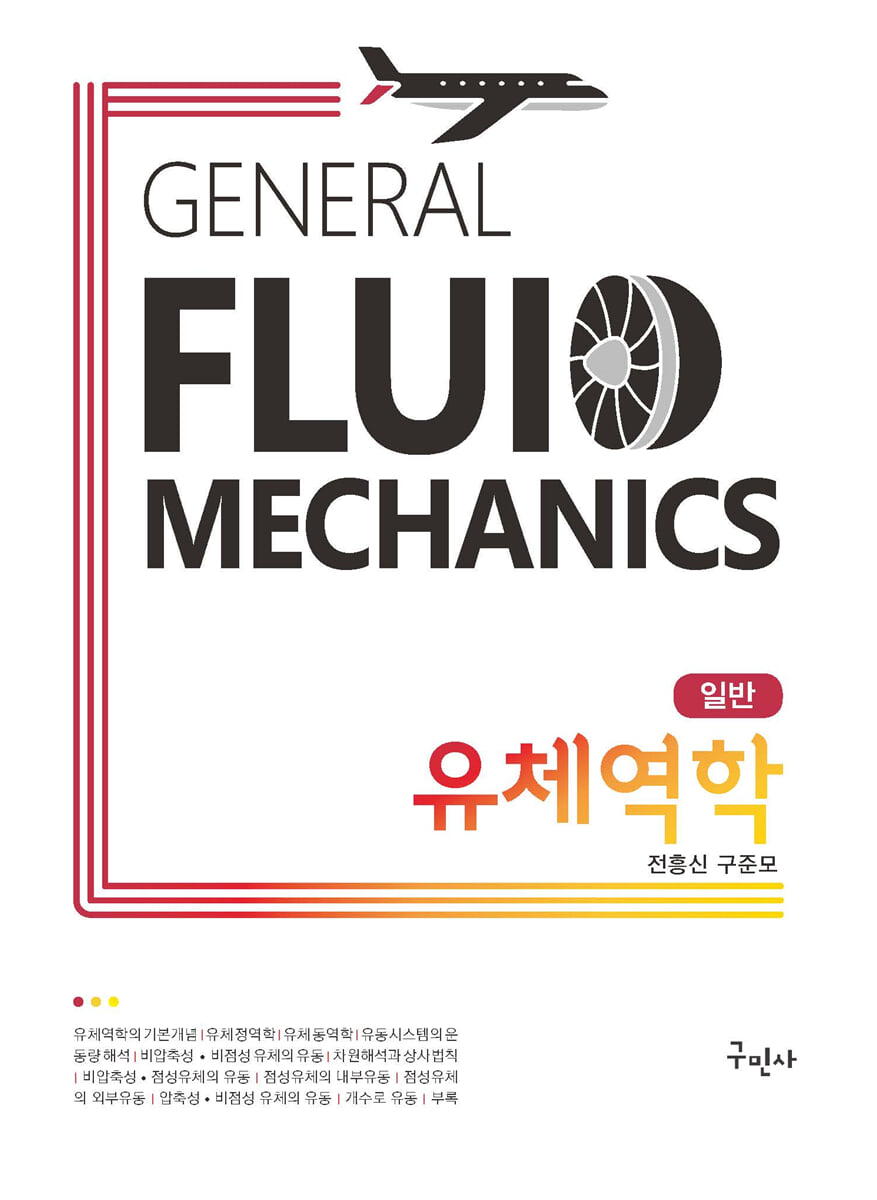
Book Introduction
Fluid mechanics can be broadly divided into fluid statics and fluid dynamics, and fluids can be classified into incompressible fluids and compressible fluids.
Both incompressible and compressible fluids are further divided into inviscid and viscous fluids.
Therefore, this book covers the basic concepts of fluid mechanics, then fluid statics, and from Chapter 3 onwards, all of the fields of fluid dynamics.
Both incompressible and compressible fluids are further divided into inviscid and viscous fluids.
Therefore, this book covers the basic concepts of fluid mechanics, then fluid statics, and from Chapter 3 onwards, all of the fields of fluid dynamics.
- You can preview some of the book's contents.
Preview
index
CHAPTER 01: Basics of Refrigeration and Mathematics
1.1 Fluids and Flow Fields
1.1.1 Definition of fluid
1.1.2 Fluid flow field
1.1.3 Types of fluids
1.1.4 Fluid Mechanics
1.2 Dimensions and Units
1.2.1 SI units
1.2.2 Gravitational Unit System
1.3 Fluid properties
1.3.1 Density
1.3.2 Specific weight
1.3.3 Astrology
1.3.4 Compressibility and elasticity
1.3.5 Surface tension
1.3.6 Vapor pressure and cavitation
CHAPTER 02 FLUID STATICS
2.1 Fluid pressure
2.1.1 Stress and Pressure
2.1.2 Pressure Transmission
2.1.3 Gauge pressure and absolute pressure
2.1.4 Hydrostatic pressure distribution
2.1.5 Pressure Measurement
2.2 Forces acting on objects
2.2.1 Pressure prism
2.2.2 Forces acting on reputation
2.2.3 Forces acting on curved bodies
2.3 Buoyancy and stability
2.3.1 Buoyancy
2.3.2 Stability
2.4 Relative still fluids
2.4.1 Equations of motion in hydrodynamics
2.4.2 Uniformly accelerated rectilinear motion
2.4.3 Uniform rotational motion
CHAPTER 03 FLUID DYNAMICS
3.1 Fluid flow
3.1.1 Classification of fluid flow
3.1.2 Flow field description method
3.1.3 Visualization of fluid flow
3.1.4 Euler equations
3.1.5 Bernoulli equation
3.1.6 Motion of fluid particles
3.2 Continuity equation
3.2.1 Inspection volume method
3.2.2 Reynolds transport theorem
3.2.3 Continuity equation in integral form
3.2.4 Continuity equation in differential form
3.3 Equations of motion
3.3.1 Equations of motion for ideal fluids
3.3.2 Equations of motion for viscous fluids
3.4 Energy equation
3.4.1 General energy equation
3.4.2 Extended energy equation
CHAPTER 04 Momentum Analysis of Fluid Systems
4.1 Linear momentum equation
4.1.1 Law of Momentum
4.1.2 Applications of the momentum equation
4.1.3 Other applications of the momentum equation
4.2 Momentum equation
4.2.1 Angular momentum law
4.2.2 Application of the momentum moment equation
CHAPTER 05 Flow of Incompressible and Inviscid Fluids
5.1 Basic equations
5.2 Flow functions
5.2.1 Flow function
5.2.2 Geometric meaning of flow functions
5.2.3 Applications of flow functions
5.3 Potential flow
5.3.1 Vorticity and Irrotationality
5.3.2 Irrotational flow with concentric streamlines
5.3.3 Bernoulli equation in irrotational flow
5.3.4 Velocity potential / 268 5.3.5 Complex potential
5.4 Various potential flows
5.4.1 Basic potential flow
5.4.2 Synthesis of potential flow fields
5.4.3 Potential flow around a cylinder
5.4.4 Motion of eddies
5.5 Theory of Wings
5.5.1 Blasius's formula
5.5.2 Kutta-Joukowski's theorem
5.5.3 Conformal mapping
CHAPTER 06 Dimensional Analysis and Similarity Laws
6.1 Introduction
6.2 Principles of dimensional analysis
6.3 Dimensionless numbers
6.3.1 Forces Associated with Fluid Motion
6.3.2 Important dimensionless numbers
6.4 Dimensional Analysis
6.4.1 Pi Theorem
6.4.2 Ipsen's sequential method
6.4.3 Nondimensionalization of the governing equations
6.5 Law of Similarity
6.5.1 Geometric similarity
6.5.2 Kinematic similarity
6.5.3 Mechanical superiority
CHAPTER 07 Flow of Incompressible and Viscous Fluids
7.1 Flow of real fluids
7.1.1 Laminar and turbulent flow
7.1.2 Occurrence of turbulence
7.2 Turbulence
7.2.1 Turbulence Characteristics
7.2.2 Turbulent shear stress
7.2.3 Turbulence theory
7.3 Boundary layer
7.3.1 The concept of boundary layer
7.3.2 Velocity boundary layer
7.3.3 Thickness of the velocity boundary layer
7.3.4 Boundary layer separation
7.4 Flow of incompressible and viscous fluids
7.4.1 Laminar flow between two plates
7.4.2 Laminar flow in concentric tubes
7.4.3 Lubrication Theory
CHAPTER 08 Internal Flow of Viscous Fluids
8.1 Internal flow
8.1.1 Entrance zone and fully developed zone
8.1.2 Current Loss
8.2 Laminar flow in the pipe
8.2.1 Laminar velocity distribution
8.2.2 Laminar shear stress
8.2.3 Laminar pressure drop
8.2.4 Laminar flow in a non-circular pipe
8.3 Turbulent flow within the pipe
8.3.1 Turbulent flow structure within the pipe
8.3.2 Turbulent shear stress
8.3.3 Turbulent pressure drop
8.3.4 Turbulent velocity distribution
8.4 Internal flow loss
8.4.1 Pump
8.4.2 Weekly Loss
8.4.3 Collateral Loss
8.5 Pipe network
8.5.1 Single pipe
8.5.2 Composite pipeline
CHAPTER 09 External Flow of Quasi-Fluid
9.1 General characteristics of external flow
9.1.1 Boundary Layer Development
9.1.2 Drag and lift
9.2 Characteristics of the boundary layer
9.2.1 Laminar boundary layer
9.2.2 Prandtl/Blasius boundary layer approximation
9.2.3 Momentum integral boundary layer equation
9.2.4 Turbulent boundary layer
9.2.5 Transition layer friction drag coefficient
9.2.6 Boundary layer in the presence of a pressure gradient
9.3 Drag
9.3.1 Frictional drag, pressure drag
9.3.2 Drag coefficient
9.3.3 Sedimentation velocity of the sphere
9.4 Solar calendar
9.4.1 Generation of the solar power
9.4.2 Wing Performance
9.4.3 Lift and drag due to rotation
9.4.4 Drag and lift of automobiles
CHAPTER 10 Flow of Compressible and Inviscid Fluids
10.1 Properties of compressible and inviscid fluids
10.1.1 State equation
10.1.2 Isentropic flow
10.1.3 Stagnation state quantity
10.2 Speed of sound and Mach number
10.2.1 Speed of sound
10.2.2 Mach number
10.3 Isentropic flow of ideal gases
10.3.1 Temperature, pressure, and Mach number relationships
10.3.2 Changes in velocity and state according to the flow area
10.3.3 Isentropic flow in the nozzle
10.4 Boiling entropic flow of ideal gases
10.4.1 Vertical shock wave
10.4.2 Adiabatic flow with friction
10.4.3 Frictionless heat transfer flow
CHAPTER 11 Flow by number
11.1 Characteristics of flow in a number of channels
11.1.1 Classification of flow by number of channels
11.1.2 Characteristics of the same type
11.1.3 Specific energy, limiting flow
11.2 Friction in flow through channels
11.2.1 Chezy's Formula
11.2.2 Manning's roughness relationship
11.3 Cross-section with optimal number of sections
11.3.1 Rectangular channel
11.3.2 Trapezoidal channel
11.3.3 Circular channel
11.4 Gradual change flow
11.4.1 Basic Differential Equations
11.4.2 Classification of gradual change flows
11.5 Rapidly Changing Fluid
11.5.1 Hydraulic Jump Theory
11.5.2 Classification of hydraulic jumps
CHAPTER 12 APPENDIX
1.1 Fluids and Flow Fields
1.1.1 Definition of fluid
1.1.2 Fluid flow field
1.1.3 Types of fluids
1.1.4 Fluid Mechanics
1.2 Dimensions and Units
1.2.1 SI units
1.2.2 Gravitational Unit System
1.3 Fluid properties
1.3.1 Density
1.3.2 Specific weight
1.3.3 Astrology
1.3.4 Compressibility and elasticity
1.3.5 Surface tension
1.3.6 Vapor pressure and cavitation
CHAPTER 02 FLUID STATICS
2.1 Fluid pressure
2.1.1 Stress and Pressure
2.1.2 Pressure Transmission
2.1.3 Gauge pressure and absolute pressure
2.1.4 Hydrostatic pressure distribution
2.1.5 Pressure Measurement
2.2 Forces acting on objects
2.2.1 Pressure prism
2.2.2 Forces acting on reputation
2.2.3 Forces acting on curved bodies
2.3 Buoyancy and stability
2.3.1 Buoyancy
2.3.2 Stability
2.4 Relative still fluids
2.4.1 Equations of motion in hydrodynamics
2.4.2 Uniformly accelerated rectilinear motion
2.4.3 Uniform rotational motion
CHAPTER 03 FLUID DYNAMICS
3.1 Fluid flow
3.1.1 Classification of fluid flow
3.1.2 Flow field description method
3.1.3 Visualization of fluid flow
3.1.4 Euler equations
3.1.5 Bernoulli equation
3.1.6 Motion of fluid particles
3.2 Continuity equation
3.2.1 Inspection volume method
3.2.2 Reynolds transport theorem
3.2.3 Continuity equation in integral form
3.2.4 Continuity equation in differential form
3.3 Equations of motion
3.3.1 Equations of motion for ideal fluids
3.3.2 Equations of motion for viscous fluids
3.4 Energy equation
3.4.1 General energy equation
3.4.2 Extended energy equation
CHAPTER 04 Momentum Analysis of Fluid Systems
4.1 Linear momentum equation
4.1.1 Law of Momentum
4.1.2 Applications of the momentum equation
4.1.3 Other applications of the momentum equation
4.2 Momentum equation
4.2.1 Angular momentum law
4.2.2 Application of the momentum moment equation
CHAPTER 05 Flow of Incompressible and Inviscid Fluids
5.1 Basic equations
5.2 Flow functions
5.2.1 Flow function
5.2.2 Geometric meaning of flow functions
5.2.3 Applications of flow functions
5.3 Potential flow
5.3.1 Vorticity and Irrotationality
5.3.2 Irrotational flow with concentric streamlines
5.3.3 Bernoulli equation in irrotational flow
5.3.4 Velocity potential / 268 5.3.5 Complex potential
5.4 Various potential flows
5.4.1 Basic potential flow
5.4.2 Synthesis of potential flow fields
5.4.3 Potential flow around a cylinder
5.4.4 Motion of eddies
5.5 Theory of Wings
5.5.1 Blasius's formula
5.5.2 Kutta-Joukowski's theorem
5.5.3 Conformal mapping
CHAPTER 06 Dimensional Analysis and Similarity Laws
6.1 Introduction
6.2 Principles of dimensional analysis
6.3 Dimensionless numbers
6.3.1 Forces Associated with Fluid Motion
6.3.2 Important dimensionless numbers
6.4 Dimensional Analysis
6.4.1 Pi Theorem
6.4.2 Ipsen's sequential method
6.4.3 Nondimensionalization of the governing equations
6.5 Law of Similarity
6.5.1 Geometric similarity
6.5.2 Kinematic similarity
6.5.3 Mechanical superiority
CHAPTER 07 Flow of Incompressible and Viscous Fluids
7.1 Flow of real fluids
7.1.1 Laminar and turbulent flow
7.1.2 Occurrence of turbulence
7.2 Turbulence
7.2.1 Turbulence Characteristics
7.2.2 Turbulent shear stress
7.2.3 Turbulence theory
7.3 Boundary layer
7.3.1 The concept of boundary layer
7.3.2 Velocity boundary layer
7.3.3 Thickness of the velocity boundary layer
7.3.4 Boundary layer separation
7.4 Flow of incompressible and viscous fluids
7.4.1 Laminar flow between two plates
7.4.2 Laminar flow in concentric tubes
7.4.3 Lubrication Theory
CHAPTER 08 Internal Flow of Viscous Fluids
8.1 Internal flow
8.1.1 Entrance zone and fully developed zone
8.1.2 Current Loss
8.2 Laminar flow in the pipe
8.2.1 Laminar velocity distribution
8.2.2 Laminar shear stress
8.2.3 Laminar pressure drop
8.2.4 Laminar flow in a non-circular pipe
8.3 Turbulent flow within the pipe
8.3.1 Turbulent flow structure within the pipe
8.3.2 Turbulent shear stress
8.3.3 Turbulent pressure drop
8.3.4 Turbulent velocity distribution
8.4 Internal flow loss
8.4.1 Pump
8.4.2 Weekly Loss
8.4.3 Collateral Loss
8.5 Pipe network
8.5.1 Single pipe
8.5.2 Composite pipeline
CHAPTER 09 External Flow of Quasi-Fluid
9.1 General characteristics of external flow
9.1.1 Boundary Layer Development
9.1.2 Drag and lift
9.2 Characteristics of the boundary layer
9.2.1 Laminar boundary layer
9.2.2 Prandtl/Blasius boundary layer approximation
9.2.3 Momentum integral boundary layer equation
9.2.4 Turbulent boundary layer
9.2.5 Transition layer friction drag coefficient
9.2.6 Boundary layer in the presence of a pressure gradient
9.3 Drag
9.3.1 Frictional drag, pressure drag
9.3.2 Drag coefficient
9.3.3 Sedimentation velocity of the sphere
9.4 Solar calendar
9.4.1 Generation of the solar power
9.4.2 Wing Performance
9.4.3 Lift and drag due to rotation
9.4.4 Drag and lift of automobiles
CHAPTER 10 Flow of Compressible and Inviscid Fluids
10.1 Properties of compressible and inviscid fluids
10.1.1 State equation
10.1.2 Isentropic flow
10.1.3 Stagnation state quantity
10.2 Speed of sound and Mach number
10.2.1 Speed of sound
10.2.2 Mach number
10.3 Isentropic flow of ideal gases
10.3.1 Temperature, pressure, and Mach number relationships
10.3.2 Changes in velocity and state according to the flow area
10.3.3 Isentropic flow in the nozzle
10.4 Boiling entropic flow of ideal gases
10.4.1 Vertical shock wave
10.4.2 Adiabatic flow with friction
10.4.3 Frictionless heat transfer flow
CHAPTER 11 Flow by number
11.1 Characteristics of flow in a number of channels
11.1.1 Classification of flow by number of channels
11.1.2 Characteristics of the same type
11.1.3 Specific energy, limiting flow
11.2 Friction in flow through channels
11.2.1 Chezy's Formula
11.2.2 Manning's roughness relationship
11.3 Cross-section with optimal number of sections
11.3.1 Rectangular channel
11.3.2 Trapezoidal channel
11.3.3 Circular channel
11.4 Gradual change flow
11.4.1 Basic Differential Equations
11.4.2 Classification of gradual change flows
11.5 Rapidly Changing Fluid
11.5.1 Hydraulic Jump Theory
11.5.2 Classification of hydraulic jumps
CHAPTER 12 APPENDIX
Publisher's Review
Fluid mechanics has been around for a long time, from the time Archimedes of ancient Greece explained the principles of hydraulics and buoyancy, to the measurement of river levels. However, with the development of modern science in the 17th century, it began to be systematically developed as an academic discipline through theoretical and mathematical advancements by Newton, Bernoulli, Euler, and others.
Fluid mechanics is the study of the dynamic relationships of fluids at rest or in motion.
Specifically, it deals with theories and practical problems related to fluids in all engineering fields, including fluid machinery that uses air, water, or other fluids as the working fluid, as well as shipbuilding and aviation, civil engineering, and chemical engineering.
In mechanical engineering, fluid mechanics occupies a very important position along with industrial thermodynamics and material mechanics.
Until now, fluid mechanics has been developed into two branches: theoretical fluid mechanics (hydrodynamics), which deals with ideal fluids from a theoretical or mathematical perspective, and hydraulics, which looks at the behavior of viscous fluids, that is, actual fluids such as water, from a practical and experimental perspective. However, in recent years, it has become common to group these two branches and deal with them under the single framework of fluid dynamics.
The authors have been researching and teaching fluid-related fields for a long time, but have always felt it was a pity that there was no appropriate book on fluid mechanics.
This is because the majority of published books on fluid mechanics so far are amphibious, and these books omit detailed explanations as they attempt to describe the broad field of fluid mechanics in a limited number of pages, and they emphasize practical aspects, lacking theoretical treatment.
Therefore, this book allows students to easily understand the basic concepts and theories of fluid flow through sufficient examples using their knowledge of differential equations and vector analysis.
Fluid mechanics can be broadly divided into fluid statics and fluid dynamics, and fluids can be classified into incompressible fluids and compressible fluids.
Both incompressible and compressible fluids are further divided into inviscid and viscous fluids.
Therefore, this book covers the basic concepts of fluid mechanics, then fluid statics, and from Chapter 3 onwards, all of the fields of fluid dynamics.
Next, we covered momentum analysis of fluid systems to determine the speed of moving objects, flow of incompressible and inviscid fluids (ideal fluids), dimensional analysis, and similarity laws.
Following the description of incompressible and viscous fluids (real fluids), internal flow of viscous fluids, external flow of viscous fluids, and compressible inviscid fluids, open-channel flow was finally described.
Fluid mechanics is the study of the dynamic relationships of fluids at rest or in motion.
Specifically, it deals with theories and practical problems related to fluids in all engineering fields, including fluid machinery that uses air, water, or other fluids as the working fluid, as well as shipbuilding and aviation, civil engineering, and chemical engineering.
In mechanical engineering, fluid mechanics occupies a very important position along with industrial thermodynamics and material mechanics.
Until now, fluid mechanics has been developed into two branches: theoretical fluid mechanics (hydrodynamics), which deals with ideal fluids from a theoretical or mathematical perspective, and hydraulics, which looks at the behavior of viscous fluids, that is, actual fluids such as water, from a practical and experimental perspective. However, in recent years, it has become common to group these two branches and deal with them under the single framework of fluid dynamics.
The authors have been researching and teaching fluid-related fields for a long time, but have always felt it was a pity that there was no appropriate book on fluid mechanics.
This is because the majority of published books on fluid mechanics so far are amphibious, and these books omit detailed explanations as they attempt to describe the broad field of fluid mechanics in a limited number of pages, and they emphasize practical aspects, lacking theoretical treatment.
Therefore, this book allows students to easily understand the basic concepts and theories of fluid flow through sufficient examples using their knowledge of differential equations and vector analysis.
Fluid mechanics can be broadly divided into fluid statics and fluid dynamics, and fluids can be classified into incompressible fluids and compressible fluids.
Both incompressible and compressible fluids are further divided into inviscid and viscous fluids.
Therefore, this book covers the basic concepts of fluid mechanics, then fluid statics, and from Chapter 3 onwards, all of the fields of fluid dynamics.
Next, we covered momentum analysis of fluid systems to determine the speed of moving objects, flow of incompressible and inviscid fluids (ideal fluids), dimensional analysis, and similarity laws.
Following the description of incompressible and viscous fluids (real fluids), internal flow of viscous fluids, external flow of viscous fluids, and compressible inviscid fluids, open-channel flow was finally described.
GOODS SPECIFICS
- Date of issue: August 30, 2025
- Page count, weight, size: 698 pages | 188*257*35mm
- ISBN13: 9791168755789
- ISBN10: 1168755786
You may also like
카테고리
korean


korean

![GQ KOREA Mark (Monthly): December [2025]](http://librairie.coreenne.fr/cdn/shop/files/8ef265dbbfbf186523ed75ba7319009d.jpg?v=1765340328&width=3840)


