

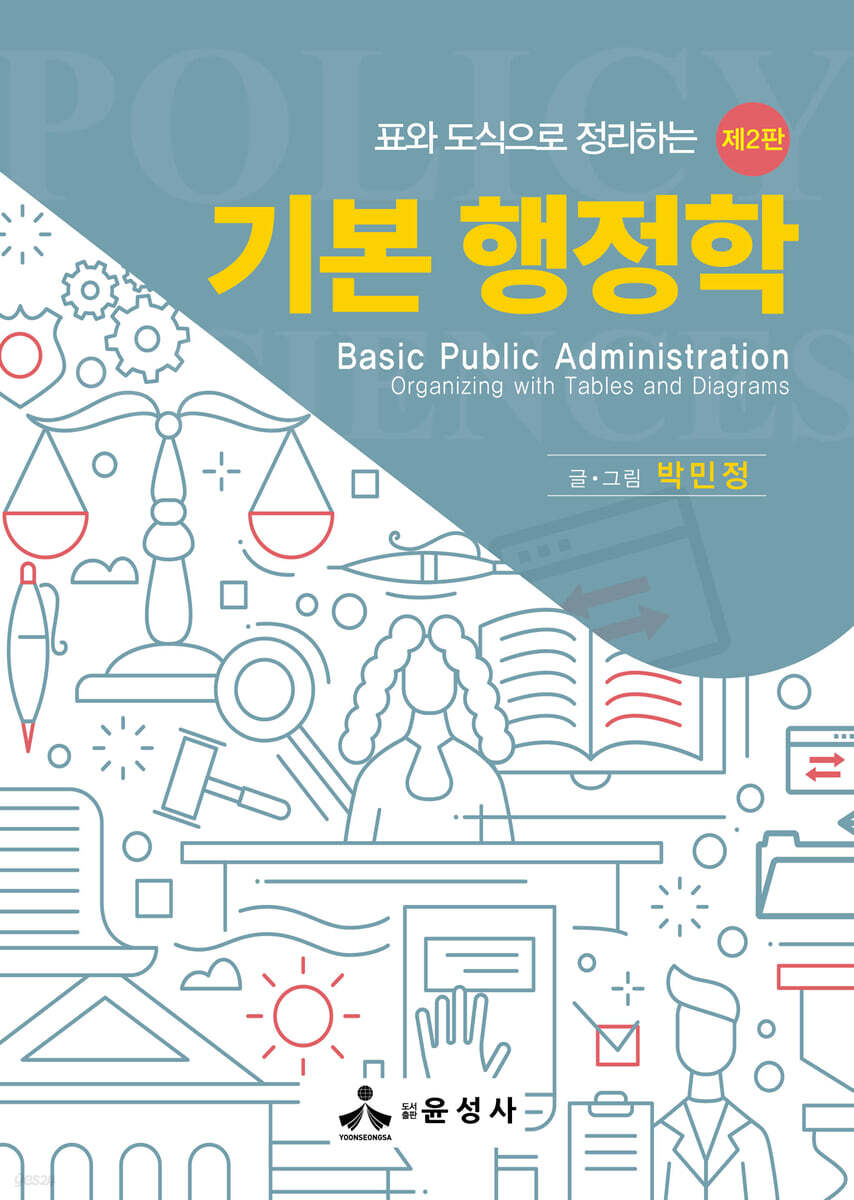
Basic administrative studies organized in tables and diagrams
 |
Description
Book Introduction
Recent revisions to laws and policy changes have been faithfully reflected, and new issues emerging in the public sector have been added.
Unnecessary or redundant content has been removed, and the content has been concisely reorganized to focus on the connections and key points between theories.
Unnecessary or redundant content has been removed, and the content has been concisely reorganized to focus on the connections and key points between theories.
index
Chapter 1: The Essence of Administration
1.
Definition of administration
2.
Administration and Management
3.
Administration and Politics
4.
The concept of government
5.
Administration and Environment
6.
Modern administration
Chapter 2: History of Administration
1.
Administration from ancient times to modern times
2.
The Birth of Public Administration (1800s)
3.
Establishment of Management-Centered Public Administration: The Perspective that "Administration is Management" (since the 1910s)
4.
Administrative state period: The view that 'administration dominates all state operations' (1940s)
5.
The era of administrative diversification: the emergence of diverse perspectives on administration (1950s and 1960s)
6.
The Age of Government Distrust: The Perspective That "Administration Should Play a Minimal Role" (1970s-2000s)
Chapter 3 Administrative Values and Administrative Ethics
1.
The value of administration
2.
Administrative ethics (= public service ethics)
3.
public value
4.
Public service values
5.
Public service motivation
Chapter 4 Organization
1.
The significance of the organization
2.
Changes in organizational theory
3.
Structural form of the organization
4.
Organizational Management
Chapter 5 Personnel Administration
1.
Civil service system
2.
public service structure
3.
Personnel management after hiring civil servants
Chapter 6 Financial Administration
1.
The significance of the government budget
2.
government budget process
3.
Budget theory
4.
Changes in the government budget system
Chapter 7 Policy
1.
Significance of the policy
2.
Policy participants
3.
policy process
Chapter 8 Local Administration
1.
The significance of local autonomy
2.
local government affairs
3.
local government finances
Chapter 9: Administrative Corruption, Control, and Administrative Reform
1.
administrative corruption
2.
Administrative responsibility and control
3.
administrative reform
Chapter 10 E-Government
1.
The significance of e-government
2.
E-Government and Innovation
3.
The Fourth Industrial Revolution and Administration
Chapter 11 Government Regulation
1.
The significance of government regulation
2.
Types of government regulations
3.
Regulatory reform
Chapter 12 Public Services
1.
The significance of public service
2.
Public service provision methods
1.
Definition of administration
2.
Administration and Management
3.
Administration and Politics
4.
The concept of government
5.
Administration and Environment
6.
Modern administration
Chapter 2: History of Administration
1.
Administration from ancient times to modern times
2.
The Birth of Public Administration (1800s)
3.
Establishment of Management-Centered Public Administration: The Perspective that "Administration is Management" (since the 1910s)
4.
Administrative state period: The view that 'administration dominates all state operations' (1940s)
5.
The era of administrative diversification: the emergence of diverse perspectives on administration (1950s and 1960s)
6.
The Age of Government Distrust: The Perspective That "Administration Should Play a Minimal Role" (1970s-2000s)
Chapter 3 Administrative Values and Administrative Ethics
1.
The value of administration
2.
Administrative ethics (= public service ethics)
3.
public value
4.
Public service values
5.
Public service motivation
Chapter 4 Organization
1.
The significance of the organization
2.
Changes in organizational theory
3.
Structural form of the organization
4.
Organizational Management
Chapter 5 Personnel Administration
1.
Civil service system
2.
public service structure
3.
Personnel management after hiring civil servants
Chapter 6 Financial Administration
1.
The significance of the government budget
2.
government budget process
3.
Budget theory
4.
Changes in the government budget system
Chapter 7 Policy
1.
Significance of the policy
2.
Policy participants
3.
policy process
Chapter 8 Local Administration
1.
The significance of local autonomy
2.
local government affairs
3.
local government finances
Chapter 9: Administrative Corruption, Control, and Administrative Reform
1.
administrative corruption
2.
Administrative responsibility and control
3.
administrative reform
Chapter 10 E-Government
1.
The significance of e-government
2.
E-Government and Innovation
3.
The Fourth Industrial Revolution and Administration
Chapter 11 Government Regulation
1.
The significance of government regulation
2.
Types of government regulations
3.
Regulatory reform
Chapter 12 Public Services
1.
The significance of public service
2.
Public service provision methods
Publisher's Review
Preface to the Second Edition
Five years have passed since the first edition of 『Basic Public Administration Organized in Tables and Diagrams』 was published.
Meanwhile, the administrative environment has changed rapidly, and policies and systems surrounding the public sector are also developing in a different way than in the past.
In particular, internal changes in the public service sector have become a task that must be reflected in public administration education.
Accordingly, the second edition was republished as a revised edition that included the latest content and was reorganized.
The learner-friendly structure emphasized in the first edition has been maintained.
To effectively convey the vast theories of public administration, the key content of each chapter is organized into tables and diagrams, and complex theories are structured visually.
In this revision, we have significantly streamlined redundant or unnecessary explanations and concisely reorganized them to focus on the connections and key points between theories.
In terms of content, the following supplements were made.
First, some of the cases used in the first edition have been replaced with more recent materials, and recent revisions to laws and policy changes have been faithfully reflected.
Second, we added new issues that have recently emerged as major issues in the public service, such as the high resignation rate of MZ generation civil servants, the redefinition of public service values, and the importance of public service motivation (PSM).
This shows that public administration is not simply academic knowledge, but must be connected to practical reality.
Additionally, QR codes are inserted at the end of each chapter to allow learners to directly check news and current affairs materials related to actual policy situations. In the second edition, new discussion topics have been revised based on recent articles and newspaper articles.
This could serve as an important learning tool that connects academia and reality.
The overall structure is maintained at 12 chapters, but each chapter naturally guides the learning flow through a structure that proceeds as follows: theory explanation → summary → visual aids (tables and diagrams) → case application.
In particular, it was designed to be both academically deep and practical so that it can be used not only for exam purposes but also as a basic education textbook for majors.
I hope this book will be useful to college students new to public administration, students preparing for public service, and the general public interested in administrative practice. I also hope it will serve as a compass that provides a foundation for understanding the rapidly changing administrative environment.
July 2025
Park Min-jeong
Five years have passed since the first edition of 『Basic Public Administration Organized in Tables and Diagrams』 was published.
Meanwhile, the administrative environment has changed rapidly, and policies and systems surrounding the public sector are also developing in a different way than in the past.
In particular, internal changes in the public service sector have become a task that must be reflected in public administration education.
Accordingly, the second edition was republished as a revised edition that included the latest content and was reorganized.
The learner-friendly structure emphasized in the first edition has been maintained.
To effectively convey the vast theories of public administration, the key content of each chapter is organized into tables and diagrams, and complex theories are structured visually.
In this revision, we have significantly streamlined redundant or unnecessary explanations and concisely reorganized them to focus on the connections and key points between theories.
In terms of content, the following supplements were made.
First, some of the cases used in the first edition have been replaced with more recent materials, and recent revisions to laws and policy changes have been faithfully reflected.
Second, we added new issues that have recently emerged as major issues in the public service, such as the high resignation rate of MZ generation civil servants, the redefinition of public service values, and the importance of public service motivation (PSM).
This shows that public administration is not simply academic knowledge, but must be connected to practical reality.
Additionally, QR codes are inserted at the end of each chapter to allow learners to directly check news and current affairs materials related to actual policy situations. In the second edition, new discussion topics have been revised based on recent articles and newspaper articles.
This could serve as an important learning tool that connects academia and reality.
The overall structure is maintained at 12 chapters, but each chapter naturally guides the learning flow through a structure that proceeds as follows: theory explanation → summary → visual aids (tables and diagrams) → case application.
In particular, it was designed to be both academically deep and practical so that it can be used not only for exam purposes but also as a basic education textbook for majors.
I hope this book will be useful to college students new to public administration, students preparing for public service, and the general public interested in administrative practice. I also hope it will serve as a compass that provides a foundation for understanding the rapidly changing administrative environment.
July 2025
Park Min-jeong
GOODS SPECIFICS
- Date of issue: August 8, 2025
- Format: Paperback book binding method guide
- Page count, weight, size: 384 pages | 173*243*30mm
- ISBN13: 9791193058992
- ISBN10: 1193058996
You may also like
카테고리
korean


korean

![GQ KOREA Mark (Monthly): December [2025]](http://librairie.coreenne.fr/cdn/shop/files/8ef265dbbfbf186523ed75ba7319009d.jpg?v=1765340328&width=3840)


