

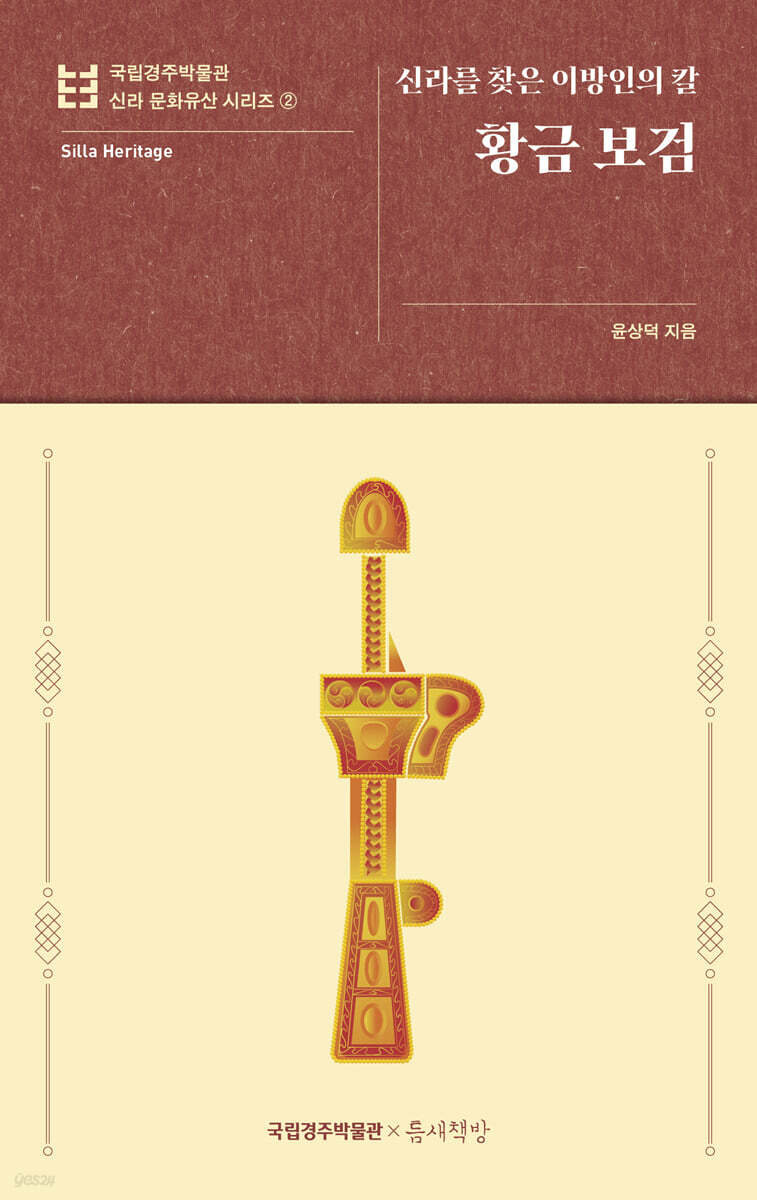
Golden Sword
 |
Description
Book Introduction
·The 'Silla Cultural Heritage Series', which explains 10 treasures of Silla selected by visitors to the Gyeongju National Museum.
·A Complete Guidebook on the Golden Sword and the Sword of a Foreigner Discovered in Silla
A guide that explains everything from the excavation process to recent research results in an easy-to-understand and detailed manner.
The 'Silla Cultural Heritage Series' is a series planned by the Gyeongju National Museum to provide higher-quality and differentiated exhibition commentary.
The following are explained: the Cheonmachong gold crown, golden sword, earthenware-decorated jar, face-patterned water taps, Hwangryongsa chimi, King Seongdeok's new bell, Baekryulsa gilt-bronze Bhaisajyaguru Buddha statue, Gim Eunsa sarira reliquary, Jangchanggok stone Maitreya triad, and gilt-bronze scissors with a wick.
The ten treasures featured in this series were selected through direct voting by visitors to the National Gyeongju Museum.
In other words, it can be said to be the Silla cultural heritage most loved by Koreans.
The "Silla Cultural Heritage Series" was written by current and former curators and Korea's top researchers who are most familiar with and have extensive experience with the artifacts, all written in a way that is accessible to the general public.
It can be said to be a guidebook that combines reliability and popularity in its interpretation of relics.
It contains a wealth of photos of artifacts that cannot be found anywhere else, and difficult historical terms are explained separately to help with understanding.
The second treasure in the ‘Silla Cultural Heritage Series’ is the Gyerim-ro Golden Sword.
The Golden Sword is a dagger discovered in 1973 in a small tomb on Gyerim-ro, Gyeongju, and is characterized by its ornate decoration.
This was a very different shape from the Silla swords that had been excavated from Silla tombs, causing great concern among researchers.
Rather, it resembles the Borovoe dagger of Kazakhstan as a sibling, and European archaeologists also showed extraordinary interest.
《Golden Sword》included the contents of the excavation report 〈Tomb No. 14, Gyerim-ro, Gyeongju〉 published in 2010, and even estimated the production site and production group based on the results of a non-destructive testing investigation conducted by the Gyeongju National Museum.
·A Complete Guidebook on the Golden Sword and the Sword of a Foreigner Discovered in Silla
A guide that explains everything from the excavation process to recent research results in an easy-to-understand and detailed manner.
The 'Silla Cultural Heritage Series' is a series planned by the Gyeongju National Museum to provide higher-quality and differentiated exhibition commentary.
The following are explained: the Cheonmachong gold crown, golden sword, earthenware-decorated jar, face-patterned water taps, Hwangryongsa chimi, King Seongdeok's new bell, Baekryulsa gilt-bronze Bhaisajyaguru Buddha statue, Gim Eunsa sarira reliquary, Jangchanggok stone Maitreya triad, and gilt-bronze scissors with a wick.
The ten treasures featured in this series were selected through direct voting by visitors to the National Gyeongju Museum.
In other words, it can be said to be the Silla cultural heritage most loved by Koreans.
The "Silla Cultural Heritage Series" was written by current and former curators and Korea's top researchers who are most familiar with and have extensive experience with the artifacts, all written in a way that is accessible to the general public.
It can be said to be a guidebook that combines reliability and popularity in its interpretation of relics.
It contains a wealth of photos of artifacts that cannot be found anywhere else, and difficult historical terms are explained separately to help with understanding.
The second treasure in the ‘Silla Cultural Heritage Series’ is the Gyerim-ro Golden Sword.
The Golden Sword is a dagger discovered in 1973 in a small tomb on Gyerim-ro, Gyeongju, and is characterized by its ornate decoration.
This was a very different shape from the Silla swords that had been excavated from Silla tombs, causing great concern among researchers.
Rather, it resembles the Borovoe dagger of Kazakhstan as a sibling, and European archaeologists also showed extraordinary interest.
《Golden Sword》included the contents of the excavation report 〈Tomb No. 14, Gyerim-ro, Gyeongju〉 published in 2010, and even estimated the production site and production group based on the results of a non-destructive testing investigation conducted by the Gyeongju National Museum.
- You can preview some of the book's contents.
Preview
index
· Introductory remarks
Ⅰ.
Was the golden sword made by the Silla people?
Ⅱ.
When, where, and by whom was it made?
Ⅲ.
How did it get to Silla?
Ⅳ.
Who is the owner of the golden sword?
· Outgoing words
· Glossary of Terms
· References
Ⅰ.
Was the golden sword made by the Silla people?
Ⅱ.
When, where, and by whom was it made?
Ⅲ.
How did it get to Silla?
Ⅳ.
Who is the owner of the golden sword?
· Outgoing words
· Glossary of Terms
· References
Into the book
In 1973, a uniquely shaped sword was excavated from a small tomb on Gyerim-ro, Gyeongju.
Domestic researchers who came across this data were deeply troubled.
This is because the shape of the sword was very different from the swords of Silla that had been excavated from Silla tombs so far.
---From "Introductory Remarks"
This process of inserting jewels is called inlaying.
The gems inlaid were garnet and glass.
At first, the red gem was seen with the naked eye and was thought to be agate, but after analyzing it using various equipment, it was found to be garnet, a rare stone in Silla.
Glass was a gem that was considered more precious than gold at the time.
When it comes to wide spaces, glass is used.
---From "Was the Golden Sword Made by the Silla People?"
To know when the golden sword was made, we need to know when the tomb where the sword is buried, Tomb No. 14 in Gyerim-ro, Gyeongju, was built, that is, the construction date of the tomb.
The construction date of a tomb can be estimated by comparing it with similar artifacts excavated from other tombs.
Yes, because the design of objects changes with the times.
---From "When, Where, and Who Made It?"
Considering that it is generally easy to imitate the form but not the manufacturing technique, it seems likely that the product was made by a skilled goldsmith.
That is, we can think of it as a group that requested an image of a dagger in the form of a golden sword, and a group with the manufacturing technology produced it.
---From "When, Where, and Who Made It?"
How did something made in such a distant region end up in Silla? In addition to the golden sword, various other foreign artifacts have been unearthed from Silla tombs dating from the 4th to 6th centuries.
Representative examples include a silver cup made using the stamping technique excavated from the northern mound of Hwangnamdaechong Tomb, a gold bracelet decorated with colored gemstones (gamok jade), and over 25 glass vessels discovered.
---From "How was it transmitted to Silla?"
On the floor where the body and coffin had rotted away, two pairs of gold earrings were found, as if they had been attached to the ears of the corpse, and teeth were found between the earrings.
The two people were buried side by side.
(…) The golden sword was held by the person buried on the left.
He was also wearing a silver belt.
The person on the right also carried a long sword.
These ornaments, including gold earrings, indicate that both were people of high status.
So how could two people be buried at the same time?
---From "Who is the owner of the golden sword?"
It is very difficult to find out the actual appearance of a place 1,500 years ago based only on the data obtained from archaeological excavations.
So, archaeologists are letting their imagination run wild.
Domestic researchers who came across this data were deeply troubled.
This is because the shape of the sword was very different from the swords of Silla that had been excavated from Silla tombs so far.
---From "Introductory Remarks"
This process of inserting jewels is called inlaying.
The gems inlaid were garnet and glass.
At first, the red gem was seen with the naked eye and was thought to be agate, but after analyzing it using various equipment, it was found to be garnet, a rare stone in Silla.
Glass was a gem that was considered more precious than gold at the time.
When it comes to wide spaces, glass is used.
---From "Was the Golden Sword Made by the Silla People?"
To know when the golden sword was made, we need to know when the tomb where the sword is buried, Tomb No. 14 in Gyerim-ro, Gyeongju, was built, that is, the construction date of the tomb.
The construction date of a tomb can be estimated by comparing it with similar artifacts excavated from other tombs.
Yes, because the design of objects changes with the times.
---From "When, Where, and Who Made It?"
Considering that it is generally easy to imitate the form but not the manufacturing technique, it seems likely that the product was made by a skilled goldsmith.
That is, we can think of it as a group that requested an image of a dagger in the form of a golden sword, and a group with the manufacturing technology produced it.
---From "When, Where, and Who Made It?"
How did something made in such a distant region end up in Silla? In addition to the golden sword, various other foreign artifacts have been unearthed from Silla tombs dating from the 4th to 6th centuries.
Representative examples include a silver cup made using the stamping technique excavated from the northern mound of Hwangnamdaechong Tomb, a gold bracelet decorated with colored gemstones (gamok jade), and over 25 glass vessels discovered.
---From "How was it transmitted to Silla?"
On the floor where the body and coffin had rotted away, two pairs of gold earrings were found, as if they had been attached to the ears of the corpse, and teeth were found between the earrings.
The two people were buried side by side.
(…) The golden sword was held by the person buried on the left.
He was also wearing a silver belt.
The person on the right also carried a long sword.
These ornaments, including gold earrings, indicate that both were people of high status.
So how could two people be buried at the same time?
---From "Who is the owner of the golden sword?"
It is very difficult to find out the actual appearance of a place 1,500 years ago based only on the data obtained from archaeological excavations.
So, archaeologists are letting their imagination run wild.
---From "Outgoing Words"
Publisher's Review
·A story no one knew, contained in the golden sword known to everyone.
· Proposing a proactive historical experience rather than passive information acquisition
Gyeongju National Museum, Korea's representative museum where you can see Silla's history and culture at a glance, has released an in-depth guide to its artifacts.
Among the many exhibits, we have selected the 10 most popular artifacts among visitors to the National Gyeongju Museum.
From a curator's perspective, the exhibition follows a trend of change from the traditional exhibition method that focused on conveying information to the current process of allowing visitors to actively experience various histories.
The photos are as vivid as the splendid relics, making you feel awe and excitement.
Who made the golden sword?
The golden sword discovered in Tomb No. 14 on Gyerim-ro was clearly different from Silla swords in many ways.
Artifacts similar to the golden sword were rather widely distributed throughout Europe and Central Asia.
By exploring various relics with similar shapes and utilizing the results of a compositional ratio survey conducted by the National Gyeongju Museum, we estimated the group and production site of the golden sword.
How did the golden sword come to Silla from that far-off western country?
How and when did the golden sword, believed to have been forged in Central Asia, enter Silla and end up buried in a small tomb in Gyeongju? Through research, we explore how Silla's foreign exchanges took place and deduce the golden sword's travel route.
Was the owner of the tomb a Westerner? What was his story?
The tomb where such a unique sword was excavated also had a unique burial style.
Judging by the replica of the excavated artifact, two men were lying side by side.
They were not buried together because they were lying side by side, and they were not buried together later.
What could have possibly happened that two men were buried in the same grave?
Gyeongju National Museum Planning Series: A Complete Guidebook on 10 Popular Treasures Representing Silla's Millennium
Current and former curators at the National Museum of Korea and Korea's leading researchers will reveal stories never before told in the exhibition hall, from the excavation of artifacts to new findings from recent research.
Detailed photos, available only at museums, allow you to see the artifacts more clearly than in real life.
It suggests a way to view and understand relics from a researcher's perspective, while also providing various perspectives on exhibits.
If you visit the National Gyeongju Museum after reading this book, you will feel that your perspective on artifacts has become much deeper and broader.
· Proposing a proactive historical experience rather than passive information acquisition
Gyeongju National Museum, Korea's representative museum where you can see Silla's history and culture at a glance, has released an in-depth guide to its artifacts.
Among the many exhibits, we have selected the 10 most popular artifacts among visitors to the National Gyeongju Museum.
From a curator's perspective, the exhibition follows a trend of change from the traditional exhibition method that focused on conveying information to the current process of allowing visitors to actively experience various histories.
The photos are as vivid as the splendid relics, making you feel awe and excitement.
Who made the golden sword?
The golden sword discovered in Tomb No. 14 on Gyerim-ro was clearly different from Silla swords in many ways.
Artifacts similar to the golden sword were rather widely distributed throughout Europe and Central Asia.
By exploring various relics with similar shapes and utilizing the results of a compositional ratio survey conducted by the National Gyeongju Museum, we estimated the group and production site of the golden sword.
How did the golden sword come to Silla from that far-off western country?
How and when did the golden sword, believed to have been forged in Central Asia, enter Silla and end up buried in a small tomb in Gyeongju? Through research, we explore how Silla's foreign exchanges took place and deduce the golden sword's travel route.
Was the owner of the tomb a Westerner? What was his story?
The tomb where such a unique sword was excavated also had a unique burial style.
Judging by the replica of the excavated artifact, two men were lying side by side.
They were not buried together because they were lying side by side, and they were not buried together later.
What could have possibly happened that two men were buried in the same grave?
Gyeongju National Museum Planning Series: A Complete Guidebook on 10 Popular Treasures Representing Silla's Millennium
Current and former curators at the National Museum of Korea and Korea's leading researchers will reveal stories never before told in the exhibition hall, from the excavation of artifacts to new findings from recent research.
Detailed photos, available only at museums, allow you to see the artifacts more clearly than in real life.
It suggests a way to view and understand relics from a researcher's perspective, while also providing various perspectives on exhibits.
If you visit the National Gyeongju Museum after reading this book, you will feel that your perspective on artifacts has become much deeper and broader.
GOODS SPECIFICS
- Date of issue: December 15, 2023
- Page count, weight, size: 80 pages | 158g | 120*190*8mm
- ISBN13: 9791188949564
- ISBN10: 118894956X
You may also like
카테고리
korean


korean

![GQ KOREA Mark (Monthly): December [2025]](http://librairie.coreenne.fr/cdn/shop/files/8ef265dbbfbf186523ed75ba7319009d.jpg?v=1765340328&width=3840)


