

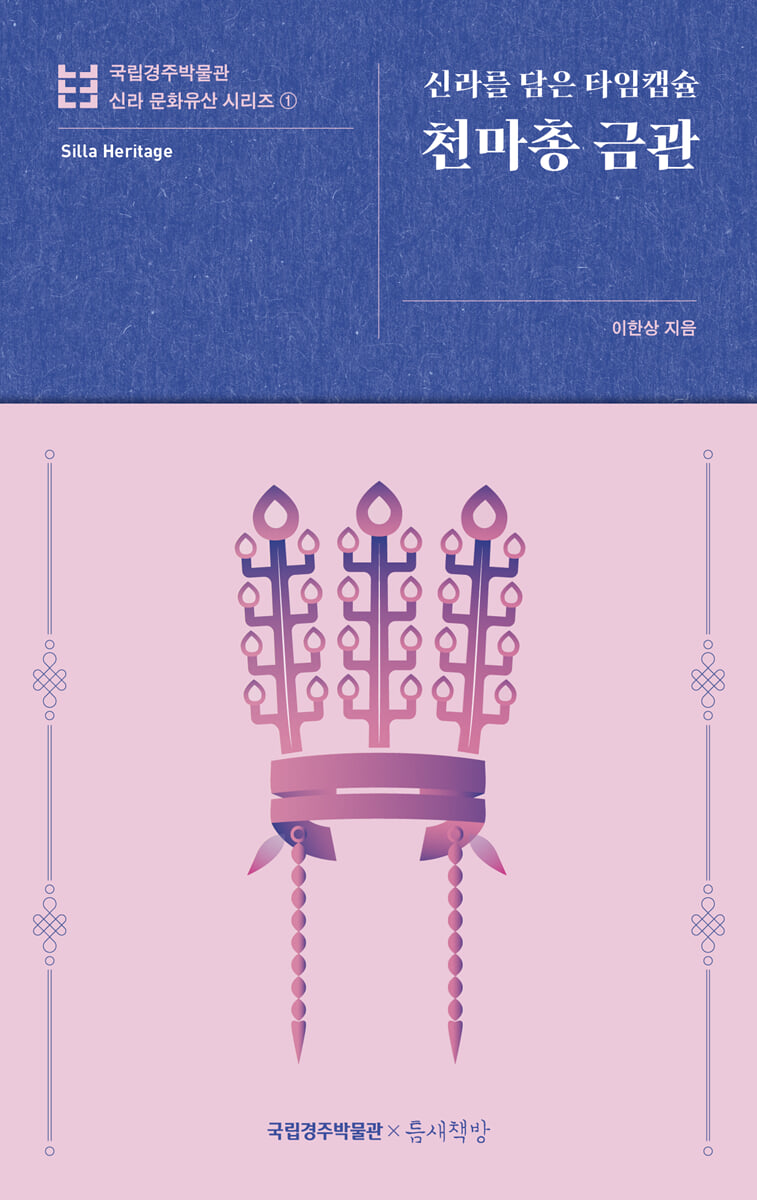
Cheonmachong Gold Crown
 |
Description
Book Introduction
-The 'Silla Cultural Heritage Series', which explains 10 treasures of Silla selected by visitors to the Gyeongju National Museum.
-The first treasure is the flower of Silla's golden culture, the Cheonmachong Gold Crown.
- A guidebook that explains everything from the excavation process to the latest conservation science research results in an easy-to-understand and detailed manner.
The 'Silla Cultural Heritage Series' is a series planned by the Gyeongju National Museum to provide higher-quality and differentiated exhibition commentary.
The following are explained: the Cheonmachong gold crown, golden sword, earthenware-decorated jar, face-patterned water taps, Hwangryongsa chimi, King Seongdeok's new bell, Baekryulsa gilt-bronze Bhaisajyaguru Buddha statue, Gim Eunsa sarira reliquary, Jangchanggok stone Maitreya triad, and gilt-bronze scissors with a wick.
The ten treasures featured in this series were selected through direct voting by visitors to the National Gyeongju Museum.
In other words, it can be said to be the Silla cultural heritage most loved by Koreans.
The "Silla Cultural Heritage Series" was written by current and former curators and Korea's top researchers who are most familiar with and have extensive experience with the artifacts, all written in a way that is accessible to the general public.
It can be said to be a guidebook that combines reliability and popularity in its interpretation of relics.
It contains a wealth of photos of artifacts that cannot be found anywhere else, and difficult historical terms are explained separately to help with understanding.
The first treasure in the 'Silla Cultural Heritage Series' is the gold crown, a representative Korean artifact and the flower of Silla's golden culture.
Among them, the Cheonmachong Gold Crown is considered to be the largest and most splendid.
Cheonmachong Tomb is the first example of a state-led excavation project in Korea, and it is also the starting point for the systematization of Silla archaeology.
The detailed excavation records following the precise excavation served as the foundation for research into the purpose and nature of the gold crown.
From the excavation of the Cheonmachong gold crown, which marks the 50th anniversary of its excavation in 2023, to recent research findings, the exhibition hall will provide easy-to-understand explanations of stories that could not be fully conveyed in the exhibition hall, at a level suitable for the general public.
-The first treasure is the flower of Silla's golden culture, the Cheonmachong Gold Crown.
- A guidebook that explains everything from the excavation process to the latest conservation science research results in an easy-to-understand and detailed manner.
The 'Silla Cultural Heritage Series' is a series planned by the Gyeongju National Museum to provide higher-quality and differentiated exhibition commentary.
The following are explained: the Cheonmachong gold crown, golden sword, earthenware-decorated jar, face-patterned water taps, Hwangryongsa chimi, King Seongdeok's new bell, Baekryulsa gilt-bronze Bhaisajyaguru Buddha statue, Gim Eunsa sarira reliquary, Jangchanggok stone Maitreya triad, and gilt-bronze scissors with a wick.
The ten treasures featured in this series were selected through direct voting by visitors to the National Gyeongju Museum.
In other words, it can be said to be the Silla cultural heritage most loved by Koreans.
The "Silla Cultural Heritage Series" was written by current and former curators and Korea's top researchers who are most familiar with and have extensive experience with the artifacts, all written in a way that is accessible to the general public.
It can be said to be a guidebook that combines reliability and popularity in its interpretation of relics.
It contains a wealth of photos of artifacts that cannot be found anywhere else, and difficult historical terms are explained separately to help with understanding.
The first treasure in the 'Silla Cultural Heritage Series' is the gold crown, a representative Korean artifact and the flower of Silla's golden culture.
Among them, the Cheonmachong Gold Crown is considered to be the largest and most splendid.
Cheonmachong Tomb is the first example of a state-led excavation project in Korea, and it is also the starting point for the systematization of Silla archaeology.
The detailed excavation records following the precise excavation served as the foundation for research into the purpose and nature of the gold crown.
From the excavation of the Cheonmachong gold crown, which marks the 50th anniversary of its excavation in 2023, to recent research findings, the exhibition hall will provide easy-to-understand explanations of stories that could not be fully conveyed in the exhibition hall, at a level suitable for the general public.
- You can preview some of the book's contents.
Preview
index
· Introductory remarks
Ⅰ.
A gold crown and golden ornaments were discovered in a tomb that was being investigated for trial purposes.
Ⅱ.
Branches and deer antlers, gold-threaded pendants and curved jade
Ⅲ.
The owner of the Cheonmachong Tomb, whose face is covered with a golden crown
Ⅳ.
Who is the owner of this magnificent golden crown?
· Outgoing words
· Glossary of Terms
· References
Ⅰ.
A gold crown and golden ornaments were discovered in a tomb that was being investigated for trial purposes.
Ⅱ.
Branches and deer antlers, gold-threaded pendants and curved jade
Ⅲ.
The owner of the Cheonmachong Tomb, whose face is covered with a golden crown
Ⅳ.
Who is the owner of this magnificent golden crown?
· Outgoing words
· Glossary of Terms
· References
Into the book
The gold crown excavated from Cheonmachong Tomb is significant because it is the first case excavated by our own hands since liberation.
Additionally, because the artifacts were recovered through precise excavation, we were able to obtain a lot of information about the tomb and the gold crown.
Thanks to this, the Cheonmachong Gold Crown serves as a symbol of the Gyeongju National Museum and a messenger of Silla culture.
---From "Introductory Remarks"
It is truly a miracle that the painting of the Cheonmado, which is a painting from 1,500 years ago, has maintained its original form while enduring the enormous weight of the mound made up of stones and earth.
Because of this, Tomb No. 155 was given a new name, Cheonmachong (Heavenly Horse Tomb) after its excavation.
The tomb, which was dug up as a practice to learn the skills needed to excavate royal tombs, suddenly received the spotlight as a royal tomb.
---From "Gold Crown and Golden Ornaments Surprisingly Discovered in a Tomb Investigated for Experimental Purposes"
Silla gold crowns feature several designs with strong symbolic meaning.
The shape of the raised decorations resembles tree branches and deer antlers, and curved jades are hung all over the place.
There are also cases where a bird is depicted on top of the gold crown, such as the Seobongchong gold crown.
So what do the tree branches, deer antlers, and curved jade depicted on the gold crown symbolize?
---From “Tree branches and deer antlers, gold-threaded danglers and curved jade”
The person buried in Cheonmachong was buried lying down with his head facing east.
Among the excavated ornaments, the side with the gold crown is to the east, and the side with the gilt-bronze shoes is to the west.
At the bedside stood a wooden chest containing burial items.
This is the place where many relics, including a horse-drawn horse with a picture of a thousand horses, were excavated.
---From "The owner of the Cheonmachong Tomb with his face covered by a golden crown"
At Cheonmachong, clothing that showed the tomb owner's status during his lifetime was excavated, largely preserving the appearance it had when he was buried.
If we examine other examples of tomb excavations, it seems that there were certain principles in the way the people buried in Silla tombs wore clothing.
However, this type of regularity is mainly confirmed in Gyeongju, the capital city.
Additionally, because the artifacts were recovered through precise excavation, we were able to obtain a lot of information about the tomb and the gold crown.
Thanks to this, the Cheonmachong Gold Crown serves as a symbol of the Gyeongju National Museum and a messenger of Silla culture.
---From "Introductory Remarks"
It is truly a miracle that the painting of the Cheonmado, which is a painting from 1,500 years ago, has maintained its original form while enduring the enormous weight of the mound made up of stones and earth.
Because of this, Tomb No. 155 was given a new name, Cheonmachong (Heavenly Horse Tomb) after its excavation.
The tomb, which was dug up as a practice to learn the skills needed to excavate royal tombs, suddenly received the spotlight as a royal tomb.
---From "Gold Crown and Golden Ornaments Surprisingly Discovered in a Tomb Investigated for Experimental Purposes"
Silla gold crowns feature several designs with strong symbolic meaning.
The shape of the raised decorations resembles tree branches and deer antlers, and curved jades are hung all over the place.
There are also cases where a bird is depicted on top of the gold crown, such as the Seobongchong gold crown.
So what do the tree branches, deer antlers, and curved jade depicted on the gold crown symbolize?
---From “Tree branches and deer antlers, gold-threaded danglers and curved jade”
The person buried in Cheonmachong was buried lying down with his head facing east.
Among the excavated ornaments, the side with the gold crown is to the east, and the side with the gilt-bronze shoes is to the west.
At the bedside stood a wooden chest containing burial items.
This is the place where many relics, including a horse-drawn horse with a picture of a thousand horses, were excavated.
---From "The owner of the Cheonmachong Tomb with his face covered by a golden crown"
At Cheonmachong, clothing that showed the tomb owner's status during his lifetime was excavated, largely preserving the appearance it had when he was buried.
If we examine other examples of tomb excavations, it seems that there were certain principles in the way the people buried in Silla tombs wore clothing.
However, this type of regularity is mainly confirmed in Gyeongju, the capital city.
---From "Who is the owner of this splendid golden crown?"
Publisher's Review
·The story contained in the Cheonmachong Gold Crown, known to everyone, but unknown to everyone
· Proposing a proactive historical experience rather than passive information acquisition
Gyeongju National Museum, Korea's representative museum where you can see Silla's history and culture at a glance, has released an in-depth guide to its artifacts.
Among the many exhibits, we have selected the 10 most popular artifacts among visitors to the National Gyeongju Museum.
From a curator's perspective, the exhibition follows a trend of change from the traditional exhibition method that focused on conveying information to the current process of allowing visitors to actively experience various histories.
The photos are as vivid as the splendid relics, making you feel awe and excitement.
How were the delicate decorations on Silla's gold crowns created?
Silla's gold crown has a unique form that is hard to find in Baekje, Goguryeo, or anywhere else in the world.
The raised decorations in the shape of tree branches and deer antlers were made of thin gold plate, with a continuous dot pattern engraved on the edge.
It was decorated with a moon made of very thin gold plate and a curved jade piece attached with gold thread.
Wasn't the plan to excavate Cheonmachong from the beginning?
Before it was named Cheonmachong, it was a relatively small tomb with the number 155.
What was initially intended as a test and experience before excavating a large tomb in 1973 attracted great interest when a gold crown and gold ornaments of royal tomb quality were unearthed.
Some time later, the tomb was named Cheonmachong after a painting of a thousand horses was discovered in a burial chest.
Whose tomb is Cheonmachong?
Who is the owner of the horse-drawn horse and the large, ornate gold crown? By comparing the artifacts excavated from other tombs, we can estimate the date of construction of the tomb and match it to the Silla king recorded to have died during this period.
Gyeongju National Museum Planning Series: A Complete Guidebook on 10 Popular Treasures Representing Silla's Millennium
Current and former curators at the National Museum of Korea and Korea's leading researchers will reveal stories never before told in the exhibition hall, from the excavation of artifacts to new findings from recent research.
Detailed photos, available only at museums, allow you to see the artifacts more clearly than in real life.
It suggests a way to view and understand relics from a researcher's perspective, while also providing various perspectives on exhibits.
If you visit the National Gyeongju Museum after reading this book, you will feel that your perspective on artifacts has become much deeper and broader.
· Proposing a proactive historical experience rather than passive information acquisition
Gyeongju National Museum, Korea's representative museum where you can see Silla's history and culture at a glance, has released an in-depth guide to its artifacts.
Among the many exhibits, we have selected the 10 most popular artifacts among visitors to the National Gyeongju Museum.
From a curator's perspective, the exhibition follows a trend of change from the traditional exhibition method that focused on conveying information to the current process of allowing visitors to actively experience various histories.
The photos are as vivid as the splendid relics, making you feel awe and excitement.
How were the delicate decorations on Silla's gold crowns created?
Silla's gold crown has a unique form that is hard to find in Baekje, Goguryeo, or anywhere else in the world.
The raised decorations in the shape of tree branches and deer antlers were made of thin gold plate, with a continuous dot pattern engraved on the edge.
It was decorated with a moon made of very thin gold plate and a curved jade piece attached with gold thread.
Wasn't the plan to excavate Cheonmachong from the beginning?
Before it was named Cheonmachong, it was a relatively small tomb with the number 155.
What was initially intended as a test and experience before excavating a large tomb in 1973 attracted great interest when a gold crown and gold ornaments of royal tomb quality were unearthed.
Some time later, the tomb was named Cheonmachong after a painting of a thousand horses was discovered in a burial chest.
Whose tomb is Cheonmachong?
Who is the owner of the horse-drawn horse and the large, ornate gold crown? By comparing the artifacts excavated from other tombs, we can estimate the date of construction of the tomb and match it to the Silla king recorded to have died during this period.
Gyeongju National Museum Planning Series: A Complete Guidebook on 10 Popular Treasures Representing Silla's Millennium
Current and former curators at the National Museum of Korea and Korea's leading researchers will reveal stories never before told in the exhibition hall, from the excavation of artifacts to new findings from recent research.
Detailed photos, available only at museums, allow you to see the artifacts more clearly than in real life.
It suggests a way to view and understand relics from a researcher's perspective, while also providing various perspectives on exhibits.
If you visit the National Gyeongju Museum after reading this book, you will feel that your perspective on artifacts has become much deeper and broader.
GOODS SPECIFICS
- Date of issue: December 15, 2023
- Page count, weight, size: 72 pages | 146g | 120*190*8mm
- ISBN13: 9791188949557
- ISBN10: 1188949551
You may also like
카테고리
korean


korean

![GQ KOREA Mark (Monthly): December [2025]](http://librairie.coreenne.fr/cdn/shop/files/8ef265dbbfbf186523ed75ba7319009d.jpg?v=1765340328&width=3840)


