

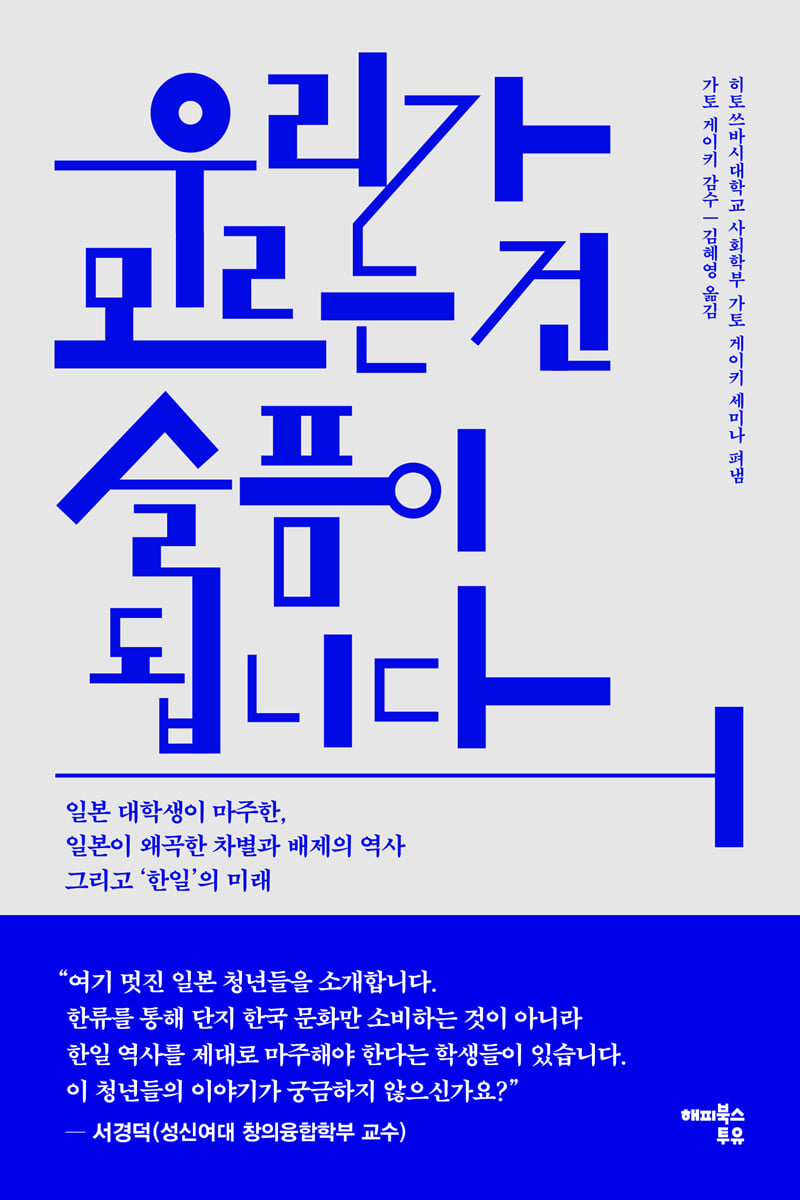
What we don't know is sad
 |
Description
Book Introduction
All proceeds from this funding will be donated to the House of Sharing.
Has there ever been a book written by a Japanese person criticizing their country's history of aggression? Here, an unprecedented book has been created, documenting the shame and confessions felt by young Japanese people living in a society rife with hatred.
When "What We Don't Know Becomes Sadness" was published in Japan, it ranked first in the "Social Science" category of Amazon Japan.
It is noteworthy that there is a certain distribution of 'anti-Korean' books in this field.
Before the official publication in Korea, major Korean newspapers also published numerous articles related to the book, which was unusual.
This was the result of early expectations from the media in both Korea and Japan that this book would serve as a 'new guide' for the stagnant Korea-Japan relationship.
"What We Don't Know Becomes Sadness" depicts the struggles and anxieties of Japanese college students as they confront the history of Japan's aggression against Korea.
While working at the Kato Keiki Seminar in the Faculty of Sociology at Hitotsubashi University, they realized the dangers of "historical ignorance" and the existence of people hurt by the Japanese people's light perception of perpetrators.
Japanese university students do not simply apologize to the victims; they pledge to fight alongside them and offer solidarity.
Has there ever been a book written by a Japanese person criticizing their country's history of aggression? Here, an unprecedented book has been created, documenting the shame and confessions felt by young Japanese people living in a society rife with hatred.
When "What We Don't Know Becomes Sadness" was published in Japan, it ranked first in the "Social Science" category of Amazon Japan.
It is noteworthy that there is a certain distribution of 'anti-Korean' books in this field.
Before the official publication in Korea, major Korean newspapers also published numerous articles related to the book, which was unusual.
This was the result of early expectations from the media in both Korea and Japan that this book would serve as a 'new guide' for the stagnant Korea-Japan relationship.
"What We Don't Know Becomes Sadness" depicts the struggles and anxieties of Japanese college students as they confront the history of Japan's aggression against Korea.
While working at the Kato Keiki Seminar in the Faculty of Sociology at Hitotsubashi University, they realized the dangers of "historical ignorance" and the existence of people hurt by the Japanese people's light perception of perpetrators.
Japanese university students do not simply apologize to the victims; they pledge to fight alongside them and offer solidarity.
- You can preview some of the book's contents.
Preview
index
prolog
People who made this book
Chapter 1: The Frustration Japanese Feel
Wasn't Japan a kind and friendly country full of tolerance?
My 'favorite' might be 'anti-Japanese'
I just said I like Korea
Because I don't know what's true
Column | The Embarrassment of Korean International Students
Roundtable | Is the Korea-Japan issue 'heavy'?
―Okita Mai, Kumano Goei, Asakura Kimika
Chapter 2 Why are Korea and Japan fighting?
Why do Korean celebrities wear 'comfort women' merchandise?
Column | Marimond and the "Girl Statue"
Why did Korea oppose the registration of 'Gunhamdo' as a World Heritage site?
Why are Korean celebrities posting anti-Japanese comments on August 15th?
Column | Gyeongbokgung Palace, the Instagram-worthy attraction
Column | Why is Dokdo considered Korean territory?
Panel Discussion | Is it true that 'colonial rule wasn't as bad as people thought'?
―Kumano Goei, Okita Mai, Lee Sang-jin, Ushiki Miku, Asakura Kimika
Chapter 3: Our Society Questioned by Korea-Japan Relations
Why do Koreans react to the 'Reiwa' text?
Column | K-Pop Artists Wear 'Atomic Bomb T-Shirts'
Why do all Korean idols go to the military?
Column | The Allure of Korean Cinema
I thought you were Japanese, but you were Korean?
Column | Was Postwar Japan a Peaceful Nation?
Panel Discussion | Isn't it just Korea that has historical issues?
―Kumano Goei, Ushiki Miku, Asakura Kimika, Lee Sang-jin
Chapter 4 'I know the truth, but... ... ', still confused
People criticize me for liking K-pop. How should I take that?
Column | Kim Ji-young, Born 1982
Why a Simple K-Pop Fan Started Learning History
A Korean student's story about his grandfather born in Japan
I made a Korean friend, but… …
Symposium | How to Encounter History
―Kumano Goei, Ushiki Miku, Asakura Kimika, Lee Sang-jin, Okita Mai
In publishing the book
Epilogue
Photo source
References
People who made this book
Chapter 1: The Frustration Japanese Feel
Wasn't Japan a kind and friendly country full of tolerance?
My 'favorite' might be 'anti-Japanese'
I just said I like Korea
Because I don't know what's true
Column | The Embarrassment of Korean International Students
Roundtable | Is the Korea-Japan issue 'heavy'?
―Okita Mai, Kumano Goei, Asakura Kimika
Chapter 2 Why are Korea and Japan fighting?
Why do Korean celebrities wear 'comfort women' merchandise?
Column | Marimond and the "Girl Statue"
Why did Korea oppose the registration of 'Gunhamdo' as a World Heritage site?
Why are Korean celebrities posting anti-Japanese comments on August 15th?
Column | Gyeongbokgung Palace, the Instagram-worthy attraction
Column | Why is Dokdo considered Korean territory?
Panel Discussion | Is it true that 'colonial rule wasn't as bad as people thought'?
―Kumano Goei, Okita Mai, Lee Sang-jin, Ushiki Miku, Asakura Kimika
Chapter 3: Our Society Questioned by Korea-Japan Relations
Why do Koreans react to the 'Reiwa' text?
Column | K-Pop Artists Wear 'Atomic Bomb T-Shirts'
Why do all Korean idols go to the military?
Column | The Allure of Korean Cinema
I thought you were Japanese, but you were Korean?
Column | Was Postwar Japan a Peaceful Nation?
Panel Discussion | Isn't it just Korea that has historical issues?
―Kumano Goei, Ushiki Miku, Asakura Kimika, Lee Sang-jin
Chapter 4 'I know the truth, but... ... ', still confused
People criticize me for liking K-pop. How should I take that?
Column | Kim Ji-young, Born 1982
Why a Simple K-Pop Fan Started Learning History
A Korean student's story about his grandfather born in Japan
I made a Korean friend, but… …
Symposium | How to Encounter History
―Kumano Goei, Ushiki Miku, Asakura Kimika, Lee Sang-jin, Okita Mai
In publishing the book
Epilogue
Photo source
References
Detailed image
.jpg)
Into the book
A rough and tangled feeling of unease, disappointment in myself, and a wavering sense of identity.
What I did in the past was clearly a violent and cruel act of domination, so why did I unconsciously 'justify' it?
Why couldn't I see it straight?
The more I knew, the more my feet began to tremble.
Still, that's why I wanted to know more.
What makes your heart heavy?
What could have disappointed you?
What made you ruminate that you couldn't leave it like this?
--- p.16
This Japanese military 'comfort women' system is recognized internationally as a system of sexual slavery.
Recently, the Japanese government has been focusing its discussions on whether or not there was forced conscription through physical violence.
However, the essence of the problem is that, regardless of the method used to recruit them, the women were held in a state of sexual slavery in the "comfort stations," and that the Japanese state committed war crimes that violated human rights based on racial, gender, and class discrimination.
--- p.41
Learning uncomfortable history is not a 'masochistic' act.
Rather, I think that not learning uncomfortable history is a 'shameful' thing and an act of 'degrading oneself'.
Isn't the point of learning history to face and reflect on even the facts we want to ignore?
--- p.168~169
It was possible to choose not to look at history, to avoid it as a difficult problem, and to say, "History and culture are separate."
This was my privilege as a Japanese person.
Because I was in a position where I didn't have to worry about Japan's history of aggression, I was able to enjoy Korean culture purely without any worries.
--- p.187
Of course, ignorance can also hurt others, so we cannot say for sure that ignorance is not a problem.
However, I realized the obvious fact that if the Japanese simply reflect on their history of aggression, they will not be able to protect the dignity of victims or eliminate discrimination.
I thought I was doing it for the person involved, but in reality, it seems like I didn't see the 'reality of discrimination' that the person involved was facing.
Before I knew it, the thought of wanting to protect myself as a Japanese person first began to creep into me.
--- p.192
There is no end to the act of understanding the victim.
In that respect, it will not be easy to overcome the ‘wall’ of historical issues.
I have lived in this country called Japan, which ignores its history of aggression and thoroughly oppresses minorities, without any doubts and with protection.
No matter what kind of thoughts I have and how I live my life in the future, I am still Japanese and will never be able to escape the responsibility of being Japanese.
What I did in the past was clearly a violent and cruel act of domination, so why did I unconsciously 'justify' it?
Why couldn't I see it straight?
The more I knew, the more my feet began to tremble.
Still, that's why I wanted to know more.
What makes your heart heavy?
What could have disappointed you?
What made you ruminate that you couldn't leave it like this?
--- p.16
This Japanese military 'comfort women' system is recognized internationally as a system of sexual slavery.
Recently, the Japanese government has been focusing its discussions on whether or not there was forced conscription through physical violence.
However, the essence of the problem is that, regardless of the method used to recruit them, the women were held in a state of sexual slavery in the "comfort stations," and that the Japanese state committed war crimes that violated human rights based on racial, gender, and class discrimination.
--- p.41
Learning uncomfortable history is not a 'masochistic' act.
Rather, I think that not learning uncomfortable history is a 'shameful' thing and an act of 'degrading oneself'.
Isn't the point of learning history to face and reflect on even the facts we want to ignore?
--- p.168~169
It was possible to choose not to look at history, to avoid it as a difficult problem, and to say, "History and culture are separate."
This was my privilege as a Japanese person.
Because I was in a position where I didn't have to worry about Japan's history of aggression, I was able to enjoy Korean culture purely without any worries.
--- p.187
Of course, ignorance can also hurt others, so we cannot say for sure that ignorance is not a problem.
However, I realized the obvious fact that if the Japanese simply reflect on their history of aggression, they will not be able to protect the dignity of victims or eliminate discrimination.
I thought I was doing it for the person involved, but in reality, it seems like I didn't see the 'reality of discrimination' that the person involved was facing.
Before I knew it, the thought of wanting to protect myself as a Japanese person first began to creep into me.
--- p.192
There is no end to the act of understanding the victim.
In that respect, it will not be easy to overcome the ‘wall’ of historical issues.
I have lived in this country called Japan, which ignores its history of aggression and thoroughly oppresses minorities, without any doubts and with protection.
No matter what kind of thoughts I have and how I live my life in the future, I am still Japanese and will never be able to escape the responsibility of being Japanese.
--- p.212
Publisher's Review
Japan, which continues to spread hatred and discrimination against Korea.
A Dialogue of Criticism and Reflection Among Japanese University Students Reporting to Their Homeland
“Where does the anti-Korean sentiment prevalent in Japanese society originate?”
Japanese university students, who felt an inexplicable sense of frustration whenever they encountered the indiscriminate hatred of Korea by the Japanese, are forced to confront the history of Japan's aggression that they had tried to ignore when they entered a sociology seminar.
They realized that their mere ignorance contributed to the structures of discrimination and exclusion, and that there were people who were hurt by their ignorance.
Furthermore, he says that Japanese people should not only be aware of their country's history and mistakes, but also stand on the side of the victims and work together to change a society filled with hatred.
Can just 'knowing' solve all problems?
We, Japanese college students, felt puzzled by the hateful remarks we inevitably received when we told people around us that we liked Korea.
Despite the baseless hatred, they tried to ignore the problem by saying that historical and cultural exchanges are different.
But every time I did that, I just felt like I wasn't facing the real problem.
Then, at a seminar I happened to attend, I learned about the undistorted history of Korea and Japan for the first time.
I saw the victims suffering under Japanese colonial rule.
'We' were angry at the Japanese society that did not acknowledge its past sins and did not offer a proper apology to Korea.
And I was disappointed in myself for turning a blind eye to all this and not questioning anything.
The feeling of frustration that I thought would completely disappear led to a heavy sense of guilt as I continued to participate in seminars.
Continued frustration
After learning about the history, I couldn't enjoy Korean culture as easily as before.
There were also doubts about the movement toward harmony among the younger generation.
As the confusion grew, I met a Zainichi Korean on a study tour that I went on for a seminar.
A shock different from when I learned of Japan's history of aggression came over me.
Because the person who directly suffered discrimination and hatred from the Japanese was right in front of us.
'We' unconsciously thought that the Japanese people of the past who committed the harm and the 'we' of the present were different people.
However, we, the Japanese living in the present, live on the blood and tears of suffering individuals.
If we stop at simply reflecting on the history of harm, nothing will change.
So we've come to the conclusion that we need to go beyond simply knowing and stand with the victims to fight against discrimination.
Why this book became a bestseller in Japan
The winds of change blowing within Japan.
As K-pop and Korean dramas spread like wildfire in Japan, Japanese college students failed to understand the older generation's baseless hatred of Korea.
Very uncomfortable and frustrating days have passed.
This book was created from talking about this frustration with each other.
Japanese university students reflect on their own history, candidly share their experiences of confusion and fear, and offer tips for fighting discrimination and hatred.
The courageous confessions of those who started like that actually changed many Japanese people.
Japanese readers who read “What We Don’t Know Becomes Sadness” posted on various social media sites, saying, “It’s like I’m looking straight at the history I’ve been ignoring for the first time.”
He left behind a sentiment such as, 'It was painful, but I think it was absolutely necessary,' and felt the need for change in Japanese society.
Japan's long-standing antipathy toward Korea, built up by Japan's distortion of history and unapologetic attitude, has frozen Korea-Japan relations.
However, "What We Don't Know is Sadness" shows that in Japan today, the younger generation is constantly struggling and uniting to change the hateful society.
The reason why this book has been a bestseller for a long time among many anti-Korean books is precisely this proof.
How about we listen to the voices of apology and reflection that the Japanese have long neglected? How about supporting them as they take their first steps?
A Dialogue of Criticism and Reflection Among Japanese University Students Reporting to Their Homeland
“Where does the anti-Korean sentiment prevalent in Japanese society originate?”
Japanese university students, who felt an inexplicable sense of frustration whenever they encountered the indiscriminate hatred of Korea by the Japanese, are forced to confront the history of Japan's aggression that they had tried to ignore when they entered a sociology seminar.
They realized that their mere ignorance contributed to the structures of discrimination and exclusion, and that there were people who were hurt by their ignorance.
Furthermore, he says that Japanese people should not only be aware of their country's history and mistakes, but also stand on the side of the victims and work together to change a society filled with hatred.
Can just 'knowing' solve all problems?
We, Japanese college students, felt puzzled by the hateful remarks we inevitably received when we told people around us that we liked Korea.
Despite the baseless hatred, they tried to ignore the problem by saying that historical and cultural exchanges are different.
But every time I did that, I just felt like I wasn't facing the real problem.
Then, at a seminar I happened to attend, I learned about the undistorted history of Korea and Japan for the first time.
I saw the victims suffering under Japanese colonial rule.
'We' were angry at the Japanese society that did not acknowledge its past sins and did not offer a proper apology to Korea.
And I was disappointed in myself for turning a blind eye to all this and not questioning anything.
The feeling of frustration that I thought would completely disappear led to a heavy sense of guilt as I continued to participate in seminars.
Continued frustration
After learning about the history, I couldn't enjoy Korean culture as easily as before.
There were also doubts about the movement toward harmony among the younger generation.
As the confusion grew, I met a Zainichi Korean on a study tour that I went on for a seminar.
A shock different from when I learned of Japan's history of aggression came over me.
Because the person who directly suffered discrimination and hatred from the Japanese was right in front of us.
'We' unconsciously thought that the Japanese people of the past who committed the harm and the 'we' of the present were different people.
However, we, the Japanese living in the present, live on the blood and tears of suffering individuals.
If we stop at simply reflecting on the history of harm, nothing will change.
So we've come to the conclusion that we need to go beyond simply knowing and stand with the victims to fight against discrimination.
Why this book became a bestseller in Japan
The winds of change blowing within Japan.
As K-pop and Korean dramas spread like wildfire in Japan, Japanese college students failed to understand the older generation's baseless hatred of Korea.
Very uncomfortable and frustrating days have passed.
This book was created from talking about this frustration with each other.
Japanese university students reflect on their own history, candidly share their experiences of confusion and fear, and offer tips for fighting discrimination and hatred.
The courageous confessions of those who started like that actually changed many Japanese people.
Japanese readers who read “What We Don’t Know Becomes Sadness” posted on various social media sites, saying, “It’s like I’m looking straight at the history I’ve been ignoring for the first time.”
He left behind a sentiment such as, 'It was painful, but I think it was absolutely necessary,' and felt the need for change in Japanese society.
Japan's long-standing antipathy toward Korea, built up by Japan's distortion of history and unapologetic attitude, has frozen Korea-Japan relations.
However, "What We Don't Know is Sadness" shows that in Japan today, the younger generation is constantly struggling and uniting to change the hateful society.
The reason why this book has been a bestseller for a long time among many anti-Korean books is precisely this proof.
How about we listen to the voices of apology and reflection that the Japanese have long neglected? How about supporting them as they take their first steps?
GOODS SPECIFICS
- Date of issue: March 29, 2024
- Page count, weight, size: 244 pages | 328g | 140*210*12mm
- ISBN13: 9791170961499
- ISBN10: 1170961495
You may also like
카테고리
korean


korean

![GQ KOREA Mark (Monthly): December [2025]](http://librairie.coreenne.fr/cdn/shop/files/8ef265dbbfbf186523ed75ba7319009d.jpg?v=1765340328&width=3840)


