

Full-fledged Korean-Chinese-Japanese World History 18
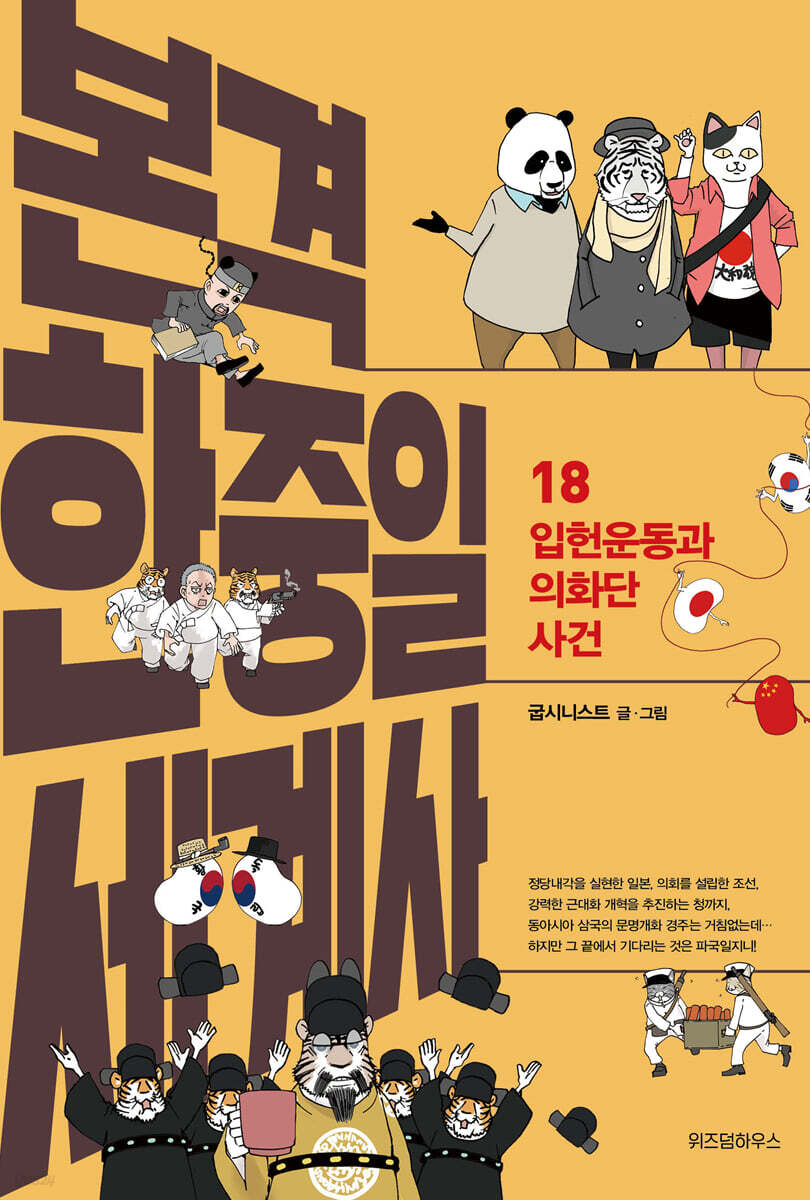 |
Description
Book Introduction
The Independence Association's movement to modernize Joseon lost the public's support due to a momentary misjudgment and died down.
Meanwhile, the Qing joins hands with the Boxer Rebellion, an extreme xenophobic group, and takes a final gamble that will determine their fate!
Volume 18 deals with the circumstances of Joseon and Qing, which each undertook their own modernization reforms.
The Independence Association, which had been carrying out a modernization movement in Joseon, was destined to disband due to King Gojong's constant restraint and misreading of public sentiment.
After that, King Gojong attempted to strengthen imperial power and modernize at the same time… .
Meanwhile, in the Qing Dynasty, modernization reforms were underway under the leadership of Emperor Guangxu and Kang Youwei, but the intervention of Empress Dowager Cixi and the Boxer Rebellion brought the country to a dead end.
Meanwhile, the Qing joins hands with the Boxer Rebellion, an extreme xenophobic group, and takes a final gamble that will determine their fate!
Volume 18 deals with the circumstances of Joseon and Qing, which each undertook their own modernization reforms.
The Independence Association, which had been carrying out a modernization movement in Joseon, was destined to disband due to King Gojong's constant restraint and misreading of public sentiment.
After that, King Gojong attempted to strengthen imperial power and modernize at the same time… .
Meanwhile, in the Qing Dynasty, modernization reforms were underway under the leadership of Emperor Guangxu and Kang Youwei, but the intervention of Empress Dowager Cixi and the Boxer Rebellion brought the country to a dead end.
- You can preview some of the book's contents.
Preview
index
preface
Chapter 1 Kang You, Why
Chapter 2: The Martial Law Reform
Chapter 3: 100 Days of Yushin
Chapter 4: The Martial Arts Coup
Chapter 5: Tokyo Collaboration
Chapter 6 Collapse
Chapter 7 1898
Chapter 8: Poison Coffee
Chapter 9 October Movement
Chapter 10: The Fall of Legislation
Chapter 11: The Morning of Reversal
Chapter 12: The Seoul Uprising
Chapter 13 Riot - Martial Arts Rebellion
Chapter 14: The Establishment of the National Assembly
Chapter 15: The Enemy's Friend
Chapter 16: Christmas Strikes Back
Chapter 17: The Gwangmu Reform of 1899
Chapter 18: Chronology of the 1890s 1
Chapter 19: Chronology of the 1890s 2
Chapter 20: Gihae Geonjeo
Chapter 21: Plum Blossoms and Fists
Chapter 22: June's Rhapsody
Chapter 23: Entering the fray
Chapter 24 D-55
Chapter 25: The Huns Are Coming
Chapter 26: 55 Days in Summer
Chapter 27: Bloodmelon
Chapter 28: To the Peking
Chapter 29: Beijing Has Fallen
Major events and people
Chapter 1 Kang You, Why
Chapter 2: The Martial Law Reform
Chapter 3: 100 Days of Yushin
Chapter 4: The Martial Arts Coup
Chapter 5: Tokyo Collaboration
Chapter 6 Collapse
Chapter 7 1898
Chapter 8: Poison Coffee
Chapter 9 October Movement
Chapter 10: The Fall of Legislation
Chapter 11: The Morning of Reversal
Chapter 12: The Seoul Uprising
Chapter 13 Riot - Martial Arts Rebellion
Chapter 14: The Establishment of the National Assembly
Chapter 15: The Enemy's Friend
Chapter 16: Christmas Strikes Back
Chapter 17: The Gwangmu Reform of 1899
Chapter 18: Chronology of the 1890s 1
Chapter 19: Chronology of the 1890s 2
Chapter 20: Gihae Geonjeo
Chapter 21: Plum Blossoms and Fists
Chapter 22: June's Rhapsody
Chapter 23: Entering the fray
Chapter 24 D-55
Chapter 25: The Huns Are Coming
Chapter 26: 55 Days in Summer
Chapter 27: Bloodmelon
Chapter 28: To the Peking
Chapter 29: Beijing Has Fallen
Major events and people
Into the book
In January 1898, the emperor personally visited Kang Youwei's court at the arrangement of Ong Donghua.
“In response to your inquiry, I will report on a plan for the survival of the country.
Peter the Great of Russia once transformed his country into a modern empire by traveling around Europe and learning from it, and Japan, a remote island nation, became a wealthy and powerful nation after 25 years of Westernization and became a country that China could not defeat in war.
“Following the humiliation of the Sino-Japanese War, we have suffered the humiliation of having our key positions taken over by four European countries this year (1898). How can we delay the great cause of Yushin for even a moment!! Modernize our country, go for it!!”
--- p.22~23, from “Chapter 2, Martial Arts Reform”
On September 19, 1898, Empress Dowager Cixi returned to the Forbidden City.
On the same day, Empress Dowager Cixi's royal guard raided Kang Youwei's home.
Kang Yu-wi's younger brother, Kang Gwang-in, is captured.
“Now that it’s settled, Your Majesty, you should go cool your head in the lake.” “…Are you going to squander this last chance for CPR to save the very lifeline of this country, the Qing Dynasty?!” “If this country’s lifeline is going to end, I should die while protecting the foundation of the Qing Dynasty. I can’t spend my deathbed watching a ragtag bunch of fake scholars.”
--- p.53~56, from “Chapter 4: Martial Arts Coup”
On October 15, 1898, the Independence Association's general representatives submitted a revision to the Privy Council (a bill to establish a parliament) to the government, beginning discussions on establishing a parliament.
“To put it clearly, the idea is to make the Privy Council into a Western ‘parliament.’
Our Central Council will first seek to play the role of the upper house of a Western parliament.
So, the Privy Council 'deliberates' the government's policies and bills." "Gasp; It's here!! Democracy;;"
--- p.122~124, from “Chapter 10: The Fall of Legislation”
The night of November 4th.
The conservative royalist faction's delegation urgently enters the palace.
“…The agents found this poster while patrolling the four gates and brought it to us… It is a poster inciting treason, calling for tomorrow’s election to elect Park Jeong-yang as president and Yun Chi-ho as vice president and declare a republic!!” “You democratic protesters! I thought you were going to be so rebellious all along!! Let’s immediately begin the operation to arrest the criminals of the times!!” At dawn on November 5, 1898, the Gyeongmu Office arrest unit was dispatched.
17 leaders of the Independence Association, including Lee Sang-jae and Namgung Eok, were suddenly arrested while sleeping at home.
On the morning of November 5th, the people who gathered at Independence Hall to vote were shocked.
An angry crowd gathers in front of the police station.
The People's Assembly continues all night.
--- p.142~146, from “Chapter 11: The Morning of Reversal”
The riots continued until late at night on November 21st, destroying the offices of the Seoul peddlers, the houses of the Hwangguk Association executives, and the houses of the royalist ministers.
“Huh;; Has Demo now developed into Riot;;” From the night of November 22nd to the 23rd, Western ambassadors stay at Gyeongungung Palace to protect the Emperor.
“…People, I will allow the Independence Association to be re-established, so calm down~ calm down~ haha;;” November 22, the Independence Association was re-established.
On November 23, 1898, negotiations between the People's Assembly and the government were concluded.
--- p.161~165, from “Chapter 13 Riot-Martial Arts Rebellion”
Meanwhile, on December 15, 1898, the Privy Council was somehow opened.
“The first modern parliament on the Korean Peninsula begins!!” On December 16, Choi Jeong-deok and other members of the Independence Association presented their first agenda item: “Instead of forming a new government, let’s create a list of candidates and submit it to the higher-ups!” The list of candidates was created based on the votes of the members of the Independence Association.
Park Young-hyo
--- p.175~176, from “Chapter 14: Pro-Yu & Establishment of the National Assembly”
Park Yeong-hyo, who was considered an accomplice in the Eulmi Incident, was a name that touched the emperor's sore spot.
The public was greatly disappointed with the Independence Association's movement to save Park Yeong-hyo and turned away.
The military sentiment was also greatly shaken.
December 21, 1898, Emperor proclaimed.
"Patience is over!! Arrest all those who defend the traitor Park Yeong-hyo!! There will absolutely be no pardon for those who have fled the country!!"
--- p.179~187, from “Chapter 15: The Enemy’s Friend”
“It seems necessary to replace the emperor with a well-behaved child to avoid any trouble later on.
(…) Unlike his father, King Danwang Jaeyi is loyal and intelligent.” (King Danwang Jaeyi) caught the eye of Empress Dowager Cixi and married her niece.
From that marriage, a son, Bujun, is born.
“…I should make your son, Bujun, the next emperor.” “What an excellent choice!” “Oh, that, um, that’s something that the senior officials are concerned about and want you to reconsider…” King Danwang Jaeui and his faction are extreme xenophobic.
In contrast, although Yeongrok and his group destroyed the Wusul Reform, they continued to push for the introduction of Western civilization.
Crucially, the Western powers also vetoed Bujun's succession to the throne.
Bujun refuses to attend the New Year's celebrations of 1900 hosted by the acting emperor.
--- p.282~288, from “Chapter 20, Gihae Geonjeo”
"No, honestly, isn't the right to practice martial arts itself just a martial art? If you look closely, the conflict between local residents and the church is the church's fault.
Catching and beating up bad guys unconditionally is not the solution.
Rather, the best way to control them is to officially recognize the groups of the Righteous Army as "training"!! The point is that the targets of the current popular flow are the Western church, Western civilization, Westerners - the West itself.
And they also consider the Western puppets, the Yangwu faction, as their enemies! So, shouldn't we find out whether they have political value? In February 1898, the Qing government issued an edict recognizing the Boxer Rebellion's discipline.
--- p.305~310, from “Chapter 21: Plum Blossoms and Fists”
“More than anything, there is a rumor that the Marine Corps troops that entered Beijing the day before yesterday were actually troops supporting the coup d’état by the Emperor and the Reform Party.
“It seems necessary to use the Boxer Rebellion’s numbers to exert pressure in order to prevent the Emperor and the Chinese from doing such things.” “What?!?! How can we ignore the beautiful hearts of our children, our loyal subjects, who have come to visit their mother! We permit the Boxers to enter Beijing!” June 7, 1900, the Boxers entered Beijing.
--- p.323, from “Chapter 22, June’s Rhapsody”
On June 20, the German minister, Baron Ketteler, went to the Forbidden City with a small entourage.
On the way, he gets into an altercation with some soldiers.
“Apologize for the Chinese man shot dead by the German embassy guard a few days ago!!” “Oh, that, I gave the order to shoot any rioters approaching the embassy immediately! The cult must die to be cured!” “Oh, let’s shoot Yang Gui right away too!!” “Killing… a diplomat?!” And so the situation went beyond the river of no return.
On June 21, 1900, the Qing Dynasty declared war.
“Shall we live so pathetically that we will leave a mark of shame for all eternity? Let us rise up and compete!”
--- p.343~344, from “Chapter 23: Entering the Battle”
On June 23, the Boxer Rebellion began a full-scale offensive by setting fire to the Hanlinwon in an attempt to attack the British embassy.
The western defensive line is occupied by British and Russian forces, and the eastern defensive line is occupied by French, Japanese, and Austrian forces.
And the southern inner city wall of Beijing overlooking the embassy district.
The east and west sides of the wall are occupied by German and American troops respectively.
The 3,000 or so Chinese Christians who took refuge in the area are responsible for building barricades and carrying out various transportation tasks.
“The final moment is approaching!!! Let’s light the ammunition depot and go with them!!”
“In response to your inquiry, I will report on a plan for the survival of the country.
Peter the Great of Russia once transformed his country into a modern empire by traveling around Europe and learning from it, and Japan, a remote island nation, became a wealthy and powerful nation after 25 years of Westernization and became a country that China could not defeat in war.
“Following the humiliation of the Sino-Japanese War, we have suffered the humiliation of having our key positions taken over by four European countries this year (1898). How can we delay the great cause of Yushin for even a moment!! Modernize our country, go for it!!”
--- p.22~23, from “Chapter 2, Martial Arts Reform”
On September 19, 1898, Empress Dowager Cixi returned to the Forbidden City.
On the same day, Empress Dowager Cixi's royal guard raided Kang Youwei's home.
Kang Yu-wi's younger brother, Kang Gwang-in, is captured.
“Now that it’s settled, Your Majesty, you should go cool your head in the lake.” “…Are you going to squander this last chance for CPR to save the very lifeline of this country, the Qing Dynasty?!” “If this country’s lifeline is going to end, I should die while protecting the foundation of the Qing Dynasty. I can’t spend my deathbed watching a ragtag bunch of fake scholars.”
--- p.53~56, from “Chapter 4: Martial Arts Coup”
On October 15, 1898, the Independence Association's general representatives submitted a revision to the Privy Council (a bill to establish a parliament) to the government, beginning discussions on establishing a parliament.
“To put it clearly, the idea is to make the Privy Council into a Western ‘parliament.’
Our Central Council will first seek to play the role of the upper house of a Western parliament.
So, the Privy Council 'deliberates' the government's policies and bills." "Gasp; It's here!! Democracy;;"
--- p.122~124, from “Chapter 10: The Fall of Legislation”
The night of November 4th.
The conservative royalist faction's delegation urgently enters the palace.
“…The agents found this poster while patrolling the four gates and brought it to us… It is a poster inciting treason, calling for tomorrow’s election to elect Park Jeong-yang as president and Yun Chi-ho as vice president and declare a republic!!” “You democratic protesters! I thought you were going to be so rebellious all along!! Let’s immediately begin the operation to arrest the criminals of the times!!” At dawn on November 5, 1898, the Gyeongmu Office arrest unit was dispatched.
17 leaders of the Independence Association, including Lee Sang-jae and Namgung Eok, were suddenly arrested while sleeping at home.
On the morning of November 5th, the people who gathered at Independence Hall to vote were shocked.
An angry crowd gathers in front of the police station.
The People's Assembly continues all night.
--- p.142~146, from “Chapter 11: The Morning of Reversal”
The riots continued until late at night on November 21st, destroying the offices of the Seoul peddlers, the houses of the Hwangguk Association executives, and the houses of the royalist ministers.
“Huh;; Has Demo now developed into Riot;;” From the night of November 22nd to the 23rd, Western ambassadors stay at Gyeongungung Palace to protect the Emperor.
“…People, I will allow the Independence Association to be re-established, so calm down~ calm down~ haha;;” November 22, the Independence Association was re-established.
On November 23, 1898, negotiations between the People's Assembly and the government were concluded.
--- p.161~165, from “Chapter 13 Riot-Martial Arts Rebellion”
Meanwhile, on December 15, 1898, the Privy Council was somehow opened.
“The first modern parliament on the Korean Peninsula begins!!” On December 16, Choi Jeong-deok and other members of the Independence Association presented their first agenda item: “Instead of forming a new government, let’s create a list of candidates and submit it to the higher-ups!” The list of candidates was created based on the votes of the members of the Independence Association.
Park Young-hyo
--- p.175~176, from “Chapter 14: Pro-Yu & Establishment of the National Assembly”
Park Yeong-hyo, who was considered an accomplice in the Eulmi Incident, was a name that touched the emperor's sore spot.
The public was greatly disappointed with the Independence Association's movement to save Park Yeong-hyo and turned away.
The military sentiment was also greatly shaken.
December 21, 1898, Emperor proclaimed.
"Patience is over!! Arrest all those who defend the traitor Park Yeong-hyo!! There will absolutely be no pardon for those who have fled the country!!"
--- p.179~187, from “Chapter 15: The Enemy’s Friend”
“It seems necessary to replace the emperor with a well-behaved child to avoid any trouble later on.
(…) Unlike his father, King Danwang Jaeyi is loyal and intelligent.” (King Danwang Jaeyi) caught the eye of Empress Dowager Cixi and married her niece.
From that marriage, a son, Bujun, is born.
“…I should make your son, Bujun, the next emperor.” “What an excellent choice!” “Oh, that, um, that’s something that the senior officials are concerned about and want you to reconsider…” King Danwang Jaeui and his faction are extreme xenophobic.
In contrast, although Yeongrok and his group destroyed the Wusul Reform, they continued to push for the introduction of Western civilization.
Crucially, the Western powers also vetoed Bujun's succession to the throne.
Bujun refuses to attend the New Year's celebrations of 1900 hosted by the acting emperor.
--- p.282~288, from “Chapter 20, Gihae Geonjeo”
"No, honestly, isn't the right to practice martial arts itself just a martial art? If you look closely, the conflict between local residents and the church is the church's fault.
Catching and beating up bad guys unconditionally is not the solution.
Rather, the best way to control them is to officially recognize the groups of the Righteous Army as "training"!! The point is that the targets of the current popular flow are the Western church, Western civilization, Westerners - the West itself.
And they also consider the Western puppets, the Yangwu faction, as their enemies! So, shouldn't we find out whether they have political value? In February 1898, the Qing government issued an edict recognizing the Boxer Rebellion's discipline.
--- p.305~310, from “Chapter 21: Plum Blossoms and Fists”
“More than anything, there is a rumor that the Marine Corps troops that entered Beijing the day before yesterday were actually troops supporting the coup d’état by the Emperor and the Reform Party.
“It seems necessary to use the Boxer Rebellion’s numbers to exert pressure in order to prevent the Emperor and the Chinese from doing such things.” “What?!?! How can we ignore the beautiful hearts of our children, our loyal subjects, who have come to visit their mother! We permit the Boxers to enter Beijing!” June 7, 1900, the Boxers entered Beijing.
--- p.323, from “Chapter 22, June’s Rhapsody”
On June 20, the German minister, Baron Ketteler, went to the Forbidden City with a small entourage.
On the way, he gets into an altercation with some soldiers.
“Apologize for the Chinese man shot dead by the German embassy guard a few days ago!!” “Oh, that, I gave the order to shoot any rioters approaching the embassy immediately! The cult must die to be cured!” “Oh, let’s shoot Yang Gui right away too!!” “Killing… a diplomat?!” And so the situation went beyond the river of no return.
On June 21, 1900, the Qing Dynasty declared war.
“Shall we live so pathetically that we will leave a mark of shame for all eternity? Let us rise up and compete!”
--- p.343~344, from “Chapter 23: Entering the Battle”
On June 23, the Boxer Rebellion began a full-scale offensive by setting fire to the Hanlinwon in an attempt to attack the British embassy.
The western defensive line is occupied by British and Russian forces, and the eastern defensive line is occupied by French, Japanese, and Austrian forces.
And the southern inner city wall of Beijing overlooking the embassy district.
The east and west sides of the wall are occupied by German and American troops respectively.
The 3,000 or so Chinese Christians who took refuge in the area are responsible for building barricades and carrying out various transportation tasks.
“The final moment is approaching!!! Let’s light the ammunition depot and go with them!!”
--- p.374~379, from “Chapter 26, 55 Days in Summer”
Publisher's Review
The Independence Association, which fired the starting signal for parliamentary politics after enduring hardships
Raise your hands and feet in front of the absolute truth that the will of the people is the will of heaven!
The summer of 1898 in Joseon was very hot.
Almost daily, countless citizens gathered in Jongno Square, freely expressing their thoughts on society, politics, culture, and more! At the center of this seething public sentiment was the Independence Association, which rallied public opinion and launched a powerful protest calling for the establishment of a parliament.
In particular, as the protests continued through the night starting October 7, discussions on opening a parliament gained momentum.
Throughout October, Gojong and the Independence Association wrestled over the composition of the uniforms, and on October 29th, it was decided that half of them would be given to the Independence Association.
Accordingly, the first election to select members of the Independence Association is scheduled for November 5th.
However, on the dawn of the election day, an unknown poster was discovered stating that the Independence Association would declare a republic, and King Gojong, as if he had been waiting for this, ordered the arrest of the Independence Association's leadership.
In response, the angry people gathered in front of Gyeongungung Palace, where Emperor Gojong was staying, and continued to hold protest rallies, and from November 21, even signs of civil unrest began to appear.
Surprised by this, King Gojong personally appeared before the people and promised to restore the Independence Association and establish a parliament.
Thus, on December 15, the Privy Council, which had been an advisory body, was reorganized into a parliament, marking the beginning of the first parliamentary government on the Korean Peninsula.
However, the very next day, the National Assembly committed a major blunder: instead of forming a government, they recommended Park Yeong-hyo, who was suspected of being an accomplice in the Eulmi Incident, as a candidate.
At that time, the people treated Park Yeong-hyo as a traitor, so public sentiment quickly turned against the National Assembly and the Independence Association.
Emperor Gojong, who noticed this, mobilized the army between December 21 and 25 to disband the National Assembly and the Independence Association at once.
King Gojong, who judged that he had regained the hearts of the people, launched the Gwangmu Reform in June 1899, a unique reform aimed at both strengthening imperial power and modernization.
Will the Gwangmu Reform, which relied on the lightness of public sentiment, be able to complete King Gojong's big picture?
From radical scholars to extreme xenophobes
Is the Qing Dynasty's modernization reforms, now a mishmash, headed for disaster?
Meanwhile, the winds of change were blowing in the Qing Dynasty, and at the center of it was Kang Youwei, a scholar of the past who had a long life.
The 'Western rationalism based on Confucianism' he advocated was seen by scholars as a stepping stone to advance to the center stage of politics.
As the number of forces supporting Kang Youwei increased, Emperor Guangxu, who was just trying to escape the shadow of Empress Dowager Cixi and establish his own politics, reached out.
In January 1898, Emperor Guangxu met with Kang Youwei and organized his thoughts, and in June he raised the flag of reform.
The martial law reforms that began in this way carried out general measures such as tax, military, and education reforms, but also heralded radical changes.
Ito Hirobumi, the mastermind behind the Sino-Japanese War, was appointed as a foreign advisor, and discussions were underway to unite the country with Western powers. Shocked by this inflammatory reform, Empress Dowager Cixi mobilized her army in September 1898, seized Beijing, and imprisoned the Guangxu Emperor.
At the dawn of the new year in 1899, Empress Dowager Cixi nominated her nephew-in-law, Prince Danwang Jaeyi's son, Fujun, as the new emperor.
However, King Danwang Jaeyi was a strong xenophobe, and because of this, the Western powers and the Western Wu faction, which had been at the forefront of introducing Western civilization, strongly opposed it.
Then, King Danwang Jaeyi tried to increase his power by bringing in the Boxer Rebellion, which had extreme xenophobia mixed with cult-like characteristics.
Empress Dowager Cixi, who was deceived by Prince Zaiyi's fake news that the Guangxu Emperor and the Yangwu faction were plotting treason together with the Western powers, allowed the Boxer Rebellion to enter Beijing in June 1900 and declared war on all Western powers.
Then, as if they had been waiting, the Boxer Rebellion began attacking the Western embassy… .
Would the 55-day Battle of Beijing be the catalyst for the Qing's resurgence, or would it be the last spark before it dies out?
▶ The 『Authentic Korean-Chinese-Japanese World History』 series
This is foul play, how can you not lose the humor while still having depth in the content?
Easily overcoming the conventional wisdom that history must be memorized to be understood.
When we talk about 'history', we often have the common perception that it is 'boring' and that 'you have to memorize it to understand it'.
This may be because the memories of memorizing the years and processes of each event in middle and high school history classes are all that remain of our image of history.
In contrast, this series deviates significantly from the conventional wisdom that history must be memorized.
This series is a historical comic by cartoonist Gupsinist, who uses his major to cover the modern history of Korea, China, and Japan. It describes the modern history of 19th century East Asia, while naturally incorporating various subcultures such as games, military, animation, and dramas.
As you slowly follow the author's extensive knowledge of history, the various parodies and wordplay that are sprinkled throughout, the zeitgeist and world situation of the time will naturally come to mind.
Through this series, readers will experience a significant reduction in the barriers to entry into history, which was once perceived as difficult.
In the face of the tidal wave of Western imperialist powers entering the world,
How did Korea, China, and Japan resist or comply?
Why must we read world history through the lens of "Korea, China, and Japan"? To observe the tree of Korean history, our own history, we must first see the forest of East Asian history. Without understanding this, we cannot grasp the larger picture of world history.
To understand our country's past and present, and the global situation, we will compare the history of three East Asian countries.
World history up to now has not strayed far from the form of a brief description of the history of Western powers and the surrounding nations and peoples within the global historical flow they created.
However, not only the military and diplomacy of powerful nations, but also the resistance and identity of weak nations occupy a large portion of history.
This series is an attempt to break away from the conventional Western-centric historical narrative and look at history from an East Asian perspective.
Among these, we will take a closer look at the period from the mid-19th century to the mid-20th century, when Korea, China, and Japan were most closely connected.
01.
The beginning of the West Sea branch
02.
Taiping Heavenly Kingdom Rising
03.
Japan's opening
04.
Taiping Heavenly Kingdom Downfall
05.
Archipelago Games
06.
Tsunami of Dawn
07.
Heungseon Daewongun and the Byeongin Yangyo
08.
The fall of the shogunate and the Boshin War
09.
Bloody Sunshine Shinmiyangyo
10.
Ganghwa Island Treaty Ominous
11.
Southwestern War and Uyghur Uprising
12.
The Im-o Incident and the Tonkin Crisis
13.
The Sino-French War and the Gapsin Coup
14.
Geomundo Crisis and Banggokryeong
15.
Donghak Peasant Revolution and the Sino-Japanese War
16.
The Triple Intervention and the Gabo Reforms
17.
The Eulmi Incident and the Yellow Sea Crisis
18.
The Constitutional Movement and the Boxer Rebellion
19.
The Treaty of New York and the Anglo-Japanese Alliance (foundation)
*Continued publication.
Raise your hands and feet in front of the absolute truth that the will of the people is the will of heaven!
The summer of 1898 in Joseon was very hot.
Almost daily, countless citizens gathered in Jongno Square, freely expressing their thoughts on society, politics, culture, and more! At the center of this seething public sentiment was the Independence Association, which rallied public opinion and launched a powerful protest calling for the establishment of a parliament.
In particular, as the protests continued through the night starting October 7, discussions on opening a parliament gained momentum.
Throughout October, Gojong and the Independence Association wrestled over the composition of the uniforms, and on October 29th, it was decided that half of them would be given to the Independence Association.
Accordingly, the first election to select members of the Independence Association is scheduled for November 5th.
However, on the dawn of the election day, an unknown poster was discovered stating that the Independence Association would declare a republic, and King Gojong, as if he had been waiting for this, ordered the arrest of the Independence Association's leadership.
In response, the angry people gathered in front of Gyeongungung Palace, where Emperor Gojong was staying, and continued to hold protest rallies, and from November 21, even signs of civil unrest began to appear.
Surprised by this, King Gojong personally appeared before the people and promised to restore the Independence Association and establish a parliament.
Thus, on December 15, the Privy Council, which had been an advisory body, was reorganized into a parliament, marking the beginning of the first parliamentary government on the Korean Peninsula.
However, the very next day, the National Assembly committed a major blunder: instead of forming a government, they recommended Park Yeong-hyo, who was suspected of being an accomplice in the Eulmi Incident, as a candidate.
At that time, the people treated Park Yeong-hyo as a traitor, so public sentiment quickly turned against the National Assembly and the Independence Association.
Emperor Gojong, who noticed this, mobilized the army between December 21 and 25 to disband the National Assembly and the Independence Association at once.
King Gojong, who judged that he had regained the hearts of the people, launched the Gwangmu Reform in June 1899, a unique reform aimed at both strengthening imperial power and modernization.
Will the Gwangmu Reform, which relied on the lightness of public sentiment, be able to complete King Gojong's big picture?
From radical scholars to extreme xenophobes
Is the Qing Dynasty's modernization reforms, now a mishmash, headed for disaster?
Meanwhile, the winds of change were blowing in the Qing Dynasty, and at the center of it was Kang Youwei, a scholar of the past who had a long life.
The 'Western rationalism based on Confucianism' he advocated was seen by scholars as a stepping stone to advance to the center stage of politics.
As the number of forces supporting Kang Youwei increased, Emperor Guangxu, who was just trying to escape the shadow of Empress Dowager Cixi and establish his own politics, reached out.
In January 1898, Emperor Guangxu met with Kang Youwei and organized his thoughts, and in June he raised the flag of reform.
The martial law reforms that began in this way carried out general measures such as tax, military, and education reforms, but also heralded radical changes.
Ito Hirobumi, the mastermind behind the Sino-Japanese War, was appointed as a foreign advisor, and discussions were underway to unite the country with Western powers. Shocked by this inflammatory reform, Empress Dowager Cixi mobilized her army in September 1898, seized Beijing, and imprisoned the Guangxu Emperor.
At the dawn of the new year in 1899, Empress Dowager Cixi nominated her nephew-in-law, Prince Danwang Jaeyi's son, Fujun, as the new emperor.
However, King Danwang Jaeyi was a strong xenophobe, and because of this, the Western powers and the Western Wu faction, which had been at the forefront of introducing Western civilization, strongly opposed it.
Then, King Danwang Jaeyi tried to increase his power by bringing in the Boxer Rebellion, which had extreme xenophobia mixed with cult-like characteristics.
Empress Dowager Cixi, who was deceived by Prince Zaiyi's fake news that the Guangxu Emperor and the Yangwu faction were plotting treason together with the Western powers, allowed the Boxer Rebellion to enter Beijing in June 1900 and declared war on all Western powers.
Then, as if they had been waiting, the Boxer Rebellion began attacking the Western embassy… .
Would the 55-day Battle of Beijing be the catalyst for the Qing's resurgence, or would it be the last spark before it dies out?
▶ The 『Authentic Korean-Chinese-Japanese World History』 series
This is foul play, how can you not lose the humor while still having depth in the content?
Easily overcoming the conventional wisdom that history must be memorized to be understood.
When we talk about 'history', we often have the common perception that it is 'boring' and that 'you have to memorize it to understand it'.
This may be because the memories of memorizing the years and processes of each event in middle and high school history classes are all that remain of our image of history.
In contrast, this series deviates significantly from the conventional wisdom that history must be memorized.
This series is a historical comic by cartoonist Gupsinist, who uses his major to cover the modern history of Korea, China, and Japan. It describes the modern history of 19th century East Asia, while naturally incorporating various subcultures such as games, military, animation, and dramas.
As you slowly follow the author's extensive knowledge of history, the various parodies and wordplay that are sprinkled throughout, the zeitgeist and world situation of the time will naturally come to mind.
Through this series, readers will experience a significant reduction in the barriers to entry into history, which was once perceived as difficult.
In the face of the tidal wave of Western imperialist powers entering the world,
How did Korea, China, and Japan resist or comply?
Why must we read world history through the lens of "Korea, China, and Japan"? To observe the tree of Korean history, our own history, we must first see the forest of East Asian history. Without understanding this, we cannot grasp the larger picture of world history.
To understand our country's past and present, and the global situation, we will compare the history of three East Asian countries.
World history up to now has not strayed far from the form of a brief description of the history of Western powers and the surrounding nations and peoples within the global historical flow they created.
However, not only the military and diplomacy of powerful nations, but also the resistance and identity of weak nations occupy a large portion of history.
This series is an attempt to break away from the conventional Western-centric historical narrative and look at history from an East Asian perspective.
Among these, we will take a closer look at the period from the mid-19th century to the mid-20th century, when Korea, China, and Japan were most closely connected.
01.
The beginning of the West Sea branch
02.
Taiping Heavenly Kingdom Rising
03.
Japan's opening
04.
Taiping Heavenly Kingdom Downfall
05.
Archipelago Games
06.
Tsunami of Dawn
07.
Heungseon Daewongun and the Byeongin Yangyo
08.
The fall of the shogunate and the Boshin War
09.
Bloody Sunshine Shinmiyangyo
10.
Ganghwa Island Treaty Ominous
11.
Southwestern War and Uyghur Uprising
12.
The Im-o Incident and the Tonkin Crisis
13.
The Sino-French War and the Gapsin Coup
14.
Geomundo Crisis and Banggokryeong
15.
Donghak Peasant Revolution and the Sino-Japanese War
16.
The Triple Intervention and the Gabo Reforms
17.
The Eulmi Incident and the Yellow Sea Crisis
18.
The Constitutional Movement and the Boxer Rebellion
19.
The Treaty of New York and the Anglo-Japanese Alliance (foundation)
*Continued publication.
GOODS SPECIFICS
- Date of issue: February 19, 2024
- Page count, weight, size: 424 pages | 152*225*23mm
- ISBN13: 9791171711406
- ISBN10: 1171711409
You may also like
카테고리
korean


korean

![GQ KOREA Mark (Monthly): December [2025]](http://librairie.coreenne.fr/cdn/shop/files/8ef265dbbfbf186523ed75ba7319009d.jpg?v=1765340328&width=3840)


