

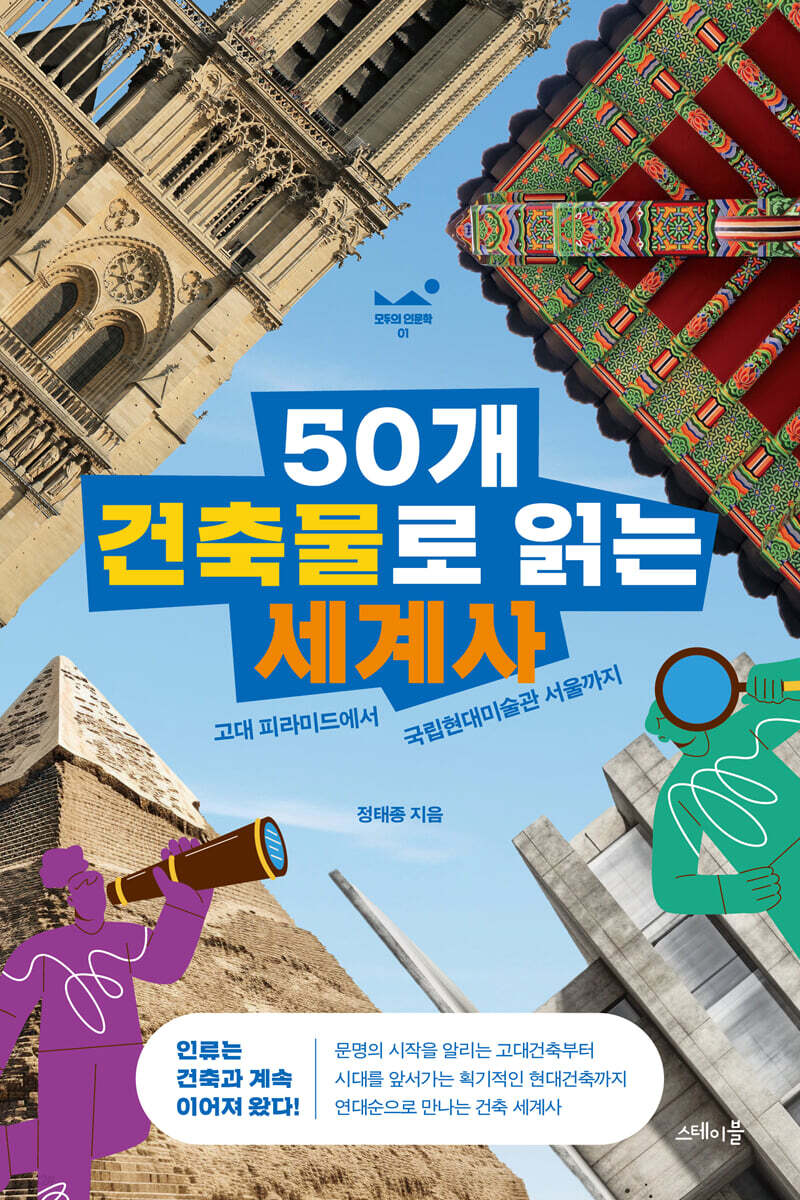
World History in 50 Buildings
 |
Description
Book Introduction
"Let's go! An architectural tour that reads world history!"
Culture, technology, politics, society, and economy of each era
Understanding architecture in an easy and fun way
Hidden historical stories inside and outside the building, with rich photos.
Although we are more connected to the world than ever before, understanding world history as a whole remains challenging.
This is because, in addition to having to digest a vast amount of information about each era, region, and social structure, it is also necessary to select and access objective, unbiased data based on facts.
So, why not study world history through architecture? Buildings often serve as symbols and landmarks for cities.
When it comes to France, it's the Eiffel Tower in Paris; when it comes to Italy, it's the Colosseum in Rome or the Leaning Tower of Pisa; when it comes to South Korea, it's the Sungnyemun Gate in Seoul. Architecture is the icon that most clearly defines the image of a country or city.
In other words, it allows you to learn about the city's history without having to go there in person.
"World History Through 50 Buildings" is a liberal arts book that contains a novel combination of architecture and world history written by author Taejong Jeong, who worked as a dentist before falling in love with architecture and becoming an architecture professor.
It selects 50 architectural examples from ancient Western and Eastern societies, modern and contemporary societies, and explains the history and culture of the time.
Especially in the modern society section, we included many of our country's architectural structures that can be seen in person.
Readers will be able to naturally absorb knowledge of world history through this book, which includes abundant photographs, while taking a 'tour through the world of architectural corners of the room.'
Culture, technology, politics, society, and economy of each era
Understanding architecture in an easy and fun way
Hidden historical stories inside and outside the building, with rich photos.
Although we are more connected to the world than ever before, understanding world history as a whole remains challenging.
This is because, in addition to having to digest a vast amount of information about each era, region, and social structure, it is also necessary to select and access objective, unbiased data based on facts.
So, why not study world history through architecture? Buildings often serve as symbols and landmarks for cities.
When it comes to France, it's the Eiffel Tower in Paris; when it comes to Italy, it's the Colosseum in Rome or the Leaning Tower of Pisa; when it comes to South Korea, it's the Sungnyemun Gate in Seoul. Architecture is the icon that most clearly defines the image of a country or city.
In other words, it allows you to learn about the city's history without having to go there in person.
"World History Through 50 Buildings" is a liberal arts book that contains a novel combination of architecture and world history written by author Taejong Jeong, who worked as a dentist before falling in love with architecture and becoming an architecture professor.
It selects 50 architectural examples from ancient Western and Eastern societies, modern and contemporary societies, and explains the history and culture of the time.
Especially in the modern society section, we included many of our country's architectural structures that can be seen in person.
Readers will be able to naturally absorb knowledge of world history through this book, which includes abundant photographs, while taking a 'tour through the world of architectural corners of the room.'
- You can preview some of the book's contents.
Preview
index
Chapter 1: Western Society, the Beginning and Construction of World History
1. Ancient Civilization Period: Egyptian and Mesopotamian Civilizations
- Egyptian pyramids, Mesopotamian ziggurats
2 Greece, the Society of the Gods: The Temple of Athens
- Parthenon, Greece
3 Rome's Rise: The Roman Empire Dominates the West
- Italian Colosseum, Aqueduct, and Appian Way
4 Early Middle Ages: Romanesque Architecture
- Speyer Cathedral in Germany, Pisa Cathedral in Italy
5 Late Middle Ages: Gothic Architecture
- Notre Dame Cathedral, Chartres Cathedral, France, Cologne Cathedral, Germany
6 The Birth of Islam: Moorish Architecture
- Hagia Sophia and Blue Mosque in Turkey, Alhambra Palace in Spain
7 The Renaissance: The Restoration of Humanity
- Florence Cathedral, Italy
8 Baroque and Rococo: Distorted Pearl and Shell Decorations
- Palace of Versailles, France, Schönbrunn Palace, Austria
9 The Beginning of Modernity: Ornament is a Crime
- Austrian Ross House
10 After the Industrial Revolution: The Age of the Masters
- Bauhaus and Fagus Factory in Germany, Villa Savoye in France, Barcelona Pavilion in Spain, Paimio Tuberculosis Sanatorium in Finland, Fallingwater and Salk Institute for Biological Studies in the United States, and the National Assembly Building in Bangladesh
11 The Rise of Steel: Steel Structures and Skyscrapers
- The Eiffel Tower in France and the Empire State Building in the United States
12 Finding Answers in Nature: From Art Nouveau to Postmodernism
Spain's Sagrada Familia Cathedral, Austria's Hundertwasser House and Spittelau incinerator
Chapter 2: Oriental Society: Architecture in Harmony with Nature
1 Chinese thought: The sky is round and the earth is square
- China's Temple of Heaven
2. East meets West: Indian and Islamic Architecture
- Taj Mahal and Agra Fort in India
3 The Golden Age of Southeast Asia: Buddhist Architecture
- Bagan, Myanmar, Wat Pho and Wat Arun, Thailand
4 Connecting Wood and Materials: Traditional Korean Architecture
- Sudeoksa Temple in South Chungcheong Province, Buseoksa Temple in North Gyeongsang Province
5. A geomantic site with a mountain and a river: A traditional Korean village
- Mucheomdang in Yangdong Village and Yangjindang in Hahoe Village, Gyeongsangbuk-do
6 Wearing Western clothing and a hat: the priest's style
- Former Buyeo Museum of South Chungcheong Province
Chapter 3: Modern Society: Architecture for a New Era
1 Building on Philosophy: Architectural Phenomenology
- Portugal Lesa Swimming Pool, Jeju Island Ark Church, Gangwon-do Museum San
2 Emptying and Connecting Spaces: Spatial Topology
- Kunsthal Museum, Netherlands, Seoul National University Museum of Art, Seoul
3. Borrowing Nature's Principles in the Digital Age: Parametric Architecture
- Guggenheim Museum Bilbao, Spain, Yunseul, Seoul, National Museum of Modern and Contemporary Art, Seoul
1. Ancient Civilization Period: Egyptian and Mesopotamian Civilizations
- Egyptian pyramids, Mesopotamian ziggurats
2 Greece, the Society of the Gods: The Temple of Athens
- Parthenon, Greece
3 Rome's Rise: The Roman Empire Dominates the West
- Italian Colosseum, Aqueduct, and Appian Way
4 Early Middle Ages: Romanesque Architecture
- Speyer Cathedral in Germany, Pisa Cathedral in Italy
5 Late Middle Ages: Gothic Architecture
- Notre Dame Cathedral, Chartres Cathedral, France, Cologne Cathedral, Germany
6 The Birth of Islam: Moorish Architecture
- Hagia Sophia and Blue Mosque in Turkey, Alhambra Palace in Spain
7 The Renaissance: The Restoration of Humanity
- Florence Cathedral, Italy
8 Baroque and Rococo: Distorted Pearl and Shell Decorations
- Palace of Versailles, France, Schönbrunn Palace, Austria
9 The Beginning of Modernity: Ornament is a Crime
- Austrian Ross House
10 After the Industrial Revolution: The Age of the Masters
- Bauhaus and Fagus Factory in Germany, Villa Savoye in France, Barcelona Pavilion in Spain, Paimio Tuberculosis Sanatorium in Finland, Fallingwater and Salk Institute for Biological Studies in the United States, and the National Assembly Building in Bangladesh
11 The Rise of Steel: Steel Structures and Skyscrapers
- The Eiffel Tower in France and the Empire State Building in the United States
12 Finding Answers in Nature: From Art Nouveau to Postmodernism
Spain's Sagrada Familia Cathedral, Austria's Hundertwasser House and Spittelau incinerator
Chapter 2: Oriental Society: Architecture in Harmony with Nature
1 Chinese thought: The sky is round and the earth is square
- China's Temple of Heaven
2. East meets West: Indian and Islamic Architecture
- Taj Mahal and Agra Fort in India
3 The Golden Age of Southeast Asia: Buddhist Architecture
- Bagan, Myanmar, Wat Pho and Wat Arun, Thailand
4 Connecting Wood and Materials: Traditional Korean Architecture
- Sudeoksa Temple in South Chungcheong Province, Buseoksa Temple in North Gyeongsang Province
5. A geomantic site with a mountain and a river: A traditional Korean village
- Mucheomdang in Yangdong Village and Yangjindang in Hahoe Village, Gyeongsangbuk-do
6 Wearing Western clothing and a hat: the priest's style
- Former Buyeo Museum of South Chungcheong Province
Chapter 3: Modern Society: Architecture for a New Era
1 Building on Philosophy: Architectural Phenomenology
- Portugal Lesa Swimming Pool, Jeju Island Ark Church, Gangwon-do Museum San
2 Emptying and Connecting Spaces: Spatial Topology
- Kunsthal Museum, Netherlands, Seoul National University Museum of Art, Seoul
3. Borrowing Nature's Principles in the Digital Age: Parametric Architecture
- Guggenheim Museum Bilbao, Spain, Yunseul, Seoul, National Museum of Modern and Contemporary Art, Seoul
Detailed image

Into the book
Understanding world history through architecture is an adventure because it is a different approach from conventional methods.
But as always, there are things you don't get without taking risks.
Architecture is closely connected to and reflects the social conditions of the time.
Therefore, we can understand world history from a new perspective and in a different way than before.
--- From "Starting the Story"
The Egyptian and Mesopotamian civilizations have had a great influence on Western society and are closely related to it, and the architectural structures that symbolize them are the 'pyramids' and 'ziggurat'.
These buildings are very similar in form, despite the distance between them and their direct influence.
This type of pyramid shape is easy to build tall and large without any special design or materials, so many similar ruins have been built in civilizations around the world.
Let's take a look at the most artificial geometric structures and the first civilization that created them.
--- From "Ancient Civilizations: Egyptian and Mesopotamian Civilizations"
The Palace of Versailles is the royal palace of Louis XIV in Versailles, a city outside Paris, France.
(…) Originally a summer residence, it was the center of power during the Ancien Régime (the period of absolute monarchy before the French Revolution) when Louis XIV moved his residence from the Louvre Palace in Paris to Versailles in 1682, and until the royal family returned to the capital in 1789.
The Palace of Versailles is a representative example of Baroque architecture, and is famous for its luxurious buildings, vast and beautiful French-style gardens, 1,400 fountains, and over 700 rooms, especially the Hall of Mirrors.
This room is 73 meters long and has walls and ceilings made of Venetian mirrors. It is decorated with the fleur-de-lis, a symbol of France from the mid-12th century (a picture or letter representing a country, group, or household).
It is also where the Treaty of Versailles, which formally ended World War I in 1919, was signed.
--- From "Baroque and Rococo: Distorted Pearl and Shell Decorations"
China has a long history and many buildings representing each era.
Among them, the building that represents Chinese thought is undoubtedly the Temple of Heaven.
The Temple of Heaven is a building located in the southeast of Beijing, where emperors of the Ming and Qing dynasties offered sacrifices to heaven and prayed for a good harvest.
Completed in 1420 during the reign of Emperor Yongle of the Ming Dynasty, it is currently the largest ancient ceremonial building preserved in China.
Emperors of all ages regarded performing ancestral rites as an important activity for maintaining imperial rule, and mobilized a large amount of manpower, material resources, and financial resources for this purpose.
--- From "Chinese Thought: The Heaven is Round and the Earth is Square"
Our country's traditional villages were planned using the natural terrain, unlike the uniformly formed geometric checkerboard patterns of China.
Here, we followed the 'Baesanimsu' pattern, with the mountain at the back and the water in the front.
Representative traditional villages, Yangdong Village in Gyeongju-si, Gyeongsangbuk-do and Hahoe Village in Andong-si, are living spaces and living heritages where the traditional culture, customs, and systems of Koreans are still preserved.
It was also registered as a UNESCO World Heritage Site.
--- From "A place with a mountain behind and a river in front: a traditional Korean village"
The Ark Church is a series of four art galleries and buildings named after water, wind, stone, and earth, designed by Jun Itami, and is also called the Church of the Empty.
That is, it is the church of heaven.
The architect pondered over how to harmoniously integrate the upper part of the building with the sky, and completed a form that reflects the color of the sky on the roof.
(…) He was also the first to introduce the concept of ‘local architecture’, which is a harmony between Jeju’s local culture, people, and space, including water and sky.
Additionally, the unique characteristics of the Ark Church were emphasized by contrasting concrete, a representative modern building material, with natural materials such as earth, stone, metal, glass, and wood.
The texture of these materials elevated the building into a work of art.
But as always, there are things you don't get without taking risks.
Architecture is closely connected to and reflects the social conditions of the time.
Therefore, we can understand world history from a new perspective and in a different way than before.
--- From "Starting the Story"
The Egyptian and Mesopotamian civilizations have had a great influence on Western society and are closely related to it, and the architectural structures that symbolize them are the 'pyramids' and 'ziggurat'.
These buildings are very similar in form, despite the distance between them and their direct influence.
This type of pyramid shape is easy to build tall and large without any special design or materials, so many similar ruins have been built in civilizations around the world.
Let's take a look at the most artificial geometric structures and the first civilization that created them.
--- From "Ancient Civilizations: Egyptian and Mesopotamian Civilizations"
The Palace of Versailles is the royal palace of Louis XIV in Versailles, a city outside Paris, France.
(…) Originally a summer residence, it was the center of power during the Ancien Régime (the period of absolute monarchy before the French Revolution) when Louis XIV moved his residence from the Louvre Palace in Paris to Versailles in 1682, and until the royal family returned to the capital in 1789.
The Palace of Versailles is a representative example of Baroque architecture, and is famous for its luxurious buildings, vast and beautiful French-style gardens, 1,400 fountains, and over 700 rooms, especially the Hall of Mirrors.
This room is 73 meters long and has walls and ceilings made of Venetian mirrors. It is decorated with the fleur-de-lis, a symbol of France from the mid-12th century (a picture or letter representing a country, group, or household).
It is also where the Treaty of Versailles, which formally ended World War I in 1919, was signed.
--- From "Baroque and Rococo: Distorted Pearl and Shell Decorations"
China has a long history and many buildings representing each era.
Among them, the building that represents Chinese thought is undoubtedly the Temple of Heaven.
The Temple of Heaven is a building located in the southeast of Beijing, where emperors of the Ming and Qing dynasties offered sacrifices to heaven and prayed for a good harvest.
Completed in 1420 during the reign of Emperor Yongle of the Ming Dynasty, it is currently the largest ancient ceremonial building preserved in China.
Emperors of all ages regarded performing ancestral rites as an important activity for maintaining imperial rule, and mobilized a large amount of manpower, material resources, and financial resources for this purpose.
--- From "Chinese Thought: The Heaven is Round and the Earth is Square"
Our country's traditional villages were planned using the natural terrain, unlike the uniformly formed geometric checkerboard patterns of China.
Here, we followed the 'Baesanimsu' pattern, with the mountain at the back and the water in the front.
Representative traditional villages, Yangdong Village in Gyeongju-si, Gyeongsangbuk-do and Hahoe Village in Andong-si, are living spaces and living heritages where the traditional culture, customs, and systems of Koreans are still preserved.
It was also registered as a UNESCO World Heritage Site.
--- From "A place with a mountain behind and a river in front: a traditional Korean village"
The Ark Church is a series of four art galleries and buildings named after water, wind, stone, and earth, designed by Jun Itami, and is also called the Church of the Empty.
That is, it is the church of heaven.
The architect pondered over how to harmoniously integrate the upper part of the building with the sky, and completed a form that reflects the color of the sky on the roof.
(…) He was also the first to introduce the concept of ‘local architecture’, which is a harmony between Jeju’s local culture, people, and space, including water and sky.
Additionally, the unique characteristics of the Ark Church were emphasized by contrasting concrete, a representative modern building material, with natural materials such as earth, stone, metal, glass, and wood.
The texture of these materials elevated the building into a work of art.
--- From "Building on Philosophy: Architectural Phenomenology"
Publisher's Review
“Humanity has always been connected to architecture!”
From ancient architecture that marked the beginning of civilization
From groundbreaking modern architecture ahead of its time,
A Chronological History of the World of Architecture
A world tour of architectural corners
Four Benefits of Studying World History
First, you can understand the cultures of various countries.
Architecture reflects a country's history, culture, and social values.
The Egyptian pyramids are huge structures that symbolize absolute royal power, like that of a god, and are the tombs of the Egyptian kings, the pharaohs.
This is a style of tomb (a place where corpses or remains are buried in the ground) created by a religious view that believed that this world is a temporary residence and the place where one stays after death is an eternal residence.
Therefore, inside, the body of the Pharaoh was preserved in a mummified state, and various items necessary for life after death were stored.
In this way, through the pyramid as a building, we can easily and interestingly learn about the ideas of the immortality of the soul and the return of the body at that time.
Second, it shows the process of technological development of mankind.
Architecture is the result of a fusion of technology, engineering, and art.
The architectural structure, materials, design, and decorative techniques clearly reveal the development of that era.
The Eiffel Tower, the tallest building in Paris, France, is an iron structure built by engineer Gustave Eiffel in 1889 to commemorate the 100th anniversary of the French Revolution.
When it was first built, it was criticized for damaging the city's landscape, but it gradually gained recognition as a modern building using steel, concrete, and glass, and had a great influence on later railway stations and bridges.
It has been used as a backdrop for many movies and has become a must-see tourist attraction in Paris. It is also used for practical purposes, such as as an aviation lighthouse and as a wireless communication antenna installation.
This is a good example of the power that can be created when leading technologies of the era are reflected in architecture.
Third, you can understand world politics and economy.
Palaces, parliament buildings, public facilities, and religious buildings help us understand the political, social, and power structures of a country or region.
The Roman Empire, which once ruled the West, built a variety of aqueducts (bridges built to carry water across rivers or roads) to supply water from distant sources to village baths, fountains, and private estates.
By the 3rd century, eleven aqueducts supported the economy of a city with a population of over one million.
The Roman Empire, like modern new city planning, first planned roads and then built plazas and public buildings. The first highway, the Appian Way, was included in this category.
This road, still in some use today, was the fastest route from Rome to Greece and Egypt, giving rise to the famous saying, "All roads lead to Rome."
Fourth, you can understand the world from all angles.
Studying the architecture of different countries allows us to compare and connect the histories of each place.
It fosters a perspective that helps us understand the world by examining not only interdependent cultural exchanges but also multiculturalism.
In this way, reading world history through architecture will allow readers to discover global insights from a wide range of perspectives.
From ancient architecture that marked the beginning of civilization
From groundbreaking modern architecture ahead of its time,
A Chronological History of the World of Architecture
A world tour of architectural corners
Four Benefits of Studying World History
First, you can understand the cultures of various countries.
Architecture reflects a country's history, culture, and social values.
The Egyptian pyramids are huge structures that symbolize absolute royal power, like that of a god, and are the tombs of the Egyptian kings, the pharaohs.
This is a style of tomb (a place where corpses or remains are buried in the ground) created by a religious view that believed that this world is a temporary residence and the place where one stays after death is an eternal residence.
Therefore, inside, the body of the Pharaoh was preserved in a mummified state, and various items necessary for life after death were stored.
In this way, through the pyramid as a building, we can easily and interestingly learn about the ideas of the immortality of the soul and the return of the body at that time.
Second, it shows the process of technological development of mankind.
Architecture is the result of a fusion of technology, engineering, and art.
The architectural structure, materials, design, and decorative techniques clearly reveal the development of that era.
The Eiffel Tower, the tallest building in Paris, France, is an iron structure built by engineer Gustave Eiffel in 1889 to commemorate the 100th anniversary of the French Revolution.
When it was first built, it was criticized for damaging the city's landscape, but it gradually gained recognition as a modern building using steel, concrete, and glass, and had a great influence on later railway stations and bridges.
It has been used as a backdrop for many movies and has become a must-see tourist attraction in Paris. It is also used for practical purposes, such as as an aviation lighthouse and as a wireless communication antenna installation.
This is a good example of the power that can be created when leading technologies of the era are reflected in architecture.
Third, you can understand world politics and economy.
Palaces, parliament buildings, public facilities, and religious buildings help us understand the political, social, and power structures of a country or region.
The Roman Empire, which once ruled the West, built a variety of aqueducts (bridges built to carry water across rivers or roads) to supply water from distant sources to village baths, fountains, and private estates.
By the 3rd century, eleven aqueducts supported the economy of a city with a population of over one million.
The Roman Empire, like modern new city planning, first planned roads and then built plazas and public buildings. The first highway, the Appian Way, was included in this category.
This road, still in some use today, was the fastest route from Rome to Greece and Egypt, giving rise to the famous saying, "All roads lead to Rome."
Fourth, you can understand the world from all angles.
Studying the architecture of different countries allows us to compare and connect the histories of each place.
It fosters a perspective that helps us understand the world by examining not only interdependent cultural exchanges but also multiculturalism.
In this way, reading world history through architecture will allow readers to discover global insights from a wide range of perspectives.
GOODS SPECIFICS
- Date of issue: March 14, 2024
- Page count, weight, size: 232 pages | 368g | 140*210*15mm
- ISBN13: 9791193476024
- ISBN10: 119347602X
You may also like
카테고리
korean


korean

![GQ KOREA Mark (Monthly): December [2025]](http://librairie.coreenne.fr/cdn/shop/files/8ef265dbbfbf186523ed75ba7319009d.jpg?v=1765340328&width=3840)


