

Madness and Genius
 |
Description
Book Introduction
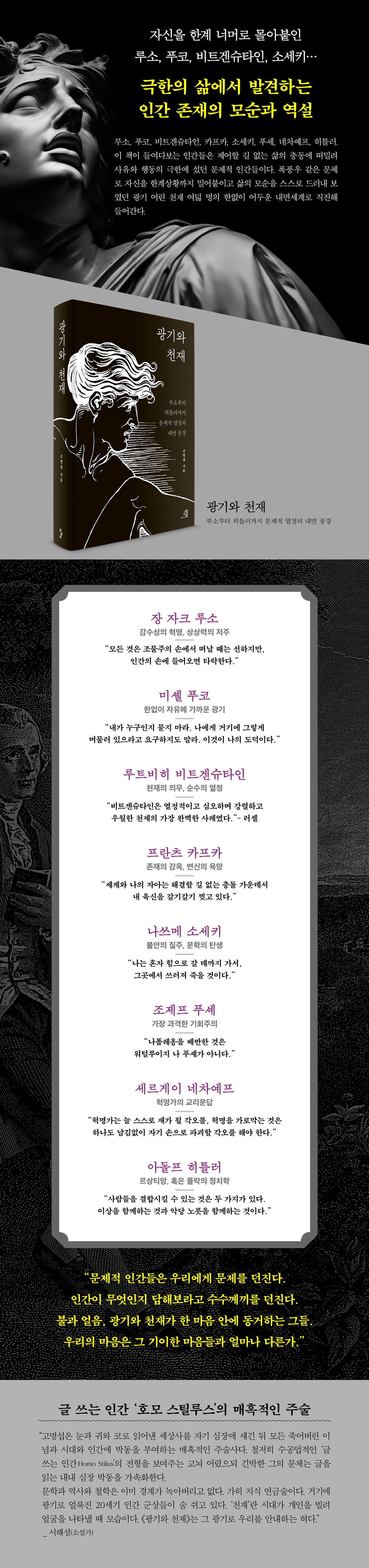
Rousseau, Foucault, Wittgenstein, who pushed themselves beyond their limits…
The inner world of human existence discovered in extreme life
Rousseau, Foucault, Wittgenstein, Kafka, Hitler… … The people this book examines are problematic people, full of contradictions and paradoxes.
These are people who are pushed to the limits of thought and action by the uncontrollable impulses of life.
The author traces the inner lives of eight mad geniuses who pushed themselves to their limits and thereby exposed the contradictions of life.
Problematic people give us problems.
It poses a riddle to answer what a human is.
A people full of contradictions, where fire and ice, madness and genius, gentleness and ruthlessness coexist within one mind.
How different our minds are from those strange minds.
Examining their behavior and way of thinking can serve as a compass for understanding the life around us.
When we peer into their minds, we see a landscape that is sometimes like a kaleidoscope, sometimes like a savage landscape, and sometimes a sublime spectacle that inspires awe.
In his characteristically stormy style, the author cuts across literature, thought, and politics, delving straight into the endlessly dark labyrinth of the inner lives of problematic people.
Passing through the inner world of human beings, torn apart, fighting and discordant with themselves, we encounter the universal paradox of human existence.
“Genius rises from the depths of madness, and madness is the dark shadow of genius.
Without madness there would be no genius, and without genius madness would be meaningless.
Madness is another word for the inner impulse that drives one to the limit of experience.
I expected that on the horizon opened up by that mad impulse, human desire, despair, and hope would be revealed like the fog at dawn or the sunlight at midday.
Just as the completion of life is an impossible dream, so too is the understanding of humanity beyond my humble perception.
“I only glimpsed that vastness for a moment.” - From the ‘Preface’
The inner world of human existence discovered in extreme life
Rousseau, Foucault, Wittgenstein, Kafka, Hitler… … The people this book examines are problematic people, full of contradictions and paradoxes.
These are people who are pushed to the limits of thought and action by the uncontrollable impulses of life.
The author traces the inner lives of eight mad geniuses who pushed themselves to their limits and thereby exposed the contradictions of life.
Problematic people give us problems.
It poses a riddle to answer what a human is.
A people full of contradictions, where fire and ice, madness and genius, gentleness and ruthlessness coexist within one mind.
How different our minds are from those strange minds.
Examining their behavior and way of thinking can serve as a compass for understanding the life around us.
When we peer into their minds, we see a landscape that is sometimes like a kaleidoscope, sometimes like a savage landscape, and sometimes a sublime spectacle that inspires awe.
In his characteristically stormy style, the author cuts across literature, thought, and politics, delving straight into the endlessly dark labyrinth of the inner lives of problematic people.
Passing through the inner world of human beings, torn apart, fighting and discordant with themselves, we encounter the universal paradox of human existence.
“Genius rises from the depths of madness, and madness is the dark shadow of genius.
Without madness there would be no genius, and without genius madness would be meaningless.
Madness is another word for the inner impulse that drives one to the limit of experience.
I expected that on the horizon opened up by that mad impulse, human desire, despair, and hope would be revealed like the fog at dawn or the sunlight at midday.
Just as the completion of life is an impossible dream, so too is the understanding of humanity beyond my humble perception.
“I only glimpsed that vastness for a moment.” - From the ‘Preface’
- You can preview some of the book's contents.
Preview
index
『Preface to the Revised Edition』 What Problematic Passions Throw at Us
『Preface』 The Adventures and Struggles of 'Unhappy Consciousness'
Jean-Jacques Rousseau: The Revolution of Sensibility, the Curse of Imagination
“My birth was my first misfortune” / Setting out on a journey at the age of sixteen / The young Rousseau’s ‘Golden Age’ / The father who abandoned five children / “I saw another world and became another person” / “Discourse on the Origin of Inequality,” denouncing civilization / “New Eloise,” an explosion of sensibility / “Emile” and “The Social Contract” / An unfortunate exile trapped in delusion / “Confessions,” an unprecedented self-disclosure / “I would rather choose dangerous freedom than the peace of submission”
Michel Foucault: Madness Close to Infinite Freedom
The mad genius of the École Normale Supérieure / Beyond psychoanalysis, existentialism, and Marxism / The discovery of Nietzsche, archaeology, and genealogy / The birth of "The History of Madness" / The bomb called "Words and Things" / A political fighter with an iron pipe / The word "power" that appeared like a code / How to make life a work of art
Ludwig Wittgenstein: The Duty of Genius, the Passion of Purity
The meek youngest child in a family of geniuses / The Vienna Rebels, Weininger, Krauss, and Roth / "The most perfect example of genius" / The Logico-Philosopheric Tractatus written on the battlefield / After being an elementary school teacher, back to philosophy / The one who cleans the stables of philosophy / "Philosophy is the way to reconciliation with God"
Franz Kafka's The Prison of Existence, The Desire for Transformation
The death of his younger siblings and his sense of guilt / Extreme love and hate for his father / Concise, cool, and indifferent writing style / The 'underground dweller' of the literary world / The pleasure of self-abuse and self-punishment / Tuberculosis, a small sanctuary in a cramped world
Natsume Soseki: The Ride of Anxiety, the Birth of Literature
A childhood strewn like a roadside stone / Existential illnesses: gastric ulcers and nervous breakdown / A foreign student trapped in self-loathing / A sense of confrontation with Europe, a belief in 'self-centeredness' / Salvation found in novels / Modern criticism that failed to transcend the limitations of its time
Joseph Fouché, the most radical opportunist
Leaving the monastery and becoming a revolutionary / A man who always stood for the 'majority' / The 'First Communist Manifesto' / The 'Butcher of Lyon' begging for his life / The final confrontation with Robespierre / The architect of the Thermidorian coup / The intelligence politician behind Napoleon / The eternal conspirator, the endless traitor
The Catechism of the Revolutionary Sergei Nechayev
The evil revolutionary in Dostoevsky's "The Possessed" / The steely, "special man" / The rise of conspiracy theories and terrorism / The devil that sucked Bakunin / The ruthless revolutionary program, "The Revolutionary's Catechism" / Self-destructive hatred and a burning desire for revenge / "The revolutionary, a man trapped in an unfortunate fate" / The psychology of revenge realized through revolution
Adolf Hitler's Resentment, or the Politics of Downfall
A tyrannical father and a challenging son / A dreamer thrown to the bottom / A fearful and loathsome Jew / The battlefield experience that saved Hitler / “I will save Germany” / The birth of the propagandist Hitler / A revered leader / The textbook of Hitlerism, Mein Kampf / The Nazi Party’s rise to power / The aestheticization of politics, theatricalization of politics / The fall of the gods
"annotation"
『Preface』 The Adventures and Struggles of 'Unhappy Consciousness'
Jean-Jacques Rousseau: The Revolution of Sensibility, the Curse of Imagination
“My birth was my first misfortune” / Setting out on a journey at the age of sixteen / The young Rousseau’s ‘Golden Age’ / The father who abandoned five children / “I saw another world and became another person” / “Discourse on the Origin of Inequality,” denouncing civilization / “New Eloise,” an explosion of sensibility / “Emile” and “The Social Contract” / An unfortunate exile trapped in delusion / “Confessions,” an unprecedented self-disclosure / “I would rather choose dangerous freedom than the peace of submission”
Michel Foucault: Madness Close to Infinite Freedom
The mad genius of the École Normale Supérieure / Beyond psychoanalysis, existentialism, and Marxism / The discovery of Nietzsche, archaeology, and genealogy / The birth of "The History of Madness" / The bomb called "Words and Things" / A political fighter with an iron pipe / The word "power" that appeared like a code / How to make life a work of art
Ludwig Wittgenstein: The Duty of Genius, the Passion of Purity
The meek youngest child in a family of geniuses / The Vienna Rebels, Weininger, Krauss, and Roth / "The most perfect example of genius" / The Logico-Philosopheric Tractatus written on the battlefield / After being an elementary school teacher, back to philosophy / The one who cleans the stables of philosophy / "Philosophy is the way to reconciliation with God"
Franz Kafka's The Prison of Existence, The Desire for Transformation
The death of his younger siblings and his sense of guilt / Extreme love and hate for his father / Concise, cool, and indifferent writing style / The 'underground dweller' of the literary world / The pleasure of self-abuse and self-punishment / Tuberculosis, a small sanctuary in a cramped world
Natsume Soseki: The Ride of Anxiety, the Birth of Literature
A childhood strewn like a roadside stone / Existential illnesses: gastric ulcers and nervous breakdown / A foreign student trapped in self-loathing / A sense of confrontation with Europe, a belief in 'self-centeredness' / Salvation found in novels / Modern criticism that failed to transcend the limitations of its time
Joseph Fouché, the most radical opportunist
Leaving the monastery and becoming a revolutionary / A man who always stood for the 'majority' / The 'First Communist Manifesto' / The 'Butcher of Lyon' begging for his life / The final confrontation with Robespierre / The architect of the Thermidorian coup / The intelligence politician behind Napoleon / The eternal conspirator, the endless traitor
The Catechism of the Revolutionary Sergei Nechayev
The evil revolutionary in Dostoevsky's "The Possessed" / The steely, "special man" / The rise of conspiracy theories and terrorism / The devil that sucked Bakunin / The ruthless revolutionary program, "The Revolutionary's Catechism" / Self-destructive hatred and a burning desire for revenge / "The revolutionary, a man trapped in an unfortunate fate" / The psychology of revenge realized through revolution
Adolf Hitler's Resentment, or the Politics of Downfall
A tyrannical father and a challenging son / A dreamer thrown to the bottom / A fearful and loathsome Jew / The battlefield experience that saved Hitler / “I will save Germany” / The birth of the propagandist Hitler / A revered leader / The textbook of Hitlerism, Mein Kampf / The Nazi Party’s rise to power / The aestheticization of politics, theatricalization of politics / The fall of the gods
"annotation"
Detailed image
Into the book
Jean-Jacques Rousseau: Originality Born from the Cracks of Contradiction and Discord
Rousseau's life was “a drama of irreconcilable contradictions.”
Although he denounced literature and art as corrupting society, he wrote the romance novel "New Eloise" which opened the door to Romantic literature, and "Emile" which became the starting point of modern pedagogy, but he abandoned all of his children in orphanages.
He constantly attacked the rich, nobles, and powerful of his time, but he earned his livelihood through their favor and support.
His contradictions were endless.
But from within that contradiction, that gap of discord, a voice shining with originality burst forth, and a new era began.
What is characteristic of Rousseau's experience is that he was so excited that he burst into tears, soaking his coat.
Rousseau, who suddenly saw the truth of the world, made the shocking discovery that this world, adorned with learning and art, was in fact corrupt and decadent, and that he, who had been trampled by the order of that world, was in fact pure.
… … From this realization, Rousseau “saw another world and became another person.”
--- p.43
Everything Rousseau wrote was a direct challenge to the conventional wisdom of the intellectuals of his time.
Among the Enlightenment intellectuals, including Voltaire, no one denied scholarship, art, and knowledge.
Rather, they were convinced that these were the driving force and source of progress.
Rousseau struck a blow to this conviction.
--- p.44
Because Rousseau, like his contemporaries in the Enlightenment, refused to believe in the steady improvement of humanity and the natural development of society, he believed that a much more fundamental solution was needed to create a truly humane new society.
This is where his historical pessimism leaps into revolutionary voluntarism.
--- p.56
He was at odds with everything, even with his own life, but he never quarreled with one principle of his life: freedom.
He stuck to this principle from beginning to end.
… … “I would rather choose dangerous freedom than peace through submission.” He was the first philosopher to elevate freedom to an absolute value.
--- p.65-66
Michel Foucault, the apostate, the scoundrel of the intellectual world
Foucault was a philosopher with a hammer.
He was the one who destroyed the temple of morality that the modern West had built up over hundreds of years.
It exposed that no morality is moral, that behind the pulpit lurks dark ambition, a desire for domination.
By making the 'madness' within oneself the foundation of philosophy and reinterpreting the history of subjectivity, reason, and knowledge, all the authorities and symbols that had ruled the academic world for a long time were shattered and demolished.
In the preface to The History of Madness, Foucault explicitly declares that he is on the side of the madman, not the doctor.
I pledge to revive the language of the madman, which has been silenced and buried by the language of reason, that is, the language of the doctor.
… … This rigorous academic treatise was also, at the same time, a bloody cry from Foucault himself, who identified himself with madness.
--- p.85-86
Foucault's "The Word and the Thing" was criticized by many camps regardless of left or right, but at the same time, it was delivered as news of liberation to those who could not stand the oppressive rule of Marxism and existentialism.
Foucault wrote the book to free himself from the ideas that had oppressed him, and in doing so, he freed many others in similar situations from the prison of the mind.
--- p.92
A parrhesiast is someone who practices 'parrhesia'.
‘Parrhesia’ means “courage of truth,” and when written out, it means “speaking the truth without fear.”
Parrhesia is “the act of honestly speaking what one believes to be the truth without fear of punishment or repercussions.”
The one who performs this parrhesia is the Foucauldian subject, or the Foucauldian intellectual.
--- p.108
“Why can things like lamps and houses be objects of art, but not human life itself?” Through the abyss of madness and the river of resistance and struggle, he finally arrived at the forest of existence, where everyone makes their own life into art, and where each subject participates in making it into art.
Life is beautiful.
Foucault's life of suffering and triumph says so.
--- p.109
Ludwig Wittgenstein, Tyrant of Morality and Warrior of Purity
Wittgenstein, “the most perfect example of genius,” was a moral tyrant and a warrior of purity.
He ventured to find a land of clarity where the philosophical fog had cleared, and labored to lay a foundation of certainty on which to rest his mind.
He fought a fierce battle with his own weaknesses inside his heart.
Although no one else knew it, he was waging a fierce battle against his own weakness and incompetence, which were pressing issues within him.
To completely overcome oneself, that was Wittgenstein's ultimate goal.
To completely overcome oneself, that was Wittgenstein's ultimate goal.
Therefore, within himself he was neither a prophet nor a magician.
He was simply a rebel who could not bear the chaos surrounding him and rose up out of necessity.
But that rebellion came to others as a terrifying rebellion, a terrifying roar.
--- p.114
Wittgenstein's meticulousness and perfectionism could not tolerate his own imperfections.
His obsession with logic was also coupled with his desire to explain and rescue himself by logically explaining the world.
Now this aspiration is heading to the battlefield.
There was something connected to it that could be called a 'death drive'.
The idea that it would be better to die cleanly if I could not change myself thoroughly was ingrained deep in my mind.
--- p.132-133
Wherever he went, Wittgenstein overwhelmed people.
No one could object to his words, and those who saw him froze as if they had seen the face of Medusa.
He demanded rigor and accuracy always and everywhere.
I did not tolerate nonsense.
People worshipped him and feared him at the same time.
To be Wittgenstein's friend was, so to speak, to confront his personality nakedly.
--- p.145
He felt an almost pathological pain whenever something he didn't like was around him.
The pain didn't go away unless I corrected it.
Because of that, he constantly repeated the work of pointing out, criticizing, and correcting.
His work in philosophy was no different.
He sought to eliminate at the root the philosophical problems that philosophers create by misunderstanding language.
It was the task he gave himself to clear away the fog of philosophy, to clean out its stables.
--- p.147~148
Franz Kafka, the boy trapped in the darkness of the 'underworld'
Kafka was “a boy wandering in fear through the forest of adulthood.”
The characters in Kafka's works who are imprisoned behind invisible chains, invisible bars, and invisible walls are Kafka himself, unable to escape from his father due to his sense of guilt.
The outstanding managers and competent workers of the real world, in the darkness of the literary "underworld," created unprecedented images with their concise and cool style that defined much of 20th-century literature.
For Kafka, his father was a fearful judge, a ruler who did not allow resistance, and an absolute being who ruled over everything.
The child, oppressed by his father's overwhelming authority, perceived himself as insignificant and useless.
… … The force to move away from his father and the force to approach him were in complete tension in Kafka’s mind.
--- p.166-167
Under the pressure of this ethical stricture, Kafka's guilt became unbearably heavy, and his fear that people would catch him and punish him grew just as much.
Kafka tried to alleviate his fear by retreating as far as possible from the outside world.
… … cut off from the outside world and walked inside himself.
The isolation and confinement only worsened over time.
Kafka, a boy trapped in his own world, found an outlet in reading and writing.
--- p.169~170
Kafka was an observer.
He observed the whole scene from a distance, not getting caught up in the heated atmosphere of the cafe.
It was from that psychological distance that Kafka's unique literary style was born.
… … His concise, cool, and indifferent style was the product of an ethical attitude that sought to see the world honestly, and an ascetic attitude that rejected any lies or decoration about himself.
However, the world created by the transparent and honest writing style has created a world of unique images that are difficult to find a precedent for.
--- p.172-173
Natsume Soseki, who crossed the boundaries of the century with anxiety and discontent
For Natsume Soseki, literature was a voyage into an unfamiliar world and an adventure.
Without a beacon or a lighthouse, he gazed discontentedly and anxiously over the horizon, and crossed the boundary of the century in fear.
Soseki marked the beginning of modern Japanese literature by writing novels that criticized the times and civilization and questioned human existence.
However, this 'critic of civilization' was a tiger trapped within the limitations of the times, blind to the reality of Japan's imperialist invasion.
He used the power of novels to criticize the times, critique civilization, and question human existence.
His colorful literary symphony, along with his sharp critical awareness, elevated him to the status of a national writer.
The footsteps of his junior writers who followed him continued endlessly to his house.
There, countless second seeds of modern Japanese literature were sown and sprouted.
The four-letter word 'self-reliance' he discovered during his time in London seemed to stand firmly on its own feet, supported by literary glory.
--- p.218~219
That egoism was a great strength in the fight against oneself, and it also served as a shield when confronting advanced Britain.
But when he treated the Asian colonial countries with that self-serving attitude, it was nothing more than another word for selfish egocentrism.
… … He was a tiger trapped in the dark power of the modern imperialist system.
--- p.226
Joseph Fouché, the eternal conspirator, endless traitor, and radical opportunist
From the French Revolution, which sent Louis XVI to the guillotine, to the Thermidor Coup that overthrew Robespierre, to the downfall of Napoleon, Fouché was the mastermind behind some of history's most dramatic revolutionary events.
This 'political animal', who has swung between the far left and the far right, is the person who most clearly showed the darkest side of humanity.
Starting from scratch, by thoroughly learning the physiology of politics and practicing its logic perfectly, he built his country from a swamp of fear and filth.
There was a special aspect to Fouché's opportunism.
He didn't just change his views; he shamelessly pushed them forward without changing his expression, and went all the way to the other extreme.
… … In that he possessed both boldness and cleverness, Fouché could be called a representative opportunist of his time.
In the place where the Girondins had fallen, he became the unparalleled Jacobin.
He also became a radical Jacobin.
--- p.240-241
Fouché's goal was power and the enjoyment of power, not the realization of noble ideals.
The reason he started the slaughter machine was because he was afraid that if he failed to properly carry out the orders from his superiors, he would be branded a moderate and purged.
He simply carried out the logic of the radicals who dominated the majority, albeit a little too faithfully.
--- p.245~246
It was a situation where it was impossible to know when the guillotine blade would fall on one's neck.
Moreover, public opinion was growing weary of the politics of fear.
… … It was in this extreme situation that Fouché began his activities.
He moved tirelessly underground like a mole.
He secretly met with the terrified members of Congress and wove them into a web of intrigue.
That was Fouché's job: to orchestrate the perfect conspiracy behind the scenes.
Hatred, anger, jealousy, anxiety, and fear were woven together to create a web that would never be broken.
--- p.251
Sergei Nechayev, radical revolutionary and bloodthirsty criminal
Nechayev was the most radical revolutionary of the Russian Revolution.
At the same time, he was a conspirator, a fraud, a blackmailer, a vengeful spirit, and a bloodthirsty criminal.
Nechayev was all of this.
In the annals of the revolution, Nechayev is almost entirely forgotten, but his infamous work, The Revolutionary Catechism, was read countless times in the back alleys of the revolution.
He was a shadow lurking behind all sound revolutionaries.
For him [Nechaev], destruction and violence themselves became the goal.
Rakhmetov's rigorism also went beyond its original attitude of 'subordinating all of life to revolution' and was overturned into a vulgar Machiavellianism that 'any means are acceptable if the goal is achieved.'
… … The hero-martyr fantasy was further strengthened, on the one hand swelling into heroic self-aggrandizement, and on the other hand falling into an even more excessive martyr mentality in response to it.
--- p.279
This brief program of twenty-six articles, with its unbridled display of extreme immorality and ruthlessness, has been the subject of countless controversies, praise, and loathing for over a century.
This document synthesized and elevated to a higher level all the radical tendencies that had appeared in the revolutionary movement up to that time: nihilism, Rakhmetovism, terrorism, Jesuitism, etc.
The Revolutionary Catechism portrayed the revolutionary as a complete immoral person who would not hesitate to commit any crime, betrayal, or fraud if it meant destroying the existing order.
--- p.286-287
The crime or evil that Nechayev displayed is called Nechayevshina in Russian.
Although Nechayevshina, or Nechayevism, which implies Nechayev crime or Nechayev evil, was officially denied and rejected, there is scant evidence that it has disappeared from the history of the revolution.
In fact, there is much more evidence to the contrary.
… … More importantly, a significant portion of the official revolutionary history had Nechaevism as its internal principle.
--- p.
299
The politics of revenge and destruction: Adolf Hitler
For Adolf Hitler, life was a great horror.
Wherever I looked, I was alone.
The terrified little man stood on the edge of the precipice of existence.
Long-suppressed resentment, hatred, and anger burst out.
I will burn everything and destroy everything.
Those blinded by revenge and destruction ran over the edge of the cliff.
In the pace of his life, a world was built from nothing and then disappeared into nothing along with him.
It was unprecedented in human history that in such a short period of time, a single will to build and a single will to destroy arose with such ferocious force, and that they carried out such destructive impulses.
Humans had to start thinking about humanity again from the beginning.
The shy and gloomy young man trembled in fear, wondering where this endless fall would end.
If the Jewish question was his concern, it was because it psychologically triggered this fear.
By replacing fear with disgust, that is, by psychologically manipulating the feared object into a disgusted object, he was barely able to control his mind.
With eyes soaked in anxiety and fear, he observed things, people, and the world from the bottom of life for several years.
--- p.319
At the evening rally, attended by 111 people, Hitler spoke as the second speaker.
The feelings of hatred, the images of anger, the accusations mixed with resentment that had long been contained in gloomy monologues since the days of the bottom in Vienna burst forth.
By the end of the speech, the people gathered in the small beer hall were electrified.
… … That evening, the demagogue Hitler was born from a thirty-year-old young man wandering around without a future.
This moment was the decisive moment when he decided to become a politician.
It was then that he witnessed the power of words not only to persuade people but also to awaken and ignite the emotions that had been dormant within them.
--- p.332
Hitler's weapon was words.
All his strength came from his words.
… … For Hitler, ideology was nothing more than a few principles, so what was always of central importance to him were the techniques of propaganda and the mobilization of the masses.
His unwavering belief was that whoever controls the masses controls power.
Here, Hitler's dark vision as a pop psychologist shined through.
--- p.335
What Hitler wanted was not a simple dictatorship, not simple power.
The relentless pursuit of power, its expansion, its exploitation, and finally its exhaustion, was entirely inconsistent with the laws of a simple dictator.
He was obsessed with a sense of mission to confront the deadly threat of the Germanic peoples.
… … What really mattered to him was the consent and enthusiasm of the entire nation.
He aspired to become a true leader, a true ruler who fully embodies the general will of the people.
--- p.354-355
As per his request, the body was burned in the courtyard of the Chancellery outside the bunker.
… … The rise and fall of Adolf Hitler, the man who unleashed the wildest imagination in political reality since the dawn of time, the man who thrilled and terrified the world with a terrifying energy that transcended all measure, placed humanity on the horizon of a terrifying and profoundly new experience.
Rousseau's life was “a drama of irreconcilable contradictions.”
Although he denounced literature and art as corrupting society, he wrote the romance novel "New Eloise" which opened the door to Romantic literature, and "Emile" which became the starting point of modern pedagogy, but he abandoned all of his children in orphanages.
He constantly attacked the rich, nobles, and powerful of his time, but he earned his livelihood through their favor and support.
His contradictions were endless.
But from within that contradiction, that gap of discord, a voice shining with originality burst forth, and a new era began.
What is characteristic of Rousseau's experience is that he was so excited that he burst into tears, soaking his coat.
Rousseau, who suddenly saw the truth of the world, made the shocking discovery that this world, adorned with learning and art, was in fact corrupt and decadent, and that he, who had been trampled by the order of that world, was in fact pure.
… … From this realization, Rousseau “saw another world and became another person.”
--- p.43
Everything Rousseau wrote was a direct challenge to the conventional wisdom of the intellectuals of his time.
Among the Enlightenment intellectuals, including Voltaire, no one denied scholarship, art, and knowledge.
Rather, they were convinced that these were the driving force and source of progress.
Rousseau struck a blow to this conviction.
--- p.44
Because Rousseau, like his contemporaries in the Enlightenment, refused to believe in the steady improvement of humanity and the natural development of society, he believed that a much more fundamental solution was needed to create a truly humane new society.
This is where his historical pessimism leaps into revolutionary voluntarism.
--- p.56
He was at odds with everything, even with his own life, but he never quarreled with one principle of his life: freedom.
He stuck to this principle from beginning to end.
… … “I would rather choose dangerous freedom than peace through submission.” He was the first philosopher to elevate freedom to an absolute value.
--- p.65-66
Michel Foucault, the apostate, the scoundrel of the intellectual world
Foucault was a philosopher with a hammer.
He was the one who destroyed the temple of morality that the modern West had built up over hundreds of years.
It exposed that no morality is moral, that behind the pulpit lurks dark ambition, a desire for domination.
By making the 'madness' within oneself the foundation of philosophy and reinterpreting the history of subjectivity, reason, and knowledge, all the authorities and symbols that had ruled the academic world for a long time were shattered and demolished.
In the preface to The History of Madness, Foucault explicitly declares that he is on the side of the madman, not the doctor.
I pledge to revive the language of the madman, which has been silenced and buried by the language of reason, that is, the language of the doctor.
… … This rigorous academic treatise was also, at the same time, a bloody cry from Foucault himself, who identified himself with madness.
--- p.85-86
Foucault's "The Word and the Thing" was criticized by many camps regardless of left or right, but at the same time, it was delivered as news of liberation to those who could not stand the oppressive rule of Marxism and existentialism.
Foucault wrote the book to free himself from the ideas that had oppressed him, and in doing so, he freed many others in similar situations from the prison of the mind.
--- p.92
A parrhesiast is someone who practices 'parrhesia'.
‘Parrhesia’ means “courage of truth,” and when written out, it means “speaking the truth without fear.”
Parrhesia is “the act of honestly speaking what one believes to be the truth without fear of punishment or repercussions.”
The one who performs this parrhesia is the Foucauldian subject, or the Foucauldian intellectual.
--- p.108
“Why can things like lamps and houses be objects of art, but not human life itself?” Through the abyss of madness and the river of resistance and struggle, he finally arrived at the forest of existence, where everyone makes their own life into art, and where each subject participates in making it into art.
Life is beautiful.
Foucault's life of suffering and triumph says so.
--- p.109
Ludwig Wittgenstein, Tyrant of Morality and Warrior of Purity
Wittgenstein, “the most perfect example of genius,” was a moral tyrant and a warrior of purity.
He ventured to find a land of clarity where the philosophical fog had cleared, and labored to lay a foundation of certainty on which to rest his mind.
He fought a fierce battle with his own weaknesses inside his heart.
Although no one else knew it, he was waging a fierce battle against his own weakness and incompetence, which were pressing issues within him.
To completely overcome oneself, that was Wittgenstein's ultimate goal.
To completely overcome oneself, that was Wittgenstein's ultimate goal.
Therefore, within himself he was neither a prophet nor a magician.
He was simply a rebel who could not bear the chaos surrounding him and rose up out of necessity.
But that rebellion came to others as a terrifying rebellion, a terrifying roar.
--- p.114
Wittgenstein's meticulousness and perfectionism could not tolerate his own imperfections.
His obsession with logic was also coupled with his desire to explain and rescue himself by logically explaining the world.
Now this aspiration is heading to the battlefield.
There was something connected to it that could be called a 'death drive'.
The idea that it would be better to die cleanly if I could not change myself thoroughly was ingrained deep in my mind.
--- p.132-133
Wherever he went, Wittgenstein overwhelmed people.
No one could object to his words, and those who saw him froze as if they had seen the face of Medusa.
He demanded rigor and accuracy always and everywhere.
I did not tolerate nonsense.
People worshipped him and feared him at the same time.
To be Wittgenstein's friend was, so to speak, to confront his personality nakedly.
--- p.145
He felt an almost pathological pain whenever something he didn't like was around him.
The pain didn't go away unless I corrected it.
Because of that, he constantly repeated the work of pointing out, criticizing, and correcting.
His work in philosophy was no different.
He sought to eliminate at the root the philosophical problems that philosophers create by misunderstanding language.
It was the task he gave himself to clear away the fog of philosophy, to clean out its stables.
--- p.147~148
Franz Kafka, the boy trapped in the darkness of the 'underworld'
Kafka was “a boy wandering in fear through the forest of adulthood.”
The characters in Kafka's works who are imprisoned behind invisible chains, invisible bars, and invisible walls are Kafka himself, unable to escape from his father due to his sense of guilt.
The outstanding managers and competent workers of the real world, in the darkness of the literary "underworld," created unprecedented images with their concise and cool style that defined much of 20th-century literature.
For Kafka, his father was a fearful judge, a ruler who did not allow resistance, and an absolute being who ruled over everything.
The child, oppressed by his father's overwhelming authority, perceived himself as insignificant and useless.
… … The force to move away from his father and the force to approach him were in complete tension in Kafka’s mind.
--- p.166-167
Under the pressure of this ethical stricture, Kafka's guilt became unbearably heavy, and his fear that people would catch him and punish him grew just as much.
Kafka tried to alleviate his fear by retreating as far as possible from the outside world.
… … cut off from the outside world and walked inside himself.
The isolation and confinement only worsened over time.
Kafka, a boy trapped in his own world, found an outlet in reading and writing.
--- p.169~170
Kafka was an observer.
He observed the whole scene from a distance, not getting caught up in the heated atmosphere of the cafe.
It was from that psychological distance that Kafka's unique literary style was born.
… … His concise, cool, and indifferent style was the product of an ethical attitude that sought to see the world honestly, and an ascetic attitude that rejected any lies or decoration about himself.
However, the world created by the transparent and honest writing style has created a world of unique images that are difficult to find a precedent for.
--- p.172-173
Natsume Soseki, who crossed the boundaries of the century with anxiety and discontent
For Natsume Soseki, literature was a voyage into an unfamiliar world and an adventure.
Without a beacon or a lighthouse, he gazed discontentedly and anxiously over the horizon, and crossed the boundary of the century in fear.
Soseki marked the beginning of modern Japanese literature by writing novels that criticized the times and civilization and questioned human existence.
However, this 'critic of civilization' was a tiger trapped within the limitations of the times, blind to the reality of Japan's imperialist invasion.
He used the power of novels to criticize the times, critique civilization, and question human existence.
His colorful literary symphony, along with his sharp critical awareness, elevated him to the status of a national writer.
The footsteps of his junior writers who followed him continued endlessly to his house.
There, countless second seeds of modern Japanese literature were sown and sprouted.
The four-letter word 'self-reliance' he discovered during his time in London seemed to stand firmly on its own feet, supported by literary glory.
--- p.218~219
That egoism was a great strength in the fight against oneself, and it also served as a shield when confronting advanced Britain.
But when he treated the Asian colonial countries with that self-serving attitude, it was nothing more than another word for selfish egocentrism.
… … He was a tiger trapped in the dark power of the modern imperialist system.
--- p.226
Joseph Fouché, the eternal conspirator, endless traitor, and radical opportunist
From the French Revolution, which sent Louis XVI to the guillotine, to the Thermidor Coup that overthrew Robespierre, to the downfall of Napoleon, Fouché was the mastermind behind some of history's most dramatic revolutionary events.
This 'political animal', who has swung between the far left and the far right, is the person who most clearly showed the darkest side of humanity.
Starting from scratch, by thoroughly learning the physiology of politics and practicing its logic perfectly, he built his country from a swamp of fear and filth.
There was a special aspect to Fouché's opportunism.
He didn't just change his views; he shamelessly pushed them forward without changing his expression, and went all the way to the other extreme.
… … In that he possessed both boldness and cleverness, Fouché could be called a representative opportunist of his time.
In the place where the Girondins had fallen, he became the unparalleled Jacobin.
He also became a radical Jacobin.
--- p.240-241
Fouché's goal was power and the enjoyment of power, not the realization of noble ideals.
The reason he started the slaughter machine was because he was afraid that if he failed to properly carry out the orders from his superiors, he would be branded a moderate and purged.
He simply carried out the logic of the radicals who dominated the majority, albeit a little too faithfully.
--- p.245~246
It was a situation where it was impossible to know when the guillotine blade would fall on one's neck.
Moreover, public opinion was growing weary of the politics of fear.
… … It was in this extreme situation that Fouché began his activities.
He moved tirelessly underground like a mole.
He secretly met with the terrified members of Congress and wove them into a web of intrigue.
That was Fouché's job: to orchestrate the perfect conspiracy behind the scenes.
Hatred, anger, jealousy, anxiety, and fear were woven together to create a web that would never be broken.
--- p.251
Sergei Nechayev, radical revolutionary and bloodthirsty criminal
Nechayev was the most radical revolutionary of the Russian Revolution.
At the same time, he was a conspirator, a fraud, a blackmailer, a vengeful spirit, and a bloodthirsty criminal.
Nechayev was all of this.
In the annals of the revolution, Nechayev is almost entirely forgotten, but his infamous work, The Revolutionary Catechism, was read countless times in the back alleys of the revolution.
He was a shadow lurking behind all sound revolutionaries.
For him [Nechaev], destruction and violence themselves became the goal.
Rakhmetov's rigorism also went beyond its original attitude of 'subordinating all of life to revolution' and was overturned into a vulgar Machiavellianism that 'any means are acceptable if the goal is achieved.'
… … The hero-martyr fantasy was further strengthened, on the one hand swelling into heroic self-aggrandizement, and on the other hand falling into an even more excessive martyr mentality in response to it.
--- p.279
This brief program of twenty-six articles, with its unbridled display of extreme immorality and ruthlessness, has been the subject of countless controversies, praise, and loathing for over a century.
This document synthesized and elevated to a higher level all the radical tendencies that had appeared in the revolutionary movement up to that time: nihilism, Rakhmetovism, terrorism, Jesuitism, etc.
The Revolutionary Catechism portrayed the revolutionary as a complete immoral person who would not hesitate to commit any crime, betrayal, or fraud if it meant destroying the existing order.
--- p.286-287
The crime or evil that Nechayev displayed is called Nechayevshina in Russian.
Although Nechayevshina, or Nechayevism, which implies Nechayev crime or Nechayev evil, was officially denied and rejected, there is scant evidence that it has disappeared from the history of the revolution.
In fact, there is much more evidence to the contrary.
… … More importantly, a significant portion of the official revolutionary history had Nechaevism as its internal principle.
--- p.
299
The politics of revenge and destruction: Adolf Hitler
For Adolf Hitler, life was a great horror.
Wherever I looked, I was alone.
The terrified little man stood on the edge of the precipice of existence.
Long-suppressed resentment, hatred, and anger burst out.
I will burn everything and destroy everything.
Those blinded by revenge and destruction ran over the edge of the cliff.
In the pace of his life, a world was built from nothing and then disappeared into nothing along with him.
It was unprecedented in human history that in such a short period of time, a single will to build and a single will to destroy arose with such ferocious force, and that they carried out such destructive impulses.
Humans had to start thinking about humanity again from the beginning.
The shy and gloomy young man trembled in fear, wondering where this endless fall would end.
If the Jewish question was his concern, it was because it psychologically triggered this fear.
By replacing fear with disgust, that is, by psychologically manipulating the feared object into a disgusted object, he was barely able to control his mind.
With eyes soaked in anxiety and fear, he observed things, people, and the world from the bottom of life for several years.
--- p.319
At the evening rally, attended by 111 people, Hitler spoke as the second speaker.
The feelings of hatred, the images of anger, the accusations mixed with resentment that had long been contained in gloomy monologues since the days of the bottom in Vienna burst forth.
By the end of the speech, the people gathered in the small beer hall were electrified.
… … That evening, the demagogue Hitler was born from a thirty-year-old young man wandering around without a future.
This moment was the decisive moment when he decided to become a politician.
It was then that he witnessed the power of words not only to persuade people but also to awaken and ignite the emotions that had been dormant within them.
--- p.332
Hitler's weapon was words.
All his strength came from his words.
… … For Hitler, ideology was nothing more than a few principles, so what was always of central importance to him were the techniques of propaganda and the mobilization of the masses.
His unwavering belief was that whoever controls the masses controls power.
Here, Hitler's dark vision as a pop psychologist shined through.
--- p.335
What Hitler wanted was not a simple dictatorship, not simple power.
The relentless pursuit of power, its expansion, its exploitation, and finally its exhaustion, was entirely inconsistent with the laws of a simple dictator.
He was obsessed with a sense of mission to confront the deadly threat of the Germanic peoples.
… … What really mattered to him was the consent and enthusiasm of the entire nation.
He aspired to become a true leader, a true ruler who fully embodies the general will of the people.
--- p.354-355
As per his request, the body was burned in the courtyard of the Chancellery outside the bunker.
… … The rise and fall of Adolf Hitler, the man who unleashed the wildest imagination in political reality since the dawn of time, the man who thrilled and terrified the world with a terrifying energy that transcended all measure, placed humanity on the horizon of a terrifying and profoundly new experience.
--- p.364
Publisher's Review
The captivating magic of the writing human, Homo stylus
“Go Myeong-seop is a fascinating sorcerer who reads the world through his eyes, ears, and nose, engraves it in his heart, and then gives life to all dead ideologies, eras, and people.
His writing style, which is both agonizing and urgent, exemplifies the thoroughly crafty 'writing man (Homo Stilus)', and makes your heart beat faster as you read.
The boundaries between literature, history, and philosophy have already dissolved.
It is truly the alchemy of knowledge.
There, a crowd of 20th century humans stained with madness breathe.
'Genius' is the image of an era that reveals its face through the use of an individual.
Madness and Genius is the tongue that guides us into that madness.
Just one caveat to add.
"Beware! Beware again! The temptation of words that make you swallow your saliva makes the joints of your mind tremble with ignorance." - Seo Hae-seong (novelist)
“Go Myeong-seop is a fascinating sorcerer who reads the world through his eyes, ears, and nose, engraves it in his heart, and then gives life to all dead ideologies, eras, and people.
His writing style, which is both agonizing and urgent, exemplifies the thoroughly crafty 'writing man (Homo Stilus)', and makes your heart beat faster as you read.
The boundaries between literature, history, and philosophy have already dissolved.
It is truly the alchemy of knowledge.
There, a crowd of 20th century humans stained with madness breathe.
'Genius' is the image of an era that reveals its face through the use of an individual.
Madness and Genius is the tongue that guides us into that madness.
Just one caveat to add.
"Beware! Beware again! The temptation of words that make you swallow your saliva makes the joints of your mind tremble with ignorance." - Seo Hae-seong (novelist)
GOODS SPECIFICS
- Date of issue: January 5, 2024
- Page count, weight, size: 378 pages | 530g | 140*205*27mm
- ISBN13: 9791193154182
- ISBN10: 1193154189
You may also like
카테고리
korean


korean

![GQ KOREA Mark (Monthly): December [2025]](http://librairie.coreenne.fr/cdn/shop/files/8ef265dbbfbf186523ed75ba7319009d.jpg?v=1765340328&width=3840)


