

The Spring and Autumn Period and the Warring States Period, Part 5
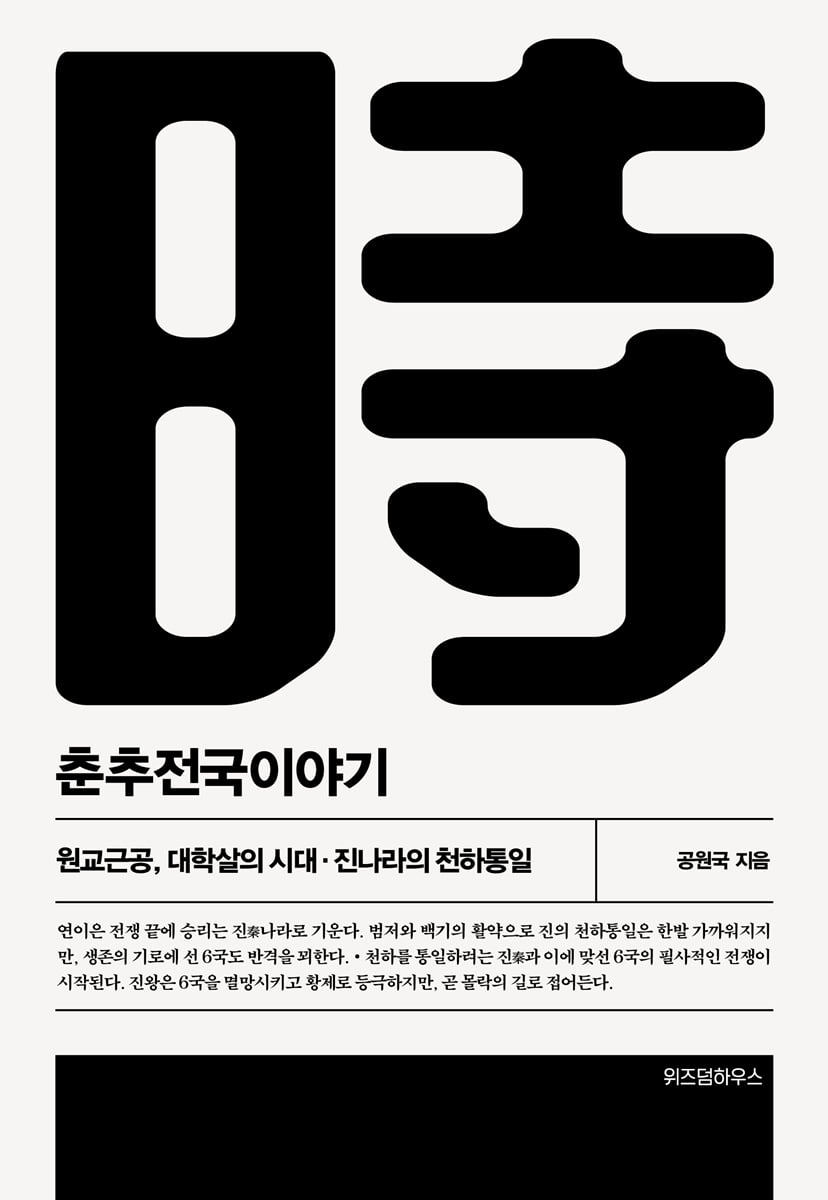 |
Description
Book Introduction
The process by which Qin emerged as China's first empire is vividly restored.
This is the revised second edition of 『The Spring and Autumn Annals and Warring States Stories』.
Volume 5 of the series delves into the era of massacres in which the great powers attacked and counterattacked, including the Battle of Changping, the largest bloody battle of the Warring States period, and the Duke of Yuanjiao, who led the Qin Dynasty to great power.
In Part 2, we examine the rise and fall of the great Qin Empire, examining the power and spirit that fit the era of unification and the hidden power that led the great empire.
The process of Jin's unification war, which has been described only in a few lines in historical documents up to now, is vividly restored using all available materials.
This is the revised second edition of 『The Spring and Autumn Annals and Warring States Stories』.
Volume 5 of the series delves into the era of massacres in which the great powers attacked and counterattacked, including the Battle of Changping, the largest bloody battle of the Warring States period, and the Duke of Yuanjiao, who led the Qin Dynasty to great power.
In Part 2, we examine the rise and fall of the great Qin Empire, examining the power and spirit that fit the era of unification and the hidden power that led the great empire.
The process of Jin's unification war, which has been described only in a few lines in historical documents up to now, is vividly restored using all available materials.
- You can preview some of the book's contents.
Preview
index
Main Character 4
Part 1: The Age of Massacre
Entering 15
Chapter 1: Jin's Northern and Southern Expeditions 27
Chapter 2: The History of the Three Strikes 63
Chapter 3: The Long and Short Stances 97
Chapter 4: The Greatest War of the Warring States Period 153
Chapter 5: Handan's Crisis and Counterattack 211
Chapter 6: The Final Alliance of the Great Swordsman and the Wei Weapons 269
Chapter 7: The Merchant Yeo Buwei Rolls the Dice (295)
Going Out: The Qualities of a Warring States Period King: Reflection and Learning 325
Part 2: The Unification of China by the Qin Dynasty
Enter 335
Chapter 1: The Birth of the Iron Man 345
Chapter 2: The Prelude to the War of Unification: Planners and Strategies 379
Chapter 3: The War of Unification: The Destruction of Zhao 417
Chapter 4: The Unturned Merchant, the Unturned Time 457
Chapter 5: The Rain of the Nations: Waters Destroy Wei (491)
Chapter 6: Unification of the World 557
Chapter 7: Rusty Iron Man 589
Chapter 8: Who Will Destroy Jin? Ho or Min? 641
Leaving: Empire and the Spirit of Miscellaneous Songs 679
supplement
Chronology of the Reigns of the Major States of the Warring States Period, 696
Major Events of the Warring States Period 698
Note 699
Search 704
Part 1: The Age of Massacre
Entering 15
Chapter 1: Jin's Northern and Southern Expeditions 27
Chapter 2: The History of the Three Strikes 63
Chapter 3: The Long and Short Stances 97
Chapter 4: The Greatest War of the Warring States Period 153
Chapter 5: Handan's Crisis and Counterattack 211
Chapter 6: The Final Alliance of the Great Swordsman and the Wei Weapons 269
Chapter 7: The Merchant Yeo Buwei Rolls the Dice (295)
Going Out: The Qualities of a Warring States Period King: Reflection and Learning 325
Part 2: The Unification of China by the Qin Dynasty
Enter 335
Chapter 1: The Birth of the Iron Man 345
Chapter 2: The Prelude to the War of Unification: Planners and Strategies 379
Chapter 3: The War of Unification: The Destruction of Zhao 417
Chapter 4: The Unturned Merchant, the Unturned Time 457
Chapter 5: The Rain of the Nations: Waters Destroy Wei (491)
Chapter 6: Unification of the World 557
Chapter 7: Rusty Iron Man 589
Chapter 8: Who Will Destroy Jin? Ho or Min? 641
Leaving: Empire and the Spirit of Miscellaneous Songs 679
supplement
Chronology of the Reigns of the Major States of the Warring States Period, 696
Major Events of the Warring States Period 698
Note 699
Search 704
Into the book
Just as someone wearing fancy clothes stands out when dancing the same dance, it is harder for a genius from a noble family to rise up than for a cowardly person from a noble family.
Even now, for a genius of Poe to arise, several layers of coincidence must help.
Here is a man who is like a dragon born from a stream, and that is Beomjeo.
A foreign wanderer with no foundation who had suffered all kinds of hardships entered Jin and achieved achievements comparable to those of his predecessor, Shang Yang, without waiting.
He immediately drives away the arrogant Yang Hu Wei Yan and places the position of the King of Jin on an impregnable rock.
By using the strategy of joining hands with distant countries and attacking nearby countries, Jin's territory expanded year by year, and he roasted and boiled Shandong politicians to make them Jin's puppets.
The reason why Sima Qian, borrowing Han Fei's words, lamented, "You need long sleeves to dance well, and you need a lot of money to do business well" is clear.
Who else but Jin would accept such a talent? While the king's flashy but hollow confidants dominated politics in Shandong, Jin elevated and utilized effective figures from the grassroots who could immediately test his strategies.
--- p.88, from “Part 1, Chapter 3, The Long-Term Efforts”
The long-range attack is a terrifying strategy.
It's not that it's complex and bizarre, but rather that it's a very simple and practical judgment.
It is a strategy designed to move to the next stage without policy confusion once one stage is completed.
If we look at the situation from Jin's perspective, Han is the closest and weakest.
Therefore, Jin does not move his troops here and there, but first attacks the closest and weakest side and extinguishes it.
If Han is destroyed, the situation of the Yuan-Jiao-Gung-Gong will be repeated in the order of Wei, Jo, Chu, and Je.
Until when? Until we reach the Yellow Sea.
--- p.124~125, from “Part 1, Chapter 3, The Long-Term Efforts”
Tens of thousands of those who died in battle were buried there, and 400,000 people died, a whopping 400,000 people disappeared in a single war.
This massacre committed by the invading forces has given rise to numerous controversies throughout history.
If Baekgi had not been so eager to attack Handan right away, it would not have been an inevitable choice.
Fortunately, if the 『Strategies of the Warring States』 or 『Records of the Grand Historian』 had not recorded the scene of a massacre unprecedented in the history of ancient warfare, this incident would have been buried.
I reviewed the records of Baekgi killing hundreds of thousands of people before, and I assumed that he killed them after the battle, not during it, but I was not sure.
The fight in Jangpyeong is proof that that assumption is correct.
--- p.203~204, from “Chapter 4, Part 1, Commentary on the Bloody Jang”
We know that it is not clear whether King Jin of Zheng was the son of King Zhuangxiang or the son of Lü Buwei.
Sima Qian respected the royal family of Jin and called him Ying Zheng, but Ban Gu called him Lü Zheng.
Even if he was not the son of Lü Buwei, it would not have been very pleasant for the Jin monarch to have had his mother be Lü Buwei's concubine.
Could such a proud man have acknowledged his mother's former mistress? But it was the era of Lü Buwei, and indeed, without him, there would have been no throne.
--- p.353, from “Part 2, Chapter 1: The Birth of the Iron Man”
This is how all of Jin's planners gathered.
The military strategist Ulyeo came and administered military law, the lawyer and strategist Yi Sa came and administered internal and external affairs, the influential figures such as Yo-ga and Don-yak traveled around the world with money, and Jin's assassins ran rampant throughout the country.
And the military was entrusted to the traditional military families, the Mong and Wang clans.
King Jin had a desire to acquire talented people, and he was willing to bend down and get those with real potential.
In this way, all the planners for unification gathered under the commander, and bribes filled the courts of the nations.
So now it's time for the army to leave.
--- p.415, from “Part 2, Chapter 2: The Prelude to the War of Unification”
The training system of the Jin army was simple and clear.
They trained cells to come together to form organs, and organs to come together to form a complete organism.
After completing the minimum unit training, we move on to the next stage and eventually finish by practicing at the full military level.
At the parade ground, the commander trained the soldiers every day.
Since there were not enough drums and gongs, they trained in the camp using wooden boards and tiles as substitutes for drums and gongs, and poles as substitutes for flags.
When the drum is struck, they advance, when the flag is lowered, they run, and when the gong is struck, they retreat.
If you point the flag to the right, they move to the right, if you point it to the left, they move to the left, and if you strike the drum and gong at the same time, they kneel down.
--- p.437~438, from “Part 2, Chapter 3, Unification War”
The King of Jin's power covered the world.
At that time, Jin's land extended eastward to the sea and Joseon, westward to Linzhou and Qiangzhong, southward to Beixianghu, and northward to the Yellow River, relying on it as a fortress, encompassing Yinshan and reaching Liaodong.
Since I have gained the world, shouldn't I get a name that fits it? (Omitted) "I have eliminated the character 'Tae' and taken the character 'Hwang', and have taken the ancient character 'Je' as my title. From now on, call me 'Huangdi'." Thus, the word 'Emperor' was born for the first time in Chinese history.
--- p.517~518, from “Part 2, Chapter 6: Unification of the World”
Qin Shi Huang loved life too much.
This is a part that stands in stark contrast to Emperor Gaozu of Han, Liu Bang, who shed everything when facing death.
It is natural for a living being to love life, but the desire for eternal life is a behavior that goes beyond the rules of experience.
The rule of thumb is based on common sense. But if an emperor, who rules over ordinary people living within common sense, himself deviates from it, what can be the basis for trust? Knowing that an omnipotent leader is obsessed with extending life, those who seek to exploit that desire for wealth and honor are bound to be ensnared.
It's like the flies that gather in a soy sauce jar can't be driven away by force.
With this swarm of flies, Qin Shi Huang's mind gradually becomes confused.
Even now, for a genius of Poe to arise, several layers of coincidence must help.
Here is a man who is like a dragon born from a stream, and that is Beomjeo.
A foreign wanderer with no foundation who had suffered all kinds of hardships entered Jin and achieved achievements comparable to those of his predecessor, Shang Yang, without waiting.
He immediately drives away the arrogant Yang Hu Wei Yan and places the position of the King of Jin on an impregnable rock.
By using the strategy of joining hands with distant countries and attacking nearby countries, Jin's territory expanded year by year, and he roasted and boiled Shandong politicians to make them Jin's puppets.
The reason why Sima Qian, borrowing Han Fei's words, lamented, "You need long sleeves to dance well, and you need a lot of money to do business well" is clear.
Who else but Jin would accept such a talent? While the king's flashy but hollow confidants dominated politics in Shandong, Jin elevated and utilized effective figures from the grassroots who could immediately test his strategies.
--- p.88, from “Part 1, Chapter 3, The Long-Term Efforts”
The long-range attack is a terrifying strategy.
It's not that it's complex and bizarre, but rather that it's a very simple and practical judgment.
It is a strategy designed to move to the next stage without policy confusion once one stage is completed.
If we look at the situation from Jin's perspective, Han is the closest and weakest.
Therefore, Jin does not move his troops here and there, but first attacks the closest and weakest side and extinguishes it.
If Han is destroyed, the situation of the Yuan-Jiao-Gung-Gong will be repeated in the order of Wei, Jo, Chu, and Je.
Until when? Until we reach the Yellow Sea.
--- p.124~125, from “Part 1, Chapter 3, The Long-Term Efforts”
Tens of thousands of those who died in battle were buried there, and 400,000 people died, a whopping 400,000 people disappeared in a single war.
This massacre committed by the invading forces has given rise to numerous controversies throughout history.
If Baekgi had not been so eager to attack Handan right away, it would not have been an inevitable choice.
Fortunately, if the 『Strategies of the Warring States』 or 『Records of the Grand Historian』 had not recorded the scene of a massacre unprecedented in the history of ancient warfare, this incident would have been buried.
I reviewed the records of Baekgi killing hundreds of thousands of people before, and I assumed that he killed them after the battle, not during it, but I was not sure.
The fight in Jangpyeong is proof that that assumption is correct.
--- p.203~204, from “Chapter 4, Part 1, Commentary on the Bloody Jang”
We know that it is not clear whether King Jin of Zheng was the son of King Zhuangxiang or the son of Lü Buwei.
Sima Qian respected the royal family of Jin and called him Ying Zheng, but Ban Gu called him Lü Zheng.
Even if he was not the son of Lü Buwei, it would not have been very pleasant for the Jin monarch to have had his mother be Lü Buwei's concubine.
Could such a proud man have acknowledged his mother's former mistress? But it was the era of Lü Buwei, and indeed, without him, there would have been no throne.
--- p.353, from “Part 2, Chapter 1: The Birth of the Iron Man”
This is how all of Jin's planners gathered.
The military strategist Ulyeo came and administered military law, the lawyer and strategist Yi Sa came and administered internal and external affairs, the influential figures such as Yo-ga and Don-yak traveled around the world with money, and Jin's assassins ran rampant throughout the country.
And the military was entrusted to the traditional military families, the Mong and Wang clans.
King Jin had a desire to acquire talented people, and he was willing to bend down and get those with real potential.
In this way, all the planners for unification gathered under the commander, and bribes filled the courts of the nations.
So now it's time for the army to leave.
--- p.415, from “Part 2, Chapter 2: The Prelude to the War of Unification”
The training system of the Jin army was simple and clear.
They trained cells to come together to form organs, and organs to come together to form a complete organism.
After completing the minimum unit training, we move on to the next stage and eventually finish by practicing at the full military level.
At the parade ground, the commander trained the soldiers every day.
Since there were not enough drums and gongs, they trained in the camp using wooden boards and tiles as substitutes for drums and gongs, and poles as substitutes for flags.
When the drum is struck, they advance, when the flag is lowered, they run, and when the gong is struck, they retreat.
If you point the flag to the right, they move to the right, if you point it to the left, they move to the left, and if you strike the drum and gong at the same time, they kneel down.
--- p.437~438, from “Part 2, Chapter 3, Unification War”
The King of Jin's power covered the world.
At that time, Jin's land extended eastward to the sea and Joseon, westward to Linzhou and Qiangzhong, southward to Beixianghu, and northward to the Yellow River, relying on it as a fortress, encompassing Yinshan and reaching Liaodong.
Since I have gained the world, shouldn't I get a name that fits it? (Omitted) "I have eliminated the character 'Tae' and taken the character 'Hwang', and have taken the ancient character 'Je' as my title. From now on, call me 'Huangdi'." Thus, the word 'Emperor' was born for the first time in Chinese history.
--- p.517~518, from “Part 2, Chapter 6: Unification of the World”
Qin Shi Huang loved life too much.
This is a part that stands in stark contrast to Emperor Gaozu of Han, Liu Bang, who shed everything when facing death.
It is natural for a living being to love life, but the desire for eternal life is a behavior that goes beyond the rules of experience.
The rule of thumb is based on common sense. But if an emperor, who rules over ordinary people living within common sense, himself deviates from it, what can be the basis for trust? Knowing that an omnipotent leader is obsessed with extending life, those who seek to exploit that desire for wealth and honor are bound to be ensnared.
It's like the flies that gather in a soy sauce jar can't be driven away by force.
With this swarm of flies, Qin Shi Huang's mind gradually becomes confused.
--- p.624, from “Part 2, Chapter 7, Rusty Iron Man”
Publisher's Review
Three years of planning, ten years of direct exploration across China
Korea's first historical textbook that directly addresses the Spring and Autumn Period and the Warring States Period.
Stories of the Spring and Autumn Annals and the Warring States are back with a new design and meticulous proofreading.
This is the revised second edition of the 『Spring and Autumn Annals and Warring States』 series, planned over three years by traveling humanist Park Won-guk and Wisdom House, and written by the author after exploring all of China for ten years.
After the first edition published in 2010 and the revised edition in 2017, it meets readers in a new form after six years.
In this revision, the composition has changed first and foremost.
The original 11 volumes were changed to a combined 6 volumes to take into account the flow of the story.
Readers can feel a powerful sense of immersion in the feast of stories that continues seamlessly from the Spring and Autumn Period to the Warring States Period and the Hundred Schools of Thought.
The second thing that changes is the design.
The cover design has been renewed to enhance the completeness of the series.
If you unfold the covers of all volumes, it seems as if the 550-year Spring and Autumn Period and the Warring States Period unfolds like a panorama.
As a reader, you can visually feel the thrill of breaking through a brick book and the fulfillment of understanding an era every time you finish reading each volume of 'Spring, Autumn, Jeon, Guk, Poetry, and Dae'.
The main text format was also reduced from the existing new national format to a national format and the line spacing was widened to increase readability while allowing readers to enjoy the pleasure of reading.
The third thing that has changed is the proofreading of the entire text.
We have carefully corrected errors in the content, reflected typos and unified terminology, as well as changed spelling.
This series is an unprecedented series that presents a completely new historical perspective through a 'geographical approach' that took a long time to plan and write.
Even in China, the birthplace of 『The Spring and Autumn Annals and the Warring States』, its value was recognized, and in an unusual move, the complete volume was translated and published in Chinese by the Yelin Publishing House under the Jiangsu Phoenix Publishing Group.
As this is a work that is unlikely to be reproduced again in Korean publishing history, we hope that this revision will allow it to be read by readers for a longer period of time.
The origin of East Asian culture and a keyword for understanding modern China.
The Spring and Autumn Period and the Warring States Period, a collection of unprecedented events and characters.
In the overwhelming pleasure of narrative that provides insight into the times,
Read history and gain wisdom to understand life!
The Spring and Autumn Period and the Warring States Period refers to a period of approximately 550 years from 770 BC, when the Zhou Dynasty was forced by the Rong people and moved east to Luoyang (Luoyi), until 221 BC, when the Qin Dynasty unified the country.
Chinese history began with the Shang Dynasty and developed into a vast empire through the Zhou Dynasty and the Warring States Period.
During the Spring and Autumn Period and the Warring States Period, powerful centralized states emerged around major rivers, including the Yellow River.
In addition, the foundation of an agricultural nation was established in which ordinary people took charge of production instead of slaves, and a national tax system and standing army were created.
Towards the end of the Warring States period, Qin finally absorbed the six rival states and formed the first unified empire.
And the Han Dynasty inherited this, and the huge body we call 'China' was born today.
This is why the Spring and Autumn Period and the Warring States Period can be said to be the period when the great framework called 'China' was born, and the flesh of history was added to that framework to create the China of today.
The "Spring and Autumn Annals and Warring States" series does not focus on fragmentary events, but rather examines Chinese history by focusing on the fierce competition and rise and fall of the great powers in a macroscopic way.
Through the rise and fall of numerous nations and the people who played a central role in their development, we can gain wisdom for life through the broad perspective of history.
In addition to known sources, the author meticulously researched the field and examined various bamboo slips, inscriptions, and stone steles to capture the essence of the Spring and Autumn Period and the Warring States Period, a time of constant conflict, convergence, and development.
This series presents a profound insight that allows us to understand the past, reflect on the present, and open the door to the future by intertwining the contemporary assessments of the Spring and Autumn Period and the Warring States Period, the records of later generations, and the author's perspective on them.
You can also look at the flow of the world that creates the joys and sorrows of life, winners and losers.
Based on the geographical background I personally investigated
It presents a completely new historical perspective.
The Four Books and Five Classics, which were required reading for scholars in the Joseon Dynasty, were established during the Spring and Autumn Period and the Warring States Period.
In China, until the Xinhai Revolution, the institutions of the Spring and Autumn Period and the Warring States Period continued to be adopted even when dynasties changed.
Ultimately, the keyword that can help us understand the roots of not only China but also East Asian countries at once is the 'Spring and Autumn Period and Warring States Period'.
Just as there were hundreds of states at the beginning of the Spring and Autumn Period, but only seven remained at the end of the Warring States Period, the Spring and Autumn Period and the Warring States Period were a battleground for survival and competition more fiercely than any other period in history.
In this fierce battlefield, countless heroes and iron men have competed with their strength and wisdom, and tens of millions of people have poured their lives into it.
In the process, the paths of humanity and evil, virtue and power, justification and practicality collided with each other, ultimately creating a crossroads of victory and defeat.
The author has spent several years traveling through China and its neighboring countries, seeking to understand how a small tribal state that began in the Yellow River basin expanded to the limits of nature, and how it integrated diverse cultures to create the vast nation we know today as "China."
And the original form of China was traced back to a special period called the 'Spring and Autumn Period and Warring States Period' two thousand years ago.
Because the author describes the history of the Spring and Autumn Period and the Warring States Period based on the geographical background he personally confirmed through field research, readers will be able to imagine this era in a more three-dimensional way with a broad outline.
The Jin Dynasty accelerated its unification of China through the Yuanjiao campaign.
After the mid-3rd century BC, the scales of victory tilted towards the Qin Dynasty.
The Qin state, which had become the undisputed leader of the Seven Kingdoms, had acquired such great power that by the end of the reign of King Zhao of Qin, it was even able to look forward to unifying the country.
The Jin Dynasty adopted a diplomatic strategy called 'relationships from afar and attacks from afar', gradually expanding its front line eastward from the nearby Three Jins (Wei, Han, and Zhao) to the distant Qi, and was finally able to seize the opportunity to unify the country.
However, the six countries at the crossroads of survival did not sit idly by and wait for their own destruction.
The more fierce the Jin attack, the more fierce the counterattack.
『Spring and Autumn Annals and Warring States Stories 5』 Part 1 vividly depicts the era of massacres in which the great powers attacked and counterattacked, including the Battle of Changping, the bloodiest battle of the Warring States period, and the Duke of Yuanqiao, who led the Qin Dynasty to great power.
King Jin employed the peerless strategist Fan Ju and accepted the Won-gyo-geun-gong-cheok, and on the battlefield, he utilized the undefeated general Bai Qi to win battles and gradually expanded his territory to the east.
In response, prominent figures from six countries, including Insangnyeo and Josa of Zhao and Wei Wuji of Wei, appeared and engaged in a bloody battle with the Jin Dynasty, which was on the rise.
The author pays particular attention to the figure 'Wimugi', who served as a window to the times.
To avoid the trap of consequentialism that can easily be fallen into in history books, it is necessary to look at the contemporary era through individuals.
It is also important to examine the victor's strategies, including each country's attack and defense, intimidation and appeasement, alliances and conflicts.
However, if we pay attention to the actions of those who, even in the midst of fierce battles, tried to practice their cause for the well-being of the community, we can step back from the conclusions of who won and who lost and gain a perspective that allows us to see the overall flow of the times.
Qin Dynasty ends war with war
The Qin Dynasty, which seized the opportunity to gain hegemony through 'distant alliances and nearby attacks', unified the Warring States in 221 BC and stood tall as China's first empire.
The commander who led the Qin Dynasty at that time was Qin Shi Huang, and the planners who assisted him in unifying the country were figures who influenced the era, such as Li Si, Yu Liao, Wang Jian, and Meng Tian.
Jin's army, which had driven the six countries into a frightening corner with its strong military laws and power, swept across the plains of Shandong and finally stopped only when it reached the sea.
Thus, an imperial kingdom was born, encompassing countless peoples and vast territories from the desert in the west to Balhae in the east.
This book vividly restores the rise of Qin Shi Huang and the process of the Qin Dynasty's war for unification.
The six eastern countries that fought against the advance did not collapse until the very end, but they were ultimately unable to endure and were destroyed, with countless people dying on the battlefield.
The Qin Dynasty, which achieved unification at a great cost, attempted to transform into an emperor-centered bureaucratic state and expanded the empire's territory, but soon fell due to its rule that suppressed the freedom of the people.
By examining the rise and fall of the great Qin Empire, we will be able to discover the strength and spirit appropriate for the era of unification, and the hidden values that lead a great empire.
Korea's first historical textbook that directly addresses the Spring and Autumn Period and the Warring States Period.
Stories of the Spring and Autumn Annals and the Warring States are back with a new design and meticulous proofreading.
This is the revised second edition of the 『Spring and Autumn Annals and Warring States』 series, planned over three years by traveling humanist Park Won-guk and Wisdom House, and written by the author after exploring all of China for ten years.
After the first edition published in 2010 and the revised edition in 2017, it meets readers in a new form after six years.
In this revision, the composition has changed first and foremost.
The original 11 volumes were changed to a combined 6 volumes to take into account the flow of the story.
Readers can feel a powerful sense of immersion in the feast of stories that continues seamlessly from the Spring and Autumn Period to the Warring States Period and the Hundred Schools of Thought.
The second thing that changes is the design.
The cover design has been renewed to enhance the completeness of the series.
If you unfold the covers of all volumes, it seems as if the 550-year Spring and Autumn Period and the Warring States Period unfolds like a panorama.
As a reader, you can visually feel the thrill of breaking through a brick book and the fulfillment of understanding an era every time you finish reading each volume of 'Spring, Autumn, Jeon, Guk, Poetry, and Dae'.
The main text format was also reduced from the existing new national format to a national format and the line spacing was widened to increase readability while allowing readers to enjoy the pleasure of reading.
The third thing that has changed is the proofreading of the entire text.
We have carefully corrected errors in the content, reflected typos and unified terminology, as well as changed spelling.
This series is an unprecedented series that presents a completely new historical perspective through a 'geographical approach' that took a long time to plan and write.
Even in China, the birthplace of 『The Spring and Autumn Annals and the Warring States』, its value was recognized, and in an unusual move, the complete volume was translated and published in Chinese by the Yelin Publishing House under the Jiangsu Phoenix Publishing Group.
As this is a work that is unlikely to be reproduced again in Korean publishing history, we hope that this revision will allow it to be read by readers for a longer period of time.
The origin of East Asian culture and a keyword for understanding modern China.
The Spring and Autumn Period and the Warring States Period, a collection of unprecedented events and characters.
In the overwhelming pleasure of narrative that provides insight into the times,
Read history and gain wisdom to understand life!
The Spring and Autumn Period and the Warring States Period refers to a period of approximately 550 years from 770 BC, when the Zhou Dynasty was forced by the Rong people and moved east to Luoyang (Luoyi), until 221 BC, when the Qin Dynasty unified the country.
Chinese history began with the Shang Dynasty and developed into a vast empire through the Zhou Dynasty and the Warring States Period.
During the Spring and Autumn Period and the Warring States Period, powerful centralized states emerged around major rivers, including the Yellow River.
In addition, the foundation of an agricultural nation was established in which ordinary people took charge of production instead of slaves, and a national tax system and standing army were created.
Towards the end of the Warring States period, Qin finally absorbed the six rival states and formed the first unified empire.
And the Han Dynasty inherited this, and the huge body we call 'China' was born today.
This is why the Spring and Autumn Period and the Warring States Period can be said to be the period when the great framework called 'China' was born, and the flesh of history was added to that framework to create the China of today.
The "Spring and Autumn Annals and Warring States" series does not focus on fragmentary events, but rather examines Chinese history by focusing on the fierce competition and rise and fall of the great powers in a macroscopic way.
Through the rise and fall of numerous nations and the people who played a central role in their development, we can gain wisdom for life through the broad perspective of history.
In addition to known sources, the author meticulously researched the field and examined various bamboo slips, inscriptions, and stone steles to capture the essence of the Spring and Autumn Period and the Warring States Period, a time of constant conflict, convergence, and development.
This series presents a profound insight that allows us to understand the past, reflect on the present, and open the door to the future by intertwining the contemporary assessments of the Spring and Autumn Period and the Warring States Period, the records of later generations, and the author's perspective on them.
You can also look at the flow of the world that creates the joys and sorrows of life, winners and losers.
Based on the geographical background I personally investigated
It presents a completely new historical perspective.
The Four Books and Five Classics, which were required reading for scholars in the Joseon Dynasty, were established during the Spring and Autumn Period and the Warring States Period.
In China, until the Xinhai Revolution, the institutions of the Spring and Autumn Period and the Warring States Period continued to be adopted even when dynasties changed.
Ultimately, the keyword that can help us understand the roots of not only China but also East Asian countries at once is the 'Spring and Autumn Period and Warring States Period'.
Just as there were hundreds of states at the beginning of the Spring and Autumn Period, but only seven remained at the end of the Warring States Period, the Spring and Autumn Period and the Warring States Period were a battleground for survival and competition more fiercely than any other period in history.
In this fierce battlefield, countless heroes and iron men have competed with their strength and wisdom, and tens of millions of people have poured their lives into it.
In the process, the paths of humanity and evil, virtue and power, justification and practicality collided with each other, ultimately creating a crossroads of victory and defeat.
The author has spent several years traveling through China and its neighboring countries, seeking to understand how a small tribal state that began in the Yellow River basin expanded to the limits of nature, and how it integrated diverse cultures to create the vast nation we know today as "China."
And the original form of China was traced back to a special period called the 'Spring and Autumn Period and Warring States Period' two thousand years ago.
Because the author describes the history of the Spring and Autumn Period and the Warring States Period based on the geographical background he personally confirmed through field research, readers will be able to imagine this era in a more three-dimensional way with a broad outline.
The Jin Dynasty accelerated its unification of China through the Yuanjiao campaign.
After the mid-3rd century BC, the scales of victory tilted towards the Qin Dynasty.
The Qin state, which had become the undisputed leader of the Seven Kingdoms, had acquired such great power that by the end of the reign of King Zhao of Qin, it was even able to look forward to unifying the country.
The Jin Dynasty adopted a diplomatic strategy called 'relationships from afar and attacks from afar', gradually expanding its front line eastward from the nearby Three Jins (Wei, Han, and Zhao) to the distant Qi, and was finally able to seize the opportunity to unify the country.
However, the six countries at the crossroads of survival did not sit idly by and wait for their own destruction.
The more fierce the Jin attack, the more fierce the counterattack.
『Spring and Autumn Annals and Warring States Stories 5』 Part 1 vividly depicts the era of massacres in which the great powers attacked and counterattacked, including the Battle of Changping, the bloodiest battle of the Warring States period, and the Duke of Yuanqiao, who led the Qin Dynasty to great power.
King Jin employed the peerless strategist Fan Ju and accepted the Won-gyo-geun-gong-cheok, and on the battlefield, he utilized the undefeated general Bai Qi to win battles and gradually expanded his territory to the east.
In response, prominent figures from six countries, including Insangnyeo and Josa of Zhao and Wei Wuji of Wei, appeared and engaged in a bloody battle with the Jin Dynasty, which was on the rise.
The author pays particular attention to the figure 'Wimugi', who served as a window to the times.
To avoid the trap of consequentialism that can easily be fallen into in history books, it is necessary to look at the contemporary era through individuals.
It is also important to examine the victor's strategies, including each country's attack and defense, intimidation and appeasement, alliances and conflicts.
However, if we pay attention to the actions of those who, even in the midst of fierce battles, tried to practice their cause for the well-being of the community, we can step back from the conclusions of who won and who lost and gain a perspective that allows us to see the overall flow of the times.
Qin Dynasty ends war with war
The Qin Dynasty, which seized the opportunity to gain hegemony through 'distant alliances and nearby attacks', unified the Warring States in 221 BC and stood tall as China's first empire.
The commander who led the Qin Dynasty at that time was Qin Shi Huang, and the planners who assisted him in unifying the country were figures who influenced the era, such as Li Si, Yu Liao, Wang Jian, and Meng Tian.
Jin's army, which had driven the six countries into a frightening corner with its strong military laws and power, swept across the plains of Shandong and finally stopped only when it reached the sea.
Thus, an imperial kingdom was born, encompassing countless peoples and vast territories from the desert in the west to Balhae in the east.
This book vividly restores the rise of Qin Shi Huang and the process of the Qin Dynasty's war for unification.
The six eastern countries that fought against the advance did not collapse until the very end, but they were ultimately unable to endure and were destroyed, with countless people dying on the battlefield.
The Qin Dynasty, which achieved unification at a great cost, attempted to transform into an emperor-centered bureaucratic state and expanded the empire's territory, but soon fell due to its rule that suppressed the freedom of the people.
By examining the rise and fall of the great Qin Empire, we will be able to discover the strength and spirit appropriate for the era of unification, and the hidden values that lead a great empire.
GOODS SPECIFICS
- Date of issue: December 28, 2023
- Page count, weight, size: 716 pages | 145*210*33mm
- ISBN13: 9791171710737
- ISBN10: 1171710739
You may also like
카테고리
korean


korean

![GQ KOREA Mark (Monthly): December [2025]](http://librairie.coreenne.fr/cdn/shop/files/8ef265dbbfbf186523ed75ba7319009d.jpg?v=1765340328&width=3840)


