

Joseon Dynasty's Money War
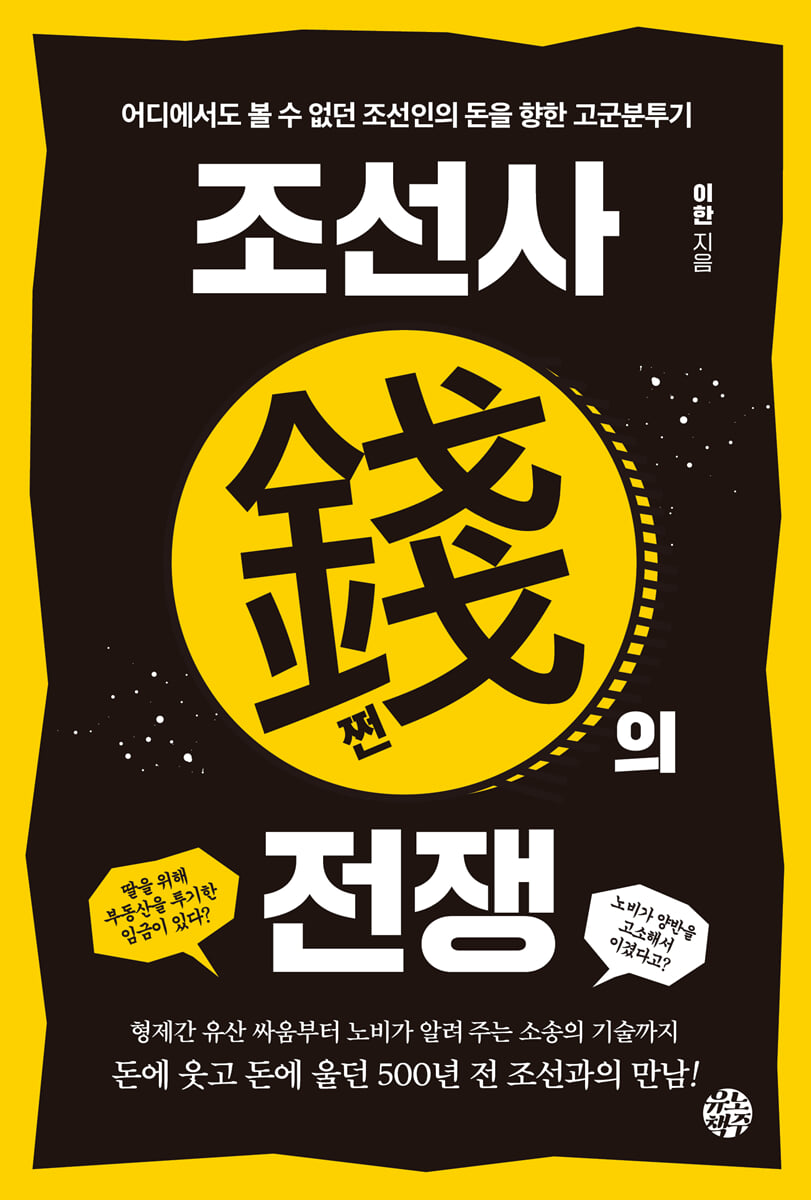 |
Description
Book Introduction
From sibling inheritance battles to the art of litigation taught by slaves.
An encounter with Joseon 500 years ago, where people laughed and cried over money!
“A man will soon forget the murder of his parents, but he will repay the murder of his property even after death.” This is a quote from the 16th century politician Machiavelli.
It is said that the thing that accumulates the greatest resentment, anger, and injustice in the human heart is 'money'.
People living in the modern era, about five centuries later, are not much different.
Aren't we all living our lives entangled in money, suffering from stocks, coins, real estate speculation, and more? So, would things have been different in the 14th century Joseon, a country steeped in Confucianism and respectable scholars, even further back in time?
The author of this book, Lee Han, says that the various stories of Joseon people gleaned from various historical sources are absolutely no different from those of modern times.
It is said that there are many cases where there is no distinction between nobles and commoners in front of money, and where siblings, parents, and children are not considered.
This would have been even more so in a time when food, clothing, and shelter were not as abundant as they are today, and even a caste system existed.
It was not uncommon for those who were wealthier and higher in status to plunder and exploit those who were poorer and lower in status than themselves, as they were accustomed to having more.
The nobles took advantage of the system called 'Gisang', where slaves would offer money to their masters, and brazenly extorted the wealth of wealthy slaves who would even cry and offer up their own money. In times of severe tax corruption, they even taxed the bones of the dead and newborn babies, exploiting the people.
So, did the common people just endure the trampling, enduring and living in silence? You're starting to get the sense, but they certainly didn't just suffer.
During the Joseon Dynasty, anyone, whether a slave or a woman, could officially appeal their grievances.
There was a system of 'Songsa (lawsuit)' that allowed anyone to request mediation if they suffered injustice, and there was 'Hangeul' that helped people organize their situations in writing even if they did not know Chinese characters.
Thus, the people of Joseon literally fought lawsuits by going in and out of government offices until the thresholds were worn down.
A country where anyone, from the nobles to the commoners, can bring a lawsuit and shout, “Give me back my property!” would certainly be different from the Joseon we know so far.
Reading this book makes me think a lot about world affairs and human nature.
Is it true that humans cannot live free from materialism? Where does this greed end? Does it even have an end? Is it an inescapable human nature to be without blood, tears, and family and friends, and to become insignificant before mere money?
We may not know the exact answer, but one thing we do know for sure is that they fought, resisted, and challenged fearlessly to protect themselves, their families, and their property.
Perhaps it is human nature to fight to protect what is precious to us?
I hope that through the refreshing and courageous struggles of the Joseon people, who did not sit back and cry because they suffered injustice, and who did not just step on others no matter how hard they were trampled, we, living in modern times, will gain the strength to overcome various trials, and I hope that we will break down our prejudices by encountering a new side of Joseon that we have not seen anywhere else.
An encounter with Joseon 500 years ago, where people laughed and cried over money!
“A man will soon forget the murder of his parents, but he will repay the murder of his property even after death.” This is a quote from the 16th century politician Machiavelli.
It is said that the thing that accumulates the greatest resentment, anger, and injustice in the human heart is 'money'.
People living in the modern era, about five centuries later, are not much different.
Aren't we all living our lives entangled in money, suffering from stocks, coins, real estate speculation, and more? So, would things have been different in the 14th century Joseon, a country steeped in Confucianism and respectable scholars, even further back in time?
The author of this book, Lee Han, says that the various stories of Joseon people gleaned from various historical sources are absolutely no different from those of modern times.
It is said that there are many cases where there is no distinction between nobles and commoners in front of money, and where siblings, parents, and children are not considered.
This would have been even more so in a time when food, clothing, and shelter were not as abundant as they are today, and even a caste system existed.
It was not uncommon for those who were wealthier and higher in status to plunder and exploit those who were poorer and lower in status than themselves, as they were accustomed to having more.
The nobles took advantage of the system called 'Gisang', where slaves would offer money to their masters, and brazenly extorted the wealth of wealthy slaves who would even cry and offer up their own money. In times of severe tax corruption, they even taxed the bones of the dead and newborn babies, exploiting the people.
So, did the common people just endure the trampling, enduring and living in silence? You're starting to get the sense, but they certainly didn't just suffer.
During the Joseon Dynasty, anyone, whether a slave or a woman, could officially appeal their grievances.
There was a system of 'Songsa (lawsuit)' that allowed anyone to request mediation if they suffered injustice, and there was 'Hangeul' that helped people organize their situations in writing even if they did not know Chinese characters.
Thus, the people of Joseon literally fought lawsuits by going in and out of government offices until the thresholds were worn down.
A country where anyone, from the nobles to the commoners, can bring a lawsuit and shout, “Give me back my property!” would certainly be different from the Joseon we know so far.
Reading this book makes me think a lot about world affairs and human nature.
Is it true that humans cannot live free from materialism? Where does this greed end? Does it even have an end? Is it an inescapable human nature to be without blood, tears, and family and friends, and to become insignificant before mere money?
We may not know the exact answer, but one thing we do know for sure is that they fought, resisted, and challenged fearlessly to protect themselves, their families, and their property.
Perhaps it is human nature to fight to protect what is precious to us?
I hope that through the refreshing and courageous struggles of the Joseon people, who did not sit back and cry because they suffered injustice, and who did not just step on others no matter how hard they were trampled, we, living in modern times, will gain the strength to overcome various trials, and I hope that we will break down our prejudices by encountering a new side of Joseon that we have not seen anywhere else.
- You can preview some of the book's contents.
Preview
index
Entering the Joseon version of the Money War we first encounter
Chapter 1: An Encounter with Joseon, a People Who Live and Die for Money│The Prelude to War
A mudslinging money fight in the land of scholars
What is the story behind Lee Seong-gye's real estate speculation?
Joseon Litigation Annals 1) The Birth of a Nation of 500 Years of Litigation
Chapter 2: Giving an extra inheritance to a pretty child instead of a whip... │The First War: The Siblings' Dispute over Inheritance
Did Yi Sun-sin receive a large inheritance due to favoritism?
The struggle of a legitimate son who lost all his property to his illegitimate son
Joseon Litigation Annals 2) The First Step to Prosecution for Those Who "Cheok" Jin
Chapter 3: The Tangled Inheritance of the Yangban Family: The Second War: The Inheritance Dispute Between Relatives
Jang-hwa and Hong-ryeon were hated because they were rich?
The adopted sons who sold their family for money
Joseon Litigation Annals 3) Was it illegal to hire a lawyer in Joseon?
Chapter 4: How Did the Slave Win Against the Yangban in a Lawsuit? │The Third War: Property Disputes Between Neighbors
Why did the Prime Minister engage in usury?
What Jeong Yak-yong said to a wealthy slave
Joseon Litigation Annals 4) Chunhyang had a plan.
Chapter 5: The Fourth War: The Battle Over Slaves
People could be exchanged like objects, but…
Why did they threaten to call their relatives their slaves?
Has anyone ever claimed to be a slave for money?
Joseon Litigation Annals 5) Proving Paternity in the Age of Scientific Investigation
Chapter 6: A Massive Conflict Caused by Unjustly Stolen Money│The Fifth War: The War Against Unfair Taxes
Why I Paid My Dead Husband's Taxes for 12 Years
Who will win the fierce battle for power surrounding the Han River?
Joseon Litigation Annals 6) How much is the alimony for a husband who was divorced because he was poor?
As I said, history is fun, really.
Chapter 1: An Encounter with Joseon, a People Who Live and Die for Money│The Prelude to War
A mudslinging money fight in the land of scholars
What is the story behind Lee Seong-gye's real estate speculation?
Joseon Litigation Annals 1) The Birth of a Nation of 500 Years of Litigation
Chapter 2: Giving an extra inheritance to a pretty child instead of a whip... │The First War: The Siblings' Dispute over Inheritance
Did Yi Sun-sin receive a large inheritance due to favoritism?
The struggle of a legitimate son who lost all his property to his illegitimate son
Joseon Litigation Annals 2) The First Step to Prosecution for Those Who "Cheok" Jin
Chapter 3: The Tangled Inheritance of the Yangban Family: The Second War: The Inheritance Dispute Between Relatives
Jang-hwa and Hong-ryeon were hated because they were rich?
The adopted sons who sold their family for money
Joseon Litigation Annals 3) Was it illegal to hire a lawyer in Joseon?
Chapter 4: How Did the Slave Win Against the Yangban in a Lawsuit? │The Third War: Property Disputes Between Neighbors
Why did the Prime Minister engage in usury?
What Jeong Yak-yong said to a wealthy slave
Joseon Litigation Annals 4) Chunhyang had a plan.
Chapter 5: The Fourth War: The Battle Over Slaves
People could be exchanged like objects, but…
Why did they threaten to call their relatives their slaves?
Has anyone ever claimed to be a slave for money?
Joseon Litigation Annals 5) Proving Paternity in the Age of Scientific Investigation
Chapter 6: A Massive Conflict Caused by Unjustly Stolen Money│The Fifth War: The War Against Unfair Taxes
Why I Paid My Dead Husband's Taxes for 12 Years
Who will win the fierce battle for power surrounding the Han River?
Joseon Litigation Annals 6) How much is the alimony for a husband who was divorced because he was poor?
As I said, history is fun, really.
Detailed image

Into the book
Taejo's orders for the new house are surprisingly detailed.
The main building and kitchen of the house are to be tiled, while the attic, annex, and western room are to be thatched. The directions of the house in the east, west, south, and north, as well as the layout of the building, are also determined, as are the number of rooms.
In addition, we hope that our descendants will live in this 24-kan tile-roofed house forever.
“…I will inherit the document of sale of the house site purchased by Heo Geum along with the foundation stone. (From the document of the house of Princess Suksin)”
It is heartbreaking to see a father worrying about the future of his cute daughter, whom he had at a young age, but it is also ironic to think of his fifth son, who must have been biting his father's sleeve right next to him.
For reference, this document was written in 1401, the first year of King Taejong's reign, and the capital of Joseon at the time was Gaeseong.
When Joseon was first founded, the capital was moved to Hanyang, but the First Princes' Rebellion broke out there, with brothers killing each other.
Because of this, King Jeongjong, the second king of Joseon, returned to the old capital, Gaeseong, and Hanyang was abandoned and became a ruin.
However, Taejo gave his beloved daughter a house in Hanyang, not Gaeseong.
It may seem like a strange decision, but we know the subsequent history.
---From "Why did Lee Seong-gye speculate in real estate?"
According to the 1588 Chogye Byeon clan's star-level document, Yi Sun-sin's family owned land and 22 slaves in Chungcheong-do, Jeolla-do, Hwanghae-do, etc.
Yi Sun-sin had a fortune to inherit! In fact, it would be difficult to consider someone with this level of wealth exceptionally wealthy.
If you look at the records of famous families, they owned hundreds to thousands of maji of land, and they also had hundreds to thousands of slaves.
Still, at least there was some land and slaves.
That's more than you might think! So why did Yi Sun-sin's family leave Hanyang for Asan? For modern people, for whom living in Seoul is considered a privilege, this may seem like a strange choice, but living with the in-laws was quite common until the mid-Joseon period.
This was especially true if the father's family was poor and the wife's family was rich.
---From "Did Yi Sun-sin receive a large inheritance due to favoritism?"
The king loved his concubine so much that he drove out his wife.
Also, he loved his concubine's children so much that he beat and tormented his first wife's children.
The fourth son, Kwon Ram, ran away from home after suffering from his father's violence, and one of his daughters was even kicked to death by her father.
The Annals of the Joseon Dynasty records that the killing of his child was buried because King Gwon was in charge of an important task.
Even so, how could it have been possible for a murderer, let alone a parricide, to have driven out his wife and abused his own children? In any case, Kwon Je was a truly terrible father.
However, he did not stop there, and gave all his wealth to the son he had with his concubine, and this was even recorded in the Annals of the Joseon Dynasty.
“He gave many slaves to the children of his concubines, and gave little or none to the children of his legitimate wife.
(From Volume 6 of the Annals of the Joseon Dynasty, Annals of King Yejong)
---From "The Struggle of a Legitimate Son Whose Property Was Stolen by an Illegible Son"
You might wonder why we're talking about Chunhyangjeon when talking about litigation during the Joseon Dynasty, but there's no better guidebook for accusations.
On Dano Day, Lee Mong-ryong saw Seong Chun-hyang riding a swing at Gwanghanru Pavilion and fell in love with her at first sight, sending her a love letter.
After several secret meetings, the two young men fell in love and ended up going all the way within a day of meeting, but the problem was what came next.
When his father goes up to Hanyang, Mongryong tells Chunhyang that he has no choice but to part ways with her.
At this point, did Chunhyang shed tears? Or did she cling to Mongryong's clothes? Neither.
I screamed that I would sue you! In the classic novel and pansori of the Joseon Dynasty, "Chunhyangjeon," instead of lamenting her abandoned life, Chunhyang declares, "I knew this would happen," and declares that she will prepare a large-scale lawsuit.
The main building and kitchen of the house are to be tiled, while the attic, annex, and western room are to be thatched. The directions of the house in the east, west, south, and north, as well as the layout of the building, are also determined, as are the number of rooms.
In addition, we hope that our descendants will live in this 24-kan tile-roofed house forever.
“…I will inherit the document of sale of the house site purchased by Heo Geum along with the foundation stone. (From the document of the house of Princess Suksin)”
It is heartbreaking to see a father worrying about the future of his cute daughter, whom he had at a young age, but it is also ironic to think of his fifth son, who must have been biting his father's sleeve right next to him.
For reference, this document was written in 1401, the first year of King Taejong's reign, and the capital of Joseon at the time was Gaeseong.
When Joseon was first founded, the capital was moved to Hanyang, but the First Princes' Rebellion broke out there, with brothers killing each other.
Because of this, King Jeongjong, the second king of Joseon, returned to the old capital, Gaeseong, and Hanyang was abandoned and became a ruin.
However, Taejo gave his beloved daughter a house in Hanyang, not Gaeseong.
It may seem like a strange decision, but we know the subsequent history.
---From "Why did Lee Seong-gye speculate in real estate?"
According to the 1588 Chogye Byeon clan's star-level document, Yi Sun-sin's family owned land and 22 slaves in Chungcheong-do, Jeolla-do, Hwanghae-do, etc.
Yi Sun-sin had a fortune to inherit! In fact, it would be difficult to consider someone with this level of wealth exceptionally wealthy.
If you look at the records of famous families, they owned hundreds to thousands of maji of land, and they also had hundreds to thousands of slaves.
Still, at least there was some land and slaves.
That's more than you might think! So why did Yi Sun-sin's family leave Hanyang for Asan? For modern people, for whom living in Seoul is considered a privilege, this may seem like a strange choice, but living with the in-laws was quite common until the mid-Joseon period.
This was especially true if the father's family was poor and the wife's family was rich.
---From "Did Yi Sun-sin receive a large inheritance due to favoritism?"
The king loved his concubine so much that he drove out his wife.
Also, he loved his concubine's children so much that he beat and tormented his first wife's children.
The fourth son, Kwon Ram, ran away from home after suffering from his father's violence, and one of his daughters was even kicked to death by her father.
The Annals of the Joseon Dynasty records that the killing of his child was buried because King Gwon was in charge of an important task.
Even so, how could it have been possible for a murderer, let alone a parricide, to have driven out his wife and abused his own children? In any case, Kwon Je was a truly terrible father.
However, he did not stop there, and gave all his wealth to the son he had with his concubine, and this was even recorded in the Annals of the Joseon Dynasty.
“He gave many slaves to the children of his concubines, and gave little or none to the children of his legitimate wife.
(From Volume 6 of the Annals of the Joseon Dynasty, Annals of King Yejong)
---From "The Struggle of a Legitimate Son Whose Property Was Stolen by an Illegible Son"
You might wonder why we're talking about Chunhyangjeon when talking about litigation during the Joseon Dynasty, but there's no better guidebook for accusations.
On Dano Day, Lee Mong-ryong saw Seong Chun-hyang riding a swing at Gwanghanru Pavilion and fell in love with her at first sight, sending her a love letter.
After several secret meetings, the two young men fell in love and ended up going all the way within a day of meeting, but the problem was what came next.
When his father goes up to Hanyang, Mongryong tells Chunhyang that he has no choice but to part ways with her.
At this point, did Chunhyang shed tears? Or did she cling to Mongryong's clothes? Neither.
I screamed that I would sue you! In the classic novel and pansori of the Joseon Dynasty, "Chunhyangjeon," instead of lamenting her abandoned life, Chunhyang declares, "I knew this would happen," and declares that she will prepare a large-scale lawsuit.
---From "Chunhyang Had Everything Planned"
Publisher's Review
From the property fight between the nobleman and the slave to the nobleman's wife who runs a loan shark
The art of litigation by those who are 'pretending' for money
In 1554, a nobleman and a slave engaged in a legal battle in what is now Jangsu-hyeon (then Chimgok) in Jeollabuk-do.
This lawsuit was a matter between a nobleman, Lee Mun-geon, and a slave, Nae Jeol-geum, who claimed ownership of a fertile piece of land.
It's a lawsuit between a nobleman and a slave, so the outcome seems very obvious.
No, isn't it surprising that before that, the nobles and slaves had the opportunity to fairly determine right and wrong through litigation?
Naejeolgeum claimed that the land belonged to him because his mother had been forced to donate it to him, and Lee Mun-geon claimed that the land belonged to him because it was donated by his slave.
What was the outcome of this lawsuit? Lee Mun-geon didn't record the outcome in his diary, "Mukjae Diary," and even after the lawsuit, the landowner remained a vassal of the king.
Yes, that's right.
Surprisingly, the lawsuit between these two is believed to have been won by the slave Naejeolgeum!
Meanwhile, the noble wives who seemed to have quietly supported their husbands started lending money.
At that time, the noblewomen were the leaders who managed the entire household finances. In order to further enrich the household finances, they played with money by lending the money they had worked hard to save to neighbors or slaves and getting it back at interest.
There were even cases of people dying due to fights over debt, and Lee Deok-mu, a Silhak scholar of the late Joseon Dynasty, even gave special instructions to noble women not to play with money.
This book introduces the Joseon people's war for money, which is unprecedented, yet heartbreaking and at the same time encouraging, unlike anything we have seen in any history book before.
I hope you will discover a Joseon where anyone could struggle to protect their property, a Joseon where anyone could cry out for injustice regardless of their social status—a Joseon like no other.
Is there a king who speculated in real estate for his daughter?
A slave sued a nobleman and won?
Relearning Joseon history through property, status, and taxes
This book contains various stories of Koreans' struggles for money.
Chapter 1 tells us about the major incidents and accidents that occurred in Joseon and what was considered property at the time, stories that are quite different from modern times.
In chapters 2 and 3, we encounter a fierce fight over property between brothers and relatives who are ruthless when it comes to money.
Watching that brutal war, you might think, "Get out of here, modern-day chaebol dramas."
Chapter 4 contains a property dispute between neighbors.
From the secrets of women accumulating and managing household wealth to the litigation between a wealthy slave and a beggar nobleman in an era when slaves were recognized as private property, it contains aspects of Joseon that you will never see anywhere else.
Chapter 5 contains a somewhat gloomy story of a time when people were treated as property, like objects.
It tells the story of a struggle to protect one's life, family, and property by overcoming the inevitable shackles of the caste system.
Chapter 6 talks about the war against unfair taxes.
From the stories of vicious nobles who collected taxes even from bones to the stories of merchants who constantly visited government offices to protect their interests, it has collected everything.
Not only that, but since most disputes over money would involve rushing to the government office with a complaint, the Annals of Joseon Litigation, which provides a glimpse into the litigation techniques of the Joseon Dynasty, was included as an appendix.
When conflicts arose, instead of sitting back and crying, we witnessed the Korean people actively and courageously working to resolve them. This will help us shed some of our prejudices.
The art of litigation by those who are 'pretending' for money
In 1554, a nobleman and a slave engaged in a legal battle in what is now Jangsu-hyeon (then Chimgok) in Jeollabuk-do.
This lawsuit was a matter between a nobleman, Lee Mun-geon, and a slave, Nae Jeol-geum, who claimed ownership of a fertile piece of land.
It's a lawsuit between a nobleman and a slave, so the outcome seems very obvious.
No, isn't it surprising that before that, the nobles and slaves had the opportunity to fairly determine right and wrong through litigation?
Naejeolgeum claimed that the land belonged to him because his mother had been forced to donate it to him, and Lee Mun-geon claimed that the land belonged to him because it was donated by his slave.
What was the outcome of this lawsuit? Lee Mun-geon didn't record the outcome in his diary, "Mukjae Diary," and even after the lawsuit, the landowner remained a vassal of the king.
Yes, that's right.
Surprisingly, the lawsuit between these two is believed to have been won by the slave Naejeolgeum!
Meanwhile, the noble wives who seemed to have quietly supported their husbands started lending money.
At that time, the noblewomen were the leaders who managed the entire household finances. In order to further enrich the household finances, they played with money by lending the money they had worked hard to save to neighbors or slaves and getting it back at interest.
There were even cases of people dying due to fights over debt, and Lee Deok-mu, a Silhak scholar of the late Joseon Dynasty, even gave special instructions to noble women not to play with money.
This book introduces the Joseon people's war for money, which is unprecedented, yet heartbreaking and at the same time encouraging, unlike anything we have seen in any history book before.
I hope you will discover a Joseon where anyone could struggle to protect their property, a Joseon where anyone could cry out for injustice regardless of their social status—a Joseon like no other.
Is there a king who speculated in real estate for his daughter?
A slave sued a nobleman and won?
Relearning Joseon history through property, status, and taxes
This book contains various stories of Koreans' struggles for money.
Chapter 1 tells us about the major incidents and accidents that occurred in Joseon and what was considered property at the time, stories that are quite different from modern times.
In chapters 2 and 3, we encounter a fierce fight over property between brothers and relatives who are ruthless when it comes to money.
Watching that brutal war, you might think, "Get out of here, modern-day chaebol dramas."
Chapter 4 contains a property dispute between neighbors.
From the secrets of women accumulating and managing household wealth to the litigation between a wealthy slave and a beggar nobleman in an era when slaves were recognized as private property, it contains aspects of Joseon that you will never see anywhere else.
Chapter 5 contains a somewhat gloomy story of a time when people were treated as property, like objects.
It tells the story of a struggle to protect one's life, family, and property by overcoming the inevitable shackles of the caste system.
Chapter 6 talks about the war against unfair taxes.
From the stories of vicious nobles who collected taxes even from bones to the stories of merchants who constantly visited government offices to protect their interests, it has collected everything.
Not only that, but since most disputes over money would involve rushing to the government office with a complaint, the Annals of Joseon Litigation, which provides a glimpse into the litigation techniques of the Joseon Dynasty, was included as an appendix.
When conflicts arose, instead of sitting back and crying, we witnessed the Korean people actively and courageously working to resolve them. This will help us shed some of our prejudices.
GOODS SPECIFICS
- Date of issue: January 2, 2024
- Page count, weight, size: 276 pages | 430g | 142*210*17mm
- ISBN13: 9791171830039
- ISBN10: 1171830033
You may also like
카테고리
korean


korean

![GQ KOREA Mark (Monthly): December [2025]](http://librairie.coreenne.fr/cdn/shop/files/8ef265dbbfbf186523ed75ba7319009d.jpg?v=1765340328&width=3840)


