

A complete history of the Japanese colonial period seen through posters
 |
Description
Book Introduction
- A word from MD
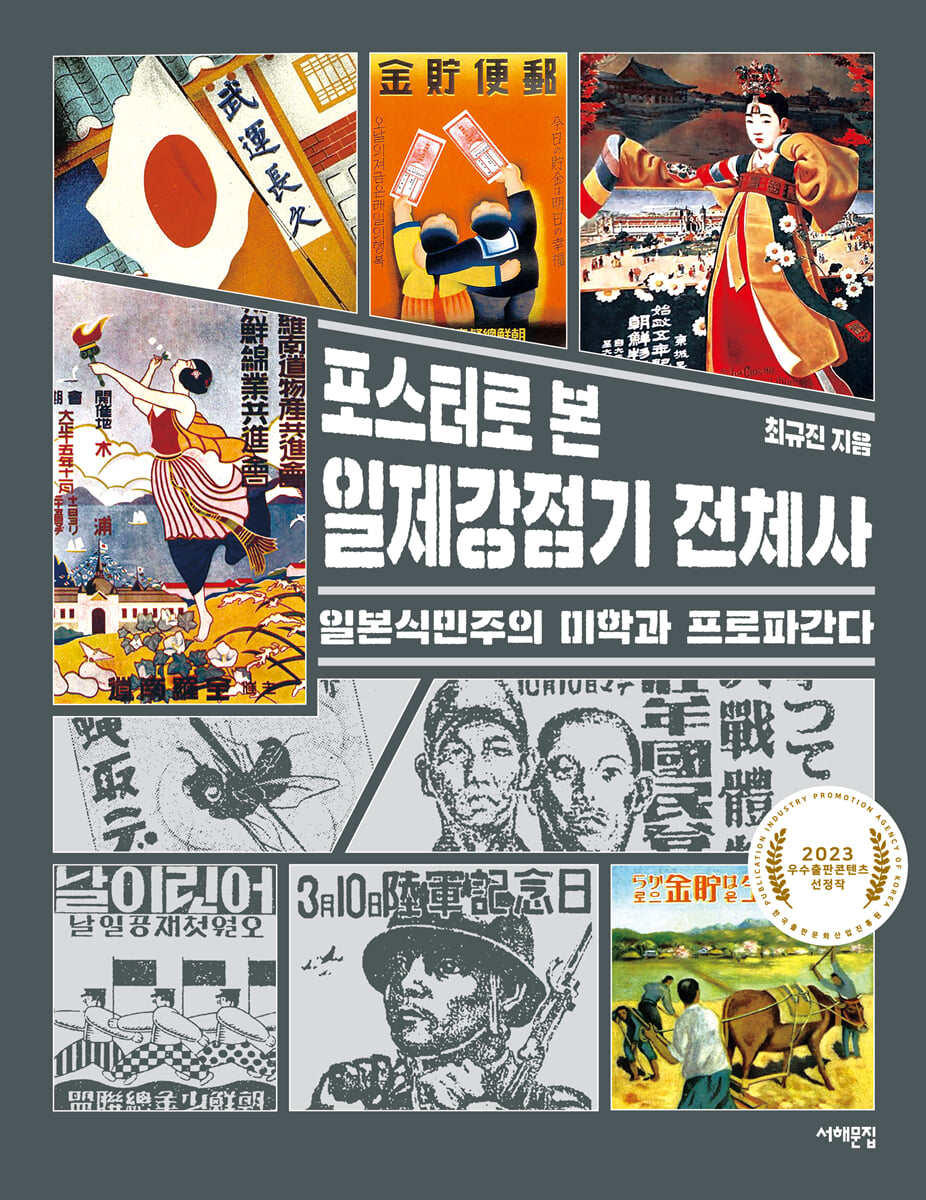
- [Japanese Colonialism in Posters] A book that interprets the Japanese colonial policy hidden in posters during the Japanese colonial period in a political and cultural context.
From 1915 to August 1945, we analyze the imperialist ideology contained in posters produced by the Japanese.
By rediscovering almost all the posters published in media and literature, we describe the 'entire history' of the Japanese colonial period.
- Ahn Hyeon-jae, History PD
A detailed explanation of Japanese colonial policy and a rich interpretation of the poster's political and cultural context!
Although this book covers numerous posters, it is by no means a compilation of them.
Rather, it is an interesting history book that richly examines the ideology of 'Japanese colonialism' contained in the poster and the 'daily life history' of the people.
In particular, the social and political context of the poster was clearly revealed and even the subtle areas of life history were explored in detail.
Thanks to this, this book faithfully reflects the achievements of domestic and international research to date, while also containing a considerable amount of new content based on specific historical materials.
In this book, posters from the Japanese colonial period are divided into several categories and arranged and explained according to the flow of time within each category.
Chapter 1 (Wake up, 'People') is grouped under the category of 'enlightenment', and Chapter 2 (Let it be widely known) is grouped under the category of 'publicity'.
Chapter 3 (Become Imperial Subjects) deals with ‘ideological mobilization’, and Chapter 4 (Mobilized Bodies and Materials) deals with ‘war mobilization’.
Each separate chapter is organically related to each other within the framework of Japan's propaganda strategy.
Additionally, this book sometimes includes non-poster image materials (magazine covers, photographs, illustrations, comics, advertisements, flyers, etc.) to help readers better understand posters.
In addition, it included not only posters that were introduced in black and white in almost all media at the time, but also 'existing materials' in color.
Accordingly, this book utilizes organically intertwined compositions and extensive image data to present posters in three dimensions, allowing present-day readers to easily and enjoyably approach the 'entire history of the Japanese colonial period' while sharing a visual experience with the people of the past.
Although this book covers numerous posters, it is by no means a compilation of them.
Rather, it is an interesting history book that richly examines the ideology of 'Japanese colonialism' contained in the poster and the 'daily life history' of the people.
In particular, the social and political context of the poster was clearly revealed and even the subtle areas of life history were explored in detail.
Thanks to this, this book faithfully reflects the achievements of domestic and international research to date, while also containing a considerable amount of new content based on specific historical materials.
In this book, posters from the Japanese colonial period are divided into several categories and arranged and explained according to the flow of time within each category.
Chapter 1 (Wake up, 'People') is grouped under the category of 'enlightenment', and Chapter 2 (Let it be widely known) is grouped under the category of 'publicity'.
Chapter 3 (Become Imperial Subjects) deals with ‘ideological mobilization’, and Chapter 4 (Mobilized Bodies and Materials) deals with ‘war mobilization’.
Each separate chapter is organically related to each other within the framework of Japan's propaganda strategy.
Additionally, this book sometimes includes non-poster image materials (magazine covers, photographs, illustrations, comics, advertisements, flyers, etc.) to help readers better understand posters.
In addition, it included not only posters that were introduced in black and white in almost all media at the time, but also 'existing materials' in color.
Accordingly, this book utilizes organically intertwined compositions and extensive image data to present posters in three dimensions, allowing present-day readers to easily and enjoyably approach the 'entire history of the Japanese colonial period' while sharing a visual experience with the people of the past.
- You can preview some of the book's contents.
Preview
index
preface
1 Wake up, 'people'
Allah! Hygiene of 'Modernity'
Hygiene and Health: Fly-catching day, pulmonary distoma and roundworm / Do not hide the disease: dysentery, plague, cholera / 'National disease', tuberculosis: tuberculosis prevention / Eyes and teeth for the nation: Eye Memorial Day and Cavity Prevention Day
Let's change our lives
Drive out the 'white-clothing addicts': 'color clothes' and mompe / The clock's command, the discipline of time: the anniversary of the hour / "Weighing rather than measuring": the metric system / Poisonous alcohol: the temperance campaign / Frugal living: Saving for fuel and war / Savings are here: banks, post offices and financial associations / Go, turn left: Driving on the left / Laughter and service: the kindness and cheerfulness movement
Things to do in life
Paying taxes above all else: Serving the nation through tax payments/ A big problem is brewing: 'Aerim' and forest fires, Fire Safety Day/ Traffic training and transportation: Traffic safety and maritime safety
Enrich your life
Leading the People's Heart: Library Week / "My Life, My Own": Local Product Promotion Movement / Knowledge is Power: The Bunarod Movement / "Scientification of Life, Science in Daily Life": Science Day / Keeping Hope Alive: Children's Day
2. Let it be widely known
Please join us
Radio where ghosts cry: JODK and radio registration / Radio, sports and gymnastics: Radio broadcasting and radio gymnastics / Census and 'national roll call': National Census / Helping the underprivileged: 'Sympathy' / Sports for the nation: Sports Day and sports competitions / Seal against tuberculosis: Christmas seal / Society that encourages smoking: 'Cigarettes as a hobby' / Betting on horses: Horse racing / The temptation of the sea: Beach
Come and take a look
Military rule and events: Joseon Products Fair, Home Expo, Incheon Aquarium / No time to play: Sideline product fair and self-reliance / Similar yet different fairs: Regional products fair / Colonial rule and fairs: Joseon Expo, Joseon Industrial Expo, Joseon Grand Expo / I also have a fair: Fairs of all names / Secret persuasion: Exhibitions and fairs
3 Become a citizen of the Empire
Remember this day
The Beginning of the '15-Year War': Manchurian Incident Anniversary and 'Manchurian Development' / Puppet Manchukuo: 'Royal Politics' and 'Five-Clan Harmony' / Call It a 'Holy War': China Incident Anniversary / Memories of War: Army Anniversary and Military Discipline / 'Z-Spirit': Navy Anniversary / "The Sky, Where Men Should Go": Aviation Day / Enjoying the Sea: Sea Anniversary
Stop thinking nonsense
'Red Devil': Anti-Communism / Spy the Spy: Counterintelligence / Friendly Police, Familiar Law: Crime Prevention and Law-abiding / War by My Side: Air Defense
The path to 'internal unity'
Japanese Becomes the National Language: "National Language Use" and the National Language Transmission Movement / "Dedicating Ourselves to the Emperor": The Japanese Spirit / Patriotism at Every Turn: The Love of Domestic Products and Patriotic Events
4. Mobilized bodies and materials
Body for War
'The Nation's Treasure': Child Love and the Excellent Child Competition / Is Your Body Worthy?: Physical Fitness Test and Physical Examination / A Body to Become a Soldier: Health Week and the National Health Movement / Fighting Without Worries: Support / 'The Lily of the Battlefield': Military Nursing Corps
Life to go to war
Report Me: National Registration, Youth and Middle-Aged National Registration, and the Giryu Order / Instilling Military Spirit in Youth: Youth Training Center, Women's Youth Training Center / The 'Imperial Army' that Calls for Death: Volunteers, Student Soldiers, Child Soldiers, and the Conscription System / 'National Defense Animals': Military Horses and Military Dogs
Savings that become military equipment
An Economy Like War: Economic Warfare Emphasis Movement / Diligent and Frugal: Frugality Day / For Family and Country: Joseon Simple Life Insurance / Saving through Debt: 'Savings Service' / Money the Nation Borrows: Government Bonds and Bonds
Everyone work and pay everything
Not Labor, but 'Work': Serving the Nation through Labor and National Development / 'Metal Wars': Collecting Gold and Metal Recovery Movements / Offering Sweat and Goods: Increased Production and Requisition
Conclusion
supplement
main
References
1 Wake up, 'people'
Allah! Hygiene of 'Modernity'
Hygiene and Health: Fly-catching day, pulmonary distoma and roundworm / Do not hide the disease: dysentery, plague, cholera / 'National disease', tuberculosis: tuberculosis prevention / Eyes and teeth for the nation: Eye Memorial Day and Cavity Prevention Day
Let's change our lives
Drive out the 'white-clothing addicts': 'color clothes' and mompe / The clock's command, the discipline of time: the anniversary of the hour / "Weighing rather than measuring": the metric system / Poisonous alcohol: the temperance campaign / Frugal living: Saving for fuel and war / Savings are here: banks, post offices and financial associations / Go, turn left: Driving on the left / Laughter and service: the kindness and cheerfulness movement
Things to do in life
Paying taxes above all else: Serving the nation through tax payments/ A big problem is brewing: 'Aerim' and forest fires, Fire Safety Day/ Traffic training and transportation: Traffic safety and maritime safety
Enrich your life
Leading the People's Heart: Library Week / "My Life, My Own": Local Product Promotion Movement / Knowledge is Power: The Bunarod Movement / "Scientification of Life, Science in Daily Life": Science Day / Keeping Hope Alive: Children's Day
2. Let it be widely known
Please join us
Radio where ghosts cry: JODK and radio registration / Radio, sports and gymnastics: Radio broadcasting and radio gymnastics / Census and 'national roll call': National Census / Helping the underprivileged: 'Sympathy' / Sports for the nation: Sports Day and sports competitions / Seal against tuberculosis: Christmas seal / Society that encourages smoking: 'Cigarettes as a hobby' / Betting on horses: Horse racing / The temptation of the sea: Beach
Come and take a look
Military rule and events: Joseon Products Fair, Home Expo, Incheon Aquarium / No time to play: Sideline product fair and self-reliance / Similar yet different fairs: Regional products fair / Colonial rule and fairs: Joseon Expo, Joseon Industrial Expo, Joseon Grand Expo / I also have a fair: Fairs of all names / Secret persuasion: Exhibitions and fairs
3 Become a citizen of the Empire
Remember this day
The Beginning of the '15-Year War': Manchurian Incident Anniversary and 'Manchurian Development' / Puppet Manchukuo: 'Royal Politics' and 'Five-Clan Harmony' / Call It a 'Holy War': China Incident Anniversary / Memories of War: Army Anniversary and Military Discipline / 'Z-Spirit': Navy Anniversary / "The Sky, Where Men Should Go": Aviation Day / Enjoying the Sea: Sea Anniversary
Stop thinking nonsense
'Red Devil': Anti-Communism / Spy the Spy: Counterintelligence / Friendly Police, Familiar Law: Crime Prevention and Law-abiding / War by My Side: Air Defense
The path to 'internal unity'
Japanese Becomes the National Language: "National Language Use" and the National Language Transmission Movement / "Dedicating Ourselves to the Emperor": The Japanese Spirit / Patriotism at Every Turn: The Love of Domestic Products and Patriotic Events
4. Mobilized bodies and materials
Body for War
'The Nation's Treasure': Child Love and the Excellent Child Competition / Is Your Body Worthy?: Physical Fitness Test and Physical Examination / A Body to Become a Soldier: Health Week and the National Health Movement / Fighting Without Worries: Support / 'The Lily of the Battlefield': Military Nursing Corps
Life to go to war
Report Me: National Registration, Youth and Middle-Aged National Registration, and the Giryu Order / Instilling Military Spirit in Youth: Youth Training Center, Women's Youth Training Center / The 'Imperial Army' that Calls for Death: Volunteers, Student Soldiers, Child Soldiers, and the Conscription System / 'National Defense Animals': Military Horses and Military Dogs
Savings that become military equipment
An Economy Like War: Economic Warfare Emphasis Movement / Diligent and Frugal: Frugality Day / For Family and Country: Joseon Simple Life Insurance / Saving through Debt: 'Savings Service' / Money the Nation Borrows: Government Bonds and Bonds
Everyone work and pay everything
Not Labor, but 'Work': Serving the Nation through Labor and National Development / 'Metal Wars': Collecting Gold and Metal Recovery Movements / Offering Sweat and Goods: Increased Production and Requisition
Conclusion
supplement
main
References
Detailed image

Into the book
In Figure 10, a 'savage Korean' with a topknot is greedily eating a crab.
He had a sign with an arrow on his lungs that said 'Soil Prevention'.
The right side of the poster depicts catching crayfish and crabs, and the left side depicts selling crayfish.
At the very bottom, crayfish and crabs are drawn.
The poster read, “To prevent soil contamination, we cannot catch or sell crayfish and crabs.”
'Soil' is a type of lung disease.
Pulmonary distoma is a parasite that invades the lungs and causes disease.
If you are infected with pulmonary edema, you will cough up phlegm mixed with blood.
Until at least 1944, there was no reliable treatment for the pneumonic plague parasite.
Because the disease progressed slowly, pulmonary distoma was considered relatively mild.
However, the disease was widespread, reducing many people's ability to work, and many people died from complications.
The Government-General conducted a survey in 1922-1923 to establish measures to eradicate pneumonia.
The investigation found that it was caused by eating raw crayfish and Southeast crabs, which are popular among Koreans.
In 1924, a law was enacted and implemented to prohibit the harvesting and trading of crayfish and southeastern crabs.
--- p.33
Figure 5 focuses on the rural development movement that began in 1932.
“Self-reliance is through savings,” he wrote.
In the village far away, cherry blossoms are in full bloom, and farmers wearing straw sandals work together to plow the fields.
The countryside in the poster is prosperous and the people are hard-working.
The Japanese government launched a rural development movement to revive the devastated farming economy and stabilize the system.
He said that farmers must break free from their lazy and ignorant state and live a new life with the spirit of self-reliance.
The rural development movement was an ideological brainwashing policy that taught people that they could live well if they worked hard and saved money, while thoroughly concealing the mechanisms of exploitation.
--- p.79
Figure 1 was already introduced when describing the ‘Joseon Products Exhibition’, but it is included here again for easy comparison with Figure 2.
Of course, Figure 1 and Figure 2 are different.
First, Figure 1 has Gyeongbokgung Palace in the background, and Figure 2 has Bulguksa Temple’s Dabotap Pagoda in the background.
Second, Figure 2 puts the flower bed and fountain of Building 1 in the foreground rather than the appearance of the parasite.
Third, Figure 1 shows the chrysanthemum, a symbol of the Japanese imperial family, but Figure 2 does not.
But in the big picture, the two posters are almost identical.
In particular, the old space is depicted as a lifeless and dark space, while the modern space is depicted as a lively and bright space.
--- p.243
In Figure 3, a girl clasps her hands before eating her lunchbox.
It says, “Let us give thanks, let us protect the general.”
At the very bottom, in very small letters, it said, “1st place in the current affairs poster contest.”
This poster successfully symbolizes frugality and gratitude.
The lunch box in the poster is called 'Hinomaru Bento'.
If you translate it, it means 'Rising Sun Flag Lunchbox'.
If you put a pickled plum (umeboshi) in the middle of your lunch box, it will look like the Japanese flag.
By lunchtime, the red color of the pickled vegetables spreads and looks like the Rising Sun Flag.
I ordered a Hinomaru bento to be packed for Patriot's Day and other events.
--- p.393
In Figure 5, it is written, “Age: 16 to 40 years old, Due date: September 30 to October 10.”
It was titled “Report All, Final System Youth and Middle-Aged Citizen Registration.”
What is the decisive battle system?
As the war dragged on, the term "decisive battle system" began to be used from late 1941 to mean strengthening the wartime system.
The term "final battle system" is much more oppressive than the term "war system" and even carries an atmosphere of defeat.
As the tide of the war turned in favor of the Allied Forces during the Battle of Guadalcanal (August 7, 1942 - February 9, 1943), the Japanese began to use the term "decisive battle system" more frequently.
Since 1943, this phrase has become something of a catchphrase.
In Figure 5, the two people are solemn and solemn, reflecting the ‘final battle system.’
The purpose of the third youth national registration in 1943 was to “establish a human mobilization system to expand military supplies and production capacity under the decisive battle system.”
--- p.451
Figure 19 is a photo from the cover of the Japanese national media and photo magazine, Photographic Magazine.
This photo is from the 'Modern 3D Attack and Defense Exercise', which was one of the events commemorating the 1st anniversary of the Greater East Asia War.
Anyone can easily see that the poster for Figure 20, 'Seaweed Increase', was modeled after Figure 19.
In Figure 20, the grass the soldier is covering himself with to camouflage his body is reminiscent of seaweed.
“Seaweed is a war resource,” he wrote, “We need seaweed to win the war.”
The bottom left of Figure 20 lists the seaweeds that need to be increased, such as kelp, wakame, seaweed, and sea mustard.
He explained, with small drawings, that it was necessary for making airplane materials, explosives, matches, optical glass, mining supplies, etc.
The 'seaweed production increase movement' first started in Japan.
In Joseon, a 'seaweed production increase movement' was also carried out, mainly in Jeollanam-do and Jeju-do.
The increase in production movement meant an expansion of requisition.
As with all requisitions, the seaweed requisition was a great hardship for the coastal villages.
Jeju Island, which had to collect seaweed, which was used as a raw material for gunpowder, is an example.
In Jeju Island, seaweed was a valuable seaweed used as compost in fields.
As hundreds of sacks of seaweed were allocated to each village, making it impossible to make compost, the fields became increasingly barren.
He had a sign with an arrow on his lungs that said 'Soil Prevention'.
The right side of the poster depicts catching crayfish and crabs, and the left side depicts selling crayfish.
At the very bottom, crayfish and crabs are drawn.
The poster read, “To prevent soil contamination, we cannot catch or sell crayfish and crabs.”
'Soil' is a type of lung disease.
Pulmonary distoma is a parasite that invades the lungs and causes disease.
If you are infected with pulmonary edema, you will cough up phlegm mixed with blood.
Until at least 1944, there was no reliable treatment for the pneumonic plague parasite.
Because the disease progressed slowly, pulmonary distoma was considered relatively mild.
However, the disease was widespread, reducing many people's ability to work, and many people died from complications.
The Government-General conducted a survey in 1922-1923 to establish measures to eradicate pneumonia.
The investigation found that it was caused by eating raw crayfish and Southeast crabs, which are popular among Koreans.
In 1924, a law was enacted and implemented to prohibit the harvesting and trading of crayfish and southeastern crabs.
--- p.33
Figure 5 focuses on the rural development movement that began in 1932.
“Self-reliance is through savings,” he wrote.
In the village far away, cherry blossoms are in full bloom, and farmers wearing straw sandals work together to plow the fields.
The countryside in the poster is prosperous and the people are hard-working.
The Japanese government launched a rural development movement to revive the devastated farming economy and stabilize the system.
He said that farmers must break free from their lazy and ignorant state and live a new life with the spirit of self-reliance.
The rural development movement was an ideological brainwashing policy that taught people that they could live well if they worked hard and saved money, while thoroughly concealing the mechanisms of exploitation.
--- p.79
Figure 1 was already introduced when describing the ‘Joseon Products Exhibition’, but it is included here again for easy comparison with Figure 2.
Of course, Figure 1 and Figure 2 are different.
First, Figure 1 has Gyeongbokgung Palace in the background, and Figure 2 has Bulguksa Temple’s Dabotap Pagoda in the background.
Second, Figure 2 puts the flower bed and fountain of Building 1 in the foreground rather than the appearance of the parasite.
Third, Figure 1 shows the chrysanthemum, a symbol of the Japanese imperial family, but Figure 2 does not.
But in the big picture, the two posters are almost identical.
In particular, the old space is depicted as a lifeless and dark space, while the modern space is depicted as a lively and bright space.
--- p.243
In Figure 3, a girl clasps her hands before eating her lunchbox.
It says, “Let us give thanks, let us protect the general.”
At the very bottom, in very small letters, it said, “1st place in the current affairs poster contest.”
This poster successfully symbolizes frugality and gratitude.
The lunch box in the poster is called 'Hinomaru Bento'.
If you translate it, it means 'Rising Sun Flag Lunchbox'.
If you put a pickled plum (umeboshi) in the middle of your lunch box, it will look like the Japanese flag.
By lunchtime, the red color of the pickled vegetables spreads and looks like the Rising Sun Flag.
I ordered a Hinomaru bento to be packed for Patriot's Day and other events.
--- p.393
In Figure 5, it is written, “Age: 16 to 40 years old, Due date: September 30 to October 10.”
It was titled “Report All, Final System Youth and Middle-Aged Citizen Registration.”
What is the decisive battle system?
As the war dragged on, the term "decisive battle system" began to be used from late 1941 to mean strengthening the wartime system.
The term "final battle system" is much more oppressive than the term "war system" and even carries an atmosphere of defeat.
As the tide of the war turned in favor of the Allied Forces during the Battle of Guadalcanal (August 7, 1942 - February 9, 1943), the Japanese began to use the term "decisive battle system" more frequently.
Since 1943, this phrase has become something of a catchphrase.
In Figure 5, the two people are solemn and solemn, reflecting the ‘final battle system.’
The purpose of the third youth national registration in 1943 was to “establish a human mobilization system to expand military supplies and production capacity under the decisive battle system.”
--- p.451
Figure 19 is a photo from the cover of the Japanese national media and photo magazine, Photographic Magazine.
This photo is from the 'Modern 3D Attack and Defense Exercise', which was one of the events commemorating the 1st anniversary of the Greater East Asia War.
Anyone can easily see that the poster for Figure 20, 'Seaweed Increase', was modeled after Figure 19.
In Figure 20, the grass the soldier is covering himself with to camouflage his body is reminiscent of seaweed.
“Seaweed is a war resource,” he wrote, “We need seaweed to win the war.”
The bottom left of Figure 20 lists the seaweeds that need to be increased, such as kelp, wakame, seaweed, and sea mustard.
He explained, with small drawings, that it was necessary for making airplane materials, explosives, matches, optical glass, mining supplies, etc.
The 'seaweed production increase movement' first started in Japan.
In Joseon, a 'seaweed production increase movement' was also carried out, mainly in Jeollanam-do and Jeju-do.
The increase in production movement meant an expansion of requisition.
As with all requisitions, the seaweed requisition was a great hardship for the coastal villages.
Jeju Island, which had to collect seaweed, which was used as a raw material for gunpowder, is an example.
In Jeju Island, seaweed was a valuable seaweed used as compost in fields.
As hundreds of sacks of seaweed were allocated to each village, making it impossible to make compost, the fields became increasingly barren.
--- p.570
Publisher's Review
From ‘street art gallery’ to ‘tool of ideological propaganda’,
A detailed look at the Japanese colonial period in the world of posters spread out like a vast net!
This book covers the period from 1915, when the Japanese began producing and distributing posters, to August 1945, when Japan was defeated.
One of the main goals is to analyze the imperialist ideology contained in the poster.
However, we will not miss the historical background and cultural context in which the posters were distributed.
I also want to read the lives of the people who had to survive those times through posters.
(…) This book aimed to be a “total history of the Japanese colonial period seen through posters.”
The term 'holistic history' has different meanings for different people, but it generally refers to a historical narrative that transcends separate frameworks such as political history, economic history, and cultural history.
'Comprehensive history' is also a history that interprets individual events 'integrally' while taking into account the broader context.
This book attempted to describe the 'entire history' of the Japanese colonial period by interpreting the posters from an 'integrated perspective.'
_ In the preface
◆ Rediscovering posters as important historical materials!!
In historical research, non-written sources are as important as written sources.
In particular, image materials such as photographs, cartoons, advertisements, illustrations, and paintings are ‘historical reproductions’ and important historical materials.
The same goes for posters.
Moreover, posters have the characteristic of being 'objective' and conveying the message clearly compared to other image materials, as they add keywords or text.
Interpreting posters can be the foundation for a richer understanding of history.
◆ Almost all posters published in media and literature have been newly discovered and included!!
Nowadays, it is easy to search and find a lot of materials, but image materials such as posters are almost impossible.
Just as you would pick out a pretty stone from a pile of rocks, you have to dig through newspapers, magazines, and other materials one by one.
Over a period of over ten years, the author collected and organized nearly every poster published in media and literature from the Japanese colonial period.
That is why many posters are being introduced to the world for the first time through this book.
Furthermore, even for already known posters, we reinterpreted them by clearly specifying the time of distribution or by using a comparative historical methodology that compares them with Japanese or Western posters.
There is no propaganda without ideology.
Even if the poster is dressed in the clothes of 'enlightenment', there is always ideology within it.
This book pointed out that the so-called enlightenment project, or in other words, the plan for 'civilization', had the intention of instilling an inferiority complex in the colonized people and making them automatically obedient.
Ultimately, the poster of enlightenment was a device to “seduce with modernity.”
The poster served to soothe the resistance energy of the colonized and strengthen their inclusion by promoting universal values such as hygiene, health, and kindness.
The colonial power sought to protect the lives of its colonized people by providing hygiene and health because the lives of the colonized people were useful to them.
But the lives of the colonists could easily be sacrificed whenever necessary.
Even the 'social welfare' that was only in name had the biggest goal of preventing social conflict.
The true face of 'good imperialism' depicted in the posters of enlightenment has always been like this.
(…) Humans are not puppets.
No matter how much propaganda is done, it is impossible to completely eradicate human self-consciousness.
People may pretend to accept propaganda on the surface, but they may find other meanings in it themselves.
Just as water flows even under thick ice, the nameless masses sometimes defy the system with 'invisible resistance.'
“I resist.
Therefore, it exists.” Even in the midst of heavy oppression and harsh suppression, there are always people who move to find gaps in resistance.
So we see hope in history.
_ In conclusion
A detailed look at the Japanese colonial period in the world of posters spread out like a vast net!
This book covers the period from 1915, when the Japanese began producing and distributing posters, to August 1945, when Japan was defeated.
One of the main goals is to analyze the imperialist ideology contained in the poster.
However, we will not miss the historical background and cultural context in which the posters were distributed.
I also want to read the lives of the people who had to survive those times through posters.
(…) This book aimed to be a “total history of the Japanese colonial period seen through posters.”
The term 'holistic history' has different meanings for different people, but it generally refers to a historical narrative that transcends separate frameworks such as political history, economic history, and cultural history.
'Comprehensive history' is also a history that interprets individual events 'integrally' while taking into account the broader context.
This book attempted to describe the 'entire history' of the Japanese colonial period by interpreting the posters from an 'integrated perspective.'
_ In the preface
◆ Rediscovering posters as important historical materials!!
In historical research, non-written sources are as important as written sources.
In particular, image materials such as photographs, cartoons, advertisements, illustrations, and paintings are ‘historical reproductions’ and important historical materials.
The same goes for posters.
Moreover, posters have the characteristic of being 'objective' and conveying the message clearly compared to other image materials, as they add keywords or text.
Interpreting posters can be the foundation for a richer understanding of history.
◆ Almost all posters published in media and literature have been newly discovered and included!!
Nowadays, it is easy to search and find a lot of materials, but image materials such as posters are almost impossible.
Just as you would pick out a pretty stone from a pile of rocks, you have to dig through newspapers, magazines, and other materials one by one.
Over a period of over ten years, the author collected and organized nearly every poster published in media and literature from the Japanese colonial period.
That is why many posters are being introduced to the world for the first time through this book.
Furthermore, even for already known posters, we reinterpreted them by clearly specifying the time of distribution or by using a comparative historical methodology that compares them with Japanese or Western posters.
There is no propaganda without ideology.
Even if the poster is dressed in the clothes of 'enlightenment', there is always ideology within it.
This book pointed out that the so-called enlightenment project, or in other words, the plan for 'civilization', had the intention of instilling an inferiority complex in the colonized people and making them automatically obedient.
Ultimately, the poster of enlightenment was a device to “seduce with modernity.”
The poster served to soothe the resistance energy of the colonized and strengthen their inclusion by promoting universal values such as hygiene, health, and kindness.
The colonial power sought to protect the lives of its colonized people by providing hygiene and health because the lives of the colonized people were useful to them.
But the lives of the colonists could easily be sacrificed whenever necessary.
Even the 'social welfare' that was only in name had the biggest goal of preventing social conflict.
The true face of 'good imperialism' depicted in the posters of enlightenment has always been like this.
(…) Humans are not puppets.
No matter how much propaganda is done, it is impossible to completely eradicate human self-consciousness.
People may pretend to accept propaganda on the surface, but they may find other meanings in it themselves.
Just as water flows even under thick ice, the nameless masses sometimes defy the system with 'invisible resistance.'
“I resist.
Therefore, it exists.” Even in the midst of heavy oppression and harsh suppression, there are always people who move to find gaps in resistance.
So we see hope in history.
_ In conclusion
GOODS SPECIFICS
- Date of issue: November 30, 2023
- Page count, weight, size: 716 pages | 1,358g | 173*224*44mm
- ISBN13: 9791192988368
- ISBN10: 1192988361
You may also like
카테고리
korean


korean

![GQ KOREA Mark (Monthly): December [2025]](http://librairie.coreenne.fr/cdn/shop/files/8ef265dbbfbf186523ed75ba7319009d.jpg?v=1765340328&width=3840)


