

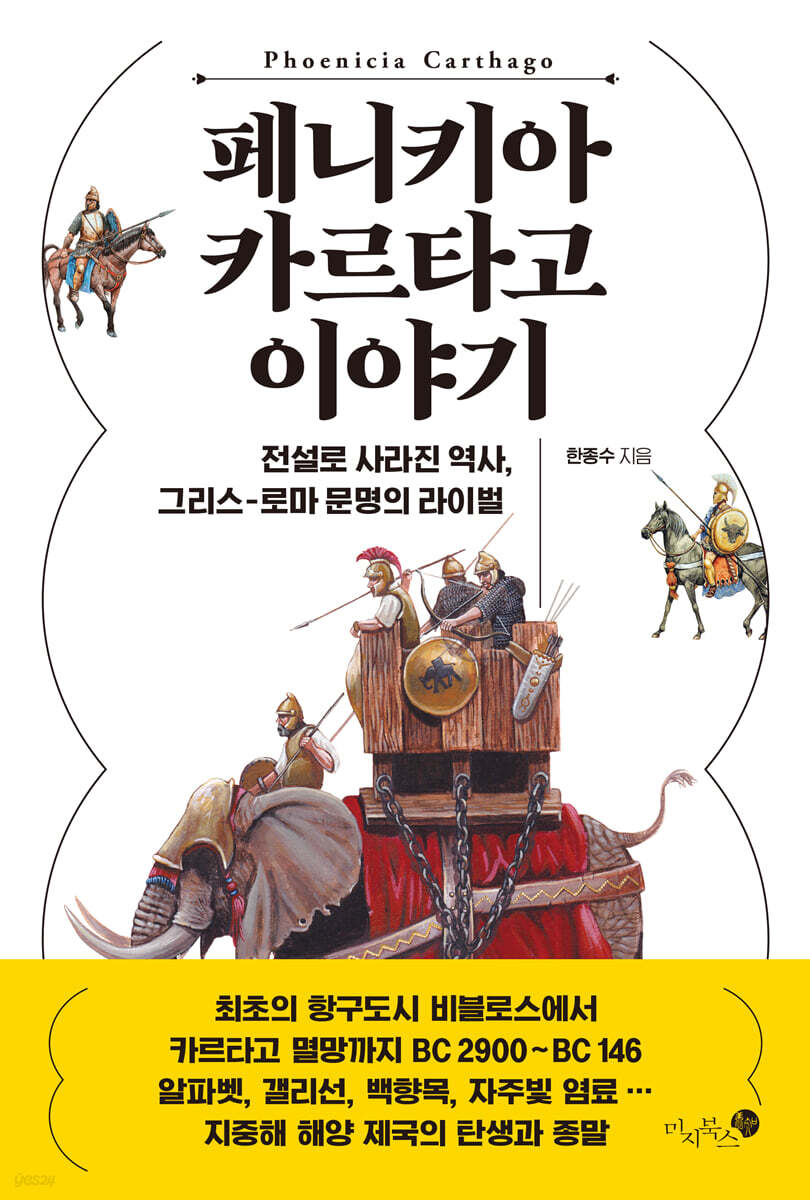
The Story of Phoenicia and Carthage
 |
Description
Book Introduction
- A word from MD
- [Phoenicia, the lost power of the ancient Mediterranean] The first comprehensive history to introduce the history of Phoenicia-Carthage in Korea.
It sheds new light on Phoenicia, which was previously considered a supporting role in Greco-Roman civilization.
The Phoenician civilization, a lost great people who built the world's first port city and navy and were the ancestors of Carthage, invites readers into the ancient Mediterranean world.
- Ahn Hyeon-jae, History PD
A people of seafaring and commerce who dominated the ancient Mediterranean
3,000 Years of Phoenician-Carthaginian History
Inventors of the alphabet and the galley,
Why were they erased from history?
A comprehensive history that introduces the history of Phoenicia-Carthage for the first time in Korea.
This book restores the lost civilization of the Phoenicians, who were once considered a supporting role in Greco-Roman civilization, and takes readers into the heart of the exciting ancient Mediterranean world.
Beginning with the archaeological site of Byblos, the world's first port city, and continuing through the tragic fall of Carthage, three thousand years of history unfold in vivid detail.
The first half of the book is about the Phoenicians.
The story follows the Phoenicians, inventors of the alphabet and the galley, as they built a maritime empire using cedar wood and purple dye, interacting with the great empires of the Asian continent, and competing with the newly emerging power of the Greeks.
The second half of the book is the history of the Carthaginians, descendants of the Phoenicians.
Carthage, which established its base in present-day Tunisia in North Africa, dominated the trade network and hegemony of the Western Mediterranean, but was reduced to ashes after fierce struggles with Rome, including three Punic Wars.
This book invites readers into a new world of ancient history by restoring the story of the Phoenicians-Carthaginians, a major part of the ancient Mediterranean world, a shining half that had been hidden from the Greco-Roman civilization.
3,000 Years of Phoenician-Carthaginian History
Inventors of the alphabet and the galley,
Why were they erased from history?
A comprehensive history that introduces the history of Phoenicia-Carthage for the first time in Korea.
This book restores the lost civilization of the Phoenicians, who were once considered a supporting role in Greco-Roman civilization, and takes readers into the heart of the exciting ancient Mediterranean world.
Beginning with the archaeological site of Byblos, the world's first port city, and continuing through the tragic fall of Carthage, three thousand years of history unfold in vivid detail.
The first half of the book is about the Phoenicians.
The story follows the Phoenicians, inventors of the alphabet and the galley, as they built a maritime empire using cedar wood and purple dye, interacting with the great empires of the Asian continent, and competing with the newly emerging power of the Greeks.
The second half of the book is the history of the Carthaginians, descendants of the Phoenicians.
Carthage, which established its base in present-day Tunisia in North Africa, dominated the trade network and hegemony of the Western Mediterranean, but was reduced to ashes after fierce struggles with Rome, including three Punic Wars.
This book invites readers into a new world of ancient history by restoring the story of the Phoenicians-Carthaginians, a major part of the ancient Mediterranean world, a shining half that had been hidden from the Greco-Roman civilization.
- You can preview some of the book's contents.
Preview
index
preface
Chapter 1: The Birth and Development of Phoenicia
Phoenicia Reappears on the Stage of History | Byblos, the World's Oldest City
Phoenician Cedar | The Rise of Tyre, Purple Dye, and Bitumen
The Ancient Orient and the Upheaval of Phoenicia | Ugarit, the International Commercial City
The upheaval of the Iron Age
Chapter 2 The Golden Age of Phoenicia
Sidon, the eldest son of Phoenicia | The Phoenician alphabet | The honeymoon between Tyre and the Kingdom of Israel
The Age of Exploration and the Construction of Trade Hubs | Another Phoenician Masterpiece
The rise of Tyre's hegemony and prosperity | Phoenicia's diverse industries | The Pillars of Melqart
Reasons for Phoenicia's Success
Chapter 3: Phoenicia Between Empires
Phoenicia in the era of the superpower Assyria | Phoenicia in the Neo-Babylonian era
Revival under Persian hegemony
Chapter 4: The War with the Greeks and the Decline of Phoenicia Mainland
Rivals of the Sea | Did the Persian Wars Begin in Phoenicia?
The Ionian Revolt and the Phoenicians | The Rise of Athens
Athens's Naval Expansion and the Phoenician Expedition | The Disaster of Artemision
The Eve of the Battle of Salamis | Defeat and Aftermath | The Continuing Wars Between Phoenicia and Greece
The Siege of Tyre | The Fall of Tyre and the Rise of Carthage
Miscellaneous facts about the Phoenicians
Chapter 5: The Birth and Development of Carthage
The Founding Myth of Carthage | The Truth Behind the Legend of Elisha | The Location of Carthage
The Rise of Carthage | The Formation of the Carthaginian 'Empire' | The Struggle with the Greeks
The struggle among Mediterranean peoples over Sicily | Malchus's coup
The Mago dynasty's conquest of the Western Mediterranean | Treaty with Rome
The eve of the Persian War | The First Sicilian War | The End of the Alliance | Carthage, the Agricultural Powerhouse
Hanno's Exploration | Himilco's Voyage | Carthage's Expansion into the Sahara
Second Sicilian War | Third Sicilian War | The Mutual Influence of Carthage and Greece
The Truce and the Carthaginian Republic | The Fourth and Fifth Sicilian Wars and the Death of Dionysius
Twenty Years of Peace and the Rise of Timoleon | The Sixth Sicilian War | Carthage's Second Defeat
Seventh Sicilian War | Wars in Sicily and Italy | Pyrrhic Wars
Carthage's Final Siege of Syracuse | The Carthaginian-Roman Alliance and the Fall of Pyrrhus
Chapter 6: The Eve of the First Punic War
Comparison of Political Systems | Comparison of Military Power | Carthage's Economic Power
Chapter 7: The First Punic War
An Unexpected Beginning | The Battle of Akragas | The Birth of the Roman Navy | The Battle of Mylae
The Widening Battlefield | The Battle of Ecnomus and the Roman Invasion of Africa
The Battle of Bagradas and the Great Flood | Two Powers Sink into a Swamp
The Destruction of the Elephant Corps | The Siege of Lilybaeum | The Battle of Drepanum
Carthage's Negligence and the Rise of Hamilcar | Hamilcar Barca, the Hero of Carthage
The Fiscal Policies of Two Nations That Determined Victory and Defeat in the War | The Revival and Innovation of the Roman Fleet
The Reemergence of the Roman and Carthaginian Fleets | The Battle of Aegates and the Peace Treaty
General Review of the First Punic War
Chapter 8: Interlude Between Two Wars
Mercenary Wars and Hamilcar's War of Intent | Spain's Barca Family
The Treaty with Rome and the Rise of Hannibal | Hannibal's Debut
Chapter 9: The Second Punic War
Saguntum and the Beginning of War | Preparations for the Great Expedition | The Beginning of the Legendary Great Expedition
Crossing the Alps | The Gauls of Northern Italy | Battle of Ticinus | Battle of Trebia
Crossing the Arno Marsh | Battle of Trasimeno | Macedon's Approach
The Rise of Fabius the Slug | The Battle of Cannae | Hannibal's Dilemma
The Romans, united around the Senate | Hannibal, the "ruler" of southern Italy
Syracuse and Sardinia join the anti-Roman coalition.
Hannibal and Philip V's Alliance | Hannibal in Campania | The Fall of Syracuse
The Fall of Tarentum | Hannibal vs. Rome | Hannibal's Power Remains
Hannibal at the Gate | Hannibal Lost His Light | The Brave Battle of Hannibal and Marcellus
The Outrageous Warrior of Marcellus | Barca vs. Scipio | The Rise of Scipio
Fall of Cartagena | Battle of Baicula | Battle of Metaurus | Battle of Ilipa
The Too Young Consul | Scipio's Landing in Africa | The Loss of Numidia
Hannibal Leaves Italy! | Battle of Zama
Chapter 10: The Final Prosperity
Supet Hannibal | Hannibal's Exile | The Great Defeat of Syria
Hannibal's Second Exile | Scipio's Trial and Death
The End of Hannibal | Carthage Must Fall!
Chapter 11: The Disappearance of the Punic Sea
Background of the Third Punic War | The Beginning of the Last War
The Carthaginians Embark on a Desperate Fight | The Structure and Defense of Carthage
The Carthaginian Victory | The Deaths of Masinissa and Cato | The Rise of Soscipio
Carthage in a Corner | Carthage Turned into a Living Hell
The Last Bastion: Birsa Hill | Behind the Scenes
Conclusion
Phoenician-Carthaginian chronology
References
Search
Chapter 1: The Birth and Development of Phoenicia
Phoenicia Reappears on the Stage of History | Byblos, the World's Oldest City
Phoenician Cedar | The Rise of Tyre, Purple Dye, and Bitumen
The Ancient Orient and the Upheaval of Phoenicia | Ugarit, the International Commercial City
The upheaval of the Iron Age
Chapter 2 The Golden Age of Phoenicia
Sidon, the eldest son of Phoenicia | The Phoenician alphabet | The honeymoon between Tyre and the Kingdom of Israel
The Age of Exploration and the Construction of Trade Hubs | Another Phoenician Masterpiece
The rise of Tyre's hegemony and prosperity | Phoenicia's diverse industries | The Pillars of Melqart
Reasons for Phoenicia's Success
Chapter 3: Phoenicia Between Empires
Phoenicia in the era of the superpower Assyria | Phoenicia in the Neo-Babylonian era
Revival under Persian hegemony
Chapter 4: The War with the Greeks and the Decline of Phoenicia Mainland
Rivals of the Sea | Did the Persian Wars Begin in Phoenicia?
The Ionian Revolt and the Phoenicians | The Rise of Athens
Athens's Naval Expansion and the Phoenician Expedition | The Disaster of Artemision
The Eve of the Battle of Salamis | Defeat and Aftermath | The Continuing Wars Between Phoenicia and Greece
The Siege of Tyre | The Fall of Tyre and the Rise of Carthage
Miscellaneous facts about the Phoenicians
Chapter 5: The Birth and Development of Carthage
The Founding Myth of Carthage | The Truth Behind the Legend of Elisha | The Location of Carthage
The Rise of Carthage | The Formation of the Carthaginian 'Empire' | The Struggle with the Greeks
The struggle among Mediterranean peoples over Sicily | Malchus's coup
The Mago dynasty's conquest of the Western Mediterranean | Treaty with Rome
The eve of the Persian War | The First Sicilian War | The End of the Alliance | Carthage, the Agricultural Powerhouse
Hanno's Exploration | Himilco's Voyage | Carthage's Expansion into the Sahara
Second Sicilian War | Third Sicilian War | The Mutual Influence of Carthage and Greece
The Truce and the Carthaginian Republic | The Fourth and Fifth Sicilian Wars and the Death of Dionysius
Twenty Years of Peace and the Rise of Timoleon | The Sixth Sicilian War | Carthage's Second Defeat
Seventh Sicilian War | Wars in Sicily and Italy | Pyrrhic Wars
Carthage's Final Siege of Syracuse | The Carthaginian-Roman Alliance and the Fall of Pyrrhus
Chapter 6: The Eve of the First Punic War
Comparison of Political Systems | Comparison of Military Power | Carthage's Economic Power
Chapter 7: The First Punic War
An Unexpected Beginning | The Battle of Akragas | The Birth of the Roman Navy | The Battle of Mylae
The Widening Battlefield | The Battle of Ecnomus and the Roman Invasion of Africa
The Battle of Bagradas and the Great Flood | Two Powers Sink into a Swamp
The Destruction of the Elephant Corps | The Siege of Lilybaeum | The Battle of Drepanum
Carthage's Negligence and the Rise of Hamilcar | Hamilcar Barca, the Hero of Carthage
The Fiscal Policies of Two Nations That Determined Victory and Defeat in the War | The Revival and Innovation of the Roman Fleet
The Reemergence of the Roman and Carthaginian Fleets | The Battle of Aegates and the Peace Treaty
General Review of the First Punic War
Chapter 8: Interlude Between Two Wars
Mercenary Wars and Hamilcar's War of Intent | Spain's Barca Family
The Treaty with Rome and the Rise of Hannibal | Hannibal's Debut
Chapter 9: The Second Punic War
Saguntum and the Beginning of War | Preparations for the Great Expedition | The Beginning of the Legendary Great Expedition
Crossing the Alps | The Gauls of Northern Italy | Battle of Ticinus | Battle of Trebia
Crossing the Arno Marsh | Battle of Trasimeno | Macedon's Approach
The Rise of Fabius the Slug | The Battle of Cannae | Hannibal's Dilemma
The Romans, united around the Senate | Hannibal, the "ruler" of southern Italy
Syracuse and Sardinia join the anti-Roman coalition.
Hannibal and Philip V's Alliance | Hannibal in Campania | The Fall of Syracuse
The Fall of Tarentum | Hannibal vs. Rome | Hannibal's Power Remains
Hannibal at the Gate | Hannibal Lost His Light | The Brave Battle of Hannibal and Marcellus
The Outrageous Warrior of Marcellus | Barca vs. Scipio | The Rise of Scipio
Fall of Cartagena | Battle of Baicula | Battle of Metaurus | Battle of Ilipa
The Too Young Consul | Scipio's Landing in Africa | The Loss of Numidia
Hannibal Leaves Italy! | Battle of Zama
Chapter 10: The Final Prosperity
Supet Hannibal | Hannibal's Exile | The Great Defeat of Syria
Hannibal's Second Exile | Scipio's Trial and Death
The End of Hannibal | Carthage Must Fall!
Chapter 11: The Disappearance of the Punic Sea
Background of the Third Punic War | The Beginning of the Last War
The Carthaginians Embark on a Desperate Fight | The Structure and Defense of Carthage
The Carthaginian Victory | The Deaths of Masinissa and Cato | The Rise of Soscipio
Carthage in a Corner | Carthage Turned into a Living Hell
The Last Bastion: Birsa Hill | Behind the Scenes
Conclusion
Phoenician-Carthaginian chronology
References
Search
Into the book
For 2,000 years, cedar was the finest wood in the Mediterranean world, used to build the finest buildings, including palaces and temples, throughout the Mediterranean and Oriental world.
As is well known, the Mesopotamian and Egyptian civilizations were able to grow thanks to the alluvial soil created by the Tigris, Euphrates, and Nile rivers.
However, the alluvial soil, which was very good for farming, was not the soil where good trees could grow.
That is why both civilized worlds were so envious of the cedar forests, and the Mesopotamians in particular called the forests the 'house of the gods'.
--- p.25
The Phoenician golden age began not simply because of the decline of Egypt, cedar wood, and purple dye.
The Mediterranean's main commodities, salt, wine, and olives, are greatly influenced by climate and soil.
So trade naturally took place, with the Phoenicians acting as a link.
--- p.39
By carefully studying the wind and currents, the Phoenicians succeeded in developing a safe route from the mainland to the west: Cyprus-Greece-Italy-Sardinia-Balearic Islands-Spain, and a safe route along the North African coast when returning home.
Perhaps that is why Pliny the Great, famous for his Natural History, left behind the famous saying, “The Egyptians created dynasties, the Greeks created democracy, and the Phoenicians created commerce.”
--- p.51
The Mediterranean city-states, beginning with Byblos and ending with the fall of Venice, were eventually overwhelmed by the great empires that arose in Europe and Asia, but they were by no means fleeting.
These city-states, which lasted from a few hundred years to over a thousand years, left us with an enormous legacy.
Above all, in an era when conquest, force, and religion were the highest values, people pursued wealth through trade, and the fact that they ventured out to the sea rather than land to pioneer new worlds became one of the major trends in human history.
--- p.61~62
As the Phoenicians struggled to survive between great empires like Assyria and Babylonia, they also encountered a formidable opponent at sea: the Greeks.
Unlike the Phoenicians, who had been active throughout ancient times, they disappeared for several centuries after the fall of Mycenae and then reappeared, fighting with Phoenicia for commercial and maritime supremacy throughout the Mediterranean, and after the decline of the Phoenician mainland, they became their opponents with Carthage.
--- p.75
Although Alexander the Great had a brilliant military record, the Siege of Tyre, which was his most difficult battle, began in January 332 BC.
From Tyre's perspective, it was like dealing with the third great power after Sennacherib of Assyria and Nebuchadnezzar II of Neo-Babylonia.
--- p.107
Princess Elisa, wandering west, arrived in what is now Tunisia, where she requested asylum and a base.
It was a midpoint in Tyre's Mediterranean trade network.
The mischievous chieftain Iarbas offered Elisha only enough land to cover with the skin of an ox.
So the clever princess cut the ox hide into thin threads and wrapped it around a hill.
This hill became the origin of Carthage, one of the greatest cities in the ancient Mediterranean world, and its name was given to it by the Greek word Byrsa, meaning 'leather'.
--- p.128
Carthage treated its military commanders harshly.
If you win too many victories, you may be accused of having ambitions to become a dictator and face trial in court.
Conversely, if he suffered a major defeat, he would likely be crucified.
So sometimes we lose experienced leaders at crucial times.
Ultimately, this bad habit proved to be a fatal weakness in the fateful battle with Rome.
--- p.145
Now the Alps, a gigantic enemy, appeared before Hannibal's army.
In the late 18th century, when Napoleon attempted to cross the Alps, those around him said it was impossible, to which Napoleon replied, “There is no such thing as impossible in my dictionary,” and eventually crossed the Alps. This is a very famous anecdote.
But 2,000 years before that, leading a large army across the Alps in winter was an impossible feat for ordinary people.
However, the young but cool-headed Hannibal thought it was possible, and preparations proceeded steadily.
As is well known, the Mesopotamian and Egyptian civilizations were able to grow thanks to the alluvial soil created by the Tigris, Euphrates, and Nile rivers.
However, the alluvial soil, which was very good for farming, was not the soil where good trees could grow.
That is why both civilized worlds were so envious of the cedar forests, and the Mesopotamians in particular called the forests the 'house of the gods'.
--- p.25
The Phoenician golden age began not simply because of the decline of Egypt, cedar wood, and purple dye.
The Mediterranean's main commodities, salt, wine, and olives, are greatly influenced by climate and soil.
So trade naturally took place, with the Phoenicians acting as a link.
--- p.39
By carefully studying the wind and currents, the Phoenicians succeeded in developing a safe route from the mainland to the west: Cyprus-Greece-Italy-Sardinia-Balearic Islands-Spain, and a safe route along the North African coast when returning home.
Perhaps that is why Pliny the Great, famous for his Natural History, left behind the famous saying, “The Egyptians created dynasties, the Greeks created democracy, and the Phoenicians created commerce.”
--- p.51
The Mediterranean city-states, beginning with Byblos and ending with the fall of Venice, were eventually overwhelmed by the great empires that arose in Europe and Asia, but they were by no means fleeting.
These city-states, which lasted from a few hundred years to over a thousand years, left us with an enormous legacy.
Above all, in an era when conquest, force, and religion were the highest values, people pursued wealth through trade, and the fact that they ventured out to the sea rather than land to pioneer new worlds became one of the major trends in human history.
--- p.61~62
As the Phoenicians struggled to survive between great empires like Assyria and Babylonia, they also encountered a formidable opponent at sea: the Greeks.
Unlike the Phoenicians, who had been active throughout ancient times, they disappeared for several centuries after the fall of Mycenae and then reappeared, fighting with Phoenicia for commercial and maritime supremacy throughout the Mediterranean, and after the decline of the Phoenician mainland, they became their opponents with Carthage.
--- p.75
Although Alexander the Great had a brilliant military record, the Siege of Tyre, which was his most difficult battle, began in January 332 BC.
From Tyre's perspective, it was like dealing with the third great power after Sennacherib of Assyria and Nebuchadnezzar II of Neo-Babylonia.
--- p.107
Princess Elisa, wandering west, arrived in what is now Tunisia, where she requested asylum and a base.
It was a midpoint in Tyre's Mediterranean trade network.
The mischievous chieftain Iarbas offered Elisha only enough land to cover with the skin of an ox.
So the clever princess cut the ox hide into thin threads and wrapped it around a hill.
This hill became the origin of Carthage, one of the greatest cities in the ancient Mediterranean world, and its name was given to it by the Greek word Byrsa, meaning 'leather'.
--- p.128
Carthage treated its military commanders harshly.
If you win too many victories, you may be accused of having ambitions to become a dictator and face trial in court.
Conversely, if he suffered a major defeat, he would likely be crucified.
So sometimes we lose experienced leaders at crucial times.
Ultimately, this bad habit proved to be a fatal weakness in the fateful battle with Rome.
--- p.145
Now the Alps, a gigantic enemy, appeared before Hannibal's army.
In the late 18th century, when Napoleon attempted to cross the Alps, those around him said it was impossible, to which Napoleon replied, “There is no such thing as impossible in my dictionary,” and eventually crossed the Alps. This is a very famous anecdote.
But 2,000 years before that, leading a large army across the Alps in winter was an impossible feat for ordinary people.
However, the young but cool-headed Hannibal thought it was possible, and preparations proceeded steadily.
--- p.280~281
Publisher's Review
When people think of the ancient Mediterranean, what comes to mind? Egyptian civilization, symbolized by the pyramids; Greek mythology and the Iliad and the Odyssey; the great wars between the Greek poleis, led by Athens, and the Persian Empire; and Rome, the ultimate power that transformed the Mediterranean into its own lake.
But there was one people who were just as active and dominated the Greeks and Romans for centuries: the Phoenicians.
The Phoenicians were the ones who built the world's first port cities and navy, and long before the Greeks established colonies in the Mediterranean, it was the Carthaginians, descendants of the Phoenicians, who established many colonies in Spain, Sicily, and elsewhere.
They dominated the commerce and seas of the ancient Mediterranean, but were eventually defeated by the Greco-Roman world and disappeared into the pages of history.
Because of the irony that they were the inventors of the alphabet but left behind very few records of their own, we can only encounter them as supporting characters in Western ancient history.
In this book, readers will be able to vividly encounter the overall history of the Phoenician-Carthaginian civilization, which was a rival to the Greco-Roman civilization politically and economically and the greatest enemy of Israel religiously.
Cedar and purple dye that gave rise to Phoenician civilization
The ancient Phoenicians lived in several cities along what is now the Syria-Lebanon coast and northern Israel.
Although they never achieved political unification, the Phoenician port cities of Sidon, Tyre, Byblos, Aradus, and Berytus enjoyed a golden age from 1200 to 800 BC.
The Greeks, who were rivals of the Phoenicians, also failed to achieve political unity, but they once united their forces to fight against the great Persian Empire.
The Phoenicians, on the other hand, were subject to the great empires of the Asian continent (Assyria, Neo-Babylonia, Persia, and the empire of Alexander the Great).
In the ancient Mediterranean world dominated by the Greco-Romans, the Phoenicians were denigrated as a commercial people, the infamous "economic animals," while the Greeks and Romans were regarded as honorable warrior peoples.
Archaeologists date human habitation in Byblos, the world's oldest port city, back to 8800 BC.
A stone city believed to have been built around 2900 BC was also excavated.
The Byblos ruins included watchtowers, roads, drainage systems, and walls up to 25 meters thick.
But Byblos was just a trailer.
Afterwards, Phoenicia enjoyed great prosperity through Mediterranean maritime trade, with the two cities of Sidon and Tyre at the forefront.
Phoenicia's main export was cedar (Lebanon cedar), which was the finest wood in the Mediterranean for 2,000 years.
Phoenicia exported cedar and imported papyrus in trade with its main customer, Egypt, from which the name Byblos is derived (the word Bible also has the same root).
What brought Phoenicia great wealth along with the cedar was the purple dye extracted from sea snails.
This dye, which was a very deep purple, was an incredibly expensive luxury item, and the Greeks called it phonix, from which the names Phoenicia and Poeni also derive.
These two trade goods, cedar wood and purple dye, literally gave birth to the Phoenician civilization.
The invention of the alphabet sparked by maritime trade
The Phoenicians, who engaged in maritime trade, had no choice but to come into contact with the languages of many different peoples.
However, the existing cuneiform script of Mesopotamia or Egyptian hieroglyphs were too cumbersome to write, making it difficult to write ledgers or documents.
Naturally, the need for characters that can be written easily and quickly increased.
Eventually, in the mid-11th century BC, the Phoenicians refined the Ugaritic script to create the Phoenician writing system, consisting of 22 letters and written from left to right.
Because this was a groundbreaking invention, it spread throughout most Mediterranean cultures, including Greece.
Even the Israelites, who were religiously diametrically opposed to it, accepted it and created the Hebrew alphabet.
In particular, Tyre under Hiram I in the 10th century BC also had close economic cooperation with Israel under the famous King Solomon.
For example, the temple in Israel was built by Phoenician craftsmen using Phoenician cedar and materials.
In return, Solomon sent large quantities of wheat and fine olive oil to Tyre.
Israel provided inland trade routes and military stability, while Phoenicia provided ships, commerce, and technological know-how.
It was a collaboration between powerful religious rivals in the ancient world (the infamous 'Baal' of the Bible was the supreme god of Phoenicia).
The names of Carthaginian men, such as Hannibal [Baal's grace] and Hasdrubal [Baal's help], also come from here.
But in the big picture, the Phoenicians created the alphabet, but ironically, they failed to leave their records for posterity.
Thus, the Greco-Roman world, which formed the two major axes of Western culture, and the Hebraic world, which formed the basis of monotheism, regarded the Punic world, their powerful rival, as their mortal enemy and distorted and completely erased their history.
Active colonial construction and the birth of the galley
The Greeks established colonial cities throughout the Mediterranean.
Naples, Istanbul, Marseille, Taranto, and Syracuse are some of the cities founded by the Greeks that still exist today.
However, the Greeks' activities in the Mediterranean world lasted only half of its history.
The Phoenicians established overseas colonies before the Greeks.
The cities they founded, such as Cadiz, Cartagena, Barcelona, Malaga, Lisbon, and Tangier in Spain, Tripoli in Libya, Cagliari in Sardinia, and Palermo in Sicily, still stand today.
The fact that most of the cities built by the Phoenicians were in the Western Mediterranean and the Atlantic coast, while most of the cities built by the Greeks were in the Eastern Mediterranean and the Black Sea, shows how advanced their navigation skills were.
The original name for the present-day Strait of Gibraltar, which the Greeks called the 'Pillars of Hercules', was the 'Pillars of Melqart' by the Phoenicians (Melkart was a Phoenician god).
The Phoenicians, who possessed the best shipbuilding material, cedar, were also natural engineers.
The Phoenicians built a ship suitable for ocean voyages by making a hull frame with a keel that corresponds to the spine in humans and beams and frames that correspond to the ribs.
As early as the 9th century BC, byrem-style galleys with double-deck oars were built and equipped with rams on the bows for use in battle.
It was the birth of the galley ship that dominated the ancient Mediterranean.
Galleys became larger and larger, and later Carthage even had five-regiment galleys.
With these cutting-edge ships, the Phoenicians virtually turned the Mediterranean into a 'Phoenician sea'.
Why did the Phoenicians continue to advance westward? They sought metal.
Spain, in particular, was a treasure trove of metals, with famous silver mines in the Tinto River basin.
Pliny the Elder, famous for his Natural History, once said, “The Egyptians created dynasties, the Greeks created democracy, and the Phoenicians created commerce.”
The Fall of Phoenicia Mainland and the Rise of Carthage
As great empires such as Assyria, Neo-Babylonia, and Persia emerged in the Orient, Phoenicia's history was one of repeated resistance and subjugation.
Under the generous rule of the Persian Empire, Phoenicia regained some autonomy and enjoyed prosperity, but with the emergence of a powerful rival, Greece, it gradually lost its maritime hegemony.
Phoenicia participated in the two Greco-Persian Wars as a naval force, but was defeated, and Tyre was conquered and destroyed by Alexander the Great, who later destroyed Persia and united the Orient (332 BC).
With the fall of the Phoenician mainland, the new queen of the Mediterranean was Carthage, founded by the inhabitants of Tyre.
The founding of Carthage is believed to have occurred in 814 BC, about half a century before the founding of Rome in 753.
Carthage was founded in Tunisia, North Africa, at the midpoint of the Phoenician trade network.
What made Carthage different from the Phoenician mainland was its military character.
The Carthaginians grew into an empire through continuous struggles with the Greeks over the Mediterranean, and by the 3rd century BC they had a near-monopolized trade in the western Mediterranean.
Of particular geopolitical importance was Sicily, the largest island in the Mediterranean and a must-have for any nation seeking Mediterranean hegemony.
Carthage and the Panhellenic powers (primarily Syracuse) fought seven wars over the island of Sicily.
Meanwhile, Rome, which would become Carthage's greatest rival, was growing rapidly in Italy.
The First Punic War and the Loss of Control of the Mediterranean
The conflict between Carthage and Rome over Mediterranean hegemony was inevitable.
Although Carthage was nominally a republic, the commercial aristocracy held the power of the state.
And military commanders had weak political power and were subject to harsh punishments, including death, when they lost a war.
Unlike Rome, which had a national conscription system, Carthage, which had no plebeian force, relied on foreign mercenaries for its military.
In short, Carthage was a country with a strong economy but many problems with its military.
Carthage's relationship with its overseas colonies was one of unilateral domination and subordination, while Rome gave its allies a share in Roman affairs.
For this reason, Rome had a considerable army at its disposal, numbering 500,000 men by the end of the 4th century BC.
Considering that Alexander mobilized 50,000 troops for his eastern expedition and that Persia mobilized 200,000 troops when it invaded Greece, Rome's mobilization capacity was enormous.
Thanks to this immense mobilization power, Rome became a country that lost battles but never lost wars.
The First Punic War began when Carthage responded to Rome's entry into Sicily, the unsinkable aircraft carrier of the Mediterranean.
The war was destined to continue until one of the two powers gained complete control of Sicily.
The winner would become ruler of the Western Mediterranean.
Rome, a traditional land power, built a new navy.
At that time, naval battles were decided by the clash of ships, which gave Carthage, a maritime people, a traditional advantage.
Then, Rome tried to make up for its disadvantage by equipping its ships with a pontoon bridge called a crow (so named because the horn at the end of the pontoon bridge resembled a crow's beak).
Crows were a powerful force on the battlefield and brought great victories to the Roman navy.
However, because the ship weighed up to 1 ton, the bow became excessively heavy, which adversely affected navigation and caused large-scale maritime accidents when it encountered storms.
Rome, having lost numerous men and ships in several serious maritime disasters, even gave up its navy altogether, but Carthage failed to capitalize on this opportunity and recklessly squandered it.
At that time, public opinion in Carthage was divided between those who wanted to advance inland and those who wanted to advance overseas.
Carthage, defeated by Rome, which eventually rebuilt its fleet, was forced to give up Sicily and even lost the islands of Sardinia and Corsica to Rome (241 BC).
Hannibal wages war on Roman soil
After the First Punic War, the capable Carthaginian general Hamilcar (Hannibal's father) conquered southern Spain.
His son-in-law Hasdrubal further consolidated his father-in-law's power, making Spain a virtual kingdom of the Barca family.
The Second Punic War broke out after Hannibal Barca succeeded his brother-in-law Hasdrubal as ruler.
The basic strategy of Hannibal, the greatest general in history since Alexander the Great, was to make Italy a battlefield and, through this, to collapse the Roman Union.
Since Carthage had already lost control of the seas during the First War, Hannibal advanced north by land from Spain into Italy.
During this process, the legend of Hannibal leading an army of elephants across the Alps was created.
The Romans, shocked by the invasion of their mainland, quickly sent a large army, but suffered a crushing defeat at the Battle of Trebia, the Battle of Trasimeno, and the Battle of Cannae, with tens of thousands of casualties.
Hannibal did not attack Rome directly, but moved south in order to separate southern Italy, which had only recently been under Roman rule, from Rome.
In southern Italy, he formed his own forces, calling himself a liberator.
Rome, led by Quintus Fabius, adopted a strategy of fighting Hannibal, who was superior in the field, through a war of attrition rather than a direct confrontation.
Hannibal's strategy was to fight on the Italian mainland, dismantle Rome's alliances, receive reinforcements and supplies from home, and then besiege and attack Rome.
However, his plans were shattered when Rome reconquered Sicily.
While Hannibal was holding out superhumanly in the heart of Italy without any help from his homeland, the Roman general Publius Cornelius Scipio went to Spain and destroyed the Barca family's base.
He rode the momentum of his victory to invade Carthage proper, drawing Hannibal from Italy to Africa, and finally winning the Battle of Zama.
This ended the Second Punic War, ushering in an era of complete Roman supremacy in the Mediterranean and ending the possibility of an African-based Mediterranean empire (202 BC).
The greatest rival of Greco-Roman civilization that has faded into legend
Although Carthage completely lost its potential as a Mediterranean military power, it was reborn as an economic power even after its defeat.
But Rome did not leave Carthage alone.
The Third Punic War was all about the siege and besiege of one city, Carthage.
The Carthaginians resisted desperately for three years, but the Roman army led by Soscipio finally captured Carthage and mercilessly destroyed it (146 BC).
After the fall of Carthage, the wealthy Romans copied Carthage's plantation farming methods, which used slaves on a large scale and scientific farming methods to increase production, and reaped huge profits from the farms in North Africa that became their territory.
However, because of this, the independent farmers who formed the backbone of the Roman army lost out in competition with the large farms and suffered economic ruin.
It is an irony of history that this led to the collapse of the Roman Republic.
Meanwhile, the ruins of Carthage were rebuilt a century later by Caesar and Augustus as a city for their soldiers to reside in after their retirement.
It later flourished as one of the largest cities in the Roman Empire, boasting a population of over 200,000.
The Phoenician cities retained a significant sense of identity until the Byzantine period, but after the Arab conquest they were assimilated by waves of Arabs and disappeared.
It is right, but easy, to criticize the Carthaginian government for its incompetence and greed during its downfall.
However, it is worth remembering that the Hellenistic kingdoms of the East, as well as Macedonia, the Seleucid Empire, and Ptolemaic Egypt, the legacies of Alexander the Great, fell to Rome much more helplessly than Carthage.
They had virtually no field victories and were unable to gain any ground in the Roman civil war waged on a grand scale by Sulla and Marius.
No city resisted for three years like Carthage.
Carthage alone fought on equal terms with Rome for half a century during the war and even devastated mainland Italy.
Yet they were defeated and disappeared.
Phoenicia-Carthage left a proposition to later nations: which is more important for the survival of a nation: economic power or military power.
The Phoenicians-Carthaginians were the greatest enemies of the three civilizations that had the greatest influence on mankind, the Hebrew-Greek-Roman civilizations, but they also contributed greatly to them by leaving behind the alphabet, navigation, and trade networks. However, they were defeated and disappeared as a great nation.
But there was one people who were just as active and dominated the Greeks and Romans for centuries: the Phoenicians.
The Phoenicians were the ones who built the world's first port cities and navy, and long before the Greeks established colonies in the Mediterranean, it was the Carthaginians, descendants of the Phoenicians, who established many colonies in Spain, Sicily, and elsewhere.
They dominated the commerce and seas of the ancient Mediterranean, but were eventually defeated by the Greco-Roman world and disappeared into the pages of history.
Because of the irony that they were the inventors of the alphabet but left behind very few records of their own, we can only encounter them as supporting characters in Western ancient history.
In this book, readers will be able to vividly encounter the overall history of the Phoenician-Carthaginian civilization, which was a rival to the Greco-Roman civilization politically and economically and the greatest enemy of Israel religiously.
Cedar and purple dye that gave rise to Phoenician civilization
The ancient Phoenicians lived in several cities along what is now the Syria-Lebanon coast and northern Israel.
Although they never achieved political unification, the Phoenician port cities of Sidon, Tyre, Byblos, Aradus, and Berytus enjoyed a golden age from 1200 to 800 BC.
The Greeks, who were rivals of the Phoenicians, also failed to achieve political unity, but they once united their forces to fight against the great Persian Empire.
The Phoenicians, on the other hand, were subject to the great empires of the Asian continent (Assyria, Neo-Babylonia, Persia, and the empire of Alexander the Great).
In the ancient Mediterranean world dominated by the Greco-Romans, the Phoenicians were denigrated as a commercial people, the infamous "economic animals," while the Greeks and Romans were regarded as honorable warrior peoples.
Archaeologists date human habitation in Byblos, the world's oldest port city, back to 8800 BC.
A stone city believed to have been built around 2900 BC was also excavated.
The Byblos ruins included watchtowers, roads, drainage systems, and walls up to 25 meters thick.
But Byblos was just a trailer.
Afterwards, Phoenicia enjoyed great prosperity through Mediterranean maritime trade, with the two cities of Sidon and Tyre at the forefront.
Phoenicia's main export was cedar (Lebanon cedar), which was the finest wood in the Mediterranean for 2,000 years.
Phoenicia exported cedar and imported papyrus in trade with its main customer, Egypt, from which the name Byblos is derived (the word Bible also has the same root).
What brought Phoenicia great wealth along with the cedar was the purple dye extracted from sea snails.
This dye, which was a very deep purple, was an incredibly expensive luxury item, and the Greeks called it phonix, from which the names Phoenicia and Poeni also derive.
These two trade goods, cedar wood and purple dye, literally gave birth to the Phoenician civilization.
The invention of the alphabet sparked by maritime trade
The Phoenicians, who engaged in maritime trade, had no choice but to come into contact with the languages of many different peoples.
However, the existing cuneiform script of Mesopotamia or Egyptian hieroglyphs were too cumbersome to write, making it difficult to write ledgers or documents.
Naturally, the need for characters that can be written easily and quickly increased.
Eventually, in the mid-11th century BC, the Phoenicians refined the Ugaritic script to create the Phoenician writing system, consisting of 22 letters and written from left to right.
Because this was a groundbreaking invention, it spread throughout most Mediterranean cultures, including Greece.
Even the Israelites, who were religiously diametrically opposed to it, accepted it and created the Hebrew alphabet.
In particular, Tyre under Hiram I in the 10th century BC also had close economic cooperation with Israel under the famous King Solomon.
For example, the temple in Israel was built by Phoenician craftsmen using Phoenician cedar and materials.
In return, Solomon sent large quantities of wheat and fine olive oil to Tyre.
Israel provided inland trade routes and military stability, while Phoenicia provided ships, commerce, and technological know-how.
It was a collaboration between powerful religious rivals in the ancient world (the infamous 'Baal' of the Bible was the supreme god of Phoenicia).
The names of Carthaginian men, such as Hannibal [Baal's grace] and Hasdrubal [Baal's help], also come from here.
But in the big picture, the Phoenicians created the alphabet, but ironically, they failed to leave their records for posterity.
Thus, the Greco-Roman world, which formed the two major axes of Western culture, and the Hebraic world, which formed the basis of monotheism, regarded the Punic world, their powerful rival, as their mortal enemy and distorted and completely erased their history.
Active colonial construction and the birth of the galley
The Greeks established colonial cities throughout the Mediterranean.
Naples, Istanbul, Marseille, Taranto, and Syracuse are some of the cities founded by the Greeks that still exist today.
However, the Greeks' activities in the Mediterranean world lasted only half of its history.
The Phoenicians established overseas colonies before the Greeks.
The cities they founded, such as Cadiz, Cartagena, Barcelona, Malaga, Lisbon, and Tangier in Spain, Tripoli in Libya, Cagliari in Sardinia, and Palermo in Sicily, still stand today.
The fact that most of the cities built by the Phoenicians were in the Western Mediterranean and the Atlantic coast, while most of the cities built by the Greeks were in the Eastern Mediterranean and the Black Sea, shows how advanced their navigation skills were.
The original name for the present-day Strait of Gibraltar, which the Greeks called the 'Pillars of Hercules', was the 'Pillars of Melqart' by the Phoenicians (Melkart was a Phoenician god).
The Phoenicians, who possessed the best shipbuilding material, cedar, were also natural engineers.
The Phoenicians built a ship suitable for ocean voyages by making a hull frame with a keel that corresponds to the spine in humans and beams and frames that correspond to the ribs.
As early as the 9th century BC, byrem-style galleys with double-deck oars were built and equipped with rams on the bows for use in battle.
It was the birth of the galley ship that dominated the ancient Mediterranean.
Galleys became larger and larger, and later Carthage even had five-regiment galleys.
With these cutting-edge ships, the Phoenicians virtually turned the Mediterranean into a 'Phoenician sea'.
Why did the Phoenicians continue to advance westward? They sought metal.
Spain, in particular, was a treasure trove of metals, with famous silver mines in the Tinto River basin.
Pliny the Elder, famous for his Natural History, once said, “The Egyptians created dynasties, the Greeks created democracy, and the Phoenicians created commerce.”
The Fall of Phoenicia Mainland and the Rise of Carthage
As great empires such as Assyria, Neo-Babylonia, and Persia emerged in the Orient, Phoenicia's history was one of repeated resistance and subjugation.
Under the generous rule of the Persian Empire, Phoenicia regained some autonomy and enjoyed prosperity, but with the emergence of a powerful rival, Greece, it gradually lost its maritime hegemony.
Phoenicia participated in the two Greco-Persian Wars as a naval force, but was defeated, and Tyre was conquered and destroyed by Alexander the Great, who later destroyed Persia and united the Orient (332 BC).
With the fall of the Phoenician mainland, the new queen of the Mediterranean was Carthage, founded by the inhabitants of Tyre.
The founding of Carthage is believed to have occurred in 814 BC, about half a century before the founding of Rome in 753.
Carthage was founded in Tunisia, North Africa, at the midpoint of the Phoenician trade network.
What made Carthage different from the Phoenician mainland was its military character.
The Carthaginians grew into an empire through continuous struggles with the Greeks over the Mediterranean, and by the 3rd century BC they had a near-monopolized trade in the western Mediterranean.
Of particular geopolitical importance was Sicily, the largest island in the Mediterranean and a must-have for any nation seeking Mediterranean hegemony.
Carthage and the Panhellenic powers (primarily Syracuse) fought seven wars over the island of Sicily.
Meanwhile, Rome, which would become Carthage's greatest rival, was growing rapidly in Italy.
The First Punic War and the Loss of Control of the Mediterranean
The conflict between Carthage and Rome over Mediterranean hegemony was inevitable.
Although Carthage was nominally a republic, the commercial aristocracy held the power of the state.
And military commanders had weak political power and were subject to harsh punishments, including death, when they lost a war.
Unlike Rome, which had a national conscription system, Carthage, which had no plebeian force, relied on foreign mercenaries for its military.
In short, Carthage was a country with a strong economy but many problems with its military.
Carthage's relationship with its overseas colonies was one of unilateral domination and subordination, while Rome gave its allies a share in Roman affairs.
For this reason, Rome had a considerable army at its disposal, numbering 500,000 men by the end of the 4th century BC.
Considering that Alexander mobilized 50,000 troops for his eastern expedition and that Persia mobilized 200,000 troops when it invaded Greece, Rome's mobilization capacity was enormous.
Thanks to this immense mobilization power, Rome became a country that lost battles but never lost wars.
The First Punic War began when Carthage responded to Rome's entry into Sicily, the unsinkable aircraft carrier of the Mediterranean.
The war was destined to continue until one of the two powers gained complete control of Sicily.
The winner would become ruler of the Western Mediterranean.
Rome, a traditional land power, built a new navy.
At that time, naval battles were decided by the clash of ships, which gave Carthage, a maritime people, a traditional advantage.
Then, Rome tried to make up for its disadvantage by equipping its ships with a pontoon bridge called a crow (so named because the horn at the end of the pontoon bridge resembled a crow's beak).
Crows were a powerful force on the battlefield and brought great victories to the Roman navy.
However, because the ship weighed up to 1 ton, the bow became excessively heavy, which adversely affected navigation and caused large-scale maritime accidents when it encountered storms.
Rome, having lost numerous men and ships in several serious maritime disasters, even gave up its navy altogether, but Carthage failed to capitalize on this opportunity and recklessly squandered it.
At that time, public opinion in Carthage was divided between those who wanted to advance inland and those who wanted to advance overseas.
Carthage, defeated by Rome, which eventually rebuilt its fleet, was forced to give up Sicily and even lost the islands of Sardinia and Corsica to Rome (241 BC).
Hannibal wages war on Roman soil
After the First Punic War, the capable Carthaginian general Hamilcar (Hannibal's father) conquered southern Spain.
His son-in-law Hasdrubal further consolidated his father-in-law's power, making Spain a virtual kingdom of the Barca family.
The Second Punic War broke out after Hannibal Barca succeeded his brother-in-law Hasdrubal as ruler.
The basic strategy of Hannibal, the greatest general in history since Alexander the Great, was to make Italy a battlefield and, through this, to collapse the Roman Union.
Since Carthage had already lost control of the seas during the First War, Hannibal advanced north by land from Spain into Italy.
During this process, the legend of Hannibal leading an army of elephants across the Alps was created.
The Romans, shocked by the invasion of their mainland, quickly sent a large army, but suffered a crushing defeat at the Battle of Trebia, the Battle of Trasimeno, and the Battle of Cannae, with tens of thousands of casualties.
Hannibal did not attack Rome directly, but moved south in order to separate southern Italy, which had only recently been under Roman rule, from Rome.
In southern Italy, he formed his own forces, calling himself a liberator.
Rome, led by Quintus Fabius, adopted a strategy of fighting Hannibal, who was superior in the field, through a war of attrition rather than a direct confrontation.
Hannibal's strategy was to fight on the Italian mainland, dismantle Rome's alliances, receive reinforcements and supplies from home, and then besiege and attack Rome.
However, his plans were shattered when Rome reconquered Sicily.
While Hannibal was holding out superhumanly in the heart of Italy without any help from his homeland, the Roman general Publius Cornelius Scipio went to Spain and destroyed the Barca family's base.
He rode the momentum of his victory to invade Carthage proper, drawing Hannibal from Italy to Africa, and finally winning the Battle of Zama.
This ended the Second Punic War, ushering in an era of complete Roman supremacy in the Mediterranean and ending the possibility of an African-based Mediterranean empire (202 BC).
The greatest rival of Greco-Roman civilization that has faded into legend
Although Carthage completely lost its potential as a Mediterranean military power, it was reborn as an economic power even after its defeat.
But Rome did not leave Carthage alone.
The Third Punic War was all about the siege and besiege of one city, Carthage.
The Carthaginians resisted desperately for three years, but the Roman army led by Soscipio finally captured Carthage and mercilessly destroyed it (146 BC).
After the fall of Carthage, the wealthy Romans copied Carthage's plantation farming methods, which used slaves on a large scale and scientific farming methods to increase production, and reaped huge profits from the farms in North Africa that became their territory.
However, because of this, the independent farmers who formed the backbone of the Roman army lost out in competition with the large farms and suffered economic ruin.
It is an irony of history that this led to the collapse of the Roman Republic.
Meanwhile, the ruins of Carthage were rebuilt a century later by Caesar and Augustus as a city for their soldiers to reside in after their retirement.
It later flourished as one of the largest cities in the Roman Empire, boasting a population of over 200,000.
The Phoenician cities retained a significant sense of identity until the Byzantine period, but after the Arab conquest they were assimilated by waves of Arabs and disappeared.
It is right, but easy, to criticize the Carthaginian government for its incompetence and greed during its downfall.
However, it is worth remembering that the Hellenistic kingdoms of the East, as well as Macedonia, the Seleucid Empire, and Ptolemaic Egypt, the legacies of Alexander the Great, fell to Rome much more helplessly than Carthage.
They had virtually no field victories and were unable to gain any ground in the Roman civil war waged on a grand scale by Sulla and Marius.
No city resisted for three years like Carthage.
Carthage alone fought on equal terms with Rome for half a century during the war and even devastated mainland Italy.
Yet they were defeated and disappeared.
Phoenicia-Carthage left a proposition to later nations: which is more important for the survival of a nation: economic power or military power.
The Phoenicians-Carthaginians were the greatest enemies of the three civilizations that had the greatest influence on mankind, the Hebrew-Greek-Roman civilizations, but they also contributed greatly to them by leaving behind the alphabet, navigation, and trade networks. However, they were defeated and disappeared as a great nation.
GOODS SPECIFICS
- Date of issue: December 15, 2023
- Page count, weight, size: 452 pages | 678g | 152*224*28mm
- ISBN13: 9791190498586
- ISBN10: 1190498588
You may also like
카테고리
korean


korean

![GQ KOREA Mark (Monthly): December [2025]](http://librairie.coreenne.fr/cdn/shop/files/8ef265dbbfbf186523ed75ba7319009d.jpg?v=1765340328&width=3840)


