

A Dictionary of Mysterious Animals Hidden in Cultural Heritage
 |
Description
Book Introduction
Beautiful and wondrous tales of fantastical creatures hidden throughout our culture.
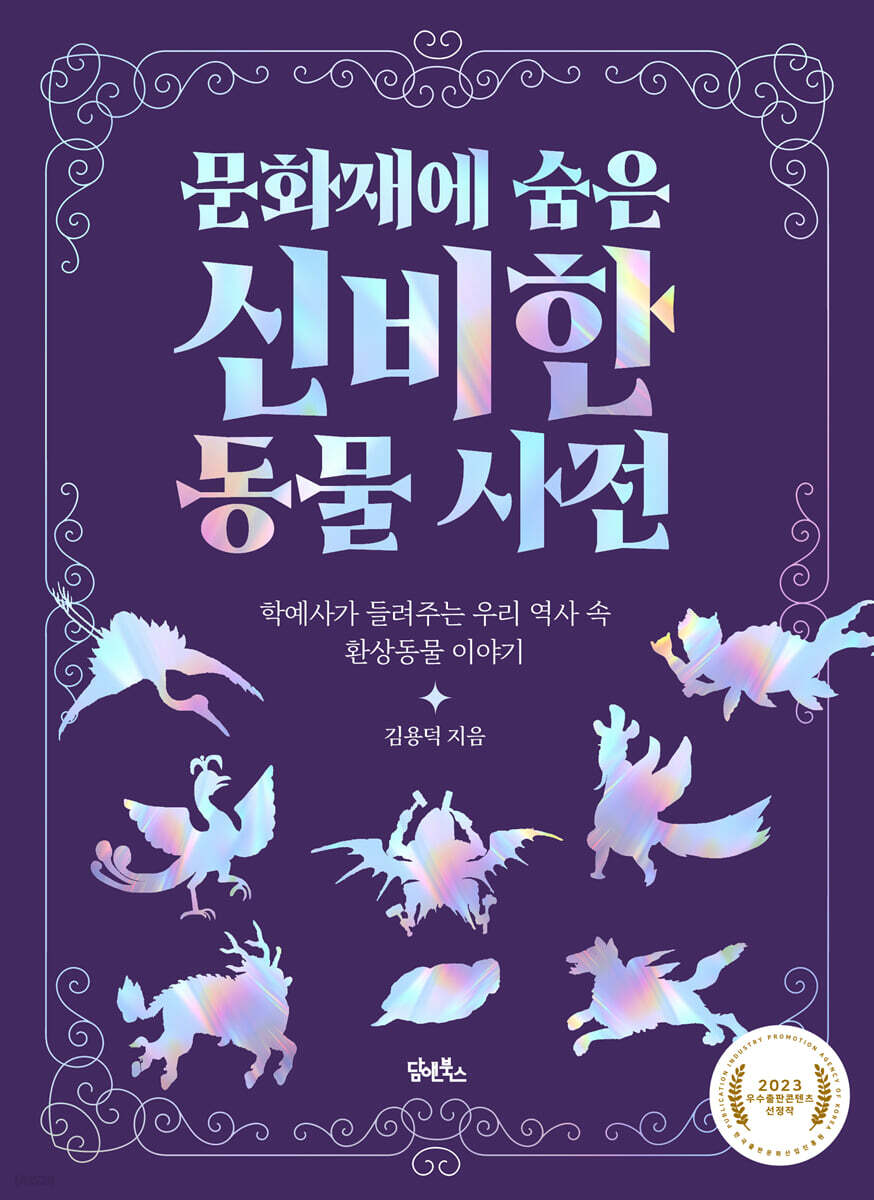
"The Dictionary of Mysterious Beasts Hidden in Cultural Heritage" is an exciting cultural guidebook and an Eastern version of the "Dictionary of Mysterious Beasts" that allows us to explore the creative imagination of our ancestors through the fantastic beasts that appear in our cultural heritage and old tales.
This book introduces imaginary animals that do not actually exist, such as the Garungbinga, Gongmyeongjo, Kirin, Noegongsin, Phoenix, Red Bird, Seonhak, Mermaid, Hwasangeo, and Cheonma.
A beautiful and wondrous story unfolds in an interesting way, based on the legends and images of various fantastical creatures that appear in various relics and ancient documents.
Additionally, it includes over 150 rich photographs to allow readers to freely let their imagination run wild.
As creative imagination emerges as the new buzzword of our time, our traditional cultural heritage already holds an infinite supply of creative ideas.
『Dictionary of Mysterious Animals Hidden in Cultural Heritage』 is written by a current curator who has worked at various museums. Under the motto that "art is a medium that represents history," it explains the stories of various fantastic animals found in our cultural heritage in an easy and fun way.
This will serve as a stepping stone to the discovery of cultural content that connects the past, present, and future.
"The Dictionary of Mysterious Beasts Hidden in Cultural Heritage" is an exciting cultural guidebook and an Eastern version of the "Dictionary of Mysterious Beasts" that allows us to explore the creative imagination of our ancestors through the fantastic beasts that appear in our cultural heritage and old tales.
This book introduces imaginary animals that do not actually exist, such as the Garungbinga, Gongmyeongjo, Kirin, Noegongsin, Phoenix, Red Bird, Seonhak, Mermaid, Hwasangeo, and Cheonma.
A beautiful and wondrous story unfolds in an interesting way, based on the legends and images of various fantastical creatures that appear in various relics and ancient documents.
Additionally, it includes over 150 rich photographs to allow readers to freely let their imagination run wild.
As creative imagination emerges as the new buzzword of our time, our traditional cultural heritage already holds an infinite supply of creative ideas.
『Dictionary of Mysterious Animals Hidden in Cultural Heritage』 is written by a current curator who has worked at various museums. Under the motto that "art is a medium that represents history," it explains the stories of various fantastic animals found in our cultural heritage in an easy and fun way.
This will serve as a stepping stone to the discovery of cultural content that connects the past, present, and future.
- You can preview some of the book's contents.
Preview
index
Recommendation
introduction
1.
Garungbinga and Gongmyeongjo - Singing the Buddha Land
2.
Kirin - a sacred animal symbolizing an era of peace
3.
Brain God - Crying the Heavens
4.
The Phoenix and the Vermilion Bird - Flying to Heaven
5.
Seonhak - The Friend of the Immortals
6 Mermaids - There are fantastic creatures in the water.
7.
Firefish - A mysterious fish nestling in the mountains
8.
Cheonma - a winged horse that runs through the sky
Source of the illustration
References
introduction
1.
Garungbinga and Gongmyeongjo - Singing the Buddha Land
2.
Kirin - a sacred animal symbolizing an era of peace
3.
Brain God - Crying the Heavens
4.
The Phoenix and the Vermilion Bird - Flying to Heaven
5.
Seonhak - The Friend of the Immortals
6 Mermaids - There are fantastic creatures in the water.
7.
Firefish - A mysterious fish nestling in the mountains
8.
Cheonma - a winged horse that runs through the sky
Source of the illustration
References
Detailed image
Into the book
The Garungbinga is basically a human-faced bird-body iconography.
This is reminiscent of winged angels in Catholicism or Cupid, the god of love in Roman mythology.
If the Garungbinga is the representative of the human-faced guardian deity in Eastern culture, then in the West, angels and Cupid are the icons.
--- p.12, from “The Human-faced Bird Appearing in Various Cultures”
Ancient people, regardless of East or West, considered meteorological phenomena such as thunder, lightning, rain, and wind to be the work of the gods and regarded them as objects of faith.
And that belief remains with us, appearing as the god of brain power in the East and as Zeus and Thor in the West.
--- p.77, from “The Western Brain Gods, Zeus and Thor”
The phoenix appears in Confucian literature as the leader of feathered birds and a mystical ordinal number that announces the arrival of a saint.
This concept has been passed down to this day and can be seen in the appearance of the phoenix.
This is because the emblem and national seal of the President, the head of the Republic of Korea, are also two phoenixes.
--- p.111, from “The Symbol of a Virtuous King, the Commander Phoenix”
Mermaids were also frequently mentioned by scholars of Silhak (practical learning) in the late Joseon Dynasty.
If the mermaids that appeared in existing poetry were objects of empathy and romance, they were literally objects of study for scholars of Silhak who pursued truth from facts.
Mermaids appear almost without exception in many books related to fish, including 『Jasaneobo (玆山魚譜)』, a representative work by Jeong Yak-jeon (丁若銓), a pioneer in fish biology research during the Joseon Dynasty, and 『Nanhoeomyeonggo (蘭湖魚名考)』 by Seo Yu-gu (徐有?).
--- p.170, from “The Mermaid Who Weaves Silk and Makes Pearls with Tears”
The most distinctive feature of the Hwasang-eo is the image of a human head and turtle body combined.
From the ancient Goguryeo tomb murals to the mermaids of the late Joseon Dynasty, we have seen countless half-human, half-beast creatures, but the image of a turtle and a human combined like the Hwasang-eo is a unique case that is difficult to find in our art.
This is reminiscent of winged angels in Catholicism or Cupid, the god of love in Roman mythology.
If the Garungbinga is the representative of the human-faced guardian deity in Eastern culture, then in the West, angels and Cupid are the icons.
--- p.12, from “The Human-faced Bird Appearing in Various Cultures”
Ancient people, regardless of East or West, considered meteorological phenomena such as thunder, lightning, rain, and wind to be the work of the gods and regarded them as objects of faith.
And that belief remains with us, appearing as the god of brain power in the East and as Zeus and Thor in the West.
--- p.77, from “The Western Brain Gods, Zeus and Thor”
The phoenix appears in Confucian literature as the leader of feathered birds and a mystical ordinal number that announces the arrival of a saint.
This concept has been passed down to this day and can be seen in the appearance of the phoenix.
This is because the emblem and national seal of the President, the head of the Republic of Korea, are also two phoenixes.
--- p.111, from “The Symbol of a Virtuous King, the Commander Phoenix”
Mermaids were also frequently mentioned by scholars of Silhak (practical learning) in the late Joseon Dynasty.
If the mermaids that appeared in existing poetry were objects of empathy and romance, they were literally objects of study for scholars of Silhak who pursued truth from facts.
Mermaids appear almost without exception in many books related to fish, including 『Jasaneobo (玆山魚譜)』, a representative work by Jeong Yak-jeon (丁若銓), a pioneer in fish biology research during the Joseon Dynasty, and 『Nanhoeomyeonggo (蘭湖魚名考)』 by Seo Yu-gu (徐有?).
--- p.170, from “The Mermaid Who Weaves Silk and Makes Pearls with Tears”
The most distinctive feature of the Hwasang-eo is the image of a human head and turtle body combined.
From the ancient Goguryeo tomb murals to the mermaids of the late Joseon Dynasty, we have seen countless half-human, half-beast creatures, but the image of a turtle and a human combined like the Hwasang-eo is a unique case that is difficult to find in our art.
--- p.190, from “The Mysterious Fire Fish Nestled in Palgongsan Mountain”
Publisher's Review
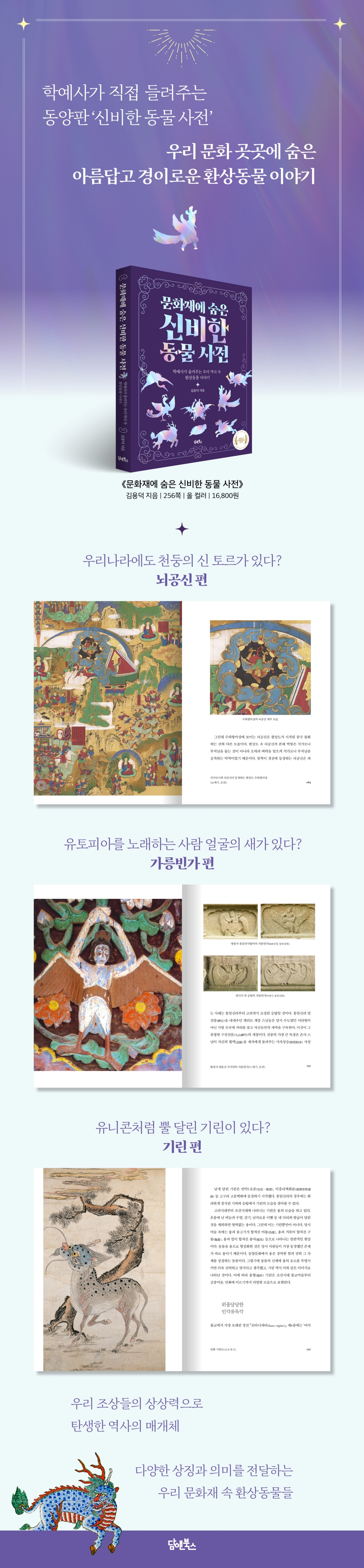
Does our country also have a god of thunder, Thor?
An Asian edition of "Fantastic Beasts and Where to Find Them," as told by a curator.
A truly diverse range of animals appear in cultural assets.
You can see a variety of animals, from real ones like tigers, turtles, deer, and monkeys to imaginary ones like dragons and phoenixes.
These imaginary animals that allow the viewer to use their imagination are often called 'fantasy animals'.
Among the fantastical creatures that appear in our history, there are also some little-known and enigmatic creatures.
Hidden fantastical creatures such as the Thunder God, who can be called the Eastern version of Thor, the Hwaseo Fish with the body of a turtle and the face of a monk, the Gongmyeongjo, a fantastical bird with two human heads, and the Yongma with strange patterns carved on its back stimulate our creative imagination.
"The Dictionary of Mysterious Animals Hidden in Cultural Heritage" is a cultural guidebook in which a current curator who has worked at various museums personally explains the fantastic animals hidden in our cultural heritage in an easy-to-understand manner.
Furthermore, under the motto that "art is a medium that represents history," the author provides a wide range of interesting information about fantasy creatures from various perspectives, including artistic, historical, philosophical, political, and economic.
We explain fantastic creatures from a popular perspective so that the general public can become interested in our cultural heritage as easily and enjoyably as possible.
To borrow the author's words, cultural assets depicting fantastical creatures can be described as a collection of mysterious creatures, an Eastern version of the "Fantastic Beasts and Where to Find Them."
A medium of history born from the imagination of our ancestors
Fantasy animals in our cultural heritage that convey various symbols and meanings.
When we encounter artifacts in a museum, we usually look closely at the cultural property's purpose or appearance.
However, it is easy to overlook the various patterns and hidden stories expressed in those cultural assets.
By truly understanding the meaning and stories behind the symbols hidden behind cultural assets, you can delve deeper into history and gain a richer understanding of the lives of our ancestors.
In particular, fantasy animals born from the creative imagination of our ancestors are an interesting medium of history for us living in the modern era.
So, what do the fantastic animals in our cultural heritage symbolize?
First, it expresses utopia, an ideal world, a fantasy world that cannot exist in reality.
The place where fantasy animals run wild is an oriental utopia, a paradise, a time of peace, a paradise on earth.
It's about expressing utopia through fantasy animals.
A second lesson can be learned.
Like the many animals in Aesop's Fables that teach us life lessons, fantasy creatures were created to teach us the lessons of good over evil and karma.
Through this book, which easily explains the fantastical creatures found in our cultural heritage, conveying diverse symbols and meanings, readers will not only glimpse the creative imagination of our ancestors but also discover new, convergent cultural content.
An Asian edition of "Fantastic Beasts and Where to Find Them," as told by a curator.
A truly diverse range of animals appear in cultural assets.
You can see a variety of animals, from real ones like tigers, turtles, deer, and monkeys to imaginary ones like dragons and phoenixes.
These imaginary animals that allow the viewer to use their imagination are often called 'fantasy animals'.
Among the fantastical creatures that appear in our history, there are also some little-known and enigmatic creatures.
Hidden fantastical creatures such as the Thunder God, who can be called the Eastern version of Thor, the Hwaseo Fish with the body of a turtle and the face of a monk, the Gongmyeongjo, a fantastical bird with two human heads, and the Yongma with strange patterns carved on its back stimulate our creative imagination.
"The Dictionary of Mysterious Animals Hidden in Cultural Heritage" is a cultural guidebook in which a current curator who has worked at various museums personally explains the fantastic animals hidden in our cultural heritage in an easy-to-understand manner.
Furthermore, under the motto that "art is a medium that represents history," the author provides a wide range of interesting information about fantasy creatures from various perspectives, including artistic, historical, philosophical, political, and economic.
We explain fantastic creatures from a popular perspective so that the general public can become interested in our cultural heritage as easily and enjoyably as possible.
To borrow the author's words, cultural assets depicting fantastical creatures can be described as a collection of mysterious creatures, an Eastern version of the "Fantastic Beasts and Where to Find Them."
A medium of history born from the imagination of our ancestors
Fantasy animals in our cultural heritage that convey various symbols and meanings.
When we encounter artifacts in a museum, we usually look closely at the cultural property's purpose or appearance.
However, it is easy to overlook the various patterns and hidden stories expressed in those cultural assets.
By truly understanding the meaning and stories behind the symbols hidden behind cultural assets, you can delve deeper into history and gain a richer understanding of the lives of our ancestors.
In particular, fantasy animals born from the creative imagination of our ancestors are an interesting medium of history for us living in the modern era.
So, what do the fantastic animals in our cultural heritage symbolize?
First, it expresses utopia, an ideal world, a fantasy world that cannot exist in reality.
The place where fantasy animals run wild is an oriental utopia, a paradise, a time of peace, a paradise on earth.
It's about expressing utopia through fantasy animals.
A second lesson can be learned.
Like the many animals in Aesop's Fables that teach us life lessons, fantasy creatures were created to teach us the lessons of good over evil and karma.
Through this book, which easily explains the fantastical creatures found in our cultural heritage, conveying diverse symbols and meanings, readers will not only glimpse the creative imagination of our ancestors but also discover new, convergent cultural content.
GOODS SPECIFICS
- Date of issue: November 30, 2023
- Page count, weight, size: 256 pages | 446g | 153*210*15mm
- ISBN13: 9791162014141
- ISBN10: 1162014148
You may also like
카테고리
korean


korean

![GQ KOREA Mark (Monthly): December [2025]](http://librairie.coreenne.fr/cdn/shop/files/8ef265dbbfbf186523ed75ba7319009d.jpg?v=1765340328&width=3840)


