

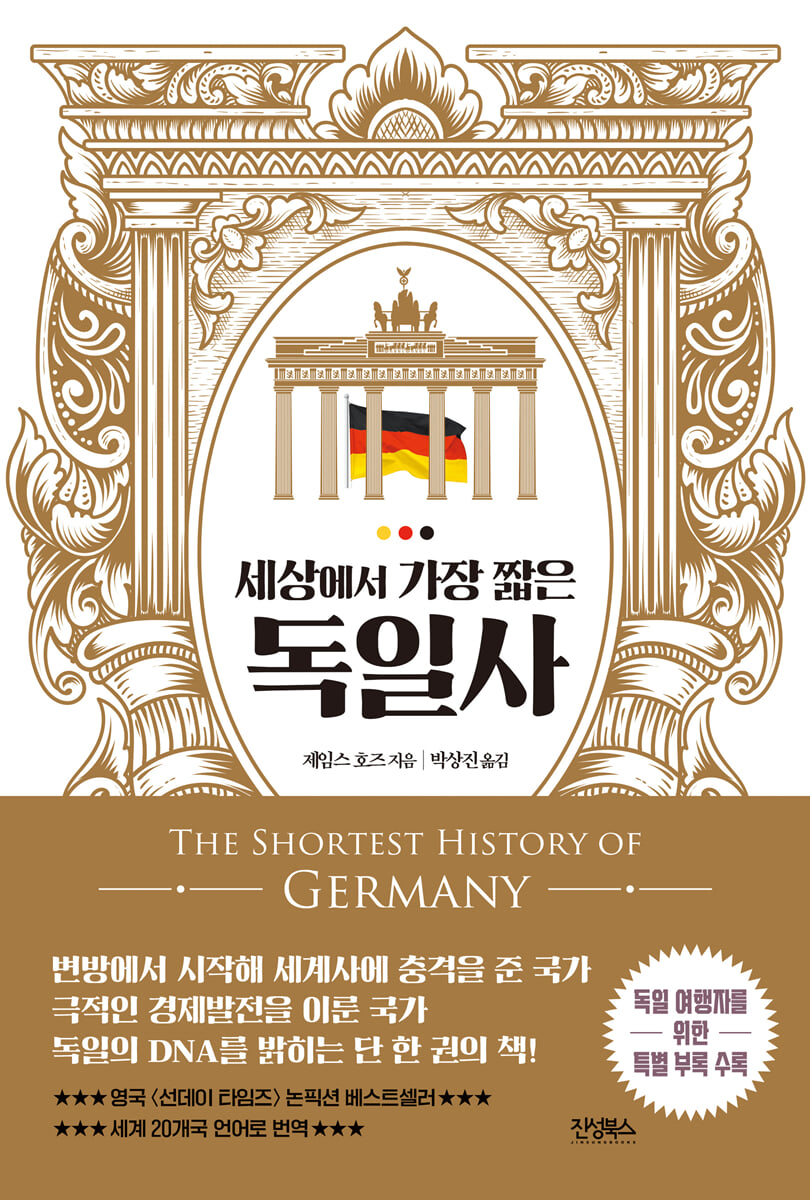
The shortest German history in the world
 |
Description
Book Introduction
From the Roman era of Caesar to Charlemagne, Otto the Great, Martin Luther, Bismarck, and Merkel, this masterpiece depicts the highlights of German history that shocked the world over two thousand years, in the historian's exceptionally brilliant handwriting!
There are many words to describe Germany.
A global economic powerhouse (expected to surpass Japan to become the world's third-largest economy by 2023), a country with a world-class quality of life, a land of philosophy, literature, and music, a place that has advanced militarism, world wars, science, technology, and medicine, the world's leading publisher of books per capita, and, of course, the beautiful scenery of its magnificent castle...
Germany is a country whose DNA makes one curious, with its historical contrast of positive and negative characteristics that is unprecedented in world history.
"The World's Shortest History of Germany" coolly delves into the essence of German history, a tangled web of conflicting concepts: barbarism and reason, democracy and militarism, coexistence and exclusion, moderation and greed.
It also highlights how they contributed to the restoration of the brilliant intellectual heritage of Greece and Rome, while helping to destroy the Roman Empire that ruled ancient Europe.
Furthermore, he meticulously examines many key historical milestones, including the Reformation, the confrontation with France, the World Wars, division, and reunification, and applies his merciless scalpel as a historian.
In particular, the part that is critically introduced in this book is the description of Prussia and its origin, Eastern Elbia, i.e. the Junkers.
Otto the Great, who laid the true foundation of German history, crossed the Elbe River and invaded in 935 AD.
The Slavs drove the Germans out again in 982 AD.
The Germans attempted another attack in 1127 and over the next two centuries succeeded in largely (but by no means completely) driving the Slavs back to the Oder River.
The Teutonic Knights continued to expand until the Poles crushed them in 1410.
Prussia was reborn under Polish lords in 1525 after a revolt against Rome, gained fame in the wars against Sweden, and became a great power through a series of victories between the Elbe and Oder rivers.
And then in 1807 it was also saved from destruction by the Tsar.
The fatal inability of the western Germans to unite led to the Prussian conquest of the region in a single major battle (the Battle of Königgrätz in the Austro-Prussian War) on the Elbe River in 1866.
Prussia shattered France in 1870.
After that, the Germans poured manpower and money into resolving the thousand-year-old struggle with the Slavs.
These struggles ended in vain in 1945, when part of eastern Elbia was lost forever, and the remaining lands between the Elbe and Oder rivers became a helpless Russian colony.
The author traces the seeds of German militarism to the Junkers.
The Korean edition includes a section titled “History in History,” which provides detailed explanations of the historical significance of key figures and events mentioned in the book.
Additionally, the "Essential Guide for Travelers to Germany" is provided as an appendix, including Germany's UNESCO World Heritage Sites, the Seven Great Routes, and recommended travel cities.
We've compiled valuable information that anyone traveling to Germany should definitely refer to.
There are many words to describe Germany.
A global economic powerhouse (expected to surpass Japan to become the world's third-largest economy by 2023), a country with a world-class quality of life, a land of philosophy, literature, and music, a place that has advanced militarism, world wars, science, technology, and medicine, the world's leading publisher of books per capita, and, of course, the beautiful scenery of its magnificent castle...
Germany is a country whose DNA makes one curious, with its historical contrast of positive and negative characteristics that is unprecedented in world history.
"The World's Shortest History of Germany" coolly delves into the essence of German history, a tangled web of conflicting concepts: barbarism and reason, democracy and militarism, coexistence and exclusion, moderation and greed.
It also highlights how they contributed to the restoration of the brilliant intellectual heritage of Greece and Rome, while helping to destroy the Roman Empire that ruled ancient Europe.
Furthermore, he meticulously examines many key historical milestones, including the Reformation, the confrontation with France, the World Wars, division, and reunification, and applies his merciless scalpel as a historian.
In particular, the part that is critically introduced in this book is the description of Prussia and its origin, Eastern Elbia, i.e. the Junkers.
Otto the Great, who laid the true foundation of German history, crossed the Elbe River and invaded in 935 AD.
The Slavs drove the Germans out again in 982 AD.
The Germans attempted another attack in 1127 and over the next two centuries succeeded in largely (but by no means completely) driving the Slavs back to the Oder River.
The Teutonic Knights continued to expand until the Poles crushed them in 1410.
Prussia was reborn under Polish lords in 1525 after a revolt against Rome, gained fame in the wars against Sweden, and became a great power through a series of victories between the Elbe and Oder rivers.
And then in 1807 it was also saved from destruction by the Tsar.
The fatal inability of the western Germans to unite led to the Prussian conquest of the region in a single major battle (the Battle of Königgrätz in the Austro-Prussian War) on the Elbe River in 1866.
Prussia shattered France in 1870.
After that, the Germans poured manpower and money into resolving the thousand-year-old struggle with the Slavs.
These struggles ended in vain in 1945, when part of eastern Elbia was lost forever, and the remaining lands between the Elbe and Oder rivers became a helpless Russian colony.
The author traces the seeds of German militarism to the Junkers.
The Korean edition includes a section titled “History in History,” which provides detailed explanations of the historical significance of key figures and events mentioned in the book.
Additionally, the "Essential Guide for Travelers to Germany" is provided as an appendix, including Germany's UNESCO World Heritage Sites, the Seven Great Routes, and recommended travel cities.
We've compiled valuable information that anyone traveling to Germany should definitely refer to.
index
Translator's Preface
Introduction: Let's get to know Germany, the future of Europe.
Part 1: The Birth of Germania_8 BC–526 BC
Part 2: Germans Restore Rome_526–983
Part 3: The War for the Germans_983–1525
Part 4: Germany at a Fork in the Road_1525–1924
Part 5: Germany and the Future of Europe_1924–Present
Appendix: Essential Guide for Travelers to Germany
Introduction: Let's get to know Germany, the future of Europe.
Part 1: The Birth of Germania_8 BC–526 BC
Part 2: Germans Restore Rome_526–983
Part 3: The War for the Germans_983–1525
Part 4: Germany at a Fork in the Road_1525–1924
Part 5: Germany and the Future of Europe_1924–Present
Appendix: Essential Guide for Travelers to Germany
Into the book
This was a very significant moment in the unfolding history of Germany and Europe.
The stop at Elbe was not an ordinary political-military decision.
This was a revelation from God coming down from above.
Crossing the Rhine was fine, but the Elbe became the destination of 'legitimate ambition'.
Finally, in 6 AD, the conquest of Germania between the Danube, Rhine, and Elbe rivers was accomplished.
--- p.32
Martel's second son, Pepin III, abolished the Merovingian dynasty's ineffective power structure in 751 AD and established his own Franco-Carolingian dynasty.
However, as a usurper, it was urgent for him to secure the legitimacy of the throne, and the Pope of Rome at the time desperately needed an assistant who could contribute to the restoration of Rome's independence from the Eastern Roman Empire of Constantinople.
Pippin and the Pope had a perfect deal.
--- p.67
For the next six centuries, German history was marked by a tense seesaw game between kings, nobles, and the church.
In some ways, it seemed to flow similarly to the history of France or England, but Germany's problems were a bit more complicated.
This was due to the peculiar tradition of elective rather than hereditary kingship, and the fatal temptation that made the German kings believe and desire themselves to be Roman emperors.
--- p.99
The Electorate, now unchallenged by anyone, chose the next king whom they could control at will and installed him on the throne.
They chose an older German nobleman who would have difficulty becoming an elector on his own.
His name was Rudolph, a powerless Habsburg count, and he was 55 years old, well into middle age at the time.
It was a truly disappointing appearance for the beginning of a family that would later be synonymous with imperial power and that would dictate countless stories of European history until 1918.
--- p.116
The second major pillar of Luther's thought was Sola Fide (faith alone).
This was a rather radical idea.
He argued that one could not get to heaven by going to confession, doing penance, or even by doing endless good deeds.
Luther made it clear that salvation can only be found by forgetting all worldly things, renouncement of the sweet intercourse with the devil, surrendering everything to true faith, and surrendering to faith as an undeserved gift directly from God.
--- p.123
The three major German dynasties were the biggest beneficiaries of gentrification (the displacement of natives as run-down areas become revitalized).
These three dynasties were the Habsburgs of Austria-Hungary, the newly emerged Wettins of Saxony, and the Hohenzollerns, who had been only margraves since 1415.
They had the significant advantage of a buffer zone and the physical distance between their core territories and the French Alsace region facing the Rhine.
Once again, geography played a role as fate.
--- p.149~150
Frederick the Great, considered the greatest king in German history, inherited a capable bureaucracy and an overly large army from his beastly father.
Voltaire, the French authority who was once favored at the court of Frederick II, left behind a famous saying:
'Other countries have armies, but in Prussia the army has the country.'
--- p.156
From 1908, the tenth anniversary of Bismarck's death, the Prussian crown and the Junker regime not only had to face a logically invincible coalition of Britain, France, and Russia, but they were also virtually surrounded from within.
On the left, the Social Democrats had won the battle of public opinion, and everyone, including Lenin, was confidently waiting for the new millennium of socialism that Germany would soon begin.
--- p.215
When the truth was revealed, both the morale of the German army and Rubendorf's impudence came to an end.
There was no such thing as a bolt from the blue.
On September 29, 1918, Rubendorf suddenly told the Kaiser that he could no longer prolong the military disaster and that a new government must be formed.
On October 3, 1918, Hindenburg confirmed this to a shocked Reichstag.
Finally, and quite deliberately, the generals who had ruled Germany for the previous two years handed over power to civilians.
As Ludendorff said, it was just in time for 'the soup to be served, the responsibility to be taken'.
--- p.229
After the Munich Agreement, Hitler finally felt free to do whatever he wanted.
He no longer needed to wear the conservative mask.
What he really wanted became clear on the eve of Luther's birthday, November 10, 1938.
--- p.291
The West's top priority was to make parts of Germany function again.
The old RM Mark has lost so much credibility that it is now relegated to being used for rolling tobacco leaves.
Economic recovery was impossible without a functioning currency.
--- p.309
Germany was not the only country where the vague idealism of the 1960s rapidly degenerated into violence.
But RAF Baader-Meinhof was a peculiar nuisance, with its own viciousness.
In 1977, during the height of the election campaign, a period known as the "German Autumn," it was possible to assassinate prominent figures such as industrialist Hans-Martin Schlier and Dresdner Bank President Jürken Ponto at will.
--- p.321
The crowd cheered for Gorbachev.
After he left, the police beat the crowd.
On October 9, people gathered in Leipzig, determined but fearful.
Until then, no one knew whether the authorities would adopt a Beijing-style hard-line policy or a Polish-style compromise.
No one in the crowd threw bottles, and no one in the police or military opened fire.
On October 17, Honecker resigned, and on November 3, the Czechoslovak border was reopened.
In just two days, 15,000 people fled East Germany.
On November 9th, by what appeared to be an accident, the Berlin Wall was declared open and was immediately torn down by people who were thrilled to get through or come out with hammers.
--- p.327
If today's Germans recall this story, it might help them, like Adenauer, to look back on their true friends and true interests before it is too late.
Germany (actually West Germany) runs a huge trade surplus within the eurozone itself.
In particular, the eurozone alone posted a surplus of $100 billion in 2016-2017.
As a result, the German government can obtain credit at shockingly low interest rates.
The stop at Elbe was not an ordinary political-military decision.
This was a revelation from God coming down from above.
Crossing the Rhine was fine, but the Elbe became the destination of 'legitimate ambition'.
Finally, in 6 AD, the conquest of Germania between the Danube, Rhine, and Elbe rivers was accomplished.
--- p.32
Martel's second son, Pepin III, abolished the Merovingian dynasty's ineffective power structure in 751 AD and established his own Franco-Carolingian dynasty.
However, as a usurper, it was urgent for him to secure the legitimacy of the throne, and the Pope of Rome at the time desperately needed an assistant who could contribute to the restoration of Rome's independence from the Eastern Roman Empire of Constantinople.
Pippin and the Pope had a perfect deal.
--- p.67
For the next six centuries, German history was marked by a tense seesaw game between kings, nobles, and the church.
In some ways, it seemed to flow similarly to the history of France or England, but Germany's problems were a bit more complicated.
This was due to the peculiar tradition of elective rather than hereditary kingship, and the fatal temptation that made the German kings believe and desire themselves to be Roman emperors.
--- p.99
The Electorate, now unchallenged by anyone, chose the next king whom they could control at will and installed him on the throne.
They chose an older German nobleman who would have difficulty becoming an elector on his own.
His name was Rudolph, a powerless Habsburg count, and he was 55 years old, well into middle age at the time.
It was a truly disappointing appearance for the beginning of a family that would later be synonymous with imperial power and that would dictate countless stories of European history until 1918.
--- p.116
The second major pillar of Luther's thought was Sola Fide (faith alone).
This was a rather radical idea.
He argued that one could not get to heaven by going to confession, doing penance, or even by doing endless good deeds.
Luther made it clear that salvation can only be found by forgetting all worldly things, renouncement of the sweet intercourse with the devil, surrendering everything to true faith, and surrendering to faith as an undeserved gift directly from God.
--- p.123
The three major German dynasties were the biggest beneficiaries of gentrification (the displacement of natives as run-down areas become revitalized).
These three dynasties were the Habsburgs of Austria-Hungary, the newly emerged Wettins of Saxony, and the Hohenzollerns, who had been only margraves since 1415.
They had the significant advantage of a buffer zone and the physical distance between their core territories and the French Alsace region facing the Rhine.
Once again, geography played a role as fate.
--- p.149~150
Frederick the Great, considered the greatest king in German history, inherited a capable bureaucracy and an overly large army from his beastly father.
Voltaire, the French authority who was once favored at the court of Frederick II, left behind a famous saying:
'Other countries have armies, but in Prussia the army has the country.'
--- p.156
From 1908, the tenth anniversary of Bismarck's death, the Prussian crown and the Junker regime not only had to face a logically invincible coalition of Britain, France, and Russia, but they were also virtually surrounded from within.
On the left, the Social Democrats had won the battle of public opinion, and everyone, including Lenin, was confidently waiting for the new millennium of socialism that Germany would soon begin.
--- p.215
When the truth was revealed, both the morale of the German army and Rubendorf's impudence came to an end.
There was no such thing as a bolt from the blue.
On September 29, 1918, Rubendorf suddenly told the Kaiser that he could no longer prolong the military disaster and that a new government must be formed.
On October 3, 1918, Hindenburg confirmed this to a shocked Reichstag.
Finally, and quite deliberately, the generals who had ruled Germany for the previous two years handed over power to civilians.
As Ludendorff said, it was just in time for 'the soup to be served, the responsibility to be taken'.
--- p.229
After the Munich Agreement, Hitler finally felt free to do whatever he wanted.
He no longer needed to wear the conservative mask.
What he really wanted became clear on the eve of Luther's birthday, November 10, 1938.
--- p.291
The West's top priority was to make parts of Germany function again.
The old RM Mark has lost so much credibility that it is now relegated to being used for rolling tobacco leaves.
Economic recovery was impossible without a functioning currency.
--- p.309
Germany was not the only country where the vague idealism of the 1960s rapidly degenerated into violence.
But RAF Baader-Meinhof was a peculiar nuisance, with its own viciousness.
In 1977, during the height of the election campaign, a period known as the "German Autumn," it was possible to assassinate prominent figures such as industrialist Hans-Martin Schlier and Dresdner Bank President Jürken Ponto at will.
--- p.321
The crowd cheered for Gorbachev.
After he left, the police beat the crowd.
On October 9, people gathered in Leipzig, determined but fearful.
Until then, no one knew whether the authorities would adopt a Beijing-style hard-line policy or a Polish-style compromise.
No one in the crowd threw bottles, and no one in the police or military opened fire.
On October 17, Honecker resigned, and on November 3, the Czechoslovak border was reopened.
In just two days, 15,000 people fled East Germany.
On November 9th, by what appeared to be an accident, the Berlin Wall was declared open and was immediately torn down by people who were thrilled to get through or come out with hammers.
--- p.327
If today's Germans recall this story, it might help them, like Adenauer, to look back on their true friends and true interests before it is too late.
Germany (actually West Germany) runs a huge trade surplus within the eurozone itself.
In particular, the eurozone alone posted a surplus of $100 billion in 2016-2017.
As a result, the German government can obtain credit at shockingly low interest rates.
--- p.346
Publisher's Review
★★★★British Sunday Times Nonfiction Bestseller & Translated into 20 Languages Worldwide★★★★
Meet the most 'solid' German history chosen by the British
"The Shortest History of Germany" is a book in which the author, a historian and bestselling novelist, compiles all of Germany's history from the ancient Germanic tribes, who are said to be the first Germans, to Rome, the Frankish Kingdom, the Holy Roman Empire, Prussia, the German Empire, East Germany, West Germany, and today's Germany, which leads the European Union, in a single volume with his own unique perspective.
This book, which weaves together numerous historical documents and photographs from the perspectives of a Roman, a religious, and at other times a cool-headed and critical historian, has been translated into over 20 languages, including the English language, and has been loved by many around the world.
Born from the barbarians, he became a symbol of reason.
Until today's Germany was completed
How did the Germanic people, despised by Caesar as "Germania," surpass Rome and conquer Europe? Why did Germany come to be called a nation of perfectionists? Why did Germany, once boasting the world's most rational people and state system, cause countless tragedies, including World War II? And what was the driving force that enabled Germany to overcome the pain of division and become the leader of Europe today? "The World's Shortest History of Germany" isn't simply a history book filled with famous figures and events. It weaves together the diverse stories and causal relationships that quietly unfolded behind the vast currents of history, unseen before. Through this book, readers will encounter the most three-dimensional picture of Germany.
Three features of this book
First, as a history book, it has an exceptionally colorful style and the power to convey the historical context clearly and neatly through appropriate metaphors.
The author's writing style, which appropriately incorporates literary elements to instantly dispel the preconception that history books are inevitably somewhat boring, enriches the reading experience.
Second, it is a critical awareness of the issues that the author addresses in dealing with Prussia and the Junkers, which he believes have had a profound influence on German history and from which it has not escaped even to this day.
A critical examination of the Junkers, who played a key role in the development of Prussia, originating from the Teutonic Knights.
They were landowners with large houses, lands, and serfs who were part of a colonization movement in the late Middle Ages to develop eastern Germany.
Afterwards, it transformed into a group that pursued a sense of privilege and military culture.
The author repeatedly argues that many of Germany's belligerent and military problems were caused by these Junkers, who held political views quite different from those of the Germans in the old Roman region around the Rhine in western Germany.
Third, although the author praises Germany as the “future of Europe,” he does not view or evaluate German history with only praise.
Quite the opposite.
It revisits historical scenes that ordinary people might find bland, one by one, and mercilessly applies an unexpectedly sharp knife to them.
It may be possible to analyze it more objectively because it is not their own history, but it may be a somewhat uncomfortable truth for Germans.
However, it provides readers with plenty of exciting reading material that cannot be found in other history books.
"History within History" for readers unfamiliar with Germany
Essential Guide for Travelers to Germany
In addition, for Korean readers unfamiliar with Western history, we have added "History in History," which provides a more detailed look at historical events and figures, and "The Essential Guide for Travelers to Germany," which contains various travel information about Germany.
As you build your historical knowledge through the "History within History" section that follows the main text, along with the German story that flows as a main thread, and read the guide filled with numerous heritage sites and travel attractions, you will soon find yourself feeling closer to Germany as a "friendly stranger."
“I bought this book to prepare for my trip to Germany, but it was so entertaining that I couldn’t put it down.” _Amazon Review
Meet the most 'solid' German history chosen by the British
"The Shortest History of Germany" is a book in which the author, a historian and bestselling novelist, compiles all of Germany's history from the ancient Germanic tribes, who are said to be the first Germans, to Rome, the Frankish Kingdom, the Holy Roman Empire, Prussia, the German Empire, East Germany, West Germany, and today's Germany, which leads the European Union, in a single volume with his own unique perspective.
This book, which weaves together numerous historical documents and photographs from the perspectives of a Roman, a religious, and at other times a cool-headed and critical historian, has been translated into over 20 languages, including the English language, and has been loved by many around the world.
Born from the barbarians, he became a symbol of reason.
Until today's Germany was completed
How did the Germanic people, despised by Caesar as "Germania," surpass Rome and conquer Europe? Why did Germany come to be called a nation of perfectionists? Why did Germany, once boasting the world's most rational people and state system, cause countless tragedies, including World War II? And what was the driving force that enabled Germany to overcome the pain of division and become the leader of Europe today? "The World's Shortest History of Germany" isn't simply a history book filled with famous figures and events. It weaves together the diverse stories and causal relationships that quietly unfolded behind the vast currents of history, unseen before. Through this book, readers will encounter the most three-dimensional picture of Germany.
Three features of this book
First, as a history book, it has an exceptionally colorful style and the power to convey the historical context clearly and neatly through appropriate metaphors.
The author's writing style, which appropriately incorporates literary elements to instantly dispel the preconception that history books are inevitably somewhat boring, enriches the reading experience.
Second, it is a critical awareness of the issues that the author addresses in dealing with Prussia and the Junkers, which he believes have had a profound influence on German history and from which it has not escaped even to this day.
A critical examination of the Junkers, who played a key role in the development of Prussia, originating from the Teutonic Knights.
They were landowners with large houses, lands, and serfs who were part of a colonization movement in the late Middle Ages to develop eastern Germany.
Afterwards, it transformed into a group that pursued a sense of privilege and military culture.
The author repeatedly argues that many of Germany's belligerent and military problems were caused by these Junkers, who held political views quite different from those of the Germans in the old Roman region around the Rhine in western Germany.
Third, although the author praises Germany as the “future of Europe,” he does not view or evaluate German history with only praise.
Quite the opposite.
It revisits historical scenes that ordinary people might find bland, one by one, and mercilessly applies an unexpectedly sharp knife to them.
It may be possible to analyze it more objectively because it is not their own history, but it may be a somewhat uncomfortable truth for Germans.
However, it provides readers with plenty of exciting reading material that cannot be found in other history books.
"History within History" for readers unfamiliar with Germany
Essential Guide for Travelers to Germany
In addition, for Korean readers unfamiliar with Western history, we have added "History in History," which provides a more detailed look at historical events and figures, and "The Essential Guide for Travelers to Germany," which contains various travel information about Germany.
As you build your historical knowledge through the "History within History" section that follows the main text, along with the German story that flows as a main thread, and read the guide filled with numerous heritage sites and travel attractions, you will soon find yourself feeling closer to Germany as a "friendly stranger."
“I bought this book to prepare for my trip to Germany, but it was so entertaining that I couldn’t put it down.” _Amazon Review
GOODS SPECIFICS
- Publication date: November 22, 2023
- Page count, weight, size: 428 pages | 152*255*30mm
- ISBN13: 9788997743599
- ISBN10: 8997743597
You may also like
카테고리
korean


korean

![GQ KOREA Mark (Monthly): December [2025]](http://librairie.coreenne.fr/cdn/shop/files/8ef265dbbfbf186523ed75ba7319009d.jpg?v=1765340328&width=3840)


