

Hong Seong-uk's History of Science Through Illustrated Pictures
 |
Description
Book Introduction
You are invited to the 'Science History Gallery' by science and technology scholar Hong Seong-wook!
Over 150 color plates
A rare collection of paintings for lectures and research
Reexamining the Erased from the History of Science
'History of Science' where images are the main characters
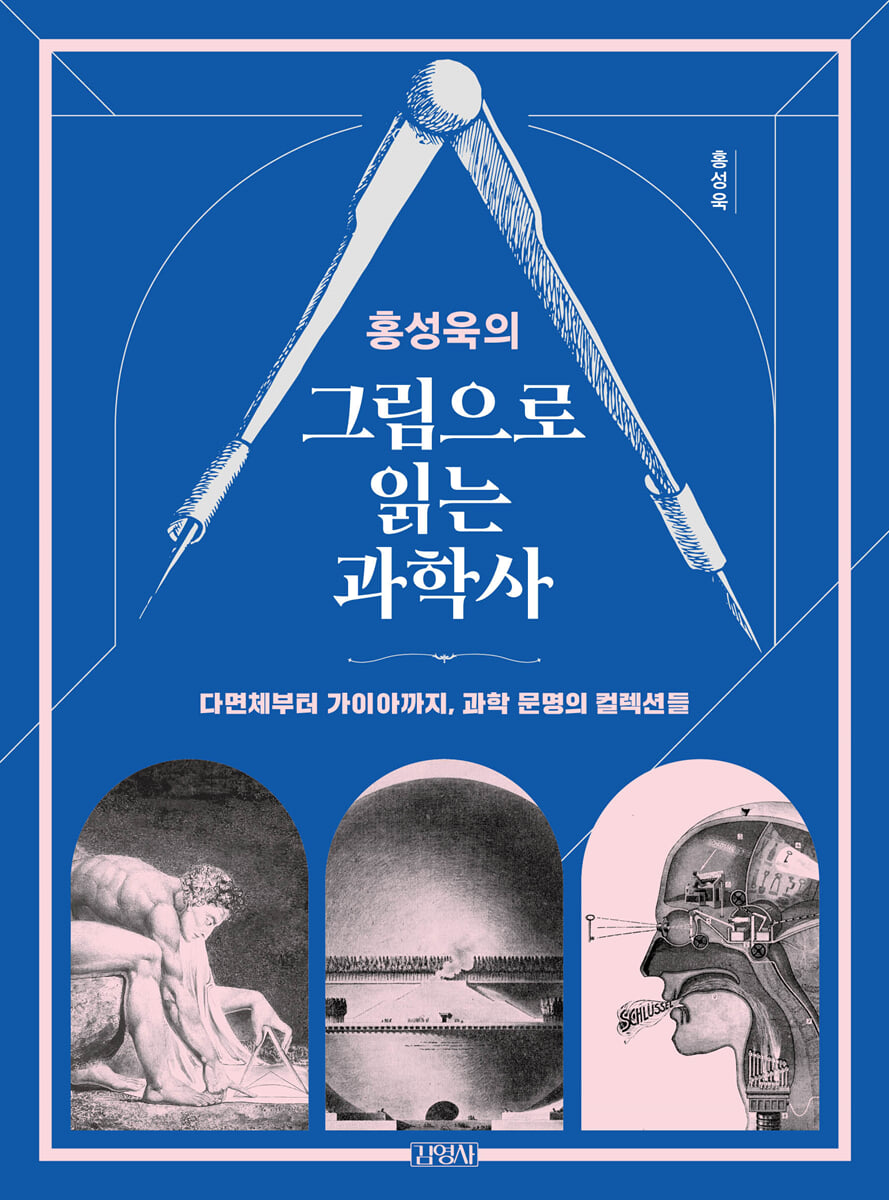
Are images simply a byproduct of science, or are they a key player in the history of science? Hong Seong-wook, a leading Korean scientist and technologist, has compiled a collection of remarkable images he has collected over many years for his lectures and research.
The main characters of this book are images that were once considered mere props in the history of science, such as Plato's polyhedrons, which explored the fundamental principles of the world; the Encyclopédie, which attempted to gather the world's knowledge through the power of reason; the laboratory of Lavoisier and his wife, which brought about the modern chemical revolution; and Humboldt's 'nature picture', which synthesized ecological information from 19th-century exploration sites.
『Reading the History of Science through Hong Seong-wook's Pictures』 started with the motivation to look at the history of science in a new way by placing 'images' at the center of the stage, moving away from the "history of science that has been written centered on the development of theories and concepts" so far.
Therefore, unlike other science history books, it does not contain pages-filling formulas or vague, rigid concepts.
Rather, it is filled with famous paintings such as Escher's "Star" (1948) and Dürer's "Melancholia I" (1514), the covers and detailed frontispieces of famous books such as Newton's "Principia" and Kepler's "Rudolphine Tables," portraits of people who led the scientific revolution, Darwin's experimental notebooks and oddly shaped modern laboratories and experimental equipment, and ingenious graphs devised by unique figures of the 18th and 19th centuries.
Each image is captivating in its own right, and the stories contained within each picture give us a glimpse into just how richly the world of science is filled with stories.
Over 150 color plates
A rare collection of paintings for lectures and research
Reexamining the Erased from the History of Science
'History of Science' where images are the main characters
Are images simply a byproduct of science, or are they a key player in the history of science? Hong Seong-wook, a leading Korean scientist and technologist, has compiled a collection of remarkable images he has collected over many years for his lectures and research.
The main characters of this book are images that were once considered mere props in the history of science, such as Plato's polyhedrons, which explored the fundamental principles of the world; the Encyclopédie, which attempted to gather the world's knowledge through the power of reason; the laboratory of Lavoisier and his wife, which brought about the modern chemical revolution; and Humboldt's 'nature picture', which synthesized ecological information from 19th-century exploration sites.
『Reading the History of Science through Hong Seong-wook's Pictures』 started with the motivation to look at the history of science in a new way by placing 'images' at the center of the stage, moving away from the "history of science that has been written centered on the development of theories and concepts" so far.
Therefore, unlike other science history books, it does not contain pages-filling formulas or vague, rigid concepts.
Rather, it is filled with famous paintings such as Escher's "Star" (1948) and Dürer's "Melancholia I" (1514), the covers and detailed frontispieces of famous books such as Newton's "Principia" and Kepler's "Rudolphine Tables," portraits of people who led the scientific revolution, Darwin's experimental notebooks and oddly shaped modern laboratories and experimental equipment, and ingenious graphs devised by unique figures of the 18th and 19th centuries.
Each image is captivating in its own right, and the stories contained within each picture give us a glimpse into just how richly the world of science is filled with stories.
- You can preview some of the book's contents.
Preview
index
Preface to the Revised Edition
Preface to the first edition
A very simple history of science that is good to know in advance
1 The Birth of Modern Science
01 Plato and Archimedes' Solids - The Boundary of Art and Science
02 Tycho Brahe's 'Castle in the Sky' - Science of Darkness, Science of Light
03 Kepler's Worldview - The Order of the Universe and the Progress of Science
04 Galileo and the Moon - The Meeting and Parting of Science and Art
2 Reason and Modernity
05 Newton and Blake - The Completion of the Scientific Worldview and Its Critics
06 Madame de Châtelet and Voltaire - From a Philosopher's Lover to a Female Scientist
07 Reason, Progress, and the Encyclopedia - A Duet of Reason and Imagination
08 Beings Erased in the Laboratory - Madame Lavoisier and Her Assistants
3 The Vitality of Images and Modern Science
09 'The Room of Thought', Images of the Brain - What Happens in the Invisible Brain?
10 Trees of Life, Evolution, and Technology—Familiar and Strange Tree Images
11 Revolutions in Data Visualization - Humboldt, Playfair, Minar, and Nightingale
12 Bruno Latour and Gaia - Visualizing the Critical Zone, Combining Science and Art
References
Source of the illustration
Search
Preface to the first edition
A very simple history of science that is good to know in advance
1 The Birth of Modern Science
01 Plato and Archimedes' Solids - The Boundary of Art and Science
02 Tycho Brahe's 'Castle in the Sky' - Science of Darkness, Science of Light
03 Kepler's Worldview - The Order of the Universe and the Progress of Science
04 Galileo and the Moon - The Meeting and Parting of Science and Art
2 Reason and Modernity
05 Newton and Blake - The Completion of the Scientific Worldview and Its Critics
06 Madame de Châtelet and Voltaire - From a Philosopher's Lover to a Female Scientist
07 Reason, Progress, and the Encyclopedia - A Duet of Reason and Imagination
08 Beings Erased in the Laboratory - Madame Lavoisier and Her Assistants
3 The Vitality of Images and Modern Science
09 'The Room of Thought', Images of the Brain - What Happens in the Invisible Brain?
10 Trees of Life, Evolution, and Technology—Familiar and Strange Tree Images
11 Revolutions in Data Visualization - Humboldt, Playfair, Minar, and Nightingale
12 Bruno Latour and Gaia - Visualizing the Critical Zone, Combining Science and Art
References
Source of the illustration
Search
Detailed image

Into the book
When you think of science, you probably think of complicated formulas, but real science is full of images.
Although it is rare to see a scientist wearing a white coat, the image of a scientist carefully dropping a reagent into a beaker in a white lab coat is also a powerful image.
Images in science include photographs, drawings, graphs, tables, diagrams, simulation images, journal covers, posters, and photographs of scientists used to popularize science, photographs of research centers and laboratories, art based on science, and even imaginary images such as artist's impressions of black holes.
--- p.8
Melancholia I features a variety of mathematical and scientific devices, including scales, compasses, an hourglass, a magic square (a square number board with numbers arranged so that adding up all the numbers in any row always results in the same sum), a sphere, an alchemical jar, and a strangely shaped saw. The most interesting object is the polyhedron that appears to the right of the contemplative young angel.
--- p.45
It is said that the budget supporting Brahe's Uraniborg Observatory was comparable in scale to the budget the U.S. government currently supports for NASA's space exploration projects.
Some have estimated that it is equivalent to 5 billion dollars (6-7 trillion won) today.
--- p.63
This painting by Riccioli captures the shift in cosmology that was accepted as authoritative in the scientific community at the time.
Aristotle--- p. Because the sphere symbolizing Ptolemy's universe is abandoned on the floor and Ptolemy is depicted as an old man lying on the floor.
--- p.77, 80
Brahe, dressed in luxurious clothes and with a confident expression, points to a model of the universe painted on the ceiling of the temple and asks, "What if that were so?"
This is the question Brahe posed through the portraits of astronomers painted in the underground antechamber of Stjerneborg.
--- p.99
He (Galileo) informed the Medici family that he had discovered four new stars orbiting Jupiter and that they could be named the Medici stars.
The Medici family was very interested in this new discovery and eventually accepted Galileo's tribute and appointed him as their court philosopher and mathematician.
--- p.
120
Newton is gazing intently at a simple figure drawn with a ruler and compass, and Blake portrays the scene as if Newton believes that the simple drawing on paper is a profound truth that reveals the way the world works.
--- p.151
The claim that the moon, which was thought to be a perfect being, was an imperfect being like the Earth was a blow that undermined the authority of the Aristotelian and Christian worldview.
If the moon, which was thought to be perfect, was imperfect, then other celestial bodies, such as the sun, which was also thought to be perfect, could also be imperfect.
No, the celestial body itself may not be perfect.
--- p.125
At the top of the temple hang portraits of three male scientists: Descartes, Newton, and Leibniz.
It means that these three scientists were the first to discover the truth, and their portraits were hung in the temple in recognition of their achievements.
On the steps leading to the temple, a woman is seen ascending towards truth, and this woman appears to be Madame de Chatelet herself.
--- p.165, 167
Voltaire held Madame de Châtelet in very high esteem, but found it difficult to understand that she could have achieved such intellectual achievements as a woman.
Voltaire said, “Madame de Châtelet was a great man, whose only fault was that she was a woman,” and considered it a miracle that she was able to translate and understand Newton.
--- p.174
Just think about it for a moment.
Why haven't women produced tragedies, pure poetry, worthy stories, beautiful paintings, or fine books on physics for centuries? Why do creatures possessing intellects comparable in every way to men's seem to be held back by an insurmountable force? If anyone can, please explain why.
--- p.176
Robert Merton called the phenomenon of the gap between famous and unfamous people the 'Matthew Effect'.
The Matthew Effect comes from the verse in the Gospel of Matthew: “For to those who have, more will be given; but from those who do not have, even what they have will be taken away.”
Perhaps there are Korean scientists who have disappeared in this way from paintings and photographs of foreign scientists.
--- p.230~232
Humboldt carried a lot of equipment, including a telescope, a barometer, and a thermometer, and went on a hike, measuring the temperature and air pressure as he climbed a certain distance, and collecting plants and mosses that grew there.
He discovered that no plants grow above 5,500 meters, and also left the world's first record of altitude sickness.
--- p.295
Most of the data visualization methods used during the COVID-19 pandemic were outdated, dating back to the 19th century.
Most dashboards reporting the number of confirmed cases, deaths, and fatality rates due to the coronavirus pandemic in near real-time employed visualization methods such as the standard graph, bar graph, pie chart, Minar's flow map, Pa's North Pole graph, and Nightingale's rose graph, first used by Playfair.
--- p.325
Even when looking at humanity as a whole, the space where all humans and non-humans who are meaningful to humanity live is not a spherical Earth with a radius of 6,300 kilometers, but a thin layer of rock, soil, forests, water, and atmosphere on the surface.
In his Gifford Lectures, Latour said, “Gaia is not a sphere at all.
Rather, it is just a thin film that is not more than a few kilometers thick,” he emphasized.
Although it is rare to see a scientist wearing a white coat, the image of a scientist carefully dropping a reagent into a beaker in a white lab coat is also a powerful image.
Images in science include photographs, drawings, graphs, tables, diagrams, simulation images, journal covers, posters, and photographs of scientists used to popularize science, photographs of research centers and laboratories, art based on science, and even imaginary images such as artist's impressions of black holes.
--- p.8
Melancholia I features a variety of mathematical and scientific devices, including scales, compasses, an hourglass, a magic square (a square number board with numbers arranged so that adding up all the numbers in any row always results in the same sum), a sphere, an alchemical jar, and a strangely shaped saw. The most interesting object is the polyhedron that appears to the right of the contemplative young angel.
--- p.45
It is said that the budget supporting Brahe's Uraniborg Observatory was comparable in scale to the budget the U.S. government currently supports for NASA's space exploration projects.
Some have estimated that it is equivalent to 5 billion dollars (6-7 trillion won) today.
--- p.63
This painting by Riccioli captures the shift in cosmology that was accepted as authoritative in the scientific community at the time.
Aristotle--- p. Because the sphere symbolizing Ptolemy's universe is abandoned on the floor and Ptolemy is depicted as an old man lying on the floor.
--- p.77, 80
Brahe, dressed in luxurious clothes and with a confident expression, points to a model of the universe painted on the ceiling of the temple and asks, "What if that were so?"
This is the question Brahe posed through the portraits of astronomers painted in the underground antechamber of Stjerneborg.
--- p.99
He (Galileo) informed the Medici family that he had discovered four new stars orbiting Jupiter and that they could be named the Medici stars.
The Medici family was very interested in this new discovery and eventually accepted Galileo's tribute and appointed him as their court philosopher and mathematician.
--- p.
120
Newton is gazing intently at a simple figure drawn with a ruler and compass, and Blake portrays the scene as if Newton believes that the simple drawing on paper is a profound truth that reveals the way the world works.
--- p.151
The claim that the moon, which was thought to be a perfect being, was an imperfect being like the Earth was a blow that undermined the authority of the Aristotelian and Christian worldview.
If the moon, which was thought to be perfect, was imperfect, then other celestial bodies, such as the sun, which was also thought to be perfect, could also be imperfect.
No, the celestial body itself may not be perfect.
--- p.125
At the top of the temple hang portraits of three male scientists: Descartes, Newton, and Leibniz.
It means that these three scientists were the first to discover the truth, and their portraits were hung in the temple in recognition of their achievements.
On the steps leading to the temple, a woman is seen ascending towards truth, and this woman appears to be Madame de Chatelet herself.
--- p.165, 167
Voltaire held Madame de Châtelet in very high esteem, but found it difficult to understand that she could have achieved such intellectual achievements as a woman.
Voltaire said, “Madame de Châtelet was a great man, whose only fault was that she was a woman,” and considered it a miracle that she was able to translate and understand Newton.
--- p.174
Just think about it for a moment.
Why haven't women produced tragedies, pure poetry, worthy stories, beautiful paintings, or fine books on physics for centuries? Why do creatures possessing intellects comparable in every way to men's seem to be held back by an insurmountable force? If anyone can, please explain why.
--- p.176
Robert Merton called the phenomenon of the gap between famous and unfamous people the 'Matthew Effect'.
The Matthew Effect comes from the verse in the Gospel of Matthew: “For to those who have, more will be given; but from those who do not have, even what they have will be taken away.”
Perhaps there are Korean scientists who have disappeared in this way from paintings and photographs of foreign scientists.
--- p.230~232
Humboldt carried a lot of equipment, including a telescope, a barometer, and a thermometer, and went on a hike, measuring the temperature and air pressure as he climbed a certain distance, and collecting plants and mosses that grew there.
He discovered that no plants grow above 5,500 meters, and also left the world's first record of altitude sickness.
--- p.295
Most of the data visualization methods used during the COVID-19 pandemic were outdated, dating back to the 19th century.
Most dashboards reporting the number of confirmed cases, deaths, and fatality rates due to the coronavirus pandemic in near real-time employed visualization methods such as the standard graph, bar graph, pie chart, Minar's flow map, Pa's North Pole graph, and Nightingale's rose graph, first used by Playfair.
--- p.325
Even when looking at humanity as a whole, the space where all humans and non-humans who are meaningful to humanity live is not a spherical Earth with a radius of 6,300 kilometers, but a thin layer of rock, soil, forests, water, and atmosphere on the surface.
In his Gifford Lectures, Latour said, “Gaia is not a sphere at all.
Rather, it is just a thin film that is not more than a few kilometers thick,” he emphasized.
--- p.333~334
Publisher's Review
Science and technology scholar Hong Seong-wook
You are invited to the 'Science History Gallery'!
A collection of rare paintings collected over a long period of time for lectures and research.
A History of Science Where Images Are the Main Characters: The Power of Images to Drive Science
'History of Science' where images are the main characters
Are images simply a byproduct of science, or are they a key player in the history of science? Hong Seong-wook, a leading Korean scientist and technologist, has compiled a collection of remarkable images he has collected over many years for his lectures and research.
The main characters of this book are images that were once considered props in the history of science, such as Plato's polyhedrons, which explored the fundamental principles of the world; the Encyclopédie, which attempted to gather the world's knowledge through the power of reason; the laboratory of Lavoisier and his wife, which brought about the modern chemical revolution; and Humboldt's 'nature picture', which synthesized ecological information from 19th-century exploration sites.
≪Reading the History of Science through Hong Seong-wook's Pictures≫ started with the motivation to look at the history of science in a new way by placing 'images' at the center of the stage, moving away from the "history of science that has been written centered on the development of theories and concepts" so far.
Therefore, unlike other science history books, it does not contain pages-filling formulas or vague, rigid concepts.
Rather, it is filled with famous paintings such as Escher's "Star" (1948) and Dürer's "Melancholia I" (1514), the covers and detailed frontispieces of famous works such as Newton's "Principia" and Kepler's "Rudolphine Tables," portraits of people who led the scientific revolution, Darwin's experimental notebooks and the oddly shaped modern laboratories and experimental equipment, and ingenious graphs devised by unique figures of the 18th and 19th centuries.
Each image is captivating in its own right, and the stories contained within each picture give us a glimpse into just how richly the world of science is filled with stories.
The newly opened 'Science History Gallery'
≪Reading the History of Science through Hong Seong-wook's Pictures≫ is a revised edition of the steady seller ≪The Hidden History of Science through Pictures≫ (2012, selected as the best science book by the Ministry of Culture, Sports and Tourism) that has been consistently loved by readers.
In terms of architecture, this is the first remodeling in 11 years, and the design concept is a kind of 'science history gallery.'
We put a lot of effort into editing the size and layout of the illustrations so that visitors to the exhibition can comfortably enjoy them with their eyes.
Design-wise, we've updated the format and body design, replaced old images, and added new collections.
In terms of content, one chapter with less timeliness ('Mad Cow Disease and Variant Freon') was removed and two chapters ('Data Visualization Revolution in the 18th and 19th Centuries' and 'Bruno Latour and Gaia') were added.
The two additional chapters address emerging topics in science and technology studies, particularly the recent coronavirus pandemic and climate crisis, and feature compelling narratives and colorful illustrations.
Readers can read lightheartedly, starting with the pictures that catch their eye, as if they were strolling through a gallery.
A Story of 'Real Science' in Pictures
- How to enjoy reading this book
Before opening the gallery door and stepping inside, it would be useful to preview what topics this book covers and how it is addressed.
This book, divided into three parts, follows the chronological flow of the history of science, but covers twelve different topics.
Part 1, which opens with the story of the ancient philosopher's polyhedron, features key figures who led the birth of modern science, from Tycho Brahe to Galileo.
In particular, Copernicus, Tycho Brahe, and Kepler, who led the development of astronomy, are given significant coverage, and the changes in the astronomical charts (pictures showing the structure of the universe) decorated in the paintings allow us to capture the changes in the cosmology accepted as authoritative in the scientific community of the time.
Readers may wish to read Part 1, focusing on the polyhedrons and astronomical charts.
In Part 2, the characteristics of modern science, represented by reason and modernity, are discussed through images.
A representative example is the compass that appears on the covers and front matter of modern publications, as well as in portraits of scientists.
Particularly noteworthy is the painting “Newton” (1795) by the poet and painter William Blake.
Blake depicted Newton, the greatest scientist of his time, as a man with a bent posture, holding a compass and measuring the world, and he also intended to criticize the world's obedience to the 'god of reason' (Urizen).
This clash of science versus art, reason versus imagination, would be rekindled centuries later over the installation of a sculpture modeled after Blake's work (Eduardo Paolozzi's "Newton") in front of the British Library.
Another topic worth noting in Part 2 is the re-examination of women and scientists' assistants (technicians), who have been considered marginalized in the history of science.
Representative examples include Madame de Châtelet, the French translator of the Principia and Voltaire's lover, and Madame de Lavoisier, who led the chemical revolution with her husband. Although they demonstrated sufficient ability and roles as scientists, today they are regarded only as the lover of a famous philosopher and the wife of Lavoisier, respectively.
Meanwhile, the scientist's assistants, darkly shadowed in Madame Laveuzier's laboratory painting, cannot be overlooked.
Who the person in the painting was and what specific role he played remains a blank in the history of science.
As the author emphasizes, “When examining the history of science, we need to pay attention not only to what is visible, but also to the voices and roles of those who have disappeared without a name.” This is because “in reality, scientific activity is carried on by these invisible people.”
Part 3 contains more unfamiliar and special images.
Representative examples include images of trees showing the evolution of life and technology, compartmentalized brain structures, early bar graphs, and images of the Earth as cracked and split.
Let's take a look at the newly added chapters.
In Chapter 11, which covers the "data visualization revolution" of the 18th and 19th centuries, we can see the prototypes of the visual techniques we commonly use today to present statistical data at a glance.
Surprisingly, the dashboards that reported confirmed cases, deaths, and fatality rates in near real-time during the coronavirus pandemic employed visualization methods such as bar/pie charts pioneered by William Playfair, flow maps by Charles-Joseph Minard, and rose graphs by Florence Nightingale, famous as the “Angel in White.”
In Chapter 12, the image of the 'critical zone', which is a new visualization of the concept of Gaia by science and technology researcher Latour, is also interesting.
When we think of 'Gaia', we think of the spherical blue Earth seen from space, but strictly speaking, "the space where all humans and non-humans meaningful to humanity live (the core concept of Gaia) is a thin layer of rocks, soil, forests, water, and atmosphere on the Earth's surface." Latour emphasizes that Gaia is "just a thin membrane, no more than a few kilometers thick," and calls it the "critical zone," which he visualized with Alexandra Aren, who specializes in landscape architecture.
Although less mythological and aesthetically pleasing, it is an image that is faithful to the concept of 'Gaia'.
Meanwhile, the image of the 'critical zone', which is a new visualization of the concept of Gaia by science and technology researcher Latour, is also interesting.
When we think of 'Gaia', we think of the spherical blue Earth seen from space, but strictly speaking, "the space where all humans and non-humans meaningful to humanity live (the core concept of Gaia) is a thin layer of rocks, soil, forests, water, and atmosphere on the Earth's surface." Latour emphasizes that Gaia is "just a thin membrane, no more than a few kilometers thick," and calls it the "critical zone," which he visualized with Alexandra Aren, who specializes in landscape architecture.
Although less mythological and aesthetically pleasing, it is an image that is faithful to the concept of 'Gaia'.
The Power of Images to Drive Science
In this book, the author focuses on the role of images in constructing scientific knowledge.
This is also the central theme of Part 3, where the author poses the question, 'Why do certain concepts correspond to certain images in the history of science?'
For example, why do we divide the brain into small chambers? Why do we use trees to classify life? Why do we use graphs to visualize data? Why do we use a spherical Earth to depict Gaia? Many people believe that scientists only present their research in drawings or graphs after it's completed, but the reality is different.
As we see in the chapter “Tree Images,” “images in science have a life of their own.
Images beget images, and old images gradually transform into new images.
“Even images that seem dead can be resurrected in unexpected places after a long time.” In other words, images that appear repeatedly throughout history can have the effect of guiding scientists’ research or theories in a certain direction or framing them in a certain way.
This means that the ‘power of image’ can be that strong.
At this point, readers will discover what makes this book special.
While existing science books have limited images to merely auxiliary means of explaining the history of science, this book expands the interpretation to the extent that science and images influence each other.
Only then can we discover the rightful place of images in the history of science and enrich the history of science.
“Reading the diverse images that appear in science is an exercise in understanding science in its social and cultural context, and this exercise can make science more interesting, more alive, and more humane.” Through this book, which contains the author’s honest yet ambitious will, I hope that readers will also immerse themselves in the story of “real science.”
The collection of scientific and technological civilizations displayed in this book will make science more familiar and vivid to readers.
You are invited to the 'Science History Gallery'!
A collection of rare paintings collected over a long period of time for lectures and research.
A History of Science Where Images Are the Main Characters: The Power of Images to Drive Science
'History of Science' where images are the main characters
Are images simply a byproduct of science, or are they a key player in the history of science? Hong Seong-wook, a leading Korean scientist and technologist, has compiled a collection of remarkable images he has collected over many years for his lectures and research.
The main characters of this book are images that were once considered props in the history of science, such as Plato's polyhedrons, which explored the fundamental principles of the world; the Encyclopédie, which attempted to gather the world's knowledge through the power of reason; the laboratory of Lavoisier and his wife, which brought about the modern chemical revolution; and Humboldt's 'nature picture', which synthesized ecological information from 19th-century exploration sites.
≪Reading the History of Science through Hong Seong-wook's Pictures≫ started with the motivation to look at the history of science in a new way by placing 'images' at the center of the stage, moving away from the "history of science that has been written centered on the development of theories and concepts" so far.
Therefore, unlike other science history books, it does not contain pages-filling formulas or vague, rigid concepts.
Rather, it is filled with famous paintings such as Escher's "Star" (1948) and Dürer's "Melancholia I" (1514), the covers and detailed frontispieces of famous works such as Newton's "Principia" and Kepler's "Rudolphine Tables," portraits of people who led the scientific revolution, Darwin's experimental notebooks and the oddly shaped modern laboratories and experimental equipment, and ingenious graphs devised by unique figures of the 18th and 19th centuries.
Each image is captivating in its own right, and the stories contained within each picture give us a glimpse into just how richly the world of science is filled with stories.
The newly opened 'Science History Gallery'
≪Reading the History of Science through Hong Seong-wook's Pictures≫ is a revised edition of the steady seller ≪The Hidden History of Science through Pictures≫ (2012, selected as the best science book by the Ministry of Culture, Sports and Tourism) that has been consistently loved by readers.
In terms of architecture, this is the first remodeling in 11 years, and the design concept is a kind of 'science history gallery.'
We put a lot of effort into editing the size and layout of the illustrations so that visitors to the exhibition can comfortably enjoy them with their eyes.
Design-wise, we've updated the format and body design, replaced old images, and added new collections.
In terms of content, one chapter with less timeliness ('Mad Cow Disease and Variant Freon') was removed and two chapters ('Data Visualization Revolution in the 18th and 19th Centuries' and 'Bruno Latour and Gaia') were added.
The two additional chapters address emerging topics in science and technology studies, particularly the recent coronavirus pandemic and climate crisis, and feature compelling narratives and colorful illustrations.
Readers can read lightheartedly, starting with the pictures that catch their eye, as if they were strolling through a gallery.
A Story of 'Real Science' in Pictures
- How to enjoy reading this book
Before opening the gallery door and stepping inside, it would be useful to preview what topics this book covers and how it is addressed.
This book, divided into three parts, follows the chronological flow of the history of science, but covers twelve different topics.
Part 1, which opens with the story of the ancient philosopher's polyhedron, features key figures who led the birth of modern science, from Tycho Brahe to Galileo.
In particular, Copernicus, Tycho Brahe, and Kepler, who led the development of astronomy, are given significant coverage, and the changes in the astronomical charts (pictures showing the structure of the universe) decorated in the paintings allow us to capture the changes in the cosmology accepted as authoritative in the scientific community of the time.
Readers may wish to read Part 1, focusing on the polyhedrons and astronomical charts.
In Part 2, the characteristics of modern science, represented by reason and modernity, are discussed through images.
A representative example is the compass that appears on the covers and front matter of modern publications, as well as in portraits of scientists.
Particularly noteworthy is the painting “Newton” (1795) by the poet and painter William Blake.
Blake depicted Newton, the greatest scientist of his time, as a man with a bent posture, holding a compass and measuring the world, and he also intended to criticize the world's obedience to the 'god of reason' (Urizen).
This clash of science versus art, reason versus imagination, would be rekindled centuries later over the installation of a sculpture modeled after Blake's work (Eduardo Paolozzi's "Newton") in front of the British Library.
Another topic worth noting in Part 2 is the re-examination of women and scientists' assistants (technicians), who have been considered marginalized in the history of science.
Representative examples include Madame de Châtelet, the French translator of the Principia and Voltaire's lover, and Madame de Lavoisier, who led the chemical revolution with her husband. Although they demonstrated sufficient ability and roles as scientists, today they are regarded only as the lover of a famous philosopher and the wife of Lavoisier, respectively.
Meanwhile, the scientist's assistants, darkly shadowed in Madame Laveuzier's laboratory painting, cannot be overlooked.
Who the person in the painting was and what specific role he played remains a blank in the history of science.
As the author emphasizes, “When examining the history of science, we need to pay attention not only to what is visible, but also to the voices and roles of those who have disappeared without a name.” This is because “in reality, scientific activity is carried on by these invisible people.”
Part 3 contains more unfamiliar and special images.
Representative examples include images of trees showing the evolution of life and technology, compartmentalized brain structures, early bar graphs, and images of the Earth as cracked and split.
Let's take a look at the newly added chapters.
In Chapter 11, which covers the "data visualization revolution" of the 18th and 19th centuries, we can see the prototypes of the visual techniques we commonly use today to present statistical data at a glance.
Surprisingly, the dashboards that reported confirmed cases, deaths, and fatality rates in near real-time during the coronavirus pandemic employed visualization methods such as bar/pie charts pioneered by William Playfair, flow maps by Charles-Joseph Minard, and rose graphs by Florence Nightingale, famous as the “Angel in White.”
In Chapter 12, the image of the 'critical zone', which is a new visualization of the concept of Gaia by science and technology researcher Latour, is also interesting.
When we think of 'Gaia', we think of the spherical blue Earth seen from space, but strictly speaking, "the space where all humans and non-humans meaningful to humanity live (the core concept of Gaia) is a thin layer of rocks, soil, forests, water, and atmosphere on the Earth's surface." Latour emphasizes that Gaia is "just a thin membrane, no more than a few kilometers thick," and calls it the "critical zone," which he visualized with Alexandra Aren, who specializes in landscape architecture.
Although less mythological and aesthetically pleasing, it is an image that is faithful to the concept of 'Gaia'.
Meanwhile, the image of the 'critical zone', which is a new visualization of the concept of Gaia by science and technology researcher Latour, is also interesting.
When we think of 'Gaia', we think of the spherical blue Earth seen from space, but strictly speaking, "the space where all humans and non-humans meaningful to humanity live (the core concept of Gaia) is a thin layer of rocks, soil, forests, water, and atmosphere on the Earth's surface." Latour emphasizes that Gaia is "just a thin membrane, no more than a few kilometers thick," and calls it the "critical zone," which he visualized with Alexandra Aren, who specializes in landscape architecture.
Although less mythological and aesthetically pleasing, it is an image that is faithful to the concept of 'Gaia'.
The Power of Images to Drive Science
In this book, the author focuses on the role of images in constructing scientific knowledge.
This is also the central theme of Part 3, where the author poses the question, 'Why do certain concepts correspond to certain images in the history of science?'
For example, why do we divide the brain into small chambers? Why do we use trees to classify life? Why do we use graphs to visualize data? Why do we use a spherical Earth to depict Gaia? Many people believe that scientists only present their research in drawings or graphs after it's completed, but the reality is different.
As we see in the chapter “Tree Images,” “images in science have a life of their own.
Images beget images, and old images gradually transform into new images.
“Even images that seem dead can be resurrected in unexpected places after a long time.” In other words, images that appear repeatedly throughout history can have the effect of guiding scientists’ research or theories in a certain direction or framing them in a certain way.
This means that the ‘power of image’ can be that strong.
At this point, readers will discover what makes this book special.
While existing science books have limited images to merely auxiliary means of explaining the history of science, this book expands the interpretation to the extent that science and images influence each other.
Only then can we discover the rightful place of images in the history of science and enrich the history of science.
“Reading the diverse images that appear in science is an exercise in understanding science in its social and cultural context, and this exercise can make science more interesting, more alive, and more humane.” Through this book, which contains the author’s honest yet ambitious will, I hope that readers will also immerse themselves in the story of “real science.”
The collection of scientific and technological civilizations displayed in this book will make science more familiar and vivid to readers.
GOODS SPECIFICS
- Date of issue: November 10, 2023
- Page count, weight, size: 372 pages | 558g | 152*205*20mm
- ISBN13: 9788934956815
- ISBN10: 893495681X
You may also like
카테고리
korean


korean

![GQ KOREA Mark (Monthly): December [2025]](http://librairie.coreenne.fr/cdn/shop/files/8ef265dbbfbf186523ed75ba7319009d.jpg?v=1765340328&width=3840)


